No one uses smartphones more than the Swiss

Google Switzerland and Ricardo.ch have presented the latest figures on the behavior of Swiss mobile users. Our country tops the list: Swiss users are the European champions when it comes to mobile internet.

More users search for products and services on their smartphones in Switzerland than in any other neighboring country - and they also store heavily on their mobile phones. Shoppers spend more money per item on their cell phone than when shopping online on their desktop, and they are buying more and more on the move: compared to the previous year, purchases increased by 79% in 2012, as the latest statistics from Ricardo.ch show.

The Swiss are more mobile than average and use their smartphones more extensively than their European neighbors. This is confirmed by the study "Our Mobile Planet - Switzerland", which shows that the Swiss population is among the best in Europe when it comes to mobile internet. Mobile search queries in Switzerland are increasing rapidly, with 96% of local smartphone users having already searched for a product or service on their mobile device. Switzerland is the country with the most mobile searches for vacations and travel in Europe.

In its first mobile user analysis, Ricardo.ch has observed rapid growth in purchases via cell phone: Almost 14 percent of all access to the website is from cell phones. "The trend will continue, and we expect this figure to rise to 20 percent by the end of the year," says Ricardo.ch CEO Heiner Kroke. According to Heiner Kroke, active mobile users have made 79 percent more purchases this year than in the previous year.

There are clear differences in behavior between Apple mobile users (iPhone and iPad) and owners of devices with other mobile operating systems (Android, OVI): iPhone users surf Ricardo.ch a lot, and they buy more and at higher prices than other users. Mobile shoppers are also generally more "profitable" than desktop shoppers: the average selling price is significantly higher. In contrast to the buying behavior on the desktop PC, female buyers are more active on Ricardo.ch than male buyers, their mobile share of bids is 12.8 percent, while that of men is 10.5 percent. On average, men spend 33 francs more per item than women.
 

Switzerland's first open government data portal goes online

Zurich is the first Swiss city to make a data portal available to the public for free use. The open government data portal will be launched as part of the second Swiss open data conference "Opendata.ch 2012" on June 28.

The aim of the project is open access to government data and its free use. This was announced by the city on Thursday. The city council hopes that innovative information services will be developed on the basis of this data.

The first step is to release data from the areas of socio-demographics and construction. This includes, for example, building and housing statistics, geoinformation such as the basic map of the city, an excerpt from the point-of-interest database and the list of street names. In addition, the results of all votes since 1933 at communal, cantonal and federal level are made accessible. The open government data portal (OGD portal) will be managed and further expanded by Statistik Stadt Zürich in the future.

Zurich to become top ICT location
The portal was developed as part of the "eZürich" project, which was declared a legislative priority by the city council. This has provided a strong impetus to make Zurich a top European location for information and communication technology (ICT), says City Councillor Martin Vollenwyder (FDP) in the press release.

It has succeeded in strengthening solidarity within the ICT sector and making the concerns of Zurich as an ICT location heard by a broad public. According to Vollenwyder, numerous projects have been initiated since fall 2010 in cooperation with business, science and politics. These include the "Zeeder" project, a financing platform for Internet start-ups in the early stages. It was launched by four Zurich startup founders and expands the "Blue Lion" foundation's offer to promote young companies.

Store personal documents in a "digital safe"
The "Data Purse" cooperation project - a "highly secure service" for the storage and management of personal and sensitive data and documents - is currently in the implementation phase, according to the press release. For example, salary statements or passports can be securely stored in the "digital safe", said a city spokeswoman

This enables users to exchange their data electronically with their bank, tax office, police or insurance company via a single account. The project was developed in collaboration with ICT companies and the University of Zurich. It was supported with a contribution from the federal government.

Computer science lessons for school classes
Various activities are underway to promote young talent. For example, the project week "Computer science is exciting" is being held in two school classes in the city of Zurich. The courses, which were developed by the city of Zurich in cooperation with the ETH, are to be offered throughout the canton in a second step. The new offer also includes the "Hack an App in one Week" course.

Some of the administration's internal e-government projects have also already been implemented. For example, supervised internet corners are offered in the city's retirement homes, temporary traffic regulations can be viewed online and a free app from the city police makes it easier to raise the alarm in an emergency.

A further 29 projects are in the implementation phase that were not developed directly as part of "eZürich", but pursue the same goal. For example, the City of Zurich's electricity utility EWZ is currently conducting a study to test the possible use of smart meter technology to reduce energy consumption. (sda)
 

The persuader

Nick Brambring has been Zattoo’s new CEO for nearly half a year now, succeeding founder Beat Knecht. He intends to continue positioning the Internet TV provider as «the number one in Switzerland» and also drive its expansion into other countries. In Europe, Zattoo has over 10 million registered users.

Unbenannt-20_0

In 2006, they were ridiculed. Video on demand was the topic, live streaming was seen as downright reactionary. It is now clear that Zattoo founder Beat Knecht's vision that linear television must also take place on the Internet is very real. "As a pioneer and market leader, we are a force to be reckoned with in this rapidly growing segment," says Nick Brambring confidently. With around ten million registered users, the former Chief Operation Officer took over from Beat Knecht at the head of the company at the beginning of February 2012. Before Zattoo, Brambring worked for the Boston Consulting Group. In the meantime, he completed his MBA at Insead in Singapore and Fontainebleau, one of the world's most renowned business schools. "Thanks to economics and the Boston Consulting Group, I had a good basic knowledge of business. I wanted to deepen this in the areas of media management, but also negotiation and finance. But the main thing was the personal experience, a year off from my job abroad with great fellow students and lots of fun. And I had it!"

The contact with Zattoo came at just the right moment during this creative phase in Singapore via Francesco Vass, now Managing Director of the online marketplace Tutti in Switzerland. Vass was already at Zattoo in 2006 and was looking for a Content Acquisition Manager for Internet television via Insead's online job market. This is how Brambring was lured to Zurich in January 2007.

"I've always been passionate about film and television. As a teenager, I produced short films and music films," he says, explaining his interest in the world of media. Even while working for the Boston Consulting Group, he was always on the lookout for exciting jobs in the media industry. "In the end, Zattoo offered me a strong package: exciting colleagues, a fascinating business idea and a job in which I could take responsibility from the outset. And Zurich is a great city."

In his first year at Zattoo, Brambring mainly negotiated rights with TV broadcasters and collecting societies as Content Acquisition Manager. But for a start-up, it doesn't stop at the "actual" tasks. "When we opened a new country with new channels, I also took care of satellite decoder cards and general terms and conditions when in doubt."

Brambring initially sees the expansion into new markets as his most important success in building up Zattoo. "That took a lot of convincing, especially with TV broadcasters. We were always the 'little one' who could only offer the promise that Zattoo had a great product and would become something." Brambring was also able to do important persuasive work in building up the advertising business. These successes led to the turnaround in 2008/2009. "We had a high burn rate and almost no revenue. Despite difficult conditions - economic crisis, emerging competition, major technological changes - we were ultimately able to turn this around through fundamental changes, at that time under the leadership of Beat Knecht." As COO, Nick Brambring later managed to lead Zattoo to "adulthood" in 2010/2011. "We worked internally on efficiency and reliability and created and filled new positions in a targeted manner. We now know much better than before what it takes to run a successful Internet TV business." As a result, a large number of partnerships were concluded with major customers and partners.

"Zattoo has become an established player in Switzerland and parts of Europe." Since 2008, Nick Brambring has been entrusted with various management roles by Beat Knecht. This was a very good preparation for the subsequent transfer of operational management as COO in the second half of 2010. Since then, Knecht has increasingly focused on investment issues and strategic projects. The division of responsibilities has worked well and will now be continued consistently with Knecht as Chairman of the Board of Directors.

And Zattoo today?

In the beautiful business book "Rework" by Jason Fried, it is exaggeratedly written that "planning is guessing". Brambring agrees with this assessment in part: "So much has happened at Zattoo and in the company's environment that we were unable to plan the overall development like a drawing board. It was important to always react quickly and flexibly to new circumstances. We often did this very well. It was just as important to learn from mistakes - and we clearly made mistakes - and do better next time. " Zattoo has "a great team" and the mature start-up wants to continue to invest heavily in good people and the development of the product. "We have the opportunity to do so thanks to steadily increasing sales both in the advertising market and in the user fees for our premium offer. Everyone is talking about Internet TV and we continue to lead the way in terms of user numbers and innovations." Of course, it is important not to lose sight of the mission. "We want to be the No. 1 in Internet TV worldwide." And with all these strategies, there are also areas that can be planned, Brambring adds: "In the Swiss advertising market, for example, we have had stable customer relationships for years and work with easily calculable budgets."

Around 25 employees currently work at Zattoo. We are still looking for additional software developers and currently also a Campaign Manager in the advertising team. "We can clearly see the next steps we want to take with our product. But the bottleneck is often resources. It's not easy to find software developers who meet our high standards."

It is also time to expand again. "Because this was my first task for Zattoo, the topic is particularly close to my heart. However, expansion always costs money at first. That's why we're currently looking for an investor that suits us." Despite all these visions, the basic idea for the product and business model, which Beat Knecht already had in 2005, remains the same. "We offer live TV free of charge and earn money with advertising. We have specifically supplemented the model, for example with recording and paid premium packages. We can therefore concentrate fully on expanding our business along the existing model, namely through regional expansion, applications for new end devices including smart TVs and adding content to TV. The latter involves social features and recommendations, for example: What are your friends watching?"

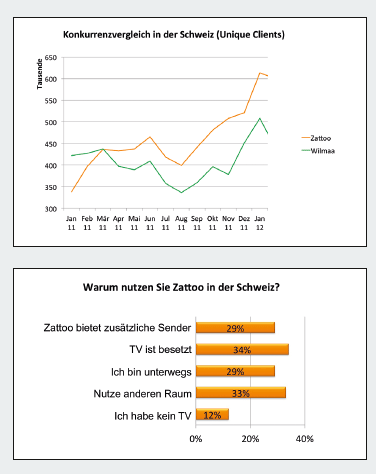
Nick Brambring is aware that there are always new competitors who are doing a very good job in a particular area. Wilmaa, for example, has a successful browser version and Teleboy has successful mobile apps. "This spurs us on to remain No. 1 in each individual area or, if we lose our position in one area, to become No. 1."

Blick TV shows that it is becoming increasingly difficult for new players to enter the market, "which, despite massive investments and enormous advertising - often hidden in editorial contributions - is not a success as far as I know". Outside of Switzerland, Brambring sees "no legal competition" due to the complex legal situation.

For the new CEO of Zattoo, it is "great to see" how Beat Knecht's idea has developed into an entire, very dynamic market. "Not only Internet television as such, but also many Zattoo details such as channel choosers or channel switch ads are now industry standard. Although we don't receive any license fees for this, we are delighted with the confirmation."

The team is also a particular source of pride. "With 25 people, we offer millions of users a great service, manage hundreds of advertising campaigns and work closely with over 100 contractual partners. We do it all with a lot of joy. Especially in difficult times, we have shown that we stand together as a team. That makes us strong for future tasks." Where there is success, there are also dangers. "Our offering is a great addition to the traditional TV offering and the corresponding business model. The participants in this traditional eco-system don't always like this and put up a fight. In some cases, this is absolutely legitimate, for example when Swisscom copies our web TV model. However, in some cases, particularly in Germany, we have noticed that market players are deliberately positioning themselves against Zattoo in order to delay the need for adaptation that comes with the Internet for a few more years. " Brambring finds it particularly annoying "that illegal platforms that don't care about rights are attracting users at the same time". In Switzerland, the latter does not play a role thanks to the complete TV offering on Zattoo and competing platforms.

The search for fields of activity that are not immediately obvious is nothing new for Nick Brambring. After his first degree at the University of Cologne, he prepared colleagues for their law exams as a tutor and worked as a trainee lawyer at the court and public prosecutor's office. He then joined BCG, deliberately as a springboard for a business career in the media industry. "Brambring sees this leap into the world of film and television as "generally successful". Even today, the plan to "one day produce a movie myself" is still not completely out of the question. Like everything else, he approached his goal of working in the world of media at Boston Consulting with a well thought-out strategy. "Six months before I started, I got the contact details of the partners who did media projects. Unfortunately, there were hardly any projects in this area at the time. I then worked in very different industries, from insurance to telco. The weak media connection bothered me. In retrospect, I'm still happy and grateful for my time at BCG. It prepared me well for my job at Zattoo. "

What has remained from this time is the connection to the USA. The Zattoo developer team still works in Ann Arbor, Michigan. However, due to the difficult legal situation in the USA and the resulting weak channel line-up, Zattoo is practically unknown to users there. "But I am of course following developments in the USA. On the one hand, to wait for the right time to enter the market. On the other hand, to find inspiration in technical developments. In my private life, I'm a fan of the USA anyway and always combine my trips to Ann Arbor with at least one weekend in New York." But Brambring doesn't want to live on the other side of the Atlantic entirely. He likes life in Zurich. "The Swiss media landscape is small. You don't just see each other twice in a lifetime, you probably see each other 20 times. If you're a competitor today, you could be a business partner or work colleague tomorrow.

This leads to a very decent and thoughtful approach. Promises are not made lightly, but are then highly binding. And you give the other person room to breathe and sometimes hold back. I really appreciate that." In such a climate, Nick Brambring can quote the former CEO of General Electric in addition to his "planning is guessing" from the book "Rework". Jack Welch said "Enjoy your job and never work again". The CEO of Zattoo is in the fortunate position that this applies to him. "I generally enjoy life." Andreas Panzeri

Unbenannt-21_0
Unbenannt-22_0
 

The Motz from Butz: Swisscom advertising is at its end

In advertising, anything is possible. But what Swisscom is now presenting through “Heimat von Berlin” is simply impossible. Column by Theophil Butz.

What it's about: In recent years, Swisscom has collaborated with Contexta, Valencia, Jung von Matt, Y&R, Saatchi & Saatchi, Publicis, and most recently with the Berlin advertising agency Heimat. An advertising world or an advertising idea with strong emotional value had been found. If the ad (see picture) is indeed from Heimat Berlin, as reported by Tages-Anzeiger and Basler Zeitung, then this attempt has gone awry. Anyone who has read my Motz of May 11 now understands that Swisscom does not have a virus or a bacterial disease, but is suffering to the highest degree from a mental disorder.

My theory: In every advertising book you can read that A a credible positioning, B a creative and witty implementation and C above all continuity is the recipe for successful advertising. Swisscom's marketing managers have not yet grasped this ABC. As a Swisscom customer, the first thing I do is dismiss the marketing manager without notice. I don't have the words for more dismissals and comments in this column. ... ............................................................................................ ............................................................................................ ................................................................................. ............................................................................................ ............................................................................................ ............................................................................................ ............................................................................................ ............................................................................................ ................ ............................................................................................ ............................................................................................ ............................................................................................ ............................................................................................ .....

My setup of the week was that for a week on my home connection from Swisscom, which has been in function for three years only for the alarm system, no acquisition call "Bonjour. Avec nous vous êtes à la bonne adresse!" came in anymore. More about this in the next Motz.

Theophil Butz, once a star advertiser (Ringier), now an inspirer and, as of now, a mothballer. "Not an easy role, but a necessary one, which I perform here every fortnight." Please send any relevant information to [email protected].

Unbenannt-3_9
 

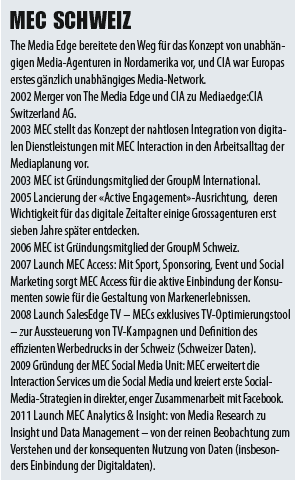
Happy Birthday, MEC Switzerland!

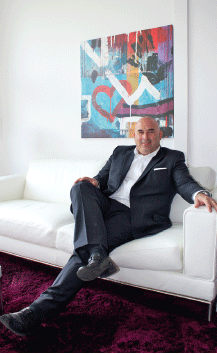
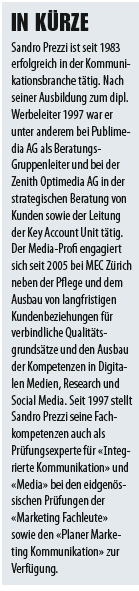
MEC Switzerland celebrates its 10th birthday. Managing Director Sandro Prezzi talks to Werbewoche Editor-in-Chief Pierre C. Meier.

WW: Sandro Prezzi, we're sitting here in a beautifully furnished room with all kinds of consumer electronics equipment. Is this your office?
Sandro Prezzi: No (laughs). This is our media lounge. It used to be our accountant's office, which we converted into a multifunctional room. We've always needed an additional conference room, but we wanted something special. A room where you can sit and talk to customers or employees in a more informal setting. Outside of these meetings, it can be used freely by employees, who should feel comfortable. Enjoy the latest episode of your favorite series with video on demand on the 3D LED screen during your lunch break. Or replay yesterday's game on the PS3 with the FIFA European Championship soccer game. If it takes longer in the evening (because of a pitch, for example), we also enjoy a pizza here. In addition to being a technology lab, the room is also a retreat where employees can find peace and quiet. This helps the working atmosphere and promotes an understanding of how to use the latest entertainment technology.

Since February, you have been responsible for MEC Switzerland and thus also for the two locations in Zurich and Lausanne....
That is correct. As part of the new organizational structure, I have assumed responsibility as Managing Director of MEC in Switzerland and, together with Myrtha Hafner (MEC Zurich), Vera Presas (MEC Lausanne) and Huw Jones (Global Solutions), I manage the Swiss agencies and the Global Solution special unit (service for internationally active Swiss companies). A total of around 40 employees work at MEC Switzerland. Strategically, I am supported in my role by our Chairman, Konrad Mayr-Pernek, Managing Director of MEC in Austria.

MEC is part of GroupM. What is GroupM?
GroupM is the consolidated media investment management company of WPP, which as the parent company supports the agencies MEC, Maxus, MediaCom and Mindshare. The main purpose of GroupM is to maximize the performance of WPP's media agencies for the benefit of our clients, our shareholders and our employees. Maximizing in the sense of performance-enhancing activities in the areas of digital, finance, research, trading, administration and IT. The focus is on the intelligent application of physical and intellectual economies of scale for the benefit of clients. GroupM also develops initiatives that establish media agencies at the forefront of the industry and further enhance their global, regional and national reputation as a creative force in the market. GroupM develops market analysis, benchmarking systems and market simulations to ensure the best possible strategies and results for our clients. It also promotes investment in new technologies, tools, systems and methods to strengthen the Group's innovative power and influence on the Swiss media market.

How are Swiss media agencies doing?
Even if some colleagues are constantly complaining about prices, fees and staffing problems, things aren't so bad. Of course there are always customers who want to pay even less, and there will always be. These cost optimizers use the media agencies as leverage - some even as crowbars - to push down prices at the media companies. Consequently, they usually have the same attitude towards agency fees. One of the basic problems is getting paid decently for comprehensive services. Despite state-of-the-art systems and tools, the work of a media agency is very time-consuming. The rapid change in the media landscape requires know-how, perseverance and still means a lot of manual work. Getting this paid in full by the client means persuasion and transparency. However, this also requires appropriate agency structures. MEC is rarely the absolute cheapest in pitches. Instead, we offer full transparency and probably one of the best price/performance ratios across the board. It is important that we can show the client the added value. Unfortunately, this is exactly what you normally do last in an agency's daily business. We have already defended clients in a pitch, even though our fee was significantly higher in direct comparison. We were able to give the client the confidence that the quality of the advice, our knowledge of them and their brand and their challenges, and the added value of our MEC tools would be correspondingly higher. Any business-minded person knows that fees that are too low mean that the best people are not working on the job. In most cases, the client does not get a senior strategist with 15 to 20 years of market experience and an army of experienced and well-trained planners for a 2 percent fee. The client largely defines the quality of advice himself with his fee. I would like to refer here to the BSW guidelines, which suggest a fee of 5 percent for a medium budget. Very large budgets should be compensated with no less than 3 percent and small budgets with 10 percent. As we know, this is unfortunately still a long way from reality.

What are you particularly proud of?
Of course, we are delighted with every pitch in which we were able to convince and win. One of the biggest pitches we won here in Zurich was for the global budget of the Swiss brand Geberit. We manage and coordinate 19 countries and markets from Zurich. The same applies to ABB and Adobe, for which we plan and implement campaigns worldwide from here. We are proud of the fact that we have a large number of long-standing customers who have remained loyal to us and with whom we have grown over the years. This is no longer a matter of course in the fast-moving marketing and advertising industry. I am also pleased with the performance of our Digital Unit - MEC Interaction. This team has had its nose in the wind for years. MEC Interaction makes very smart use of the close networking within MEC worldwide and the size of GroupM to recognize new trends early on and implement them immediately in campaigns for our Swiss customers. We invested consistently in social media back in 2009 and have built up a small team over the last two and a half years. As part of MEC Interaction, the social media team can now plan and implement appropriate strategies, networking concepts, promotions and campaigns, drawing on its well-established contacts with the most important social media providers such as Facebook. Over the last 12 months, our unit has planned, booked, optimized and monitored over one billion ad impressions on Facebook in Switzerland.

What comes next?
2012 is a year of consolidation and reorganization for us. We have consistently aligned our team structures to the needs of integrated communication and integrated planning. This means that the specialists in the specialist units have been integrated directly into the customer support teams. This allows us to ensure that the full specialist and channel expertise is applied from briefing to invoicing. This makes the smart integration of digital media easier and has a positive impact on media strategies that orchestrate paid, owned and earned media more effectively. In order to implement this even better, we will continue to invest in research (advertising efficiency, touchpoints, media convergence), tools (improved benchmarking, tracking and dashboards) and the further expansion of expertise in digital and mobile media.

Interview: Pierre C. Meier

Unbenannt-25
Unbenannt-26
Unbenannt-27

Euro RSCG designs new print campaign for Credit Suisse

Credit Suisse has launched a new testimonial campaign for its private banking division. For the campaign, the bank’s clients were photographed by Zurich-based photographer Nico Schaerer in front of Switzerland’s most impressive trees.

A tree that has grown over decades is intended to symbolize the values that characterize Credit Suisse Private Banking: stability, sustainability, long-termism, flexibility and growth. This message is further reinforced by the headline. The aim of the campaign is to further consolidate Credit Suisse's role in Swiss private banking, the agency said in a statement.

The print campaign comprises five subjects. These include the 550-year-old Mümliswil oak in the canton of Solothurn, the sycamore maple of Wiesenberg with a trunk circumference of around ten meters, and the oldest oak in Europe in Châtillon in the Jura. The campaign has been featured in newspapers and magazines throughout Switzerland since June 16, 2012.

Responsible at Credit Suisse: Tarkan Özküp (overall responsibility), Beat Wyss (Marketing Private Banking Switzerland), Anja Herrmann, Alessandra Ira, Delila Kurtovic (Advertising Private Banking). Responsible at Euro RSCG Zurich: Frank Bodin (overall responsibility), Axel Eckstein (Executive Creative Director), Andrea Huber (Art Direction), Florian Birkner (Text/Concept), Laurie Morard (Graphics), Walter Tagliaferri, Patrick Naef.
 

TV on the way from print?

The trend toward time-shifted television (catch-up TV) is gaining momentum and will have a significant impact on the TV advertising business. This is because there is a widespread assumption that people who watch programs on a time-shifted basis skip the commercial breaks.

The increasing time-shifted usage puts Mediapulse in a difficult situation: clients, agencies and media specialists have high expectations of the new TV panel, which was set up primarily to measure web TV and time-shifted usage. However, as Mediapulse confirmed at the request of Werbewoche, the new panel cannot directly measure the extent to which advertising is skipped. (A detailed report on this can be found in the current print edition of Werbewoche).

In the longer term, the question arises as to whether the digitalization of television consumption (this includes not only catch-up TV, but also smart TV, i.e. television via the Internet) will have a similar impact on the earnings situation of TV broadcasters as the slump in print advertising as a result of the advent of the Internet over the last 15 years or so? This question is answered differently by various industry experts:

TV consumption via an online device does not change the nature of TV advertising per se - it simply gives consumers the opportunity to consume it anywhere. The option to skip advertising will certainly be used differently by different target groups. Depending on the conditions offered, target groups with a smaller daily time budget, such as people with higher incomes, will find this more appealing than broad target groups. Most of the products advertised on TV are aimed at the latter, so that an evolutionary rather than a revolutionary development can be expected.
Karen Wilbrand, Director TV, Mediabrands

No, absolutely not. As long as it is possible to measure where usage takes place, I don't see any problems. Unlike print, TV is still being consumed, only the distribution channels are changing.
Axel Beckmann, CEO, Mediacom

The comparison is flawed; we see more growth potential through digitization, as broadcasters can now sell content as well as advertising. Unlike publishers, who initially reacted cautiously to the advent of the Internet, we see more flexibility in TV broadcasters (they have probably also learned from the past).
Brigitte Gubser, CEO, Zenith Optimedia Switzerland

No, this is by no means the case! TV is stimulated by the new distribution channels, especially the Internet. In addition, there are many formats that are not or hardly ever consumed time-shifted, such as live broadcasts, current major sporting events such as the European Football Championships or the Olympic Games, sports broadcasts in general or show highlights. Linear television will continue to account for the majority of media consumption in the future and will remain a social experience.
Alexander Duphorn, CEO, Goldbach Media

We hope not, of course. Our "Media of the future" study shows that TV consumption is likely to increase slightly over the next five years. Added to this is the diverse use of audiovisual content produced by TV broadcasters on other transmission channels and other forms of use. Provided that this can be used with advertising (legislation, copyrights) and can (technical requirements and user acceptance), we certainly see opportunities to at least partially offset the expected slight decline in live TV advertising income with additional income from other vectors.
Markus Hollenstein, Head of Marketing, Publisuisse

No, I don't think so - it wasn't the Internet per se that caused print advertising to collapse. The job and real estate market has shifted to the Internet because it is much easier to use - the rest has been driven by cost and efficiency pressures. Thanks to digitization, television has significantly increased its technological reach, not least because of mobile devices such as tablets and smartphones. This provides the basis for a good earnings situation for TV broadcasters. Anyone who broadcasts exciting programs and enough live events (which no one voluntarily watches time-shifted), keeps commercial breaks to a tolerable level (length and number), offers interesting integration options for advertisers (sponsorship, placements, special formats, etc.) and does so at a good price/performance ratio will remain in business for a long time to come.
Sandro Prezzi, Managing Director, MEC

Read more about this topic in the current print edition of Werbewoche.

Cannes Lions: Three Lions for SFLB

Success for Spillmann/Felser/Leo/Burnett: The Swiss agency won three Silver Lions at the awards ceremony in Cannes. SFLB received the three Lions in the Press Lions category.

The first Lion went to "Broken Vase" for Fleurop.
More info

The agency received another Silver Lion for "I love my house" for Swiss Life.
More info1
More info2
More info3
More info4
More info5

The third Lion went to "Not interested in getting married" for Swiss Life
More info1
More info2

More info3
More info4

Cannes Lions: No Lions for Switzerland


Schmidli.Cometti.Dialog and Dialog heads join forces

After more than a year of close collaboration, the two dialogue marketing agencies, Dialogköpfe and Schmidli.Cometti.Dialog, merged their operations under a single umbrella effective April 1, 2012.

For the newly founded agency Dialogköpfe, based in Bubikon, Zurich, Remo Bachmann and Guido Cometti will jointly look after clients in the future. The portfolio includes Swisscard AECS, Helsana Krankenversicherungen, Sport Trend Shop, Tages-Anzeiger, Alpha, Axa Versicherungen and ITS Coop Travel. The agency owners of Schmidli.Cometti.Dialog and Dialogköpfe had decided to shape their future together in the sense of a long-term succession plan and to concentrate on their core tasks.

Extended management
Remo Bachmann, owner and managing director of Dialogköpfe, is very happy about the joint future: "The collaboration with Guido Cometti is a great enrichment, both professionally and personally". Remo Bachmann, who in the new constellation intends to devote more time to conception and creation, will be supported by Guido Cometti (Member of the Executive Board, Head of Strategy and Consulting) and Alice Schmidli (Head of Administration).
 

Irritating at first sip

Renzen Communications is launching the new Rimuss Secco with bold challenges to taboos: Drinking alcohol during pregnancy or at work? The answer is: «Cheers!» because it’s Rimuss Secco!

Whether driving, at work or during pregnancy - there are many good reasons to enjoy alcohol-free drinks. And now there is also a good drop. The newly launched Rimuss Secco stands out from the rest of the Rimuss range with its dry, less sweet taste. The trendy development is being promoted by Renzen Communications in Aarau. "The very first assignment for this new client was a real challenge, as we had to freshen up the somewhat 'dusty' image and get away from the cliché of 'sweet children's champagne'," explains CD Hanno Lietz. The result is an advertising campaign that clearly conveys the USP "enjoyment without alcohol in any situation" and positions Rimuss Secco as a stylish, sophisticated aperitif drink for adults. So far, there are three different advertisements, with further measures such as a TV commercial in the pipeline.

Rimuss has been bringing together young and old for over 50 years. In 1945, the farmer and vine grower Jakob Rahm bought his first grape press. By 1949, one hundred thousand liters of grape juice had already been sold. Finally, a research institute in western Switzerland suggested to the industry that they should try their hand at producing a sparkling, sparkling grape juice. After some trial and error, the first non-alcoholic "sparkling wine" bottle was uncorked. However, it was not a large company but the small family business Rahm that entered the market in 1954. Renzen has stylishly incorporated this historic development into the new imagery. "Rimuss stossed alli aa!" was the previous claim. The aim was to capture this feeling, but to move away from the family groove. Renzen succeeded in doing this with a little deliberate irritation.

Andreas Panzeri

Unbenannt-9_9
 

The Impact Check of Werbewoche

We show how current campaigns are performing with consumers.

In terms of awareness, the Migros “I-am” ad by the advertising agency Advico Young & Rubicam ranks first, followed by the Swiss Post ad by the agency Wirz Wietlisbach Dialog and the Floralp ad by Spillmann Felser Leo Burnett. In the “Uniqueness” category, the Floralp ad is far and away in the lead, followed by the Dar-Vida ad by Jung von Matt and the “Drink Water” ad, also by Jung von Matt. Floralp also wins in the “Brand Fit” category, well ahead of the Nescafé ad by the advertising agency Publicis and the Dar-Vida ad. Floralp also wins by a wide margin in the “Likeability” category, ahead of Dar-Vida and “Trink Wasser.”.

> Results at a Glance (PDF)
> Detailed Results (PDF)

Unbenannt-23_0

User behavior in electronic media

Since the beginning of this year, the Goldbach Group—a leading marketer of electronic, digital, interactive, and mobile media—has been conducting surveys on electronic media usage six times a year.

TV, radio, online, in-store radio and ad screen are included. Activities in social media or search, online shopping and online gaming are also surveyed. Following the basic survey in February 2012, the second survey was conducted at the end of April. The results provide the Goldbach Group and its customers with important information for aligning their offerings even more specifically to the needs of the market. With the surveys, which are conducted six times a year, the Goldbach Group also aims to identify changes in consumer media behavior that can be observed in the short term and that can be noticeably controlled or influenced by special events, e.g. in the areas of sport, politics, business, culture and weather. These findings can be of great importance in the design of advertising concepts, tactical measures and cross-media networking of the media.

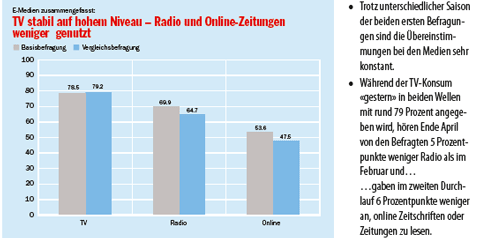
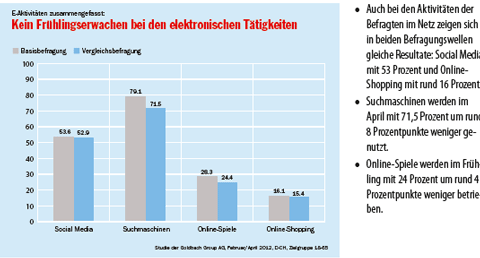
The agency Marketagent.com conducts the surveys directly with 500 representatively selected, web-active people between the ages of 18 and 65 in German-speaking Switzerland in the form of online interviews. They are asked about media use and online activities from the previous day. The results of the first two waves of the survey are now available: an initial baseline survey in February and a comparative survey in April 2012. What is striking is the similarity between the two surveys in terms of TV usage at around 79%. In contrast, the use of radio and online newspapers and magazines fell by around 5 percentage points each (chart e-media combined). The same can be said for online activities, where social media remained stable at around 53%, while search engines, online games and shopping suffered losses (chart summarizing e-activities). The Goldbach Group provides detailed results of the "Electronic Footprint" study for the individual media and activities as well as demographic characteristics in the Goldbach Guidegoldbachguide.ch. The next survey wave will be conducted during the European Football Championship in June and published in July. The results will become more meaningful with each subsequent survey. red

Unbenannt-15_3
Unbenannt-16_2
 

get_footer();