Cannes Lions: One Last Shortlist Nomination

At the Cannes Lions Festival, the Swiss have already taken home seven Lions. At the last shortlist nomination, only one Swiss agency was nominated.

The nomination in the Film Lions category goes to Advico Young&Rubicam (Exxtra Kommunikation) with the brand film "Peace Talks" for the Sunday newspaper. So now there is one more Swiss representative in the running for the Film Lions. These will be awarded on Saturday.

Shortlisted nomination in the Film Lions category:
Exxtra Kommunikation, "Peace Talks" for the Sunday newspaper
More info

Cannes Lions: Three Lions for SFLB
 

Farner makes invisible raw material visible for Cemsuisse

Farner was commissioned by Cemsuisse, the Swiss Cement Industry Association, to launch a campaign to raise awareness of the importance of Swiss cement production. The result is a two-year national information and awareness campaign.

The campaign aims to bring cement and its social benefits into a direct context. In everyday life, cement is ubiquitous, it is needed and used everywhere, it plays a literally supporting role in any highly civilized society, but people don't notice it, Farner said in a statement. The agency developed a campaign idea for the Swiss cement industry that conceptually turns the tables: "Whatever you can imagine in our Switzerland, cement makes it possible because it is so versatile. And exactly where cement is needed, it is available. It is the invisible but omnipresent and, in its ecological significance, underestimated only real raw material in Switzerland."

The campaign aims to bring cement and its social benefits into a direct context: The headline takes on the function of buildings made of cement. Key images are created that show the achievements of civilization for which the use of cement has become indispensable. For example, for our energy production, our mobility, our housing construction or our education sector, or for securing our future.

The campaign is scheduled to run for two years. Advertisements, posters and the website http://www.schweizer-zement.ch will be flanked by other communication measures.

Responsible at Cemsuisse: Georges Spicher (Director), Olivia Zbinden (Head of PR and Promotion). Responsible at Farner: Michel Grunder (PR Consulting), Alexander Roosdorp (Advertising Consulting), Matthias Berg (CD, Text), Reto Sidler (PR Consulting), Irena Barbaric (PR Consulting), Tsunshan Samson Ng (AD), Marco Cavalli (DTP), Peter Thieu (Web Programming), Nina Wick (Media Planning), Otto Zingg (3-D Design, formD).
 

UBI rejects complaint against "DOK" report on SVP

The Independent Complaints Authority for Radio and Television (UBI) rejected a complaint on Friday against the SF «DOK» documentary «The SVP’s Switzerland—A People in a Reduit.» The decision was made unanimously during a public hearing .

The report was broadcast on October 27, 2011 - after the federal elections and before the second round of voting for the Zurich Council of States. The focus of the report is on three active SVP members from the Zurich Unterland region. But the then candidate for the Council of States, Christoph Blocher, also appeared in the feature.
 
The complaint criticized that the film did not convey a representative and accurate picture of the SVP. It merely confirmed prejudices and clichés. Moreover, the timing of the broadcast was problematic. The film had diminished Christoph Blocher's chances as a candidate for the Council of States.

Milieu study - not a party portrait
However, the UBI did not accept the complainant's arguments. The article had not violated any of the requirements for balanced and factual reporting. The interviewees had been able to express themselves freely. Moreover, the report was not a party portrait, but a milieu study. According to UBI President Roger Blum, TV viewers were able to form their own opinions. Regarding the criticized broadcasting time, Blum said that media should be allowed to make federal elections a topic of discussion. In the end, the complaint was unanimously rejected.

UBI Anniversary Meeting
The UBI has existed since 1984, its predecessor being the Complaints Commission for Radio and Television. On Friday, it celebrated an anniversary with its 200th meeting. According to Blum, a total of 668 complaints have been received since 1984. The UBI is composed of nine part-time members elected by the Federal Council and a secretariat. It has its headquarters in Bern. Within the scope of its duties, it is not bound by any instructions from the Federal Assembly, the Federal Council or the Federal Administration. It must submit an annual activity report to the Federal Council. Administratively, the UBI is attached to the General Secretariat of the Federal Department of the Environment, Transport, Energy and Communications. (sda)

Saatchi&Saatchi: The biggest new little one from Seat

Seat has expanded its model lineup in the microcar segment. For the Swiss premiere of the Seat Mii, the Saatchi & Saatchi agency has made the name «Mii» the focus of its campaign.

This is staged in the Facebook game, on interactive banners, and in print ads and megaposters. The key visual of the Mii campaign is a blue wall in front of which the new car is presented. Saatchi&Saatchi developed the launch ideas for the Swiss market. Lovemarks touchpoints guaranteed.

Responsible at Seat: Ronald Ziegler (Brand Manager), Andreas Huwyler (Marketing Manager), Diane Simeone (Marketing Assistant). Responsible at Saatchi & Saatchi: Petar Dakovic (Managing Director), Marlon Chng (Client Service Director), Léonie Kelly (Consulting), Jürg Aemmer (Creative Direction), Felix Freese (Text), Chantal Ehrensperger (Art Direction), René Berzia (DTP), Detail (Image Editing/Litho).
 

Metzgerlehner designs brand identity for Schmidlin

Schmidlin, a manufacturer of duct and pipe systems, has commissioned Metzgerlehner to design a new brand identity. With a new logo and the new claim «Leading the way in air traffic», the ventilation pioneer's market leadership is to be consolidated.

The new market presence is intended to mark a new beginning as well as continuity in the value proposition, the agency said in a statement. The new image will be implemented at all four company headquarters. In addition to the changes already made to letterheads, vehicles and buildings, price lists, brochures and a completely new website will soon follow.

Responsible at Schmidlin: Jürg and Robert Schmidlin (owners). Responsible at Metzgerlehner Worldwide Partners: Michael Rottmann (Creative Direction), Patrick Meyer (Text/Concept), Janine Aebischer (Art Direction), Annette Vetsch and Katja Kurzweck (Graphics), Mark Berger (metzgerlehner digital), Silvan Metzger and Anna-Lea Michael (Consulting).
 

Ideart shows the subtle difference for Pastinella

Ideart has created a new company brochure for its long-standing client, Pastinella. It is titled «Pastinella—The Subtle Difference.».

The company brochure will be in use from May 2012.

Responsible at Pastinella Orior Menu, Oberentfelden: Patrizia Fischer (Marketing Assistant). Responsible at Ideart, Lucerne: Ludek Martschini (creation, consulting), Peter Martschini (production, organization), Andreas Troxler (text). Photo: Lukas Bidinger (photo plus).
 

Swiss Milk Producers and APG|SGA take Lovely up high

At Bern’s train station, Lovely—known throughout Switzerland—is surprising passersby for a month. Smiling from a height of over six meters, she greets visitors to Bern’s main train station.

The Swiss dairy cow Lovely has many hobbies, including soccer, yoga or cycling. This year, one of her activities, climbing, is staged in 3D: In the north hall of the main station in Bern, Lovely climbs up a mega poster. According to the motto: "Milk. Your Natural Fitness Program".

In collaboration with Swiss Milk Producers/AMS Media and APG|SGA Mega Poster, this 3D conversion was created. As a basis, a small plaster model was created, which was then digitized with a 3D scanner. With the 3D data created from this, a CNC machine milled out the individual parts from expanded polystyrene EPS, which were glued together and remodeled by hand. The next step was to apply a synthetic resin coating that makes Lovely extremely weather-resistant, APG|SGA said in a statement Friday. The final touch was paint, which was sprayed on using airbrush techniques. Structural engineers inspected and approved the mounting fixture, which was produced specifically for Lovely. Partner company Richnerstutz was busy with the overnight assembly work for more than six hours.

Lovely will make a guest appearance in Bern until July 15, 2012.

Responsible at Swissmilk/Swiss Milk Producers: Charlotte Hofstetter (Head of Marketing), Martin Rüst (Head of Advertising & Media), Olivia Etter (Project Manager Advertising Milk), Matthias Glauser (Head of AMS Media). Responsible at AGP|SGA Mega Poster: Ernst Fuhrer (Head of APG|SGA Mega Poster), Denise Cevallos (Sales Consultant).

Publicitas announces premium sell side platform initiative

At the 2012 Digital Forum, Publicitas and its sister company Adnative announced the launch of an initiative for an international sell-side platform (SSP). The platform is intended to target publishers in the premium segment and help premium media providers better monetize and manage their digital advertising inventory.

More than 60 media providers from all over Europe took part in the two-day event. The Digital Forum 2012, held in Berlin on June 21 and 22, was hosted by Publicitas as well as its sister company Adnative. It was designed to give media providers an insight into the SSP initiative, Publicitas wrote in a statement.

The SSP, he said, offers media providers a technologically and dynamically driven platform where they can make their unsold ad inventory available to the automated ad trading market while maintaining full control. This would allow media providers to provide Real Time Bidding buyers with access to this inventory and also to set up closed and private marketplaces.
 

Spiked: TV evening with movie and mockery

Anne-Friederike Heinrich, a freelance contributor to *Werbewoche*, on TV commercials that are guaranteed to dumb you down.

The other day I treated myself to something quite rare: an evening in front of the TV. Oh my God, what have I done to myself! That goes for the completely lowbrow movie with the completely lowbrow Til Schweiger anyway. But who watches Sat.1 after a long absence from television? It's our own fault. Disappointingly, this also applies to the commercials. After two commercial breaks, it was clear to me that the feature films must be so stupid that the viewer doesn't realize how idiotic the commercials are. Once you have lowered yourself to the subterranean level of the films, you won't switch over or switch off even if the commercials are brain-dead, or so the program strategists hope. Nonsense stuns. To ensure that the battle plan works, films and commercials virtually flow into one another. After a few minutes, viewers can no longer tell whether they are watching a commercial break or the (wrong) movie, and their soft-boiled brain stem can no longer manage to get their thumb or any other part of their body to press the off button. The ratings are over.

Couple ship capsizing

Til Schweiger disappears and a middle-aged, middle-pretty lady wobbles out of the white background onto the screen and says: "Today we live in the same apartment. We met at the same address." Then a half-beautiful, half-aged guy wiggles onto the screen next to the lady and smiles smugly. He has nothing to say. This thoroughly realistic scenario is an advertisement for the dating site Parship. Dear people, if a dating agency sets itself the simple goal that two half-beautiful and half-old people end up "living in the same apartment", then it could also simply find partners in shared flats or rooms in retirement homes. Moving out of a shared flat is also cheaper than getting divorced. And the two people in question would be spared a long process of getting to know each other and countless "what are you doing like this" interrogations. Oh, it's about more than a shared doorbell sign? Then the commissioned advertising specialists would do well to convey this content. They'd love to be clever. But: puns are not the last word in advertising.

Egg of the daus

Then a few animated eggs, a tube of mustard and a tube of mayonnaise make their grand entrance. The eggs cheer, the mayonnaise is amazed at the joyful frenzy, and the mustard explains that it has "added its mustard" - hence the great mood. Oh dear, flat joke producers were at work here too! Who would be tempted to buy a product like this? I don't want to imagine these people and hope that Til Schweiger will finally come back to me. And if I'm longing for Til Schweiger, I must be in a really bad way.

But before the dubious redemption comes, a blonde Polish housewife intervenes. She has wrapped herself in a white coat and introduces herself as Dr. Lefkowitz. In other words, she moves her mouth and a dubbing artist has come up with an ill-fitting text. Somehow it's about dandruff. Then a black-haired woman appears and the doctor presses a black piece of paper on the top of her head, which she then pulls up again, beaming with joy. Take a look at this commercial without sound ... "Head & Shoulders" - well, even the brand name was taken by some branding expert just before it was too late.

Somehow I must have dozed off. In any case, I'm not woken up by Til Schweiger, but by a voice chanting: "So fresh, so close, so ... SPAR." What a nightmare!
 

Vice, Versa - there is no magic formula for social media

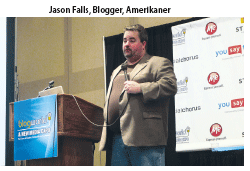
Beat Hürlimann attended the Blog World & New Media Expo in New York. He shares his impressions exclusively with *Werbewoche*.

For three days, I felt the pulse of social media experts in 14 specialist presentations and numerous discussions. I am left with memories of committed people and the following insight to pass on: when developing your social media strategy and designing your social media campaigns, never fall for the magic of grandiose patent remedies - because they don't exist. For me, the Blog World & New Media Expo from June 5 to 7 was a congress of exciting contradictions. Every expert opinion was immediately refuted with a counter-expert opinion - vice versa. So: do your own thing. Get stuck into the subject matter, work methodically, tap into your sources and create your own areas of tension. Areas of tension are the most fertile ground for strategically anchored social media ideas and effective new media campaigns. What follows are three, in my opinion, practical quote duels with exciting food for thought for your social media work.

Vice: "Don't worry about being consistent - just blog and have fun". As a disciple of holistic communication theories - from Bruhn (University of Basel) to Bleustein (Publicis) - I find this statement by star blogger Chris Bogan remarkable. What Brogan wants to tell us: Planning is good, starting is better. Pondering over which posts and tweets are likely to generate the most likes, comments and retweets is the wrong recipe. A mix of learning by doing and trial and error is better. You will learn quickly and recognize your mistakes quickly. Because the feedback from your recipients on posts, comments, tweets and retweets is immediate and authentic.

Versa: "Framing matters!". That's what the same Brogan says, and here's what he means: Create your content and pay attention to a consistent structure and dramaturgy. Over time, you will become more experienced in form design, more creative in content, and the viewer will become more practiced in reception.

Vice: "Move away from word driven content to picture driven content" - says Mat Knell, Head of Social Media at AOL. Visuals communicate faster and more emotionally. Both speed and emotionality are basic requirements if you want to use the 3-second attention window of people surfing past to your advantage. Knell and his three co-speakers document the triumph of visual language with the explosive growth in popularity of visually oriented online networks: Pinterest is the fastest growing network. Instagram was acquired by Facebook for a billion dollars, and Tumblr is the darling of a young, up-and-coming and influential generation of bloggers.

Versa: "Visual pollution". This quote comes from Jay Bear, author of the highly recommended social media book "Convince and Convert". Image storms are taking over the networks, stirring up dust and clouding the general view. This makes it difficult for image and brand worlds to grow together in the long term. Erik Decker is a professional blogger from Indianapolis and co-author of the book entitled "No Bullshit Social Me Media - The All-Business, No-Hype Guide to Social Media Marketing". Decker captains us through the image storm to the calm center, and he has a clear message: "A word is worth more than 1000 pictures". He relies on "The art of creating methaphors" and the "Iceberg Principle" by the great Ernest Hemingway. One eighth of the icebergs rise out of the water. An equal proportion of words protrude from seeming insignificance. Take a dive and get to the bottom of the meaning of words for the people you are writing for. In Decker's words: the right word is more valuable than a thousand pictures. And another argument in favor of words: Googlebots, the Google programs that search the Internet when you make a query. Googlebots cannot recognize images. For search engines, an image is invisible as a visual object. They only find image descriptions.

Vice: "Automate what you can." Stephanie Sammons is a Texan and an advocate of social automation. And she's in good company. It feels like 99 percent of all posts from companies on the four largest social networks Facebook, Linkedin, Twitter and Pinterest are published automatically. Sammons justifies her "Automate what you can" philosophy with a "Minimize your time, maximize your impact" strategy. The aim is to achieve a comprehensive "always on - 24/7" presence with as little effort as possible. With the help of social media management dashboards, posts, tweets and updates are timed and automatically fed into the channels. For example, if you comment on your favorite team's performance on Facebook or Twitter and don't get any words of appreciation posted in return, you are usually interacting with a vending machine.

Versa: "You can't automate authenticity." Scott Stratten is Canadian, author of the book "Unmarketing", and he calls a spade a spade. For example, when he says: "Social media automation is mannequin networking. " Half of all updates on Linkedin are made via Twitter. At that moment, the recipient is on Linkedin and the sender is on Twitter. The same applies when the blogger promotes their latest post via Twitter. The recipient is on Twitter, the blogger in his blogsphere. For Stratten, what such senders do has nothing to do with "social". Because what the sender is signaling to the recipient is: "I'm here to announce something. I'm not here to engage with you, listen to you or answer your questions." But according to Stratten, this is the only truly effective way to engage in social networks: Being with the recipient at the moment they respond to the message by answering their question, commenting on their statement or taking on board their opinion. Take Twitter, for example: the half-life of a tweet is ten minutes. Within this time window, the sender has the unique opportunity to engage in conversation with committed recipients - customers, buyers, employees, opinion leaders. After that, the recipient is gone and the opportunity is lost. Stratten's recipe? "You don't have to be at every social media site." Beat Hürlimann

Unbenannt-30
 

Grayling Pulse study predicts growth for PR industry

More than 1,200 communications experts surveyed worldwide as part of the Grayling Pulse study see great potential for the PR industry despite the economic crisis. According to the study, the PR industry will grow in importance worldwide.

It is making it to the executive level more often, and the contribution of communications work to a company's success is increasingly being recognized. Grayling writes this in a press release. At the same time, however, caution in budget planning, increased insourcing of PR competencies and a shift from framework agreements toward project business are to be expected. While consumers are demanding more dialog from companies instead of one-way communication, online PR is still considered an experimental laboratory for many companies and organizations.

PR industry grows - Asia and Middle East gain
More than one-fifth of global respondents say that - despite corporate cost-cutting pressures and global economic instability - investment in PR activities is generally more likely to increase. The strongest growth in PR spending is predicted in the Asia-Pacific region (17 percent), followed by the Middle East (9.2 percent). Western Europe is currently more cautious: 12.2 percent think budgets will increase, 28.9 percent think they will remain the same and 13.7 percent suspect a decrease). Globally, only 5 percent of respondents expect PR budgets to decrease. "These figures confirm our observations in our daily work with national and international clients" explains Stephan Oehen, Managing Director of Grayling in Switzerland. "The change processes in the Swiss media landscape, the uncertainty about the further economic development in Switzerland, the increased competitive pressure in the domestic market and last but not least the consequences of the continuing strength of the Swiss franc - all these changes increase the demands on the PR industry. What is needed is strategic experience as well as strong implementation skills, regionally, nationally and in many cases with an international focus." In terms of budget and resource planning, however, companies and organizations are becoming more cautious. 22.3 percent of respondents see a decline in long-term consulting contracts, while 19.6 percent expect an increase in shorter-term assignments on a project basis. "This development is understandable in the current economic situation, but it makes it more difficult for companies and brands to position themselves strategically in a clear and, above all, continuous manner. If a company loses focus on long-term reputation management due to short-term decisions, this can quickly turn into a boomerang" says Oehen.

Management level takes PR seriously
47 percent of respondents believe that the visibility and relevance of strategic communications at management level will become more important in the future, and 55 percent believe that the perceived value of PR for a company's economic success will also continue to rise. This trend is also reflected in HR policy. A quarter of those surveyed expect the number of employees in the various communications departments to tend to increase in the coming quarters.

Consumers expect dialog communication instead of marketing
According to the Grayling Pulse study, the biggest revenue growth in PR in the future will be in the consumer & retail sector. Twenty-eight percent of respondents say they think budgets for brand PR will increase, 32 percent expect an increase in staff in this area, and 52 percent think visibility and relevance of PR work will become more important at management level in this sector. Oehen says, "Consumers expect innovative approaches and real dialogue from brand owners. Simple slogans and one-way communication are not effective. Similarly, aspects such as sustainability and a sense of social responsibility are coming more into focus. Communicating dialog, transparency and authenticity are classic core tasks of PR."

Online PR - still an experimental laboratory for many companies
Not surprisingly, just under half of the respondents believe that there will be even greater investment in social media and digital PR in the future, whereas spending on corporate communications and reputation management, CSR communications and crisis communications will remain the same. "The predicted growth in this area is related to the fact that many companies have yet to discover and tap into online PR. So it's not exclusively a question of more investment; in many cases it's a matter of making strategic investments in the area of reputation management for the first time ever, away from marketing and CRM activities," says Oehen.

Grayling Pulse
Grayling Pulse is a global study on current and future trends in PR. For this purpose, communications professionals in companies, organizations and agencies worldwide are surveyed on a quarterly basis. The Pulse Report highlights important changes in the PR industry. Differences by region, industry, communications disciplines, budgets or perceived value of PR and communications work for companies and organizations are identified.


Publicitas is on the move

The advertising broker yields to pressure from advertisers and begins signing commission contracts with the first publishers again, based on the old model—albeit with extremely short terms.

Since the beginning of June, Publicitas has once again been placing advertisements in the daily newspapers Bieler Tagblatt, Journal du Jura and Walliser Bote - as well as in all other titles published by the two independent publishers Gassmann AG (Biel) and Mengis (Visp). This was announced by the two publishers and "P" in a joint communiqué on June 5.

Muscle play did not make an impression everywhere

14 months earlier, the two media companies had broken with P because the latter wanted to impose a brokerage agreement with a new pricing model on the publishers. This provided for a fixed basic amount per brokered advertisement - reportedly 30 to 65 francs per advertisement, depending on the publisher and title portfolio - plus a commission based on turnover. The major publishers accepted, but Gassmann and Mengis resisted. But Hanspeter Rohner, Chairman of the Board and CEO of PubliGroupe, and the then new Publicitas CEO Beat Roeschlin set an example: they stopped placing ads with the Mengis and Gassmann titles and had their data deleted from the P system. In short: P broke with universal mediation. But Gassmann and Mengis were not alone: months later, Basler Zeitung and Landbote also dispensed with P's services - for the same reason.

The basic amount is off the table

And this is what the new solutions look like: According to Mengis CEO Kurt Hasen and Marcel Geissbühler, Board Delegate of W. Gassmann AG, the P waived the basic amount per advertisement in both cases and is once again accepting a placement contract based on the old commission model. Conversely, it now receives a "slightly higher commission" from the two publishers than before. "For us, it is crucial that the contract is continued according to the previous model," says Geissbühler. Hasen agrees: "A basic amount is not acceptable for small publishers," he says. "No entrepreneur buys services where they lose money."

And what does the P say? There was no direct confirmation. "Publicitas was able to reach an agreement with W. Gassmann AG and Mengis AG on an economically sensible model for the placement of advertising orders," wrote P CEO Beat Roeschlin. But wait - if he calls the new-old commission solution "economically sensible", then one can probably conclude that he now considers the model with a basic amount to be less sensible and is abandoning it in favor of small publishers. There are many indications of this, including the situation in Winterthur.

But what led to the rapprochement in Biel and Visp? There was no information from Roeschlin. But the two publishers did. "The P became more flexible. It realized that it was in the same boat as the publishers," says Hasen. He also points to the economic situation: times have become tougher for publishers, especially because individual companies and major distributors have massively reduced their print advertising. Geissbühler sees other reasons for the successful talks: "New people led the negotiations on the P side." In addition, national customers have exerted pressure because not all titles can be booked via P channels. "Customer satisfaction must remain our top priority," he says.

Still a lot of work on the P construction sites

However, the new contracts also have a catch: they are limited to the end of the year. Therefore, renegotiations will take place again in the fall, according to Visp and Biel. Walliser Bote and Bieler Tagblatt are part of the newspaper pool with Freiburger Nachrichten (FN). It is therefore important for both of them to know what is happening at the FN, especially as negotiations with the P were also pending in the fall of 2011. However, nothing had been heard since then. "We spoke to each other, but left everything as it was. We still have the same commission," says Deputy Director Gilbert Jenny. He continues: "The P is an important partner for us. We are now waiting to see how it repositions itself in Fribourg." (see box).

Little movement on the P construction site in Basel. Roland Steffen, CEO of Basler Zeitung Medien, does not want "any change" at the moment, because despite the break with P, "only positive experiences" have been made on the Rhine bend. Nevertheless, he is keeping the door ajar: "If Publicitas convinces us with its performance and a fair remuneration model, there is basically nothing to stop us talking about working together," he writes. The situation is completely different in Winterthur: "We are holding more intensive talks with P than ever before," says Markus Wenger, Publishing Director of Landbote. And as in Biel and Visp, they are "talking about a higher commission - but without a basic amount!". Markus Knöpfli

p1
p2
Unbenannt-19_0
 

get_footer();