My house! My car! My blood pressure!

By Manuel P. Nappo, Program Director of the CAS in Social Media Management at HWZ and Chief Networking Officer at Centralway.

Sharing is caring, but sometimes I don't really care." This is certainly not news to anyone, but for me it's something that has recently caused my blood pressure readings to plummet. The reason for this is an acute lack of interest in running and walking in my timeline and comparing kilometers, calories and times.

Anyone who follows me on Twitter or is my friend on Facebook knows that I share like a world champion. I also like to share content about myself, where I am, what I'm listening to, what I'm watching and anything else. When I visit a bar, I check in on Foursquare. If I watch my favorite series "Friday Night Lights" again, my social web friends find out thanks to the GetGlue app. And every now and then, Sushi Toni from San Francisco ends up on Instagram. That satisfies the hunger. The hunger to make your condition known.

I don't want to know what comes after the empty plate. I don't want to know who eats it, when, where and how. Not my cheese - to stick with the culinary vocabulary. However, apps like Runkeeper, gadgets like the Nike Fuelband and the high-tech personal scales from Withings force me to do so.

It all started with Runkeeper in my timeline. I found out when one of my friends went jogging, which route he ran, how fast and how incredibly fit he was. Since then, it's been running, swimming and running up and down my timeline. Last entry: XY just completed a 1.49 km walk. I applaud. By the way, you can actually do that. There is live tracking where you can cheer on the athletes with a click.

Those who were struggling too much to breathe during the race have now moved on to the next battle: Nike Fuelband, a wristband that records your daily movements, displays them in Fuel points and compares them with friends on the social web. This actually seems to encourage some people to move more. A playful gadget that frustrates some and confirms to others that they are physically active. In other words, something that nobody really needs.

If you don't just want to share how fit you are, you can also share your health with others. The manufacturer Withings has both a personal scale and a blood pressure monitor with Wi-Fi on the market. The values are transferred directly to a PC, smartphone or tablet and can be shared with the whole world from there. From a medical point of view, the blood pressure monitor should certainly be of interest. So far, I haven't been able to find out my friends' current weight or blood pressure on the social web. I'm actually just waiting for rankings of the community's best blood pressure values to be published soon. I have now written around 3,000 characters, which corresponds to an insignificant calorie consumption. I'm about to hit the treadmill for an unknown number of kilometers. Anyone who wants to can drop by and cheer me on from the edge of the treadmill. I won't be squinting at my neighbor's display to compare myself with him. My blood pressure will inevitably rise, and the pointer on the bathroom scales will remain silent about what only he and I know.

Unbenannt-24_1

Worries with jumpers

The trend toward time-shifted television is gaining momentum and will have a significant impact on the TV advertising business.

Unlike print advertising, television advertising has so far survived digitalization unscathed. Now two important trends from the digital world are attacking the reach of traditional TV advertising: Smart TV, i.e. the integration of the Internet into TV sets (Werbewoche reported on this in the last issue), and catch-up TV, time-shifted television without the need to program recordings. This corresponds to a modern lifestyle of time- and location-independent television consumption, but the general suspicion applies to TV advertising: those who watch programs time-shifted skip the commercial breaks. If this trend increases, the reach of advertising will suffer. There are still hardly any solid facts on this, but the evidence is mounting (see "Clear evidence").

If need be, take a detour

Because Mediapulse's current TV measurement panel does not include time-shifted viewing, there are no precise facts on this. Nico Gurtner, Head of Communications at Publicadata, refers to a collective pool that also includes other television consumption behavior that has nothing to do with time-shifted use, whereby a clear separation of these elements is not possible. Nevertheless, he can provide some "indicative values" based on the data from the Mediapulse television panel:

- In German- and Italian-speaking Switzerland, time-shifted television consumption is likely to account for significantly less than 10% of total TV usage. This figure is higher in French-speaking Switzerland, but is unlikely to have reached the 10% threshold yet.
- In digital households, around one in five people are likely to make use of the time-shift option at least once a day, albeit for a short time.
- Looking at the figures from 2010 onwards, there has been a steady increase in the use of the time-shifted television consumption option from semester to semester.

In Switzerland, time-shifted television has apparently already become more established than in other foreign markets. According to Goldbach Media, an average of one to five percent of viewers in Europe watch time-shifted television every day. The specific figures in Austria are 0.5 percent, in France 2.8 percent, in the Netherlands 3.1 percent and in Germany less than 5 percent.

From next year, it will also be possible to survey time-shifted usage in Switzerland using a new panel. However, it will not be possible to answer the question of the extent to which advertising is skipped. However, according to Gurtner, it "cannot be ruled out" that "something in this direction can be explored in a roundabout way".

Jumpers are almost impossible to record reliably

In the near future, the advertising industry will therefore have to find a generally accepted way of dealing with jumpers when measuring reach. At first glance, a universal solution along the lines of "if you watch TV programs with a time delay, you skip the advertising" seems obvious. As a survey of media agencies conducted by Werbewoche shows, there are various arguments for a more differentiated approach. Says Axel Beckmann, CEO at MediaCom: "Young target groups who watch less linear TV will use this option more than older target groups." Karen Wilbrand, Director TV at Mediabrands, points out: "As a decidedly lean-back medium, consumers will continue to devote themselves to real TV consumption and forego this option on one occasion or another." And Sandro Prezzi, Managing Director at MEC, says: "At the moment, I would use the 'zapping rate' as a guide: Those who zap today will probably also jump."

As long as there are no reliable, technically collected values, we will try to make do with additional surveys. Cheap, superficial studies are more likely to cause confusion than provide clarity. For example, a study from the UK in 2010 claims to have found that 86% of viewers who watch time-shifted television skip the advertising. Meanwhile, a survey conducted in New Zealand at the beginning of this year put this figure at 50 percent. This suggests that reliable figures on skipping behavior will only be available at a high price. Because as long as habitual jumping is not a mass phenomenon, large surveys will be needed to capture enough jumpers. And the willingness to jump will vary depending on the program and target group and will presumably become increasingly widespread over time.

As there are no hard facts on jumping behavior in sight, it is foreseeable that price negotiations in the future will increasingly be based on the argument of coverage losses due to skips. In the Werbewoche survey, some agencies confirmed that such discussions are already taking place. Brigitte Gubser, CEO of ZenithOptimedia, speaks plainly: "Pricing that includes time-shifted usage without providing proof that the service was provided in return (i.e. advertising blocks were not skipped) is unacceptable and cannot be enforced with customers." Marketers play it down, pointing to the minimal impact on reach so far and refusing to talk about pressure on prices. Markus Hollenstein, Head of Marketing at Publisuisse, argues: "However, advertising prices are not solely dependent on ratings. In addition to the number of viewers, demand is an important factor. Advertising opportunities with a large effective reach are in high demand and will continue to justify correspondingly higher prices in the future."

Legal disputes and investment pressure

Catchup TV is not without its obstacles. There are major disputes over legal issues, as broadcasters and content producers see this as an additional use of their works and demand compensation. The GT 12 (Gemeinsamer Tarif 12, remuneration for the transfer of use of set-top boxes with memory and vPVR) of the collecting society Suiss-image exists for this purpose, which expires at the end of the year and is currently being renegotiated. The fact that an appeal against the current tariff is pending before the Federal Administrative Court shows that the negotiations are tough. So it is not an unsatisfactory tariff per se that is putting a damper on business, but the uncertainty about the fees to be paid.

In the technical field, there are repeated calls for technical measures to prevent advertising skipping. According to Markus Hollenstein from Publisuisse, this is hardly a realistic solution, at least in this country: "It may be possible to achieve something in the short term, but we don't believe that blocking a viewer need is effective. We are also not making any efforts in this direction." And Swisscom media spokesperson Olaf Schulze states: "There is currently no technical solution for this."

Schulze points to another technical aspect that could become a challenge for network operators in connection with catch-up TV: It leads to a "massively higher load on the IT infrastructure". In contrast to simultaneous transmission, where the signal is only distributed once, with time-shifted television it has to be transmitted individually for each customer. Network operators are therefore faced with the task of correctly estimating and providing servers and network capacity based on customer usage behavior. That costs money. Says Sunrise spokesperson Tobias Kistner: "In order to cope with the higher data volume, Sunrise will increase line capacity by expanding capacity." Meanwhile, Andreas Werz, media spokesperson at UPC Cablecom, is confident: "Our network is very broad, so there are no bottlenecks in terms of performance."

TV advertising under the premises of the Internet

The increase in time-shifted usage puts Mediapulse in a difficult situation: clients, agencies and media specialists had high expectations of the new TV panel, which was set up primarily to measure web TV and time-shifted usage. It is now becoming clear that the figures collected in this way from next year will hardly be able to achieve the status of a hard currency due to the increasingly simple jumping functions in digital TV. Mediapulse, but also the technology suppliers for media monitoring, are running behind the train of rapid technical development without any prospect of being able to influence it.

Catch-up TV, smart TV, web TV, mobile TV and the like will primarily affect established broadcasters. If there is a loss of advertising revenue, their performance will decline, as is currently the case with newspaper publishers. One important aspect is the broadcasters' media portals, where additional exploitation potential is opening up. This is because the right audience is more valuable online than on TV, and the opportunities for interaction are more diverse. Take Hulu, the video portal of various American broadcasters: users have long been able to choose which commercials they want to see in pre-roll ads. Since last fall, they have been able to stop an ad that has already started and replace it with another one. Advantage number one: ads can be played in a more targeted manner and the recall values are better. Advantage number two: Because such commercials can be sold at a higher price, there are fewer commercial breaks. Advantage number three: Hulu can take on the lucrative role of an advertising network based on the targeting data obtained.

In an age where skipping advertising is as instinctive as changing channels, advertising needs to evolve - and advertising that audiences actually want to see works best. Marketers will therefore make their messages appear more as content in the future and target them precisely to the intended audience. Anyone who previously published a customer magazine will now maintain their own online channel on portals such as YouTube, where the brand message can be optimally embedded in content.

There is not only a new audience here, but above all better usage data than with TV: Who are the viewers? Why are they here? Where do they come from and where do they go afterwards? These questions can be answered more conclusively in the online world than with Mediapulse and Nielsen. Online channels can also be linked with social media and combined with supplementary formats (so-called second screen). The future of television includes screens of all sizes. For advertisers, this means spots and programs that work on all these screens, anytime and anywhere. Christoph J. Walther

Clear circumstantial evidence

The main drivers are the digital TV services offered by telecommunications companies. For a long time, the television connection business belonged to cable television operators, primarily Cablecom. In 2006, Swisscom launched its IPTV offering, which is now marketed as Swisscom TV. When Sunrise also entered the IPTV business at the beginning of this year, it needed special unique selling points to stand a chance as a latecomer to the market. So the ComeBack TV function was launched. Without having to record the program in advance, the entire TV program (initially 40, now 80 channels) can be watched spontaneously up to 28 hours after it has been broadcast. In addition, programs can be restarted, paused, fast-forwarded and rewound. Smaller cable networks such as Quickline have been offering such features for some time, but are only active in local niches. Sunrise's entry into the market has put the two top dogs UPC Cablecom and Swisscom under pressure. At Sunrise, media spokesman Tobias Kistner is satisfied: since the launch of Sunrise TV at the beginning of this year, "several thousand" customers have already opted for it. Around 80 percent of all customers tested the ComeBack TV option in the first week after it went live, and those who have used it once "usually use it again soon".

Swisscom is currently offering the replay function as part of a market test. According to media spokesperson Olaf Schulze, interest in this is "very high" and around 100,000 Swisscom TV plus customers have now registered for it. In terms of usage, it is apparent that customers are particularly interested in programs that are already running. The company is observing the user behavior of customers and will adjust the function in terms of available channels and rewind times if necessary. "In general, there is an increased demand for time-shifted television," confirms Andreas Werz, media spokesperson at UPC Cablecom. The desire of television customers to watch more television in different places and at different times in future will be met with the introduction of the new TV platform Horizon "later this year". Since 2010, it has been possible to watch programs from Swiss television, MTV and Nickelodeon time-shifted - in the case of SRF programs free of charge for 7 days after the initial broadcast.
Web TV services also offer services for watching TV programs afterwards. When asked by Werbewoche, both Zattoo and Wilmaa reported that the use of these services still plays a small role compared to live, but is increasing. Niklas Brambring, CEO of Zattoo.com, says: "Users who have tried recording once are usually enthusiastic and stick with it." He has noticed that advertising is zapped away considerably less with the free offer than with traditional cable TV because users are shown a pre-roll advertisement again, which prevents them from zapping on quickly. Further evidence of time-shifted television use comes from the 2012 Kommtech study, in which 29.1% of respondents stated that they at least occasionally watch programs after they have been broadcast. Half of those surveyed use video recorders (either analog devices or those that record digitally onto a hard disk).

And according to data from Swissstream, the Swiss Association of Streaming Providers, its member companies paid usage-based copyright fees of CHF 46,000 for catch-up TV offerings in the first quarter of this year (excluding Swisscom). This represents a remarkable increase: last year, an average of around CHF 21,000 was billed per quarter, and in 2010 it was only CHF 15,000. cjw

Filming permit refused - SF wins in Strasbourg

According to the European Court of Human Rights, the Swiss Confederation has violated the freedom of information vis-à-vis Swiss Television SF. In 2004, SF was refused permission to film an interview with an imprisoned murderess.

In August 2004, Swiss television unsuccessfully asked the management of the Hindelbank women's prison in Bern to allow filming of a woman who had murdered her husband in Bern in 1998. The interview with her was to be shown in the program Rundschau in view of the upcoming trial against one of the perpetrators. The negative decision of the station management was confirmed by the Federal Supreme Court in 2006. The Swiss Broadcasting Corporation SRG subsequently appealed to the European Court of Human Rights in Strasbourg.

Its fifth division ruled on Thursday by five votes to two that the Swiss authorities and courts had violated the freedom of information under Article 10 of the European Convention on Human Rights ECHR by categorically refusing to grant SF permission to film. According to the judges in Strasbourg, the federal authorities did not sufficiently examine whether the filming ban was actually necessary for security reasons or to protect the rights of fellow prisoners. The imprisoned interviewee herself did not need to be protected, especially as she had given her consent. Overall, the various interests at stake had not been sufficiently weighed up. Switzerland had not been able to show that the absolute ban on filming would meet a compelling social need. (sda)
 

To the point: Tunnel vision

A new, serious problem is causing concern in Switzerland. Our beloved gadgets—smartphones, laptops, navigation systems, and even digital cameras—are giving us away. They can pinpoint our exact location to within a meter.

And even worse, they report it somewhere. In certain cases, this can save lives, but that is only of marginal interest. Much more serious seems to be the danger of our position data falling into the wrong hands. Maybe even to commercial companies that could do something with it. In the worst case, these could even be companies based abroad. The study "Geographical landmarks in the cyber world" by the Center for Technology Assessment (TA-Swiss), which was presented recently, warns against this.

The federal data protection officer Hanspeter Thür supports TASwiss' fears and, of course, states that there is an increasingly urgent need for action. As always, there is a call for effective political measures. They are supposed to fix it. A corresponding proposal has already been submitted to the National Council. Things are starting to turn around. The country needs new regulations and laws. Yes, indeed! The 360-degree all-round prevention and mentality machinery strikes once again. The citizen must be protected. State-imposed security versus self-responsibility. The almighty, benevolent state should please fix it. Don't get me wrong, dear readers. I am not against data protection. It is important. I'm just against this tunnel-vision attitude under the motto "commerce is fie. It is at least as important to be skeptical about a state that is interfering in more and more areas and patronizing more and more. I'm much more afraid of state surveillance than I am of getting an advertising message on my iPhone when I'm near a McDonald's. I'm just waiting for the state to intervene in more and more areas. I'm just waiting for some prevention specialist to come up with the idea that positioning data could be used for traffic monitoring or control. But there is very little talk of this in the whole discussion. And why should we, since the state is benevolent? Well timed, Google's new hit: indoor navigation. It is now to come to Switzerland as well. Android users will be able to get directions to shopping malls, among other things. What possibilities that opens up!

I am already curious about the reactions of our citizen protectors.

Pierre C. Meier, Editor-in-Chief
[email protected]


The new generation of financial services

The financial market is in flux. The crisis has had a decisive impact on customer needs and behavior, bringing about significant changes. eny Finance is a new financial services provider launching with the aim of responding to these changes. Together with TBWA Zurich, the company also plans to break new ground in its communications strategy.

The banking and finance world knows that its current business models have had their day. But it is still struggling to develop new ones. With eny Finance, a financial service provider is launching that stands for a new generation of financial services: a customer-centric financial service provider that systematically strengthens the self-determination of customers and turns them into contributors. "A financial service provider 3.0, so to speak - this in reference to the coming Internet generation Web 3.0," says Chief Marketing Officer Martin Waeber. Because, of course, everything at eny Finance is online and mobile.

The company, which was founded in 2011 and has been operating since the second quarter of 2012, is based in Windisch in the canton of Aargau. "After all, an online financial services provider no longer has to receive its customers on Zurich's Paradeplatz, but must be able to operate from as convenient a location as possible," says Head Marketing Communications Bonart Kerimi with conviction. In Windisch, the startup is installed in an old spinning mill. With a private investor, the young company is "independent and not a subsidiary" of a major bank.

Dieter Lützelschwab is responsible as CEO. Most recently, as CEO of smile.direct, he successfully established the former Coop insurance company in the market as an online insurer. Lützelschwab has also worked as Head of Marketing Retail Banking at Credit Suisse. With his new eny Finance, he wants to obtain a banking license soon. All services offered by eny Finance, which is breaking new ground with its own sales strategy and relying exclusively on direct channels, are online-based. They gradually cover the main areas of the retail business and are aimed broadly at private customers. The Internet enables fast and simple processing and at the same time saves costs. With this concept, eny Finance can offer top conditions.

"What eny Finance is building is novel for Switzerland: a customer-centric financial service provider that systematically strengthens customers' self-determination and turns them into contributors," Martin Waeber sees as a decisive argument for the new player on the Swiss financial market. In other words, eny Finance's offering is not only geared to customers' needs in all financial matters, but also "to their ideas, visions and ideas about life". The products and services are geared to people - not the other way around. Accordingly, the offering is to be expanded at a later date.

"I decide"

TBWA Zurich won the contract to launch eny Finance in a pitch. For nine months, the agency has already been intensively engaged in a wide range of work, as Managing Director Matthias Kiess explains. The advertising primarily plays the online media. "In terms of the business model, it's a purely online business, so most of the communication should also take place in this world." More than 200 banners have been realized so far. Numerous informative video films also play an important role on the eny Finance portal. In addition, various below-the-line measures are being implemented, according to Account Director Lanny Cresta Schrag.

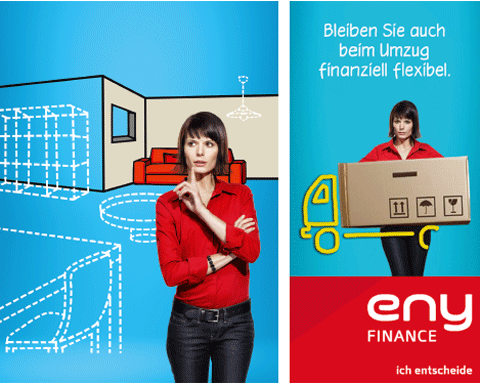
A striking feature of the communication for eny Finance is the visual language, which differs greatly from conventional bank advertising. CD Frederick Rossmann's team relied on the iPhone as the key visual for the information films on the web. The images for the animated clips were also "drawn" directly on the iPhone using a completely new technique by illustrator Ameli Neureuther, who is active in Berlin and New York. In her AN Art Studios she has developed this "App Art", where the "touch screen is used as a canvas " and the "finger as a brush". With this artistic invention, Neureuther questions the traditional boundaries of artistic creation with the zeitgeist phenomenon "iPhone" and shows "that the digital revolution can reach into the original field of art". For eny Finance, this illustration world allows a high degree of flexibility and speed in implementation. "We don't have to organize an expensive shoot in South Africa for every new idea, but can act very quickly on the market."

The films were produced by coloraffairs, a Zurich-based start-up by Beni Leoni and Roland Luder. The films and other information are presented on the eny Finance and eny Lab portal by a testimonial. This "showcase customer" is called Eny and is not entirely coincidentally female - because it is precisely women who already play an important role in the relationship between bank and customer today and probably even more so in the future. Eny is not just meant to be associated with the similar-sounding English expression for "anyone." Eny is also a real name from Ireland and can be translated as "the victorious one." In the casting process, TBWA and its client focused on an attractive face that was deliberately not yet known in the "Glanz & Gloria" sector.

"Simple, human and affordable" are the core values of the company and these should also be reflected in the communication. Doing business with eny Finance is easy and playful for customers. The products are easy to understand and the processes for customer contact are also programmed to be easy to understand. The advertising can demonstrate this credibly. In addition, "transparent" and "human" are core elements if trust is to be built up in the online world. "On the web, too, we want to convey the closest possible sympathy to the customer. We can achieve this with language that is very easy to understand," is Waeber's important point.

On the subject of "cheap", the future bank does not want to appear as a discounter, but always wants to be able to "offer the best value for money". A second striking innovation in eny Finance's communication, in addition to the popular visual language, is the bright red signal color. Until now, the world of finance has been depicted more discreetly in blue or in gray. Finally, Chief Marketing Officer Martin Waeber sees the claim as the most important element of the advertising presence. "I decide" is not just a slogan, but a program and communicates in two words the decisive philosophy of the new financial services provider.

The eny Lab enables co-design

With eny Lab, a freely accessible interactive online platform has been created for the first time that enables a broad audience to actively discuss financial issues and help shape financial solutions. Users have access to commentary and dialog functions, while experts provide background information in blogs and are available to answer questions. The eny Lab platform uses the most modern communication channels and builds up the community through the targeted inclusion of social networks such as Facebook, Twitter and Google+.

On eny Lab, participants can learn in a playful way how to understand and improve their own behavior in financial matters. Participants learn from experts and become experts themselves who can actively help others. CMO Martin Waeber: "With eny Lab, users become fitter in all money matters, their self-determination is systematically increased and they can make financial decisions better and more in line with their needs." Andreas Panzeri

Unbenannt-1_13
ENY FINANCE
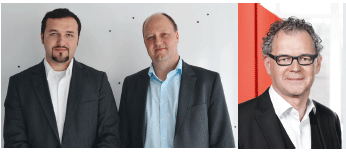
The finance portal, which has been active since the 2nd quarter of 2012, operates from Windisch. The company employs 25 people. The management team includes (from left) Bonart Kerimi, Head of Marketing Communications, Martin Waeber is Chief Marketing Officer and Dieter Lützelschwab is responsible as CEO. At eny Finance, customers can apply for loans, followed by savings deposits and insurance.

Unbenannt-2_10


It's getting googly here in Cannes

The Cannes Lions International Festival of Creativity may still be all about extraordinary campaigns, but the use of technology is dominating the conversation. And internet companies are taking the lead.

In Cannes in the south of France, there are new protagonists who cannot be overlooked due to their presence. While the advertising festival was originally firmly in the hands of film productions and advertising agencies, who celebrated lavish parties on the Croisette, today the flags of Google, Facebook, Microsoft and Yahoo are flying. The internet companies not only own the festival grounds. They have also taken control of the fashionable beach sections. Where advertising agencies used to host their parties, the American super web companies have now set up camp. With their own creative departments such as "Creative Labs" (Google) or "Creative Solutions" (Microsoft), they are increasingly pushing their way into advertising agency territory. The top dog here in Cannes is clearly Google. The search engine company has set up a small tent city called "Sandbox" in the most prominent location. The range on offer dwarfs pretty much everything else on the Croisette. The place is virtually predestined for networking. With live concerts, super-fast Wi-Fi, a relaxed beach atmosphere, free drinks, comfortable sofas and showrooms, Google manages to attract festival participants in large numbers.

However, it must also be said that nowadays there is no way around Google when it comes to advertising. The company has invested a lot of money in recent years to buy advertising companies and know-how. Many advertising agencies are therefore looking to get close to the company. And Google turns the advertising world upside down practically every month. At the beginning of June, just in time for the advertising festival, Google integrated the mobile advertising platform Ad Mob into the Google universe. Two years ago, Google bought the company, which specializes in mobile advertising, for several hundred million dollars. Now several teams are vying for the favor of advertisers in Cannes. Anyone looking for a strong position is dependent on a partnership.

Mobile is the future

And that is important. Mobile is the medium of the future, according to the dozens of speakers here in Cannes. Festival participants are storming the halls and attending seminars such as "The only way to be creative, is to be mobile" or "Secrets of mobile superstars". It's obvious: the smartphone is revolutionizing consumption. The figures speak for themselves. There are now more mobile phones than televisions in the world. In some countries, there are even more subscriptions than people. Experts from the Mobile Marketing Association said in Cannes that a new generation of mobile devices will turn the entire advertising industry on its head. The offline and online worlds will become even more closely linked. It will soon be possible to photograph items of clothing in public and buy them online with just a few clicks. Of course, friends on social networks will also benefit. The rapidly increasing use of the mobile internet will undoubtedly present companies and brands with major challenges. Incidentally, the growth drivers are the markets in Japan and the USA. They are setting a pace that Europe cannot yet keep up with. According to forecasts by mobile advertising specialists and market researchers, Europe will have developed into a billion-dollar powerhouse in mobile advertising by 2015. However, Japan is already at this point today.

The mobile business is therefore the big future. This is why the Mobile category was created for the first time in Cannes. This year's shortlist features some truly exceptional works. The first Mobile Grand Prix in Cannes went to the USA. The "Project Re:Brief" for Coca-Cola, commissioned by Google, exemplifies all the possibilities of mobile advertising. Users were able to buy a Coke for someone anywhere in the world using their mobile device. For this purpose, the can vending machines were linked to the web. The creative concept for the campaign came from the agencies Grow Interactive and Johannes Leonardo. The reaction of the community here in Cannes: "Crazy". With the emergence of new channels, especially mobile ones, the "creativity and technology" debate is also being pushed forward. Countless panel discussions deal with this topic. The term "Creativology" was also created for this purpose. The appeal of individual agency heads is interesting. They are calling for a move away from traditional thinking. New management models are needed. For example, a head of creative and a head of technology should lead teams and develop campaigns together. One final observation on mobile: while the so-called QR code, a pixel square that links offline and online media via a cell phone camera, has only been used sporadically in advertising campaigns in recent years, it has now reached the masses. Many award-winning works here in Cannes work with the cell phone code. For a long time, advertisers found the QR code aesthetically unpleasant, but now the pixel thing seems to be developing iconic potential.

And what else stood out during the first few days in Cannes? As last year, Google seems to be the big winner. The company is one of the favorites in most categories. In the prestigious Media category, Google won the Grand Prix for "Voice Search". To promote the new service, Google launched an outdoor campaign in London that referred to surrounding houses, institutions, businesses or landmarks on every single billboard. How did they do it? With terms in spoken language that promoted Google Voice Search in an ideal way. The campaign was praised for its ability to cleverly combine technology, analysis and storytelling. Two-time Grand Prix winner American Express should also be mentioned, as this example shows that the big advertising agencies such as Crispin Porter + Bogusky are turning away from funny gimmicks and are now trying to solve companies' existential problems. Advertisers came up with the "Small Business Saturday" initiative for the credit card company American Express. The starting point was the realization by American Express that many small businesses suffer from low sales. So in 2010, American Express declared the last Saturday in November, one of the top shopping Saturdays in the USA, as Small Business Saturday for the first time. The aim of the campaign was to raise public awareness of the services and offerings of small regional businesses and stores. With resounding success: 1.5 million Facebook users supported the campaign. And more than 100,000 businesses declared themselves Small Business Day companies - with the result that they achieved an average of 29% more turnover on Small Business Saturday than usual.

A festival of records

Even if internet companies are spreading their wings in Cannes and upstaging the traditional advertisers, Cannes is setting new records. In terms of submissions this year, the agencies have gone all out, not all out. This year's record number of entries and participants is dizzying. 34,301 works were submitted. Last year the figure was 28,828, and in the crisis year of 2009 it was only 22,652. Queues form in front of the seminars and workshops. Waiting times of 30 minutes or more are the rule. The festival has long since ceased to belong to the agency people alone. According to the festival management, around 3,000 representatives from client circles are in Cannes, which led advertising icon Patrick Collister to make the tongue-in-cheek statement in an interview: "Leave us one fucking week alone." The advertising industry is not only doing well, it is booming. The number of entries from Switzerland also increased by 100 compared to the previous year. 503 works entered the race for the coveted Lions. Christian Lüscher
 

"Don't be afraid of tricky questions"

Since early May, elementary school students have been writing weekly reports for the «Kinder-Tagi.» The editorial directors explain how they work with the children to put together the newspaper page and what makes collaborating with the young reporters so special.

Unbenannt-28

WW: As editorial director of "Kinder-Tagi", you design a newspaper page with primary school pupils. Are you more of a teacher or a journalist?
Melanie Kollbrunner MK: Something in between. We don't want to be teachers. But of course, as journalists we have a special role to play: We develop topics, help with the approach and edit.
Jean-Pierre Costa JPC: We accompany the children to events and interviews, they come to the editorial office to draw. We try to establish a connection with the pupils and teach them how to tackle a text, conduct an interview or write a report.

What attracted you to working with children as a journalist?
MK: The job is a great interface between journalism and children. I like having children. And I particularly like being able to work freely and creatively. As we layout the site ourselves, we have a lot of creative freedom. The work is also very varied. No two days are the same.

The content: Suggest topics to the children or let them think about them themselves. you would like to write?
MK: A mixed form: We provide the teachers and the children with a list each. For the first block of 20 classes, there were 60 different topics. Together with the teachers, the children choose five of the suggestions and can also suggest a topic of their own. We then decide on one. We find it desirable that the classes themselves come up with topics. However, our experience is that the set topics are usually better received by the pupils.

In which of the articles already published did the topic come from the children?
MK: One class had explicitly requested the interview with Bligg. Not yet published, but also written by the children, is the article "School in the past and today". The children went to a village festival, visited a museum and talked to village elders.

How do you select the classes?
MK: Admission is on a first come, first serve basis. As long as there is space, we accept classes. The only criterion is that they must be 4th to 6th graders from the city or canton of Zurich.

Why is the "Kinder-Tagi" aimed at primary school pupils and not high school pupils?
MK: This decision was not up to us, but to the marketing department and the exciting, as children of this age have their own tone and a unique visual language. The texts have this authentic, childlike quality. 16-year-olds would perhaps rather copy the tone they know from the newspaper and set different standards.

You mentioned the childlike tone. As a reader, you ask yourself: how much did the children write themselves, how much was edited?
JPC: Our basic maxim is to change as little as possible. We have also told the teachers that the texts should be authentic. It's not about winning a Pulitzer Prize.
MK: Of course, we don't know how much the teachers are involved. The idea is that they don't, or not too much. Of course we correct grammatical errors. After all, we don't want to embarrass the children...
JPC: We do not distort or enrich the articles with words that are not in the children's vocabulary. Over 90 percent of the page is the result of the pupils. I think that's good. The "Kinder-Tagi" should really be their newspaper page.

As editorial director, are you not worried that it will be boring if the "Kinder- Tagi" is published every Saturday?
MK: We particularly value the long term. It is valuable that readers can get used to the site.

What reactions do you get from readers?
JPC: So far, I have only received positive feedback. And although we are fully booked until the end of March, we are still receiving registrations from classes. That shows: The site is being noticed.

The online presence of the "Kinder-Tagi" seems rudimentary. There are only PDFs of the print pages to download...
MK: The website is currently being expanded to give students the opportunity to get to know the online medium better. The site is to become more versatile, more colorful and less static. There will be a blog and a Twitter function. Facebook is out of the question, as a profile can only be created from the age of 13 - although Facebook is of course already an issue for boys. There will be a kind of making-of feature so that readers can gain an insight into how the pages were created. For example, the article about the visit to the zoo could include photos showing how the children experienced the trip, an interview with a keeper or something similar.
JPC: You could also include other drawings made by pupils. It's a shame when excellent drawings disappear just because they don't make it onto the newspaper page for reasons of space or fit.

Last question: What do you learn from the children for your job as a journalist?
MK: A lot: Curiosity, directness and openness... And I'm learning to keep an eye on the very basic questions. The children are less prejudiced in their approach to topics.
JPC: That also applies to me. It's also a return to my roots for me. I come from the teaching profession. It's a re-immersion in processes that were relevant at the beginning of my professional career and were later pushed back by journalism.
MK: It's great to see how children interview. They ask different questions than journalists and are not afraid of sensitive topics. They ask about wages, about touching experiences, about fears. And they have no inhibitions about asking simple questions or questions that have already been asked three times. There are always children who are not satisfied with the answers and follow up. In the case of rapper Bligg, they probed: "But when was the first time you kissed?" or: "Why won't you tell me now?" Children have this straightforward, inquisitive approach.

Interview: Isabel Imper

Unbenannt-29
 

Sticking to the POS

Araldite is sold all over the world. Its branding is as versatile as the uses of this two-component adhesive. Ramstein Ehinger Associates has now developed the first official design.

The adhesive even holds rockets together. The most renowned technology companies in the aerospace sector rely on the qualities of Araldite industrial adhesive. This two-component adhesive was invented back in the 1930s in a small laboratory in Zurich. The patent later ended up with the Basel-based chemical company Ciba. However, the invention gathered quite a bit of dust there until the product was finally discovered by the aluminum industry and many years later was also used in the construction of electrical systems. An important boost to commercialization was the emergence of "fiberglass" for sporting goods such as skis and tennis rackets. At the same time, the almost magical powers of Araldite were also discovered for DIY and household applications. The brand was then marketed by the US company Huntsman. Until a few weeks ago, this company also offered Araldite in various countries in a wide variety of packaging. In some cases with great success. In France, Araldite has a 90 percent market share. In Switzerland, the label is synonymous with "all-purpose adhesive".

Despite this, "Araldite had no brand management until now", as Martin Tuch, Project Manager & Design Director at Ramstein Ehinger Associates explains. This Zurich agency for branding & corporate identity won the contract for the first internationally binding branding in a pitch in January 2011. This also involved developing a comprehensive redesign for a line extension for the client Huntsman. "Our task was to reposition Araldite as a product for professionals and DIY enthusiasts and to make the packaging uniform for the whole of Europe," says Managing Account Director Manuela Brunner, summarizing the briefing.

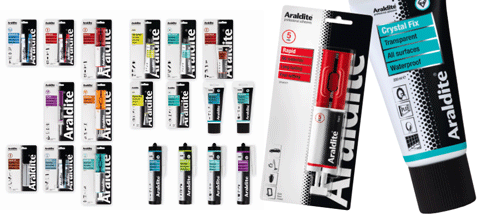
Black & White

As a first step, the designers carried out an extensive analysis of the competition. Glue was purchased "by the crate" from all of the employees' travels throughout Europe. This revealed a wide variety of colors. Yellow, black and red, for example, on the packaging of main competitor Henkel. However, there was no black and white in any of the designs. "A glue is hardly ever bought because of its brand - except by enthusiasts. The most important decision for the choice is made at the POS. This is where we have to stand out from the crowd," was the final argument for why the new packaging for Araldite is now being offered in this color combination, which has never been used for this type of product before. Another new feature is the symbols, which can be understood across all language barriers. Four on each pack indicate what can be best glued with the respective extensions such as "Rapid" or "Crystal Fix". In addition, there are three characteristics per pack that stand out in a colored square. A key condition was that the shapes for the cardboard packaging had to be the same internationally. The set also had to be able to be opened without scissors. Ramstein Ehinger Associates has been working in the field of branding and corporate identity for around 20 years. The Zurich-based company was founded by former executives from the "school" of Interbrand Zintzmeyer & Lux and today employs an interdisciplinary team of 14 specialists. The agency is primarily active in the B2B sector. Other clients include Sika, Eternit, Sympany, Vigier, Pax and Nationale Suisse, for example.

Andreas Panzeri

Unbenannt-8_12
 

Time travel from the Baroque

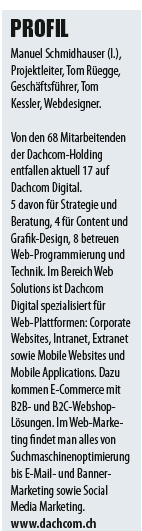
Dachcom Digital is one of the Internet pioneers. The agency in Rheineck built the first e-shops and today offers the entire digital marketing portfolio. The specialist has now been accepted into the BSW.

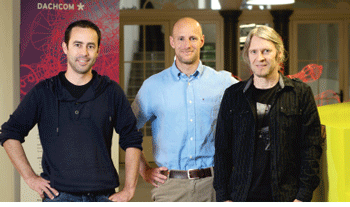
The first digital agencies in Switzerland emerged from the field of technology and grew relatively quickly. However, they often lacked the know-how for creation later on. Dachcom Digital, on the other hand, has developed from the growing need for digital solutions in the creative sector and has grown a little more slowly. But more sustainably. Over time, Dachcom Digital has been able to take on more and more creative jobs from companies that rely a little too much on technology. "We were born out of a customer need," recalls Christin Gmeiner. Her Dachcom agency group has been active in the border triangle of Switzerland, Germany and Austria for almost 30 years. The area of activity (D-A-CH) with its peripheral location also gave Dachcom its name. Christin and Otto Gmeiner are the founders and owners of the agency and are operationally active in customer consulting and conception. Dachcom now has six locations in the DACH region and is organized as a holding company. Dachcom focuses on the development of communication solutions for companies, brands and institutions on all media levels.

Strategically sensible concentration

In the early days of the Internet, digital requirements were still managed by a small team within the traditional agency. Outsourcing Dachcom Digital as an independent company seemed to make sense in 1999. "The organizational and local separation between classic and digital communication promotes concentration on the respective core competencies. The and owners of the agency and operationally active in customer consulting and conception. Dachcom now has six locations in the DACH region and is organized as a holding company. Dachcom focuses on the development of communication solutions for companies, brands and institutions on all media levels.

Strategically sensible concentration

In the early days of the Internet, digital needs were still managed by a small team within the traditional agency. Outsourcing Dachcom Digital as an independent company seemed to make sense in 1999. "The organizational and local separation between classic and digital communication promotes concentration on the respective core competencies. The dovetailing of classic and digital communication is already taken into account at a conceptual level," says Christin Gmeiner. The pioneer's first projects almost five years after the beginnings of the Internet were in the CD-ROM sector. The first websites were soon programmed, but "still without any practical benefit for users". For the team of five people in the start-up phase, most jobs still meant "learning by doing", as Tom Kessler, the web designer from the very beginning, remembers. An important task was also to "actively educate" customers about the growing possibilities of the new medium, as Managing Director Tom Rüegge explains.

After the dotcom bubble burst, which also left its mark on Rheineck, the agency experienced a new upswing when cross-media projects became increasingly important from 2008 onwards. An e-shop for the beauty brand Dobi became a Swiss milestone in this development and soon led to numerous other clients. The ever-growing expanse of the World Wide Web made it necessary for Dachcom Digital to increase its team from 10 to 17 since last year alone. However, these are "only" the specialists, as editing, consulting and back office services are still provided by the parent company. Andreas Panzeri

Unbenannt-11_8
Unbenannt-12_9
 

SRG plans future with hybrid TV

SRG wants to offer new forms of television by combining traditional television with the Internet. Radio Télévision Suisse RTS is launching an initial pilot service this year. The other SRG channels will follow in the course of 2013.

Since the new generation of hybrid devices can receive both television programs and the Internet, new opportunities are opening up for audiences and program providers. For SRG, the focus is on two forms of use: "Hybrid broadcast broadband television"(HbbTV and "second screen". HbbTV enriches traditional television with Internet content. "Second screen" extends the television experience to a second screen (cell phone, tablet or laptop). Parallel to the TV program, additional information can be called up or interactive participation in a program is possible, writes SRG in a communiqué on Thursday.

SRG is currently gathering experience with internal HbbTV trials. A pilot service is already being set up for Radio Télévision Suisse RTS. Viewers of RTS are to enjoy the first additional services before the end of 2012. These include the successor service to today's teletext with current news and sports information, a video-on-demand offering of the company's own broadcasts, and services for the sensory impaired. Anyone who owns an HbbTV-compatible device can use the service. They must also have satellite reception or be connected to a network operator that supplies the additional signal. The SRG wants to gain experience with this RTS project, analyze the needs of the audience and take these into account in a later offer, according to the statement. The first second-screen applications are also being developed at RTS and SRF.

In further steps, the first HbbTV offerings will be set up for Schweizer Radio und Fernsehen SRF and Radiotelevisione svizzera RSI. In German- and Italian-speaking Switzerland, a rollout is expected in the course of 2013.
 

Swiss agencies win Red Dot Award 2012

Among this year's winners of the Red Dot Award: Communication Design 2012 are Mettler + Mettler and Komet. The jury evaluated 6,823 entries from 43 countries.

The best projects were awarded. The agency Mettler + Mettler, founded just one year ago, was able to convince the jury of experts with its campaign for Hurter Designers wallpapers and the label Mettler+Clark.

mettler

Komet has received the Red Dot award for the work Soirée graphique Werkzeitung.

Soiree_Graphique
get_footer();