Jung von Matt/Limmat: "We are young and need the money"

Under the slogan «We’re young and need the money,» Migros« iconic brand M-Budget kicked off its festival campaign last weekend at Openair St. Gallen. With the start of the festival season, the »M-Budget WG” shared-apartment contest is also entering its next round.

Ten qualified flat-sharing communities, equipped with VIP passes and their own flat-sharing tent, will battle it out at the Openairs to reach the final. They will be accompanied by the interactive TV channel joiz.
 

At the St. Gallen, Frauenfeld, Gurten, Heitere and Gampel Openairs, M-Budget helpers offer festival visitors unusual but practical services at rock-bottom prices. For 3.90 francs, an M-Budget helper will take over the laborious task of putting up the tent. For 2.90 francs you can enjoy a concert on the shoulders of an M-Budget helper and for 1.90 francs an M-Budget helper will carry your luggage. M-Budget helpers offer sun or rain protection with umbrellas for 1.10 francs. M-Budget helpers with fans keep you cool on hot days. If you don't feel like queuing or shopping on the festival site, you can book an M-Budget helper for CHF 1.90 or CHF 2.90 respectively. And for just 10 centimes, every festival visitor gets a hug.

At M-budget-festivals.ch the community not only had a say in which M-Budget services should be offered at the festivals, but could also apply to become an M-Budget volunteer. So far, 3,450 volunteers have registered.

Responsible at Migros: Martin Haslinger (Brand Manager M-Budget), Dirk Worring (Head of Digital Marketing), Catherine Maeder (Project Manager Digital Marketing), Patricia Zingg, Urs Engler (Project Manager Sponsoring and Event Marketing). Responsible at Jung von Matt/Limmat: Alexander Jaggy (Creative Director), Samuel Christ (Text), Wim Roelfs, Bruno Manser (Art Director), Tenzin Tibatsang (Graphics), Thomas Steiner, Dan Nessler, Petra Moser (Consulting), Philipp Bühler, Bettina Luginbühl (Public Relations, Social Media). Responsible at Joiz: Alexander Mazzara (CEO and Co-Founder), Dominik Stroppel (Chief Operations Officer), Yves Schifferle (Project Manager), Martina Strul (Producer).
 

The international Bühler magazine redesigned

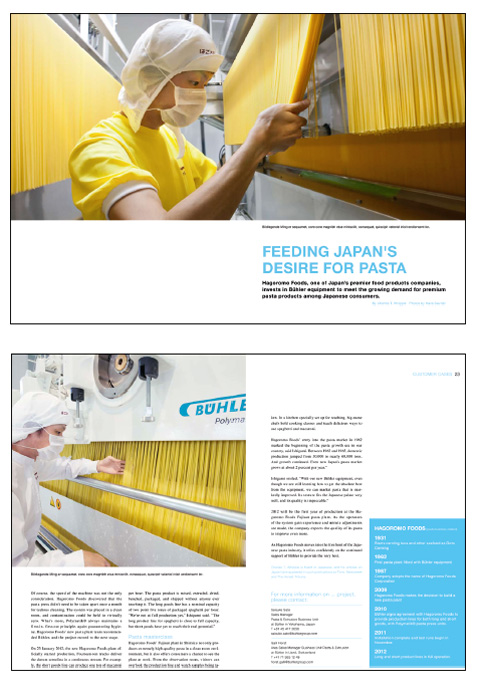
Bühler’s long-standing international customer publication, *Diagram*, was transformed into a magazine. The content was expanded to include more in-depth journalistic coverage.

The new diagram in magazine format was published in April of this year. Corporate publishing service provider Primafila AG is now responsible for the concept, content, design and production of the international Bühler publication, which has been in existence since the 1950s. If the headquarters of the international technology group in Uzwil is bright, fresh and reflects the innovative spirit, Bühler's publishing should also be committed to these branding values in its own way. But it's not just about the design in this world of process technology, but also about the journalistic approach. The international Primafila network is used in Portugal, Pakistan, Egypt, Canada, India and Japan (see image). Diagram, a classic B2B publishing product, is published three times a year in eight languages.

Buehler-Magazin

Cherchez la femme (II)

A First Lady’s Jealousy as a Freelancer: Valérie Trierweiler’s “Twittergate” Becomes the French Summer Spectacle. By Jürg Altwegg, Geneva correspondent for the Frankfurter Allgemeine Zeitung.

And how is the most beautiful journalist in Paris?". Dominique Strauss-Kahn also tried his clumsy come-on with Valérie Trierweiler. She had been in a relationship with François Hollande for two years when he was the faithful partner at Ségolène Royal's side during the 2007 election campaign. She had met the socialist politician as a cultural journalist at Paris Match, whose editor-in-chief was once dismissed because he put the former Madame Sarkozy on the cover with her new partner. During the election campaign, Trierweiler was sidelined by the magazine - after the left-wing triumph, her contract was extended. However, her office is in the Elysée and the secretary is paid by the state.

Her first article: a review of a biography of the wife of US President Roosevelt. Trierweiler explained on the radio that she would decide on sensitive interview requests to the president and between the different media. And reignited the debate about the role of female journalists alongside politicians. In the love affair between power (male) and the media (female), the republic locates its dream couple: Minister and star journalist, married in second and third marriages. It is an achievement of the caviar left: DSK/Anne Sinclair, together with Bernard Kouchner/Christine Ockrent, were its pioneers. Since then, bourgeois cabinet members have also been TV presenters. The model is also represented in the new cabinet.

In the Elysée, however, female journalists have so far been limited to the rumor that she is an alleged mistress. It has been circulating since Giscard d'Estaing. L'Express founder Jean-Jacques Servan-Schreiber deliberately sent the most attractive female editors in short skirts to the politicians. Between Cecilia and Carla Bruni, a journalist from Figaro was located at Sarkozy's side. "I thought the most beautiful journalist in Paris was Anne Sinclair," the quick-witted Trierweiler is said to have dismissed DSK at the time. Her Twitter message, in which she supported Ségolène Royal's opponent in the parliamentary elections, sparked the first affair since the change of power. The Prime Minister had to rebuke the wife of his President. "Who's the boss in the Elysée?" was the headline in L'Express.

The rivalry between two women becomes the theme of the summer theater. The book "Les Strauss-Kahn", whose authors - journalists from the world newspaper Le Monde - reveal DSK's advances towards the most beautiful female journalist, is the bestseller of the season. "The great jealous women who make history" are listed by Marianne magazine. "Praying for the president" between two women is what star writer Philippe Sollers wanted in a Sunday newspaper. He has been writing for the Journal du Dimanche for years. We now know more about François Hollande, who wanted to be a "normal" president, from his private biography than we ever had to read about his extravagant predecessor. Only Paris-Match, whose core business is all this, has its hands tied out of consideration for the powerful freelancer. The Journal du Dimanche, which is published by the same publishing house, is also once again practising its loyalty to the government. In 2007, an article about Sarkozy's wife, who did not go to the polls, was removed from the paper. And now Philippe Sollers has been given the boot. PS: Half of the more than thirty ministers in the new cabinet are women. Never before has their share in parliament been as high as since the election in June.
 

Four trends are shaping the TV of the future

Das TV wird den Fernseher verlassen. Zugleich wird das TV-Gerät für immer mehr Funktionen genutzt werden. Dies sind zwei von vier Trends, die einer neuen deutschen Studie zufolge die Zukunft des TV prägen werden.

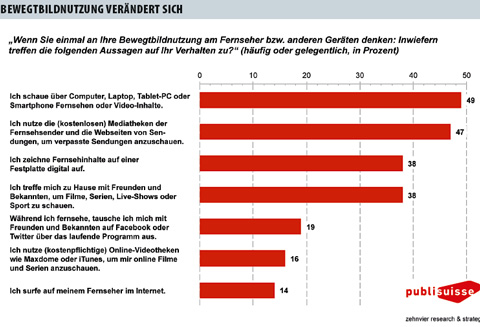
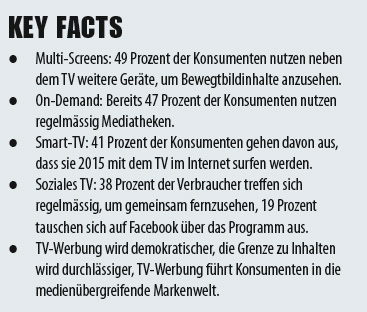
In order to draw a picture of the lines of development of TV, the communications agency Interone and the trend research institute JeldenTTC combined various methods - including in-depth interviews with lead users, a representative survey of over 1,000 consumers aged between 18 and 74 and interviews with media experts. First of all, the study shows that multi-screening is becoming normal. On the one hand, traditional TV will continue to play a central role, while on the other, new forms of television will become more important. One in two people already regularly use other devices to watch video content. Those who own mobile devices - and more and more consumers do - are integrating them into their viewing habits. 86% consider their notebook to be important for their use of video content, while smartphones and tablets are important for three out of four owners. While the TV maintains its function as a social campfire, mobile devices are used more individually. They complement traditional TV use by providing in-depth information, facilitating an exchange with others about the program and allowing content to be viewed on the move. And they strengthen individual TV usage. Even today, one in four respondents (27%) has a partner in the same room watching their own program on a mobile device while they are watching TV themselves. The second trend identified by the study is increasing on-demand use. The freedom to watch content at any time is only being used to a limited extent, but the opportunity counts. The trend towards on-demand use is also being fueled by media libraries. As many as 47% of respondents state that they use media libraries regularly. The content is often simply started later because it is more convenient at the time. Occasionally, users also browse the media libraries when they don't know what to watch. In future, on-demand use will become even more convenient thanks to new recommendation and curation mechanisms. The third trend is the leap in the development of TV sets. Today, networked TVs are still a niche phenomenon: only 14% regularly surf the net via their TV. However, 41% of consumers expect to do so in 2015. Around one in four can also imagine using apps on their TV. Networking also increases the opportunity to involve viewers interactively in the TV program. Almost one in five think that they will be able to participate interactively in TV shows in 2015. According to the study makers, "social television" is the fourth key trend. TV remains a social medium - consumers' need for community ensures this. In addition to public viewing, private group viewing and social TV play an important role: 38% of respondents regularly meet up with friends and acquaintances to watch films, shows or sport together, while one in five (19%) discuss TV content on Facebook or Twitter. In future, TV broadcasters will focus even more on formats with live and participatory elements that take longer to develop. The question remains as to what this means for marketing communication. The study shows that TV advertising will become more democratic. Viewers will be able to choose between advertising approaches (e.g. pre-roll or interruption advertising), and they will rate commercials with "I like". The boundary between advertising and content will become more permeable, with offers increasingly being placed in films, series or shows. In future, brands will increasingly rely on long-term engagement strategies. TV advertising will be a signpost that leads consumers into the cross-media brand world. Clemens Koob  

keyfacts
bewegtbildnutzung
  •  

The House Agency: Holiday photo contest for Hotelplan

As part of the relaunch of Hotelplan’s Facebook page—which features new apps and expanded content—The House Agency organized the summer photo contest «Show Us Your Vacation Happiness.».

The agency is focusing on the fusion of online/offline with the aim of increasing the efficiency of Hotelplan's online campaign. For the vacation competition, in line with the claim "Nobody makes more Swiss happy", the public is asked to upload the happiest vacation picture of their 2012 summer vacations to the Facebook competition page. A jury from Hotelplan will select 8 winning photos from all participants. The deadline for entries is August 26, 2012, and the winners will be announced on September 3, 2012.

The campaign will be promoted by means of flyers in Hotelplan branches and in customers' travel documents. In addition, the vacation photo competition will also be promoted via social media, Google search and display networks, newsletters and the Hotelplan.ch homepage.
 

"Literature Club" on SF 1 new with Stefan Zweifel

Stefan Zweifel is the new host of the «Literaturclub.» The panel of critics on the SRF literary program will feature Elke Heidenreich, Rüdiger Safranski, and Hildegard Elisabeth Keller starting September 18, 2012.

Stefan Zweifel will be the discussion leader of the new round from September 18, 2012. He is a freelance journalist and has been a member of the "Literaturclub" team of critics since 2007. He has made a name for himself with translations of the Marquis de Sade and Rousseau, holds a doctorate in philosophy and has written for Das Magazin, Du and the NZZ. Since 2009 he has directed the "Reflektorium" discussion series at the Burgtheater Vienna. In 2009, he received the Berlin Prize for Literary Criticism. Stefan Zweifel on his new role: "The Literature Club has always been a wonderful school of reading for me. I'm looking forward to seeing what the new group of critics will open my eyes to. I want to explore the broad landscape of Swiss literature more closely. Because it hasn't been narrow for a long time. And I also want to recognize what is my own from a global distance."

Elke Heidenreich is now a permanent member of the "Literaturclub" team of critics. The writer and literary critic, who is known to a wide audience, became popular with her radio broadcasts, her book publications and the program "Lesen!", which she hosted on ZDF from 2003 to 2008. From 2008, she published her own edition of music books. She has received several awards for her work.

Rüdiger Safranski is also a new addition. The philosopher and writer became known for his books on Schiller, E.T.A. Hoffmann, Schopenhauer, Nietzsche and Heidegger. Together with Peter Sloterdijk, he last hosted the "Philosophical Quartet" on ZDF from 2002 to 2012.

Hildegard Elisabeth Keller, born in 1960 in Sankt Gallen, is Professor of German Literature at the University of Zurich and Indiana University in Bloomington (USA). She has been a member of the jury for the Ingeborg Bachmann Prize since 2009. Hildegard Elisabeth Keller is also a freelance author, critic and performer. She will alternate with another critic from Switzerland in the team.

As before, the discussion will be supported by inserts on a case-by-case basis. According to SDA, Esther Schneider, head of the literature editorial team, said that these would now mainly be of a documentary nature. The "Who are you sleeping with?" section will be dropped in future. The "Literature Club" will continue to be recorded publicly and in front of an audience in the Papiersaal Sihlcity in Zurich. However, discussions will no longer take place at the bar but in armchairs, said Schneider. Since the relaunch two years ago, the discussion had taken place at the bar. The new round starts on Tuesday, September 18, 2012, with its first broadcast. The focus of the show will be a lively discussion about relevant new literary publications, non-fiction books and classics that are being reissued.
 

Corporate movies without advertising platitudes

With the growing importance of video content in corporate communications, the question of the right format is becoming increasingly important. Which formats are convincing and in which direction should corporate movies develop? One thing is clear: films that focus too much on advertising messages usually come across as stiff and no longer fit into the age of Web 2.0.

Moving images are becoming an increasingly important medium for corporate communication. This realization is by no means new. However, gone are the days when more or less elaborately produced videos were primarily used to promote products and services without criticism, as in an advertising spot. With the advent of social media in corporate communications and the changes in user needs brought about by Web 2.0, such one-dimensional formats simply lack credibility - at least in most cases. It is not uncommon for wooden CEO statements or stilted interviews to border on the embarrassing. The entertainment value is also usually not at its best: Only a few corporate movies can stand up to the growing competition of videos on the Internet.

Storytelling enters the next round

But how do you present a company in the right moving light? How does a company appear credible and not flat or embarrassing via the medium of video? The solution lies in an indirect connection to the company. Existing and potential customers must be surprised and be able to identify with what is shown in the film. Digital natives in particular can no longer simply be fobbed off with rehearsed phrases. This is the only way a film in Web 2.0 can play to its strengths, namely the telling of a lasting story and the associated dissemination. Identification therefore takes place through storytelling that is directly linked to the company and its world, but this does not have to be forced on the viewer. Interchangeable PR messages all too often come across as strained and fundamentally assume a lack of understanding on the part of the viewer.

A good story, authenticity and aesthetics

For example, aesthetic film portraits with authentic life stories from the world of customers are very effective - whether for a consumer goods company, an insurer or a B2B group. In other words, people who stand out through their work, their profession or a particular passion. In this way, the customer becomes an indirect ambassador for the company, without prefabricated sentences being put in their mouth. A good story always works, and if it can be linked in some way to the company's activities, the company is given a face and benefits from an enhanced reputation. Products or services are one thing, but who claims them is the other, usually more relevant sales argument. Infotainment-oriented company blogs or web magazines offer the ideal platform for spreading this idea. Otto, for example, is moving in a good direction with its blog Twoforfashion.otto.de, as is Mercedes-Benz with its blog mb.mercedes- benz.com. Among others, the unicycle pioneer Kris Holm talks about his daring interpretation of riding on just one wheel - always stylishly staged and authentic. The Mercedes Benz brand is not mentioned at all. Nevertheless, the star is given more shine.


Decisions are made in milliseconds

Megatrend or just hype? Everyone’s talking about «real-time bidding.» The latest approach to online advertising works like a «banner exchange.» This refers to the auction-based purchase of online ad space in real time, as Remo Prinz of Serranetga explains.

WW: Everyone is talking about real-time bidding. What are these people talking about?
Remo Prinz: This refers to the auction-based purchase of online advertising space in real time. With this new high-tech solution, the exchange between the demand and supply side - i.e. between advertisers and publishers - takes place electronically. For this to work, software systems are used on both sides: the "Demand Side Platform" (DSP) on the demand side and the "Supply Side Platform" (SSP) on the supply side. The entire process, from the request and availability check to the bid to the acceptance and delivery of the advertising material, is completed in just a few milliseconds. This is so fast that the advertising arrives in real time from the point of view of the targeted consumer. Hence the name real-time bidding, or RTB for short.

Are there also misconceptions in circulation?
We are at the beginning of an innovation cycle. It is clear that there are also misconceptions in circulation. First of all, the idea that you can jump on this bandwagon without any prior knowledge is wrong. The emerging DSPs and SSPs are wonderful tools, but you need people who can drive these innovations forward and operate the tools correctly. If you put a layman in the cockpit of a jet, it will never take off, let alone land safely. It's the same with real-time bidding. Even the selection process for the right technologies is complex and requires a great deal of prior knowledge. Only those who are prepared to invest time and money and get the right people on board to build up and expand this expertise will take off with the new technologies and perhaps even fly a loop.

Read more about this in the current Print edition of the advertising week.

Burda expands "Editorial Commerce

Burda Intermedia Publishing (BIP) has expanded its strategic focus on «Editorial Commerce.» Since July 1, 2012, Kathrin Bierling has been a member of the editorial board at BIP Digital, and Rolf Moelter has joined Patrick Fischer’s team as Head of E-Commerce.

burda_Bierling1_160x120
Kathrin Bierling is responsible for the online presence across all brands with a thematic focus on fashion and beauty (including Elle, Freundin, In Style and Cover). Kathrin Bierling is a fashion journalist and has been running the blog Modepilot for several years. In addition, she most recently managed the online store of luxury fashion retailer Maendler. Kathrin Bierling was previously an editor at InS tyle and editor-at-large at Fivetonine, a publication of Wirtschaftswoche. According to a Burda press release, she will further expand the online presence of the Burda Style Group's strong women's brands and provide them with additional innovative impetus.

burda_Moelter1_160x120
The second new addition is Rolf Moelter, who joined the team of Patrick Fischer, Director Digital, as Head of E-Commerce on July 1 and is responsible for all of BIP's online stores. Rolf Moelter was most recently Head of Online Marketing at Tirendo Holding and worked at Zooplus in Munich for several years directly before that. His tasks include expanding and professionalizing BIP's e-commerce activities and forging further partnerships for all portals.
 

Continuing education: What must the employer pay?

«A rolling stone gathers no moss.» Progressive companies therefore pay for their employees’ continuing education so that they can stay up to date professionally and provide the greatest possible benefit to the company. In return, it is permissible to retain such employees with the company for the long term under certain conditions. By Irmtraud Bräunlich Keller, lic.rer.pol., editor and labor law expert at the Beobachter Advisory Center.

Are employees entitled to regular further training? And does the employer have to contribute to the costs incurred? To date, this has not been explicitly regulated by law. Nevertheless, the Federal Council wants to promote continuing education with a new law on continuing education. Employers are to be obliged to "encourage" the further training of their employees. But this is a long way off. At present, the Swiss Code of Obligations only stipulates that expenses necessarily incurred in the course of work are to be borne by the employer. This means that the costs of training or courses that the employer declares to be mandatory must be paid by the company. The training period then counts as working time. The situation is different if employees attend a training course on their own initiative because they are eager to learn and want to progress in their career. In this case, the employer is not obliged to contribute to the costs or grant the employee time off to attend the course. Many employers do this anyway in order to encourage their employees. But further training is expensive, and anyone who invests in training their employees wants to be sure that they don't immediately leave for the competition with their newly acquired knowledge. To prevent this, employers can attach conditions to their payments.

In most cases, the employee must undertake to remain with the company for a certain period of time after completing the training or to reimburse the training costs. Many companies draw up further training regulations that stipulate when and under what conditions the company will contribute to courses and training programs financially and by granting additional time off. In addition, it is advisable to conclude individual agreements with the employees concerned, which define the details in each specific case. The following principles should be observed:

- The agreement must be made in writing before the start of the training.
- The duration of the commitment must be limited in time and must be proportionate to the training period and the employer's financial commitment - two to three years since completion of the training is usual.
- If the employee terminates prematurely, a pro rata repayment obligation applies, graduated by month. For example, if the employee remains with the company for only half of the contractually agreed period, the company must reimburse half of the training costs.
- If the employer terminates the contract through no fault of their own, the employee is not obliged to repay the amount.

Do you need legal advice?
The Beobachter Advisory Center offers you and your employees expert advice by telephone on legal issues relating to your company - 6 months for just CHF 99. Order the consulting package for SMEs at www.beobachter.ch/kmu or 0800 83 0800.

Book tip
Labor law
From contract to termination

This handbook by the Beobachter employment law specialist provides a clear overview. What should be included in an employment contract? What to do in the event of a pay cut? What about overtime? How do I give notice correctly? How can I defend myself? Here you will find competent answers to your questions, groundbreaking court rulings and lots of practical tips. 272 pages, Fr. 36.-, 11th, revised and updated edition, 2011, ISBN 978 3 85569 440 2, Beobachter- Buchverlag

buchtipp

Mediaedge:cia Switzerland: Sergio Zappa succeeds Oliver Frank

Sergio Zappa has been appointed Interaction Director at MEC Mediaedge:cia Switzerland, effective immediately. He succeeds Oliver Frank, who is moving on to a new challenge.

Sergio Zappa, previously Senior Interaction Planner, has in-depth IT and online experience and previously worked for Blick, Bluewin.ch and Tilllate.com, according to a statement on Wednesday. Sergio Zappa and his interaction team offer full service in the digital area in strategy, planning, purchasing, optimization as well as analysis and documentation.

At MEC Mediaedge:cia Switzerland, around 40 employees work at the two locations in Lausanne and Zurich throughout Switzerland, developing integrated communications solutions for local, regional and international clients.
 

"Vatileaks: Investigation report to be available soon

The results of the investigation into the so-called «Vatileaks» affair at the Vatican are expected to be available by the end of July. The report will then be handed over to Pope Benedict XVI, a Vatican spokesperson said on Tuesday.

The report of the investigative committee consisting of cardinals is therefore to remain confidential. In recent months, internal documents from the Vatican have been repeatedly leaked to the Italian media, including those relating to corruption, money laundering and child abuse. In May, the Pope's valet de chambre, Paolo Gabriele, was arrested. Gabriele is suspected of being one of the leakers. He faces up to six years in prison if convicted, but could also be pardoned by the Pope.

Gabriele's interrogation is to be completed next week or the week after. According to the Vatican, a possible trial would not begin before October. Meanwhile, the Pope flew by helicopter to his summer residence Castel Gandolfo near Rome. According to the Vatican, he intends to stay there for just under three months. (SDA/AFP)

Last but not least: Wikileaks has a successor: Vatileaks

(Image: Keystone)

get_footer();