Fascinated by stories

For Guido Von Deschwanden, Creative Director at the corporate media agency Infel, good editorial design is more than just effective storytelling. «A nice story and a beautiful layout don’t necessarily make for a good product.»

Unbenannt-4_1

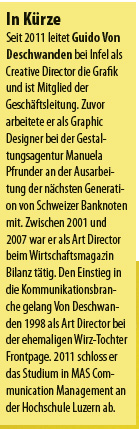
Guido Von Deschwanden loves stories. "Tell me a story," he often asked his father as a young boy. And he, a gifted storyteller, would write something off the cuff. It was his passion for storytelling that later led Von Deschwanden to corporate communication and his current job as Infel's CD. That's because Von Deschwanden's approach to corporate media is not only one of design, but also one of content. How can values and the essence of a company be brought to life in a corporate publication? What stories help a reader identify more strongly with a brand? To answer these questions, Von Deschwanden not only has to think his way into the value system of his clients, but also take the readers' perspective. He is interested in what content and stories captivate and fascinate. Under no circumstances should one think: "They would be better off investing the money elsewhere instead of printing an expensive magazine or programming an elaborate app... " Readers should learn exciting things and things worth knowing - and not just in areas that concern the company. "We hold journalism in high regard," CD emphasizes. "If a reader is convinced that the magazine, website or app brings them a benefit, this has a positive effect on the relationship they have with the company. In this way, a well-crafted magazine can increase sympathy for the client, contribute to customer loyalty and also strengthen loyalty to the brand."

Customers and readers in view

Von Deschwanden is certain: A pretty story and a nice layout do not make a good product. A corporate magazine, for example, must take over part of the company's communication task. To fulfill this task, Von Deschwanden thinks his way into his customer's mind when designing a magazine. What are the structures like? What values characterize the company? And what communication goals are to be achieved? From these considerations, he derives the content and design requirements for the publishing mix. Over the years, practice was no longer enough for Guido Von Deschwanden as his sole source of inspiration. During his MAS of Communication Management studies, which he completed in 2011 at the Lucerne University of Applied Sciences and Arts, he delved into fundamental communication areas such as brand management, corporate and strategic communication. He learned a lot about how clients view corporate publishing from his fellow students, the majority of whom were from the corporate side. He believes these insights have given him a better understanding of what clients want from CP products. Von Deschwanden also expects the editorial designers he works with at Infel to think deeply about the company. A designer should not be content with the aesthetics alone, but should also take an in-depth look at the medium. Just reading the articles is not enough. For example, you have to think about whether the content really makes sense. Von Deschwanden has nothing to gain from random columns or texts that make it into the magazine, onto a website or an app on the principle: "I have a mountaineer we could portray. That would certainly make for nice pictures." The question must always be asked: What does the reader get out of it - and does the climber really fit in with the company?

Design instead of technology

Despite his fascination with stories: Von Deschwanden did not come to communication in a direct way. His penchant for drawing prompted him to opt for an apprenticeship as a mechanical draftsman at the age of 16. A misconception, as it soon turned out. He was far less interested in how machines worked than how they looked: "When I saw a toaster, I was more interested in how it looked than how it worked," says Von Deschwanden. And his enthusiasm for good stories came up short in the engineering office anyway. That's why he had to move on to where content is created and stories are written. "I'm a news junkie," he says of himself. Having to do without newspapers on vacation is still torture for him today, he says. Von Deschwanden first became active as a journalist in his early twenties. When the youth political movement was also gaining strength in his home canton of Obwalden, he gave the young people a voice with a magazine that appeared three times a year. He enjoyed helping to determine the editorial topics, designing the layout and writing articles. Nevertheless, he would not describe himself as a politically active member of the movement. At that time, he was less fascinated by politics than by his work as a newspaper publisher.

The note designer

In 1998, he started as Art Director at the then Wirz subsidiary Frontpage and was responsible for clients such as Clariant, Swiss Re and Messe Basel. Three years later, he decided to switch to the publishing side. He wanted to experience what it's like to work for a magazine where it's not primarily a client who decides, but the readers who are the final authority. He worked as AD at the business magazine Bilanz for around six years, during which time he was responsible for the re-design and the development of additional magazines such as Bilanz Homes. Von Deschwanden then worked for two years at the design agency Manuela Pfrunder on the design of the new Swiss banknotes. The feel of the notes fascinated him. He fine-tuned small details, colors and security aspects, and worked with documents that were x times larger than the original. In design development, he moved in the micrometer range on the screen. You have to be interested in technology and enjoy working on the same detail over and over again," says Von Deschwanden, describing the requirements of his job at the time. His passion was less so.

Corporate publishing rethought

Regularly launching new projects and moving forward is important to Von Deschwanden. He can live this out in his current role at Infel. From time to time, the CD likes to develop novel, unconventional approaches. For CSS Versicherung, for example, he created a magazine that breaks with almost all conventions: neither a section structure nor page numbers serve as orientation. Instead, the reader is guided through the magazine with questions that are posed at the beginning of each article and answered in the course of reading. And it was precisely this magazine that won gold at this year's Best of Corporate Publishing in Berlin. As a designer, he is also increasingly concerned with how the content is to be disseminated and expanded upon on different channels. How is the content best perceived on tablets or other devices? How should the design change depending on whether a user holds their pad landscape or portrait? And is an offer suitable for mobile use at all? Von Deschwanden develops the concepts together with the in-house digital department, which - just like the editors, photographers and designers - are involved in the development from the very beginning and contribute their respective perspectives. Even at meetings with customers, a representative from each of the three areas is often present. It is an enormous customer need to be advised holistically, the CD emphasizes. At Infel, the online department itself never works separately from editorial, design and photography. Von Deschwanden has basically arrived at his profession. Occasionally, he draws inspiration from his time as a sheet music designer: For example, when it comes to special printing processes, when a silver print that lies finely over another color takes on a different color depending on the light. However, he is glad that he can now always turn to new projects, new stories at Infel. "Banknotes are practically made to last forever. A magazine - to exaggerate - for the wastepaper basket." An issue is created, it is read and discussed. But then another new magazine comes along, a new customer with new stories. After all, you can never get enough stories. Isabel Imper
kuerze1
kuerze2

Premotion opens office in Andermatt

The event and marketing agency Premotion has opened an office in Andermatt. The agency aims to provide better local support for the "Andermatt Swiss Alps" project.

Premotion is convinced of the long-term success of this vision and can look back on various successful events in Andermatt. Other corporate clients from Switzerland and abroad are already signaling their interest in holding customer or employee events in the historic Ursern Valley and around the imposing Gotthard massif, as the agency writes in a press release. As an event and marketing partner with its own local branch, Premotion can now respond even more specifically to individual customer needs and intensify cooperation with local partners.

The office shares an office with the Andermatt heating association and Energy of Events, a company specializing in event decorations.
 

Quality improvement through communications controlling

«In the future, communications professionals will need to make decision-making transparent.»

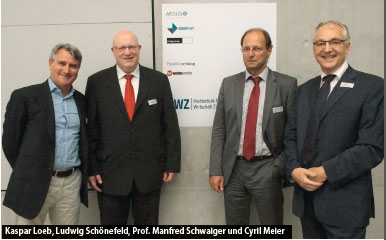
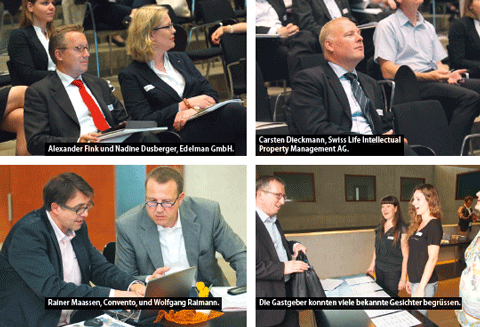
It has been a tradition for half a decade: in June, Swiss communication controlling specialists meet for their annual conference at the HWZ University of Applied Sciences in Business Administration Zurich. On June 21, Dr. Manfred Schwaiger, Professor at the Ludwig Maximilian University in Munich, opened the high-profile event. As a business economist, he demonstrated the value-enhancing effect of a good corporate reputation and showed how an established system of control and management can be used in practice to take the right communication measures. Ludwig Schönefeld, Hoerbiger Holding AG, Zug, then demonstrated how an international group based in Switzerland plans, implements, monitors and improves its global communication activities in detail. The basis for this is a communication scorecard, which defines the communication goals in the short and medium term. The strategy map is then used to plan specific internal and external communication measures. It was impressive for the participants how detailed the speaker provided an insight into his global controlling system.

The other case studies presented in the subsequent breakout sessions also showed how communications controlling can be used to improve day-to-day communications work. Nadine Dusberger, Edelman Frankfurt, presented the case of the market launch of a new drug by AstraZeneca. Christian Lüdi, Social Media Manager at Swiss, impressively demonstrated the reactions of the community to the volcano crisis and the introduction of the new logo; Carsten Dieckmann gave an insight into the management of the Swiss Life brand, and Nadia Vitale, Project Manager Media Analysis, Argus der Presse AG, Zurich, used examples to show how efficient communications controlling can be carried out.

Finally, Kaspar Loeb, Partner Dynamics Group, amused the participants when he reported on the practical experience of Swiss companies. Far too often, communication budgets are still not spent on the cause, but on the personal goals and ambitions of the decision-makers and agencies involved. Many of those responsible for corporate campaigns could not in good conscience answer the simplest controlling question with a yes. "Would you have spent the money if it had been your own?".

2013 together with the controllers

The Communications Controlling Expert Group of the International Controller Association (ICV) will take part in the next Swiss Communications Controlling Conference on June 20, 2013. In cooperation with the German Public Relations Association DPRG, the ICV is developing standards for the value-oriented management of corporate communications and aims to establish them internationally. "With our participation, we want to help intensify cooperation between controllers and communication specialists in Switzerland too. We have had very good experiences with this in Germany and Austria. We will be happy to provide detailed information on some of the practical applications next year in Zurich," says Rainer Pollmann, Deputy Head of the ICV Communications Controlling Expert Group, during his visit to this year's conference in Zurich. Andreas Jäggi

Notes at the symposium
"The market value of a company is largely explained by intangible assets...." "Communication managers will have to make control transparent." Prof. Dr. Manfred Schwaiger, University of Munich. "Institutional communication must be available to the company at all times with a reliable quality standard: Internal and external resources ensure top implementation." Ludwig Schönefeld, Head of Corporate Communications, Hoerbiger Holding AG, Zug. "Internal processes and necessities determine the course of events more than the brand and its customers." "We hardly understand the drivers that influence the reputation of our brand positively and negatively." Kaspar Loeb, Senior Partner Dynamics Group, Zurich "Maximum impact with minimum effort": communication managers are also subject to this aspiration, if only because they are considered to be a walking cost factor in many places and are therefore subject to special scrutiny." Cyril Meier, Head of the Center for Communications HWZ.

Unbenannt-1_1
Unbenannt-2_11


Selling stories

How WWZ, a highly diversified energy provider, uses the traditional publishing channel of its customer magazine to market digital television, a low-involvement product.

Everyone is talking about digital television, but the market is far from saturated. WWZ, Wasserwerke Zug AG, uses its customer magazine Strom (quarterly, circulation 55,000) as a market penetration tool for its telecommunications offering, in particular for digital television. The challenge is to emotionalize this purely technical sales offer by telling stories. Storyselling instead of storytelling.

Innovations make stories

Initially, the innovation cycle of digital television sets the rhythm. With four current issues, there is one story per year for digital television: Issue 2/2010 focuses on high picture resolution on the occasion of the World Cup in South Africa. Together with Xaver Stierli, former World Cup participant and team colleague of Köbi Kuhn and Karl Elsener, Infel takes the reader on a journey back to 1966, when "light" still played against "dark" at the World Cup in England. Issue 2/2010 focuses on the "smart card" innovation, which makes the set-top box superfluous. Text and images dramatize the absence of qualitative losses. A year later, interactive television still dominates WWZ's sales pitch: Infel translates the possibility of time-shifted television thanks to digital technology into the analog world with a wink.

Sequential storyselling

At the end of 2011, digital television will become even more important for WWZ. Infel increases the cadence. From now on, an article on the topic will appear in every issue of Strom. Now the stories can no longer develop along the lines of technical innovations alone. The advantages must be repeated and placed in surprising contexts. For example, Infel takes customers by the horns and portrays digital abstainers as yesterday's couch potatoes (4/2011). Or: As a free rider of the SRF's HDTV switchover campaign, Infel turns February 29 into a switchover day in a double sense (1/2012).

Emotions lead to action

Each article has its own dramaturgy and "works" as a self-contained story. But only the sum of all reading experiences leads to an overall impression of the offer. The emotionalization of the stories is important here. As we know from neurology, recipients hardly remember facts, but they do remember feelings. Donald B. Calne, Professor of Neurology at the University of British Columbia, puts it in a nutshell: "The essential difference between emotion and reason is that emotion leads to action while reason leads to conclusions." The aim of storyselling is therefore to anchor rational aspects such as technological innovations or product features in the reader's consideration set with humor, positive surprise effects and emotionally charged stories. Matthias Bill, Martin Fritsche

Facing: Mandate of the University Hospital Basel

The University Hospital of Basel has commissioned the Zurich-based agency Facing to further develop its brand identity. The hospital is to be given a distinctive, modern, and consistent identity.

The University Hospital Basel USB has set itself the goal of optimally exploiting the existing synergies between the overall company and the individual parts. With the introduction of a USB-wide brand architecture as well as a uniform corporate design, it is to appear on the market as a modern university hospital in Switzerland, according to the agency. Facing has taken on the mandate to further develop the USB's brand identity based on the existing trademark and the previous version of the corporate design program.
The current website was introduced five years ago and has established itself in the hospital environment. Facing's task was to further develop the existing appearance and to elaborate it for all areas of application (office communication, patient information, publications, forms, cooperation). The aim was to ensure that the appearance was defined as uniformly as possible across all areas.

Thanks to the expanded brand identity of the University Hospital Basel and on the basis of the newly defined brand architecture, the USB can complete its transformation into an independent, public-law company with an independent identity, the agency added. The further developed corporate design program strengthens the characteristic visual profile and creates a uniform basis for successful communication and the development of a strong corporate brand.

Responsible at the University Hospital Basel: Andreas Bitterlin (Head of Marketing & Communications), Urs Flury (Marketing & Communications). Responsible at Facing: Lucius Leonhardt (Management, Consulting), Roger Sandmeier (Creative Director), Martina Baer Simonett (Consulting), Ute Terboczi and Matthias Restle (Design), Jasmin Offergeld (DTP).
 

The medium of dialog is becoming increasingly important

Survey at the award ceremony of the Swiss Dialog Marketing Association, June 22, 2012.

WW: How satisfied is the association with the submissions?

Erik Neumann: Very satisfied in quantitative terms. We have 25 percent more submissions than last year and even 45 percent more than two years ago. That speaks for itself. And so does the quality. We were therefore able to present slightly more awards this year than last year with a shortlist of almost the same size. This proves that the quality of the work has improved. A good development. We can be proud, also when you look at our study, which examines the importance of dialog marketing today. What's more, the commitment of the entire agency scene in Switzerland has now clearly relegated the international submissions to the back of the list - a result of continuous good work over the last three years with the new team!

The event as such should also be strengthened. Does that work?

The event is just one part of the award, the crowning finale, where the winners and their work are in the spotlight. It should be the flagship of Swiss dialog marketing. The event is also important for us from a networking perspective. This is where the "who's who" of the industry meet and exchange ideas. The event is the best opportunity to present the award-winning work, i.e. the figureheads, to a wider public. We offer a good balance between a gala event and entertainment.

The works can be seen in an exhibition. How much interest was there?

The exhibition was very well attended, as were the evenings surrounding it, which we made available to our partners. All three events were fully booked. It's an important part of our job in the association to make our work accessible to the public. This is done via the Award Night and the exhibition with the shortlist, which was also booked as a traveling exhibition at ten different locations last year.

The Internet is playing a growing role in dialog marketing. Is it being used correctly?

Based on the work, we can see that digital networks are being used in a more intelligent, sophisticated, creative and witty way. Things that used to win awards are now standard. It's great to see how these new media are becoming much more integrated into entire campaigns.

Is there a visible trend?

There are no new trends, as could be said with the advent of the internet. Mobile is certainly a very important topic, the use and implementation of mobile advices. But when it comes to the Dialog Marketing Award, people tend to forget one major achievement: the number of submissions in the form of traditional mailings has dominated by far. 64 percent of submissions are still classic mailings, addressed and unaddressed. This is still the category with the strongest growth.

The Award Night coincided with the match between Germany and Greece. The impact?

Corinne Harder: The European Football Championship was our biggest concern when we were planning the event. But who knew that Germany versus Greece would be so politically and sportingly explosive? So we are all the more pleased that almost 400 people came. There is also a "small" side event tonight in Cannes ...

How is the contact with these creatives, for example with the ADC?

The approach has been successful. In the composition of the jury, for example, we have tried to use this creative potential and integrate it into the jury's work in order to increase the value of the assessment. We know that the works are and must become much more integrated. We want to take this into account. The feedback we get is that the award, but also a lot of work within the association, has raised our profile among traditional advertisers. That makes us proud. And that's how it should be.

You were a member of the jury. How far has dialog marketing developed in Switzerland?

Ralf Doller: My impression is that the Swiss are still about a year behind developments in Germany when it comes to the use of social media. What is dialog? The word comes from the Greek and means dialog: one person talks to the other and the other talks back. The Germans are more advanced in that they say that a dialog must be goal-oriented, something must come back, you want to achieve a goal. The goal can be different, a consultation, in fundraising a donation. We in Switzerland have not yet defined dialog so precisely. We have still been able to win work that is not really a dialog, but rather many people talking to many people. Especially in social media, there are such promotional campaigns where people can do something on a Facebook page. But that is not yet a dialog. The goal of someone contacting me or even being introduced to a purchasing process has not yet been achieved. Many of the campaigns submitted had such a promotional character that you don't even know what happens to the addresses of these "fans" afterwards. You just have them. Targeted, however, means that you really do find these interested parties afterwards, with whom you can continue the dialog, which should ultimately culminate in a purchase decision process.

Does the hype sometimes lead to premature ideas?

If you want to be present on Facebook, give away a car every day. Then you have lots of fans every day. But they only come because of the competition. They are far from being customers. You have to offer them content. Large companies like Mars Bars don't have direct customer contact, that goes through retailers. That's why fans on Facebook are a possibility here. But small companies that already know their customers don't need to take the detour via Facebook, they just need to maintain their database and make proper use of it. We still need to hone this in the award.

Has dialogue marketing become more recognized?

Alexander Jaggy: Dialog marketing has become more relevant and faster. Especially with the technical possibilities available today. Some people are concerned about this tectonic shift: Away from the pure print product, towards electronic media. I can understand this concern. I can't say for sure whether it is justified. What is certain is that there are certainly creative solutions and new ways of engaging with the public in this area, as we saw at this year's DM Award.

What are the benefits of dialog marketing?

Milo Stössel: Many budgets go into dialog marketing because people want to measure success. Only dialog marketing can do that. That's why this trend is also noticeable in our award. I can see this in the many traditional agencies that are now submitting more entries to us. We are seeing a trend of traditional agencies slipping far up the rankings in our competition. Of course, their participation also has to do with the fact that our award is rightly included in Werbewoche's creative ranking again.

The "trench" disappears?

Peter Leutenegger: There used to be more fear of contact between traditional advertisers and direct marketing. But then it became clear that good creation is also worthwhile in the direct marketing sector. In recent years, very good creations have won awards, which has also made the industry more attractive for creative people. You can win prizes, which means more people are taking part in this competition. Cannes has also discovered this for itself. But actually, all other disciplines have been upgraded compared to purely traditional advertising.

Peter Grob: The ASW also used to have reservations. But we have long since overcome these. We said they are equal agencies, they are simply not full-service agencies. Survey: Andreas Panzeri

Article about the SDV Awards.
 

Summer of Art

Interactive cultural engagement: The House Agency has staged "Art and the Hard Turm Park".

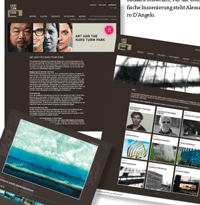
Hardturm AG, which is responsible for the development of the "Hard Turm Park" development in Zurich-West, is presenting a new facet of its cultural commitment under the title "Art and the Hard Turm Park". What began in the 1990s with Limmatwest is now reflected in its support for the public art exhibition "Art and the City" with its 43 works from all over the world. The linchpin of "Art and the Hard Turm Park" is the website, which was integrated into the gate www.hardturmpark.ch already realized by The House Agency. The concept and text are by Richard Schweizer, while Alessandro D'Angelo is responsible for the photographic staging. pan

kunstsommer
 

Advertising like in the Wild West, but used in a more targeted way

SFLB, a "classic" agency, was the winner of the Swiss Dialog Marketing Award. Awards were presented to 29 entries in 12 categories.

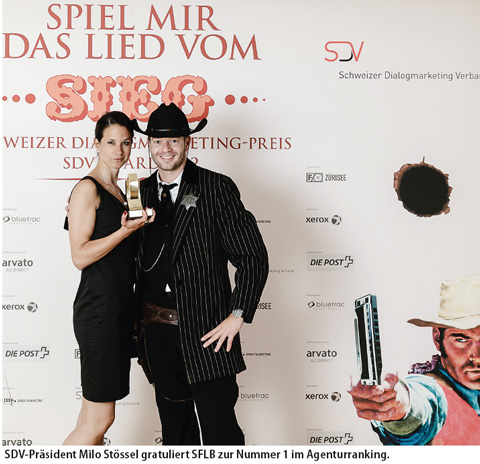
Spillman Felser Leo Burnett were able to leave the festive saloon with the most awards in their pockets without drawing their revolvers: three gold awards, two silver and one platinum. With a total score of 24 points, SFLB left the other agencies far behind. Platinum award winner and thus the best work of the year "WOZ - Werbung stört!" (WOZ - Advertising disturbs!) impressed with its unique idea. As a newspaper that does not advertise, WOZ is dependent on other sources of income. Spillmann Felser Leo Burnett came up with the surprising solution of avoiding advertising by reading between the lines of advertising messages to find out how annoying they can be. Avoiding advertising with advertising sounds like a high-noon, but in addition to the platinum prize, it was also worth gold to the jury in the "Addressed mailings" category. In the agency ranking, Jung von Matt/Limmat followed eleven points behind the first-placed agency. Three of their works were awarded silver in the categories "Integrated Dialogue Campaigns" and "Digital Dialogue Measures". The "Graubünden Obermutten" campaign was worth a gold award to the jury. Agentur am Flughafen came third in the agency ranking with a total score of 11 points. In addition to the audience award, it won bronze in the categories "Addressed mailings up to 250 copies" and "Production" and silver in the "Ambient" category.

In the "Art Direction" and "Dialogue Strategies" categories, the jury searched in vain for winners of one of the three precious metals and did not award any prizes. But there were special awards. In keeping with the rugged Wild West, the agency at the airport scooped the AZ Direct Audience Award with its "Pigskin Tattoo Poster" for the tattoo convention. Luca Schneider and Sebastian Eppler deservedly received the SDV Junior Award and thus set the theme for the upcoming SDV Award with their work "The DM Games are open". pan

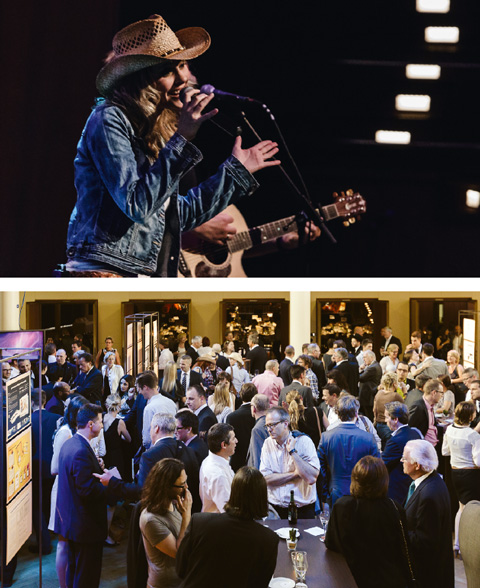
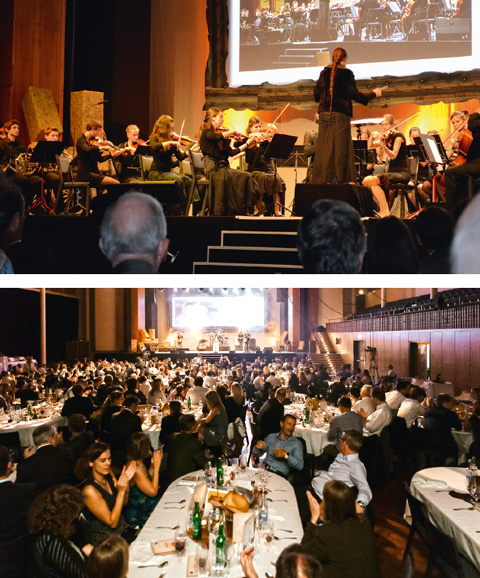
Highnoon On June 22, 2012, the Kongresshaus Zurich was transformed into a Western landscape for the SDV Awards ceremony under the motto "Play me the song of victory". A total of 29 entries were honored in 12 categories. With the award-winning work, the Swiss Dialog Marketing Association was able to convincingly demonstrate that the divide between traditional advertising and dialog marketing, which has been "cultivated" over the years, is not actually that deep. The classic agencies definitely came out on top in the agency ranking. The impression pictures show the winners, the show acts Zürcher Jugendorchester and Tinka Belle, the presenter Melanie Winiger with jury president Christian Huldi. The main sponsor of the event was Post Mail, represented by Jan Remmert.

sdmp01
sdmp02
sdmp03
sdmp03.jp4_
 

"It's nice to have you on the phone personally, Mr. Butz..."

My wife calls these telemarketers «potbellied pigs.» I don’t know why, but the expression fits. By Theophil Butz.

What this is about: There are many types of advertising, from word-of-mouth to this newfangled telemarketing.Much of this advertising, as you can tell from my rants, is bad advertising. The worst and most annoying, however, is, in my opinion, these telemarketing calls from companies that have no distinct identity and no unique selling proposition.

Today, for example, I witnessed a wine shop trying for ten minutes to talk the owner of Ristorante Madonna in Zurich (highly recommended, by the way) into buying an absolutely bargain-priced wine. Four times, Ivan politely explained to the lady that he already had all the wines he needed for his Italian cuisine in his wine cellar. I could hear the whole rambling conversation through the speaker. Ivan repeatedly said he was in a meeting and didn’t need anything. The woman on the other end then added, «But we also have an excellent rosé at an exceptional price.» Nonsense.

I feel sorry for these telemarketers. They have to sell something—anything—come hell or high water. A revolutionary insurance plan—and if that doesn’t work, maybe a “super trial” subscription. A friend told me that his daughter took this apparently well-paying job, but quit after two weeks for moral and ethical reasons.

My theory: There must be some people who were called either at eight in the morning or after eight in the evening and let themselves be «sweet-talked,» otherwise this worst kind of advertising wouldn’t work. But what a negative image this leaves for the company. The day before yesterday, a woman from Nespresso with a Valais dialect called me to ask about my satisfaction after my coffee machine had been in for repairs. The repair went perfectly, but it was completed over two months ago. The lady couldn’t explain what she was actually trying to sell me, so I politely cut her off. And yet, a «Tolggen» still remains in the Nespresso customer record. I could list countless such «potbellied pig» conversations here. Just one more, this one to my wife: «Dear Mrs. Theophil, we have…». Two weeks later, the same lady: «Dear Mrs. Theophil…». My wife: «My name is Butz, Gottfried Stutz.».

You can overlook an ugly, incomprehensible poster, a silly TV commercial, or a sales flyer, but these annoying phone calls are an outrage. My standout of the week is the Wakudoki campaign for Toyota. Hey, buddy, don't even think about it.

Theophil Butz, once a star advertiser (Ringier), now an inspirer and, as of now, a mothballer. "Not an easy role, but a necessary one, which I perform here every fortnight." Please send any relevant information to [email protected].
 

Fighting email spies in flagrante

Emails can be easily intercepted. That's why In Flagranti recommends Inca Mail's encryption service.

The agency communicates the benefits of IncaMail by addressing the risk of being spied on and its possible consequences such as financial damage, loss of reputation and imprisonment. To this end, it presents IncaMail as the solution. According to the agency, this easy-to-use service from Swiss Post protects e-mails so well that even documents previously sent by post can be sent confidentially, quickly and cost-effectively by e-mail.
Advertising is done with advertisements, factsheets, interactive banners, an adapted subsite on Post.ch/incamail and a linked Landing page.
 

To the point: Beautiful language

The Federal Office of Communications (OFCOM) recently published a representative survey designed to provide information on the audience's assessment of programming quality.

The surveys were conducted last fall and in the spring by the Institute of Mass Communication and Media Research at the University of Zurich (IPMZ). The findings are based on representative samples of around 3,600 telephone interviews each in 18 regions of Switzerland.

Original press release: "The majority of the audience is fairly or even very satisfied with the programs of public and private radio in Switzerland. In a media comparison, radio, with around 70 percent very and fairly satisfied audiences, performs better than television, with 55 percent. And significantly more are satisfied with SRG radio programs (70 percent) than with private radio (55 percent). However, while satisfaction with SRG radio programming has improved slightly over the past three years, satisfaction with private radio providers has worsened."

The IPMZ presentation summarizes: Two-thirds and more rate SRG offerings as: professional, credible, responsible, credible and they consider the information to be substantial. In a system comparison, the SRG is superior overall and (what a surprising, somewhat revolutionary finding!) the local reference is the domain of the local-regional stations. When the results are analyzed in detail, these statements are put into perspective, because the differences are actually extremely small. Across all items, the difference between the private stations and the SRG programs is just minus 0.3 points for TV and minus 0.2 points for radio. You can read the details on Werbewoche. ch.

Both the SRG television and radio programs should perform much better with the much larger budget available to them. But they don't, so it's not surprising that SFR's market share is falling and that a considerable number of viewers watch ARD or ZDF during the European Championship soccer broadcasts. And thus avoids the preachy Swiss commentators. The results should actually be a slap in the face for SRG. But it always depends on how you sell them.

Incidentally, the survey cost more than a quarter of a million francs. For nothing!

Pierre C. Meier, Editor-in-Chief
[email protected]
 

New Head of Group Communications at Alpiq

Adrienne Develey has recently taken over as head of Group Communications at the Alpiq Group. She succeeds Christina Meier, who has been leading Group Communications on an interim basis since Martin Bahnmüller’s departure.

At the beginning of September, Adrienne Develey will move from Novartis to Alpiq and take over as Head of Group Communications. In her previous position, she was responsible for external and internal communications at Novartis Pharma Switzerland, based in Berne. The 40-year-old from Basel has a degree in marketing and communications management. Adrienne Develey completed her studies in modern general history and English language and literature with a licentiate and a teaching diploma at grammar school level.
 

get_footer();