Panalpina's international magazine Connect

Panalpina has a lot to share about transportation, logistics, and supply chain services across the globe. The content is substantial, and the narrative style is intelligent and fosters cross-cultural connections.

What could be more obvious for one of the world's leading providers of supply chain solutions than to focus on journalistic storytelling? There are more than enough interesting B2B stories from the Panalpina world about intercontinental air and ocean freight transportation, comprehensive, value-generating logistics and supply chain services. Panalpina has reactivated its international customer magazine and, together with Primafila AG (concept, editing, design and production), has taken up the narrative thread again. In the first issue of the magazine, which has just been published twice a year in four languages, the China correspondent from the Primafila network has focused on the peculiarities of intra-Asian transportation. The reader learns what happens at the border crossing and how the market in this region is developing. In addition to vivid stories, international logistics luminaries have their say in Connect, such as Professor Fangruo Chen in New York as an expert in supply chain management in China, and complex innovations are explained in an easily understandable way. Regions, continents and specialist areas as well as the knowledge of experts are combined in the Panalpina magazine - the magazine's name says it all.


The Living Energy magazine on iPad

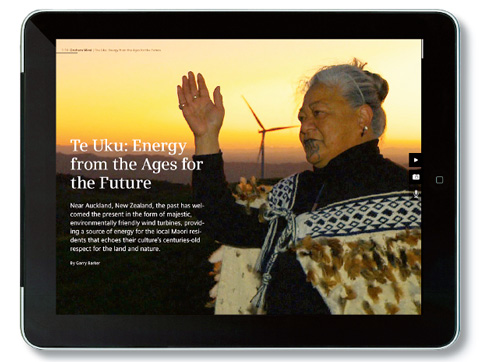
Siemens Energy's customer magazine, Living Energy, is now also available as an app for the iPad.

The target group and readership of Living Energy are international top management from business, politics, science and associations in the energy sector. The journalistically sophisticated magazine has been published twice a year since 2009 and reaches 10,000 recipients in more than 120 countries. The app supplements the articles in the printed version, for example with additional audio or video interviews and statements, photo albums, graphic animations and e-dossiers. Great importance is attached to clear and simple reader guidance. The layout is specially adapted to the iPad display. The various topics are each managed by a journalistic and editorial team. Example: Correspondent and filmmaker from the international Primafila network are on assignment in New Zealand at the wind farm opening (picture: ceremony, singing Maori woman). Primafila, Independent Medien-Design (Munich) and Kochan & Partner (Munich) are developing the app together with and for Siemens Energy. The app version can be downloaded free of charge from the Apple App Store.

ipad
 

Switzerland's only raw material

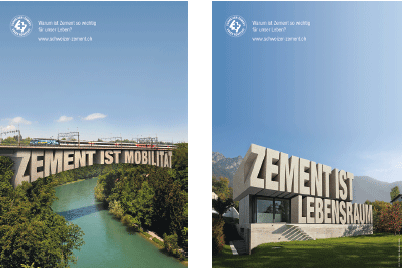
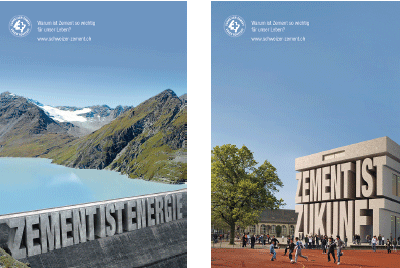
Farner was commissioned by the Swiss cement industry to launch a national information and awareness campaign to highlight the fundamental importance of Swiss cement production.

Cement plays an extremely thankless role in everyday life. It is omnipresent, used and applied everywhere. It plays a vital role in every highly civilized society in the truest sense of the word, but it goes unnoticed. Farner developed a campaign idea for Cemsuisse, the Swiss cement industry association, that turns the tables conceptually: whatever you can imagine in Switzerland, cement makes it possible because it is so versatile. And cement is available exactly where it is needed. It is Switzerland's only real raw material, invisible but omnipresent and underestimated in its ecological importance. The campaign will run for two years. Advertisements, posters and the Schweizerzement. ch website will be flanked by other targeted communication measures to continuously raise awareness of the raw material and provide answers to the question of why cement in particular is so important to our everyday lives. pan

zement1
zement2

"Raise the flag for the dual education system!"

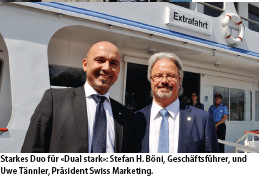
Elected for a third term of office, determined to grow and with a drive for practical training: The old and new Swiss Marketing President Uwe Tännler talks about the major topics of the number one organization in Swiss marketing.

On a sunny extra trip into the future: when 71 Swiss Marketing delegates with voting rights met on Friday, June 15, they did so on board the MS Europa on Lake Lucerne. The delegates' meeting set sail from the KKL Lucerne - and returned with a new Board of Directors after an atmospheric cruise with approved figures and successful general elections. Immediately afterwards, Uwe Tännler took the time to talk about the future. The Swiss Marketing President did so in his usual clear manner, without sweeping problems under the carpet, but also in the way that every good captain sets sail: Full of confidence, because the crew, engine room and motivation are in good shape.

Mr. Tännler, three years ago the Swiss Marketing delegates met on the Jungfraujoch, this time on Lake Lucerne. How can this symbolism be interpreted?

Uwe Tännler: Three years ago, the Top of Europe was exactly the right place for the Swiss Marketing Delegates Assembly in terms of symbolism. It was the time when we were able to go live with the European Certificate, which makes Swiss educational qualifications explainable throughout Europe. We could look back on the successful No. 1 campaign, had secure finances and were certain that the Swiss Marketing Day had established itself as the most important marketing event in Switzerland with the presentation of the Marketing Trophy in the KKL Lucerne. Swiss Marketing had reached a new peak at that time.

The 2012 Delegates' Assembly was now held on the lake. To stick with the symbolism: What new shores are you, Swiss Marketing, heading for?

The Cruise's motto for the next three years is: "Fly the flag for the dual education system! " We need to achieve an even better perception of our certificates and diplomas. Or, in the language of marketers: we need to strengthen the Swiss Marketing brand.

More marketing for Swiss Marketing?

Yes, you could say that.

Which tools from the classic marketing mix would have to be used for this?

We are probably talking about the "P" for promotion here. However, not so much by means of a campaign via traditional or new media, but by influencing all circles that come into contact with our concepts. In other words, with organizations in the business world, such as Economiesuisse or KV, but also with leading figures in HR departments. We have to call out to young talents who have just successfully completed their commercial apprenticeship: 'Don't wait until you do your MBA, but take the logical intermediate steps. Take the dual path, enter further training to become a marketing or sales specialist'. At the next level up, we are currently experiencing competition from the Executive MBA, where we need to ensure that we position our sales and marketing management training courses even better.

Where do you locate the target group among end customers?

These are the twenty somethings who are hungry for more after their apprenticeship. Talents who were born after 1990 and want to acquire more knowledge, a better network and the know-how power for everyday life with adequate further training. Young people who, thanks to Swiss Marketing, are being trained to become true practitioners.

Flying the flag for the dual education system - is this a task for Swiss Marketing alone in the area of marketing and sales?

I think this should be a team effort - we need to communicate the benefits of our education system more with the professional associations that are also members of our examination boards. Together with the sponsoring associations, we can make our presence felt on a broad front and thus achieve more.

How is the current economic situation affecting participants in the major Swiss Marketing examinations?

The economy is experiencing uncertain times; in many places, bosses are trying to save the year. For Swiss Marketing, this means a slight decline in the number of candidates at a high level. Specialists are in demand - but company bosses and HR people often don't even know what to look for.

What do you mean in concrete terms?

As a recruitment agency, I know many cases where, for example, a smaller SME is looking for a sole secretary. The job specification then includes things like sales promotion, writing advertising copy, professional handling of social media. The head of recruitment should already know that they are looking for a marketing specialist and should state this in the advertisement.

A new internal distribution formula for membership fees was decided at the Delegates' Meeting; in future, the regional clubs will benefit more. What does this mean?

Naturally, life outside takes place in the regional clubs. If more funds are now flowing to them, it is to be hoped that this will also manifest itself in additional growth in membership. There is potential for this in the regional clubs.

What is the division of responsibilities between regional clubs and the head office in Olten?

Networking and know-how transfer should be practiced in the regional clubs. This is the front line, so to speak. As the headquarters of the umbrella organization, Olten sets the direction and negotiates with the Federal Office for Professional Education and Technology OPET, for example. But what is even more important is that Swiss Marketing should gain sympathizers and fans, who will then become members. Members for the number one in Swiss marketing.

Stefan H. Böni, the new Managing Director of Swiss Marketing, made his first appearance at this delegates' meeting. Why was this new post created?

Until now, the Swiss Marketing Head Office in Olten has been managed by two divisional heads, the Head of Examinations and his counterpart in terms of the association. But the two areas have actually long been intertwined: examination candidates are members, members are examination candidates. It was therefore the right decision to hand over both areas to one managing director.

How do your tasks differ from those of the new Managing Director?

Quite simply: Stefan H. Böni leads the association internally, operationally. I represent Swiss Marketing externally, strategically. Which, even more simply, means that we both stand for the clout of Swiss Marketing. Andreas Güntert

Unbenannt-8_13
 

New job portal for the IT industry

The specialized online job market for the media and communications industry Medienjobs.ch and the online newspaper Inside-it.ch, which specializes in IT, are joining forces. They are jointly launching Ictjobs.ch today, Thursday.

Ictjobs.ch is an IT job portal independent of recruitment agencies for specialists and managers as well as employers from all areas of IT and telecommunications, from IT management to consulting, software development, system engineering/system integration, system/network technology/security/VoiP, support/IT services to web publishing and web design. The job offers from Ictjobs.ch are also available on Inside-it.ch integrated as a separate service section. In addition, the vacancies are also published on Mediajobs.ch pictured.

As with Medienjobs.ch, the "QualiProfil" applicant search is at the heart of the service. This service is aimed at companies and specialists from all fields of activity and compares the qualifications of an applicant with the requirements of the vacancy. If there is a sufficient match, the job seeker is automatically informed of the new job advertisement by e-mail. According to a Medienjobs press release, this accuracy means that even people who are not actively looking for a job will receive valuable feedback from the job market. However, the job offers in the individual occupational groups can also be subscribed to via separate RSS and Twitter channels without a "QualiProfil" job search subscription. A specific matrix was created for "QualiProfil" in collaboration with IT specialists from associations, authorities, administrations and software companies. Within this matrix, a company can search specifically by occupational group, function, industry experience, management level, training/continuing education and technology knowledge up to certificate level.

The platform will be operated by Zurich-based specialist publisher DPI Publishing Service, which also publishes the specialist portal Mediaforum.ch and the digital media magazine Medienwoche.ch. The aim of the joint venture is to combine the knowledge and experience of two independent, specialized companies, according to the press release. The people at Inside-it.ch know the Swiss ICT sector inside out, while Medienjobs.ch has shown how an industry-specific job portal can create added value for professionals and companies.
 

Goldbach Interactive: Social Media Monitoring Tool Report 2012

Goldbach Interactive has been working on an analysis of social media monitoring tools over the past weeks and months. The result is the current Social Media Monitoring Tool Report 2012 - including an infographic.

For the third time, Goldbach Interactive publishes an overview of the most important social media monitoring tools. In this year's report, the most important results are additionally presented in the form of an infographic. This can also be viewed on Goldbachinteractive.com can be downloaded.

This year, 18 out of 200 tools were particularly convincing, Goldbach Interacitve said in a statement. These were therefore examined in detail. The report lists the strengths and weaknesses of the individual tools and thus offers an overview in the jungle of monitoring providers. The term "monitoring tools" no longer does justice to many providers, as more and more functions are being offered, the report continues. The tools continue to develop in the direction of Customer Relationship Management (CRM) and partly enable the integration of existing CRM systems. Furthermore, the providers offer increasingly better engagement and deliver more diverse insights through reporting and analytics functions.
 

Cavegnwerbung calls for Edi.12

Every year, the Edi.—the Swiss award for commissioned and advertising films—is presented. Cavegnwerbung promoted the Edi.12 in the style of past campaigns.

This year's application for the Edi. also emphasizes that it is the official award for Swiss filmmaking. According to the agency, anyone who wins an Edi. is honored by a top-class jury and can also receive a certificate signed by the Federal Council in addition to the trophy, and relies on the look and language of federal elections to stage this.

Flyers and internet banners were therefore designed and written like official ballot papers, with a self-deprecating touch and a lot of humor. The envelopes were specially designed and printed on appropriate paper to give them an official character. In this way, the meaning of Edi.12 should be clear from the outset: "A lot is at stake".

Responsible at Swissfilm Association: Rita Kovacs (responsible for communications). Responsible at Cavegnwerbung: Markus Cavegn (art direction), Sarah Hepp (graphics).

Last but not least: Human rights online - China speaks out

Human rights, particularly the right to freedom of expression, must also be protected on the Internet. For this reason, the UN Human Rights Council tacitly adopted a resolution on the right to freedom of expression on the Internet on Thursday in Geneva.

The resolution on the protection of human rights on the Internet calls on all states to promote access to the Internet and to strengthen international cooperation for the development of media and communication in all countries. According to SDA, the text states that human rights apply regardless of the medium or national borders. It is supported by 83 states. Although Cuba had reservations about the text, it did not oppose the resolution.

China had taken the floor during the negotiations to endorse the resolution. The fact that China even took the floor or joined the resolution at all is somewhat surprising. As recently as April, two popular short message services had to block the possibility of publishing comments (Werbewoche reported: China: Internet censorship tightened after coup rumors). At the same time, 6 people were arrested for "inventing and spreading rumors". And now the great oppressor is even taking the floor to endorse a resolution that does not seek to protect people from torture, arbitrary detention or other atrocities, but supports the right to freedom of expression on the Internet.

Should we now applaud? A government that almost celebrates internet censorship, restricts the freedom of movement of foreign journalists, blocks the Xing service and has built an insurmountable internet wall. Well then, bravo China!

Second chance on the second screen

More and more often, people’s attention while watching TV is focused not on the large main screen but on mobile devices—this presents new opportunities and challenges.

Those who are not familiar with the second screen phenomenon from their own experience can rely on figures about its prevalence. The "Media of the Future 2017" study commissioned by Publisuisse showed that 37% of study participants also use the internet several times a week or every day while watching television. And according to a survey by the market research company Nielsen, 40% of Americans and Brits who own a smartphone or tablet use it once or several times a day while watching TV, compared to 20% of Germans and 30% of Italians.

In addition to smart TV (see Werbewoche 10/2012, p. 24) and catch-up TV (see Werbewoche 12/2012, p. 27), second screen is another trend that is eroding the actual reach of TV advertising. The audience may be gathered in front of the TV, but their attention is often elsewhere. According to another Nielsen survey, 61% check their emails and 34% check sports results during a program. However, the connection to television is not completely lost: 37% searched for information in connection with the current program. The fact that 27% searched for relevant product information following TV commercials shows the potential for commercial communication. And the fact that 22% searched for coupons or special offers shows where the use of second-screen advertising can be used. It is also interesting to note that visiting social media sites during the program (47 %) and during commercial breaks (45 %) remains attractive.

This development in consumer behavior cannot be ignored. The opportunity to find new ways to reach audiences, to inspire them and to market the newly acquired advertising inventory has given rise to a number of start-ups, especially in the USA. There are social networks specifically geared towards television, social program guides and services to find suitable programs as well as applications for the remote control. There are services (often as white labels for broadcasters) for checking in to programs, discussing them, collecting points and providers that create special second-screen content and corresponding advertising, as well as social TV analytics service providers, for example for the distribution of second-screen content.

The second screen business is currently the Wild West of the TV industry - many are trying their luck, but only a few will make ends meet and get off to a good start. The reason for this is quickly clear: hardly any consumer wants to deal with countless apps on their second screen - which is why a relatively rapid consolidation is to be expected. Cross-channel second-screen platforms will emerge that combine various activities, differentiate themselves from one another with different features and thus compete for the favor of customers and consumers. So that users do not have to constantly click again, but instead receive new content on the second screen in sync with the action on the main screen, some second-screen advertising networks use technology to recognize the current program via the microphone or camera of the second screen (so-called audio/video fingerprinting). Because second-screen devices are often extremely personal objects, consumers can be targeted in the same way as with online advertising.

The second screen phenomenon gives broadcasters in particular a second chance to defend themselves against revenue losses fueled by other trends such as smart TV and catch-up TV. Two obvious use cases are news and sports: an app on a second screen platform can provide additional information: Additional maps to news events, selected links to further information or statistics and athlete portraits. At the end of February, RTS television in French-speaking Switzerland launched a second-screen pilot of this kind for the main edition of the Tagesschau, which has now been discontinued during the summer (http://info.rts. ch/2eecran/). In future, TV shows will be developed with two parallel storylines, one for the main screen and one for the second screen. Here, the protagonists can interact directly with the audience ("Should I go out with Ben or Greg?"). Extraordinary text passages can be displayed for sharing via social media, or there are references to the current soundtrack (including a download link). In this way, advertising messages ("I love my red dress - get it here now!") can be distributed free of restrictions (such as product placement). Mobile coupons (see Werbewoche 8/2012, p. 36) can be distributed in parallel to TV commercials via apps, which not only increases brand loyalty but also makes the actual success of the advertising directly measurable when redeemed.

When it comes to the application of such practices in our country, the hurdles are immediately apparent: Are the costs of creating parallel content for the second screen worthwhile in our mini-markets? How can parallel content for purchased programs still be put to good use after they have been distributed in our original market (if the red dress mentioned above is not available in our country and is now completely démodé anyway)? The solution: TV shows are planned from the outset for simultaneous international distribution, including integrated merchandising via a dedicated e-commerce channel.

The approaches described here for TV advertising on the second screen are still hardly widespread in Germany - with one exception: web TV services such as Wilmaa or Zattoo offer program-related interaction options, even if these do not take place on a second screen. A good example is the European Football Championship: Wilmaa offered live tickers, competitions with live, historical or fun questions as well as team voting, and users could share content via Facebook and Twitter. This is at least a first step towards conquering the second-screen market, and it will be interesting to see who will position themselves and how in the near future: Will it be the heavyweights from overseas or neighboring countries who will also be able to establish themselves here, or will there be domestic companies who will be able to win this market for themselves? Will there be an EU-sponsored initiative and/or one (or more) Swiss specialty companies?

Christoph J. Walther

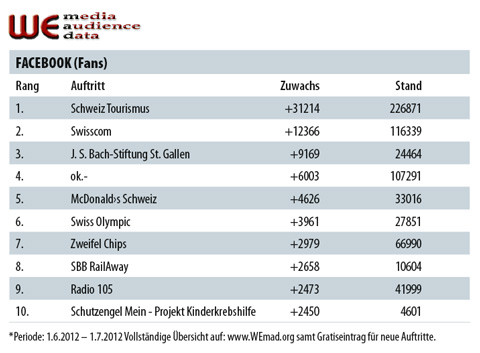
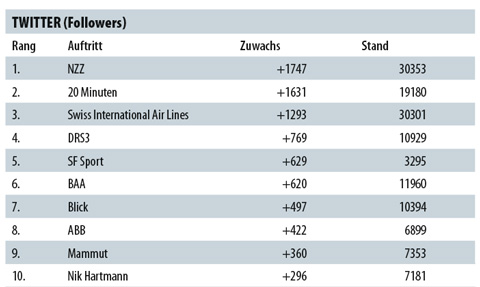
The current social media high-flyers
Who gained the most in the social media hit parade on WEmad.org in June*.

fb
tw
 

International input: Follow the Pictonauts

TBS Identity has launched an art project to support communications for the Zurich Theater Spektakel.

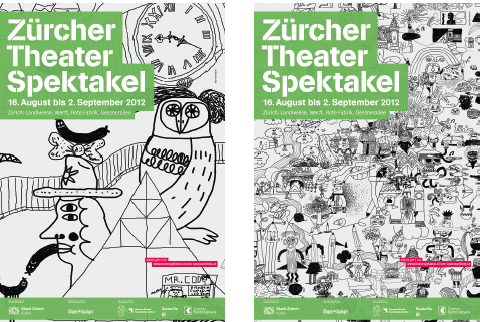
For this year's Zürcher Theater Spektakel, the Zurich-based communications and design agency TBS Identity suggested something special to the festival management: For once, the campaign motif for the international gathering of independent theaters on Zurich's "Landiwiese" was to be created as part of a specially launched art project. On the website www.pictonauts.theaterspektakel.ch, illustrators from all over the world created a work of art together. Yuka Katagiri from Tokyo, Stefan Marx from Hamburg, Marcus Oakley from London and Beni Bischof from St. Gallen made the start. The four of them met virtually on the Pictonauts platform for two weeks in March and each drew a single intercontinental illustration, which will serve as visual recognition of the 2012 festival in various media. In a second phase, the four Pictonauts invited artist friends to join them in drawing, who in turn invited their drawing friends, and so on. The art then became the visuals for the campaign. pan

theater1
theater2

Trendcommerce Group: Reorganization of the company structure

The St. Gallen-based Trendcommerce Group is reorganizing its corporate structure in response to strong growth. Trendcommerce acquired the operations of Print One Digitaldruck effective July 1, 2012.

The name change is part of the new brand strategy. The goal is to strengthen the Trendcommerce umbrella brand even more, according to a company statement. In addition to strengthening the umbrella brand and creating a uniform market presence, the name change also streamlines the corporate structure within the Trendcommerce Group. The reorganization will have no impact on the existing range of services, capacity and quality of work, says Oliver P. Künzler, commercial director, founder and co-owner of the Trendcommerce Group. The big move to the Group's new company domicile in the west of the city of St. Gallen will take place in the fall of this year.
 

Digital Drive: CP in the fast lane

Corporate publishing continues to gain momentum. Digital corporate media are clearly the key drivers of this growth. The new Basic Study III, conducted by the market research and strategy consulting firm Zehnvier on behalf of the European Institute for Corporate Publishing, shows that three trends in particular are shaping the CP market.

Compared to 2010, CP investments in German-speaking countries have risen by 6%. This year, companies in Germany, Austria and Switzerland will invest around 5.7 billion Swiss francs in corporate media. The CP landscape is characterized by three trends.

Digital Drive. Around 3.4 billion Swiss francs - roughly the same amount as in 2010 - will be invested in print media this year. Magazines, annual reports and corporate books therefore continue to be attractive means of communication. However, the growth drivers are digital corporate media, from social media to videos and apps. Compared to 2010, investments in the digital sector have increased by more than 20 percent to around 2.3 billion Swiss francs. This means that 40 percent of CP investments are already in this area. The digital momentum looks set to continue in the future: 65% of companies intend to further increase their investments in digital corporate media.

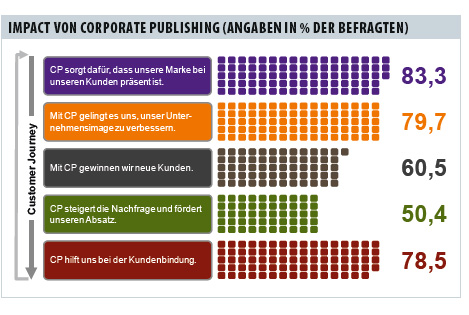
Content & Commerce. CP is increasingly gaining momentum along the entire customer journey. Corporate media continue to contribute to brand presence (mention by 83% of companies), to improving the corporate image (80%) and to strengthening customer loyalty (79%). At the same time, their influence on customers' purchasing decisions is growing. Even now, 61 percent of companies are convinced that they can win new customers with CP, and 50 percent believe that CP increases demand and promotes sales. Digital corporate media in particular offer additional opportunities to support sales with high-quality journalistic content. For example, 41% of companies that use content apps have already linked their apps to shopping systems.

Relevance. Corporate publishing is one of the most important communication disciplines today. This is clearly demonstrated by the fact that 76% of study participants consider CP to be just as relevant a communication tool as traditional advertising or PR. Four out of ten companies in German-speaking countries have already reallocated budgets from traditional advertising to CP in the last two years. The future looks set to see a further increase in the importance of corporate publishing, with 38 percent of companies planning to shift budgets from traditional advertising to corporate media in the future. Clemens Koob

impact
get_footer();