Wunderman makes Facebook shine

Wunderman has created a contest for Beads4You and the World Tour Festival. Trollbeads are going on a world tour. For everyone who wants to experience the World Tour Festival with Beads4You, Wunderman has launched a Facebook contest.

Pearl fans can win two of their favorite country beads worth 100 Swiss francs. Those who want to participate have to choose their most beautiful destination from 12 World Tour countries. As an extra surprise, all participants will be rewarded with a Beads4You shopping voucher worth 10 Swiss francs. The competition is still running - if you want to take a look at the entire World Tour collection, browse the online store at Beads4You.ch or directly at the Trollbeads store in Rapperswil.

Responsible at Beads4You: Jessica Paul. Responsible at Wunderman: Julia Miller (Design), Oliver Läubli (Programming), Sonja Wyss (Consulting).
 

Communication planner course completed

At the KV Luzern Vocational Academy, 80 communications planners received their federal professional certification, seven of whom were students at the KV Luzern Vocational Academy.

Over three semesters, the students were taught integrated communication planning, production, media planning, direct marketing, sales promotion and the organization of PR, event and sponsorship projects. On Friday, July 6, 2012, they will receive their diplomas in Zurich. Across Switzerland, 69 percent of graduates received their federal diploma.

Koch Communication takes a vacation in Thurgau

In a competitive pitch, Koch Kommunikation prevailed over two other agencies. The agency will now manage Thurgau Tourism’s core campaign for the years 2013–2015.

According to Monika Grünenfelder, Managing Director of Thurgau Tourism, the surprising and broad communication platform and the good cross-media integration were particularly convincing. The first works will already be on display in January 2013.
 

Neutral realized continuation of Bally Love

Neutral has designed a new campaign for Bally. As a follow-up to the Bally Love #1 capsule collection featuring Philippe Decrauzat, Neutral has brought New York-based Schaffhausen artist Olaf Breuning on board with Bally.

The result is a collection of shoes, bags and accessories that Breuning counterpoints with colorized bodies. The Bally Love #2 collection was launched at Art Basel Miami Beach in December 2011, and the artifacts have been in select Bally flagship stores since April, the agency said in a statement Friday. The Breuning influence continues, with sculptural window displays representing his inimitable dilettantism.

Responsible at Bally: Victoria Hennessy (Marketing Director), Francesca Nicol (Event Manager), Silvia Pavan (PR). Responsible at Neutral: Michelle Nicol, Rudolph Schürmann (overall responsibility), Peter von Ah (art direction), Pascal Hurschler, Sandra Oehy (consulting).

Olaf_Breuning_300x170
Olaf Breuning

Canton of Zurich relies more on the Internet for its official gazette

Since July 1, the Official Gazette of the Canton of Zurich has been published in a completely new format at Amtsblatt.zh.ch. Zurich is the first canton to collaborate closely with the State Secretariat for Economic Affairs (SECO) on this project and to model its publication on the Swiss Official Gazette of Commerce (SHAB).

The official publications will continue to appear weekly in printed form, and the Official Gazette will - by law - continue to be made available to restaurants free of charge. However, the definitive version is the electronic edition. Although the Official Gazette has been available on the Internet since 1998, the functionality of the online edition has been limited and not very user-friendly until now, as State Secretary Beat Husi told the media on Friday.

First the newspaper was produced and then - as a kind of "waste product", as Husi put it - the newspaper was put online in two PDF documents. The production process has now been reversed. The reports are entered directly on screen by the approximately 1000 reporting offices of cantonal and communal administrative units, courts and notary's offices according to standardized criteria and released for publication. Instead of a line price, a unit price of CHF 30 is charged per report - regardless of whether it comprises two lines or two pages.

Search for message via search engine
The internet edition also has clear advantages for users. For example, a free search function allows specific content to be found quickly and easily. In addition to the newspaper subscription, online subscriptions are also available for CHF 60 per year. Customized offers are automatically sent to the subscriber by e-mail.

The data transmitted from the canton of Zurich is managed by the State Secretariat for Economic Affairs (Seco). The platform on which economic information from the Schweizerisches Handelsblatt has been published for over 10 years is used. The printed edition of the Official Gazette is produced by the Bern printing center in Biel.

With the new form of production, the total operating costs can be reduced by around 15 percent, as Martin Jurt, Head of Central Services at the State Chancellery, explained. The costs for the changeover amounted to CHF 450,000 and could be amortized within two years.

Also useful for other cantons
Markus Tanner, Head of Publications at Seco, said that the use of the shab-online publication platform is sensible and possible for other cantonal gazettes. Experience with the SOGC has shown that the trade journal is now predominantly read via the Internet. A similar development can also be expected for the Zürcher Amtsblatt.

State Clerk Beat Husi does not rule out the possibility that the printed official gazette will one day disappear completely. However, the purpose of the Official Gazette will remain the same, as already described in the "Law on the Introduction of an Official Gazette" of December 18, 1833: "It should contain everything that requires a legally valid announcement". (sda)
 

Swiss Family: Jean-Claude Plüss becomes new advertising manager

Jean-Claude Plüss has taken over as head of advertising at the Schweizer Familie publishing house. In addition, his team has been rounded out with the addition of Daniel Felli and Roger Bührer.

Jean-Claude Plüss will take over as advertising market manager as of July 12, 2012. He looks back on many years of experience in the media industry and already worked in the same position at the Schweizer Familie publishing house from 2004 to 2009, according to a Tamedia release on Thursday. Plüss then served as account manager for German-speaking Switzerland at the newspaper Le Temps and, from 2010, as head of the advertising market at Weltwoche.

At the same time, the two vacancies in the area sales management of the Swiss family were filled. Daniel Felli started as Area Sales Manager for Western Switzerland in May 2012 and Roger Bührer is responsible for Central Switzerland and Zurich left of the Limmat from August 2012.
 

Breitling continues to climb

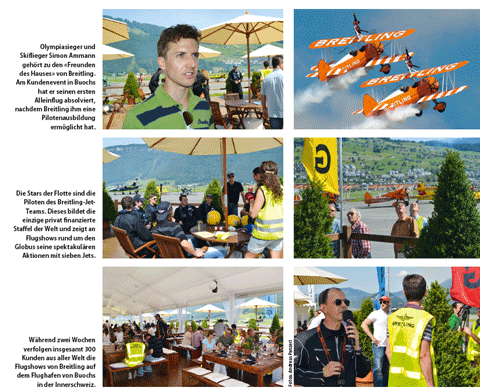
Despite the economic crisis, Breitling can look to the future with optimism. Its Swiss pilot's watches are in high demand worldwide. As a token of appreciation, the brand's top retailers have been invited to an exclusive event in Buochs.

WW: Breitling is considered the epitome of the pilot's watch: How did this image come about?
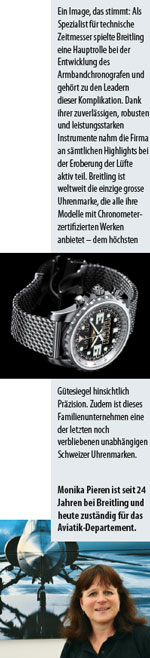
Monika Pieren: This goes back to the founders of the company. Léon Breitling and his successors did not want to limit themselves to the production of conventional watches in their first factory, which formed the basis for today's company in St. Imier in 1884. Léon Breitling specialized in chronographs from the very beginning. When, in parallel with the development of the company, the aviation industry also celebrated its first successes, from 1903 onwards, these aviation pioneers also needed reliable instruments. In his second factory in La Chaux-de-Fonds, Léon Breitling discovered this gap in the market and began producing technical instruments for pilots and navigators. At that time, aircraft technology was not yet so advanced and pilots had to rely on and depend on their wrist instruments. Since those pioneering days, we at Breitling have been associated with aviation and continue to equip pilots with our watches - both civilian and military pilots. This is also a testing ground for us and helps us to make our products even more reliable.

So Breitling has grown with the needs of aviation?
Throughout the history of aviation, Breitling has always endeavored and developed new technical achievements. There were products that were made especially for aviation. In the 1930s, for example, Breitling equipped the Royal Air Force with on-board instruments, and in 1962, exactly 50 years ago, Scott Carpenter was equipped with a "Cosmonaut" on his space mission. This is a model from our series of mechanical chronographs, upgraded with a slide rule. In 1995, we launched the "Emergency". This watch is equipped with a micro-transmitter that transmits on the 121.5 MHz flight emergency frequency and helps to locate missing persons in the event of an accident or aviation incident. We developed this instrument together with Dassault, the French manufacturer of civil and military aircraft. These are just three examples that clearly demonstrate the credibility and legitimacy that we have been able to develop in aviation together with our watches.

The terms pilot's watch and diver's watch are now often copied.
Every company has to know for itself what strategy it wants to pursue. Of course, there are free riders as well as brands that have their justification in these areas. However, the brand that clearly has a genuine and almost genetic connection with aviation is undoubtedly Breitling. Our history shows this impressively.

When did Breitling start using this image for marketing?
After the Second World War, it became fashionable for our chronographs for pilots to be worn on civilian wrists. The relationship with aviation was there and it was further promoted. Because we manufacture technical instruments, this is of course the perfect combination. We also have comparable values. What is aviation all about? Precision and professionalism. We are all passengers and are happy about these qualities because we want to arrive safely. And these are precisely the criteria that we have also committed ourselves to as a watch manufacturer: precise instruments - our chronometers are certified, reliable, functional and, of course, visually appealing.

What fascinates customers about pilot watches or diving watches? Nobody dives to 3000 meters?
There are two things. Flying is clear. Like here at the event in Buochs, there is probably no man who didn't want to be a pilot as a boy. Flying is a fascination. When it comes to diving - Breitling also has an anchor in its logo - nobody dives to a depth of 3,000 meters. Nevertheless, we have a watch that is still water-resistant there. The main aim here is to show that we have the technical ability and knowledge to produce watches that can withstand such pressures.

About the event: Breitling invited customers and resellers from all over the world to Buochs. A reward?
Yes, alongside the Basel Watch and Jewelry Fair, this is our most important event. A corporate event that lasts two weeks, where we invite our customers and resellers as well as selected media representatives from all over the world. The event lasts two days for each group. The first day is dedicated to flying. Here, customers can actively experience what we tell them all year round and demonstrate our close connection with aviation. Each customer can choose which aircraft from our fleet they would like to fly in. We want customers to see that Breitling builds its marketing on its story, which is truly authentic. On the second day, we travel to western Switzerland, where we present our manufactory, Breitling Chronométrie. Here, customers can see up close how our movements are developed and assembled.

How many people are invited?
About 300 customers every year. It's an exclusive event. We have 45 to 50 guests per day so that everyone can fly a little.

There are also guests from an exclusive club with celebrities?
For us, these are "friends of the house". Not celebrities that you can "buy", but successful athletes who have a great affinity with our brand. We want to say "thank you" to them for wearing our chronographs. This is the best form of advertising when these celebrities are out and about with our products and show that they have not been paid for them, but enjoy wearing our watches, some of which were given to them as gifts. In return, they are not obliged to make any further appearances in our advertising. They really are just "friends of the house".

But John Travolta, who can fly himself, is a paid figurehead?
He is also a "friend of the house" - for us, he is a pilot first and an actor second and therefore also the only ambassador. We make a little nuance there. He's the only one we use in our advertising campaign. Part of it is focused on John Travolta. We make posters and other advertising subjects with him.

What other arguments are there for marketing?
Breitling is still one of the few completely independent family-owned companies. We are 100 percent Swiss-owned, which is quite rare in the watch industry. Our entire production is not just "Swiss Made" but "Made in Switzerland". That is an important difference. All parts come from Switzerland. There are no components that come from abroad or are produced there. These are good arguments on the world market. Our most important market is America. Japan is also interesting. We are building up the Chinese market.

Which advertising agency do you work with?
No advertising agency, we do everything in-house with a few people in marketing. We may be a well-known brand, but we are a relatively small company. For PR, we work with PPR Media Relations, a subsidiary of Keystone, but only for Switzerland. The foreign media are handled by our international PR and media coordinator.

One of these PR messages shows Simon Ammann on his first solo flight. What does that mean?
As a well-known ski pilot, Simon Ammann was the godfather three years ago when our jets were freshly launched with the new black livery. Ammann joined us for the christening flight. The Olympic champion has always raved about being allowed to fly a jet. We offered him the chance to do so and subsequently we also enabled Simon to get his pilot's license. He is making his first solo flight in Buochs, the last stage before his pilot's license.

Interview: Andreas Panzeri

Unbenannt-1_15
Unbenannt-2_2


Decisions are made in milliseconds

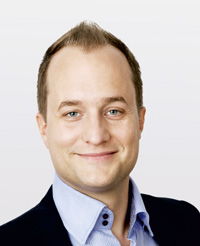
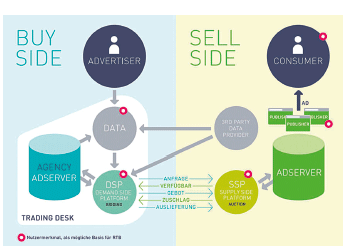
Megatrend or just hype? Everyone’s talking about «real-time bidding.» The latest approach to online advertising works like a «banner exchange.» This refers to the auction-based purchase of online ad space in real time, as Remo Prinz of Serranetga explains.

WW: Everyone is talking about real-time bidding. What are these people talking about?
Remo Prinz: This refers to the auction-based purchase of online advertising space in real time. With this new high-tech solution, the exchange between the demand and supply side - i.e. between advertisers and publishers - takes place electronically. For this to work, software systems are used on both sides: the "Demand Side Platform" (DSP) on the demand side and the "Supply Side Platform" (SSP) on the supply side. The entire process, from the request and availability check to the bid to the acceptance and delivery of the advertising material, is completed in just a few milliseconds. This is so fast that the advertising arrives in real time from the point of view of the targeted consumer. Hence the name real-time bidding, or RTB for short.

Are there also misconceptions in circulation?
We are at the beginning of an innovation cycle. It is clear that there are also misconceptions in circulation. First of all, the idea that you can jump on this bandwagon without any prior knowledge is wrong. The emerging DSPs and SSPs are wonderful tools, but you need people who can drive these innovations forward and operate the tools correctly. If you put a layman in the cockpit of a jet, it will never take off, let alone land safely. It's the same with real-time bidding. Even the selection process for the right technologies is complex and requires a great deal of prior knowledge. Only those who are prepared to invest time and money and get the right people on board to build up and expand this expertise will take off with the new technologies and perhaps even fly a loop.

How did this development come about in the first place?
Almost all websites have a lot of unused advertising inventory that cannot be sold by conventional means or through personal contact. Today, individual online advertising networks exploit this situation by bundling the inventory from different websites and turning it into "structured products" - so-called pools or channels - and selling them to advertisers. The problem for publishers is that they cede the lion's share of the margin to the network as a middleman. The problem for advertisers, on the other hand, is that they are buying a "black box" and usually have to be fobbed off with cheap clicks or low CPMs. In online advertising, however, it is not decisive how cheaply volumes or clicks are purchased. Rather, it is the quality that is decisive - i.e. the results that are measured in terms of pure clicks or visual contact. If you look at today's network products from this perspective, they are overpriced, not to say worthless, for the advertiser. This discrepancy between the supply and demand side will be eliminated by e-commerce in the future. Intermediary trading with manually bookable pools will be eliminated by electronic trading in the medium term. The emergence of demand-side and supply-side platforms will bring publishers and advertisers closer together in the context of digitization, which will ultimately optimize value creation for both. The media business is becoming increasingly dominated by technology.

What are solid arguments for real-time bidding?
In my opinion, there are three main arguments:
Firstly, the increase in efficiency compared to manual booking processes is enormous. What today takes a week or even longer - calling each individual website, negotiating, reserving, confirming the booking and sending the advertising material - happens in a few milliseconds with RTB. By way of comparison, we can hardly imagine securities changing hands on the stock exchange in the 1980s with traders shouting loudly. Today, the customer instructs the bank to buy a security, while another customer instructs his bank to sell his shares. The transaction is then carried out electronically. In the near future, online campaigns will be handled in exactly the same way. In the somewhat more distant future, this principle will apply to all forms of digital advertising.

Secondly, the return on investment of the online advertising budget used improves significantly for advertisers. Not only because the middleman is eliminated, but also because the efficiency of delivery is increased. The contact dose per user profile can now be precisely controlled across all placements. Expensive double and multiple purchases by consumers on individual placements are eliminated - the advertising finds its way to the user profile at the most economical price and in the defined contact dose. In addition, all modern targeting options can be combined with RTB. At Serranetga, the return on investment for our customers has improved many times over through the use of RTB.

Thirdly, publishers also earn more money with online advertising thanks to RTB. Their idle advertising inventory can be monetized more easily through electronic trading. In the medium term, supply-side platforms will take over what is known as yield management for publishers - in other words, they are algorithms that ensure maximum utilization of advertising inventory at the best possible prices for publishers. The potential cannibalization of premium inventory is a legitimate concern for publishers. It is therefore imperative that quality titles ensure that they set correspondingly high minimum prices for their premium products that reflect the quality of the advertising environment - including in e-commerce.

What does this mean for publishers?
The emergence of RTB is good news for small and medium-sized websites. It gives them access to the advertising market. Today, it is difficult for smaller websites to get bookings via direct sales. The manual buying and booking process makes it virtually impossible for advertisers to include smaller websites in a media plan due to a lack of resources. This is now changing. Because with the advent of RTB, they too are participating in a centralized electronic marketplace for advertising inventory. Swiss publishers should actually try to sell the unsold residual space, which makes up a large part of their advertising inventory, via an RTB system. This is because an electronic trading system could also achieve a significant increase in efficiency on the supply side. However, there is still little interest on the part of publishers. Which is a shame, because all of this money is currently flowing abroad. However, this will change at the latest when advertisers' RTB budgets skyrocket.

Who can do this in Switzerland?
Only online units with highly trained specialists can do this. It takes a lot of know-how and a certain willingness to take risks to establish a trading desk. If, for example, the ad trader inadvertently fails to restrict a booking to Switzerland, the floodgates for advertising delivery would be wide open and media costs could reach dizzying heights within minutes. As an agency, Serranetga assumes this uninsurable purchasing risk. But it was precisely for these reasons that we first invested several months in testing the technologies and training our specialists internally before we went live with the first RTB campaign. Apart from using a DSP, you also have to master other ad serving systems and program interfaces between them. Only then can a fully functioning trading desk take effect. For all these reasons, very few people in Switzerland will get it right in the foreseeable future, because dealing with RTB cannot be compared with social media, for example, where the barrier to entry for market participants is minimal.

What is currently going on in this business?
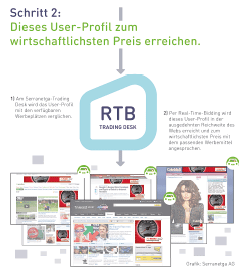
Let me explain this using a current case study: Mobiliar has set itself the goal of reducing the cost of its car insurance leads. In a first step, we created user profiles that matched the target groups as closely as possible. In a second step, we addressed this target group - in this case "women from the Zurich region who are interested in cars" - at low cost using RTB. It doesn't matter which website they are currently on.

How does Remo Prinz see the future of real-time bidding?
At the moment, RTB is mainly used for display banners and remnant spaces. Soon, however, online moving image advertising should also be booked automatically via RTB. The online marketer Stailamedia is already in the test phase for its Swiss Video Network. Everything else is still up in the air. One thing is certain: digitization will ensure that the majority of media use will be via digital channels - including newspapers, posters and television. So digitalization will not stop at media purchasing. In the future, algorithms will decide in real time and not manually working people whether a consumer is addressed at the right place and at the right time. This trend is just beginning in the area of online display advertising and will gradually spread to all digital forms of advertising in the coming years. Interview: Andreas Panzeri

prinz

Also possible for the first time: keyword-based display advertising via real-time bidding
Thanks to a new technology, advertising banners can now also be assigned to the desired environments via keywords and delivered via real-time bidding (RTB). Serranetga's trading desk is one of the first providers in Europe to use this technology. Here's how it works: a crawler searches all websites that can be accessed via RTB for the relevant keywords. If the consumer reads an article with the desired keyword, the advertising material is immediately purchased via RTB and displayed directly. This opens up completely new possibilities for advertisers: The targeting accuracy of keyword advertising and the effectiveness of images are thus linked. This is interesting for all advertisers who already use search engine advertising - the relevant keywords can be used one-to-one for display advertising.

real1
teal2
sell


Franz & René wins mandate from ACV

Following a joint pitch involving four agencies from Western and German-speaking Switzerland, Franz & René won the communications account for the ACV (Association Charcuterie Vaudoise IGP). The account begins in 2013 and runs through 2015.

The campaign will be seen nationally in 2013 in various forms of classic media, as well as in dynamic forms. This writes the agency in a statement on Thursday. The Association Charcuterie Vaudoise IGP was founded in 1997 and is an industry organization, which belongs to pork producers and sausage makers.
 

One country, one label

Anne-Friederike Heinrich, a freelance contributor to Werbewoche, on the eternal Zurich attraction to (German-speaking) Switzerland.

If someone's name is Balz Hösly, he must be right. "To be strong, you have to pool resources and knowledge," says the man who goes by this name and is also President of the (!) Greater Zurich Area (GZA). Hösly has done a bit of pooling and now wants to sell the whole of German-speaking Switzerland to foreign investors as the Greater Zurich Area. The president of the GZA is struggling to attract foreign economic power to (German-speaking) Switzerland. And since, in Hösly's opinion, there are only three Swiss brands of international renown abroad - Switzerland itself, Zurich and Geneva - everything has to come together under these three umbrellas. Sorry Lucerne! Sorry Basel! Sorry all the other cities that you think are attractive locations.

Struggle for rank

The location becomes the point of view. Which is: Zurich is the main thing! After all, Zurich is the most beautiful and largest city in Switzerland, if not the whole world. And therefore the benchmark for all things. The cantons of Glarus, Graubünden, Schwyz, Zug, Solothurn and Schaffhausen are already part of the Greater Zurich Area. It doesn't matter that this is rather "greater" and Fridolin, the Schaffhausen goat and co. are probably rolling their eyes or other body parts as a result. Regional sensitivities simply have to take a backseat to Hösly's alliances. But as I said, the man is right. After all, inside and outside are two different things. While a Swiss finds one and the same pot for Zurich, Schaffhausen and Glarus almost unbearable, Hösly's little cheating abroad is not at all dramatic. Worse still, it goes unnoticed!

After all, the foreign investors who are the declared target group of the GZA are not supposed to pass a test in Swiss local history, but simply leave a little money here. And Zurich, sorry: Zurich, simply sounds better than Glarus. So you need a sufficiently large pot, a suitable lid and the soup is cooked. Even the unspeakably un-Swiss brand name Greater Zurich Area makes it clear how Hösly's lens is set: it's all about dancing on the international stage. It's all about cash and credits. Nobody here wants to tell you what Switzerland is really like. Polyglott is simply fast. Cash is great.

Zurich is great!

Success proves them right: last year, the (!) GZA was able to attract 91 new companies with 1,200 planned jobs to the "region", i.e. Glarus, Graubünden, Schwyz, Zug, Solothurn, Schaffhausen and Zurich. If Aargau hadn't jumped ship a year and a half ago and thrown itself at Basel, there would now be white socks made in the Greater Zurich Area. That would have been something. But perhaps the "Greater Aarau Area (GAA)" will soon make it big. With Basel, Lausanne and Ticino under its roof. It's the mix that makes the difference.

The Hösly an

The bemused observer wonders whether the "Switzerland" brand would not suffice in view of the non-existent size of our little country. In any case, an investor from the USA will not understand why there is a Zurich, a Basel and a Geneva area on an area of 41,285 square kilometers - that is half the size of Lake Superior in North America. And he won't be interested either. If you live in a country 233 times the size of Switzerland, you probably can't even imagine the trench warfare in the mini-state.

A suggestion to Mr. Hösly: Couldn't the whole of Switzerland be made a Greater Zurich Area? Then we could finally bridge the cantonal divide and the divide between Switzerland and Switzerland. Or we could market Switzerland as the "Greater Swedish Area". After all, this thing with "Greater" and "Area" still sounds good, and the Americans keep confusing Sweden and Switzerland anyway. What's more, Glarus, Schaffhausen and Graubünden would certainly feel more comfortable under the umbrella of "Sweden" than under Zurich's wing. And perhaps Aargau would also be back in the mix.
 

Surprising combinations

He connects things that, at first glance, seem unrelated, and presents the result in a striking and straightforward way. A visit with Simon Hofer, grandson of Bernese advertising pioneer Max Hofer.

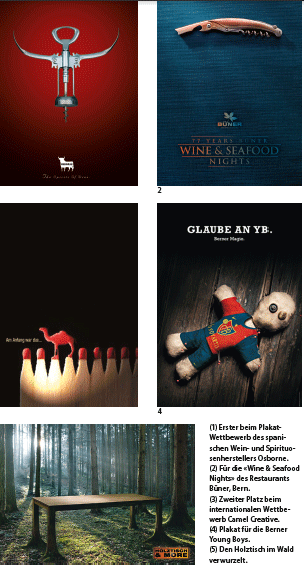
A gravel path leads to an old town house that was originally a property owned by the Bernese patrician Madame De Meuron. The façade is covered in greenery, ivy climbing upwards. The graphic designer and art director has rented space here on the first floor with his small Simon Hofer advertising agency. Drawings, illustrations and photos decorate his office and give the space a special touch. Hofer attaches great importance to welcoming his clients in a personal atmosphere. Countless photos are also stuck to the tiled stove, on whose shelf rests a large black Buddha. No one should be "processed by a smoking graphic designer" here. The creative designer takes time for his customers - especially SMEs. They come for coffee, chat in the office or on the terrace in the lounge - right next to the hammock. Visitors gain an insight into Hofer's work as soon as they enter the agency. He has hung up a selection of his work. Here is a poster for the Bernese Young Boys, there a motif that Hofer created for the Camel Creative Challenge.

Two in one

His office is decorated, but his work is tidy and straightforward. It has to be clear and simple for the graphic designer. And another line is recognizable in his works: Hofer loves to mix objects from two different contexts. For the Spanish wine and spirits producer Osborne, he has modeled the arms of a tap puller on bull horns. For the "Faith in YB" campaign, he brought football and world religions together. And for a furniture retailer, he rooted the four legs of a wooden table like tree trunks in the forest. Hofer deliberately seeks out these correspondences. For him, the appeal lies in giving things a new meaning through these connections.

When he started out under his own name in 2008, he initially still had employees on board. Now he steers his boat without a crew. The graphic designer is a lone fighter. Working independently allows him to concentrate fully on a project, to power through creative phases until the tank is empty. After that, there is sometimes a lull. Hofer's working rhythm is like an up and downhill ride, which he prefers to take on alone. Hofer works with a network of freelancers on specific projects. Often with the advertisers from Franz&René, a bilingual agency that has its office in the same building.

Not in grandfather's shoes

The Simon Hofer advertising agency is not his first self-employed project. After several years as an art director at Polyconsult and Contexta, Hofer founded the Siebensinn agency together with two partners. He finally broke away from this agency in 2008.

His grandfather, who founded the Hofer Kommunikation agency in Bern over 60 years ago, served as a source of inspiration on his path to independence. However, Hofer never got to know him in everyday professional life. By the time he finished his apprenticeship at Hofer Kommunikation, Max Hofer had already retired from advertising. Joining his grandfather's agency later on was out of the question for Simon Hofer. "That's a generational story." He wanted to leave his own mark. (Hofer Kommunikation is now managed by Reto Steiner and Daniel Scheuzger; see "Head of the week" in Werbewoche on February 17, 2012).

Loaded with ideas

What connects Simon Hofer and his grandfather is their talent as draughtsmen and illustrators. And their thirst for action.

Hofer's ideas come out of the blue. A machine gun with colored pencils as ammunition hangs on a wall in his office. "Once I have the idea in my head, it has to come out," says the graphic designer. And then it is implemented - even without an order. Like his latest idea, a product development that he is stashing safely in a corner cupboard until he finds a buyer for it. Everything is still top secret. But this much can be revealed: Hofer has remained true to his line of mixing things up in surprising ways. Isabel Imper

In a nutshell
The trained graphic designer Simon Hofer (* 1975) completed his years of training and traveling at Contexta and Polyconsult, among others. As art director at Contexta, he supported and created campaigns for clients such as Swiss Lotto, Euro Millions, Swisscom Mobile and Swisscom. In 2004, he founded his first advertising agency Siebensinn with two friends. He has been running his own business, Simon Hofer Werbeagentur, since 2008 and develops campaigns as a freelancer for the following clients: Blatter AG Keramik, Olmo Market, Musikhaus Krompholz, BMW, Swiss Red Cross, USIC and others. www.simonhofer.ch

Unbenannt-6_2
Unbenannt-7_11


Storyselling - selling stories

How WWZ, a highly diversified energy provider, uses the traditional publishing channel of its customer magazine to market digital television, a low-involvement product.

Everyone is talking about digital television, but the market is far from saturated. WWZ, Wasserwerke Zug AG, uses its customer magazine Strom (quarterly, circulation 55,000) as a market penetration tool for its telecommunications offering, in particular for digital television. The challenge is to emotionalize this purely technical sales offer by telling stories. Storyselling instead of storytelling.  
 

Innovations make stories 

Initially, the innovation cycle of digital television sets the rhythm. With four current issues, there is one story per year for digital television: Issue 2/2010 focuses on high picture resolution on the occasion of the World Cup in South Africa. Together with Xaver Stierli, former World Cup participant and team colleague of Köbi Kuhn and Karl Elsener, Infel takes the reader on a journey back to 1966, when "light" still played against "dark" at the World Cup in England. Issue 2/2010 focuses on the "smart card" innovation, which makes the set-top box superfluous. Text and images dramatize the absence of qualitative losses. A year later, interactive television still dominates WWZ's sales pitch: Infel translates the possibility of time-shifted television thanks to digital technology into the analog world with a wink. 
 

Sequential storyselling 

At the end of 2011, digital television will become even more important for WWZ. Infel increases the cadence. From now on, an article on the topic will appear in every issue of Strom. Now the stories can no longer develop along the lines of technical innovations alone. The advantages must be repeated and placed in surprising contexts. For example, Infel takes customers by the horns and portrays digital abstainers as yesterday's couch potatoes (4/2011). Or: As a free rider of the SRF's HDTV switchover campaign, Infel turns February 29 into a switchover day in a double sense (1/2012).  
 

Emotions lead to action 

Each article has its own dramaturgy and "works" as a self-contained story. But only the sum of all reading experiences leads to an overall impression of the offer. The emotionalization of the stories is important here. As we know from neurology, recipients hardly remember facts, but they do remember feelings. Donald B. Calne, Professor of Neurology at the University of British Columbia, puts it in a nutshell: "The essential difference between emotion and reason is that emotion leads to action while reason leads to conclusions." The aim of storyselling is therefore to anchor rational aspects such as technological innovations or product features in the reader's consideration set with humor, positive surprise effects and emotionally charged stories.  Matthias Bill, Martin Fritsche

get_footer();