The trick for fathers

To mark the 30th anniversary of the children’s magazine *Spick*, Künzler-based Bachmann Verlag has launched a new issue: *Big Spick*—a magazine «especially for fathers.» How is this «Spick for grown-ups» being received by its target audience? Five fathers tested the first issue for Werbewoche.

Big is the new brother of the Spick. On around 80 pages, Big Spick provides ideas on how fathers can spend time with their children in a playful and creative way. The magazine's creators rely on a mix of journalistic forms: Reports, portraits, reports, columns and interviews. For the first issue, music journalist Reto Aschwanden discussed with musicians from three children's bands how politically incorrect children's songs can be. Children's author Franz Hohler offers tips for reading aloud and telling stories.
 
Last but not least, the booklet wants to encourage fathers to "do something for their own child in the man". With excursion tips, for example: Where are there spectacular suspension bridges that you can cross on foot? With handicraft instructions: How do you build a boomerang? Or with experiments: How do you generate electricity from a few lemons? In addition, the Big Spick deals with questions of upbringing and roles. Bänz Friedli, "the nation's househusband," has written a plea for the job of househusband for the first time. And the poet Michael Stauffer plays the uncle who advises on parenting issues.
 
The layout is playful and looks partly thrown together. "Spicky, in other words. But it's not only the visual appearance of Big Spick that is reminiscent of the school magazine, but also the structure of the sections. Topics such as "Life and People" or "Nature and Us" have been relaunched. And the Spick jokes also make an appearance. And what does the target group think? Five fathers from the worlds of advertising, communications and media put the Big Spick under the microscope. The design was frequently mentioned. The interviewees also noticed that topics with a connection to daughters were missing. Is the target group primarily fathers with sons? No, says publishing director Roger Hartmann: "The Big Spick wants to address not only fathers with sons, but equally fathers with daughters." The fact that the first edition offers a lot for fathers with sons in particular was not intended. Rather, topics were selected without having realized this problem. That will be different in the next issue. Isabel Imper


Philipp Skrabal, Creative Director Wirz Werbung
 
1 son (9) and 3 daughters (8, 3, 1)
 
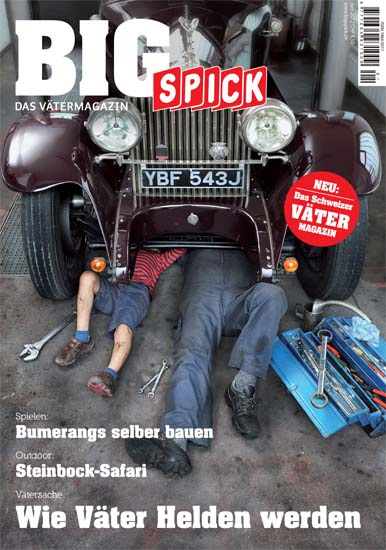
First impression: The cover art is very traditional and does not do justice to the contemporary layout inside. The cover photo is clichéd and conveys little knowledge from the real everyday life of a father.
 
Liked: I think the idea of creating a magazine for fathers is great. The first issue already proves how multi-layered the topic can be approached. It's a successful mix of tips, tricks and exciting interviews.
 
Did not like: I'm talking about me personally now: For me, a useful app would be much more exciting. Editorial content to read on the toilet, ideas and inspiration, nicely structured and thematically retrievable, for on the go. And thanks to GPS, excursion destinations and places of interest within a radius of 20 kilometers on your cell phone. But maybe it's not so stupid to switch off your cell phone!
 
Already tried a tip/trick/trip? Unfortunately, no. But I have firmly resolved to build a boomerang with my children. I've wanted to try that since I was a kid. The instructions are great. I will also do the Big Spick experiment, with electricity from the lemon, on one of the next rainy weekends.
 
What do the makers still need to hone? Certainly on the cover. Anyone who doesn't have a strong affinity for the Spick brand from their own childhood probably won't even pick up the magazine. How many fathers have an old Rolls-Royce, let alone the time for it? Does a father born in 82 even know what that is? Or wouldn't it have been better to stage father and son handling a Tesla or Twike for the photo?


Ralph Hermann, Managing Director Heads Corporate Communication
 
1 son (14) and 1 daughter (11)
 
First impression: Why didn't they come up with the idea of publishing a fathers' magazine earlier? The magazine is really well done. Even if the cover could be a bit bolder.
 
Liked: especially the high reader benefit: 39 web links to articles and 18 for leisure tips. In addition, the child in the father is not neglected: articles about classic cars, electric runabouts and other "toys for boys" show an understanding of the target group. And with "steely father-son action" (movie tip Real Steel), I'll score points with my 14-year-old son. The fathers' portraits are really worth reading.
 
Did not like: I can't do anything with the puzzle pages scattered throughout the magazine. They fit well in the Spick, but not in a fathers' magazine. Some articles don't have much to do with the target group: an article about the couple Emil and Niccel, who draw together. Would also go without. More extensively described tips instead of only short topic outlines would suit the magazine better. If Big Spick already "burns up" 18 event tips in the first number, I'm curious what will follow after the fourth number. And a lapse: As a tip the journey in the Conny country, illustrated with a jumping dolphin. At the beginning of June, you could read in the press that the dolphinarium will probably (finally!) be closed ...
 
Already tried a tip/trick/trip? Not yet. But we will probably take the suspension bridge over the Trift glacier under our feet this August.
 
What do the makers still need to hone? More clarity in the booklet would be helpful. An age reference would be useful for the tips. And you should never forget for whom you are writing. In the article about relaxed togetherness without children, you'll find the following fresh-air romantic tip: "Lie on your back under a full moon in a cornfield and talk first, for example." Dear author, Big Spick is not a mom magazine, but a dad magazine.


Philipp Landmark, Editor-in-Chief St. Galler Tagblatt
 
1 daughter (7)
 
First impression: A well-established product is to be adapted for an obvious new target group. A target group where there should still be something to be gained - traditional parenting magazines are probably largely mothers' magazines. The Big Spick is a "big thing", and the maxim "big is better than small" applies. Overall impression: ambitious project, well implemented over long stretches. 
 
Liked: that Tagblatt columnist Dieter Thomä reflects on the child in man and vividly describes the various facets of the father role. The interview with the three protagonists of the children's band is entertaining and informative, in which critical points are also addressed in a relaxed manner (Lillibiggs banner on stage). I like the pictures by photographer Philipp Baer. And finally, the unintentional double meaning of the recommendation "Champagne should also be good in masses" in an otherwise rather dull and superfluous story about romantic togetherness. 
 
Did not like: The "Are you a good father?" ego test: I am allergic to such "women's magazine psychology". The repeated use of the term "boys" in a Swiss publication (knowing that I'm sitting in a glass house there ...). In the workshop discussion with Emil and Niccel, I would have liked to see one or two of the weeklies around which everything revolves. The leisure tips are a collection of the "usual suspects". The idea with the consulting uncle is nice, but the satire in homeopathic doses is still a bit bland. The man can quietly step on the gas a bit more. 
 
Already tried a tip/trick/trip? No. 
 
What do the makers still need to hone? The whole idea of the magazine is based on a cliché. Then the clichés must not dominate large sections of the content as well. Because the boy in the daddy is often (and probably correctly) addressed, topics that have a specific reference to daughters are missing.


Alexander Jaggy, Executive Director and co-owner Jung von Matt/Limmat
 
2 sons (12, 10) and 1 daughter (6)
 
First impression: The media discover fathers as a target group. There's no other way to explain the launch of Big Spick and Yps for adults in the same year (see below). Even the renowned Wired magazine devotes its current issue to "Geek Dad - Fun Science & Tech Projects for You and the Kids." I will definitely be reading the Big Spick again. If only to reward the makers for having the courage to launch a new print product in these times of digital media hysteria.
 
Liked: I enjoyed reading the articles by music journalist Reto Aschwanden, writer Franz Hohler and Jerome Stern about the electric cars.
 
Did not like: Towards the back, the exciting topics seem to run out, which is why Hausmann-Emanze Bränz Friedli is experiencing his innumerable revival.
 
What do the makers still need to hone? The design is sometimes reminiscent of the volatility of a high school graduation newspaper. Photo spreads, watercolor drawings, and checkered tablecloth backgrounds are cheerfully mixed. This is, of course, intentional and is referred to in crib lingo as "cribby". But the fact that something is "lardy" should not be used as an excuse for mediocre design.
 
Already tried a tip/trick/trip? I will archive the booklet. Parents are always grateful for ideas. But when I really want to surprise my kids, I take the "Dangerous Book for Boys" from the bookshelf. Or I read my son's Spick.


Claudio Zuccolini, comedian, presenter and advertising figure
 
1 daughter (4)
 
First impression: is very good. The booklet is very diverse, but has too much different content on individual pages, so that the layout can sometimes be a bit overwhelming.
 
Liked: the diversity. It really does contain everything from knowledge and adventure to magic tricks and vacation tips. As someone from Graubünden, I of course really liked the Capricorn story.
 
Did not like: It seems to me that the Papi-Spick is very much designed for dads with sons. But, as I know from my own experience, there are also dads who have daughters. I would like to see more "What does the daddy do with the daughter without this one becoming a son ..." And see below: The ego test ...
 
Already tried a tip/trick/trip? I haven't tried anything yet, but I could use one or the other knowledge topic very well for myself. Things I didn't know - or no longer know. For example, the magic tricks and the different knots. Or the instructions on how to determine the age of an ibex from its horns.
 
What do the makers still need to hone? Fortunately, I am one of those fathers who can spend a lot of time at home. However, there are fathers who are often on the road and who lack the time - certainly unintentionally - for their children. More understanding needs to be shown for this. It has one or two times too much "admonishing finger" and "good fathers" themes for me. For example, I didn't like the ego test to find out whether you are a good father.
 
Yps comes back - new for adults The comic magazine Yps, which appeared between 1975 and 2000 and was particularly loved for its supplements, the gimmicks, is also venturing a new start. Egmont Ehapa Verlag, which also publishes Mickey Mouse, has announced its return for this October. The only difference is that it's no longer children who are to be enthralled, but the fans of yesteryear - today's 30- to 45-year-olds. Can you still be a secret agent at 35? The makers want to answer these and other questions. Otherwise, the content is to be adapted to the current world of the target audience. The same goes for the gimmicks. Instead of primeval crabs and submarine kits, for example, there are ten magic tricks for the next party. 
vaterspick

Publicis: Karin Lang becomes Managing Director

Karin Lang is set to become Managing Director of Publicis Communications in Switzerland. Her career to date has taken her through various Swiss agencies.

For six years, the 38-year-old held leading positions at Fisch.Meier.Direkt, which later became Publicis Dialog, followed by a longer stint at the Wirz Group as a member of the management board of Assai Dialog + Digital. She returned to the Publicis Group in 2009.

"I am delighted that Karin Lang has accepted the appointment as MD," says Curdin Janett, CEO of Publicis Communications. "She has taken on a strong and equally important role with us following the pleasing expansion of the dialog business during the integration process and has an excellent reputation both internally and externally. We are therefore looking forward to shaping the future together."

"As Managing Director of an interdisciplinary group like Publicis, I can ideally contribute my broad professional experience," says Karin Lang. "It is my clear goal to further promote the networking of communication disciplines, for which Publicis offers an excellent platform with its exciting and well-known clients. In addition, I can rely on an outstanding team that supports me accordingly."


Media policy FAQ

With the revision of the RTVG, media policy is taking center stage—*Werbewoche* has compiled the most important questions on the topic—and found some new answers.

Is media policy even important for media professionals?
Yes and no: No, because the topic is complex and definitely likely to spoil your summer mood. Yes, because it will have a significant impact on the future of the media industry and therefore on whether you will still have a media job after the summer vacation (figuratively speaking, of course).

What happens if I ignore media policy?
Then others will presumably do the same and suddenly there will only be a "Tagesschau" split edition for Switzerland from Berlin (other, worse or less bad scenarios are just as conceivable).

Why is media policy an important topic right now?
Important decisions are pending. Firstly, there is the draft for a new Radio and Television Act and secondly, the National Council and Council of States (against the will of the Federal Council) have approved the motion "Safeguarding the state and democratic functions of the media", which calls for "an overall view of the Swiss media landscape from a regional media policy and overall media policy perspective" and "funding concepts".

What is the difference between the RTVA revision and the parliamentary motion?
The revision of the RTVA stands for a pragmatic policy that responds pragmatically to an acute need for action, but is often already outdated by the time it comes into force. Parliament's motion takes a more comprehensive approach. This offers the opportunity for coordinated, holistic, forward-looking solutions, but can also lead to a lack of concrete results.

Why is a revision of the RTVA necessary?
There are more and more devices (PCs, notebooks, smartphones, tablets) with which radio and television can be consumed. This means that the current system, which is based on the ownership of conventional receivers for the collection of radio and television fees, is becoming increasingly outdated.

What solution for reception fees will the new RTVA bring?
All households and many businesses will be obliged to pay a levy for radio and television.

What is the advantage of this levy?
The criteria for the obligation to pay are simpler, as it is no longer necessary to check whether or not reception devices are in use in a household.

Is such a separate levy necessary or can radio and television not be financed by taxes?
Financing via taxes is certainly possible, especially as this is the case in a number of countries (Spain and, since 2000, the Netherlands).

Can radio and television not simply be financed via the federal tax?
The idea of financing radio and television via direct federal tax seems obvious, but it has serious flaws: because they have a low income, almost 30 percent of assessed natural persons do not pay direct federal tax. And the vast majority of legal entities have already reached the maximum tax rate, which cannot be increased without a constitutional amendment. In addition, the tax administrations in the 26 cantons would have to set up additional new processes, for example to be able to continue to handle the exemptions provided for.

Why does the revision of the RTVA not provide for an increase in VAT for radio and television?
Even in the preparatory reports, this was briefly and succinctly dismissed, mainly with the argument that a referendum would be necessary, which would take too long.

What are the arguments in favor of financing radio and television via a VAT increase?
This means that there is no need for a costly collection agency (today: Billag), as still envisaged by the RTVA revision. With the necessary referendum, a new procedure can be anchored with the electorate. The necessary preparations (in line with the motion of the Federal Assembly) offer the opportunity for a broad debate on the future shape of media policy, whereby old habits can be cut away and new, contemporary concepts can be developed. In order to finance the current fee income via VAT, this would have to be increased by 0.5% according to information from OFCOM.

What are the disadvantages of the proposed revision of the RTVG?
Its full implementation will not be possible before 2017, as the collection agency will have to be re-tendered and awarded once the law comes into force. By then, clearly recognizable trends such as catch-up TV, smart TV and second screen (Werbewoche has reported on these in recent issues) will have significantly changed the media consumption behaviour of the general public, meaning that a further adjustment will be necessary. The extension of the levy obligation to businesses is also controversial. In addition, the law only focuses on radio and television and leaves other types of media untouched.

What are the most important questions when it comes to a new media policy?
There are several elephants in the room: Will SRG still be needed at all in the future, and if so, in what form? Will publishers, which are increasingly turning into trading houses and event organizers, still be able to play their role in shaping public opinion? What obligations does the state have, not only to guarantee the communication infrastructure, but also to promote content (on a subsidiary basis)?

How can the tasks of today's SRG be performed in the future?
What the market is obviously capable of achieving no longer needs to be financed by public funds: TV series that are exclusively financed by advertising in the USA can also be broadcast here in the same way. And commercial foreign film productions and sports broadcasts no longer have to be purchased with public service fees if there is no clear link to Switzerland. Performance contracts are put out to tender for remaining content that is in the interests of the country.

How can performance contracts work in the media sector?
Requirements are described for various subject areas (current news, consumer or political magazine, discussion panels). Financing modalities (advertising time shares, sponsoring, etc.) are regulated together with the tender. Whoever submits the best offer is awarded the (temporary) contract, together with secure funding and a fixed broadcasting slot.

What are the advantages of performance contracts?
The media industry in Switzerland is being revitalized by allowing private media companies to challenge the existing SRG editorial teams. At the same time, the quality stipulated by the performance mandates is maintained. In addition, performance mandates can be awarded not only for radio and television, but also for other types of media where a market failure is identified. This creates an effective instrument for strengthening and promoting private media companies while maintaining minimum requirements.

Aren't performance mandates inevitably associated with a new media bureaucracy?
This can be kept lean if the public is involved via modern interactive communication channels, namely in quality assurance. In this way, abstract and expensive studies can be avoided. Christoph J. Walther

Six theses on media policy

As summer reading, Werbewoche outlines the main features of a possible future media policy, which are concentrated here in six theses. And after the summer vacations, we want to know how they are received by exponents of the media and, above all, the advertising industry. Please send your reactions to: www.WEmad.org/umfrage

1. what the market is obviously capable of achieving no longer needs to be financed with public funds.

2. if private companies are unable to produce content that is in the interest of the country, the federal government may support their production in whole or in part, regardless of the media genre, for which performance contracts are tendered and awarded.

3. a new media policy should be financed via the federal budget. If necessary, the value-added tax can be increased for this purpose.

4 The current draft for a new RTVA is not compatible with a future-oriented media policy and must therefore be rejected.

5 Instead of a patches policy, there needs to be a comprehensive debate for a new media policy with a referendum on a new media article.

6 It is in the vital interest of the media industry to promote and actively shape a new media policy.
 

Youtube: Faces can be made unrecognizable

Anyone who uploads videos to YouTube will be able to blur faces in them in the future. YouTube announced on Wednesday (local time) that this can be done «with just one click.».

Youtube manager Amanda Conway justified the new function with the new role of Internet users worldwide: "They produce news and videos about human rights." Youtube, she said, is therefore providing them with the tools to help them do so. Conway cautioned that the new feature is not yet perfect: depending on the setting, light and quality of the video, sometimes not all faces would be recognized. Those who make faces unrecognizable, however, are first shown the video again and can then decide whether to finally upload it to Youtube.

According to a study published a few days ago by the Pew Research Center in Washington, YouTube is becoming increasingly important as a news provider. During the 15-month study period in 2011 and 2012, users searched there more for information than entertainment.

Youtube hopes that the new function will contribute to even more films being posted there, Conway explained. Thanks to "visual anonymity," people who would otherwise not dare to do so can also communicate.

Youtube belongs to the Google Internet group. According to the company, 72 hours of footage are uploaded to Youtube every minute. Four billion videos are clicked on every day. (SDA/AFP)
 

Minds of the week - The development lab

The trio of siblings from Langnau—Annina, Lukas, and Niklaus Mettler—have founded a graphic design and design agency together in Zurich. Mettler Mettler + Mettler offers aesthetic and strategic solutions for corporate design, interior design, editorial design, and communication.

A division of labor? No, they don't know that. "A project is divided according to experience," says Lukas, who can bring the most agency experience to the trio. Annina is the editorial design specialist. Niklaus is most likely to be fixed as an illustrator. "At the start of a project, when it comes to the concept, that's when everyone talks together," he explains. And Annina adds, "With three people, the organization is very simple. This makes us agile and allows us to follow projects individually from start to finish."

It has long been a dream that the three of them would like to work together one day. This dream was already awakened in their parents' home in Emmental. Their father Reto Mettler worked as a curator of various art exhibitions and festivals and still works in Langnau as an independent graphic designer. The young entrepreneurs have been able to learn a lot from him. Their father's studio, countless trips along art-historically interesting buildings and visits to art exhibitions were part of family life and have shaped the trio. On birthdays, the children always made elaborate "works of art" for their mother, who, as head of complementary medicine at Langnau Hospital, was more responsible for the character education of the siblings. Today, these shared experiences form the cornerstone of their agency. All the more, their father "takes a great deal of interest in our ideas and is of course delighted with the success". The development to this has been pretty straightforward.

"At 15, it's still early to make a decision," says Annina, explaining why she first attended a teacher training seminar. But she soon knew "that I wanted to go to a school for design. Without the detour of a first job as a teacher, she went to Lausanne to the ECAL one year after graduation. At this art school, she studied visual communication. The trigger for Lausanne was brother Lukas, who wanted to study at ECAL at the same time.

After graduating, Annina found her first job as a graphic designer and later as art director at Das Magazin, the Saturday supplement of the Tages-Anzeiger. "That was an incredible stroke of luck, because I had the opportunity to do a complete redesign together with editor-in-chief Finn Canonica and graphic designer Jonas Vögeli in 2009." Her four-plus years at Das Magazin have had a significant impact on Annina's career as a designer. "We were a very small team and produced a new issue every week. That's where you can always mature on new tasks. In addition, working with many leading photographers was also very formative and interesting for me. It was a dream position, I'm happy to say."

Annina was able to contribute to the editorial team at Werdstrasse until she took maternity leave in 2011.

Niklaus, the youngest of the trio, took his path into graphic design most directly. He studied at the School of Design in Biel and stood out there with his talent in illustration. After graduating in 2009, he decided to do an internship in Cape Town. The agency The President works "less conceptually, but very decoratively," which was an interesting and inspiring experience for Niklaus. "Not Form follows Function, but Functions follows Form," is their credo.

After six months, Niklaus returned to Switzerland. "So of course you automatically end up in Zurich, where I found shelter with my sister for the first while." Professionally, he continued with various internships, mainly in corporate and editorial design. His last stop was at the cultural magazine Du, before a smooth transition led to the founding of Mettler Mettler + Mettler.

The eldest, Lukas Mettler, first learned to be a structural draftsman. But not in an architectural office. Atelier Oï in La Neuveville is an interior design firm, known for its design and now the largest studio of its kind in Switzerland. "I knew I had to have a profession, so I decided to do this apprenticeship. But all that really mattered to me was that I could spend four years in this studio looking over the shoulders of the three bosses." In addition to its furniture-design office, Atelier Oï became known for its Arte Plage in Neuchâtel for Expo.02, as well as serving many luxury brands in the Swiss watch market. "I was able to learn a lot there."

After graduation, he wanted to continue his education at the ECAL. Already at this art school in Lausanne, Annina and Lukas became known as "Duo Les Mettlers". While his sister stayed in Lausanne, Lukas moved on to Geneva after the preliminary course. Here, after four years at HEAD, he graduated with a degree in visual arts. "That was an important phase to try things out." To finance his studies, Lukas was able to take on commissions for various galleries and also sought his way with his own projects.

After Geneva, it was clear "that Zurich was where I was drawn to". Lukas worked in various agencies as an employee or freelancer. Brand design attracted him because here "you could work visually with a strategic background." During this freelance phase, Lukas was asked to develop the corporate design for a newly merged company of two construction companies. Microtunnel AG is a specialist in trenchless pipeline construction and needed a completely new look: from logo to brochures to advertising and website. For such a job, Lukas needed the support of his siblings. Here's how it worked out. "The idea of starting their own business together was obvious."

The successful reference with Microtunnel quickly attracted other orders for Mettler Mettler + Mettler. Soon there was so much work that the siblings could live off it. "We also have family commitments." Lukas is the father of a baby girl. Annina has since given birth to a son.

The Fotomuseum Winterthur, the Langnau Jazz Nights, Unilever or even the Green Party are now among Mettler Mettler + Mettler's clients. With the campaign for the Langnau Jazz Nights, the Mettlers were voted among the "100 best posters" in Germany, Austria and Switzerland this year. For the Green Party, they managed to work with the party to find a new image, also graphically, away from the "skull and crossbones aesthetic " surrounding the nuclear issue. "We wanted a visual language that didn't just highlight issues, but added value."

Still under development is a contract for Russia. A Russian investor wants to build a housing estate on an industrial wasteland on the outskirts of Moscow. This is to combine work, education and leisure "in a new form". The Mettlers have graphically translated the study "Creative Settlement " by the architectural office Camenzind Evolutions into two brochures. The task was to develop a visual language based on the architects' hand sketches.

Just received the Red Dot Award is the campaign for their own collection for Hurter Designers wallpaper. This idea around a wallpaper can perhaps best demonstrate how Mettler Mettler + Mettler approach their work. "We invest a lot of time in developing projects that don't even have an addressee yet. You experiment and all of a sudden something emerges for which there is a real demand. Then you get in touch with the possible partner and bring a project that already exists on a preliminary work. This is important for our office. We therefore also see ourselves as a development lab."

Detached from a mandate and "totally free", the design for a wallpaper has emerged in this way. Mettler Mettler + Mettler find the inspiration for their patterns in the wax print fabrics of West and Central Africa. They have reinterpreted these for Hurter Designers wallpaper as a four-part collection. MM+M contrast the traditional style with vibrant computer-generated designs. "Such continuing projects are important for us. Being able to develop such fantasies is the freedom we always want to take. That's the difference with most larger agencies. This part of our work has an intangible value and often we don't know at the beginning where it will eventually go. But we're convinced it's going somewhere. It's the only way to come up with new ways and ideas and create your own identity." Andreas Panzeri

mettler
 

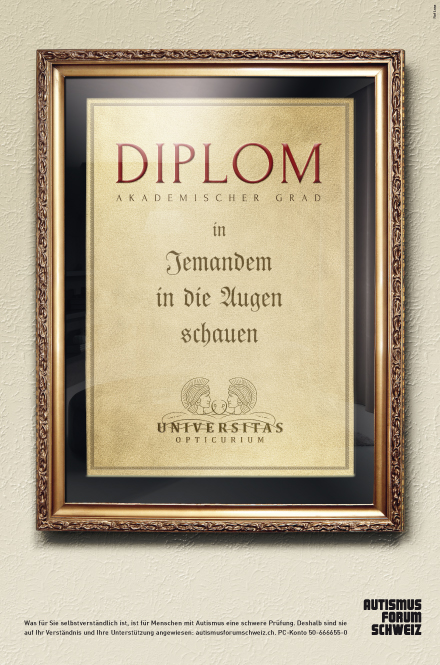
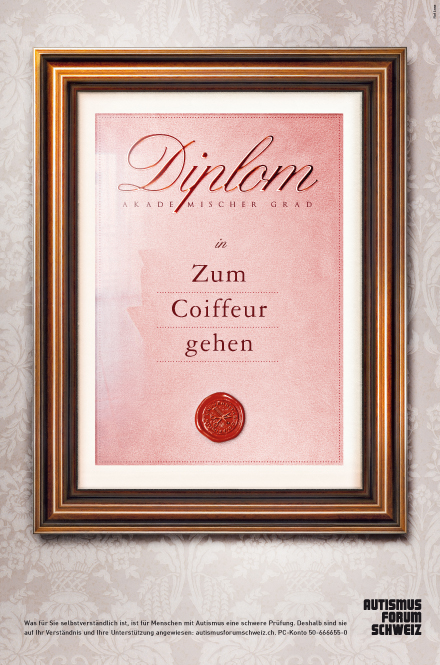
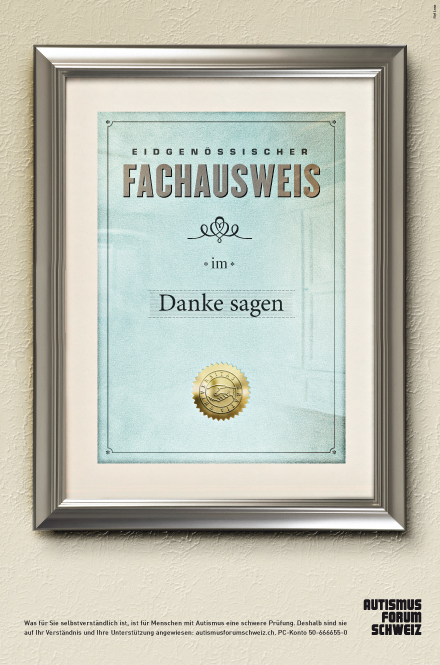
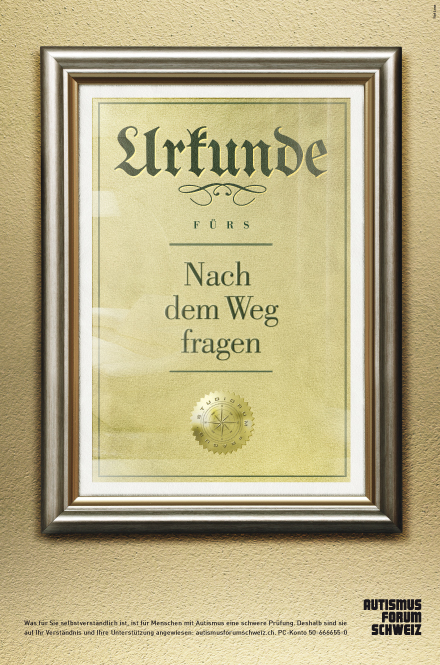
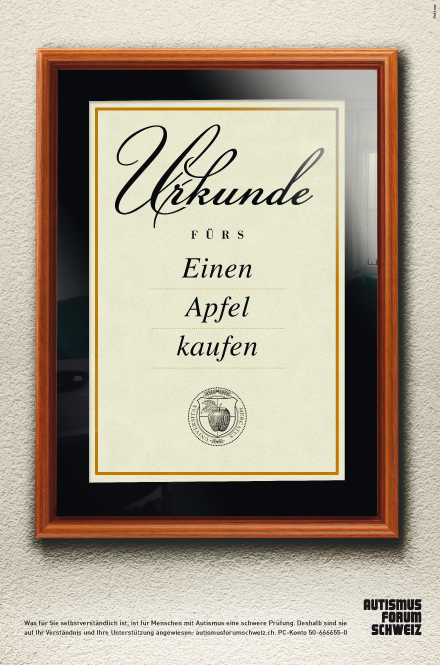
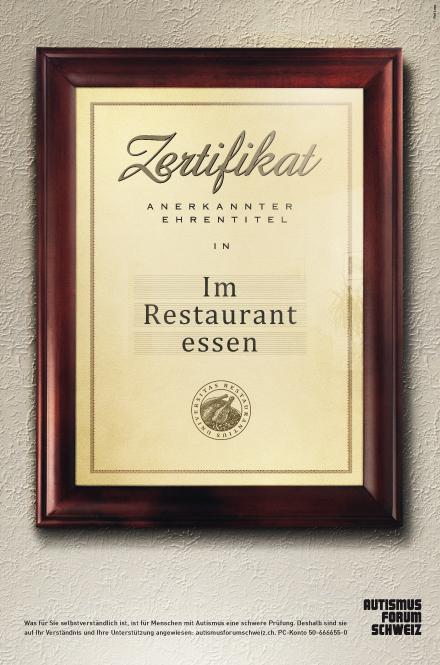
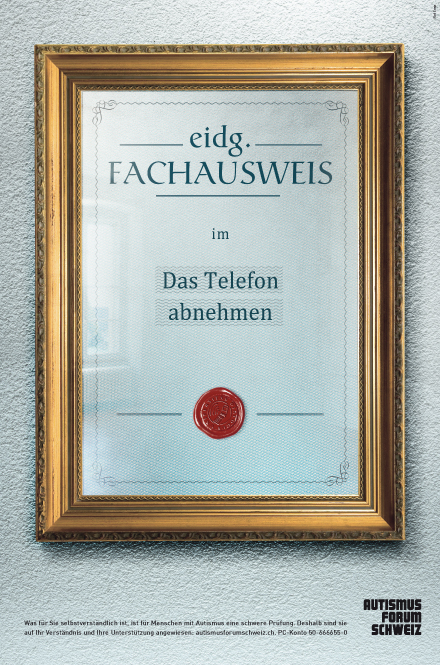
Ruf Lanz: Campaign for Autism Forum Switzerland

Autism Forum Switzerland has commissioned the agency Ruf Lanz to launch an awareness campaign highlighting the various facets of autism.

Only a few people in Switzerland are really familiar with autism, writes Ruf Lanz in a press release. Accordingly, little understanding or support is given to those affected and their environment by the population. All people with autism have impairments in social behavior in common: for example, difficulties in making contact with other people, looking them in the eye and talking to them.

According to the press release, the first phase of the campaign shows that for people with autism, even everyday activities such as "going to the hairdresser," "buying an apple," "asking for directions" or "looking someone in the eye" are a difficult test. That is why lovingly designed diplomas, certificates and certificates are issued for these and other supposedly simple activities.

From July 19, a total of seven subjects will appear full-page in numerous major Swiss newspapers and magazines. In addition, the subjects will be used on F200 backlit posters at bus stops as well as on 10'000 postcards and in online applications.

Responsible at Autismus Forum Schweiz: Nicole Ulrich (President), Thomas Girsberger, MD (Vice President), Thomas Ulrich, MD, Edith Hörler, Nikola Bellofatto (Board Members). Responsible at Ruf Lanz: Markus Ruf, Danielle Lanz (CD), Maren Beck (text), Isabelle Hauser (AD), Dave Schellenberg (graphics), Sabrina Luck (consulting). Lithograph: NC. Printing posters: Setaprint. Printing postcards: Heer Printing.

ruflanz1_6
ruflanz2_6
ruflanz3_4
ruflanz4_1
ruflanz5_0
ruflanz7_0
ruflanz8_0


Supertext: Company blogs and newsletters targeted

The copywriting and translation agency Supertext is launching two new services in its online copywriting shop: the blog post subscription and the newsletter subscription.

For a flat monthly fee, customers will receive newly written articles for their company blog or newsletter either monthly, weekly or daily, as detailed in a press release. Both subscriptions start with a personal kick-off meeting at which the topics and authors are determined. Agency boss Rinaldo Dieziger, who writes for the Tages-Anzeiger mommy blog as a dad blogger: "We write blog posts and newsletters for many clients. Instead of ordering a blog post every week or every day, the posts can now simply be subscribed to."

Supertext employs twelve full-time staff and a freelance pool of more than 300 contracted authors, copywriters, journalists, editors, proofreaders and translators. The agency's clients include Migros, Ovomaltine, Ochsner Sport, Coca-Cola, Hirslanden, Toshiba, ABB, VZ Vermögenszentrum, Wirz, KSB, Unic and Burson-Marsteller.
 

Crossing and respecting boundaries

International corporate publishing has boundaries that must be respected. A case study.

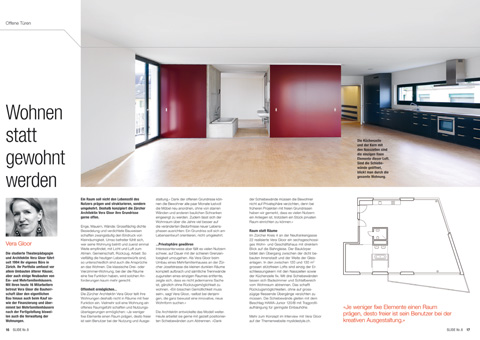
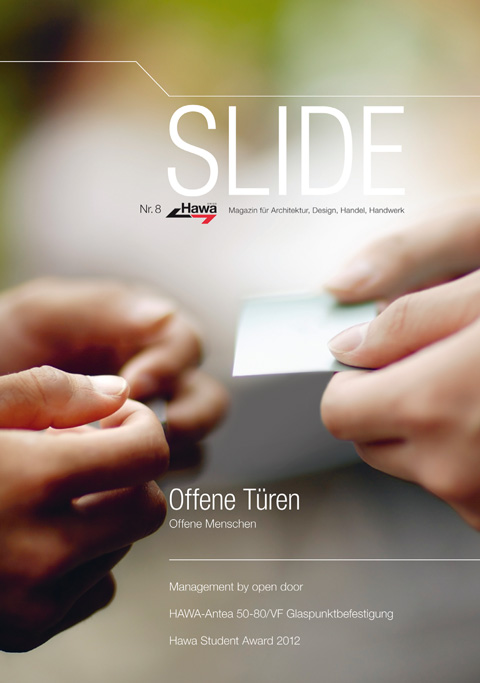
To speak of a target group for the readership of a magazine "for architecture, design, trade and crafts", which is sent to Dubai, Dagmersellen and Dallas in three languages, is a sign of optimism. The magazine is called SLIDE and is read by customers and partners of Hawa AG, which manufactures high-quality sliding hardware systems for the global market in Mettmenstetten. Every issue is like squaring the circle: How do you pick up American buyers, Arab builders and German joiners at the same time?

Linguistic and cultural differences

It starts with the terminology: In Germany, a carpenter is called a "Tischler". "Schreiner" is as far removed from him as "Tischler" is from the Swiss. Copywriter Willi Näf often has to do without sensuality and resort to approximate terms such as "Holzfachleute": "A magazine with too much national coloring in the choice of words comes across as provincial and navel-gazing." The problem is multiplied in the translations. Multilingualism can even have an impact on the design: A frog as an illustration on the subject of "frog's eye view" doesn't work if the English expression for it is "worm's eye view".

Current sensitivities and general cultural differences must also be taken into account. A report on the renovation of a branch of a major Swiss bank has a positive effect on readers in Thun, but triggers the wrong image transfer for customers in Texas. A picture of a wellness facility with too much bare skin is hardly appreciated in Dubai. And a text about the meaning of co-determination rights reads like a plea for personal responsibility in the West, but in the Arab world it may read like an accusation of suppressing the hunger for democracy. Playful language and a hint of mother wit are often not possible. In order to still meet high journalistic standards, Hawa AG and its journalists have to work together intensively and in many different ways. This seems to be working: SLIDE has won a BCP Award twice and has been nominated for an Econ Award this year.

Company: Basel West Unternehmenskommunikation AG
Contact person: Markus Siegenthaler
E-mail address: [email protected]

grenzen
grenzen_2
grenzen_3


Mediapulse: Radio usage down in the first half of the year

Radio listening declined in Switzerland during the first half of the year. Both the number of listeners and the amount of time spent listening decreased slightly in all three regions of the country compared with the second half of 2011.

In German-speaking Switzerland, 88.5 percent of the population aged 15 and over tuned in to the radio on an average day, according to media data researchers from Mediapulse announced on Thursday. In the second half of 2011, the figure was 88.8 percent. The average listening time fell from 127.7 to 125.5 minutes per day.

The market shares of the individual stations remained broadly stable. The SRG stations recorded a slight decline in market share in German-speaking Switzerland, from 65.6 to 65.5 percent. DRS1, Switzerland's most listened-to station, slipped from 33.6 percent to 33.0 percent, while DRS3 increased from 17.7 percent to 17.8 percent.

Swiss private radio stations increased their market share from 29.8 to 30.1 percent. The leader, Zurich-based Radio 24, lost slightly in both listeners and market share (from 3.4 to 3.1 percent).

In French-speaking Switzerland, SRG stations increased their market share from 65.6 to 66.4 percent. In Italian-speaking Switzerland, the traditionally very high share of SRG programs fell from 83.2 to 82.5 percent. (SDA).

Audience figures 1st semester 2012 German-speaking Switzerland
Audience figures 1st semester 2012 Suisse romande
Audience figures 1st semester 2012 Svizzera italiana

The better is the enemy of the good

Tools for planning and monitoring online marketing activities, search engine optimization, and AdWords campaigns in particular are useful for our work. However, they can make us forget that success in online marketing isn’t based solely on tools and data, but also on spontaneous inspiration and creative ideas. By Martin Caduff & Nicolas Kaufmann, dotpulse Webagentur AG.

Google Keywords Tool, AdWords and Web Analytics make it possible for search engine optimization or AdWords campaigns, among other things, to pick out exactly the keywords that bring qualified visitors to the website, to analyze visitor behavior on the website until we only present the visitor with the information he (supposedly) wants to see, to uncover the channels through which interested parties come to the website before they trigger a conversion, and to advertise where potential customers are, and finally to find the approach that activates our consumers.

We are advocates of these tools, but are opposed to the boundless trust that is sometimes placed in them. This can ultimately lead to bureaucrats and controllers taking the helm and displacing professional online marketers, lateral thinkers and creative minds. We can already see where this can lead with AdWords campaigns: different providers advertise the same offer with identical ad texts. This ignores the fact that providers are interchangeable without clear differentiating features. If AdWords is used in this way, the market will soon dismiss this tool as bad advertising.

Controlling and optimizing online marketing activities with data is certainly the right thing to do. However, we would like to point out that this data comes from the past and is partly accessible to everyone, such as the Google Keywords Tool.

The Google Keywords Tool is valuable for the selection of keywords for search engine marketing, as it shows us how the general public searches. It helps us to recognize the possible keywords for our offer to a large extent. But beware: our competitors also use exactly these keywords. That's why we recommend setting a large pot on "general keywords" that Google Keywords provides us with. A small pot is placed on "own keywords", which are evaluated by examining the offer, creativity and gut feeling. This is how we find attractive niches that are free of competitors.

We recommend the tactic of large and small pots not only for search engine marketing, but for online marketing in general. The numerous tools and databases enable us to quickly lay the foundations to create scope for creativity in conception, planning and implementation.

We advocate creativity. With AdWords, we already see identical ad texts that differ only in the provider name. Without clear differentiation features, the providers are interchangeable and, ultimately, AdWords advertising is dismissed by the market as bad advertising.
 

Eyeloveyou: Sujets realized for Radio Basilisk

The Eyeloveyou agency has created a series of ad campaigns for Radio Basilisk designed to foster a sense of connection with the Basilisk brand among people in the region.

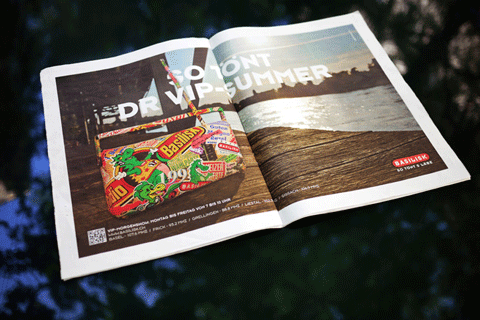
At well-known locations in the region, such as the Rheinbadhaus Breite or the Kaserne, the agency has re-staged the Basilisk transistor radio, according to the press release. In the spirit of "If it ain't broke then don't try to fix it", the Basilisk claim "So tönt s Läbe" was incorporated into the content of the various headlines. The ads can be seen throughout the summer in various print media such as 20 Minuten and Basler Zeitung.

Responsible at Radio Basilisk: Pascal Bloch, Melanie Fanti (Marketing). Responsible at Eyeloveyou: Stevie Fiedler (art direction), Oliver Kirschbaum (consulting). Photography: David Merkofer.

basilisk2
basilisk1
basilisk3

Facebook appearance reveals personality

A new method for analyzing Facebook pages makes it possible to determine a user's personality. The rating scale is intended to benefit advertisers.

Researchers at the University of Missouri use public Facebook profiles to determine whether users are "adventurous" or "predictable". These findings are now to be applied in the advertising industry. "I believe that this could allow advertising companies and media houses to target potential customers with personalized ads. The identification of individual personalities brings advertisers decisive advantages," emphasizes research director Heather Shoenberger.

Central business model

"The declared goal of advertisers is to analyze the behavior of Internet users. Facebook thrives on personalized advertising," says social media expert Jonny Jelinek to Pressetext. All the data you disclose on the social network is used for advertising. "Facebook does have settings that allow you to hide certain information, but you can't protect yourself completely. Over the next few years, the company will also try to place advertisements outside of its own network," says Jelinek.

Adventurous users

When developing the scale, Shoenberger found that users with dangerous leisure activities tend to post pictures and interact with friends frequently. In contrast, more reserved users are also more reserved on the social network, hardly scrolling through the newsfeed or creating updates only hesitantly.

The study was presented at this year's International Communication Association Conference presented in Phoenix. (Press release)

get_footer();