For three weeks, requirements are levied differently

On July 1, 2012, WEMF’s new circulation regulations took effect. The most important changes: There is now a «circulation» category; mailings targeting different audience groups can be certified; other sales are limited; and e-papers are divided into so-called “replicas” and “non-replicas.”.

The new circulation regulations generally have two effects: It tends to lead to higher print runs, but at the same time the figures for paid circulation are also tougher," says Roland Achermann, Head of Circulation Certification at Wemf. What is also certain is that when the circulation figures are published for the first time in just over a year's time on October 1, 2013, they will no longer be comparable with the previous figures, not even with those that will be published this fall. This is because the changes will affect a large number of titles.
 
New value: Circulation

The first change is the introduction of a new value: in order for a publisher to be able to publish the copies actually distributed in one figure, the paid circulation and the free circulation become the "widespread circulation" added together. In the imprint, however, the distributed circulation may only be stated together with the paid circulation for reasons of transparency.
 
Sold circulation is now more meaningful

A second change has a direct impact on circulation: In the future, interruptions in delivery, for example due to a subscriber being absent on vacation, will result in the Circulation sold to a reduction - and thus to a harder value. Previously, interruptions could be reported to Wemf, but they did not have any effect on reducing the requirement, despite the pause in delivery. Further the other sale, a subcategory of paid circulation, has been revised: Previously, this was understood to mean copies sold at less than 50 percent of the regular subscription price. Often, hundreds or thousands of copies were "sold" under this category to bulk buyers (restaurants, companies) at merely symbolic rock-bottom prices. The new regulations now introduce a lower price limit: Only copies sold at at least 20 percent of the regular subscription price are considered other sales; anything sold at a lower price now counts as free circulation.
 
Digital usage is partially mapped

E-Papers are now also counted differently. Previously, only sold e-papers were counted, which also had to correspond to the print edition in terms of layout, advertisements and mode of publication, but could at most include additional image, video, text or music sections. This type of e-paper is now called Replica, and free copies will also be shown in future. This will increase the free circulation. Different the Non-replicas: This refers to e-papers that belong to the same print brand, but whose layout, editorial contributions and advertisements can change at any time. Although they are now also listed, they are not counted in the distributed circulation at the request of advertisers, among others.
 
Switch target group verses are now worth something

The last change concerns the Target shipping. This was already part of the free circulation, but only if a daily or weekly title was delivered to the same address for at least three months, and a monthly title for six months. Change target verses on the other hand, where a different additional audience is supplied per issue, were not shown at all. This is now changing. However, since alternate target audiences vary in frequency and size, the so-called median value is used for this category. "This calculation method is a kind of average value, but it prevents individual upward or downward fluctuations from being reflected in the reported circulation figures," explains Roland Achermann.

Markus Knöpfli

Graphic: The changes at a glance

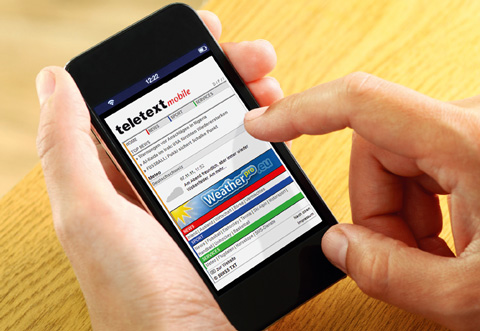
Teletext goes mobile

Live updates, news apps with push notifications, online TV. Up-to-the-minute information—faster, more dynamic, and more mobile than ever—has long been a reality we live and experience every day. Can an «info dinosaur» like Teletext still keep up? By Beat U. Schneider, Head of Marketing & Sales at SWISS TXT Schweizerische Teletext AG.

The 2012 European Championships, Roger Federer at the French Open or the vote on the second home initiative have shown that political results, sports results and other daily news are still accessed regularly, in large numbers and above all via Teletext. The TV information channel has over one million visitors a day. Teletext - outdated and only for the over-40 generation? Not at all!

55 million touchpoints with potential customers

"Mobile is not a form of advertising, but a usage channel. That's why it's important to fully tap into the way customers move through the day and use media, and to meet them where they are with mobile advertising." This is the thesis of "Gruner + Jahr" manager Oliver von Wersch. And secondly: mobile is one of the most important customer touchpoints and therefore also a suitable channel for brand building - the question of the future is when a company meets the consumer in which situation with its advertising and how they can be interested in a campaign. Two assertions from a competent source. And promising prospects that speak for the success of teletext on the one hand, but also - and above all - for its online and mobile variants on the other.
 
Even though teletext is generally seen as a television information tool, it has long since made the transition to modern channels: the internet version is available at www.teletext.ch, and there is both a mobile portal (m.txt.ch) and a teletext app for smartphone users. Teletext has successfully established itself in the new media and generates over 55 million cross-media contacts per month: a good 33 million on TV teletext, around 18 million on the Internet and just under 4.3 million via mobile platforms. Teletext picks up customers where they are.

Successful product: mobile teletext

Teletext's success in the mobile sector has been a real surprise: the Teletext app for smartphones, which was launched in April 2009 and is subject to a charge, has been purchased over 93,000 times to date - plus around 122,000 downloads of the free launcher app for the mobile website m.txt.ch. Users are therefore not only looking for the simple and quick information options in teletext via the television channel, but also increasingly via new media. And the fee-based Teletext app seems to be popular with users: With 85 ratings, it achieves an average of four out of five possible stars.

Reputable channel - large return on the safe side

Teletext on television has existed in Switzerland since 1984. The angular, "pixelated" characters are well known to everyone and, in the age of HD television and cameras with well over ten megapixels, even have cult status. The simple presentation is obviously an essential part of the high credibility of teletext. Teletext is still perceived today - or even more so today - as a trustworthy, serious information channel that provides accurate and complete information about events - and has done so consistently for almost 30 years. Anyone who advertises in such an environment can be almost certain of a large response. And the fact that Teletext successfully closes the gap between conventional and new information channels benefits advertising customers. The cross-media offering makes Teletext mobile - in other words, a modern, far-reaching advertising space. Always there when users need it.

txt

Seven golden rules for intercultural publishing

Seven is a particularly popular number in our culture. Here, then, are seven golden rules for international and intercultural corporate publishing—and the most important prerequisite for them: a journalistic network built on personal relationships. By Dr. Viviane Egli, Primafila AG, [email protected]

1) Local knowledge is essential

A locally based story is committed to the local conditions. This requires familiarity with the situation and culture as well as prior research on location.

2) International knowledge is essential

The narrative style of the local circumstances follows the diverse and culturally different customs of the international readership and community. Accordingly, the internationally diverse perceptions and clichés about the topic and the local culture in which the story takes place must be subtly taken into account.

3) Intercultural team composition

The journalistic team is made up of local experts with knowledge of the (industry) topic and knowledge of the recipient's culture. In concrete terms: the filmmaker and photographer from the region are supported by the interculturally experienced correspondent who has moved to the region and, if necessary, a local representative of the publishing company.

4) Intercultural research as a first step

This intercultural journalistic team on location is as small as possible and undertakes the necessary preliminary research in the first step. The local culture, the cultures of the recipients and the (industry) culture of the publishing company are interwoven as early as the research stage.

5) Cross-media and intercultural welding together

In cross-media storytelling, such intercultural teamwork is essential for a professional result: The story for print, digital publishing, the iPad presentation and for the video is researched and implemented by a journalistic team.

6) Distinguish between intercultural and multicultural starting points

International B2B content usually has an international readership and community with homogeneous interests and heterogeneous circumstances and market conditions. This initial situation must be taken into account interculturally - with a great deal of sensitivity and know-how. International B2C content, on the other hand, generally has an international readership/community with heterogeneous interests and, of course, heterogeneous circumstances. This is primarily a multicultural starting point (topic formulation, languages, etc.).

7) Selected exemplification and elegant leveling

Cosmopolitanism is a target group that has its roots in all cultures of the world and no real common home. Interculturally, this means simultaneously taking into account as many different cultures as possible and elegantly leveling them out - in the filmic and textual narrative as well as in the media design. The independent, unmistakable form is achieved through the corporate culture of the international publishing company and its know-how as well as through the personal journalistic imprint on site. Viviane Egli

About the journalistic network

As the number eight is particularly auspicious in certain cultures, such as China, here is an eighth rule: the international network of a corporate publishing player is its most important asset. Ideally, such a network has been carefully built up personally over many years (and not bought in as an agency network!) and includes renowned and specialized journalists, filmmakers and photographers all over the world. These trusted individuals are carefully formed into teams for storytelling on location. The hard core of such a network consists of a few dozen long-standing correspondents in the most important metropolitan areas. In particularly central markets, small offices are preferably run by long-serving employees. If necessary, the local office works directly with the client's office. The employees of a corporate publishing service provider are per se an intercultural team. Together with the intricate network, they are an extension of the client's journalistic content - well-rehearsed, uncomplicated and culturally adept. The culture of the corporate publishing player and its network is based on mutual trust, loyalty and respect.
 

Online recruiting: social media and mobile on the rise

Facebook, Twitter, Xing and Linkedin - employees and employers are increasingly finding each other via social media platforms. And more and more often, mobile devices are involved.

Many employees are still looking for a new professional challenge primarily via print media, job boards, recruitment agencies and company websites. And companies still prefer to use traditional channels to recruit new employees. However, social networks are becoming increasingly important, as the fourth trend report by recruiting specialist Prospective Media Services on the topic of "online recruiting" shows.

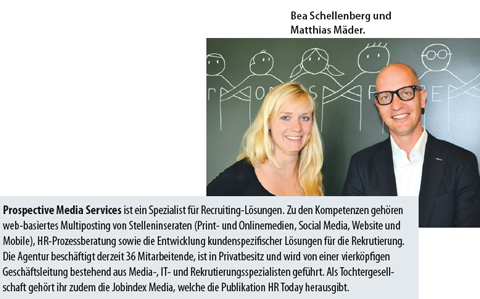
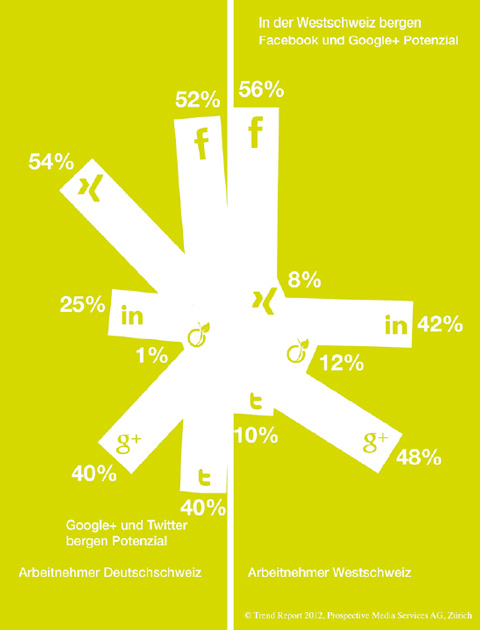
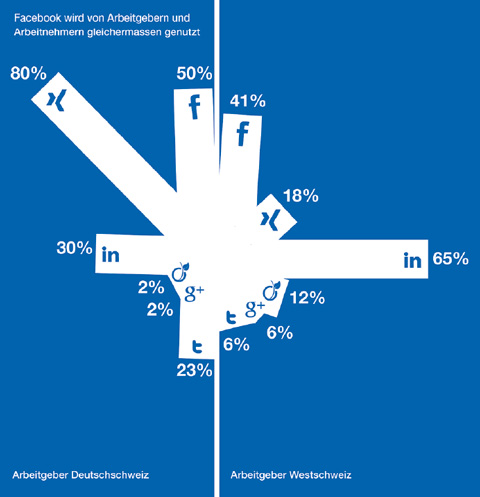
If a position needs to be filled, recruiters are increasingly no longer contacting CV databases, but searching for potential candidates on social networks. In German-speaking Switzerland, 12% of employees have already been approached by a recruiter in this way. Equally, employees come across a job offer via Xing or Linkedin or are made aware of a job via Facebook and Twitter. While Xing is the most popular business portal in German-speaking Switzerland, Linkedin is the most used network in French-speaking Switzerland (see Fig. 2). However, there are differences between employers and employees. For example, the Xing career portal is used more frequently by companies for job postings than employees use it for their searches. "We suspect that since Xing is primarily not a job exchange but a business network, interested parties use it less 'consciously' for job searches," says Bea Schellenberg from Prospective Media Services, explaining the discrepancy. "In contrast, Xing offers employers the opportunity to display suitable candidates job suggestions directly on the Xing profile and thus also address latent job seekers. Xing is also particularly suitable for approaching candidates directly."

Employers, on the other hand, appear to have some catching up to do with Google+ (g+). Many employees already use g+ to search for jobs. Companies, on the other hand, hardly take this channel into account. The same applies in German-speaking Switzerland to the short message service Twitter, which is currently (still) more popular with employees than with employers.

Via Facebook to a new job

The labor market study clearly shows that not only business networks, but also those that are traditionally used more privately, play an important role in the job search and recruiting process. Facebook leads the way. One in five employees has already discovered a job offer that someone from their circle of friends or acquaintances has posted on Facebook. Employers, who were still lagging behind employees in terms of Facebook usage last year, have caught up and are now increasingly using the network to find employees. For example, by publishing vacancies on their fan page. Or by using their employees' networks for recruitment. Jobs then no longer find their way to interested parties via conventional job portals, but are forwarded to their Facebook friends via employees. Just as sought-after apartments are passed on within the circle of acquaintances, companies advertise jobs via their employees' networks. "It's like when I have an apartment to let in Seefeld. I don't necessarily advertise it on Homegate," says Matthias Mäder, CEO of Prospective Media Services, illustrating the example. Facebook career fan pages are still rarely used in Switzerland. On such a page, which is run in addition to the normal Facebook presence, a company introduces itself to potential employees and provides information about current jobs. A photo gallery provides an insight into the company and the advertised job. Who wouldn't want to know what their new workplace, the canteen, the office building and the break room look like? Or: the person who is leaving the company is involved in the search. "There is a tendency for companies to involve their employees more and more in the recruitment process," says Mäder. It is no longer the company but the employees themselves who are looking for their successor. For example, he explains in a video what his job and everyday working life are like. Employee branding gives the company a completely different visibility. And the job seeker receives first-hand information as well as a direct contact to whom they can turn if they have any questions. "With a career fan page, a company can simply open itself up to the outside world and present itself authentically," says Mäder, summarizing the advantages of the career fan page.

The career fan page is maintained by the company's HR department, which thus has its own channel to establish a connection to potential applicants. Various companies in Germany - including Audi, Deutsche Bahn, Volkswagen and IBM - already make use of this option. In Switzerland, for example, the Baloise Group insurance company and the auditing and consulting firm KPMG have a corresponding page.

Mobile recruiting

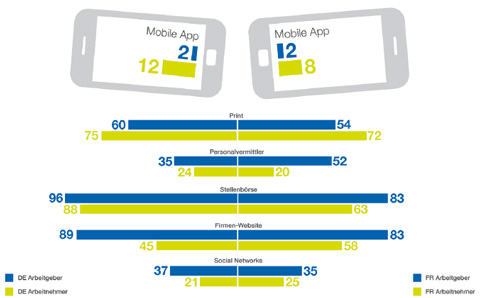
The increase in Internet use independent of time and place also determines developments in job search and recruiting. Alongside social media, mobile recruiting is one of the major trends in 2012. 17% of smartphone owners already use their device to search for jobs. 18% have also downloaded a specific app from a job platform to check job vacancies on the move. Employers are clearly lagging behind: only 1.7% currently use a mobile app to advertise their jobs. However, companies are interested: 29% are currently looking into mobile recruiting opportunities.

On the one hand, companies need to make their job advertisements mobile-friendly so that they are presented in an attractive way for users. On the other hand, it must be defined whether an application should be possible on mobile devices. This is where the profile application comes into play: as users usually do not have their CV or a letter of motivation ready on their iPhone, for example, the applicant sends their Xing or Linkedin profile to the recruiter instead, who checks it for suitability. If the profile fits, the applicant can then submit the letter of motivation and CV. "Especially for professions in which the applicant market has dried up - in the care sector or engineering - it could be exciting to approach potential applicants in this way," says Mäder. In particular, candidates who travel a lot could easily apply in this way. Profile applications are likely to be less interesting for jobs where the pool of applicants is large. "In such cases, the recruiter will probably not allow profile applications, as they would otherwise be inundated with applications."

Solid applications

It remains to be seen whether profile applications will prevail among employees - even if only in certain areas. After all, when it comes to job applications, employees do not seem to be very keen to experiment, or even downright conservative. 75% of employees still prefer to use print applications to introduce themselves to an employer. A surprising result. "I personally believe that applicants want to stand out with a print application," says Mäder, explaining the clinging to paper. "A dossier in a pink folder stands out on the recruiter's desk when they do their ABCs." Schellenberg confirms: "Many people have the feeling that an application they can hold in their hands is more effective." What many people don't seem to know: Companies prefer an email application to a printed document. After all, most companies work with IT systems in recruiting and don't want to scan print applications first in order to be able to process them at all.

Isabel Imper

rec4
rec
Fig. 1: Proportion of employers and employees who advertise or search for jobs in a specific medium (in %); left: German-speaking Switzerland, right: French-speaking Switzerland.

rec3a
rec3b
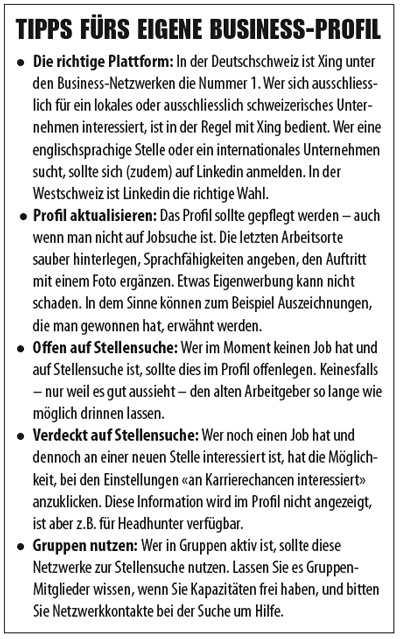
Fig. 2: Comparison of the various networks by employer and employee, German-speaking and French-speaking Switzerland.

rec2


Who is watching the watchers? SMEs need more critical attention

Whether communication press or media monitoring provider: The ownership structure of some industry services raises questions. A call for more public vigilance. By Oliver Classen, press spokesman for the development policy organization Berne Declaration and former media editor.

Like any form of introspection, journalism also has its blind spots. But the blind spots in the Swiss media industry are growing in proportion to its consolidation, because without vigilant competition there can be no effective criticism. If, for example, one's own publisher is interviewed, a major advertising client is spared or the mistakes of the competition are commented on, media journalism reaches its natural limits in terms of objectivity. Operational blindness is therefore also constitutive for the communications sector. However, this well-known weakness in the system of media self-enlightenment in no way explains or excuses the fact that problematic ownership structures are either deliberately ignored or tacitly accepted by other industry observers.

The takeover of Persönlich's parent company by Publigroupe, for example, was only announced by the "Zeitschrift für Werbung und Medien" itself in 2008. So discreetly, in fact, that it almost seemed a little coy. Strangely enough, this dubious deal was not worth a headline either to the major newspapers, most of which continue to cooperate with the troubled advertising broker, or to the direct competition. Even when the editors of Werbewoche, where I earned my living until 2005, came under the protective wing of Südostschweiz boss and publisher president Hanspeter Lebrument around two years later (disclaimer!), the questions about conflicts of interest and loss of credibility that arose did not materialize.

Even the Swiss journalist, who usually likes to scandalize, did not exploit the loss of independence of his main competitors. Only Kleinreport addressed the peculiar ownership structure - without, of course, disclosing its own - and thus refuted the emerging rumor of a mutual standstill agreement. There can really only be two reasons for the eerie calm in the eye of the storm: Either it is an expression of a lack of relevance and acrimony on the part of the two leading industry services, so that the new owners are of no interest at all. Or the opinion-forming press does not want to spoil things with the largest Swiss "media sales agency" and the influential publisher president. Both assumptions would be worth analyzing. Anyone who has noticed the lack of questions about the monopoly that has prevailed for the past year in the small, but fine Swiss market for clipping services is in even greater need of an explanation.

As a result of the merger with the up-and-coming Central Swiss family business ZMS, the Zurich top dog Argus now has de facto sole control here, despite the nominal continuation of the current subsidiary. Clipping customers like me (disclaimer!) are observing this two-company strategy without price differentiation with growing skepticism. For the business press, however, such developments are apparently only relevant when the Competition Commission comes into play - i.e. only when sales exceed CHF 100 million.

However, "journalism journalism" (the title of a great book on the meta-topic), which takes its self-observation mandate seriously, must keep an eye on the entire media industry, i.e. also look after the supposedly small fish. If these swim under the radar of those large publishing houses that can still afford media journalism, they would certainly be a feast for bloggers and online mediazines. Because in the long run, observers without observers become like kings without controllers - complacent and dangerous.


Art returns

After almost two years of construction, the art world returns to the Löwenbräukunst site at the end of August. Zurich will thus have a new "museum quarter" that no longer needs to fear comparison with the international scene in Vienna, London or Berlin.

The magnetic effect of the art in the Löwenbräukunst-Areal established the Art Mile in District 5 in 1996 and provided important impetus for the entire district. In the over 100-year-old former brewery buildings on the Löwenbräu site, a center for contemporary art was created within a very short space of time in the wake of the worldwide boom in interest in art, which soon also achieved great international appeal.

The Kunsthalle Zürich, the newly established Migros Museum für Gegenwartskunst, the Daros Collection and a small number of high-quality private galleries chose the traditional site as their new location, laying the foundations for a success story.

However, frequent changes of ownership in the years that followed repeatedly jeopardized the future of cultural activities on the Löwenbräu site. In 2005, representatives of the Kunsthalle asked the City of Zurich for support to preserve the art on the Löwenbräu site. As a result, the city council launched a project to secure the long-term future of the Löwenbräu art and culture venue. In an effort to preserve the Löwenbräu site for art in the long term, the Zurich City Council approved a private design plan in 2005 with mixed use of spaces for cultural uses and commercial, office and residential buildings.

In January 2007, following extensive preparatory work, the city council also took the fundamental decision to preserve the art cluster and commissioned a municipal project team to do so. In the course of the project work, various sponsorship models were examined more closely. The condominium owners' association soon emerged as the best sponsorship option, as it allowed large and small institutions and galleries to be involved in a participatory manner.

Unfortunately, the outbreak of the financial crisis in 2008 dealt the deathblow to this sponsorship model, primarily because the private members of the planned sponsorship considered such a strong commitment of resources in the property to be too great a risk. Under pressure from the property owner, a new form of sponsorship had to be found in a very short space of time.

Löwenbräu-Kunst AG

The newly formed sponsorship was to take over the land and buildings from the current owner in a joint commitment by non-commercial art institutions and the public sector. To this end, the two institutional tenants Kunsthalle and Migros Museum, together with the City of Zurich, founded the public limited company "Löwenbräu-Kunst AG" in May 2011, which took over the art plot from PSP after completion of the partial renovation and basic extension in early summer 2012. The three shareholders each took a one-third stake in the share capital of CHF 27 million. The purpose of Löwenbräu-Kunst AG was laid down in the articles of association as "operation of a center for art and cultural purposes" and its long-term security was anchored in shareholder agreements.

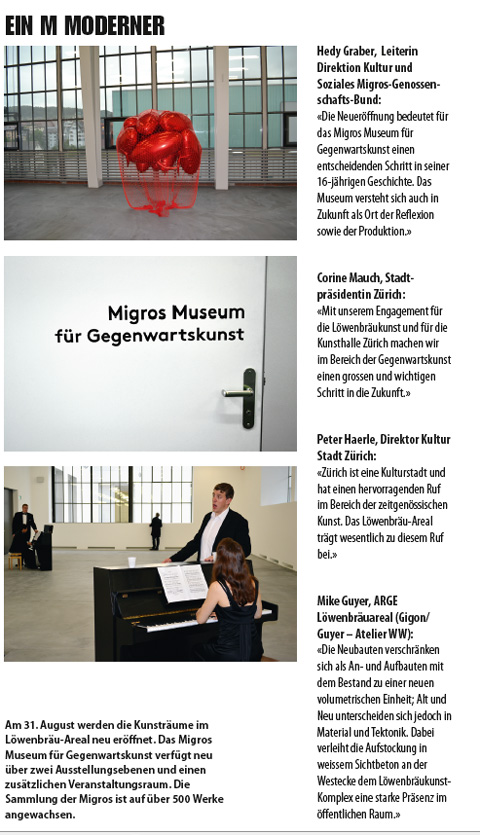
Following the preparatory and demolition work at the end of 2010, the foundation stone was laid at the Löwenbräu site on May 18, 2011 and after a construction period of around two years, the art section can now be opened at the end of August 2012. With the opening of the renovated and expanded "Löwenbräukunst", Zurich is strengthening its cultural offering and its reputation as an attractive and innovative location for the arts and creative industries. In recent years, this sector has become an important and indispensable pillar of Zurich's economy.

Double the space for old tenants

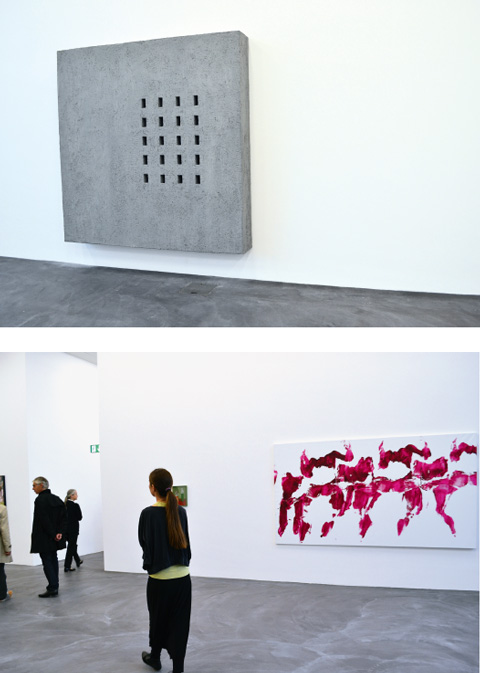
The art institutions Kunsthalle Zürich and Migros Museum für Gegenwartskunst, the Hauser & Wirth, Bob van Orsouw and Eva Presenhuber galleries and the Kunstgriff bookshop are returning to renovated and in some cases significantly enlarged spaces. The Kunsthalle and the Migros Museum für Gegenwartskunst have almost doubled their space.

In the 27 years of its existence, the Kunsthalle Zürich has developed into an internationally important center for contemporary art. With the expansion of the Kunsthalle, the exhibition space with public library and mediation rooms will be increased from around 800 to 1200 square meters. There will also be new archive, workshop and office space. The Kunsthalle Association and Foundation are investing a total of around 13 million Swiss francs in the share capital of Löwenbräu-Kunst AG and in the expansion of the infrastructure. The share capital investment of CHF 9 million and the expansion costs of CHF 4 million are covered 100 percent by private donations, grants from foundations and personal contributions.

The Migros Museum of Contemporary Art now has two exhibition floors with an area of 1,300 m2 and a total rental area of 2,500 m2: One floor is used for the presentation of the collection, while the other is available for changing solo or group exhibitions.

A new event room enables the expansion of the educational and supporting program. With these new features, the Migros Museum is positioning itself as an attractive and dynamic meeting place for contemporary art. The Migros Museum of Contemporary Art, which is patronized by Switzerland's largest retailer, is part of the Migros Culture Percentage.

Art patron Maja Hoffmann's Luma Foundation will be moving in. In addition to exhibition and event spaces, LUMA Westbau/POOL etc. will also operate a boarding house for artists and scholarship holders of the project. Other new tenants include the art book publisher JRP|Ringier and the Freymond-Guth Fine Arts gallery as well as other galleries as subtenants in the Daros Latinamerica space. While many tenants have already moved in, others are still in the process of customizing the space.

Andreas Panzer

WW14_004_004
WW14_004_004b
WW14_004_004c
WW14_005_005d
WW14_005_005e
 

Communication without borders

Müller Martini, a leading provider of solutions for the graphic arts industry, has a presence on every continent. As a result, communication knows no boundaries and is characterized by respect for the world’s diverse cultures.

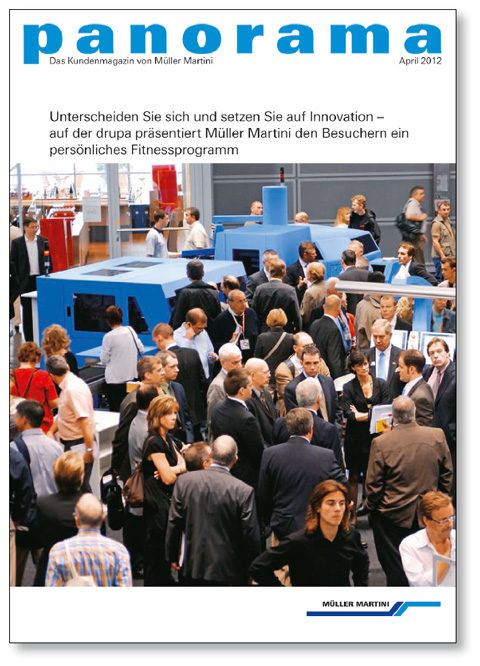
Headquartered in Zofingen, Aargau, Muller Martini has been developing solutions - saddle stitching systems, softcover perfect binders, hardcover booklines, newspaper mailing systems, digital production systems, web offset printing presses and service solutions - for the graphic arts industry for more than six decades. Production takes place in Switzerland, Germany and China - here, however, exclusively for the Chinese market. Muller Martini has sales companies worldwide. Communication, which is decisively shaped by the CP agency Brandl & Schärer in Olten in the print sector, is correspondingly international.
 
For example, the customer magazine "Muller Martini Panorama", which has been published three times a year for 27 years with a circulation of 34,000 copies in five languages. The editor-in-chief is Dr. Markus Angst. He writes customer reference reports, background reports, technical articles and interviews, which are then translated into English, French, Spanish and Italian. Customers and experts from various countries check the texts several times to ensure that the content and language are correct. "This is an important part of quality assurance," says Markus Angst. "And correspondingly time-consuming."
 
The latter also applies in particular to on-site research, explains the editor-in-chief, who travels all over the world for his interviews. "I gather a lot of impressions on site, of the people, the company, the print products, the entire cultural environment - in terms of text quality, this justifies any journey, no matter how long." Impressions that flow into the stories. The reports are authentic, experienced, based on personal encounters. No digital means of communication can replace these experiences. This is professional journalism.
 
Quality and professionalism are a top priority at Muller Martini, not only in development, production and customer service, but also in communication. And here not least in the visual language, which presents a cross-section of all continents, skin colors and cultures and at the same time takes cultural taboos into consideration. For example, Brandl & Schärer sometimes adds extra fabric to a T-shirt so as not to offend readers in Islamic countries. This is also part of the professionalism of Muller Martini, which is aware of its responsibility towards other cultures down to the last detail and shows them the respect they deserve.  
 
Company: Brandl & Schärer AG
Contact person: Kurt Schärer
E-mail address: [email protected]

mueller_martini

Spiked: Teens book themselves out

Anne-Friederike Heinrich, a freelance contributor to *Werbewoche*, on the new hope that young people have recently begun to bring once again.

Yes, yes, the youth of today ... is no longer what it used to be. Thank goodness! At least the younger boys between the ages of 13 and 15 are slowly becoming sensible again - and saying goodbye to Facebook. A ray of hope at last!

Grandma-to-be

How often do I stand on our balcony with our nine-month-old boy in my arms, we watch the kids on the street and I think: "My goodness, hopefully everything will be different again when our little one is older. Hopefully the nails will be less colorful again, the skirts longer, the hairstyles horizontal again, the pants wider and higher up and the sunglasses smaller. And hopefully it will no longer be en vogue to hang out at the bus stop in the evening, scream in the street or walk around with a boombox on wheels." And at the same time I think: "Now all you have to do is buy a cushion for the banister - and you're all set to be the grandma who gossips about the youth of today and who you never wanted to be. I've gotten old!"

But I'm right. I've always tried to keep it a secret that I'm not on Facebook, that I think it's a waste of time to link to thousands of profiles where I barely know the people behind them or would rather not know them at all, to call them my "friends" and therefore have no time for the few, good, real people I really care about. I've even felt a little ashamed that I'm not willing to share my private vacation and foam-all-I've-bought photos with the world. Because that's pretty old-fashioned these days. Twitter: yes. Xing: yes. Both have a clear function and are therefore justified. But why should I have a second existence in the virtual world? The real one is already exhausting enough.

Children on the rise

Now what a liberating blow from 13 to 15-year-olds: From May to July 2012, 10,000 Swiss teenagers logged off Facebook. Because the networking and constant maintenance of their profile stresses them out, because they are annoyed by advertising (!) and spam and because they feel they are being monitored. That is sensational. So I'm not that old after all! The world isn't spinning too fast for me yet! And I can afford not to join Facebook after all. It's a good feeling that I can rely on my gut and my common sense in virtual matters too. Even if I am an old fart. Thanks kids!

Well, well, of course young people are not completely renouncing social networks. WhatsApp is in now, and other great tools will follow. But when all this is over, perhaps knitting circles and gentlemen's evenings will come back into fashion. Text messages, temporarily something for old people, are now once again the form of communication of choice. So I can skip WhatsApp and all the other newfangled stuff with good hope and look forward to the return of the Middle Ages. Only one fear remains: That our little son, when he has finally outgrown his mother's womb, will at some point have the idea of "frying" me - or whatever that will be called in 2024 and beyond. Then, of course, I'll have to respond with a delighted "yes, of course" and quickly find out what he's talking about. Because I really couldn't live with our "little one" finding me uncool and old-fashioned one day.
 

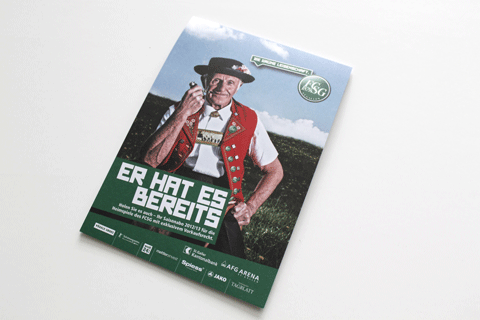
Dachcom: Campaign developed for FC St. Gallen

The Dachcom agency has created a new brand identity for FC St. Gallen, which is back in the Super League.

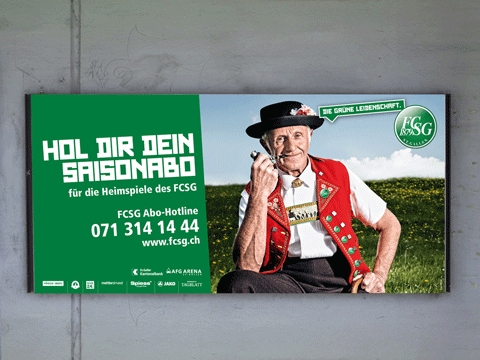
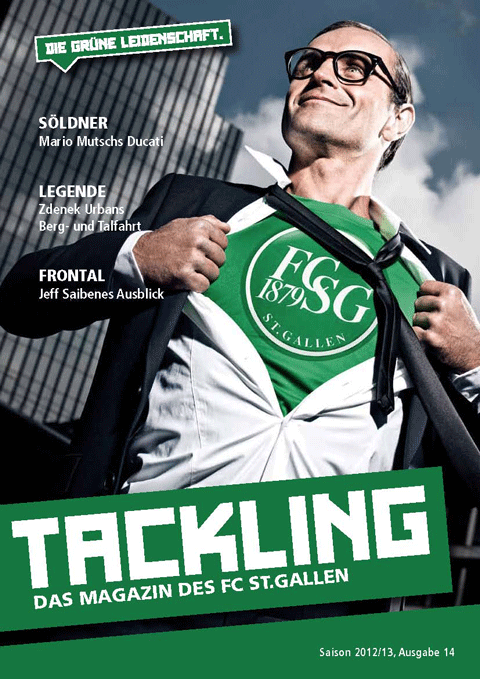
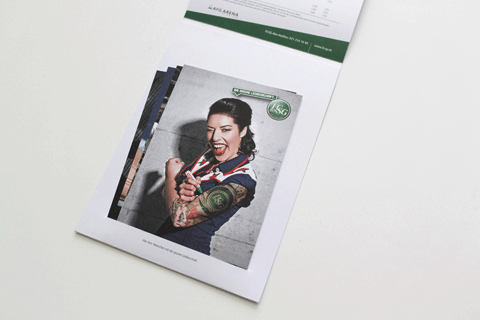
The new corporate identity was used for the first time in the form of a campaign for the sale of season tickets, as the agency writes in a press release. The campaign included posters, advertisements and publicity reports, a mailing with enclosed postcards as well as radio and TV commercials. The communication coverage of the current season will also be carried out in the new look, using measures such as advertisements, posters and match programs before every home game, as well as magazines and other means.

Responsible at FC St. Gallen: Bill B. Mistura (CEO), Brigitta Wegmann (Marketing). Responsible at Dachcom, Rheineck: Pascal Rüegg (AD), Ralf Bruggmann (text/concept), Brigitte Mebold (project coordination), Jérôme Walz (consulting/strategy), Otto Gmeiner (overall responsibility).

dachcom7
dachcom6
dachcom5
dachcom4
dachcom3
dachcom2
dachcom1

Disqualified!

At the end of July, the Olympic Games are once again on the program. After the 2008 Games in Beijing, this year's Games in London are being dubbed the "Socialympics". But will it really be the first Social Media Games, as the IOC is praising itself? By Manuel P. Nappo, Head of Studies CAS Social Media Management at the HWZ, Chief Networking Officer at Centralway. www.about.me/mpn

The IOC's head of social media, Alex Huot, is talking about the first social media games to be held in London this year. In contrast to Beijing, where there were even stricter guidelines on the use of new media in 2008. The IOC is encouraging athletes to use the new channels and is reportedly even offering courses. The specially created microsite hub.olympic.org also suggests that the first Socialympics will actually start at the end of July.

But if you take a closer look at the small print on the tickets or the IOC Social Media Guidelines, you will quickly realize that things will not be quite as sociable as initially assumed.

Even though the Olympic Committee encourages athletes to use social media channels, the guidelines contain strict rules. For example, messages may only be written in the first person, they may not appear editorial and may not comment on competitions or the activities of other participants. Photos for personal use are permitted, but video and audio recordings of the Olympic site may not be shared on social media platforms. The rights to the photos must be clarified if third parties are depicted in them, and brands of non-sponsors must not be visible in the photos under any circumstances. The Olympic rings may not be used in images. Accredited media, on the other hand, may use all social media platforms in good faith (bona fide).

When asked about the strict guidelines, the IOC qualifies that it is not forbidden to share content, just not for commercial purposes. But where is the line between private and commercial use for a professional athlete? Isn't every Twitter account of a public figure also commercial in some way?

The small print when buying a ticket for the Olympic Games is similarly difficult to read. Point 19.6.3 (there are 138 points to consider) states that the holder of a ticket may only use image and sound recordings for private purposes and that publication on social media is not permitted. Let's imagine that the 80,000 people in the Olympic Stadium in London take pictures and videos and none of them share them with friends on Facebook, Twitter or the like. Illusory, isn't it? The question arises as to how the IOC intends to crack down on so many people. It has allegedly already been agreed with Twitter that non-sponsors who use the hashtag #London2012 will receive a warning and may even be banned. Facebook has also been actively involved and will scan all images for unauthorized content. Some are now even rumoring that the IOC could crack down so hard thanks to its special status that the posting of photos and videos on Facebook could even be stopped during the Olympic Games.

Socialympics? Disqualified!
 

Swissprinters closes Renens site

Swissprinters plans to concentrate its Swiss web offset business at a single production site in Zofingen. The Swissprinters Lausanne operation in Renens is to be transferred to a new constellation at the end of 2012.

With the planned exit at its printing site in Renens, Swissprinters is pursuing the path of consistent consolidation and concentration on industrial web offset production, as the company writes in a statement on Thursday. Discussions are being held with interested parties for the transfer of the printing activities to a new partnership, which will reach decision-making stage in the near future. A contract is already ready to be signed with a leading printing company in the Lausanne area, which provides for the takeover of the sheetfed offset division and part of the workforce. Any measures will be subject to legal approval and will in any case be carried out in compliance with the rules of social partnership.

Persistently unsatisfactory result

The reason for the planned changes is the continuing unsatisfactory result of the printing operation, triggered by the increasing decline in volumes, the still considerable price pressure and the low profit margins in printing. "All efforts and the great efforts of many employees to make the Renens site profitable within Swissprinters are unfortunately having too little effect to be able to present the operating result in a sustainably positive light. We very much regret this," says Alfred Wälti, Managing Director of Swissprinters.

The Swissprinters Group was formed in 2005 from the merger of all the non-newspaper printing operations of Ringier and the NZZ Media Group. In 2006, the western Swiss media group Edipresse joined the group as a shareholder. The Group completed its consolidation to one web offset site in German-speaking Switzerland in mid-2012, closing both its St. Gallen and Zurich operations. Swissprinters prints magazines, catalogs and brochures using the web offset process.


Der Motz vom Butz: What have we learned from the Motzerei?

Before we put our feet up, let’s recap everything that went wrong in advertising communications—and why. By Theophil Butz, once a star advertising executive (Ringier), now an inspiration, and from now on, a complainer as well.

What this is all about: So far in 2012, I've issued a mottos twelve times and a praise once (Advertising Week May 25). Since I realize that despite my advertising theories, the same mistakes are made over and over again, I have decided to hold a recap lesson.

Moth 1: Saving in the wrong place. Nespresso spent 80,000 francs a month on a single poster display at Zurich station. They saved on a professional designer. You can only save on media costs to a limited extent, but if the TV, radio or poster message is not professional and the target group doesn't understand anything, then saving is nonsense. Better to do nothing.

Moth 2: Texts aimed at Denner customers should be understood by them with a smile. Only the makers understand copywriting and insider wordplay. How did Deutsche Bahn describe a winter picture back then: "Everyone's talking about the weather. Not us." So write in plain language.

Moth 3: Car advertising is just a series of the same benefits being offered (Euro discount, super leasing, new, complete, etc.). Almost no one has a clear positioning, everyone talks the same. We learn that the brave will be the winners. VW has always done good advertising and God knows it hasn't done any harm. On the contrary.

Moth 4: VBZ sold their rail vehicles to the private sector without any aesthetic restrictions. If ten international artists had been chosen and Sunrise had selected one of them, these streetcars would not be so ugly, but small works of art. And Sunrise could be proud. And the VBZ too. So, no good solution without a concept.

Moth 5: The name and corporate identity are an important key to the success of a company or product. So a professional approach is crucial. No cheap quick fixes.

Moth 6: Using Renault's old-fashioned and unstylish brochure, printed in millions, I made it clear that cheap advertising also makes the product cheap. We learn from this that uninteresting advertising also makes the product uninteresting. That's clear.

Moth 7: The telephone directory, an absolutely superfluous money-making exercise. Lesson learned: don't waste paper without having an important message.

Moth 8: The fact that the magazine "in", which arrives in my letterbox almost every week, thinks I'm a Neanderthal with its content is also a waste of paper. We learn from this that consumers are not messies or Neanderthals.

Moth 9: With a lot of money and unnecessarily massive advertising, only a monopolist like Swisscom can appear. We learn from this that the biggest should also do the best advertising. But at home itself.

Praise 10: The Lovely dairy cow. We learn from this that the best advertising memories are achieved with continuity.

Moth 11: Marlboro may no longer be the leader. We learn from this that the cowboy, i.e. the continuity, is missing.

Moth 12: The advertisement for Swisscom's home country has left me speechless and penniless. We learn: Why wander far away ... (I don't find the new TV commercial crazy at all.).

Moth 13: Telemarketing is a clever idea, but everyone gets on your nerves. There should be a better approach. Come up with something. I hope you will work diligently on everything and generate entertaining, simpler, more original and long-term advertising after the summer vacation. I've got the idea that I don't have to write a moth for a month now, so I can put my feet up (see picture).

motz_0

By Theophil Butz, once a star advertiser (Ringier), now an inspirer and, from now on, a mocker. "Not an easy role, but a necessary one, which I perform here every 14 days." Please send any relevant information to [email protected].
 

get_footer();