Feature films on Star TV

To mark its 17th anniversary, Star TV is massively expanding its programming. Starting September 1, the national commercial broadcaster will air feature films daily. With one Swiss film per week, the local film scene will also be given a platform.

Started with making-of reports, magazines and live productions, Star TV is now focusing on feature films in prime time from September. Every evening from Monday to Friday, one feature film will be broadcast; on Saturdays and Sundays, there will be two. In addition to a weekly free TV premiere, the station, which has traditionally been closely associated with Swiss filmmaking, is making room for Swiss productions on Thursdays. It kicks off with the 1985 film "Höhenfeuer" by Fredi M. Murer. In addition, viewers will be entertained with TV series on the eve in the future.

Feature films, magazines and events

Feature films are one of three main programming areas at Star TV. In addition to the feature films, the national broadcaster focuses on magazine shows and live events. This fall, for example, the Zurich Film Festival awards ceremony and the Swiss theatrical premiere of the new James Bond film "Skyfall" will be broadcast from the Abaton movie theater. In this way, Star TV aims to strengthen its expertise in lifestyle and entertainment and provide a platform for the domestic cultural scene, as CEO Paul Grau is quoted as saying.

As part of the realignment, the number of magazine shows will be limited to four. In addition to the fun sports magazine "Freestyle," the music and culture magazine "Lautstark" and the movie magazine "Neu im Kino," the daily magazine "Star News" will be broadcast before each feature film, providing viewers with entertainment news from host Dave Reichel.

With the realignment during prime time, Star TV will soon face competition from the recently announced channel 4+ received. Who is Star TV targeting with its new offering? The aim of the program expansion is to appeal to a broader audience through the feature films, as Jean-Claude Bruhin, Chief Operation Officer told Werbewoche. Currently, Star TV averages a 0.3 percent market share. While 4+ is clearly aimed at the young target group of 15- to 49-year-olds, Bruhin does not want to draw a concrete picture of the target group for Star TV: "Through various theme nights such as action, comedy, Swiss films and classics, viewers are reached segment by segment." (imp)


startv
The entertainment magazine "Star News".


Publicis brings Red Lion to Switzerland

Based on positive experiences in other markets, the Publicis agency is launching the "small agency with group connection" concept. Under the "Red Lion" brand, an agency is created within the agency that is primarily intended to develop the SME market in greater depth.

The current economic situation is also prompting the advertising industry to make entrepreneurial adjustments, as the agency writes in a press release. The Publicis Group has introduced a new type of agency in various international markets. This concept under the "Red Lion" brand is now also being implemented in Switzerland. Under the leadership of Christian Siegrist (Managing Director) and Sacha Moser (Creative Director), a team of nine employees will form the new unit within the Publicis Group. The agency operates independently in every respect, but can also draw on the services of the parent agency.

"We live in the best of all worlds, and our customers will feel that too," says Christian Siegrist, MD of Red Lion. "The best thing is that we are starting with an existing customer base and proven employees and can therefore hit the ground running," adds Sacha Moser, CD of Red Lion.

"Red Lion is a welcome addition to the Publicis offering in Switzerland," says Curdin Janett, CEO of Publicis Communications. "We have found that the concept is very well received by both long-standing Publicis clients and potential Red Lion clients. We are bringing the competition directly into our own group, which spurs us all on and creates customer benefits."

Red Lion's initial portfolio includes long-standing Publicis clients such as Bernina, Charles Vögele, Jet Aviation, Pilatus Flugzeugwerke, Hübscher and SIX, as well as the first new clients such as Froriep Renggli. The agency has been active since July 1, 2012.

siegrist
Christian Siegrist.

moser
Sacha Moser.


Summer competition

Werbewoche has rummaged through the campaign archive and - to prevent boredom during the summer break - has created a quiz. Which agencies are behind the twelve image clippings?

Allaccess: Promotion for doubts realized

Allacces has developed an open air promotion for Zweifel. The photo box is designed to provide the perfect festival experience.

The box will be used at five festivals, as Allaccess writes in a press release on Thursday. Visitors can show off their creativity under the motto "Show us your hot side!". They can have their picture taken, take part in the photo battle and, with a bit of luck, win prizes via Facebook voting.

Responsible in case of doubt: Sabina Thaqi (Sponsoring & Events / Project Coordination Online). Responsible at Allaccess: Brigitte Schäffer (Project Manager).

zweifel


The Impact Check of Werbewoche

We show how current campaigns are performing with consumers.

In terms of awareness, the Swissmilk ad by Ruf Lanz ranks first, followed by the VW Beetle ad by the agency Krieg Schlupp Bürge. In third place is the ad for Orange Cinema by the advertising agency Contexta. Lovely/Swissmilk also wins in the “Uniqueness” category, ahead of the “Waku Doki” ad by Wirz Corporate and the ad for Zurich Vitaparcours by the advertising agency Publicis. Swissmilk also leads in the “Brand Fit” category, followed by the ad for Igora by the advertising agency Vizner Borel and the ad for Zurich Vitaparcours. In terms of “Likeability,” Lovely is also far ahead of Zurich Vitaparcours and Igora.

The results at a glance

The detailed results in PDF format

Question and methodology

Method: Computer-Assisted Web Interviews (CAWI). Instrument: Online interviews via the Marketagent.com reSEARCH platform. Target group: Internet users in German-speaking Switzerland aged 14 to 65. Sample size: n = 500 net interviews, random selection by quota. Survey period: July 4, 2012–July 13, 2012.

Questions:

- We introduced you to some ads at the beginning of today's survey. Which of these ads do you remember? Please name the advertising companies or the brands advertised. (Awareness)

– In your opinion, to what extent do these ads stand out from other advertisements in newspapers, magazines, and periodicals? Please rate each on a scale from 1 (= does not stand out at all) to 6 (= stands out very strongly). (Uniqueness) – To what extent do these ads align with the image you have of the respective brands/companies? Please rate each on a scale from 1 (= does not align at all with my image of this brand) to 6 (= aligns very well with my image of this brand). (Brand Fit)

- To what extent do you like the following advertisements? Please rate each from 1 (= I don't like it at all) to 6 (= I like it very much). (Likeability) The values shown are the top box ratings "stands out very strongly", "fits very well with my image of the brand", "I like very much".

The author of the representative study «Switzerland’s Favorite Advertisements» is Marketagent.com Switzerland, a company specializing in online market research that has a registered panel of 20,000 respondents in German-speaking and French-speaking Switzerland. Marketagent.com Switzerland is a subsidiary of the leading Austrian market research company Marketagent.com online reSEARCH GmbH and the Swiss communications agency Contract Media AG.

The Swiss specialists for XXL megaprints

An overview of the Swiss specialists in XXL megaprints.

Use of electronic media constant - clear increase in online activities and Internet TV

The second comparative survey of the Goldbach Group's Electronic Footprint Study depicts the usage behavior of consumers with regard to electronic media and online activities during the 2012 European Football Championship.

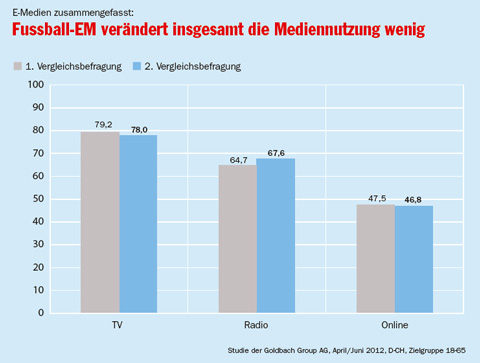
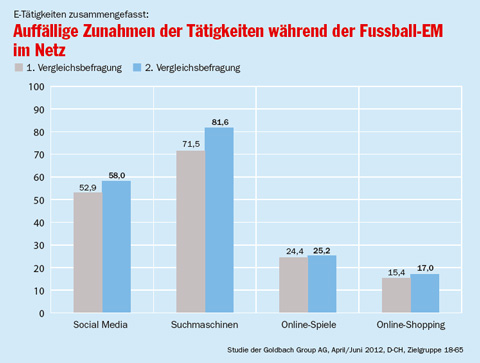
Across all target groups, the last European Football Championship only had a moderate impact on electronic media usage. Television consumption fell by 1.2 percentage points, online reading of newspapers and magazines remained constant and only radio increased slightly by 3 percentage points. However, the trends from previous surveys were confirmed in the social media sector. There was a marked increase in activity of over 5 percentage points to 71.8% among 18 to 39-year-olds compared to the comparative measurement before the start of the 2012 European Championship. Search engines were even used 10 percentage points more than in the comparative period and by over 80% of all web-active people. However, the European Football Championship had no influence on popular online gaming or shopping. This is in stark contrast to the use of Internet television, where the European Championship had a significant impact. Internet TV channel Wilmaa recorded growth of 2.3 percentage points to 31.1%, while competitor Zattoo even increased by 20.2 percentage points to 47.5% in the same period.

em

- Across all target groups, the last European Football Championship had only a moderate impact on electronic media use.
- TV consumption only decreased by 1.2 percentage points compared to the measurement before the European Football Championship.
- Radio still managed to gain almost 3 percentage points.
- Online reading of newspapers and magazines remains virtually unchanged at around 47%.

em2

- Social media showed a marked increase of 5 percentage points during the European Football Championship compared to the first comparative measurement before the European Championship.
- Search engines are even used 10 percentage points more than before.
- In contrast, the European Football Championship had no impact on the use of online games, which amounted to around 25%.
- The same can be said of online shopping with around 17%.


Werbewoche survey: Six theses on media policy

In the current print edition of *Werbewoche*, we have compiled the most important topics related to media policy. By the end of summer vacation, we want to know how these principles are received by representatives of the media and, above all, the advertising industries.

Issues relating to media policy will increasingly be on the agenda again in the near future: A draft for a new radio and television law is currently undergoing consultation (until the end of August) and the Federal Council has ordered an "overall view of the Swiss media landscape from a regional media policy and overall media policy perspective" together with corresponding "funding concepts". In the current print edition of Werbewoche, we have therefore published the most important questions on this topic and concentrated on these six theses:

1. what the market is obviously capable of delivering no longer needs to be financed with public funds.

2. if private companies are unable to produce content that is in the interest of the country, the federal government may support their production in whole or in part, regardless of the media genre, for which performance contracts are tendered and awarded.

3. a new media policy should be financed via the federal budget. If necessary, the value-added tax can be increased for this purpose.

4 The current draft for a new RTVA is not compatible with a future-oriented media policy and must therefore be rejected.

5 Instead of a patches policy, there needs to be a comprehensive debate for a new media policy with a referendum on a new media article.

6. it is in the vital interest of the media industry to promote and actively shape a new media policy.

By the end of the summer vacations, we want to know how these principles are received by exponents of the media and, above all, the advertising industry. Please use our Online surveyto evaluate and comment on the theses.


To the point: Review

Before the summer break, here’s a brief, incomplete look back at the past first half of the year January: New owners. Radio Basel becomes Energy Basel. Radio Basel changes ownership—and with it, its name.

The previous sole owner of the Radio Basel Group, Karlheinz Kögel, has brought Ringier and NRJ Group Paris on board.

February: Advertiser of the Year. The 2012 Advertiser of the Year is Urs Schneider. The owner of the Mediaschneider media agency was able to accept the trophy named Egon, designed by Swiss artist Max Grüter, at Zurich's Lake Side. It was a clear victory: 31 percent of all votes went to Urs Schneider.

March: Strong result 1. AZ Medien set an astonishing pace for the industry last year. Financially, the company ended last year with a very good result. The profit of 14.9 million Swiss francs was more than quadrupled within one year. Sales increased by 4.4 million francs to 238.8 million.

April: Strong result 2. In 2011, the Tamedia media group generated the best annual result in the company's history. On balance, Tamedia earned CHF 178.8 million, 61.4 percent more than in the previous year. Weak result. The Ringier media company had a difficult year in 2011. The company closed with lower sales and less profit than in the previous year. At 1.147 billion Swiss francs, sales fell 9 percent short of the previous year's result.

May: Discontinued. As of the beginning of June, the Tages-Anzeiger no longer obtains local news from the regional newspapers Zürcher Oberländer, Zürcher Unterländer and Zürichsee-Zeitung. At the same time, it discontinued the four regional split editions. Decline. The Basler Zeitung Medien recorded a slight decline in sales last year. This still amounted to 203.8 million Swiss francs, 3 million Swiss francs less than in the previous year. The company reports a balanced operating result.

June: Young Aunt. A new era begins for the NZZ: In the future, all content will be available digitally and via all common end devices. The centerpiece is the redesigned website. In the coming weeks, users will be gradually introduced to the announced paywall.

Pierre C. Meier, Editor-in-Chief
[email protected]
 

The artist as compressor

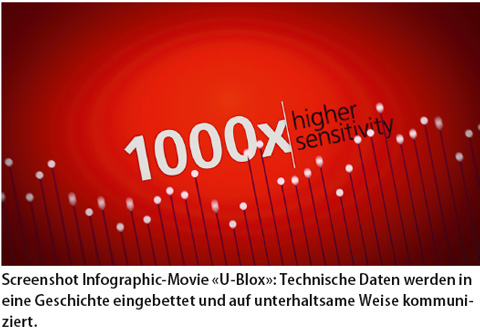
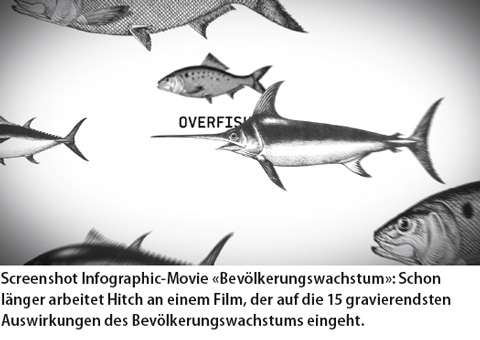
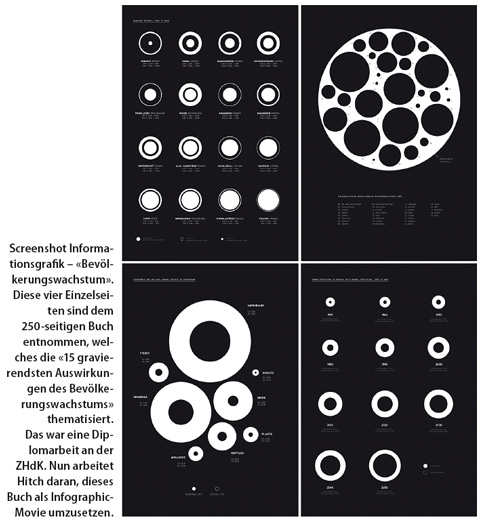
«Hi. I'm Hitch. I create infographic movies,» reads the business card of Hitch Eggenberger and his company, Hitch Design.

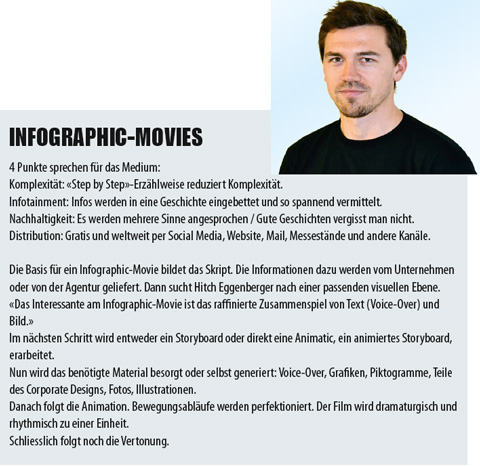
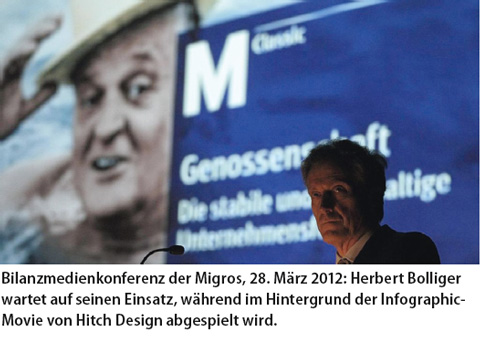
People are inundated with thousands of pieces of information every day. Much of it is unimportant. Others we should not only absorb, but also understand. One medium that can help us in this respect is an infographic movie. The latest Migros annual report is a successful example. For Migros' annual media conference, Hitch Eggenberger created a two-minute animated film with the most important business figures for the first time. A compact version of the annual report, so to speak.

"For companies that have to communicate complex and abstract information, an infographic movie is an interesting alternative," Eggenberger is convinced. An important advantage of such films: The effort for the user is minimal. "Users are lazy. A single click on the play button is all it takes and the story starts. We all love good stories and we don't forget them so quickly. The information embedded in the story also sticks better in our memory," the "compressor" is convinced. Hitch Eggenberger has been offering such a service for two years with his start-up Hitch Design in Erlenbach. He has been specializing in this area for almost ten years.

Hitch Eggenberger grew up in the Rhine Valley. As early as fourth grade, his teachers said: "Hitch will be an artist one day." Because he was also convinced of this, he looked for a suitable apprenticeship. An apprenticeship as a flat painter seemed like an "ideal foundation" to him at the time, albeit in a company that already specialized "in the decorative direction". He later switched to a proper decorative painting company and from there it was not far to the preliminary course at the ZHdK in Zurich. Hitch Eggenberger, who until then had wanted to paint pictures, discovered his fascination for information design while studying visual communication. "That set the course for me. "

Winner of the Adobe competition

During four years of intensive work in the field of information design in Zurich, the opportunity arose for an exchange semester in the USA. This was followed by an eight-month stay at SAIC in Chicago. During this time, Eggenberger also took part in the Adobe Design Archiving Awards and won a silver medal. The finalists were invited to San Fran- cisco for the award ceremony. "That was the starting point for the collaboration with Adobe." The young Swiss was commissioned to create the complete corporate design for the next competition in 2008 together with a young international team, and is still on the jury for the international competition today. Together with well-known designers from all over the world, he is on the pre-selection panel to help evaluate the almost 5,000 entries each year. "You see and learn a lot there." You also get to see what new influences come from the "youngsters", laughs the already "established" young entrepreneur.

After his success in Chicago, Eggenberger wanted to see more of the world and ended up doing an internship in Guangzhou, China. Back in Helvetia, Eggenberger began working for the Zurich Musqueteers.

The art of nesting

During this phase, he repeatedly reached the limits of his creativity. How could the ever-increasing amount of information be projected onto a surface in a comprehensible way? Eggenberger looked for ways to interweave information "so that I don't have to show everything at the same time". This problem led him to animation and ultimately to animated information films. "Here I can nest information and don't always have to show everything at once. I can guide the viewer through the information step by step and thus convey complex issues in an understandable way. "

During his subsequent Master's degree at Lucerne University of Applied Sciences and Arts, Eggenberger spent almost two years "intensively studying such films". He coined the term "infographic movie" and wrote a master's thesis on these films based on his research and analyses. Because he was convinced of the great potential of this medium, he set up his own business immediately after leaving school.

He realized the first two projects on behalf of the Identica AG agency. The Migros project was followed by a film for Swisscom - and with these two references, things have continued steadily ever since. Hitch Eggenberger does not see a larger company as his own business goal for the time being. What is certain is that he wants to focus fully on specialization and become a "top address" in the field of animated information films. Being able to work for international clients from Switzerland is a major goal. He has already been approached by the United Nations in New York. He was asked to produce an information film for the recent United Nations Conference in Rio. Eggenberger's concept made it onto the shortlist and ultimately came second. But Rio will certainly not go down in the history of infographic films as the last UN conference. Andreas Panzeri

m0
m1
m2
m3
m4
 

Sharing in the success

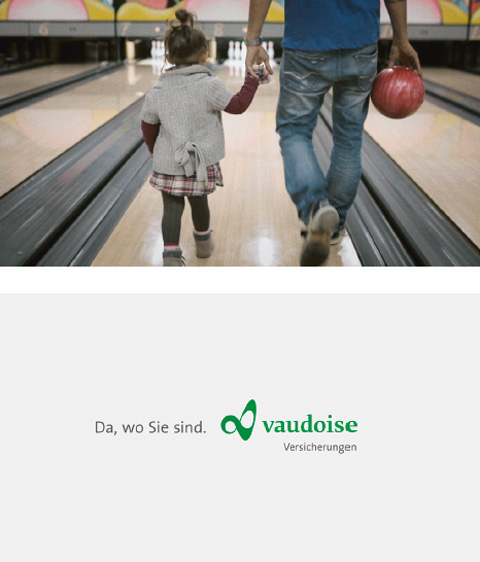
Contexta continues to refine the image of Vaudoise Insurance. Once again, the focus is on customer proximity.

In spring, Vaudoise Insurance launched a new image campaign as part of its communication offensive. The aim: to show that no other insurance company is closer to its customers. "I am Vaudoise" was the central statement with which various customers declared their loyalty to their insurance company. Now the Bern-based advertising agency responsible, Contexta, is following up with a TV commercial.

Once again, Vaudoise's proximity to its customers is being showcased. This time, the focus is on the cooperative roots. The current TV commercial draws attention to the fact that the insurance company is giving its loyal customers a 15 percent reduction in premiums in 2012 thanks to a good financial year. The spot focuses on those who win - the policyholders themselves. "Being Vaudoise means benefiting from the success of your insurance." The commercial was designed as a cost-effective collage of the staged image commercials and accompanied by a voice-over. This should not only ensure a high level of brand recognition, but also "30 seconds of great cooperative emotional cinema", according to the advertisers. imp

cont
cont2

Last but not least: "Not so cool"

Apple accuses Samsung of drawing a little too much inspiration from the iPad when developing its Galaxy tablets. A British judge has ruled that these allegations are unfounded, which naturally pleases Samsung. However, the company is likely not too happy with the judge’s reasoning.

The British court has ordered Apple to publicly apologize to Samsung - the months-long debate about the alleged infringement of design rights could have damaged Samsung's image, according to the judge's reasoning. Samsung should be satisfied with this. The company will probably be less satisfied with the judge's reasoning as to why he considers Apple's accusations to be unfounded: There is no likelihood of confusion between the devices if only because Samsung's tablets are "not as cool" as Apple's, he says.

If Apple cleverly integrates this quote from the judge into the apology, the company could even end up looking like a winner - despite losing the case.
 

get_footer();