Wirz seeks flavor designers for Terra Chips

Who will create the perfect flavor for the new Special Edition of Terra Chips? Wirz Werbung is letting customers answer that question—with a flavor contest.

At Terrachips.ch participants can compose their own chip flavor from over 100 virtual ingredients. The best creation is selected by a jury of experts, produced for sale at Migros and the winner receives 1 percent of sales. According to the agency, the new edition of last year's campaign brings taste into the digital world in a surprising way: the submitted creations are automatically converted into animated flavor images and presented to the user. In addition, a unique sound image is created from the composition of the ingredients.

Responsible at Bischofszell Nahrungsmittel: Helen Marti (Head of Marketing Services), Remo Manz (Business Unit Manager Marketing & Sales). Responsible at Wirz: Markus Schärer, Philipp Skrabal (overall responsibility), Tanja Jablanovic, Winfried Schneider, Marco Zimmerli, (creation), Amir Ferhatbegovic (consulting), Ramon Tuero, Marco Zuber (motion design), Pascal Beyeler, Ralf Brändli, Ursula Christen, Sven Scheuermeier, Sam Sherbini (technology), Alex Kirschner / Kirschnermusic, Beda Wermelinger (sound).
 

Full TV fees despite excessive advertising

Even those who are annoyed by too much advertising on television must pay the full reception fees. Although the Federal Administrative Court rejected the complaint of a Billag customer, it did at least show some understanding for his request.

In 2010, the person concerned asked Billag to reduce his radio and television reception fees because they were excessive in view of the large amount of TV advertising. He returned the annual statement for 2011 on the grounds that a third of the program consisted of advertising that was of no use.

After Billag and then the Federal Office of Communications (OFCOM) ordered him to pay the full fees, he appealed to the Federal Administrative Court. As was hardly to be expected, the judges in St. Gallen have now also rejected his appeal.

Making representations to SRG

According to the ruling, anyone who owns a device that is ready to receive must pay the full fee regardless of what is offered. At least the court concedes that the request is not completely without interest. However, he should have chosen the "right channel" and contacted the SRG directly. The judges also pointed out to him that there are already interesting advertising-free television channels that are operated by the SRG itself or in cooperation with foreign broadcasters. In addition, most SRG broadcasts can be viewed on its homepage, where online advertising is prohibited. (sda)

The community decides here

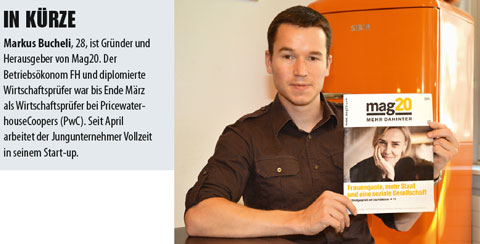
Under the title Mag20, young entrepreneur Markus Bucheli has launched a magazine experiment. He doesn’t need an editorial team for this. At the heart of his project is an active community that writes, rates, and selects articles for the magazine.

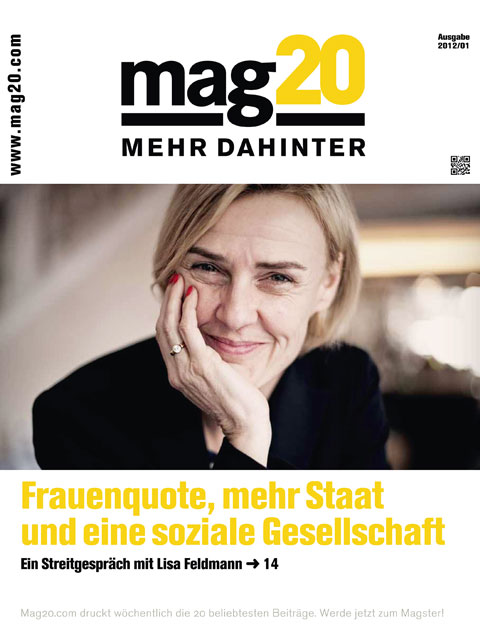
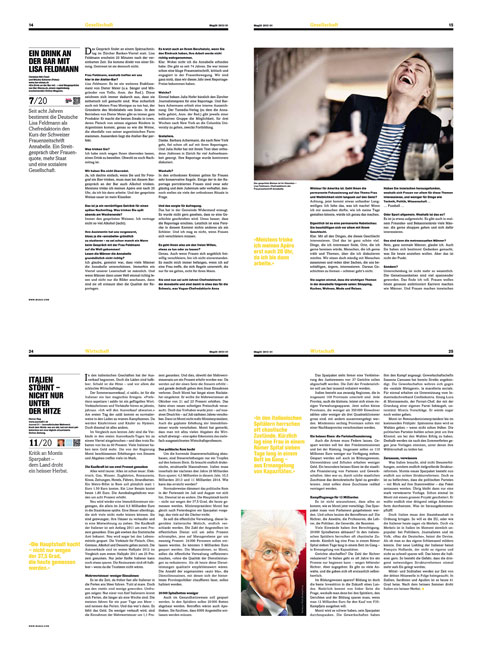
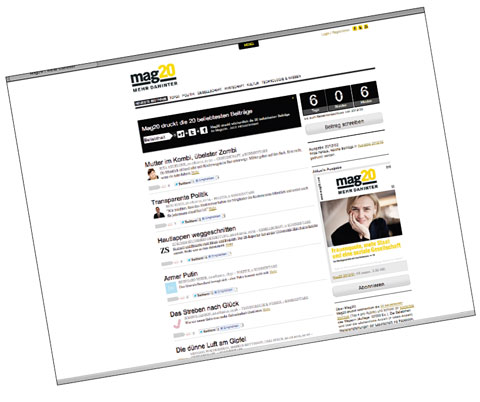
Last Friday was the first time. In addition to the familiar free titles that commuters encounter at train stations, there was a new magazine. A 46-page magazine with articles on politics, society, business, culture and knowledge. The cover reads "Mag20 - More behind it". A title that already reveals a lot about the new media project of former auditor Markus Bucheli. "20" stands for the number of articles in the weekly magazine, "Mag" for magazine. "More behind it" indicates that there is no editorial team behind Mag20, but an entire community. Unlike most print products, it is not journalists who contribute the content here, but the users themselves. The core of the experiment is the platform Mag20. com. This is where the authors upload their articles. At the same time, the website lays the foundation for the print product, because on Mag20.com the community decides which texts are printed in Mag20. The criterion is the number of recommendations an article receives on Facebook, Twitter or Google+. In this sense, the "Mag" in the title is equally to be understood as an allusion to "I like" or more aptly "I like".
 
As a crowdsourcing project, the magazine experiment stands and falls with the community, the number of authors and users who actively participate on the platform. At the start, Bucheli is primarily concerned with attracting as many authors as possible. Bloggers, scientists, politicians, students, professionals, but also journalists who publish their articles on Mag20.com. In addition, Mag20 receives articles from media partners who gain a wider reach through their presence on Mag20 - including Blogwerk, dieperspektive, Journal21, Politnetz, Schweizer Monat, The Brander and Transhelvetica. To make Mag20 known to a wide audience, the print magazine will be distributed at train stations on Fridays. In addition, advertisements are running on media partner Radio 105 until the end of the year, enticing listeners to the website with the prospect of a voucher from the online bookshop Storyworld.
 
On the one hand, the project is financed by advertisements in the print magazine. On the other hand, the young entrepreneur was able to convince the Bernese lawyer Georges Bindschedler, who is also an investor in the Basler Zeitung BaZ, of his project. The magazine experiment should be secured by the end of 2013 and the operating, printing and distribution costs covered for the time being. Subscribers currently represent an unsecured source of income. The majority of the 50,000-copy circulation reaches readers free of charge via distribution. Likewise, no money comes in when users order an e-paper subscription on the website. Readers only have to pay to have the print magazine delivered by post. However, the profit margin - if any - is likely to be minimal. After the postal subscription was announced at CHF 119 in an early phase of the project, the price for 52 issues is now set at CHF 52.
 
Bucheli explains the both-and strategy for the payment model and other specifics of the project in an interview.
 
Isabel Imper


"We rely completely on the reader"
Interview with Markus Bucheli (28), founder and publisher of Mag20.
 
WW: Mag20 does not offer exclusive texts, but uses contributions from the Mag20 website. Why should anyone pay for texts that are available for free?
Markus Bucheli: I think there are still people who appreciate the haptic experience and like to read something on paper - without this backlighting. That's why it's worth ordering a subscription. Another advantage is that, unlike the website, all the articles in the magazine are proofread, beautifully edited and supplemented with a series of pictures by an artist.
 
However, I also have these advantages when I use the free e-Paper subscribe and print ...
Absolutely. That is also allowed. But anyone who appreciates the added value of receiving the magazine printed out and beautifully presented every week should be prepared to pay for it. The Post subscription is a classic premium model. The number of e-paper subscribers will probably always exceed the number of Post subscribers. However, we already have a surprisingly high number of Post subscriptions.
 
How many?
At the moment there are around 61, and we currently have a total of around 545 subscribers - just a few days after the website went live. I'm looking forward to seeing how it develops.
 
Which target group do you want to reach with the print product?
At the moment, the majority of copies are distributed free of charge at train stations. We reach active people there - including students and working people. Our target group is between 18 and 49 years old. Men and women should each make up 50 percent of our readership. We are aimed at people who appreciate having something of high quality in their hands. Mag20 offers content that I don't see every day.
 
Do the distribution campaigns only take place at the launch or are they continued afterwards?
The distributions will be carried out until further notice. All 20 or so distribution lists are fixed - with a three-month notice period. The reason behind the campaign is a promotional effect. We want to get people onto the platform as quickly as possible - and gain subscribers.
 
So you have two target groups in mind: those who read the magazine and those who actively participate on the platform, right?
Absolutely. We follow Jakob Nielsen's 90-9-1 rule for user behavior on websites. It states that 90% of users read and watch, 9% interact from time to time and only 1 % contribute content. In our case, that would be 90% who read the magazine, 9% who comment from time to time or recommend something via Google+, Twitter or Facebook. And finally the 1% who write articles. With the last two groups, we will maintain communication that is as personal and direct as possible. In my opinion, this is central to this magazine experiment, as Mag20 needs a large and high-quality community. 
 
Otherwise, you have a few users who determine how the magazine looks ...
Exactly ...
 
What is the goal: How big should the community be?
We have not defined a number. The aim is to gain as many users as possible...
 
You have not set a minimum?
No, there is no limit. However, I am optimistic due to the interest that already exists - the many contributions that have been written.
 
Mag20 does not have a content focus. Are there guidelines as to what kind of contributions are accepted?
In terms of content, we rely entirely on the reader. We print what the reader likes. There is a certain amount of channeling through the sections - classic newspaper sections such as politics, society, business, culture and knowledge. These are designed to optimize reading behavior. This means that the reader reaches the content that interests them relatively quickly.
 
Mag20 wants to differentiate itself from titles like 20 Minuten. But perhaps users like what they find in the free papers. The article "The snoring of men", for example, was very well received on Mag20.com...
I find the article about snoring interesting. It's a problem we've all had to deal with at some point. Even in established magazines, you can always find articles that make you smile. I think it's important to have interesting articles. But they can certainly be entertaining. It doesn't always have to be the pure seriousness of life.
 
As an editor, don't you wish you had more say in the content?
No. This is precisely the core of the experiment and the exciting thing about the concept. I deliberately don't want to interfere. However, it is important to me not to have anything unlawful and to comply with the media ethics guidelines of the Press Council. If an article does not comply with the author guidelines - because it is too PR-heavy, for example - we pull the lever.

In what way?
The articles will not remain on Mag20.com. Instead, we publish them on Dismag20.wordpress.com - including the reasons why they contradict the guidelines. Our decisions are transparent.
 
Back to the magazine: If Mag20 is largely available free of charge, is the magazine mainly financed by advertising?
The hope is to be able to strengthen the subscriber base in the medium term and thus reduce dependence on the advertising market. Advertisements alone do not bring in enough money. However, the authors should receive remuneration for printed articles and be compensated for their time and expenses, which is why we give them a 50% share of our annual profit. I believe that offering a purely free product in the long term is not conducive to quality.
 
A bold strategy: Publishers also initially offered their news online for free and are now hoping to make money. Once readers have become accustomed to a free product, will they spend money on it later?
We operate a different model to the current providers. The media companies initially released all their content. Now they're scaling back a bit. They are creating pay walls with the effect that users are not prepared to pay for the added value and even leave the platform if possible. With Mag20, on the other hand, the content is accessible everywhere. People who want the added value of a physical magazine, the haptic experience, buy a subscription. But they get the same content.
 
If you focus on the feel, wouldn't a glossy magazine be appropriate?
Of course, we thought about which direction to take. First we went for ordinary newsprint. Then we had the idea of going for a glossy magazine. But we decided against it because it would not have been financially viable with the current model - free distribution. We chose a middle way with the improved newsprint. I like it a lot. But who knows: it's an experiment. And as with any experiment, there may be adjustments from time to time.
 
Where does Mag20 stand at the end of 2013?
My aim with Mag20 is to contribute to more media diversity. The magazine should be a tool that allows society to have a say in the public debate. Users can already do this on the web - on blogs, for example. With Mag20, they should also have the opportunity to do so outside of the Internet. Print still has a good reach.
 
Have you set yourself a target in terms of circulation?
Absolutely not. That will develop. For me, the reader is at the center of it all. They can tell us what they think is relevant - and we will continuously optimize. I believe that if something is right at its core and is continuously optimized, circulation and reach will come naturally.
 
Interview: Isabel Imper

mag20-03-00
mag20-02
mag20-03
mag20-01

Level Two: Simon Ammann promotes Helvetia Insurance

Ski jumper Simon Amman introduces Helvetia Insurance as an employer and gives a personal tour of the entire company. Helvetia Insurance chose Level Two as its production company.

The agency's tasks included the conception and filming of the presentation, as well as the programming for the Helvetia homepage.

Simon Ammann's tour of Helvetia Insurance can be seen on Helvetia.com.

Responsible at Helvetia Insurance: Roger Gander (Head of HR Service Center), Renato Fischer (Marketing Communications Manager Branding Switzerland). Responsible at Level Two: Gregor Rott (concept and overall responsibility), André Schneider (camera), Christian Rüeger (3D and graphics), Jan Rieder (sound), Tanja Gandit (programming).
 

The big chance for the little ones

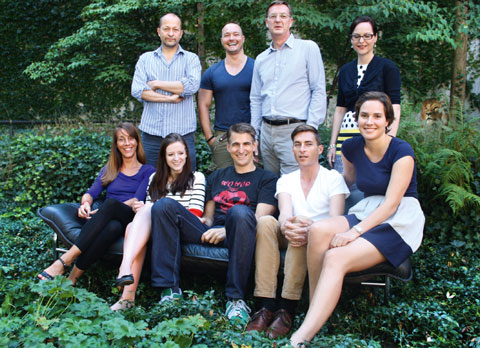
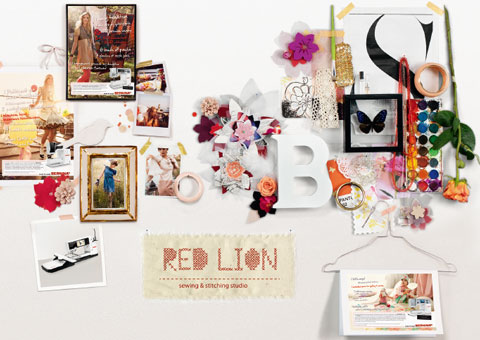
Publicis has founded a new offshoot in Zurich. Red Lion is an agile hotshop with a large network behind it. Sacha Moser is CD. Christian Siegrist managing director.

When you're on the rail of an ocean liner high above the sea all the time, you have a different perspective than on a small speedboat. There is a lot of power in a steamer. But a change of course has to be planned for the long term. A speedboat can react much more agile. Wisdom from the maritime world - but it also applies to advertising around the current economic situation in a landlocked country. "This allows us to offer the advantages of a small agency with the backup of a large agency," says Christian Siegrist, summarizing the analysis that led to the founding of Red Lion at Publicis on July 1.

The concept is not entirely new. Spin-offs called Red Lion are also exploring new avenues for Publicis' network in other European countries, as well as India and Brazil. "That's what inspired us. We believe the time is ripe for such business models," say Sacha Moser and Christian Siegrist, explaining their initiative for such a "speedboat" in Switzerland as well.

Sacha Moser was Senior AD and Associate CD at Young & Rubicam New York before Kaspar Loeb brought him back to Zurich as CD at Publicis in 2005. Prior to his five years in New York, Moser worked for two years at Y&R in Puerto Rico. Sacha Moser entered advertising as a 14-year-old teenager with a trial apprenticeship. He consistently pursued his path via the School of Arts and Crafts and an apprenticeship as a graphic designer at DDB. After brief intermezzi in Paris and with Rainer Kuhn, he finally turned professional with a "great offer" at Advico, where Moser was promoted to AD at the age of 23 before his career found its suave continuation overseas.

Christian Siegrist has been "touring advertising agencies" for 30 years. He started in Basel at the small agency Roger Meyer, followed by Ogilvy Küsnacht and eight years at GGK in Basel again, before returning to Küsnacht to the former GGK of Hermann Strittmatter. Siegrist was allowed to transfer to GGK in Paris to look after IBM's budget. From there, on a personnel level, it was a close step to Reini Weber's WHS, "which at that time was a kind of continuation of GGK." Because he "wanted to experience it harder for once", Christian Siegrist then "changed fronts " and looked after McDonald's budget for almost four years at McCann in Geneva. "Harder," he says, because this advertising was no longer driven by beautiful creation, but had to be based on hard-nosed market figures. For Siegrist, that was the challenge he was looking for. "Every Monday, there was a report on what had happened at the register the previous week."

When IBM's budget moved to Ogilvy in the meantime, this client wanted to work there once again with his proven contact Siegrist. This resulted in four years at Bergstrasse in Zurich, before Publicis followed, where Siegrist has now been working for 14 years. The last three of them as COO. "I'm not one to change all the time."

The now internal "change " to Red Lion is a very motivating step for both Siegrist and Moser. "I've always enjoyed building new things," says CD Sacha Moser happily. Managing Director Christian Siegrist says: "I can now do again what I actually got into this profession for." In a house with over 140 employees, he says, as COO he was inevitably "more concerned with finances than with customers and advertising." Now it's back to the creative business. For their "own" agency, the management duo has only two people in charge: board president Fredy Collioud and Curdin Janett, who represents the entire group as CEO of Publicis. "Otherwise, we are not accountable to anyone." The Red Lion team also works in its own "storm-free" rooms and with its own server.

In terms of growth, of course, it makes no sense for Red Lion to compete with the parent company with its own size. The spin-off should remain a boutique. Up to 17 people is an ideal target. "We want to be able to appear owner-managed. All our people are in direct contact with the customers." Their "allocation" between Publicis and Red Lion has nothing to do with size. "It's about the style they want," Siegrist says. And Moser can reveal that Red Lion has already won a pitch for an international law firm with this approach. Red Lion has also scored a special kind of win when it comes to furnishings. The young "startup" found the sofa for the meeting room for little money on Riccardo. Only when it was delivered did it turn out that the furniture had previously been used for creative chilling at Euro RSCG.

Things didn't go so smoothly with the web address. The domain Red-Lion.ch belongs to a Chinese restaurant in Kloten. Although Moser and Siegrist had a good negotiating position there for a while as "regulars", the Chinese finally did not want to sell. Instead, www.red-lion.com was free for bidding. An amazing coincidence. After all, the "red lion" is associated worldwide with a symbol of mythical success and mysterious strength in a wide variety of fields.

Andreas Panzeri

redlion
redlion2
 

Radio 1: Roger and Roger go on tour

Radio 1 and *Die Weltwoche* have decided to hold the «Roger vs. Roger» talk show regularly in front of a live audience in the greater Zurich area going forward.

On Monday, September 3, 2012, "Roger gegen Roger on Tour" will be a guest at Club Bolero in Winterthur for the first time. Radio 1 boss Roger Schawinski and Weltwoche publisher Roger Köppel will cross swords and engage in their usual exchange of blows on the current topics of the week for around 45 minutes. The successful talk show has already been held live in front of an audience twice in its two-year history. The live broadcasts differed from the studio show in that they involved active audience participation and lasted almost twice as long.
 

Notch Interactive: Book and website for Greencity

Notch Interactive is promoting the office spaces being developed in the new Greencity urban district in southern Zurich through a mailing campaign and a new website.

Numerous national and international companies are already located in the south of Zurich. In Zurich Manegg, on the site of the former Sihl paper mill, a new urban quarter is now being built with 67'000 m2 of office space.

Greencity is the ideal office location for progressive and future-oriented companies, according to a statement. The mailing, which Notch Interactive designed and implemented on behalf of Losinger Marazzi, focuses on this message. The high-quality book highlights the benefits to companies that want to consolidate their corporate locations in this central location, the release adds. With juxtapositions of old and new photos of the site and with a clear, architecture-oriented design, the book addresses important topics such as innovative office space, modern working environments or the aspect that Greencity is the first urban quarter in Switzerland to meet the criteria of a 2000-watt society.

The new website also takes up these themes and guides through the new urban quarter with animated graphics. While the new site is being built, the website will also develop step by step and thus always be up to date with the latest construction projects.

Responsible at Losinger Marazzi: Jürgen Friedrichs (Head of Real Estate Development Zurich, Deputy Director), Ulrich Blessing (Group Head of Real Estate Development Zurich), Nicolas Jauslin (Project Manager Marketing German-speaking Switzerland). Responsible at Kuoni Mueller & Partner: Philippe Mueller (partner at KM&P), Katharina Reimann (real estate marketer).Responsible at Notch Interactive: Peter A. van der Touw (overall responsibility), Roger Oberholzer (strategy), Martin Pfeiffer (producing), Jeff Gerber (creative direction), Marco Klein (art direction), David Elmiger (concept, text), Angela Erni (design), Tobias Fuhlroth (technical direction), Matthias Meier (interface programming), Bastian Ballmann (application programming), Mathias Tanner (consulting), Julia Grolimund (consulting), Sandro Müller (consulting), Paolo Emmanuele (photography), Detail AG (lithography).

book02-large
book04
Website01
Website08
 

Three new customers for Flowcube

Flowcube Communications Adds New Clients: The agency has been commissioned to handle public relations activities for the Benci Brothers and Wear Lite brands, as well as for the tourism organization Genève Tourisme & Congrès.

The mandates from shoe brand Benci Brothers and eyewear lens manufacturer Wear Lite include management consulting, corporate communications, product PR and press office support. For Genève Tourisme & Congrès, Flowcube covers special projects and all press relations in German-speaking Switzerland.
 

Contcept Communication: New customers in the portfolio

The Zurich-based communications agency Contcept Communication is pleased to announce three new clients: 3M, Babyliss, and MrLens.

Contcept Communication is now responsible for the media and PR work of 3M (Switzerland), based in Rüschlikon. In addition, the agency has won the mandate of the Babyliss brand. The agency will support Babyliss in Switzerland primarily in the area of product PR. Another mandate addition is MrLens. The online service provider for lenses, glasses and other consumer goods celebrates its 10th anniversary this year. Contcept Communication is now MrLens' Swiss press office.
 

French-speaking Swiss radio with 16 new programs

Since Monday, the French-speaking Swiss radio station has been offering 16 new programs on its «La Première» channel.

These include, for example, a new program with long reports, a satire program and a long interview on weekdays as part of the cultural magazine "Vertigo". Several new programs were also introduced on the second channel "Espace 2". By contrast, the Couleur 3 channel underwent only a few changes.

Gilles Pache, Program Director at Radio and Television of French-speaking Switzerland (RTS), told the media on Wednesday that the aim of the program change was to take account of the living conditions and listening habits of radio listeners in French-speaking Switzerland. There have been no major program changes since 1999. (SDA)
 

Gürth Design advertises Tonhalle Late

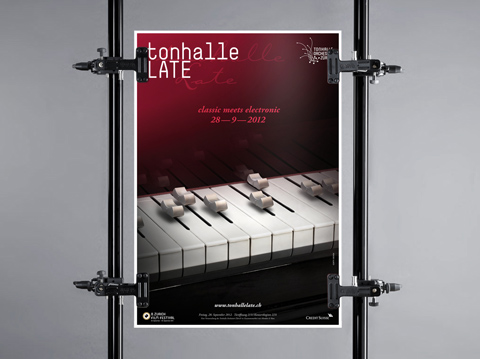
The Zurich-based agency Gürth Design was once again commissioned by the Tonhalle Orchestra Zurich to develop the concept and design for the Tonhalle Late advertising campaign.

The image series was continued for the upcoming event at the end of September, as the agency writes in a press release. The combination of the themes "classical music" and "electronic music" will be visually staged. The concert event will be advertised with flyers and posters.

Responsible at Tonhalle Orchestra Zurich: Michaela Braun (Head of Communications and Marketing), Mara Corleoni (Project Management Tonhalle Late). Responsible at Menden & Roos: Marc Menden and Ralph Roos. Responsible at Gürth Design: Emanuel Gürth (Creative & Art Direction).

late1
late2

Operhaus Zürich: New press officers

Julika Weinecker and Madeleine Wohlfahrt are now responsible for media relations at Zurich Opera House.

Julika Weinecker studied General and Comparative Literature and Cultural Studies at the Justus Liebig University in Giessen before working in the press office of the Staatsoper Unter den Linden Berlin for almost four years. She then moved to the communications agency van Almsick and worked as PR manager for concerts and tours of national and international artists. With immediate effect, she has been appointed press officer for opera and concerts at Zurich Opera House.

Madeleine Wohlfahrt studied journalism and media research at the University of Zurich. She then worked in the PR department of Coca-Cola. As Publicity Manager at The Walt Disney Company Switzerland, she was responsible for the communication of Sony Pictures films. She is now working as Press Officer Ballet at the Zurich Opera House.

(Teaser image: Keystone)

get_footer();