Evoq designs customer mailing for Ringier Print

With a "magic newspaper," Ringier Print aims to show how a print product can easily surprise its readers. Evoq designed a mailing campaign for this purpose.

Step by step, the Ringier Print newspaper specialists explain their personal magic tricks. Be it with a surprise effect thanks to the fold-out newspaper format or with the removable self-adhesive label "Newspointer". At this point, the reader immediately becomes part of a magic trick and draws a playing card directly from the newspaper out of Thomas Akermann's hands. Afterwards, the card trick will be solved in a video via cell phone and QR code. Of course, the participants will not go away empty-handed. Among them, an evening with company at the Broadway Variété Theater will be raffled. You can take part in the competition at Ringierpring.ch/competition.

Evoq was responsible for the overall concept of the mailing, while Ringier Print handled its implementation.

Vresponsible at Ringier Print Adligenswil: Thomas Akermann, Rita Krummenacher (project management), Claudia Trinkler, Nadine Zuberbühler (design), Simon Bolzern (photography). Responsible at Evoq: Adrian Schaffner (mandate management), Michael Willisch (consulting, concept).
 

Marxer/Schneider: Bringing the Palais Liechtenstein to Liechtenstein

The Liechtenstein National Museum is presenting the special exhibition «1712 – The Making of a Nation.» To do justice to the «Baroque» aesthetic of 300 years ago, freelance graphic designers and art directors Matthias Marxer and Gregor Schneider developed an exhibition concept.

This is intended to do justice to the pomp and the need for representation of the time as well as to the treasure chambers and display stages of the nobility and well-off citizens, which were filled with treasures and curiosities from the known world of the time. For the special exhibition 1712, the designers Mathias Marxer and Gregor Schneider created a complete corporate design that can be consistently implemented in all advertising materials and media.

Responsible at the Liechtenstein National Museum: Rainer Vollkommer and Donat Büchel. Responsible at Mathias Marxer Est: Mathias Marxer (art direction/concept). Responsible at Gschart: Gregor Schneider (Art Direction/Concept). Responsible to Reinold Ospelt: Heinz Beck. Responsible at Typico GmbH & Co KG: Birgit Baumann and Yasar Yenilmez.


Goldbach Group: Use of electronic media declines during Olympics

The third comparative survey of the Goldbach Group's Electronic Footprint Study depicts the user behavior of consumers with regard to electronic media and online activities during the 2012 Summer Olympics in London. Compared to the last survey conducted during the European Football Championships in June of this year, there was a decline in the use of all electronic media.

Vacations, good weather and perhaps also personal sporting activities competed with the use of electronic media during this year's Summer Olympics. This is the conclusion drawn from the results of the latest comparative survey, according to a Goldbach Group press release. Across all target groups, the use of electronic media declined during the Summer Olympics compared to the European Football Championships. Television consumption fell by 2.9 percentage points overall, with a slight increase of 1.5 percentage points recorded only in the 18 to 39 age group.

A similar picture emerges for Internet TV. Only Wilmaa was able to maintain the usage level of 31.3% achieved during the European Football Championship, Teleboy lost around 11 percentage points and Zattoo recorded a decline of a full 20 percentage points. Online reading of newspapers and magazines also fell by 3.5 percentage points, with the exception of men, who increased their electronic reading consumption by 4.6 percentage points. Radio use was a full 5.4 percentage points lower than in the same period of the previous year. There was also significantly less online activity.

Following the increase during the European Football Championship, social media fell again by 2.9 percentage points. Access to search engines fell by 6.3 percentage points and online shopping also lost 1.9 percentage points. Detailed results of the Electronic Footprint study and the latest data for TV, radio, teletext, ad screen, internet TV, performance marketing, in-game advertising and mobile marketing: www.goldbachgroup.com.
 

TBWA\Zurich brings Aperol Spritz on everyone's lips

Just in time for the nice weather, Campari Switzerland and TBWA\ Zurich are bringing the summer drink Aperol Spritz back on everyone's lips. The campaign was launched with spots in open-air cinemas, followed by posters and advertisements throughout Switzerland.

Thanks to the possibility of widening the subjects as desired, it was also possible to flexibly design extreme horizontal formats, as well as double and triple occupancies. In addition to the flagship drink "Aperol Spritz", which is prominently featured here, the current campaign also aims to increase the popularity of the Aperol brand.

And for those who still do not know how to mix an Aperol Spritz, in the Cinema spot as well as on complementary POS materials also explained at the same time the preparation.

Responsible Campari Switzerland: Sibylle Rauber, Pierina Maibach. Responsible TBWA\: Frederick Rossmann, Johannes Dörig, Samuel Wicki, Cla Campell (Creation), Matthias Kiess, Edith Swiezy, Eunike Pilz-Heil (Customer Service), Christina Buergin, Agnes Meier (Art Buying/Production).


Newsjacking: Teletext creates the perfect news environment

It’s moving at breakneck speed: News has never spread as quickly as it does today. Media alerts, Twitter, Facebook—within minutes, headlines (and rumors) are circulating around the world. Swiss Teletext, too—ever since its founding in the 1980s—has always been right in the thick of things. And it picks up on hot topics every minute.

Records - thanks to real-time information

Big events make big waves and attract masses of visitors. This year on June 10, for example, when the European Championship, the election to the French National Assembly, the French Open and Formula 1 were running in parallel, 1.4 million users checked Teletext. Or on March 11 of this year, when 1.5 million people used Teletext to find out how the votes on 6-week vacations, fixed book prices and the construction of second homes turned out. Impressive figures, an impressive pool of new customers too - for advertisers who want to produce cutting-edge content and seize the opportunity.

At the pulse of the action

And the best way is to grab them by the topic itself. What PR strategists today refer to as "newsjacking" - the split-second reaction of companies or personalities to current events with in-depth facts via blog, tweet or media alert - has long been familiar to Teletext. If something big, exciting or unusual happens in the world, contextual information can be found on Teletext - in real time, of course. And Teletext has long since jumped on the mobile fast train: Information is also available on the Internet and for smartphones via the mobile platform or the Teletext app. In total, Teletext generates over 55 million contacts per month. And that means: advertising and information space par excellence.

Perfect timing - great response

Anyone who is present on Teletext with content on hot topics reaches an enormous frequency. Let's think about the price of oil: is it going up or down? How is the volatile political situation in the Middle East developing? Teletext provides impulses - and the appropriate trend reports and purchase recommendations from resourceful energy suppliers, for example in an info column. Or take the heat wave of the last few weeks, when the summer really heated us up again. Experts urge us to protect ourselves from the sun, recommend cooling drinks and take preventive measures against high ozone levels. Teletext creates the ideal environment for prevention information and tips, for example when buying sun cream. The association is perfect. Not to mention London 2012: 1.1 to 1.2 million people were constantly watching Teletext - not least during Nicola Spirig's dream performance. Strong figures from Biel surrounding a strong performance by the triathlete from Winkel ZH. What the Olympic experience shows in particular: There is no better and faster way to get your health tips, heart rate monitor or jogging shoes across to men and women. It's all a question of timing, the right message and the credible, thematic added value you have to offer. Newsjacking generates such a big response with little effort. "The Schnäller isch der Gschwinder": the competition for the most cleverly filled containers on Teletext is on.

Like a wildfire around the world

Speaking of which: the London firefighters, who are considered the inventors of Newsjacking 2.0, so to speak, already knew this. The story behind the story: Last summer, Kate Winslet was staying with Sir Richard Branson on his British Virgin Island. A fire broke out during the festivities. Kate Winslet rescued Richard Branson's elderly mother, which led to worldwide stories. However, there was not a single correspondent on site who could have provided pictures. So the London Fire Brigade (LFB) stepped in by inviting the actress to a training program for firefighters. The short story on the LFB website - cheap and quick - spread like wildfire. Worldwide.

Beat U. Schneider
Head of Marketing and Sales
SWISS TXT Swiss Teletext AG
www.swisstxt.ch

txt_0
 

To the point: The quite normal insanity

After three weeks of vacation, two of them abroad with only sporadic consumption of Swiss media, I'm somewhat surprised at all that has happened in the media industry. Nothing about sour pickle time.

Once upon a time, there was the embarrassing advertisement of the Valais Messenger, which praised its editors as PR authors in an advertisement. Original quote: "We Valaisans are helpful people. That is why the authors and editors of Mengis do not only write for Mengis. So they write for the Valais Messenger or well-known customers and people." Peter Studer, former president of the Press Council, found clear words in the DRS-4 interview: "It's the most blatant case I've encountered so far, namely that a publisher and an editor-in-chief virtually offer this mixing of journalism and advertising on an advertisement page and are still proud of it." Press Council Secretary Martin Künzi, on the other hand, tells Infosperber that "the Press Council does not take action on the basis of a simple complaint. For this, a written complaint including reasons and documents to the Press Council is necessary. The Press Council would only become active on its own "very exceptionally" in specific individual cases. Most likely, if it is about general topics/media developments. Aha, that doesn't seem to be the case here.

Another self-advertisement caused a stir: The NZZ was looking for the polyvalent "Volontär Wirtschaft" (Business Trainee), who, with an assignment of six months each on the business editorial staff of the newspaper and in the communications department of Economiesuisse, would be given the opportunity to help shape reporting on companies (in the newspaper) and to be editorially active in business campaigns (for the association). Bravo! New journalists are what the country is looking for.

Then there was the speculation of Infosperber journalist R.L., who wished to remain anonymous (also not so fine), according to which Markus Somm was to be Markus Eisenhut's successor at the Tages-Anzeiger. What was to be expected happened: The commentary irritants Somm and Blocher led to fierce battles of words in the comments of Infosperber, which as usual had nothing to do with the article.

At first glance, the interview comedy with the Degen twins, which Christian Nill, editor of the online magazine Bar-Stories.ch, made public, was rather amusing. The interview was amusing, but the demands for retraction and threats of litigation by the two kickers, seconded by the FCB, were problematic. The fact that Blick had to apologize publicly to the former party animal Hirschmann is then only a trifle. The Swiss media world has me again.

Pierre C. Meier, Editor-in-Chief
[email protected]
 

Impaled: The hole of the summer

Anne-Friederike Heinrich, freelancer for Werbewoche, on the spasmodic reporting during the warmest time of the year.

On Saturday, when even Zurich's Niederdörfli district and the shores of Lake Zurich look like they've been hit by a nuclear attack and the most insane building sites spring up on the streets without a single construction worker to be seen, we find ourselves in the biggest and darkest hole in the world: the summer slump. Kilometers deep, dusty and completely dry - year after year.

The brains of some (unfortunate) journalists who are not allowed to leave the (unair-conditioned) editorial offices during this time of drought also seem to be parched, so that the (poor) subscribers who cannot go on vacation get the impression that a newspaper is also published in summer. But what bears this name in July and August is actually just a pile of useless, printed paper that is at best suitable for sitting on in the swimming pool when the grass lets the soil through too much. Which, of course, is also a function of a paper newspaper that should not be despised. You can't do that with the iPad. Or only once.

Yogurt is cheese

Year after year, it becomes more and more curious what the harassed news seekers consider worth reporting in order to fill the summer paper: For example, some media reported on a rescue operation by the Darmstadt police. They rescued a hedgehog from a yoghurt pot - with scissors and a scalpel, if you're interested. The article said: "Using a scalpel and scissors, the officers carefully cut open the bottom of the cup to make it easier for the animal to breathe. They then cut open the sides of the vessel." Say nothing: a real whodunit. "Because the hedgehog was outwardly unharmed," it continued, "it was released back into the wild after the operation. " Where it again sought out a yoghurt pot. Unfortunately, SDA forgot to ask the hedgehog for a statement after his release - which would have been the only exciting thing about this story. You know: "Man bites dog, that's a news story."

All sausage

Another quality newspaper reported that Thailand's monks are becoming fat and ill due to unhealthy offerings. The Thai Health Promotion Authority has therefore called on the Thai population to donate healthier food to the monks. Karma is now being saved in favor of the slim line. After all, the fatter and sweeter the offerings, the better off the deceased in the afterlife, for whom the monks are supposed to pray. At least that's what the Thais believe. It could simply be that the monks don't want to spend hours bobbing in a trance with muesli bars. And that Buddha will soon be in big trouble with a few angry souls. But of course the authorities aren't interested in that. And I certainly don't. My favorite news story this summer was the hunt by the Zug police for "a tanned giant sausage". No, it wasn't about Silvester Stallone's summer vacation on Lake Zurich, but actually about a plastic sausage that was stolen from a Hünenberg butcher's shop in an act of the vilest meanness. I was already looking forward to a weeping butcher and high ransom demands from the veggie faction when the plastic sausage was rediscovered in a nearby forest. Simply thrown away. What a disgraceful crime!

Branch with crack

Oh, and Flöru Ast was quoted as saying: "I do believe that I am faithful." Well then. Thank goodness the summer is finally over!

The maker

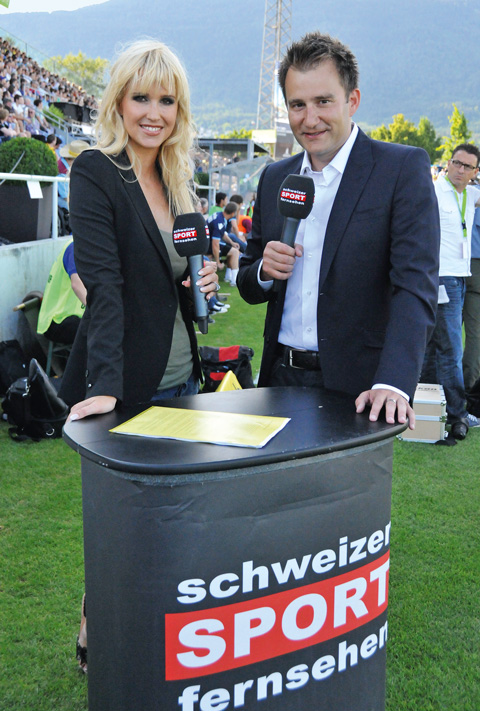
Until recently, Claudia Lässer was in charge of programming for the Swiss sports channel SSF. Now, this energetic TV executive is expanding Teleclub’s sports programming.

Claudia Lässer bungee jumping. Climbing. Wakeboarding. As a reporter. As a moderator. As an interviewer. That's how you know the blonde from eastern Switzerland from television. Moderating with a sonorous voice and a smile on her face. What remains hidden on the screen: Lässer is not only in front of the camera, but is also active as a producer, program director and entrepreneur. She has even started her own fashion label.

She shows up for the meeting in a Zurich bar wearing pink pants. No coincidence. Lässer likes to wrap herself in colored fabric. She is particularly fond of reds - colors that give her energy, as she says. The experimental and determined TV woman needs energy on a treadmill, so to speak. One project follows the next. One show after another, engagements as a presenter, events, appearances as an advertising ambassador. And in her private life, the sports fanatic trains four to five times a week. Her favorite activities include jogging, swimming, kick boxing and dancing. Standing still is not an option.

"I have the doer gene in me," the 35-year-old says of herself. Even as a child, she organized circus performances, rehearsed dance programs and performed in front of audiences. However, her dream as a child and later as a teenager was not to be in front of the camera, but to teach. So, after completing her teacher training, she began working as a secondary school teacher. A difficult task. At just 21 years old, she stood in front of students who were only a few years younger than herself. She felt she was not yet ready for the job. "I was still green behind the ears." Her sideline as a model and her final appearance in the Miss Switzerland pageant opened the door for the six-foot-one tall girl to audition for Star TV. Managing director Paul Grau approached Lässer about her educational background and suggested she expand the children's and youth program as an editor. For the teacher, this was a chance to enter the television business via a topic that was close to her heart. A "kindred entry," so to speak. So Lässer left the classroom and soon became the figurehead of the national private broadcaster.

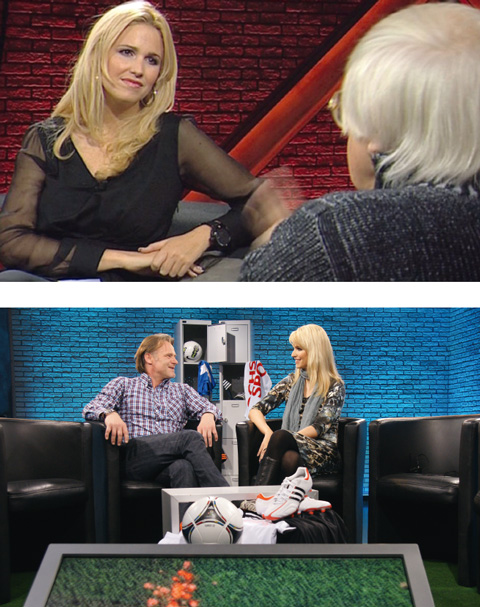
Claudia's Sofa" was the presenter's first talk show. The TV newcomer enjoyed questioning studio guests. Because just as much as Lässer likes to be the center of attention, she likes to engage with others, listen and ask questions. She wants to know what people are interested in, what they do and what moves them. That's why the curious journalist always comes out in conversation with her. Lässer asks counter-questions: "What's it like for you?" or ends a story with: "Don't you know what it's like?"

One way of playing - with sports

Today, Lässer looks back with gratitude on her time at Star TV. At the lifestyle station, she learned the television trade from the ground up. She filmed herself, sat at the editing suite and had to set the lights herself. The TV woman was able to try out what works and what doesn't on television. It was allowed to be a bit cheeky and "freaky". As a fitness fan, she was also able to bring in her sporty lifestyle.

Growing up with a sports-mad father who gave aerobics lessons and a brother who was a professional beach baller, Lässer had danced and practiced figure skating from an early age. Star TV was the link to fun sports. As host of the magazine "Freestyle," she tried out various sports together with Marco Schwab. "That was very cool. Broadcast-wise, something of the most casual thing I've ever done," the sports enthusiast still raves today. "We were allowed to do everything. There were no guidelines. " Snowboarding, skating, wakeboarding, surfing, base jumping, climbing. Sports, one or the other of which required Lässer to overcome and push herself to her limits. Her time at "Freestyle" helped her "become brave in life." You have to "move out of your comfort zone" every now and then, she says. For her, challenging herself again and again and going one step further is simply part of life.

She did this repeatedly in the course of her career. For example, when she broke with Star TV and founded the production company Trendscout together with her former partner Mathias Walther, then head of sports at Grashoppers. That was the start as an independent entrepreneur. With her company, Lässer launched various TV formats in the years that followed. With Mike Gut, she launched the Prosieben window "Faces TV," produced the soccer magazine "Kickoff" for Sat 1 Switzerland and Austria for the European Championship in 2008, and also oversaw a special section for the Austrian private TV station Puls 4. The entrepreneur also flirted with the big TV market in Germany. Then as now, however, there was no question of her giving up her "home base. She is too much of a "Switzerland fan" for that: "I always almost freak out when I travel around Switzerland. When I'm in Arosa in the mountains. It's awesome, isn't it?" Besides, he says, it's a good constellation in this country to start your own business: "I maintain: the Swiss is often not brave enough. But extremely much is possible."

In front of and behind the camera

With her own company, Lässer not only sharpened her profile as a producer, but also grew into the role of a businesswoman. She had to do her own budgeting, market formats and enter into partnerships. Experiences that later stood her in good stead. First and foremost, when she moved to SSF as head of programming in 2008 and built up the station together with technical director Simon Schmidlin. From the search for suitable studios, which they found in TV 3's old premises, to playouts, cable networks and the hiring of new staff - everything had to be done in a very short time. After the decision by the Federal Office of Communications Bakom at the end of February 2009 that the station was allowed to go on air, there were only four months until the launch. "A sporting feat," says Lässer. A feat that was to intensify when her colleague Schmidlin was killed in an accident. For her, a human tragedy. "We were like a family. And I was the station's mommy." Nevertheless, she had to get the sports station, which was supposed to provide a platform for fringe and grassroots sports, up and running together with her staff. Lässer put her energy into building up the channel, taking care of rights and cooperations with sports associations, as well as launching new formats. Thanks to a cooperation agreement and good collaboration with SF, they managed to show Swiss soccer cup matches, volleyball championships and handball matches. In return, the sports broadcaster provided montages for the SF magazine shows. In addition, Lässer stepped in as a presenter herself for some formats. On the one hand, for the soccer talk show "Kick it!", in which she interviewed two soccer experts together with former Nati goalie Jörg Stiel. On the other hand, she did the sports talk show "Close up," in which she interviewed athletes and sports-loving celebrities, trying to find out what moves her studio guests and what drives them. Her talk was about not focusing on the athletes and their performance, but showing the people behind it. "I didn't want a short fodder topic." Meanwhile, she prepared systematically for her television appearances. Like a top athlete training for a competition, Lässer, a sports enthusiast, works with mental training: she visualizes in advance how everything will go down so that, as soon as the camera starts rolling, she can concentrate 100 percent on her TV presence. "Especially with life shots: In your ear the director, the producer, the production manager, guests, then something unexpected happens.... That's when you have to be focused."

Dedicated to the sport

When Lässer talks about her time at SSF, it's still "we". Saying goodbye seems to be difficult for her. Nevertheless, she once again wants to take a step further. For .the realizer, it was time to "get out of her feel-good oasis." Lässer emphasizes that her departure has nothing to do with the delayed business development of the station, which is still not in the black after three years and is struggling with low market shares. SSF is too much "a project of the heart" for that. And she was aware from the start that she could not rely on ratings for a special interest station. As a special interest station with a much smaller target group, SSF should not be compared to a broadcaster. "You should measure what percentage of the sports community SSF reaches. Someone who doesn't watch sports doesn't suddenly start. No matter how good the programming is." Lässer remains loyal to sports no matter what. After four years in the business, her heart beats strongly for it. With Teleclub, she has also found a pay TV provider with a huge sports offering. As head of sports programming, she wants to expand the program around the broadcasts. Her new job also requires her to rethink: from a single channel to more than 30 channels programmed in parallel, with the Super League on one, the Bundesliga on the second, tennis on the third and an entertainment film on the fourth. A package of offerings that the manager wants to dovetail even better. The program "Faces TV," which Lässer produces with her own company, is also on the way. A pilot has just been shot, and the fashion magazine will soon be on air again - with a different concept. So it's not time to sit back and relax. And that wouldn't suit Lässer at all. The creator thrives on creating something new. "If it gets too comfortable, you get lazy. I don't like that."

Isabel Imper

In a nutshell

Claudia Lässer (*1976) graduated from high school, then from teacher training in Kreuzlingen, and then worked as a teacher and as a model. In 2000, she joined Star TV, where she built up the children's and youth program. In the spring of 2002, she took over the editing and moderation of the program "Fashion" and moved to the evening program. In 2002, Star TV entrusted her with department management and program purchasing for the entire lifestyle program. From 2008, Lässer was program director of Swiss sports television SSF, responsible for the entire program content, rights acquisition and the launch of new TV formats. In 2011, she was entrusted with the overall management of the channel. This summer, the sports and media manager moved to pay-TV provider Teleclub, where she will be responsible for sports programming as Head of Sports Programming and deputy to Head of Sports Roger Feiner. Since 2007, Lässer has also been producing various TV formats ("Faces TV," "Kickoff," "Face of Faces") with her own company for Pro Sieben Schweiz, Sat 1 Schweiz and Sat 1 Österreich.

claudialaesser
claudialaesser2
claudialaesser3
 

SPR+ will soon measure all Swiss poster sites

Although SPR+ is among the world leaders in poster and mobility research, the system does not collect data on poster sites in rural areas, nor does it collect data on poster contacts of commuters. The MobNat project is now set to change that: From 2014, SPR+ wants to be able to cover the whole of Switzerland.

Since the end of 2006, APG|SGA subsidiary SPR+ has been providing the outdoor advertising market with visibility-weighted contact and reach values for F200, F12, and F24 billboards on roads - across all providers. This street study is based on the routes taken by 10,000 people throughout Switzerland in the twelve largest conurbations during a week, recorded using GPS devices. Based on this data and modeling, the performance values in the 43 remaining agglomerations were then determined. In 2009, the station study was added, which also shows the media performance for the billboards in 392 stations, i.e., where the GPS devices cannot record routes due to lack of reception (see WW 34/09 or www.werbewoche.ch/zeitung/ sprstation-study-shows-the-reality-aware-cautiously).

Poster still presents itself weaker than it is

However, one problem always remained: In the agglos, only test persons were used who also lived there (e.g. Berner in Bern). In addition, only those distances covered in the residential agglos were of interest; the distances outside the agglos were not representative enough. In other words: the approximately 55,000 Swiss poster sites actually achieve higher performance values; SPR+ currently only represents the "guaranteed minimum".

But now SPR+ has developed a model that can also be used to calculate performance data for areas in the countryside and, for agglo areas, the contacts of transit passengers and commuters. The model is called MobNat (Mobility Post-Survey and National Model), was tested in 2010 in Eastern Switzerland with a pilot study and methodologically approved by the Research Advisory Council of SPR+ in March. In addition to APG|SGA and Clear Channel Switzerland (CCS), this committee also includes scientists, advertisers and media agencies. MobNat is now being implemented - in 2014, it should then provide complete contact and reach data for all street and station spaces in Switzerland.

One million road segments

MobNat works in a similar way to the station study: Whereas a route model was created for each station, showing all the possible turns (nodes) and route segments, this is now being done for the whole of Switzerland. "In total, you come up with just under a million road segments," says SPR+ managing director Felix Mende. As in the train stations, frequency counts are now necessary at a few selected locations. However, while SPR+ had these carried out in the stations themselves, MobNat uses around 4,000 public frequency measurements from the federal government, cantons and municipalities. This also includes automated counts at traffic lights or radar installations, which provide figures throughout the year. However, since they do not record pedestrians, SPR+ itself has to carry out a similar number of manual frequency measurements. According to Mende, however, four times ten minutes per location, at different times and on different days, is sufficient for this.

Highly complex data mix

However, it is not possible to distinguish between the counted persons according to place of residence, gender or age. That's why the frequencies have to be linked with data from the census and the microcensus study. For the latter, a total of 63,000 people were asked in 2010 about the distances and destinations they had traveled the previous day. All of this information is finally combined with GPS data from the SPR+ agglomeration studies in a sophisticated process developed by the German Fraunhofer Institute. Even if this mix of data from different sources is hardly comprehensible for laypersons: In this way, the weekly routes traveled are determined for virtually every person living in Switzerland. Because it is also known where the individual billboards are located, it is possible to deduce which person comes into contact with which billboard and how often. From this, in turn, the media performance of any given poster site can be calculated.

Combinable with mobile data

"MobNat is designed in such a way that changes in traffic routing or the number of billboards can be incorporated at any time," says Mende. Even if digital posters are introduced one day, for example showing different subjects during rush hour than during the day, the company is prepared. "We could then, for example, obtain anonymized, but second-by-second location data from mobile communications or navigation devices and feed it in, if that would be useful," says Mende.

Markus Knöpfli

Clear Channel joins in again

According to Felix Mende, the MobNat project costs "a mid-single-digit million amount. CCS, which withdrew from joint poster research with competitor Affichage in 2005, has also recently started to contribute to these costs again. The agreement between SPR+ and CCS was also made possible by a change in leadership at Affichage and CCS in 2010. However, CCS will continue to pay nothing to SPR+ research to date. (mk)

felix-mende
Felix Mende, Managing Director Swiss Poster Research Plus AG.
 

Republica: Tight calves, sportsmanship and a lot of heart and soul

On August 25, participants will ride lap after lap at Michaelskreuz/LU on road bikes, mountain bikes, or e-bikes to raise funds for the Cancer League. Republica is supporting the «Race against Cancer» event and will also be participating with its own team.

As individuals or in teams, the participants - including numerous celebrities such as Olympic triathlon champion Nicola Spirig, former Swiss gymnastics champion Ariella Kaeslin, Olympic snowboarding gold medal winner Tanja Frieden and four-time world track champion Franco Marvulli - will be raising money for cancer research and the fight against cancer. Republica created a new key visual for the event and designed posters, advertisements, the event flyer, the racing magazine "Update!", animated banners for the website and the Facebook visual.
Republica is taking part in the "Race against Cancer" together with its production partner Denz Bedruckbar.

Responsible at "Race against Cancer": Markus Aerni (Viceversa). Responsible at Republica: Chris Morgan (overall responsibility, CD), Christoph Emch (consulting), Rita Steinauer (text), Katja Dürig (AD), Fabian Schäublin (online). Photography: Eliane Clerc (7pictures).
 

The Motz of Butz: No medal for the CI of the Swiss Olympic team

From a country with a rich tradition of graphic design, the athletes competed in the Olympic Games wearing Jekami uniforms. By Theophil Butz, graphic designer, advertising agency owner, source of inspiration, and—for over a year and a half now—also a grumbler for *Werbewoche* readers. Please send relevant information to [email protected]

What we are talking about here: The 2012 Olympics may be over, but what remains is the good or bad image of the individual countries. No other country apart from Switzerland has such an extraordinary and simple identity: the Swiss cross, white on a red background. We all know that. Only the designers of the sports jerseys have forgotten it. The cross replaces words like Swiss, Suisse, Schweiz etc. That's why the cross has to be the first and most important symbol. Adidas and Nike figured this out long ago. The footballers have reached the pinnacle of this hodgepodge appearance. They simply left out any reference to Switzerland. (In my opinion, football should be left out of the Olympics anyway).

Dear design manager, would you also suggest to VW to sometimes put the logo, sometimes a lettering or sometimes nothing on the cars? Certainly not. Only in sport is there no consensus. My thesis is that every country is like a branded article, where the aim should be to present as good an image as possible. That's why it's important to use a clear and uniform design. I believe that those responsible for sportswear assume that everyone in the world knows that the color red means "Switzerland". This mistake is also made by brand owners who think that everyone has now seen the campaign and something new needs to be generated. Switzerland is also a brand. And it should be consistently cultivated and used. Yes, I'm talking about one of the most ingenious logos - the Swiss cross.

Incidentally, there are very precise design instructions for this: in 1989, the Federal Assembly laid down the current form in the Federal Decree on the Federal Coat of Arms of December 12, in which the aspect ratio of the arms is 7 to 6: "The coat of arms of the Confederation is an upright, free-standing white cross in the red field, with equal arms that are one-sixth longer than they are wide."

Just as Swiss warriors painted a cross on their armor to distinguish themselves from their opponents during the Crusades in the early 12th century, all Swiss Olympic fighters should have adhered to this rule uniformly. This would have given our country a greater image bonus. I believe that we Swiss are wrongly unproud of our nationality. Roger Federer or the German Swiss Airline exploit this advantage brilliantly. My view is that the British have made the most of the Games to promote their image, including with the symbol of their Union Jack.

motz_1
 

Destination new media advertising

Beat Hürlimann attended the New Media Expo in New York and wrote an exclusive report on it for *Werbewoche*. Today, he presents an 11-step inspiration program for successfully navigating the path to new-media advertising.

Hergé sent his comic book hero Tintin on a journey to the moon in 1953. In 1969, Neil Armstrong became the first man to set foot on the moon, saying: "This is one small step for man, one giant leap for mankind." There are 16 years of hard work between Hergé's great fiction and Armstrong's bold step. Since my visit to the New Media Expo in New York at the beginning of June, I am convinced that the (science) fiction phase for advertising involving social channels has been overcome. Experts are formulating initial, useful tasks and developing suitable strategy models. At the same time, practitioners are launching the first new media pilot projects. As a takeaway from New York, here is an 11-step inspiration program for the next steps on Planet New Media Advertising.

Step 1 - People trust people more than brands!
People are the most trustworthy source of information. The new social media have replaced corporate PR and marketing channels as the most common source of information. People prefer information from people, using testimonials from their own networks or product forums. If you want to stay in business, you have to follow them there.

Step 2 - Listening is more important than talking!
Yesterday's regulars' table is now the World Wide Web. And it still makes sense to follow these conversations. The topics fly unfiltered and bluntly from user to user and from network to network at breakneck speed. Every snippet of conversation is an opportunity to start an exciting discussion. Which ones concern you? How can you get involved? What are the risks?

Step 3 - The days of persuasion are over!
Is your strategy already geared towards the people involved in the discussion? Or are your messages still based on the concept of persuasion? Consumers don't want to be convinced. They want authentic stories, experiences and opinions - told in an exciting and straightforward way. But you can only be authentic if you know yourself well. How well do you know yourself?

Step 4 - Bring your business home!
Ask for the return on investment (ROI)! Despite all the romance surrounding creative ideas and original Facebook competitions, your basic concern is: How do I elicit maximum monetary behavior from addressees with minimum investment? The ROI quantifies this concern. Consider the ROI as the result of a linear sequence of five causally related steps: Capital invested - Number of contacts reached - Intensity of impact achieved - Degree of trust created - Measurable monetary behavior. After each step, test the effect of each individual measure. Intervene and improve if a measure proves to be inadequate.

Step 5 - Form your all-star team!
New media projects are extreme situations, and they are similar to team sports: no two games are the same, line-ups and tactics have to be constantly adapted to the challenges that arise. Talent and practiced automatisms determine success in extreme situations, rules ensure fair play and a positive winning spirit drives top performance. 

Step 6 - Generate attention!
The best way to attract attention is a creative advertising idea. A perfect mix of message, idea, dramaturgy and design generates the strongest attention-grabbing effect. Ideally, you should serve the most intense demand motivation with your best argument. Obtain the visitor's profile before each meeting and deliver a tailor-made message. Social media monitoring makes it possible.

Step 7 - Establish new relationships!
The best way to build loyal relationships is sincere appreciation. The strongest relationship moments are created by personal product or brand experiences where customers and suppliers meet in real locations. Ideally, they offer the experience provider unique added value as an incentive. Clever ways of involving the user in the event are particularly effective. For example, by making it as easy as possible for them to share their experiences via social media channels. Respond to their activities. Thank them. Because nothing is more valuable to people than appreciation - show it.

Step 8 - Generate sales!
The best sales tool is a consistent path to the deal. The drivers on the way to the social media buying experience are the messages in the social channels, which can now be embellished with images and videos. Illustrated messages enable comprehensive product experiences. If a product experience is convincing, the decision to buy is close. Ideally, you should offer a direct, obstacle-free path to the deal. Stay within the relevant social network or set up a shopping page that continues the path of experience.

Step 9 - Create campaigns for participation!
Design your campaign with planners who have arrived in the world of new media. Conventional media planning is content with the goal of making contact. Modern campaign design is based on the principle of participation. The two are worlds apart in every respect. Two terms you should remember: The path (lead) leads the target person from the initial contact to the desired action. The planner has a wide variety of channels, applications and influencing contributors to choose from when designing the path. The incentive keeps the target person on the path. Campaign planners are dramaturges who design paths, create connections and prepare the ground for participation.

Step 10 - Use social media monitoring!
Track the impact of your campaigns and research the needs of your target groups. Thanks to social monitoring, you can determine the effectiveness of your campaigns with unprecedented precision. The results are available in real time and allow you to intervene quickly. Monitoring also allows you to filter useful brand and consumer trends from the actions and statements of your target groups. You need this information to design effective messages. You can also identify any gaps that you should close with your own primary research.

Step 11 - As Swiss people, we know: Nothing beats perfect organization!
If you are promoting dialogue-based communication, good organization is essential. Do you want your employees and customers to behave appropriately on social media channels? Create a realistic set of rules in line with freedom of expression. Give your experienced employees personal responsibility and engage them in dialog with your target groups. Recruit customers, users and technical experts as ambassadors. Do away with hierarchies. Instead, create leaders and make further training, networking and teamwork your priorities.
 
Beat Hürlimann

get_footer();