Spiked: Vagina hurts, advertising (sometimes) too

Anne-Friederike Heinrich, a freelance contributor to *Werbewoche*, on tasteless and insensitive advertising.

Am I hopelessly boring if I think this goes way beyond the boundaries of good taste? Or have I simply not been married long enough? These days, you can hear a radio commercial advertising the assistance of a Zurich real estate company in divorces. Yes, you read that right: Real estate - divorce. It sounds like this: "Are you getting divorced? And want to sell your house or apartment? We can help you with that!" Phew, that sits well. Out of sheer shock, I didn't even remember which selfless estate agent this offer came from. But he probably has his office somewhere on Zurich's Gold Coast.

Smart divorce planning

Perhaps someone who is currently fighting a divorce war with their loved one is grateful for such a cloudless offer. Perhaps they finally feel understood and supported. Clear case, clear words. No shallow banter. But for a normal loving person like me, this commercial is a slap in the face. I already know that, on average, every second Swiss marriage ends in divorce. But I don't care about the average. After all, dozens of accidents happen every day - and yet I've been driving accident-free for years. (My husband too, by the way!) But that's just a side note. So I, a poor idealist, am woken from my sleep early in the morning by a service like this. Is that necessary? When it comes to money, nobody asks for feelings. And apparently it's a lucrative business: the housing shortage is so great and divorce rates are so high that it seems to be a good idea to combine the two and advertise it. It's simple: marriage split in two, a large apartment becomes available, cash beckons - what's the big deal? The divorced people are probably not even particularly picky when it comes to the conditions. The main thing is to quickly get rid of everything that reminds them of their time together. And the estate agent giggles into his greasy palms.

What I don't know...

Imagine if we were offered the chance to buy a "divorce apartment" or a "divorce house" - very cheap, close to the city and with a garden. I think we still wouldn't take the property. Or rather: that's exactly why we wouldn't want it. After all, we wouldn't rent an apartment if we knew that someone had died there. But you don't usually know that. However, it doesn't take more than a tasteless ad - and you feel the need to ask a little more questions ... But indignation aside: you could actually do something with this approach. For example, a toy exchange for children of divorce. The parents could sell what no longer has room in the smaller apartment of the now single parent. Or finally sell the doll's house that the hated mother-in-law gave them. Or how about a car rental company that offers a 50 percent discount if you can prove that your spouse ran off with the family car? Advertising doesn't have to be tasteful. It just has to be effective. True to the motto: "But your divorce makes my heart smile."
 

Wunderman develops online campaign for Ford

Ford Switzerland has commissioned Wunderman to develop a digital launch campaign. A homepage takeover is currently generating buzz on the online portals of 20 Minuten and Blick, as well as on select automotive and sports-related websites.

On Facebook, users can experience the sports car in a game: "Ready, Steady, Go!" is the name of the game in which players have to catch as many Ford Focus STs as possible within 30 seconds. The prize: a weekend with the Focus ST including an overnight stay at the 4-star Hotel Focus in Zermatt.

Responsible at Ford Motor Company Switzerland: Danijel Dzihic (Director Marketing);. Responsible at Wunderman: Thomas Engeli (CD), Dieter Boller (text), Daniel Schranz (AD), Dominik Sigrist (screen design), Marcin Kolonko and Paolo Brocco (programming), Stéphanie Bertschi (consulting).
 

Pegasus Award: Social ethics as a success factor

«Trust remains the most important link between brands and consumers.» That was the central message at the Pegasus Awards ceremony on Thursday evening at the Park Hyatt Hotel in Zurich.

The media and marketing company Reader's Digest honored the brands that enjoy the highest level of consumer trust in Switzerland. Numerous representatives from the top echelons of marketing and advertising attended the awards ceremony, according to a Reader's Digest press release. The winners were determined in the European consumer study "European Trusted Brands".

In the 35 product categories examined by the study, from A for cars to Z for toothpaste/mouth care, it was primarily classic brands that came out on top as the most trustworthy. These include VW, Ricola, Coop, Swisscom, Emmi, Lindt & Sprüngli, V-ZUG, Nivea, CSS, Elmex and many more. In Switzerland, around 1,500 respondents cast their vote, representative of Swiss consumers.

Anett Groch, Advertising Director of Reader's Digest Germany, Austria and Switzerland, commented that companies today are increasingly being judged on whether they act in a socially responsible manner. "Social ethics is even becoming an essential component of a successful corporate culture and brand management. It creates and supports a good reputation." This correlation was confirmed by the Reader's Digest study 2012.

Manfred Strobl, CEO of the media agency OMD Switzerland, was the guest speaker who once again emphasized the topic of brand trust to the guests. The award ceremony was framed by a potpourri of artistry, dance and music. Silvia Affolter provided the moderation.

Webguerillas open branch office in Berlin

Webguerillas now has a presence in Berlin as well. The agency is opening an office in the German capital on October 1.

The new team will be led by Corinna Nachtigall, who already worked as a consultant at Webguerillas in Munich from 2008 to 2010. The starting team of five is to be expanded by a further five employees before the end of the year. Just last October, the agency opened a branch office in Switzerland, which currently employs 24 people.

In the new Berlin office, the agency is largely bundling its technology services - especially the development and expansion of social CRM systems, the agency said in a statement on Thursday. As agency partners, the Berlin-based Webguerillas want to offer new, innovative technological solutions and work with clients to show how social media marketing can be profitably implemented. "Berlin, with its distinct start-up culture, is the right place for this," said David Eicher, managing director of webguerillas Munich.


Weka acquires Blogwerk

The Weka Group, based in Kissing near Augsburg, has acquired Blogwerk in Zurich retroactive to July 1, 2012. Blogwerk was founded in 2006 by Peter Hogenkamp.

The company designs and operates numerous corporate blogs for large companies and institutions, offers consulting in the field of social media and has developed its own software tool for professional social media communication, the Social Media Kit. Blogwerk also runs five of its own blogs: Neuerdings.com, Netzwertig.com, Imgriff.com, fokussiert.com and Startwerk.ch. Blogwerk produces around 600 blog articles, newsletter articles and Facebook posts per month for its own publications and for clients. Blogwerk employs 18 permanent staff and around 35 freelance authors.

Blogwerk can certainly benefit from the Weka group of companies in its further development on today's solid basis, just as Blogwerk can contribute to the development of the other Weka companies, says Peter Hogenkamp, founder, previous main shareholder and Chairman of the Board of Directors of Blogwerk. The Weka Group is a German family business with 19 media companies in five European countries; in Switzerland, the company is currently represented by Weka Business Media and ZfU.

Blogwerk will continue to operate as an independent sister company alongside the other Swiss companies, all employees will be taken on and the company will remain based in its recently relocated offices at Badenerstrasse 141. Thomas Mauch (content) and Olivia Menzi (services) will continue to manage the company. Werner Pehland, Managing Director of the Weka Group, will be the contact person for the Blogwerk management as a member of the Board of Directors.


Milestone 2012: Jury nominates 20 favorites

The jury for this year’s «Milestone. Swiss Tourism Award» had 92 diverse tourism projects from all parts of the country to choose from. From this wealth of entries, the jury today nominated 20 projects.

The Milestone recognizes outstanding and innovative achievements in the Swiss tourism industry and will be awarded on 13 November 2012 at the Kursaal in Bern. The award, worth a total of 33,000 Swiss francs, is presented in the categories "Outstanding Project", "Young Talent Award", "Environmental Award" and "Lifetime Achievement of a Personality". The jury consists of Mario Lütolf (Chairman), Director of the Swiss Tourism Association STV, Fiorenzo Fässler, Managing Director Smarket, Harry John, tourism expert, Barbara Rigassi, Managing Partner Brugger und Partner and Jürg Stettler, Head of the Institute of Tourism Economics ITW, Lucerne University of Applied Sciences and Arts.

The following projects have been nominated for the Milestone 2012 under the motto "Off to new shores" (in alphabetical order):

Nominees Outstanding Project
- Bus alpin, Samuel Bernhard, Bus alpin Association, Zurich
- China meets Weggis, Peter Kämpfer, Weggis Park, Weggis
- Destination model and family strategy Grächen, Berno Stoffel, Touristische Unternehmung Grächen, Grächen
- e-domizil.ch - Holiday homes online, Marc Bertschinger, e-domizil, Zurich
- Erlebniswelt Muotathal, Emil Gwerder, erlebniswelt muotathal, Muotathal
- GolfMountain Adelboden, Roger Steiner, Engstligenalp mountain railroads, Adelboden
- Guerilla Marketing Fribourg Region, Thomas Steiner, Union fribourgeoise du Tourisme, Fribourg
- Le Vieux Manoir lake projects 2010-2012, Ulrike Ruf, Le Vieux Manoir, Murten-Meyriez

- Nice toilets in Ftan, Urs Wohler, Tourism Engadin Scuol Samnaun Val Müstair, Scuol
- Panorama yacht Saphir on Lake Lucerne, Werner Lüönd, Lake Lucerne Navigation Company, Lucerne
- Project Cordiality, Ariane Ehrat, Engadin St. Moritz Tourism, St. Moritz
- Solothurn Services & Seminar Mile Solothurn, Jürgen Hofer, Solothurn Tourism Region, Solothurn
- Textilland Ostschweiz, Rolf Schmitter, Association "Textilland Ostschweiz", St. Gallen
- World novelty CabriO, Jürg Balsiger, Fabienne Huber, Stanserhorn Railway, Stans

Nominees environmental award
- Climate Project Zurich North, Stefano Alborghetti, Courtyard by Marriott Zurich North Hotel, Zurich
- ibex fairstay - promoting and demanding sustainability, Kathrin Spiller, ibex fairstay, Chur
- Les chemins du bio, Jean-Claude Cattin, les chemins du bio, Montfaucon

Nominees Young Talent Award
- Cooperative eCRM Zermatt, Sven Hauser, Zermatt Tourism, Zermatt
- Plan tours in the Lötschental interactively, Sandra Stockinger, Lötschental Tourism, Wiler
- TrekkSoft.com, Philippe Willi, TrekkSoft, Matten b. Interlaken

At www.htr-milestone.ch the nominated projects are presented in words and pictures.
 

False friends

In late August 2012, Facebook announced that it would take action against “like” fraud—that is, “likes” that were purchased rather than resulting from a genuine interest in a person. But it’s not just on Facebook that people cheat with fake friends; popularity and visibility are also faked on Twitter, YouTube, and other social media platforms. By Manuel P. Nappo, Program Director of the CAS in Social Media Management at HWZ and Chief Networking Officer at Centralway. www.about.me/mpn

The principle is actually simple: various agencies offer to buy likes, friends or followers for relatively little money. Behind the fake friends are either bots, i.e. automatically generated profiles that are not real people, or real people who receive money for their activities. Recently, strange videos or links have also been circulating. If you look at these, you automatically become a fan of a page without realizing it. Another tricky aspect of buying friends is that anyone can buy friends and assign/give them to any profile without their consent.

Fake friends can often be recognized by the fact that a large number of new friends are added within a short period of time, often with identical account creation dates. The profiles come from distant countries, and automatically generated profiles show little or no personal activity.

The primary interest in more friends, fans and ratings is the increased popularity and notoriety that is feigned. This may also explain why politicians and political parties have recently been accused of buying fake friends. In politics in particular, there is a lot of discussion about popularity in the run-up to elections. Comparisons of follower numbers are now commonplace for the media. However, if it comes to light that fake friends have been bought in, this does not exactly have a positive effect on a candidate. Even if they may not have acted themselves, but the fake friends were planted by someone else.

Ultimately, fake friends are of little use in social media, as new media thrive on interaction, but fake friends are usually silent and inactive. In the meantime, however, you can already buy interaction: YouTube views and retweets, also available for cash. However, fake friends are not useful here either, they just make statistics look prettier, although they ultimately falsify these figures. What good are fake friends on social media if the real supporters in real life don't go to the ballot box and vote for a politician after all? Once again, it's like in real life: imagine a hall with 500 people attending your event. However, 400 of them have paid to attend and only 100 are your real prospects. Neither you nor the real prospects will feel comfortable.

Social media thrive on dialog. You should take care of those people who have a genuine interest and promote exchange and strengthen trust rather than aiming to quantitatively accumulate friends.
 

"Yearbook of Advertising" becomes "The Year of Advertising"

In 2009, the "Yearbook of Advertising" was accompanied by a complete and free online version for the first time. To mark the fiftieth anniversary, publications - book and online presence - and the competition are to be realized under the name "The Year of Advertising" in future.

Under the title "Advertising in Germany", Econ Verlag published a yearbook for the first time in 1964, which presented "German advertising [...] in a closed form, detailed, explanatory and summarized in a manageable period of time". As the "Yearbook of Advertising", it established itself as a standard work of the communications industry, which honored the best work of the year with its competition of the same name.

jdw1

50 years after the publication of the first volume, the media landscape has changed fundamentally, according to a press release issued by Econ Verlag on Thursday. Although the general aim of advertising may have remained the same, the choice of communication media and channels has increased enormously. More than ever, creative professionals and clients in particular need guidance in this constantly changing market.

The "Year of Advertising" aims to provide a platform for important developments and campaigns. We are not only interested in new creative and technical ideas and styles, but first and foremost in successful, innovative concepts for the breadth of possibilities in communication and advertising. We are looking for successful campaigns that are also seen as such by the client.

Important campaigns and groundbreaking individual achievements from campaigns are invited to enter. The jury honors work that sets signals in a market that is looking for orientation. With the new competition, companies (clients), responsible creatives as well as media and specialist media will be represented on the jury in future. Competition winners will also be appointed to the juryThe jury awards the Grand Prix to the outstanding campaign of the year, which is exemplary for clever orchestration of integrated communication across all media. The best work in the individual categories of the competition, as well as entries that are combined as an integrated campaign and B2B communication, are awarded the Megaphone in gold, silver or bronze.

The above measures will come into force for the current competition. The closing date for entries is October 19. The renaming will be successively applied to all media. The next book will be published next spring under the title "The Year of Advertising 2013", edited by Thomas Rempen, Anette Scholz and Peter Wippermann. The title was designed by Anzinger, Wüschner, Rasp.

Online and print can complement each other

Roche wins the 2012 annual report rating ahead of Swiss Re and Geberit.

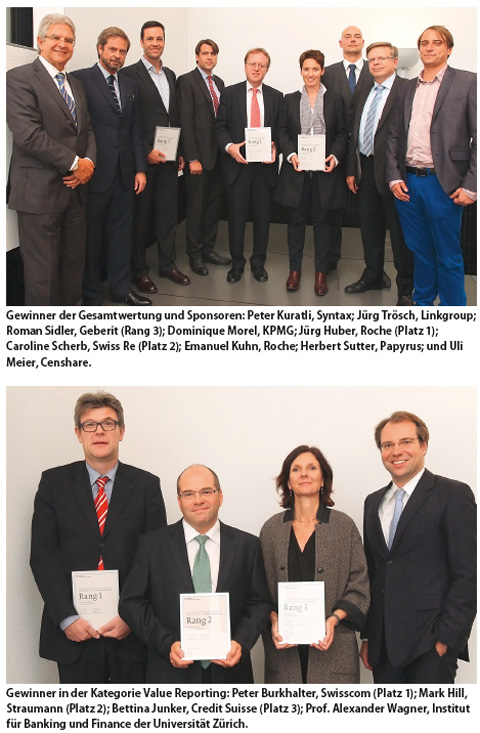
Nine medals were awarded at this year's rating event on September 20. In the overall ranking, Roche took gold ahead of Swiss Re (silver) and Geberit (bronze). The ten-member final jury was chaired by Matthias Graf, HarbourClub. Geberit is the only company to receive a second medal, as well as gold in the Design category. Kuoni took second place in this category ahead of Allreal. The design jury consisted of eleven members under the direction of Peter Vetter, Zurich University of the Arts. Swisscom came out on top in the Value Reporting category. It relegated Straumann (silver) and Credit Suisse (bronze) to the other places. The Institute for Banking and Finance at the University of Zurich is responsible for value reporting under Prof. Alexander Wagner.

The view of the Board of Directors

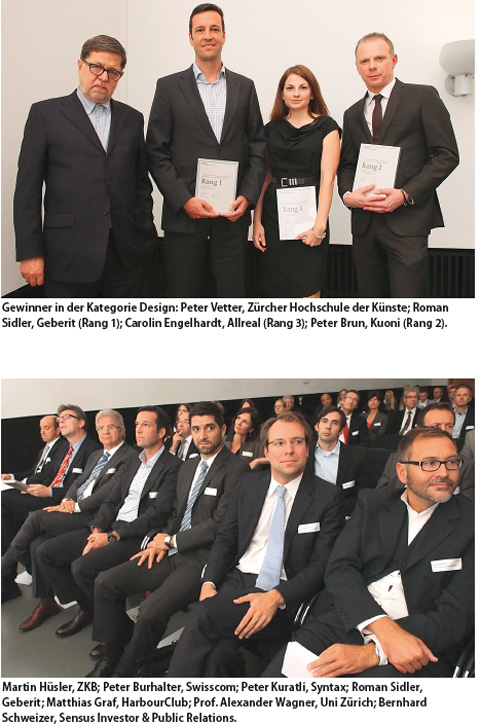
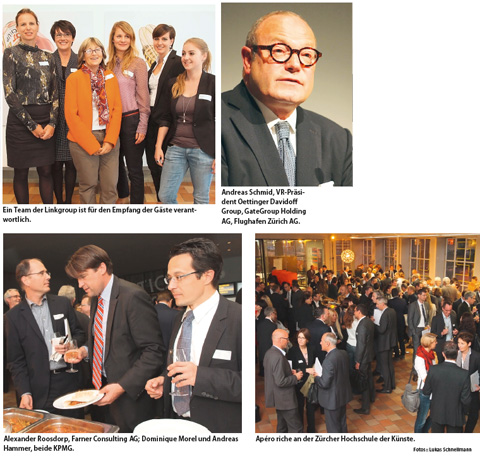
Andreas Schmid was a guest speaker who currently holds the chairmanship of three important boards: the Oettin ger Davidoff Group, GateGroup Holding AG and Flughafen Zürich AG. Three points are important to him in an annual report. Firstly, completeness and accuracy; secondly, comprehensibility and clarity; and thirdly, appearance and corporate identity. Measured against the legal requirements and the effort and costs involved, Andreas Schmid still considers the annual report to be the leading medium for corporate communication. But for the future, Schmid describes the annual report in its current printed form as a discontinued model. This is because the numerous stakeholder groups use other sources to get a picture of the company. Schmid appealed to the HarbourClub, as the organizer of the event, to discuss more suitable forms of results communication that are more appropriate for the individual stakeholder groups.

However, the Harbour Club partially anticipated Andreas Schmid's request with the reorganization of the annual report rating: For the first time, online and print were rated equally. If you want to be at the forefront of business reporting, you need to have an attractive online presence as well as a printed annual report. And so, in the end, Roche stood at the top of the winners' podium. Although it was not at the top in the special disciplines of best design print or online or value reporting, as a convincing all-rounder it prevailed over the competition in the final judging. According to Matthias Graf from the HarbourClub, Roche demonstrates how print and online complement each other perfectly. Third-placed Geberit takes an even more consistent approach. It clearly defines online as the lead medium for business reporting. This is supplemented by special publications for individual target groups. We are eager to see whether other companies will follow this example.

Which annual reports were evaluated?

The annual reports of all listed companies represented in the SPI were included in the 2012 annual report rating. In addition, the 50 companies with the highest turnover in 2011, the 15 insurance companies with the highest gross premiums in 2010 and the 25 banks with the highest total assets in 2010 (sample of 233 reports).

How was it chosen?

Prof. Alexander Wagner, project manager Florian Eugster and students from the Institute of Banking and Finance at the University of Zurich evaluated the annual reports in print and online according to defined content criteria for value reporting. At the same time, experts under the direction of Peter Vetter, Zurich University of the Arts, dealt with all aspects of design and usability and weighted the print and online presences equally, resulting in the design ranking. The addition of both ratings according to ranking points resulted in the 12 best overall. From these, the ten-member final jury finally selected the overall winners of the 2012 annual report rating.

Andreas Jäggi

po-00
op-01
op-02
op-03
 

Yello's music runs and runs and runs

Dieter Meier created an elaborate promotional film for the new VW Golf 7. Music by Yello and Boris Blank. The two artists were given complete artistic freedom for this commissioned project.

WW: Yello is known worldwide for its music clips. But not yet for commercials. How did this commission come about?
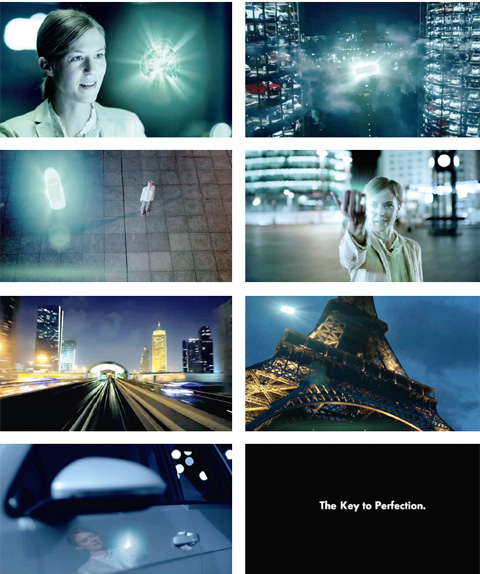
Dieter Meier: Yello was asked to produce the music for the presentation of the new VW Golf 7. We met the Volkswagen board members a few times, especially the person responsible for communications. During these discussions, the idea for a film matured. I then suggested a concept entitled "The Key to Perfection". I have seen the car in the "high-security wing" at VW several times. And it really is a very perfect car. Above all, the value impression far exceeds the price. My idea was then approved. So I developed a storyboard for "The Key to Perfection". In the end, they thought Yello should make the movie themselves. So that the movie and the music come from a single source.

Did you also contribute to the script?
Not just the script. This movie is 100 percent mine. Of course, I had an executive production company with United Visions in Berlin. But I had absolute carte blanche. I didn't have to discuss my ideas with an advertising agency or with Volkswagen. They explicitly wanted this film to look the way I thought it should look.

What is the concept?
The concept revolves around a key. This high-tech structure opens the world to the VW Golf. But before our designer can get into the car as the protagonist, the key sets off on a journey around the world. The VW Golf is a global car, the most successful model in the entire VW range. Over 30 million cars have been sold to date. Therefore, the journey of this shining key symbolizes the worldwide presence of the light of this VW Golf. Finally, the key is picked up again by our designer and becomes the "Key to Perfection". She can get into the car.

Has Dieter Meier himself traveled around the world as a director?
A lot of the movie is based on computer animation. I was there in Berlin, at studio shoots and in the city of Berlin. Then time suddenly ran out and we were no longer able to travel all over the world. So we started a very intensive search for high-quality material. That was one of the more difficult things about this film, that the footage could be edited in such a way that everything looked as if it was one piece. But I'm more than satisfied with the footage.

Did the music already exist or was it composed for the picture afterwards?
Boris Blank had a blueprint for the music. We knew that it was all about this drive. This drive around the world. A modern, urban and global music. We cut the film to the music and added a few accents at the end.

You hear about a CD that is placed in the glove compartment of the Golf?
They are still thinking about that at Volkswagen. They would like to do it. But it's a bit unusual and therefore still needs to be discussed with the people at the top, whether they want to link a music project so clearly with their most important car. We'll find out in the next few days at the Paris Motor Show. But we have already produced a few thousand CDs, for example for the media people. There were over 700 media people at the premiere of the new Golf in Berlin. Yello performed at this event.

Will Yello continue to be used as an ambassador for VW Golf?
Other events are also planned. Boris also developed music for the presentation of other cars in Paris. They were so enthusiastic that they wanted us to provide all the music for over 20 new cars from the Volkswagen Group. This was not possible due to time constraints. A dance troupe was also unable to change its choreography at such short notice. But three other Group brands will now be accompanied musically by Yello at the presentation at the Paris Motor Show.

Does Yello already have a long-term relationship with VW?
We already produced music for the Audi A5 four years ago. So a sequel was born.

Did you also enjoy the detour into advertising?
I have absolutely no reservations about promoting sensible products with music or film. And this VW Golf is of course an extremely sensible product within the whole car business. It was also an excellent collaboration. After the concept was approved, both Boris and I were given artistic freedom, so you can say: This really is now a 100 percent Yello product without any bows, bows and restrictions, both in terms of image and sound. That's not always the case when you do advertising. Several advertising agencies interfering, the management giving their input. That often results in these compromises. But in this case, it was an absolutely ideal collaboration. And after the presentation in Berlin, the board members were completely enthusiastic and wrote to Boris and me under the title "Bull's eye".

Interview: Andreas Panzeri

yello-01
yello-02
 

BSSM puts the plus of Demeter in a nutshell

The BSSM agency has highlighted the differences between organic and biodynamic products for Demeter. The promotional materials are designed to convey the benefits of Demeter cheese in a concise manner.

Demeter cows wear horns. The Demeter guidelines make this mandatory, as it strengthens the vitality of the animals. They eat the farm's own feed and live in a species- and animal-friendly manner on soils that have a markedly higher fertility and biodiversity due to the biodynamic cultivation method, the agency said in a statement Thursday. In addition, the milk is processed with care and attention.

BSSM Werbeagentur's advertising materials for the cheese are intended to make the point that Demeter dairy products have character.

Responsible at Demeter Switzerland, Liestal: Christian Butscher, Aline Haldemann (overall responsibility). Responsible at advertising agency, Basel: Urs Schneider (CD), Hans Peter Brugger (text), Daniel Bard (AD), Sylvia Halbeisen (consulting). Photographer: Eugen Leu & Partner, Riehen.

Web-based TV usage on the rise

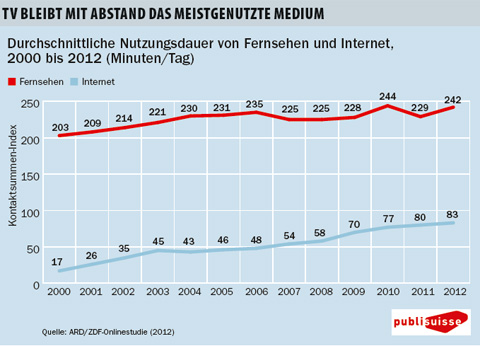
Internet usage continues to rise, and with it, web-based TV viewing. One reason for this is the rise of tablets and smartphones, which are creating new ways to use the Internet and driving greater demand for TV content online.

These are the findings of the latest "ARD/ ZDF Online Study 2012", for which Enigma GfK surveyed 1800 German consumers aged 14 and over.

First of all, the study shows that the use of the Internet continues to increase. Three out of four Germans (75.9%) now use the web at least occasionally. This corresponds to 53.4 million Internet users - exactly 1.7 million more than in the previous year. The Internet is even more popular with men than with women: 81.5 percent of men and 70.5 percent of women use the Internet. A breakdown by age shows that almost all younger people (100.0% of 14 to 19-year-olds and 98.6% of 20 to 29-year-olds) are online. However, the highest growth rates continue to come from the over-50s: 76.8% of 50 to 59-year-olds now use the Internet (+7.7% compared to the previous year). Among the over-60s, 39.2% (+4.7%) are online.

It is also clear that more and more online users are also using the internet on the move. Mobile Internet use has more than doubled since 2009, from 11% at the time to 23% now. This means that almost one in four German online users is already using mobile devices on the Internet. The younger generations in particular (42% of 14- to 19-year-olds and 40% of 20- to 29-year-olds) enjoy mobile surfing. The number one Internet-enabled mobile device is clearly the smartphone: 84% of mobile Internet users use a smartphone to access information and entertainment. Tablets are also establishing themselves as another alternative for mobile surfing. They are now used by 6% of mobile online users to access the internet.

The new end devices offer consumers further opportunities to consume TV content. For example, the number of TV programs accessed online continues to rise: 30% of online users now watch time-shifted TV on the web at least occasionally, compared to just 21% in 2009. Almost one in four online users (23 %) also watch live TV on the internet, compared to 18% three years ago.

However, it should be noted that the level of habitualization of web TV is still relatively low. Internet television is not yet habitually used by the majority of the population. Only 11% of online users watch TV via the web at least once a week and only 2% do so on a daily basis. Live streaming is used weekly by 7% and daily by 1% of online users. Regular use of moving images plays a greater role among younger people: 20% of 14 to 29-year-olds watch TV programs on the Internet on a time-shifted basis once a week, 4% on a daily basis. Live TV on the Internet is used by 11% of younger people on a weekly basis and 3% on a daily basis.

In the future, the habitual use of TV content via the Internet is expected to increase among young and old alike.

Clemens Koob

keyfacts_1
ps-tv
 

get_footer();