Swiss Media Congress 2012

At the general meeting of Schweizer Medien, Hanspeter Lebrument welcomed the Federal Council’s decision to maintain the ban on online advertising in radio and television licenses. Filippo Leutenegger is the new chair.

By maintaining the online advertising ban, the existing balance in the Swiss media landscape between the private media providers and the SRG, which is financed by the license fee, will be largely maintained, said the President of Schweizer Medien on the Federal Council's decision. Filippo Leutenegger was newly elected to the presidency. The Executive Committee and members expressed their thanks to Filippo Lombardi, who is stepping down, for his great commitment to the publishers' association. He will remain a member of the association.

The Association's management was also in a solid financial position. A profit of CHF 11,316.36 was reported for the 2011 accounts (including financial income and after deduction of provisions for ongoing projects in 2012). The lower income compared to the previous year reflects the situation in the print media, as membership fees are based on circulation figures and these have also decreased in the current financial year, according to a statement from the association. In terms of ongoing media policy business, the revision of the Postal Services Act Ordinance is currently the main focus. Another important item on the association's agenda is the revision of VAT. According to the association, there is a risk that this will result in an additional burden for media users due to a higher tax rate.

Read more in the current print edition of Werbewoche
 

Head of the week: The direct

Andreas Mädler wanted to take on creative leadership and help the cross-media agency Noise move forward creatively. Since July, the creative director and the tech-savvy agency have been working together.

Andreas Mädler's new workplace is located in an old building that could also be an apartment building. Only a few company names on the sonnerie reveal that this is not primarily a place to live, but a place to work. Steps that make a noise when stepped on and a wooden banister that swings elegantly around the corners lead to the second top floor. Here, in an apartment with parquet flooring and bright rooms that each offer space for two to four workstations, Noise is at home.

An old apartment for a modern company. Since its founding in 2001, the cross-media agency has relied on technology and a team that consists of consultants and creatives on one half and programmers and online specialists on the other. While Noise has steadily expanded its online expertise, the creative approach is now to be strengthened as well. For the latter, the owners Patrik Leuenberger and Christian Frey brought Andreas Mädler on board as Creative Director this summer. His task is to take the tech-savvy agency forward creatively.

But what brought Mädler, who worked at industry giants like Springer & Jacoby in Hamburg, later at Krieg Schlupp Bürge KSB and until recently at JWT/ Fabrikant in Zurich, to the manageable cross-media agency? "It was a conscious decision to move to a smaller agency," explains Mädler. Previously, as a CD, he always had people around or above him. Many decisions had to be made by consensus or approved by superiors. At Noise, he is now solely responsible for the creative output. "Here's an opportunity to prove myself. I wanted to see how much of an impact I could make." A 14-person team is at his side. "We're not that broad, but I have everything I need at Noise."

Mädler has already tried out how far he can get on his own as a freelancer. A time in which he got to know different agencies and processes. At the same time, he longed for something like "a sense of belonging to the family," for being an integral part of a team again. He regretted that as a freelancer he was left out of many processes and decisions. And there was something else he missed as a freelancer: the pleasure of being part of the implementation of ideas. So when he decided to leave JWT/Fabrikant this spring, it was clear that he wanted to be part of an agency team again. Nevertheless: Why something new again? After all, Mädler had only been with JWT/Fabrikant for a year. "It just wasn't a good fit," he explains. His time at his last employer is a topic he prefers to leave out. "We parted on good terms."

Clear and unambiguous Mädler pays meticulous attention to his choice of words. Actually, however, it runs counter to him to express himself diplomatically. The North German doesn't like to mince words. "The Hamburg way of expressing things is quite direct, which is usually not meant in a bad way at all, but for Swiss ears it is certainly very harsh. To what extent his directness is due to his origins and to what extent to his personality, however, is difficult to say. Mädler also personally dislikes having to bend. He is a fan of clear words. For the most part, he now chooses the happy medium: "I can't beat around the bush too much. Nevertheless, I refrain from making very direct statements. I don't want to step on anyone's toes." But if things do get loud, Mädler has no problem with it.

But since moving to Switzerland, the creative has had less need for the "thick skin" he acquired during his time at Springer & Jacoby. The fact that the climate here is generally milder than at the Hamburg advertising agency became clear to him when he joined KSB seven years ago. For his first internal presentation, he had 15 ideas in his quiver - even though he knew that half of them were no good. Simply "to have some cannon fodder". Because that's how he had learned it at Springer & Jacoby. All ideas were "basically crap at first" and were "blown out of proportion. Those who came up with masses of ideas had a clear advantage. Not so with the Zurich agency. Mädler was perplexed when even the bad ideas were discussed - probably out of politeness, as he explains it. Until finally he said, "Come on, get rid of the snot." Immediately his words were defused with a smile.

Direct and clear - yet cheeky and funny, that's how Mädler also likes creative output. Advertising should be understandable and informative. Nevertheless, he says, it would be a shame if the entertainment aspect were lost. "I quite like to laugh." However, he doesn't know what to do with "thigh-slapping". Mädler is more interested in dry humor. It has to be sober and "sophisticated. The creative director at KSB has demonstrated this with TV commercials for Coop, among others. Or with ads for VW that dramatized what it looks like without all-wheel drive: While the headline promises a view of a mountain landscape, the driver is stuck in the tunnel.

Creation and innovation Mädler now wants to assert his creative claims at Noise. However, there is little sign of the hunt-for-creative-prizes culture that he got to know at Springer & Jacoby, among others, at the cross-media agency. He is not sad about that. "I've never been a fan of gold ideas. Awards are great. But it's much more awesome when they come from a real brief." He finds it more exciting than "creating an ad for the dog salon around the corner" to work for a client in the longer term. Raising the profile of a brand or changing its image. Like during his time in Hamburg, for example, when it was a matter of rejuvenating the Mercedes brand, freeing it from the image of the old man's car.

Although he does not describe himself as a "big trophy collector," Mädler has a few awards in his cabinet. He has, among other things, cubes from ADC Germany and ADC Switzerland as well as lions and shortlist placements in Cannes. While Noise is not primarily about creative prizes, Mädler's primary goal is to ensure that the agency "slides forward a bit in the minds of clients." "Andreas' presence already has a noticeable effect," says owner Leuenberger. "The team is sensitized and knows that the bar is now higher in terms of creation." Conversely, Mädler wants to benefit from the technological knowledge and collaboration in the cross-functional team. He looks forward to exchanging ideas with people from different directions: "The interface is what's exciting." Mädler already has a few ideas ready for the cross-media agency's clients. For Amplifon, a company specializing in hearing solutions, for example, he could imagine handling communications even more on channels where hearing plays an important role. Or linking the segments of Post-it's cross-media campaign even better in the future, i.e. creating a clearer allocation between consumers and office workers.

A circumstance that the current campaign is still somewhat neglecting. Mädler can only benefit from the technical know-how of his colleagues. The creative hopes that the online specialists will draw attention to new forms of media use. But the proximity to technology should also open the door for his own inventions. As a member of the jury for the "Promo & Activation" category in Cannes this year, Mädler observed that it is trendy to develop products for advertising campaigns. The creative was delighted, for example, by the campaign of the German Aids Foundation, for which a machine was constructed that spits out helium-filled foam crosses. Placed behind billboards, the crosses rose into the air and drew the attention of passers-by to the advertising campaign. Mädler was also enthusiastic about the idea of an Arabic pizza delivery service that had a buzzer produced for loyal customers. The idea: In the event of a "pizza emergency", the hungry customer only has to press the button - and his favorite pizza will be delivered to his home. Calling was yesterday!

"It's about drawing customers in," Mädler said. "Any idea that creates an emotional experience is better than one that doesn't." So why not invent new products to bring ideas to life? After all, at Noise, the creative person has the right experts on his side.

Isabel Imper

kdw_1


http://www.youtube.com/watch?v=ADp0tgI8td4

Divorce - what happens to the business?

In the worst-case scenario, a spouse can claim half of the business assets. However, very few business owners have sufficient liquid assets to cover this. Married individuals should therefore be sure to take precautions. By Karin von Flüe, lic. iur., attorney, legal advisor, and editor at the Beobachter Advisory Center.

The standard rules of participation in accrued gains provided for by law stipulate that both spouses participate in the economic success of their marriage. This applies regardless of the division of responsibilities. In the event of a divorce, there is sometimes a harsh settlement. The assets of each spouse are divided into two categories: the spouses' personal property and their acquired property. Each spouse is allowed to keep their own property. These are mainly the assets they already had before the marriage as well as inheritances or gifts received during the marriage. The inheritance includes the assets created during the marriage from income and capital gains. It is divided equally between the spouses. This solution works well for most spouses. Entrepreneurs, on the other hand, need to be careful. If they have built up their business during the marriage, if it has increased in value after the marriage thanks to their hard work and/or if the profits have been left in the business, their spouse can claim payment of half of these assets on divorce. In the worst case scenario, this could mean ruin. There are two main ways to protect your own business in the event of a divorce. The simplest is a marriage contract for the separation of property. With separation of property, there is no inheritance and therefore no claim to the entrepreneur's economic success. This solution works well if both spouses are economically independent of each other.

In the second option, the couple retains the matrimonial property regime of joint ownership. However, the husband and wife exclude their professional or business assets from the marital estate in a marriage contract. For example, the owner of a PR agency can ensure that the assets invested in the agency are considered his or her own property. The spouses can provide for compensation in the marriage contract. This can prevent a housewife and mother who has not been able to set aside any assets of her own from going away empty-handed. For example, the spouses could agree that the wife receives all or a larger share of the remaining assets, such as savings or the property.

You can conclude the marriage contract before or at any time after the marriage. It is also possible to agree the new rules retroactively to the date of marriage. The marriage contract must be notarized. In most cantons, the notary is responsible for this. Their services also include prior advice and drafting the content of the contract. Once a marriage contract has been concluded, it can be revoked or amended by the spouses at any time by mutual agreement. This again requires public notarization.

Book tip
I am setting up my own business. From business idea to successful company foundation
This bestseller shows the way to successful self-employment. Easy to understand and with sound insider tips, the book explains everything that company founders need to know.
352 pages, Fr. 68.-. 12th edition, 2011. ISBN 978-3-85569-454-9. Beobachter-Buchverlag
 

Maxomedia: Facebook app identifies financial type

Are you the savvy Asian type? The bold Nordic type? Or perhaps the shrewd oil trader? With the new Facebook app that Maxomedia developed for Swissquote, you can easily find out what kind of Forex trader you are.

Simply visit the "Forex Type Finder" on Facebook and upload a portrait. The facial features are immediately analyzed, evaluated and the Forex type is presented with accessories. If the fun tool gives you a Viking helmet, for example, it's best to invest in crowns. And if Native American jewelry is suddenly blowing around your face, the "self-confident American type" could try dollars.

The app recognizes a total of ten different investment types. With the new tool, Maxomedia wants to playfully draw the attention of Swissquote customers and social network users to the online bank's new offer: Anyone who opens an eForex account for foreign exchange, precious metals, commodities and stock indices with a minimum balance of 1,000 dollars will receive 100 dollars trading cash as a gift. In addition to the app, Maxomedia developed and implemented a landing page with the most important information about the offer and placed banners on websites relevant to the target group.
 

The motz of Butz: pictures as riddles

Images are interpreted by the reader, but unfortunately often in such a way that they say the opposite. By Theophil Butz, graphic designer, advertising agency owner, inspirer and, for over a year and a half, also a mocker for Werbewoche readers. Please send any relevant information to [email protected]

I came across an advertisement in the NZZ for Bank Pictet that made me question the state of mind of the bank's managers. At first I thought that the advertisement didn't actually say anything at all. And the closer I looked at it, the clearer the false statement became.

The headline tells me that even after 20 years, the selection of hedge funds is not simply a routine job. In other words, every selection of a hedge fund is preceded by a carefully considered decision-making process. This is probably exactly what the black and white photo subject is intended to express. I am standing on the landing, and in front of me the corner of the staircase juts sharply into the room, forcing me to decide which way to go, left or right. I have to make a decision because I can't just stand still. But both decisions seem so negative. I go downhill to the left and to the right. On the left, there is still the possibility of catching myself on a handrail before the total fall occurs. On the right, a fall is inevitable, especially in wet weather. Whatever you decide to do with Pictet-Funds, it always goes down. This makes me doubt the client and his agency.

My theory: the more a company offers and advertises services and not haptic products, the more it reaches for the symbolic image box. People climbing stairs are currently being used by Finova Bank in an advertisement. The blue staircase leads to nowhere and the step height is about 80 cm. UBS recommends a portfolio check on a poster. It shows an American "caution wet floor" poster with a pictogram of a little man hitting the sack. So beware of UBS. There are endless other examples of such images, but they twist the intended message into its opposite. For example, Fiat had the image of rusting. To solve this problem, two Ritmo cars were placed on a sea cliff in an advertisement: one in the old design and one with the new anti-rust bodywork. After six months, one was rusty and the other was not. The result for the consumer was the opposite, because Fiat had once again put its finger in its wound. Back then, Ritmo was called "rust assembled in Turin."

You advertisers should have learned by now how fleeting advertising is perceived. Keep it simple - creative, but positive. The anti-smoking images don't try to show how healthy and beautiful you would be if you didn't smoke. I will go into the important topic of imagery in more detail in a later post. My plan now is to light up a Cohiba Club - legally on my terrace - and enjoy it.

butz_0
 

Behind the 77 tracks

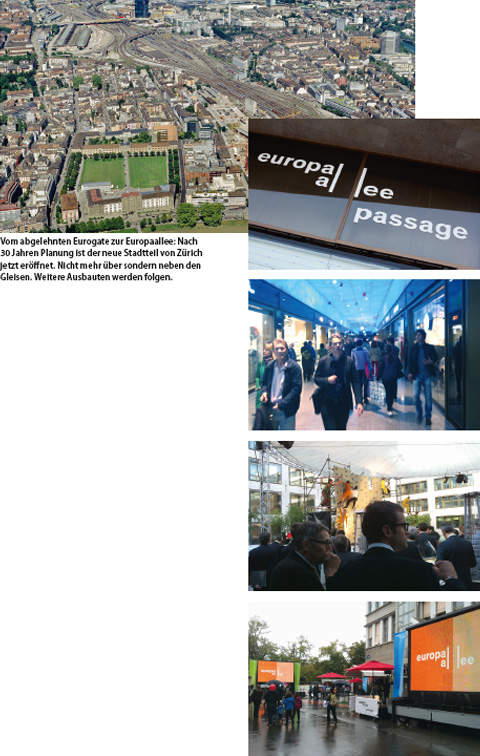
Zurich has finally become a cosmopolitan city. We now have a Europaallee. Meta Design is providing communications support for the project. The branding agency behind «Visible Strategies» developed the brand for the new development.

Hamburg has HafenCity, London has Canary Wharf, and Paris has La Défense. For a week now, Zurich has also joined the ranks of cities setting trends in urban redevelopment. Last Thursday, the Europaallee was opened behind Zurich’s main train station. Meta Design, the branding and corporate identity agency, developed the brand strategy, visual identity, and communications for the SBB’s new prestige project.

«A particular challenge here was that it wasn’t just about communicating a wide variety of offerings, but rather about the Europaallee brand as a whole,» says André Stauffer, Creative Director at Meta Design. Currently, the posters announcing the opening of Europaallee with a massive display are impossible to miss throughout the city of Zurich.

Meta Design has been working with SBB on this project since December 2011. Previously, the Zurich-based branding agency had carried out other assignments for the railway’s umbrella brand. This led to the request: For SBB’s largest real estate development project in Switzerland, a strategy was to be developed for positioning and marketing the Europaallee brand.

SBB plans to market its properties on the site of the large-scale development behind the Sihlpost on its own. In total, SBB is currently working on nearly 80 development projects throughout Switzerland. The Europaallee is the largest of these and is intended to serve as a flagship project in terms of brand strategy.

Subbrands as a Guide

Following the opening of Construction Site A on September 20—after nearly four years of construction—seven additional sections of Europaallee will be put into service over the next eight years. In 2013, UBS will move into the building behind the existing University of Teacher Education. In 2015, Sihlpost will move into a new building further west. In 2016, a design hotel will open.

Construction Site A, which has now opened, is home to the campus of the University of Education, which is already being used by 2,500 students as of the start of this semester. For the general public, the newly opened Europaallee Passage features 15 stores, primarily specializing in outdoor and sports gear. For example, visitors can discover a seven-meter-high transparent climbing wall here at the Transa Store.

MetaDesign’s brief was that the Europaallee brand should be perceived as independent, rather than directly associated with SBB. The name «Europaallee» had already been decided upon. “A strong umbrella brand ensures synergies in the development and establishment of this ambitious and unique project,” explains strategist Lukas Eiselin. Subbrands such as the Europaallee-Passage are used strategically to provide visitors and residents with geographical orientation and to address specific themes. As additional construction sites open, new subbrands will be introduced in a targeted manner.

In developing the brand identity, MetaDesign drew on the uniqueness of the diverse connections that Europaallee represents: for example, the connection between the two distinct city districts, District 1 and District 4. But even within this area, you’ll find everything you need—from retail spaces to educational institutions, restaurants, a hotel, apartments, and even a retirement community.

MetaDesign has therefore framed this urban «microcosm» within a visually distinct «bracket» that unites this diversity: two lines that are simultaneously perceived as a graphic symbol for an avenue. «The double row of trees is the graphic representation of an avenue. Through this simplification, it has become two parallel lines,» explains André Stauffer, who was responsible for the design. To promote the opening and the new name, the city of Zurich used not only numerous posters but also hanging signs in trains and trams, as well as advertisements.

Andreas Panzeri

top2-01
top2-02
 

To the point: Bestiary

People can spend hours debating the issue of quality in the media at industry gatherings and panel discussions. The direction the conversation takes depends heavily on the people currently engaged in the debate.

So let's try to bring some order into Speakers Corner. First of all, it can be roughly divided into media professionals and media consumers - whereby one must bear in mind that media professionals are also always media consumers. The reverse is not true, with the exception of the group of letter writers, online reader commentators and reader reporters. Fortunately, they do not appear at industry meetings and discussion panels.

So let's concentrate on the realm of the actual media creators and start at the top with the publishers. No publisher will say that he doesn't care about the quality of his media. He firmly believes that quality is important. But he often fails to define this quality precisely. Nevertheless, he can defend it excellently at industry meetings and discussion panels. In second place come the CEOs - although a distinction must be made here between former journalists and pure number crunchers. The former journos among the CEOs can't always completely suppress the feeling of shame that occasionally afflicts them when they come face to face with reality, while the number crunchers, on the other hand, don't know any such feeling: what's good is what's cheap and what sells. Despite arguments that are not entirely congruent, both are able to defend their positions eloquently at industry meetings and discussion panels.

Now comes the army of editors-in-chief. A wide range of opinions opens up. You'll find everything from rosy-cheeked optimism to the darkest cultural pessimism. They never agree, but their appearance at industry meetings and discussion panels is usually amusing. Or they don't even come because of toothache.

The next group is that of former editors-in-chief. They can still be found at industry meetings for some time, but rarely on the discussion podiums anymore. That's a good thing, too, because they practice media age gymnastics: articles in media blogs, comments on articles in media blogs or guest contributions at friendly editorial offices. The guiding theme: Everything used to be better, and in general ...

Let's move on to the small group of so-called professional media critics. They are often to be found at industry meetings, but never on the discussion panels. As a result, they have to make their displeasure known via break talks, Twitter, Facebook and blogs. University media researchers are also given asylum in this group. No one outside wants to listen to them anyway.

Pierre C. Meier, Editor-in-Chief
[email protected]
 

Jung von Matt/Limmat and Eichhof make a toast

Following an agency evaluation, Eichhof has chosen Jung von Matt/Limmat. The communications agency has won the marketing communications account for the Central Swiss beer brand.

The newly developed campaign focuses on Eichhof's numerous regional commitments in wrestling, soccer, ice hockey and culture. In this way, the beer brand wants to underscore its deep ties with Central Switzerland, the agency said in a statement. The first posters and ads of the new campaign can already be seen in Central Switzerland. Further work will follow in the next few days.
 

KSB: Wrestling for climate protection

The nonprofit organization Myclimate has dozens of new climate protection projects in the pipeline. With new partners and supporters, these projects can be implemented. That’s why Myclimate is now going on the offensive—with a communications package from KSB.

"FIGHT CO2" is the new, striking battle cry of Myclimate. To mark its anniversary, the organization staged the fight for the public as a live wrestling match between two masked fighters: Challenger Captain Climate against longtime dominator El Rey Loco2, "the dirtiest wrestler ever."

The first fight took place in front of around 300 guests at the Myclimate anniversary celebration on the Bundesplatz in Bern. Among the guests: top model and Myclimate ambassador Nadine Strittmatter as well as international celebrities from business, politics and NGOs. The big public match went over the main stage last Saturday at Freestyle.ch in Zurich. 30,000 fans celebrated the renewed triumph of Captain Climate over El Rey Loco2.

Trailer on Facebook

Around the central Fight events, KSB put together a package of communication measures for the narrower and broader target audience. The trailer forms the core of the interactive audience platform "Fight CO2" on Facebook. This is where "Fight CO2is stoked, accompanied and embedded in the climate protection context. The photo/combat call competition is intended to provide fun, while the Co2mpensate calculators call for action. The extraordinary "10-year report" appeared on the back of the wrestling poster that Myclimate mailed to selected addresses. Furthermore, the poster motif was used on eBoards and as newspaper advertisements.

Responsible at MyclimateRené Estermann (Managing Director), Kathrin Dellantonio (Head of Sales, Marketing and Communication), Andrea Altorfer (Project Management). Responsible at KSB war Schlupp Bürge: Daniel Krieg (CD), Beat Egger, Stefan Ganz (concept/text), Rahel Witschi (art direction), Paco Alborghetti (graphics), Julia Brun (consulting). Illustration: Amadeus Waltenspühl. Responsible at Onfilm: Hans Kaufmann (director), Michael Saxer (camera/editing), Michael Gloor (producer). Responsible at Swiss Championship Wrestling: Pascal Signer (President).
 

The End of the Analog World

In common parlance, «digital» refers to anything related to computers. But what doesn’t have to do with computers these days? The distinction between digital and analog devices is becoming increasingly blurred. How meaningful is it anymore to speak of «digital» as distinct from «analog»? By Oliver Reichenstein, an information architect who lives and works in Tokyo.

Coffee makers are equipped with graphical user interfaces; cars are computers on four wheels; phones are computers with camera and telephone technology. More and more products come with a chip: toasters, shoes, and soon even glasses. Books are written, typeset, printed, and distributed on computers; record players are full of microelectronics; houses are designed on computers. Everything today is digital to some extent. The difference between digital and analog is no longer clear-cut; it is gradual.

Going digital is, of course,

The more digital technology advances, the more natural the digital world seems. No one thinks about the fact that they’re operating a computer when they press the espresso button; the iPad and Kindle have already technically surpassed the average printed material (though there’s still room for improvement in typographic design). The audible difference in quality between a CD and an LP is, scientifically speaking, far from clear.
While it’s becoming increasingly difficult to distinguish between digital and analog in terms of user perception, the difference is clearly evident in how they’re used. Records have to be flipped over, cleaned, and carefully stored; CDs do not. You unscrew the lid of a coffee pot and fill it; you operate a coffee machine at the push of a button. You flip through the pages of a book; on an iPad, you swipe, slide, and tap. Digital products, with or without a screen, are handled differently than analog products. On the one hand, they’re more practical; on the other hand, they’re flatter.

Going Digital Is Getting Easier

When we talk about analog and digital, we are—consciously or unconsciously—referring to the fact that digital processing is both simpler and more abstract.

While interacting with digital products generally seems more practical by comparison, it simultaneously loses a sense of physical reality. People often say that what digital products lack is an active physical connection. Screwing, tilting, pulling, unpacking, lifting, pushing, flipping through pages, turning, and tapping are reduced to a nearly two-dimensional swiping and tapping.

Analog tools such as hammers, scissors, or binoculars are extensions, enhancements, and simplifications of our bodies. A hammer is a hardened fist; scissors are finely sharpened teeth; and glasses are sharper eyes.

Every product has an interface. A hammer has a handle that fits in the hand and an end that resembles a fist. Scissors are adapted to our fingers; the blades resemble our teeth. Glasses are fitted to the face and function with the eye like a second lens. Unlike analog tools, which—with a little practice—almost immediately become an extension of our bodies, computers always feel somewhat foreign. Computers do not adapt to our minds as naturally as the hammer in our hand. Digital products lack the immediacy of analog tools. Computers are extensions of our brains. Brains are confusing. So how could computers not be confusing?

Analog Becomes Digital

Nevertheless, it is only a matter of time before these strange computers seem as natural to us as a hammer and a pair of scissors. The first hammer fit as naturally in a person’s hand as the first hammer we ever picked up as children. How meaningful is it still to speak of «digital» as distinct from «analog»? It is as meaningful as it is revealing, but it’s getting harder by the day. Soon, one will have to be a writer just to be able to imagine a purely analog life at all.

Central Switzerland radio rochade approved

Radio Sunshine may be taken over by the owners of Radio Central: The DETEC has approved the transfer of the license and granted Radio Central's request.

The Federal Department of the Environment, Transport, Energy and Communications (DETEC) had previously given the go-ahead for the licensing of Radio Eviva. The digitally broadcast folk music radio station will be sold by Radio Central to three private individuals. This was announced by the Uvek in a press release on Thursday.

Until now, Radio Central has operated the two licensed stations Radio Central and Radio Eviva. As the provisions of the Radio and Television Act (RTVA) stipulate that a company may hold a maximum of two radio licenses, Radio Central transferred the Radio Eviva license to three private individuals before acquiring Radio Sunshine. After DETEC approved this transfer, the transfer of Radio Sunshine to Triner Medien Holding and Spirig Medien (45% share each) became possible. The owners of the two companies jointly own Radio Central.

With DETEC's approval, the two local FM radio stations in Central Switzerland, Central and Sunshine, will have the same owners in future. Radio Sunshine will also be able to meet the requirements of the radio license under its new ownership.

Radio Eviva to private individuals

Radio Central has sold a total of 81 percent of the shares and voting rights in Radio Eviva für Volkskultur to the three private individuals Beat Diener (38 percent), Sepp Trütsch (38 percent) and Christian Kuhn (5 percent). 19 percent will remain with Radio Central. In 2007, Radio Eviva received a license from DETEC to broadcast a popular radio station via the DAB+ digital transmitter network in German-speaking Switzerland. The company had already been licensed by the Federal Council in 1995 and 1997 to broadcast satellite, medium wave and cable radio.


Through our music, we contribute to diversity

Since Radio 105 received its FM license three years ago, the private station has been steadily gaining young listeners. Founder Giuseppe Scaglione explains what makes 105 special and talks to *Werbewoche* about loud music, criticism of his station’s news coverage, and the future of digital radio.

For the second year in a row, Radio 105 was named «Radio of the Year.» The private broadcaster received this award for the largest increase in listeners in German-speaking Switzerland—a 35 percent rise from the previous year, from 79,000 to 109,000 listeners. Compared to its FM launch in 2009, this represents more than a doubling of listener numbers (daily reach, Mediapulse Radio Panel, target group 15+, German-speaking Switzerland, private radio stations, Monday–Sunday, first half of the year).

WW: Mr. Scaglione, what is the secret to Radio 105's success?
Giuseppe Scaglione: A large part of our formula for success is passion. That may sound trite, but it’s anything but a given to find a job you enjoy so much. Our young hosts give it their all. Radio is their world, their life. And listeners can tell.

The 105 program is tailored to a young audience of 15- to 25-year-olds. The hosts do one thing above all else: they entertain. Topics include celebrity news, contests, parties, and concerts. Musically, the station focuses on the latest releases—«Today’s best music» is its slogan. A strong connection to the DJ scene is also part of the programming. On weekends, 18 DJs host their own shows—including Bob Sinclar, DJ Antoine, Mr. Da-Nos, and David Guetta.

What are the program's main focuses? Which show has the highest ratings?
As with most stations, the morning show is Radio 105’s most important program. In terms of ratings, however, we’re very strong not only in the morning but also in the evening. The reason is likely our history as a cable station. Cable TV was a medium that people typically used at home after work.

This statement implies that Radio 105's target audience has aged ...
I wouldn’t put it that way. Surveys show that we’ve been able to retain our original listeners. However, since Radio 105 moved to FM, we’ve been attracting mainly young listeners. We also see differences throughout the day: While the target audience is still relatively broad in the morning, it gets significantly younger toward the evening. For this reason, the evening programming is more focused, younger, more progressive, louder, and even edgier.

Even louder? Even more irreverent? As a listener, you already feel like you're being yelled at during the morning show …
Otherwise, you'll never wake up!

Does it have to be that way?
It’s not like there’s any screaming going on. The point is: the music we play is loud and full of energy. If the host were to whisper, he’d be completely drowned out. Our hosts have to take into account the energy that the music brings. After all, we rarely play ballads.

Music is a good topic: When 105 launched its FM service in 2009, you said that 70 percent of the music wasn’t on the charts. That’s a fact that sets 105 apart from other stations. What’s the situation today?
Currently, the percentage of music that isn't or hasn't been on the charts is around 50 to 60 percent. This has to do with changing musical tastes. The music we’ve always played on Radio 105 suddenly became popular. However, what matters to us isn’t whether the music makes it into the charts, but how fresh and how good it is.

Wouldn't it be more exciting to turn away from the trend again, musically speaking?
Just because the music is successful can’t be a reason to throw the concept overboard! Quitting right now would be practically suicidal. Why should we leave the field to others? Much of the music we play isn’t played on other private radio stations. Here, we’re making a real contribution to diversity.

You mentioned the two peaks during the day: in the morning and in the evening. What about the weekend?
There, it's spread out over the course of the day and picks up toward the evening with the DJ shows. Our chart show is also especially popular on the weekend.

How about between 11 a.m. and 12 p.m.?
I assume you're referring to the «Talk vor 12»?

«Talk vor 12» is a weekly talk show that airs every Saturday and Sunday before noon. On the show, host Michi Sahli talks with guests about politics, current referendums, legislative proposals, or their personal lives. For example, he spoke with SP Federal Councilor Simonetta Sommaruga about asylum seekers and hash cookies.

Exactly. A political show is a type of program you wouldn't expect to see on 105.
That's true. The show was mandated to us as part of our FM license. At first, we really only produced the show because we had to. By now, the talk show would exist even without that obligation. We made a virtue out of necessity.

In what way?
«Talk vor 12» is a very bold format that’s helping us reach a new audience. The show is followed by a slightly older demographic of listeners. Listeners for whom 105 isn’t usually their first choice. In addition, the talk show gives us a certain relevance and depth that isn’t possible in our regular daily programming. We stand behind the format and haven’t relegated it to off-peak hours—instead, we’ve put it front and center.

Well, for a lot of teenagers, 11 a.m. on the weekend is probably still pretty early …
That's why we're rebroadcasting the show on Sunday. Sleeping in might be an option for one day. But since the talk show airs on both Saturday and Sunday, it's hard to avoid watching it.

Let's stick with the topic of news. According to the OFCOM study, 105 of Zurich's private broadcasters have the lowest proportion of news content.
Yeah, yeah. But you’d have to take a closer look. Much of what we classify as information wasn’t recognized as such in the study. We break down political topics to the point where they become understandable to people who don’t deal with politics every day. That can quickly lead one to think that it’s no longer information in the traditional sense. I see it differently. It’s simply a different way of conveying information. Besides, is it only “information” when it comes to politics? Or are we also providing information when we discuss a new piece of music? We’re targeting a different audience than our competitors. That’s why it doesn’t make sense to compare the information we provide.

Don't you see a need for action?
I don’t think we have any shortcomings when it comes to information. Of course, we don’t cover every event or every topic. But that would be the wrong approach anyway. With the SRG, Switzerland has a broadcaster that does this very well and has the necessary resources to do so. We operate in the private sector and have to ask ourselves: Where do I stand out? How am I different from the mainstream? While we respect the law and our license, we don’t make radio primarily for lawmakers—we make it for our audience. Dying in splendor doesn’t benefit anyone. We look at what’s in demand out there. The need is greatest when it comes to music. Listeners don’t expect the same range of information from us as they do, for example, from Radio 24 or DRS3.

To what extent is Radio 105 focused on Zurich due to its FM license?
With the FM frequency came the mandate to focus on local content. That’s what we do—and not just with the weather and traffic reports. But at our core, we’re not a traditional local radio station; we’re a radio station for German-speaking Switzerland.

In addition to its FM frequency in the Zurich area, Radio 105 is available on cable—and, since November 2011, via DAB+ (Digital Audio Broadcasting) throughout German-speaking Switzerland. DAB+ is a platform that is steadily gaining importance in radio listening. Currently, 2.4 million people in Switzerland can already be reached via digital radio. Scaglione, who had long been critical of DAB+, now has high hopes for the technology …

What are your thoughts on DAB+ today?
DAB+ could very well become a success story. DAB+ radios are now being installed in cars, the SRG has invested a lot of money, and Switzerland is a pioneer in terms of the number of digital radios … DAB+ works exceptionally well. The technology is reliable and simple: just flip the switch—and it works. These are exactly the things that once made radio so successful.

Radio stations have also been promoting DAB+. Time and again, 105 has given away DAB radios …
That’s right. As a private radio station, we naturally benefit from DAB+. Having an FM frequency for Zurich is great. However, my vision has always been to create a radio station for German-speaking Switzerland. DAB+ represents a shift in mindset. For the first time, the SRG is truly allowing competitors. All stations have antennas of equal strength and cover the same area. If DAB+ catches on, everything will be turned upside down.

When it comes to radio usage, internet streaming should not be overlooked either. According to the station’s own surveys, about half of Radio 105’s listeners tune in via web radio. Scaglione is frustrated that radio listening via Internet streaming is not yet included in the official statistics (Mediapulse Radiopanel). He believes that, given its young target audience, Radio 105 should benefit more than average from the inclusion of Internet radio usage. The station’s founder will have to be patient for a while longer. While a change has already been initiated for TV data, Mediapulse expects to be able to track web radio usage starting in early or mid-2013.

What are your plans for 105?
There will be a few innovations in the program lineup. But we’ve settled on the basic mix. The goal now is to reach even more people and raise awareness of 105 outside of Zurich. Next year, we’ll also be launching a new website.

Which way are we going?
The website will be designed for mobile, device-independent use. And we're exploring new forms of advertising. That's almost the biggest challenge.

Which type of advertising challenges you the most?
Yes. We think about which offers are interesting to customers. It can't just be about clicks and banners! Integrated advertising is what's really exciting.

Radio 105 is already putting together comprehensive packages for its advertisers. A good example is the «105 DJ Night.» Last Friday, around 2,500 guests partied with the radio station and its DJs at Club X-tra. Tickets were given away in a raffle on Radio 105, and the party was funded by sponsors, who were given significant exposure over the course of a month: in the lead-up to the event—in trailers, during ticket giveaways, on flyers, and in online banners—as well as during the party itself, with logos and dedicated lounges in the club. Scaglione does not reveal the exact budget sponsors can expect: «We don’t publish figures. But let’s put it this way: If someone places one or two full-page ads in a major daily newspaper, they’re in. Should the event grow even larger, it will reach a whole new level.» Larger not only in terms of the venue but also in terms of advertising opportunities. From poster campaigns to TV broadcasts featuring sponsors, Scaglione can envision it all. Marketed in-house. That’s because, as of the end of the year, Music First Network AG—the company behind Radio 105, which is already responsible for promotions, sponsorships, and special advertising formats—will also take over traditional marketing, which is currently handled by Energy (Ringier Entertainment).

Isabel Imper

105-01


get_footer();