Klappe 33 goes international 

The 33rd Klappe is kicking off with a new look and feel. The team led by Daniel Wellschmiedt—put together by Creative Director Thomas Schwarz of Ogilvy & Mather in Düsseldorf—is rallying Klappe entrants with some rather unusual visuals.

The junior creatives are expected to present something bold and completely different to the participating agencies as an enticement. The Communications Association is opening the competition to international entries from Germany, Austria, and Switzerland, and is collaborating with the New York Festivals on this competition for emerging talent. The association announced this in a press release.

«On the international advertising film scene, there are quite a few highly successful works from productions in Germany, Austria, and Switzerland. We haven’t evaluated these at Die Klappe so far,» says Thomas Strerath of Ogilvy & Mather (photo), the new jury chair of Die Klappe, explaining the expansion of the categories.

For 2013: All up-and-coming creatives born after June 1, 1984, are eligible to submit entries and win a week-long trip to New York, including participation in the workshops and the New York Festival awards show. The deadline for the main competition is February 9, 2013; for the Young Creatives competition, it is February 1, 2013. «The winner of the Young Creatives competition will meet Grand Award jury members in New York. These are about 40 to 50 top creatives from around the world; representing Germany are: Jean-Remy von Matt, Alex Schill, Amir Kassaei, Martin Pross, and Michael Conrad as moderator,” says Peter Strahlendorf, the New York Festival’s representative for Germany. This is a networking opportunity that doesn’t come along every day.”.

Die Klappe is a platform designed to inspire innovation in the German-speaking advertising film industry. That is why a broader, international perspective is also important to Die Klappe from the association’s point of view. The association has also deliberately taken an international approach to its competition for emerging talent, says Executive Board member Hans-Joachim Berndt.

To the registration

SRF and Beobachter launch "Beobachter TV

"Beobachter TV" is a new cross-media format of the magazine "Beobachter" and Swiss Radio and Television SRF. The advice show will launch in the first quarter of 2013.

This was agreed last week by the Beobachter publishing house and SRF, according to a statement on Srf.ch. "Beobachter TV" offers the audience competent advice in various areas of life on a weekly basis. Experienced experts from the "Beobachter" advice team will support and accompany people from Switzerland in the program as they deal with their big and small challenges in everyday life, it continues. The editorial team is led by the editor-in-chief of "Beobachter," while "Beobachter TV" is produced by Faro TV on behalf of SRF.

"With SRF and Beobachter, two strong partners have come together in the area of consulting and service," says Hansruedi Schoch, Head of Department Programs SRF.

Werbeweischer cooperates with imaculix for cinema advertising films

To ensure a high standard of quality for movie theater advertising, Werbeweischer collaborates with the film and technical specialists at Imaculix. The agency conducts quality checks on all local and national movie theater campaigns to ensure they meet image and sound standards.

In the local advertising business, the company also produces slides and video formats for cinema advertising clients on behalf of Werbeweischer. In addition, Imaculix is a technical partner for the Zurich Film Festival, which is currently taking place, and is responsible for the production, as Werbeweischer noted in a press release on Friday.

Peter Kropsch Named New President of the European News Agencies

Peter Kropsch, CEO of the Austria Press Agency (APA), has been named the new president of the European News Agencies Association (EANA). He succeeds Mika Pettersson of the Finnish news agency STT.

At Friday’s General Assembly in Lisbon, the Andorran news agency ANA and the Georgian agency GHN were also admitted to the EANA. It now comprises 32 news agencies from an equal number of countries, including SDA, DPA (Germany), AFP (France), ANSA (Italy), and ITAR-TASS (Russia). In addition to the new president, Peter Kropsch, Jiri Majstr of the Czech agency CTK and George Penintaex, CEO of the Cypriot agency CNA, were newly elected to the board. Clive Marshall of the British agency PA rounds out the board.
 

New business models
 
At the fall conference, agency executives addressed the challenges facing news agencies in the changing media landscape and discussed new business models. The trend across Europe—where the use of print products is declining while that of digital media via mobile or online platforms is steadily increasing—offers new opportunities for news agencies. However, they are simultaneously facing significant cost pressures, which makes developing new products quite challenging. New partnership models with clients and multimedia offerings that can be used across all media platforms are becoming increasingly important. With their standards and efficient processes, news agencies can continue to be indispensable partners for clients both large and small. (sda)

Great Ditch

On September 24, 2012, *Werbewoche* conducted an interview with National Council members Hans-Jürg Fehr and Filippo Leutenegger. It is clear that the two represent different approaches to media policy.

There have been major changes in the media sector, and further significant upheavals are on the horizon. Opinions are divided on how to deal with this. If bridges cannot be built across the wide divides between the different positions, policymakers will have little chance of guiding this transformation in a constructive manner.

WW: Media policy isn't a major issue—neither among politicians, nor among the public, nor even within the industries it affects. What can the communications and media industries do to raise the profile of media policy?
Leutenegger: I am not a proponent of interventionist media policy. I want the media to be able to report freely, with as little government interference as possible and without being censored—that is part of the media’s fundamental mission. That is why I am not a proponent of media policy—the less the government interferes, the better.
Fehr: I believe the media need to focus more on themselves. Just as other relevant areas of society are the subject of journalism, developments in the media world should also be the subject of journalism. That would require a dose of self-criticism. Currently, there is much less media criticism in the media than there used to be, even though there are developments in the media world that are highly relevant to society. After all, there’s hardly anything that most people interact with as intensely as they do with the media.

Read the entire interview in the current print edition of *Werbewoche*.
 

FBM: Festival La Perla confesses to flash mob on the Paradeplatz in Zurich

Today at noon, FBM Communications held a flash mob on Zurich’s Paradeplatz to promote the La Perla – Aida 2013 Classical Music Festival at Pfäffikersee in Pfäffikon, Zurich. Over 100 people were captivated by the music of Giuseppe Verdi.

"With this flash mob, our musicians gave a touch of the world and the mood of Aida, as it will be seen in August 2013 on the lake stage at Lake Pfäffikon," confesses George Egloff, Managing Director Festival La Perla, about the event. The attention of the passers-by was very great, the event surprised and delighted them. Many filmed the performance with their cell phones.

Shortly after 12 o'clock, a trumpeter on the parade ground intoned the Triumphal March from Aida. He was quickly joined by other trumpeters and musicians until a full orchestra was in place. They were also joined by soprano Barbara La Faro, who rounded off the whole performance with a total of over 50 people including conductor Enrico Reggioli. Besides the Triumphal March, the aria Ritorna Vincitor was performed. After about 15 minutes the performance was ended with great atmosphere and applause of more than 100 spectators.

Festival La Perla

Generational Transition

Artistic directors come and go in Zurich. The opera and the Geissbühlers remain.

A year ago, the new opera house team led by future director Andreas Homoki began its work and put the branding budget out to new bid. Nadine Geissbühler and her team developed a concept that defied the unwritten rule that a newly put-out-to-bid account never stays with its original agency: Studio Geissbühler won the pitch. The results are now on display: The Zurich Opera House has a new look—from the logo and typography to the poster design and even the classified ads.

In the future, the focus will be less on individual poster art—as has been the case for the past 37 years under Domenic Geissbühler’s concept—«Times have changed; the goal was to create a unified visual identity. Formal recognizability is now the priority,» says Nadine Geissbühler regarding the new management team’s mandate. The goal was to create a poster concept that could be implemented independently of any specific production or date. «The goal was to bring the opera into the present day.» Nadine Geissbühler and her team drew on the power of symbolism to bring the world of opera into the present. And here’s how it works: A relevant essence is distilled from the opera’s content and transformed into a fitting symbol of the present day. As is so often the case, the themes revolve around love, power, jealousy, and death.

External development, internal implementation

«Everything that’s already on display was designed by the Opera House based on our concept. And in the future, too, all designs will be produced in-house by the Opera House itself—in collaboration with the artist and illustrator François Berthoud,» says Nadine Geissbühler, explaining the new approach to collaboration. The designs can be viewed on the website www.opernhaus.ch. And what does the longtime, multi-award-winning designer of the previous posters think of the new concept? Domenic Geissbühler: «Many people ask me about it and draw comparisons. But I think the new approach is very successful. A clear direction.» Nevertheless, Domenic Geissbühler’s work is far from forgotten. A book featuring his collected works is set to be published this spring.

Andreas Panzeri

oper
oper2_0
oper3
 

Angelink: New viral video for Profresh Micro-Mints

Angelink has posted a second viral video featuring refreshing humor on YouTube for the new candy brand Profresh.

The second prank revolves around a fictitious refreshment service on Zurich's Bahnhofstrasse, which is free of charge but hardly manages to convince passers-by. But then the unexpected happens. The viewers, again filmed by hidden cameras, experience refreshing moments and incredulous amazement:

http://www.youtube.com/watch?v=XaRntcJytLE

Angelink posted its first video on YouTube a few weeks ago:

http://www.youtube.com/watch?v=cXc7uwBD0E0

The two viral videos are intended to support the market launch of the Profresh Micro-Mints.

Responsible at Dabso SA: Jean-Yves Cuendet. Responsible at Angelink: Markus Gabriel. Responsible at Guave Studios: Sergio Herencias (production).

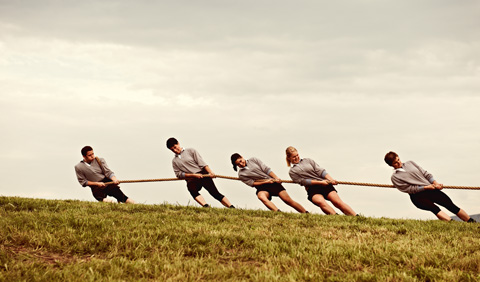
150 branches pulling on the same rope

Red Lion has designed a new campaign for Charles Vögele. The campaign was launched with an employer branding initiative under the slogan: «We bring Switzerland into fashion.» In the second phase, all Vögele stores in Switzerland were given the opportunity to outfit a club of their choice.

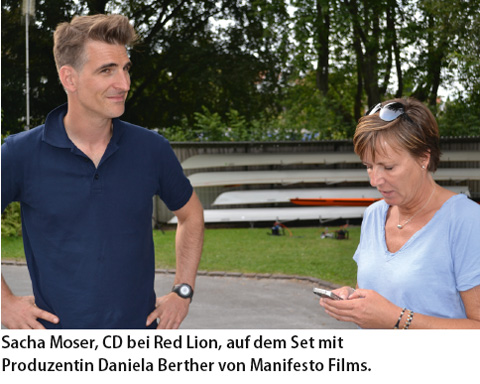
The briefing was clear: "We were asked to design a campaign specifically for Switzerland. It had to be much closer to the people than the previous advertising. The third requirement was that Charles Vögele employees should also be involved," explains Sacha Moser. The CD of the newly founded agency Red Lion had already worked for Vögele on previous campaigns. However, Red Lion now has the lead for this campaign and can therefore work more directly with those responsible at Vögele.

To find a basis for their new ideas, the Red Lion team spent two days touring various Vögele stores. "Together with the management, we wanted to create something that comes from the bottom up and is not imposed from above," says Moser, explaining the "field study". In the stores, they discovered "which customers frequent the stores and also the crucial importance of the advice given by the sales staff, some of whom are known by name, for customer loyalty and satisfaction," adds Managing Director Christian Siegrist.

The Krea team, Jan Krohn, Viviana Chiosi and Sacha Moser, sat down in a traditional Swiss pub to brainstorm. It was there that they were inspired to come up with the idea that Charles Vögele should focus its new advertising on Swiss clubs instead of Hollywood movie stars. "The diverse clubs in this country and their members are very close to Charles Vögele's target group," says Moser.

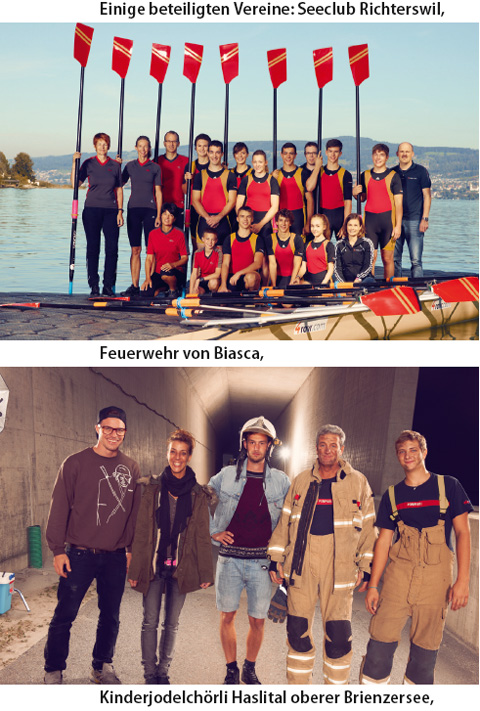
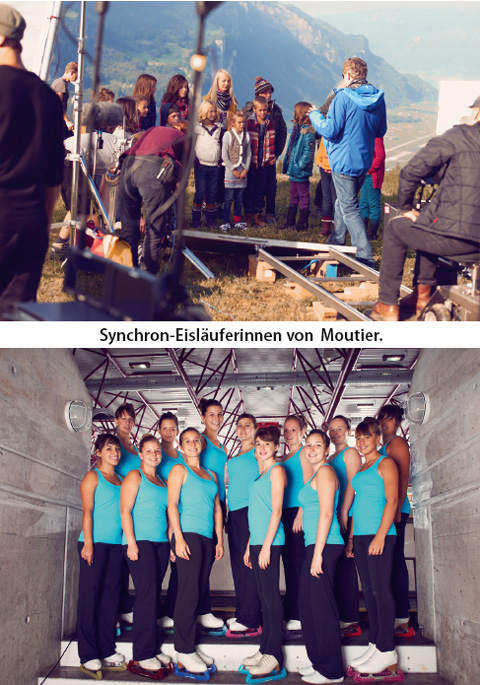
The aim is to reach these potential customers with a campaign in which the individual branches are each allowed to dress a club in their region with Charles Vögele fashion. The first step was to launch an internal campaign. In a funny and likeable film, staff in all 150 or so stores in Switzerland were asked to find a club in their immediate vicinity that would be willing to take part in an advertising campaign. "We bring Switzerland into fashion" was the motto of the employer branding. "The response was overwhelming," say the advertisers happily. 121 associations were inspired by the branches. Many of them submitted their applications with elaborate documentation or even films they had made themselves. As a thank you, all the clubs were given new clothing at Vögele's expense. A "Word of Mouth" campaign, which can of course have a much more lasting effect with this valuable fashion gift than just a "Like it" button on social media.

Five different associations from the large "casting" were then selected for a leading role in five different commercials. In the films produced by Manifesto and directed by Reto Salimbeni, the clubs and their activities are briefly presented in concise sequences. Charles Vögele's "Stil Mobil" then drives up and, together with real store managers, brings the club members into fashion as part of a suitable storyline. Tag line: "We advise you with style."

Andreas Panzeri

Rudolf P. Scheben, Vice President Marketing, on the new style

Charles Vögele's new campaign aims to be as close to the Swiss as possible. They are promised in a popular tone: "We advise you with style."
 
WW: Village clubs instead of Hollywood stars: What is the strategy behind the new advertising concept?
Rudolf P. Scheben: For the campaign, we were looking for an approach that was as close as possible to the Swiss and typical of the country. Switzerland is a "country of associations" - there are over 80,000 associations here. It was also important to us that we were able to involve the branches and our branch employees, as they are the heart of our company. We wanted an authentic campaign with real people and real employees. So we came up with the idea of having our branches dress Swiss clubs. I think this approach has enabled us to emphasize our proximity to our home market of Switzerland and to our employees.

What was the reaction from the stores?
The stores were enthusiastic and very committed. In total, we received over 121 applications for the campaign. All of these clubs were completely re-dressed by us. On average, there were ten people per club. Of course, they got to keep the outfits.

That's well over 1000 outfits. A nice budget item.
That was certainly an important budget component. But it was worth it. Our employees were able to personally invite the associations to the stores and thus establish contacts on the one hand and demonstrate our advisory and fashion expertise on the other.

Who is the target audience?
The campaign actually appeals to almost everyone. Charles Vögele is a Swiss company with strong roots. We didn't want to run a campaign that excludes people - after all, one of the aims was to show the proximity to Switzerland and the people here in the country.

So no longer an active rejuvenation like the Cruz sisters?
We want to be much closer to our customers again - and this is exactly what our new campaign stands for. In recent months, we have clearly realigned and repositioned the company. Our core target group corresponds to a good middle class with a high understanding of value for money aged 40 plus. With an up-to-date range, excellent value for money and expert advice, Charles Vögele aims to offer uncomplicated access to fashionable clothing. For our customers, this means At Charles Vögele, I can rely completely on fashion expertise.

 Will there be any concrete changes in the stores?
A lot has changed in the stores over the last 12 months. Particularly in terms of the product range, but also in terms of clarity and service. This is the basis for our communication strategy. We want to keep the promise of our campaign: "Advice with style" in our stores, i.e. we provide stylish advice and recommend stylish fashion.
 
What is the product range like? Have you heard of large stocks?
Every fashion retailer has goods that they take from the previous season. As long as this does not exceed a certain percentage - as is the case with us - it is completely unproblematic.

Vögele has over 800 stores throughout Europe. Can the Swiss campaign be adapted?
We have developed this campaign specifically for Switzerland. We are currently examining a similar approach for Austria. The prerequisite for this, however, is that authenticity is also maintained in this market so that customers know what Charles Vögele stands for.

Interview: Andreas Panzeri

top1-interview
top1-01
top1-02
top1-03
top1-04
 

Neo Advertising accelerates growth in shopping centers in German-speaking Switzerland

Neo Advertising is expanding its network with new shopping centers in German-speaking Switzerland and launching new advertising products. Thanks to digital technologies, these are expected to deliver even greater advertising impact.

In the Letzipark shopping center, the company inaugurated a system of four ellipses made up of four synchronized screens installed in the middle of the center on 20 September. The synchronized ellipses form a "branding zone" with 10 m2 of advertising space, allowing brands to reach all streams of visitors and completely dominate the shopping center with new creative possibilities, the agency said in a statement. The new installation complements the existing system with 32 screens for even more advertising impact in the fourth-largest center in the greater Zurich area.

In the Volkiland shopping center, Neo Advertising has installed two information boards with four synchronized screens in the heart of the shopping center. The new location is intended to complement the current offering of the 48 shopping centers and improve the national coverage of the product in German-speaking Switzerland.

In Bern Wankdorf, Neo Advertising is completely restructuring the existing system and installing four ellipses with three screens at the height of the central escalators and an information board with four screens at the height of the moving walkway. The new synchronized solutions should offer a greater advertising impact and make it possible to cover the most important visitor flows.

These new locations and the restructuring of existing locations are just the beginning of a comprehensive plan to strengthen the advertising offer in Swiss shopping centers, which will be implemented in 2013, according to the agency. The aim is to be present in 60 locations by the end of 2013, with influential and interactive communication products adapted to the needs of shopping centers, advertisers and customers, explains Etienne Reignoux, CEO of Neo Advertising.
 

Great Ditch

On September 24, 2012, *Werbewoche* conducted an interview with National Council members Hans-Jürg Fehr and Filippo Leutenegger. It is clear that the two represent different approaches to media policy.

There have been major changes in the media sector, and further significant upheavals are on the horizon. Opinions are divided on how to deal with this. If bridges cannot be built across the wide divides between the different positions, policymakers will have little chance of guiding this transformation in a constructive manner.

WW: Media policy isn't a major issue—neither among politicians, nor among the public, nor even within the industries it affects. What can the communications and media industries do to raise the profile of media policy?
Leutenegger: I am not a proponent of interventionist media policy. I want the media to be able to report freely, with as little government interference as possible and without being censored—that is part of the media’s fundamental mission. That is why I am not a proponent of media policy—the less the government interferes, the better.
Fehr: I believe the media need to focus more on themselves. Just as other relevant areas of society are the subject of journalism, developments in the media world should also be the subject of journalism. That would require a dose of self-criticism. Currently, there is much less media criticism in the media than there used to be, even though there are developments in the media world that are highly relevant to society. After all, there’s hardly anything that most people interact with as intensely as they do with the media.

Was your statement, Mr. Leutenegger, also a reference to a media policy position that also stands for the middle-class circles close to you?
Leutenegger: As I know from audience research, people are generally not interested in media policy. They want to be able to consume media, turn media on and off. I believe that the state must provide the media with reliable framework conditions so that they can research and report independently and under their own responsibility. And not that we subsidize, control or restrict the media.
Fehr: I don't know anyone who is in favor of unfree media creation. But advocating only minimum standards is not in line with our Swiss reality. We have a legally regulated scene in the radio and television sector ...
Leutenegger: ... yes, that's the problem ...
Fehr: ... no, that's not the problem, it's a quality of the Swiss media system that we have a public service in the audiovisual sector. However you look at it, it is the subject of legislation and therefore the subject of politics.

With convergence being talked about everywhere, isn't an integrated media policy also needed?
Leutenegger: Convergence is understood to mean many things. At SRG, it means that radio and television are merging. When I talk about convergence, I mean that all platforms are growing together and the distribution systems are converging onto digital platforms. A new democratic, free media world is being created on these digital distribution channels, and the left wants to control it by the state. We already had partial nationalization with the SRG, which was created in the dark times of the world wars. Another reason for the state monopoly was the high cost of radio and TV reception. These were the origins of the public service, so that everyone could enjoy these services. Today, all of these reasons no longer apply, which is why the issue of public service in the media sector needs to be thoroughly reconsidered.
Fehr: The traditional genre boundaries in the media world are dissolving with digitalization. This means that the nice little gardens - print: private with commercial freedom, audiovisual: state or legally regulated public service - can no longer be maintained in the future. This is why we will need an integrated media policy in future that covers all genres. Otherwise we will not be able to master their convergence. And then we will have further conflicts, as is currently the case with SRG's online advertising.

Does this mean that the current public service is no longer needed?
Leutenegger: It needs to be fundamentally rethought, as there are fewer and fewer reasons for comprehensive state provision of radio and TV, apart from the regional language provision of electronic content. The new offerings on the online portals are becoming ever richer. However, it is crucial that private providers are not pushed to the wall by state-subsidized competition. I am of the opinion that language regions such as French-, Italian- and Romansh-speaking Switzerland require a basic service. In German-speaking Switzerland, the question of whether we need such a broad basic service via the SRG is much more open. We have a relatively large market here, as we could possibly consider something else. But we need to study this carefully. We need to take care of the public service geared towards the language regions, but still fundamentally rethink it.

Mr. Fehr, do you see any merit in this attitude?
Fehr: In my opinion, we need to go one step further back. The crucial question is: What kind of media system does our federalist direct democracy need? And: Does our current system meet these requirements? And I have to say that the competitive private sector is increasingly moving away from what our direct democracy needs ...
Leutenegger: ... so, so. That's news to me ...
Fehr: ... yes, there are serious monopolization tendencies, euphemistically called press concentration. Today we have monopolies over large parts of Switzerland ...
Leutenegger: ... and SRG is the biggest...
Fehr: ... the SRG is a public service. In French-speaking Switzerland, it is the only relevant competitor to Tamedia. SRG is also the only competitor in Bern because we have a monopoly situation in the print sector with Tamedia. We have decades of press extinction behind us with countless titles that no longer exist. This has created major journalistic deficits in the cantonal, regional and communal areas, where there is now only one provider ...
Leutenegger: ... but the SRG can't make up for that either ...
Fehr: ... it does it to some extent, but not enough. That is why I am in favor of developing an integrated media policy that eliminates these deficits.

We therefore have a need for action. Do we need a corresponding constitutional article for a comprehensive, integrated media policy?
Leutenegger: No, certainly not, this would only massively whet the appetite of all politicians and civil servants with an appetite for regulation, and this is highly dangerous and undesirable in terms of democratic policy. Freedom of the media is guaranteed in the Federal Constitution and the SRG's services would have to be regulated by a special law, but certainly not the entire sector and certainly not by a new federal competence. This would lead to regulation of the online sector. Of course, many parliamentarians want that. But it would be bad for direct democracy if the state were to control the media and not the other way around. That is why the left also wants to regulate the online sector with quality criteria.
Fehr: Following a parliamentary initiative by the National Council's Political Institutions Committee, the Federal Council has two years to draw up a media policy concept. This has nothing to do with quality criteria. On the question of a constitutional article: I think we need an extended constitutional basis that also covers online and print ...
Leutenegger: ... I don't want that under any circumstances!
Fehr: I think there's no getting around it, because of the convergence, because the traditional genre boundaries are dissolving ...
Leutenegger: ... online - and thus the entire media landscape - is to be regulated via the lever of the revision of the Radio and Television Act. I don't want to regulate it. Because the independence of the media from the state applies. The rest will be regulated by the Criminal Code and all the other laws that already surround us on a massive scale. Over the past 50 years, the SRG has provided services that private broadcasters have had virtually no opportunity to provide. Now the SRG is being asked to penetrate into the area where private broadcasters have the only opportunity for development, to compete with them with state subsidies.
Fehr: If online is left solely to the private newspaper publishers, which have long since become multimedia publishers, monopolization will continue at all levels and online will ultimately be left to Tamedia and the NZZ. I want to save the freedom and democratic justice of the media system because it is being destroyed by private-sector developments.

There have been a whole series of such attempts over the last forty years, all of which have failed in the councils. What is different now?
Fehr: I'm not sure whether things will change now. But what is important is the fact that the Council of States and the National Council now want to move forward against the Federal Council, which would prefer to wait another four years. The reason for this is that the deficit analysis is shared by wide circles, especially in rural areas, where these deficits are most serious. Many middle-class politicians also no longer want to wait and see, but want to act, because in four years' time things will only be worse than they already are today. Politicians must finally take the reins and ensure that there is no undersupply, which is detrimental to direct democracy.
Leutenegger: The undersupply does not exist if it is not regulated and invented by the state. If there are no listeners, viewers or readers, there is no need for it. It is absurd to then talk about an undersupply. I would advise certain regional publishers who think they need the money [from fee-splitting] to shut down their radio or TV stations. If this position in the market is vacant, someone will come along the next day who won't make a worse program even without subsidies. The consequence of this is certainly not state funding, but a release of frequencies and larger broadcasting areas. Like Tele Züri, which does this successfully. But I am completely opposed to private broadcasters being subsidized. In principle, taxpayers have to foot the bill for their profits. That is the most absurd thing we have achieved with legislation. Subsidizing the media is the wrong way to go, because it makes them dependent on the state and thus tames them. This is a very dangerous drug program for democracy.

How do you see the future of the media in Switzerland?
Leutenegger: Positive. We have a massive democratization because everyone is a media producer thanks to the Internet. With little effort, you can do your own research and disseminate reports. And there is no reason why the state should have to invent further regulations, that would be the only gloomy prospect.
Fehr: If you act in terms of media policy, I am confident. But if it remains laissez-faire in the private sector, it won't turn out well.

Interview Christoph J. Walther

fehr
leutenegger
 

Strategic creations

Pascal Geissbühler, who has been Strategy Director at Branders, a consultancy specializing in branding, since 2008, is now taking on the role of Creative Director.

Branders is a specialized consulting company for branding. "We are dedicated to the creation and maintenance of brands. We create brands that create trust, arouse emotions and generate value. Brands that make identities tangible and convey a sense of life," is the agency's credo. Since its foundation in 2005, the company at Zurich Bellevue has grown to over 20 employees in record time. All of them are highly trained specialists from a wide range of fields, from marketing and design to business administration and psychology.

New weight for the creation

It is the strategic direction of Branders "to see the creation of brands as a strategic as well as a creative task", explains René Allemann. The CEO of Branders and his longstanding Strategy Director Pascal Geissbühler have therefore long been tossing around the idea that his consultancy, which specializes in branding, should also work with a Creative Director with a strategic background. "We see the integration of brand strategy and brand experience as a key success factor for Branders," says Allemann. This self-image is now to be communicated to the outside world with the official new appointment. Allemann and Geissbühler have held many talks with interesting candidates in advance - both with backgrounds in communication and advertising as well as in classic brand design. "However, we found the idea of better linking brand strategy and brand experience as disciplines captivating. And I am convinced that Pascal Geissbühler has the ideal combination for this: his many years of experience in strategic and conceptual brand development combined with his background in journalism and advertising. Plus his training in design and art theory at the Zurich University of the Arts," Allemann explains. "The title of Creative Director won't change much about my work," says Pascal Geissbühler, analyzing his new role. However, he finds the idea of developing brands directly with the consulting teams and the design team particularly appealing. The combination of conceptual content development and bringing brands to life. "I will continue to promote the further development of strategic topics, especially around our focus on brands and employees."

Overlap between branding and advertising

Branding and advertising have many overlaps and dependencies. However, the core business and the customers are different. Branding always involves a lot of consulting work. "It's often about change processes in companies," summarizes Geissbühler. Employees are therefore a decisive factor in branding processes. In this process, the CD must lead the brand creation, which begins in the strategy phase, as a consultant. "In a branding agency, he is a kind of identity developer. In advertising, he is rather the top boss of the advertising idea, as this is the core product and center of activities for advertising agencies," says Geissbühler, noting the difference between his tasks and those of a CD in a traditional advertising agency.

Training between art and marketing

Pascal Geissbühler joined Branders in summer 2008 and, together with René Allemann, is also responsible for the strategic direction and operational management of the agency. The Strategy Director and current CD "in dual function" has already developed various methodological tools for the consulting process and brand strategy. Geissbühler's tasks also include representation in new client business. As a moderator, he regularly leads workshops with clients at Branders. These include AXA Winterthur (for employer branding), Novartis, NZZ Media Group (brand strategy), Swiss Post and PostFinance (employer branding), Basellandschaftliche Kantonalbank (rebranding) and Thurgauer Kantonalbank (rebranding). Before joining Branders, Geissbühler gained several years of experience as a concept developer and senior brand consultant at Interbrand Zintzmeyer & Lux. It was at this agency that Geissbühler also met René Allemann. Pascal Geissbühler entered the world of brands via advertising. As a freelancer at Wirz, he was already developing ideas and concepts during his studies. He was in charge of press and exhibition coordination for his father's Studio Geissbühler, and during his time at the Zurich Academy of Art and Design he got a taste of the stage as a freelancer in the dramaturgy department at the Zurich Opera House and produced articles and interviews for various media. Pascal Geissbühler completed his degree in design and art theory at what is now the Zurich University of the Arts.

Andreas Panzeri

geissbuehler
geissbuehler-02
 

get_footer();