Kreativranking 2015: Blut ist dicker als Tinte

Saatchi & Saatchi Switzerland setzt sich zum ersten Mal an die Spitze des Kreativrankings der Werbewoche. Der Genfer Saatchi-Ableger hat dieses Jahr mit einer einzigen Kampagne die ganze Kreativ-Schweiz überrumpelt. Auch sonst blieb kaum ein Stein auf dem anderen.

Spätestens während der Cannes Lions hat sich abgezeichnet, was zuvor vermutlich niemand erwartet hätte: Saatchi & Saatchi Switzerland wurde zum Titelfavoriten des Kreativrankings 2015. Das lag einerseits an der vergleichsweise mageren Ausbeute der restlichen Schweizer Agenturen an der Côte d’Azur. Anderseits am äusserst erfolgreichen Abschneiden der von den Westschweizern kreierten Kampagne für das österreichische Lifestyle-Schwulen-Magazin Vangardist: zweimal Gold, zweimal Silber, zweimal Bronze. Die Idee, eine anlässlich des Wiener Live Balls publizierte Sonderausgabe mit dem (sterilisierten) Blut von HIV-Positiven zu drucken, war genau nach dem Geschmack der strengen Löwen-Jury. Die Menschen mit ihren Vorurteilen und Ängsten konfrontieren – und das mit einer Auflage von 3000 Exemplaren.

Der erwartete Festival-Höhenflug ging weiter. Doppel-Gold beim renommierten London International Award und zum phänomenalen Jahresabschluss zwei Eurobest-Grand-Prix – nebst erneutem Doppel-Gold und zweifacher Bronze. Die Agentur hat mit der Kampagne übrigens auch bei anderen Wettbewerben Awards gewonnen – für das Kreativranking der Werbewoche hingegen zählen «nur» die erwähnten drei. Das dürfte der Agentur herzlich egal sein, denn dieses Jahr reichte die Punktzahl von 270 für den ersten Platz – letztes Jahr wäre es Platz drei gewesen.

Kreativranking der Werbewoche 2015
2015 2014 Agentur Punkte
1 – Saatchi & Saatchi Switzerland 270
2 2 Leo Burnett Schweiz 265
3 Publicis Communications Schweiz 265
4 8 Ruf Lanz 247
5 1 Jung von Matt/Limmat 206
6 10 FCB Zürich 168
7 4 Y&R Group Switzerland 101
8 5 Wirz Werbung 93
9 – Hinderling Volkart 86
10 6 Havas Worldwide Zürich/Geneva 57
Quelle: Werbewoche

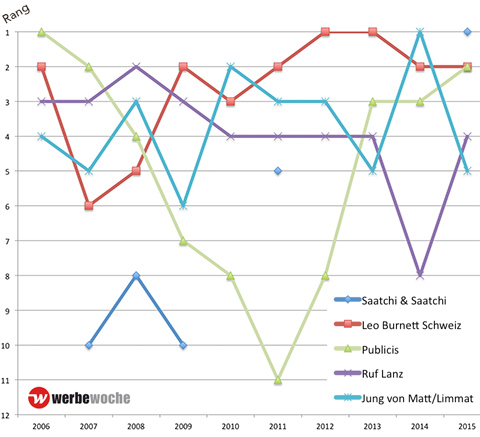
Aktuelle Top 5: Entwicklung seit 2006

Diagramm2015-v5

Viel Verkehr an der Spitze

Derart eng wurde es an der Spitze seit Jahren nicht mehr. Mit nur fünf Punkten Rückstand auf den Sieger teilen sich Leo Burnett und Publicis den zweiten Rang. Leo Burnett verteidigt damit den Spitzenplatz vom Vorjahr und führt die kreative Konstanz unbeirrt weiter: Seit 2009 ist die Agentur von der Aemtlerstrasse unter den ersten drei klassiert, seit 2011 sogar in den Top 2. Leo Burnett gewann Gold beim ADC Schweiz, Swiss Poster Award und SDV Award und punktete beim prestigeträchtigen Wettbewerb The Cup.

Auch Publicis scheint sich im Spitzentrio festzusetzen und klassiert sich nach dem steilen Aufstieg seit 2011 (Platz 11) und 2012 (Platz 8) zum dritten Mal in Folge unter den ersten drei. Die Agentur sichert sich die 265 Punkte unter anderem mit starken Auftritten beim Eurobest (zweifach Silber), ADC Schweiz (Gold, siebenfach Silber) und mit einem vollständigen Medaillensatz bei den diesjährigen Epica-Awards. Die bei den spät stattfindenden Wettbewerben Eurobest und Epica prämierte UBS-Vorsorgekampagne wurde erst im September lanciert – man darf also gespannt sein, ob für das nächste Ranking noch weitere Awards hinzukommen.

Zeit zum Verschnaufen bleibt den beiden grossen Podest-Dominatoren der letzten Jahre aber nicht. Nur 18 Punkte trennen Ruf Lanz, die mit zwölf Mitarbeitenden kleinste Agentur im Top-10-Feld, vom Spitzentrio. Die inhabergeführte Zürcher Kreativschmiede hat sich im vergangenen Jahr eine Auszeit von fast allen Wettbewerben gegönnt und meldet sich nun mit starken Auftritten beim ADC Schweiz, beim Swiss Poster Award und mit den einzigen klassierten Schweizer Clio-Punkten zurück im vorderen Feld des Rankings.

Vervollständigt wird die erste Hälfte des Rankings durch den letztjährigen Überflieger Jung von Matt/Limmat. 2014 hat die Agentur – unter anderem mit den Mannequins von Pro Infirmis – bei allen Wettbewerben der oberen, nicht frei wählbaren Ranking-Hälfte kräftig gepunktet und sich mit 624 Zählern an die Spitze vor Leo Burnett (542 Punkte) katapultiert. 2015 sorgen erfolgreiche Auftritte beim ADC Schweiz, Eurobest («The Great Escape») und The Cup (Ausgabe 2014: Mannequins) für den guten fünften Platz im Mittelfeld.

Von Auf-, Ab- und Einsteigern

In der zweiten Hälfte des Rankings treffen zwei Aufsteiger auf drei «Rang-Einbüsser». FCB Zürich macht wie Ruf Lanz vier Plätze gut – nach Saatchi & Saatchi der grösste Schritt, der dieses Jahr in den Top 10 nach vorne genommen wurde. Auch Hinderling Volkart darf sich zu den Gewinnern des Jahres zählen: Die laut Best of Swiss Web-Ranking erfolgreichste Schweizer Digitalagentur 2015 taucht somit zum ersten Mal auch in den Top 10 des Kreativrankings der Werbewoche auf. Hinderling Volkart gewann unter anderem Gold beim ADC Schweiz und gehörte beim Best of Swiss Web 2015 mit zehn Awards zu den grossen Abräumern.

Je drei Plätze eingebüsst haben die Y&R-Gruppe und Wirz Werbung und landen neu auf den Rängen sieben und acht. Wie Jung von Matt/Limmat büsst auch Havas Worldwide vier Positionen ein und bildet mit 57 Punkten den Schlusspunkt der diesjährigen zehn erfolgreichsten Kreativagenturen der Schweiz. An einer Überraschung schnupperte übrigens die kleine Zürcher Agentur Freundliche Grüsse, die dieses Jahr mit der Einlaufmänner-Kampagne für die FCZ-Damen beachtliche 44 Punkte sammelte. Zum Vergleich: 2013 reichten bereits 49 Punkte für den zehnten Platz.

Ausblick 2016

Änderungen für das Ranking 2016 werden im Frühjahr kommuniziert. Es werden keine Awards aus dem Ranking verschwinden – mit einer Ausnahme: Das Spotlight-Festival wird aus der Liste der frei wählbaren Awards entfernt. In den fünf Jahren, in denen der Wettbewerb aufgrund einer Jury-Kooperation zur Auswahl stand, wurde im Ranking kein einziger Punkt ausgewiesen. Die Vermutung, dass der Award bei Schweizer Agenturen eine überschaubare Relevanz geniesst, liegt nahe. Er wird durch das renommierte New York Festival ersetzt. Zusätzlich sollen auch die Punkte des vom Best of Swiss Web abgespaltenen Wettbewerbs Best of Swiss Apps in die Wertung integriert werden. Alle Details werden früh genug auf Werbewoche.ch bekannt gegeben.

Bereits dieses Jahr kam als kleine Ergänzung die Shortlist des Epica-Awards zur Wertung hinzu. Die Liste der Finalisten wurde 2015 von der Award-Organisation zum ersten Mal öffentlich kommuniziert und zugänglich gemacht. In den letzten Jahren war sie folglich nicht im Ranking aufgeführt. Sie ist – wie bei allen anderen Awards – ab sofort fester Bestandteil der Wertung und fliesst in die Punkte mit ein.

Thomas Häusermann
Unbenannt-3_113

Das detaillierte Ranking finden unsere Abonnenten in der Printausgabe 23/2015 vom Freitag, 18. Dezember 2015, sowie im E-Paper und als PDF-Download. Feedback zum Ranking an [email protected]

Tamedia verstärkt Bereich Programmatic Advertising

Um den Ausbau des Programmatic Advertising-Angebots weiter voranzutreiben, holt sich der Bereich «Digital Advertising & Services» von Tamedia mit Verena Pfister Verstärkung ins Boot.

Ab Januar 2016 wird Pfister als Programmatic Operations Manager die Abteilung «Real Time Advertising (RTA) & Yield Management» ergänzen. In ihrer Funktion wird sie das Team bei der Durchführung und Optimierung von Real Time Advertising Kampagnen unterstützen. Verena Pfister arbeitete zuletzt im Online Marketing Team von Ricardo.ch, dem zu Tamedia gehörenden Online-Marktplatz, und bringt laut Mitteilung durch ihre bisherigen Tätigkeiten sowie ihrer Ausbildung in Informatik und Visueller Kommunikation eine fundierte Programmier-Erfahrung sowie ein hohes Verständnis für die Kundenbedürfnisse im Bereich Werbung mit.

Foto: Xing.com
 

Auf Search.ch wurde 2015 am meisten nach Nummern von Telemarketing-Firmen gesucht

Wie eine Analyse der Informationsplattform Search.ch zeigt, wurde in der Schweiz 2015 am meisten nach Nummern gesucht, die zu Telemarketing-Unternehmen gehören.

Wie vor kurzem der Ärgerliste des Konsumentschutzes zu entnehmen war, haben sich Herr und Frau Schweizer 2015 am meisten über lästige Anrufe geärgert, die oftmals zu unchristlichen Zeiten kommen. Immer mehr Telemarketing-Unternehmen rufen nicht mehr mit anonymen Nummern an, da diese von vielen gar nicht erst entgegengenommen werden, sondern geben sich vermeintlich zu erkennen. Die Android-App von Search.ch bietet eine Möglichkeit, sich vor lästigen Werbeanrufen zu schützen (Werbewoche.ch berichtete).

Die Top 10 der Ruhestörer

Bei Search.ch sind insgesamt rund 1000 Callcenter hinterlegt. Nach den zehn häufigsten unerwünschten Anrufern wurde 2015 insgesamt fast 1,4 Millionen Mal gesucht.
 

  Telefonnummer Anzahl Anrufe
1 044 551 00 03 234‘806
2 052 508 72 63 221‘704
3 031 518 19 21 149‘458
4 044 551 00 21 136‘072
5 044 508 71 03 123‘080
6 043 550 74 18 115‘316
7 062 588 01 93 105‘266
8 044 567 25 25 100‘794
9 052 508 72 72 91‘348
10 044 551 00 90 88‘708
  Total 1‘366‘552


KSP für die Sihlpost: Zürcher Originale arbeiten im Zürcher Original

Die Sihlpost ist wieder da. Am 12. Dezember präsentierte sich das denkmalgeschützte Gebäude nach rund zwei Jahren Umbauzeit in neuem Glanz. KSP kommunizierte die Eröffnung.

Im Innern komplett modernisiert und aussen aufgefrischt. Als historisches Wahrzeichen verbindet die Sihlpost Tradition und Moderne in der Europaallee. Und: Sie ist und bleibt ein echtes Zürcher Original. Das wurde mit einem grossen Event gefeiert.

An den neu eröffneten Postschaltern bedienten sechs Zürcher Originale die Kundschaft. Persönlichkeiten von Beni Thurnheer und Beat Schlatter bis hin zu Irina Beller legten Hand an, um als Ehrenmitarbeiter die Postgeschäfte abzuwickeln und zu unterhalten. Ihre Gage stiften die Originale an das in Zürich ansässige Hilfswerk ROKPA.

151118_POST_Sihlpost_Eroeffnung_ZH_Originale_F200_ZS_d

Die Eröffnung wurde von viel Medienaufmerksamkeit begleitet und Radio Energy berichtete live aus dem Sendebus. Der Film zum Event mitsamt Spin-Offs zu den Zürcher Originalen und Truview Ads lassen nun online hinter die Postschalter blicken.

Verantwortlich bei der Post: Sarah Thiele, Natascha Baumann, Rahel Zimmermann, Morgane Krattinger, Bronson Gale (Kommunikation Poststellen und Verkauf). Verantwortlich bei KSP Krieg Schlupp Partner: Flo Wacker (Gesamtverantwortung); Sascha Borsai (Creative Direction); Mohammed Klotz (Art Direction); Flavia Meyer (Beratungsleitung); Jacqueline Lima (Beratung); Combo Entertainment (Filmproduktion).

Zu guter Letzt: «R.I.P WhatsApp»

Brasilianerinnen und Brasilianer müssen am Donnerstag und Freitag ohne den beliebten SMS-Dienst WhatsApp auskommen. Weil das US- Unternehmen angeblich bei einem Strafverfahren nicht kooperiert hat, hat ein Gericht eine 48-stündige Blockade angeordnet.

Seit 23.30 Uhr in der Nacht auf Donnerstag war der Dienst abgeschaltet, wie Nutzer berichteten. Ein Gericht in São Bernardo do Campo im Bundesstaat São Paulo hatte die Telefongesellschaften am Mittwochabend kurzfristig zur Blockade aufgefordert. Hintergrund ist ein Strafverfahren, in dem der Anbieter nicht kooperiert haben soll. Worum es im Verfahren geht, war zunächst unklar. Im Februar war eine landesweite Blockade noch von einer Berufungsinstanz zurückgewiesen worden. Damals ging es laut Medienberichten um die Herausgabe von Daten an die Polizei im Zusammenhang mit einem Pädophilie-Fall.

Über 35 Millionen Betroffene

Im aktuellen Fall soll WhatsApp auf einen Gerichtsbeschluss vom 23. Juli nicht reagiert haben. Am 7. August sei die Blockade angedroht worden. Da wieder keine Reaktion erfolgt sei, habe die Staatsanwaltschaft die bisher beispiellose Sperrung im fünftgrössten Land der Welt verfügt. Brasilien gilt als eines der Länder mit den meisten Nutzern des Dienstes. Schätzungen gehen von über 35 Millionen aus. Über den Dienst können unter anderem kostenlos Nachrichten, Fotos, Videos und Sprachmitteilungen versendet werden, auch Telefonanrufe sind bei entsprechender Internetverbindung kostenlos in alle Welt möglich. WhatsApp hat die kostenpflichtige SMS-Kurznachricht weitgehend ersetzt. Weltweit sollen rund 900 Millionen Menschen WhatsApp nutzen. Facebook hatte den Dienst 2014 für rund 22 Milliarden Dollar gekauft.

In ersten Reaktionen reagierten die Brasilianer mit Humor auf den Ausfall der Kommunikationsplattform. «R.I.P WhatsApp – Ich habe dich sehr geliebt»; «Betet für WhatsApp» und: «Lasst uns küssen, bis WhatsApp wiederkommt», lauteten Kommentare bei Twitter. 

Facebook will aktiv werden

Facebook-Gründer Zuckerberg sprach von einem «traurigen Tag für Brasilien» und forderte das Gericht auf, die Anordnung umgehend wieder aufzuheben. Zuckerberg sprach von einer «extremen Entscheidung durch einen einzelnen Richter», der damit jeden WhatsApp-Nutzer in Brasilien bestrafe. Er versprach, dass Facebook selbst alles dafür tun werde, damit der Dienst in Brasilien bald wieder zugänglich ist. In der Zwischenzeit sollten die Nutzer zum Messenger-Dienst von Facebook wechseln.

Doch stattdessen suchten sich offenbar Hunderttausende eine andere Alternative – nämlich den Dienst Telegram. Diesen gibt es seit 2013, er wurde von den russischen Brüdern Pawel und Nikolai Durow in den USA entwickelt und hat seinen Sitz in Berlin.

Telegram erklärte am Donnerstag, innerhalb von wenigen Stunden habe es 1,5 Millionen Neuanmeldungen gegeben. Über Twitter rief das Unternehmen zur Geduld auf, sollten nicht alle nötigen Codes sofort kommen. «Alle Mann sind an Deck, um den Ansturm zu bewältigen!» (uma/SDA)
 

Facebook integriert Uber in seinen Messenger

In den USA können Facebook-Nutzer künftig per Facebook Messenger auch Fahrten mit Uber buchen. Im Bestreben, seinen Mitteilungsdienst zur Plattform für alle Lebenslagen auszubauen, will Facebook den Fahrdienst- Vermittler in die App integrieren.

Einige Nutzer in den USA können künftig während der Unterhaltung mit einem Freund eine Fahrt mit Uber buchen, ohne dafür die Anwendung verlassen zu müssen. Weitere Länder und Transportdienste sollen folgen, wie Facebook am Mittwoch ankündigte.

Das weltgrösste Online-Netzwerk hat grosse Pläne für den Messenger mit zuletzt über 700 Millionen Nut-zern. So können sie darüber einander auch Geld verschicken. Eine weitere Idee ist, den Messenger als Kanal für die Kommunikation zwischen Unternehmen und ihren Kunden zu etablieren. (SDA)
 

Branding in China

In China, branding has changed greatly in the last few years – demands from digital marketing are multiplying, products are being purchased via social media and with this digital transformation, more local brands have growing chances of survival. We talked with Peggy Chen, Managing Director Process Shanghai, about the differences in brand management in China.

WW: Do you see cultural differences between branding in China and Switzerland/Europe?
Yes and no. From the agency point of view, in China we have more time pressure when setting up the brand together with our clients, as the market requires a very quick response to various business opportunities. In Europe, clients might think further ahead, and always wish to ensure that every step is properly planned, which means that the whole process of setting up a brand takes longer. The general situation is affected by the great differences in cultural and commercial background. Also, in my experience, in Asia greater diversity may be preferred to consistency. In terms of visual impact, this generally means that the visual identity of European brands is more muted, whereas Chinese brands are more visually striking. Consumer habits also play a role here. For example, consumers in China are generally very active in trying new brands and new products. This adds to the diversity of brands developed in China. In Europe, many brands have products that are classic and timeless. They are still very welcome in the market, and enjoy great loyalty.

However, entrepreneurs’ aims, and their spirit, are mostly the same across borders. Successful entrepreneurs are always willing to devote themselves to building a brand from zero in pursuit of a grand vision.

What makes the best brands in China so inspirational? What are they doing right?
I have to say that the culture is quite different in China. Though there is no lack of articles about the increasing economic slow-down in China, there are still many possibilities for young people here. Even the slower growth rate is far better than the situation in most other countries. So this business environment still provides a very good platform for developing new brands. There are many outstanding young people who start from nothing and become very successful in a few years. Even if the market becomes increasingly tough, it will not stop determined young people who have no fear of failure. I remember talking with a very young woman manager about how she set up her first shop. She said: «I tried my best to copy everything I could learn from the competitors. And I am doing a good job. Even if this is not the perfect starting point, I know that when I have learnt more I will be better still». Even if this is not the ideal strategy, it shows a strong drive for success on the part of the young generation.

Such entrepreneurs bring a similar spirit to both the business and operations. In the Chinese market brands have great diversity. They react quickly to the market by delivering new products ever more quickly and adapt to most themes with high-speed marketing approaches. Everything seems possible – it’s this energy that makes this market so interesting and inspiring.

Could you tell me something about recent branding projects and their focus?
We recently worked with some clients who are quite active in the region. For example, one of our clients from the cosmetics industry, Morita, is bringing its outstanding products from Taiwan, with technological support from Japan, and is achieving great success with sales in China. These three different factors – Taiwan for quality control, Japan for innovation, and China for an amazing market – enable a brand to perform optimally. It shows the importance of making good use of varying constellations of resources. Of course, a key to success is ensuring that the brand communicates differently and effectively.

What kind of demands come from digital marketing – especially from social media in China?
The most popular social-media platform in China is WECHAT. It provides various functions from a friends circle to an online digital wallet. Some brands set up a WECHAT site to make it convenient for Chinese to purchase products and services on line, and it is also a channel for collecting direct feedback from purchasers, who can communicate directly with their service contact. Individuals can also set up their own “microshop” at very low cost, and start doing business online by having direct conversations to set up deals, or negotiate. This changes people’s purchasing/shopping behaviour radically. It is easy to shop on the basis of friends’ recommendations, or promotional campaigns via the WECHAT platform. There are more touch points for a business, and a brand can be communicated faster at very low cost. Many brands can easily conduct online promotional campaigns, and it is also easy for consumers to participate.

So if a brand is not now thinking about digital media or online sales approaches, it might find it difficult to survive in the years ahead. While Western companies are still thinking about whether and how they should use social media for their business, in China using social media is already daily business and business is booming. In China, activity on social media is simply essential.

But surely not every brand in China is using social media?
Not yet. For some industrial brands, it does not seem absolutely necessary to use social media to promote their brand or for successful brand communication. However, one of our clients, EWAI, in the analytical-instruments sector, is being highly successful with social media. They announced their new brand identity via social media, as well as exhibitions they participated in and honours and award they received.

They can contact their customers very efficiently, exclusively and at low cost. In Europe many people might think that using social media is still a very personal matter, and people do not want relationships with brands that only want to sell things all the time. This again might be different cultural thinking. People in China enjoy the way brands participate in the WECHAT platform with such a wide range of activities, like providing news, exhibitions, customer activities, new products, microshops, events, payments and purchasing, campaigns, and many more.

A brand not bothering about digital strategies puts its survival at risk. Is it different for small brands in China?
I would say it does not matter whether it is a big or a small brand.
Even small brands might need to think more about digital strategies, since they are unlikely to have much of a budget for creating a wonderful user experience or installing an impressive window display in their flagship shop at the heart of a big city.

You mentioned that the situation is tougher for foreign brands in China. Why is that?
Economic competition in China is really tough. People are thinking a bit harder before they purchase things like luxury goods. Quality is an important topic – and gradually there are some very high-quality brands in the local market too. Awareness of quality, technology and new designs is growing. We also can feel that people are changing too; the country is not open only globally, but also for good local brands. China is anyway so large that there are always alternatives for different products and brands.

Could you give some examples of foreign brands doing well in China?
One example is the sports brand, Nike. It brings the spirit of its core values to China with its innovative, trendy products, and the well-developed character of its brand. Nike connects with local targets though extensive Chinese-style communication. It researches what young people are thinking, and then adapt its communication on social media. It also provides a link to the world, bringing to China what is happening in the US, for example. Nike’s PR events focus on local topics and internationally actions. In this way, good management plays a key role in transforming the values of the brand for different countries through different approaches, and different ways of understanding.

Is localisation generally a way for foreign brands to stand out in the Chinese market?
Overall, I think localisation is really important, also for foreign brands here. Let me give you an example.

If people are to talk about your brand, they need a brand name they can at least pronounce. From this perspective, the most important thing for an international brand is to have a Chinese name, so that people can use the name in conversation. Even in Shanghai not everyone can speak English. If people can’t pronounce the name, this increases the gap between the customer and the brand. After the name, there are also other factors involved, such as visual identity, lifestyles, communication preferences, shared values, and so on. It is not necessary to be localised 100%, but at least at the level that excites people to try things and discuss them. I would say that the level of localisation depends very much on the brand’s position in the market, as well as the target audience to be communicated to. So the best approach is to involve your local working partners in China, and make the right decision together!

Online Brand Identity

Joris Merks-Benjaminsen, Head of Digital Transformation bei Google, unterstützt über 100 Unternehmen dabei, digitales Denken in ihre Strategie zu integrieren. Merks hat gerade sein aktuelles Buch «Online Brand Identity» lanciert – eine Anleitung, wie man die eigene (digitale) Branding Strategie gestalten kann. Mit der Werbewoche hat er über online Branding gesprochen und wie Unternehmen ihre klassischen Marketing-Strategien in «Digital 1st thinking» verwandeln können.

WW: First of all, could you explain a little bit about your role with Google?
I have a role which didn’t exist before. For six years I’m now at Google and the first 3 or 4 years I was head of research. I looked at consumer journeys and did studies about it. So I became a strategy-person bridging the online and the offline world. At one point I discovered that advertisers used digital the same way they used TV – they would just take the TV-commercial and put it online. At some point I realised that we could successfully use the unique form that digital has, like digital targeting for example. Because I was a researcher I was asked to prove this first. But in my opinion, we had to do it first and then measure the success. So I discovered that as a researcher I cannot help advertisers to go through this digital transformation, because they have to do it first. It’s more of a strategic form of trying new things, not something you can prove on data. Then I wrote the description of the role I have now – I wanted to concentrate on digital transformation. Today, I run full day workshops with a very clear vision of where the process is going – for advertiser and branders who are willing to transform first and measure later. I’ve been doing this now for one and a half year.

And what made you write a book about this topic?
I discovered in the workshops, that people who understand digital very well don’t understand brands very well and vice versa. I’ve tried to combine both in a model that takes all the important information for branding that is timeless and brings it in digital thinking. It’s a model how you built your brand in a digital media mix. I don’t think there is an advertiser who does everything at the same time very well. The complete transformation takes you a few years. But every part of the model has been done already by at least a few advertisers. So every part of this model is illustrated with practical examples. The book also has some exercises to build your own strategy.

But digital transformation is very complex. How can a book give all the instruments needed to go through this complex process?
Digital Transformation is very complex. And if you look at the whole process, it seems to be too much to even start. Also it’s not something you can do based on data. Instead you have to look at the process which needs a learning curve. And then you need to bring it back to experiments that you can already run tomorrow. It took my around 4 years to get all these layers right.

Can you summarize the whole model?
What happens if you ask digital people about what branding is in their heads, it turns out to be kind of a fluffy thing. Some think, doing a little bit of online-video is branding. Or they think you’re wasting all the money, because you can’t measure it. So I start my book with a new definition of what a brand is: The brand is basically what people think, feel and say what it is, based on all the experience they have – with your products, client service, your communication, and maybe the press. So it’s not just communication, it’s everything people associate with the brand. If you try to build the online-brand-identity, you have to acknowledge that there are so many associations with the brand already and you have to communicate differently.
Based on that, everyone who creates something that is in contact with the consumer is a brand builder by definition. If you’re a digital e-commerce person, you can’t say branding is a task of the brand manager, everyone is a brand builder. Also, branding is not a fluffy thing, it’s a long term business. If you look at the brand promise for example, it stands for everything the company is doing.
So, the brand promise is like a long term business model – a business strategy choice that affects everything you do.

So, branding for you is less about image and more about a business-strategy choice?
Yes. Branding can be seen as a focus on long term sales impact; it is about making systematic business trade offs to provide a consumer experience that is consistently in line with the unique promises you make.

This means, digital transformation is a holistic process, a painful reorg – it takes years to transform…
If people hear about: «You need to think different about your audience, you need to start measuring different, and that for you need different technology» suddenly it looks like a very big thing and people don’t want to start. That’s why I try to bring it back to five small experiments. These are all kinds of things that you can already start testing today basically. If you do all of them, then you automatically start breaking with old habits.
The main problem for traditional branders is, they think that one message fits for every channel, don’t quantify engagement and then also don’t diverse the different kinds of contacts. But there are totally different levels of engagement. On youtube, for example, you can skip ads. The impact of a true view versus a forced video is about 2.8 times higher and a forced video online is again 1.5 times higher than on TV. And the opt-in choice is even higher again. And then you might have interactive videos. So there’s maybe a one-in-thirty impact difference and if you just quantify reach and not engagement, you just overlook that whole thing.

How to start the digital transformation?
As a new campaign is coming in, just take the one-size-fits-all messaging and taylor it for two types of people within your audience that are so different from each other that it is actually weird you have been serving them the same branding ads all the time. Then start measuring, find out which fits better. And then you can try to find a third audience. At some point, the extra impact you get is going to flatten out, and the video is going to cost extra money – so that’s where you find the border, the optimal number of marketing segments within a branding campaign. This is just one of the experiments you could do already today. Another one would be the testing with the true view format. If people choose to watch the video, you got a signal of interest and you can put it on the marketing list. Next time you can serve a different message, maybe even longer than the first one. So now, if you would evaluate the reach of a forced message only, you would just play the first video all the time and also repeat it to people who are not interested. If you follow the system of different videos building on signals of interest, you are more meaningful to consumers and you learn more about their interests. If you test a sequence of videos like this, you will see that view rates increase every time you serve a new video after a signal of interest.

What kinds of opportunities are offered through this targeting?
If you start the digital transformation, traditional measurements like reach are no longer useful. The new measurement system is all about organizing data across the Consumer journey. Then you start realizing things like, for example, not every purchase is caused by the last click. The data base gives you new information. If you start integrating CRM data and real-time-data, and manage everything in one system, then gradually your data starts to look like your consumer journey. As you have that, you can already start to quantify the financial value of consumer interactions earlier in the consumer journey. So this is something you can just start doing separate from all the other experiments.
And then, the final one is bringing together creative people and technical people, to see what kind of cool stuff you can do with digital.

You’re saying in your book, that the costumer is becoming pickier: «people only watch the ad they want to watch and at the time they want to see it».
Yes. What you see in the states and also in the UK is that people actually exchanging their TV subscription for online. And this year in the Netherlands you could see that TV was going down. Even if the linear watching was very stable for a long time it looked like nothing changed, but now we see that the quality of the watching went down – people are using different devices while they watch TV. This year is the first time, where the watch-time of TV also goes down, not only the quality.

Switzerland is not there yet, but already in the first phase where you see the attention is less.
And then at some point people are really watching less, that’s the point where the advertisers wake up. This is actually quite late. If you take the TV-commercial now and put it into digital, people will accept it far less as there are much more possibilities to avoid ads online. Now everything becomes digital. People will not accept advertising-blocks of ten commercials anymore, five to ten years by now. So you have to change the model. And there are two kinds of mechanisms to make that happen: one is the data, so you can be more relevant by knowing more about the costumer. The other lies in the creative opportunities that you have, like create cooler stuff or all kinds of tools to be more meaningful.

You mean tools like the content strategy of your model?
For example Nivea offered a bracelet for parents going at the beach. You could put the bracelet around the arm of your child and on your smartphone you could define how far the child can walk, so your alarm would go off if the child was too far.
You can have several ways of creating content, like branded entertainment for example. The art is to find something that really fits your brand. Right now very often you just have a program saying «sponsored by…» which is not a very meaningful link.
If your build your content strategy, first think of all the people who are important to your brand and very different to each other. Then you start to think about all the moments in their life where you could be meaningful as a brand. In some moments people just go online and they need information, at some moments they go online and they need inspiration, sometimes they need entertainment or utility.

What is the main reason to start digital transformation now?
The first thing is to understand the sense of urgency. Soon the old way isn’t working anymore because people are pushing into a digital world. Also, the new way of advertising is very different from the old way. This means, you need a learning curve. So if you start in the last minute, then you’re actually kind of too late. Start with small exercises today.

Zur Sache: Ruprecht reloaded

Von drauss vom Markte komm ich her; Ich muss euch sagen: Das Jahr war schwer!

Allüberall in Budgets, Bilanzen
Sah ich rote Zahlen tanzen;
Und dazu singt der Jahrbuch-Chor
Uns was von «Bessermachen» vor.

Ringier wagt ein grosses Tänzchen;
Mit Swisscom, SRG
Mehr als ein Werbealliänzchen –
Denn es tut vielen weh.
Die Weko meint, das ist schon gut:
Der Wettbewerb reicht aus.
Das Bakom hat das letzte Wort
Und bremst die Sache aus.

Und wie ich so strolcht’ im finsteren Bann,
Ist plötzlich glasklar: Wir packens jetzt an!
«Schaffensangst», rief ich, «du olles Gespenst,
Heb dich hinfort, eh’ aus du uns bremst!»
Wie kann digitale Transformation,
Uns so lähmen? – Ist doch ein Hohn.
Umsatz, Conversion und Performance
Bringt Ruprecht mit im Sack
Belohnt damit den schnellen Kund’ –
Den lahmen straft er ab!

O du liebes Christenkind
Gib, dass die Branche zu sich find’.
Es ist nicht nur in dieser Stadt,
Dass’s eitel gute Chancen hat.
Videos, Mobile, clev’rer Inhalt
Lassen keinen User kalt.
Und ist dem erst mal eingeheizt
Wird auch mit Geld nicht mehr gegeizt.
Nur Angst und Schweizer Gärtlidenken
Werden das Genick verrenken.

Dann triffts uns auf den Teil, den rechten.

Von drauss vom Markte komm ich her;
Ich will euch sagen, es geht so viel mehr!
Nur Furcht muss raus aus Herz und Grind!
Dann geht es voran wie der Wind.

Die Herzen fangen zu brennen an,
Das Himmelstor ist aufgetan,
Bald werden wir unsere Pläne erden,
Denn 2016 wird das Jahr des Machens werden!

(ziemlich frei nach Theodor Storm)

Die Werbewoche-Redaktion dankt Ihnen, unseren Leserinnen und Lesern, für Ihr Vertrauen und Ihre Treue in diesem Jahr, für positive Rückmeldungen und Gegenwind, für Denkanregungen und geistige Mitarbeit.

Wir wünschen Ihnen ein fröhliches Weihnachtsfest – mit vielleicht ein klein wenig Zeit für Besinnung und für die Kreation neuer Ideen.

Starten Sie auch gut ins kommende Jahr. 2016 wird uns viel Neues, Gutes bringen … Wir freuen uns sehr darauf.
 

Anne-Friederike Heinrich, Chefredaktorin
[email protected]


UBI weist Beschwerde von Ecopop gegen RTS ab

Die Unabhängige Beschwerdeinstanz für Radio und Fernsehen (UBI) hat eine Beschwerde der Vereinigung Ecopop gegen das Westschweizer Radio und Fernsehen RTS abgewiesen. Ecopop hatte die Berichterstattung im Vorfeld der eidgenössischen Wahlen kritisiert.

Ecopop rügte, die kleinen, noch nicht im Parlament vertretenen Gruppierungen seien benachteiligt worden. Die UBI kam bei ihren Beratungen jedoch zum Schluss, dass auch konzessionierte Radio- und Fernsehveranstalter bei Wahlsendungen nicht zur absoluten Gleichbehandlung aller Parteien und Gruppierungen verpflichtet sind.
Eine unterschiedliche Behandlung von Parteien aufgrund von transparenten und nicht-diskriminierenden Kriterien sei erlaubt, teilte die UBI am Donnerstag mit. Zudem seien noch nicht im Parlament vertretene Gruppen wie Ecopop bei RTS im Rahmen eines speziellen Sendegefässes berücksichtigt worden. Die UBI wies die Beschwerde daher mit 8 zu 1 Stimmen ab.
Beschwerde gegen Radio Top gutgeheissen
Gutgeheissen hat die UBI hingegen eine Beschwerde gegen einen Bericht von Radio Top über das Strassenfest „Veganmania“ in Winterthur. Darin kritisierten die Jungen Grünen Zürich die Teilnahme von zwei aus ihrer Sicht fragwürdigen Organisationen am Fest. Eine Vertreterin warf dem Verein gegen Tierfabriken Schweiz (VgT) antisemitische und rassistische Tendenzen vor.
Weil der VgT dazu im Beitrag nicht Stellung nehmen konnte, wurde aus Sicht der UBI das Sachgerechtigkeitsgebot verletzt. Die UBI hiess die Beschwerde mit 8 zu 1 Stimmen gut. Die Redaktion von Radio Top hat den Beitrag bereits freiwillig aus dem Online-Archiv gestrichen und dem VgT Gelegenheit zu einer Gegendarstellung eingeräumt, wie die UBI schrieb.
Ebenfalls gutgeheissen hat die UBI mit 6 zu 3 Stimmen eine Beschwerde gegen die Sendung «Il Quotidiano» des italienischsprachigen SRG-Fernsehens RSI. Auch hier wurde bei einem Beitrag über den Automobilsalon in Genf das Sachgerechtigkeitsgebot verletzt.
Beschwerden gegen «Rundschau» abgewiesen
Einstimmig abgewiesen hat die UBI Beschwerden gegen zwei im Mai ausgestrahlte Beiträge der SRF-Sendung «Rundschau». Es ging dabei um einen Bericht mit anschliessendem Studiogespräch über die Rasergesetzgebung sowie um einen Beitrag über die öffentliche Zugänglichkeit von Seeufern.
«Die festgestellten Mängel betrafen Nebenpunkte, welche die freie Meinungsbildung des Publikums nicht verunmöglichten», schreibt die UBI. Die Beiträge seien aufgrund der im Wesentlichen korrekt vermittelten Fakten und der transparenten Darstellung sachgerecht. (SDA)
 

Westschweizer Verleger verlängern Vertrag mit Publicitas

Mehrere Westschweizer Verlage haben ihren Zusammenarbeit mit der Werbevermarkterin Publicitas verlängert.

Die starke Verankerung in der Romandie habe sich bewährt, so Publicitas in einer Mitteilung vom Donnerstag. So setzen die Verlagshäuser St. Paul in Freiburg, Démocrate Media Holding in Delsberg und Le Groupe ESH Médias in Neuenburg die Zàusammenarbeit mit Publicitas fort.: «Ich bin überzeugt, dass die Regionalpresse durch ihre Nähe und Qualität eine aussichtsreiche Zukunft hat», sagt Patrick Cuénoud, Directeur régional. «Darum freut es mich, dass die Verleger im Wallis, Jura, Neuenburg und Freiburg die bewährte Zusammenarbeit für ihre Titel und das Romandie Combi in den nächsten Jahren mit uns fortsetzen.»


Thom Pfister verlässt Contexta

Thom Pfister, Creative Director und Mitglied der Geschäftsleitung verlässt nach einem Jahr die Agentur Contexta.

Pfister hat eine neue Herausforderung gesucht und wird ab Januar neu in einer Zürcher Agentur als Creative Director tätig sein. Dies schreibt der Schweizer Grafiker Verband SGV in einer Mitteilung vom Donnertstag.

PressFoto
get_footer();