Creative ranking 2015: Blood is thicker than ink

Saatchi & Saatchi Switzerland has topped *Werbewoche*’s creative rankings for the first time. The Geneva-based Saatchi branch took the entire Swiss creative scene by storm this year with a single campaign. In other respects, too, it left no stone unturned.

At the latest during Cannes Lions, it became clear what probably no one would have expected before: Saatchi & Saatchi Switzerland became the title favorite of the 2015 creative rankings. On the one hand, this was due to the comparatively meager yield of the other Swiss agencies on the Côte d'Azur. On the other hand, the extremely successful outcome of the campaign created by the French Swiss for the Austrian lifestyle gay magazine Vangardist: two gold, two silver, two bronze. The idea of printing a special issue published on the occasion of the Vienna Live Ball with the (sterilized) blood of HIV-positive people was exactly to the taste of the strict Lion jury. Confronting people with their prejudices and fears - and with a print run of 3,000 copies.

The expected festival high continued. Double gold at the prestigious London International Award and at the phenomenal end of the year two Eurobest Grand Prix - in addition to another double gold and double bronze. Incidentally, the agency has also won awards with its campaign in other competitions - for the creative ranking of Werbewoche, however, "only" the three mentioned above count. That shouldn't matter much to the agency, because this year the score of 270 was enough for first place - last year it would have been third place.

Advertising Week Creative Ranking 2015
2015 2014 Agency Points
1 - Saatchi & Saatchi Switzerland 270
2 2 Leo Burnett Switzerland 265
3 Publicis Communications Switzerland 265
4 8 Call Lanz 247
5 1 Jung von Matt/Limmat 206
6 10 FCB Zurich 168
7 4 Y&R Group Switzerland 101
8 5 Wirz advertising 93
9 - Hinderling Volkart 86
10 6 Havas Worldwide Zurich/Geneva 57
Source: Advertising Week

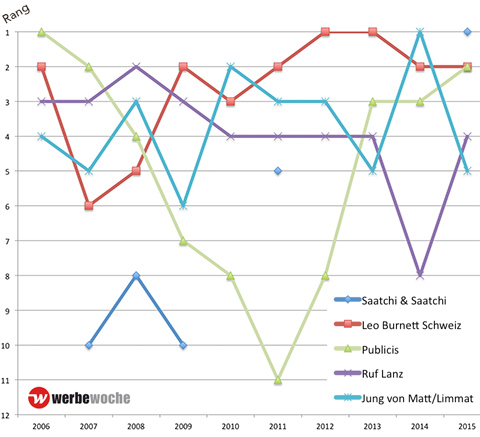
Current Top 5: Development since 2006

Diagramm2015-v5

A lot of traffic at the top

It has not been this close at the top for years. With only five points behind the winner, Leo Burnett and Publicis share second place. Leo Burnett thus defends last year's top spot and continues its creative consistency unwaveringly: Since 2009, the agency from Aemtlerstrasse has been ranked among the top three, and since 2011 it has even been in the top two. Leo Burnett won gold at ADC Switzerland, Swiss Poster Award and SDV Award and scored points at the prestigious competition The Cup.

Publicis also seems to have established itself in the top trio, ranking among the top three for the third time in a row after its steep climb since 2011 (11th place) and 2012 (8th place). The agency secured the 265 points with strong performances at Eurobest (double silver), ADC Switzerland (gold, seven silver) and a full set of medals at this year's Epica Awards. The UBS pension campaign, which won awards in the late Eurobest and Epica competitions, was only launched in September - so it will be interesting to see whether other awards are added for the next ranking.

However, the two big podium dominators of recent years do not have time to catch their breath. Only 18 points separate Ruf Lanz, the smallest agency in the top 10 with twelve employees, from the top trio. The owner-managed Zurich-based creative agency took time out from almost all competitions last year and is now coming back with strong performances. at ADC Switzerland, at the Swiss Poster Award and with the only classified Swiss Clio points back in the front field of the ranking.

The first half of the ranking is completed by the last year's High-flyer Jung von Matt/Limmat. In 2014, the agency - with Pro Infirmis mannequins, among others - scored heavily in all competitions in the top half of the ranking, which cannot be freely selected, and catapulted to the top with 624 points ahead of Leo Burnett (542 points). In 2015, successful performances at ADC Switzerland, Eurobest ("The Great Escape") and The Cup (2014 edition: Mannequins) ensure a good fifth place in the midfield.

From up, down and in

In the second half of the ranking, two up-and-comers meet three "rank losers". FCB Zurich, like Ruf Lanz, makes up four places - after Saatchi & Saatchi, the biggest step forward taken in the top 10 this year. Hinderling Volkart can also count itself among the winners of the year: According to the Best of Swiss Web Ranking Most successful Swiss digital agency 2015 thus also appears in the top 10 of Werbewoche's creative rankings for the first time. Among other things, Hinderling Volkart won gold at ADC Switzerland and was among the winners of the Best of Swiss Web 2015 was one of the big winners with ten awards.

The Y&R Group and Wirz Werbung each lost three places and are now ranked seventh and eighth. Like Jung von Matt/Limmat, Havas Worldwide also lost four positions and, with 57 points, is the last of this year's ten most successful creative agencies in Switzerland. Incidentally, the small Zurich agency Freundliche Grüsse sniffed a surprise this year with the Run-in men campaign collected a remarkable 44 points for the FCZ ladies. By comparison, 49 points were already enough for tenth place in 2013.

Outlook 2016

Changes for the 2016 ranking will be communicated in spring. No awards will disappear from the ranking - with one exception: the Spotlight Festival will be removed from the list of freely selectable awards. In the five years in which the competition was available for selection due to jury cooperation, not a single point was shown in the ranking. The assumption that the award enjoys a manageable relevance among Swiss agencies is obvious. It will be replaced by the renowned New York Festival. In addition, the points of the Best of Swiss Apps competition, which was split off from the Best of Swiss Web, will also be integrated into the ranking. All details will be announced soon enough on Werbewoche.ch.

Already this year, the shortlist of the Epica Award was added as a small supplement to the scoring. The list of finalists was publicly communicated and made available by the award organization for the first time in 2015. Consequently, it was not included in the ranking in previous years. As with all other awards, it is now an integral part of the scoring and is included in the points.

Thomas Häusermann
Unbenannt-3_113

The detailed ranking can be found our Subscribers in print edition 23/2015 of Friday, December 18, 2015, as well as in the e-paper and as a PDF download. Feedback on the ranking to [email protected]

Tamedia strengthens Programmatic Advertising division

To further expand its programmatic advertising offerings, Tamedia’s «Digital Advertising & Services» division is bringing Verena Pfister on board to strengthen its team.

From January 2016, Pfister will join the "Real Time Advertising (RTA) & Yield Management" department as Programmatic Operations Manager. In her role, she will support the team in the execution and optimization of Real Time Advertising campaigns. Verena Pfister most recently worked in the online marketing team of Ricardo.ch, the online marketplace belonging to Tamedia, and brings with her a profound programming experience as well as a high understanding of customer needs in the field of advertising due to her previous activities as well as her education in computer science and visual communication, according to a statement.

Photo: Xing.com
 

On Search.ch, the most searches in 2015 were for numbers of telemarketing companies

According to an analysis by the information platform Search.ch, the most common searches in Switzerland in 2015 were for phone numbers belonging to telemarketing companies.

As recently reported by the Annoyance list According to a survey by Consumer Protection, Mr. and Mrs. Swiss were most annoyed in 2015 by annoying calls, which often come at ungodly hours. More and more telemarketing companies are no longer calling with anonymous numbers, as many people don't even answer them, but are instead supposedly identifying themselves. The Android app from Search.ch offers a way to protect yourself from annoying advertising calls (Werbewoche.ch reported).

The top 10 disturbers of the peace

A total of around 1000 call centers are registered with Search.ch. The ten most frequent unwanted callers were searched for almost 1.4 million times in 2015.
 

  Phone number Number of calls
1 044 551 00 03 234'806
2 052 508 72 63 221'704
3 031 518 19 21 149'458
4 044 551 00 21 136'072
5 044 508 71 03 123'080
6 043 550 74 18 115'316
7 062 588 01 93 105'266
8 044 567 25 25 100'794
9 052 508 72 72 91'348
10 044 551 00 90 88'708
  Total 1'366'552


KSP for the Sihlpost: Zurich originals work in the Zurich original

The Sihlpost is back. On December 12, after about two years of renovation, the historic building was unveiled in all its new splendor. KSP announced the opening.

Completely modernized on the inside and refreshed on the outside. As a historical landmark, the Sihlpost combines tradition and modernity in Europaallee. And: it is and remains a true Zurich original. This was celebrated with a big event.

Six Zurich originals served customers at the newly opened post office counters. Celebrities from Beni Thurnheer and Beat Schlatter to Irina Beller lent a hand to handle and maintain the postal business as honorary employees. The originals donate their fee to the Zurich-based charity ROKPA.

151118_POST_Sihlpost_Eroeffnung_ZH_Originale_F200_ZS_d

The opening was accompanied by a lot of media attention and Radio Energy reported live from the broadcasting bus. The film about the event, including spin-offs about the Zurich originals and Truview Ads, can now be viewed online behind the post office counter.

Responsible at the post office: Sarah Thiele, Natascha Baumann, Rahel Zimmermann, Morgane Krattinger, Bronson Gale (Communication Post Offices and Sales). Responsible at KSP Krieg Schlupp Partner: Flo Wacker (overall responsibility); Sascha Borsai (creative direction); Mohammed Klotz (art direction); Flavia Meyer (consulting management); Jacqueline Lima (consulting); Combo Entertainment (film production).

Last but not least: "R.I.P WhatsApp"

Brazilians will have to do without the popular text messaging service WhatsApp on Thursday and Friday. A court has ordered a 48-hour blockade because the US company allegedly failed to cooperate in criminal proceedings.

The service had been switched off since 11.30 p.m. on Thursday night, as users reported. A court in São Bernardo do Campo in the state of São Paulo had ordered the telephone companies to block the service at short notice on Wednesday evening. The background to this is criminal proceedings in which the provider is said to have failed to cooperate. It was initially unclear what the proceedings were about. In February, a nationwide blockade was rejected by a court of appeal. According to media reports at the time, the case concerned the release of data to the police in connection with a paedophilia case.

Over 35 million people affected

In the current case, WhatsApp is said not to have responded to a court order from July 23. On August 7, the blockade was threatened. As there was again no response, the public prosecutor's office ordered the unprecedented block in the fifth largest country in the world. Brazil is one of the countries with the most users of the service. Estimates put the figure at over 35 million. The service can be used to send messages, photos, videos and voice messages free of charge, among other things, and phone calls can also be made free of charge to anywhere in the world with a suitable internet connection. WhatsApp has largely replaced the paid SMS short message service. Around 900 million people worldwide are said to use WhatsApp. Facebook bought the service in 2014 for around 22 billion dollars.

In initial reactions, Brazilians reacted with humor to the outage of the communication platform. "R.I.P WhatsApp - I loved you very much"; "Pray for WhatsApp" and: "Let's kiss until WhatsApp comes back" were the comments on Twitter. 

Facebook wants to become active

Facebook founder Zuckerberg spoke of a "sad day for Brazil" and called on the court to revoke the order immediately. Zuckerberg spoke of an "extreme decision by a single judge" that penalizes every WhatsApp user in Brazil. He promised that Facebook would do everything in its power to ensure that the service would soon be accessible again in Brazil. In the meantime, users should switch to Facebook's Messenger service.

However, hundreds of thousands apparently looked for another alternative instead - namely the Telegram service. This has been around since 2013, was developed by the Russian brothers Pavel and Nikolai Durov in the USA and is based in Berlin.

Telegram announced on Thursday that there had been 1.5 million new registrations within a few hours. On Twitter, the company called for patience if not all the necessary codes are received immediately. "All hands are on deck to handle the onslaught!" (uma/SDA)
 

Facebook integrates Uber into its Messenger

In the USA, Facebook users will also be able to book rides with Uber via Facebook Messenger in future. In an effort to expand its messaging service into a platform for all situations in life, Facebook wants to integrate the ride service provider into the app.

In future, some users in the USA will be able to book a ride with Uber while talking to a friend without having to leave the application. Other countries and transportation services are to follow, as Facebook announced on Wednesday.

The world's largest online network has big plans for Messenger, which currently has over 700 million users. They can also use it to send money to each other. Another idea is to establish Messenger as a channel for communication between companies and their customers. (SDA)
 

Branding in China

In China, branding has changed significantly in recent years—the demands of digital marketing are multiplying, products are being purchased via social media, and with this digital transformation, more local brands have a better chance of survival. We spoke with Peggy Chen, Managing Director of Process Shanghai, about the differences in brand management in China.

WW: Do you see cultural differences between branding in China and Switzerland/Europe?
Yes and no. From the agency point of view, in China we have more time pressure when setting up the brand together with our clients, as the market requires a very quick response to various business opportunities. In Europe, clients might think further ahead, and always wish to ensure that every step is properly planned, which means that the whole process of setting up a brand takes longer. The general situation is affected by the great differences in cultural and commercial background. Also, in my experience, in Asia greater diversity may be preferred to consistency. In terms of visual impact, this generally means that the visual identity of European brands is more muted, whereas Chinese brands are more visually striking. Consumer habits also play a role here. For example, consumers in China are generally very active in trying new brands and new products. This adds to the diversity of brands developed in China. In Europe, many brands have products that are classic and timeless. They are still very welcome in the market, and enjoy great loyalty.

However, entrepreneurs' aims, and their spirit, are mostly the same across borders. Successful entrepreneurs are always willing to devote themselves to building a brand from zero in pursuit of a grand vision.

What makes the best brands in China so inspirational? What are they doing right?
I have to say that the culture is quite different in China. Though there is no lack of articles about the increasing economic slow-down in China, there are still many opportunities for young people here. Even the slower growth rate is far better than the situation in most other countries. So this business environment still provides a very good platform for developing new brands. There are many outstanding young people who start from nothing and become very successful in a few years. Even if the market becomes increasingly tough, it will not stop determined young people who have no fear of failure. I remember talking with a very young woman manager about how she set up her first store. She said: "I tried my best to copy everything I could learn from the competitors. And I am doing a good job. Even if this is not the perfect starting point, I know that when I have learned more I will be better still". Even if this is not the ideal strategy, it shows a strong drive for success on the part of the young generation.

Such entrepreneurs bring a similar spirit to both the business and operations. In the Chinese market brands have great diversity. They react quickly to the market by delivering new products ever more quickly and adapt to most themes with high-speed marketing approaches. Everything seems possible - it's this energy that makes this market so interesting and inspiring.

Could you tell me something about recent branding projects and their focus?
We recently worked with some clients who are quite active in the region. For example, one of our clients from the cosmetics industry, Morita, is bringing its outstanding products from Taiwan, with technological support from Japan, and is achieving great success with sales in China. These three different factors - Taiwan for quality control, Japan for innovation, and China for an amazing market - enable a brand to perform optimally. It shows the importance of making good use of varying constellations of resources. Of course, a key to success is ensuring that the brand communicates differently and effectively.

What kind of demands come from digital marketing - especially from social media in China?
The most popular social-media platform in China is WECHAT. It provides various functions from a friends circle to an online digital wallet. Some brands set up a WECHAT site to make it convenient for Chinese to purchase products and services on line, and it is also a channel for collecting direct feedback from purchasers, who can communicate directly with their service contact. Individuals can also set up their own "microshop" at very low cost, and start doing business online by having direct conversations to set up deals, or negotiate. This changes people's purchasing/shopping behavior radically. It is easy to store on the basis of friends' recommendations, or promotional campaigns via the WECHAT platform. There are more touch points for a business, and a brand can be communicated faster at very low cost. Many brands can easily conduct online promotional campaigns, and it is also easy for consumers to participate.

So if a brand is not now thinking about digital media or online sales approaches, it might find it difficult to survive in the years ahead. While Western companies are still thinking about whether and how they should use social media for their business, in China using social media is already daily business and business is booming. In China, activity on social media is simply essential.

But surely not every brand in China is using social media?
Not yet. For some industrial brands, it does not seem absolutely necessary to use social media to promote their brand or for successful brand communication. However, one of our clients, EWAI, in the analytical-instruments sector, is being highly successful with social media. They announced their new brand identity via social media, as well as exhibitions they participated in and honors and award they received.

They can contact their customers very efficiently, exclusively and at low cost. In Europe many people might think that using social media is still a very personal matter, and people do not want relationships with brands that only want to sell things all the time. This again might be different cultural thinking. People in China enjoy the way brands participate in the WECHAT platform with such a wide range of activities, like providing news, exhibitions, customer activities, new products, microshops, events, payments and purchasing, campaigns, and many more.

A brand not bothering about digital strategies puts its survival at risk. Is it different for small brands in China?
I would say it does not matter whether it is a big or a small brand.
Even small brands might need to think more about digital strategies, since they are unlikely to have much of a budget for creating a wonderful user experience or installing an impressive window display in their flagship store at the heart of a big city.

You mentioned that the situation is tougher for foreign brands in China. Why is that?
Economic competition in China is really tough. People are thinking a bit harder before they purchase things like luxury goods. Quality is an important topic - and gradually there are some very high-quality brands in the local market too. Awareness of quality, technology and new designs is growing. We also can feel that people are changing too; the country is not open only globally, but also for good local brands. China is anyway so large that there are always alternatives for different products and brands.

Could you give some examples of foreign brands doing well in China?
One example is the sports brand, Nike. It brings the spirit of its core values to China with its innovative, trendy products, and the well-developed character of its brand. Nike connects with local targets though extensive Chinese-style communication. It researches what young people are thinking, and then adapt its communication on social media. It also provides a link to the world, bringing to China what is happening in the US, for example. Nike's PR events focus on local topics and international actions. In this way, good management plays a key role in transforming the values of the brand for different countries through different approaches, and different ways of understanding.

Is localization generally a way for foreign brands to stand out in the Chinese market?
Overall, I think localization is really important, also for foreign brands here. Let me give you an example.

If people are to talk about your brand, they need a brand name they can at least pronounce. From this perspective, the most important thing for an international brand is to have a Chinese name, so that people can use the name in conversation. Even in Shanghai not everyone can speak English. If people can't pronounce the name, this increases the gap between the customer and the brand. After the name, there are also other factors involved, such as visual identity, lifestyles, communication preferences, shared values, and so on. It is not necessary to be localised 100%, but at least at the level that excites people to try things and discuss them. I would say that the level of localisation depends very much on the brand's position in the market, as well as the target audience to be communicated to. So the best approach is to involve your local working partners in China, and make the right decision together!

Online Brand Identity

Joris Merks-Benjaminsen, Head of Digital Transformation at Google, helps over 100 companies integrate digital thinking into their strategies. Merks has just launched his latest book, *Online Brand Identity*—a guide to developing your own (digital) branding strategy. He spoke with *Werbewoche* about online branding and how companies can transform their traditional marketing strategies into «digital-first thinking.».

WW: First of all, could you tell us a little bit about your role at Google?
I have a role that didn’t exist before. I’ve been at Google for six years now, and for the first 3 or 4 years, I was head of research. I analyzed consumer journeys and conducted studies on them. So I became a strategist bridging the online and offline worlds. At one point, I discovered that advertisers were using digital in the same way they used TV—they would simply take a TV commercial and put it online. Eventually, I realized that we could successfully leverage the unique capabilities of digital, such as digital targeting. Because I was a researcher, I was asked to prove this first. But in my opinion, we had to take action first and then measure the results. So I realized that, as a researcher, I couldn’t help advertisers navigate this digital transformation—they had to take the first step themselves. It’s more of a strategic approach to trying new things, not something you can prove with data. Then I wrote the job description for the role I hold now—I wanted to focus on digital transformation. Today, I lead full-day workshops with a very clear vision of where the process is headed—for advertisers and brand managers who are willing to transform first and measure later. I’ve been doing this for a year and a half now.

And what made you write a book on this topic?
I discovered in the workshops that people who understand digital very well don’t understand brands very well, and vice versa. I’ve tried to combine both into a model that incorporates all the essential, timeless information for branding and integrates it into digital thinking. It’s a model for building your brand within a digital media mix. I don’t think there’s an advertiser who does everything at once very well. The complete transformation takes a few years. But every part of the model has already been implemented by at least a few advertisers. So every part of this model is illustrated with practical examples. The book also includes some exercises to help you develop your own strategy.

But digital transformation is very complex. How can a book provide all the tools needed to navigate this complex process?
Digital transformation is very complex. And when you look at the entire process, it seems like too much to even get started. It’s also not something you can do based solely on data. Instead, you have to focus on the process, which involves a learning curve. And then you need to break it down into experiments that you can actually run tomorrow. It took me about four years to get all these layers right.

Can you summarize the entire model?
If you ask people in the digital world what branding means to them, it turns out to be a rather vague concept. Some think that making a few online videos is branding. Or they think you’re wasting all that money because you can’t measure it. So I start my book with a new definition of what a brand is: A brand is basically what people think, feel, and say it is, based on all their experiences—with your products, customer service, your communication, and perhaps the press. So it’s not just communication; it’s everything people associate with the brand. If you’re trying to build an online brand identity, you have to acknowledge that there are already so many associations with the brand, and you have to communicate differently.
Based on that, anyone who creates something that comes into contact with the consumer is, by definition, a brand builder. If you work in digital e-commerce, you can’t say that branding is the brand manager’s job—everyone is a brand builder. Also, branding isn’t just some vague concept; it’s a long-term business endeavor. If you look at the brand promise, for example, it represents everything the company does.
So, the brand promise is like a long-term business model—a business strategy choice that affects everything you do.

So, for you, branding is less about image and more about a business strategy choice?
Yes. Branding can be seen as a focus on long-term sales impact; it involves making systematic business trade-offs to deliver a consumer experience that is consistently aligned with the unique promises you make.

This means that digital transformation is a holistic process, a painful reorganization—it takes years to transform…
If people hear things like, «You need to think differently about your audience, you need to start measuring differently, and for that you need different technology,» it suddenly seems like a huge undertaking, and people don’t want to get started. That’s why I try to break it down into five small experiments. These are all kinds of things you can basically start testing today. If you do all of them, you’ll automatically start breaking away from old habits.
The main problem for traditional marketers is that they think one message works for every channel, don’t measure engagement, and don’t differentiate between the various types of interactions. But there are completely different levels of engagement. On YouTube, for example, you can skip ads. The impact of a true view versus a forced video is about 2.8 times higher, and a forced video online is 1.5 times more impactful than on TV. And the impact of an opt-in video is even higher still. Then there are interactive videos. So there’s perhaps a one-in-thirty difference in impact, and if you only measure reach and not engagement, you simply overlook that entire aspect.

How to Begin the Digital Transformation?
As a new campaign rolls out, take your one-size-fits-all messaging and tailor it to two types of people within your audience who are so different from each other that it’s actually strange you’ve been showing them the same branding ads all along. Then start measuring to see which approach works better. And then you can try to identify a third audience segment. At some point, the additional impact you gain will level off, and the video will start costing extra—so that’s where you’ll find the sweet spot: the optimal number of marketing segments within a branding campaign. This is just one of the experiments you could start today. Another would be testing the TrueView format. If people choose to watch the video, you’ve received a signal of interest and can add them to your marketing list. Next time, you can serve a different message—perhaps even a longer one than the first. So, if you were to evaluate the reach of a forced message alone, you’d simply play the first video over and over again, even to people who aren’t interested. If you follow a system of different videos based on signals of interest, you’ll be more relevant to consumers and learn more about their interests. If you test a sequence of videos like this, you’ll see that view rates increase every time you serve a new video after a signal of interest.

What kinds of opportunities does this targeting offer?
Once you begin the digital transformation, traditional metrics like reach are no longer useful. The new measurement system is all about organizing data across the consumer journey. Then you start to realize things like, for example, that not every purchase is caused by the last click. The database provides you with new insights. If you start integrating CRM data and real-time data, and manage everything in a single system, your data will gradually begin to reflect the consumer journey. Once you have that, you can start quantifying the financial value of consumer interactions earlier in the consumer journey. So this is something you can simply start doing independently of all your other experiments.
And then, the last one is bringing together creative people and technical people to see what kind of cool things you can do with digital technology.

In your book, you say that consumers are becoming more selective: «People only watch the ads they want to watch, and at the time they want to see them.».
Yes. What we’re seeing in the U.S. and also in the U.K. is that people are actually switching from TV subscriptions to online streaming. And this year in the Netherlands, we saw that TV viewership was declining. Even though linear viewing remained very stable for a long time—it seemed as if nothing had changed—we’re now seeing that the quality of viewing has declined: people are using different devices while watching TV. This year marks the first time that not only the quality of TV viewing has declined, but also the total time spent watching TV.

Switzerland isn't there yet, but it's already in the first phase, where you can see that there's less attention being paid.
And then at some point, people really start watching less—that’s when advertisers finally wake up. This actually happens quite late. If you take a TV commercial and move it to digital, people are far less likely to accept it because there are so many more ways to avoid ads online. Now everything is going digital. People won’t put up with ad breaks consisting of ten commercials anymore—and this has been the case for five to ten years now. So you have to change the model. And there are two ways to make that happen: one is data, so you can be more relevant by knowing more about the customer. The other lies in the creative opportunities available to you—like creating cooler content or developing all kinds of tools to make your ads more meaningful.

You mean tools like your model's content strategy?
For example, Nivea offered a bracelet for parents going to the beach. You could put the bracelet on your child's arm and use your smartphone to set a distance limit for how far the child could walk, so an alarm would go off if the child strayed too far.
There are several ways to create content, such as branded entertainment, for example. The trick is to find something that truly fits your brand. Right now, it’s very common to see a program that simply says «sponsored by…,» which isn’t a very meaningful connection.
When you develop your content strategy, first think about all the people who are important to your brand and who are very different from one another. Then start thinking about all the moments in their lives when your brand could make a meaningful impact. Sometimes people go online simply because they need information; other times, they go online looking for inspiration; and sometimes they’re seeking entertainment or practical solutions.

What is the main reason to begin digital transformation now?
The first thing is to understand the sense of urgency. Soon, the old way won’t work anymore because people are moving into a digital world. Also, the new approach to advertising is very different from the old one. This means you’ll need to go through a learning curve. So if you wait until the last minute to get started, you’ll actually be too late. Start with small steps today.

To the point: Ruprecht reloaded

I've just come back from the market; I have to tell you: It's been a tough year!

All over budgets, balance sheets
I saw red numbers dancing;
And to this the yearbook choir sings
We're talking about "making it better."

Ringier dares a big dance;
With Swisscom, SRG
More than an advertising ally -
Because it hurts many.
The Weko thinks that's fine:
The competition is enough.
Bakom has the last word
And slows things down.

And as I so stalked in the dark spell,
Suddenly it's crystal clear: we're going to do it now!
"Schaffensangst," I cried, "you olles Gespenst,
Lift yourself away, before you slow us down!"
How can digital transformation,
Paralyze us like this? - It's a mockery.
Sales, conversion and performance
Brings Ruprecht in the bag
Rewards the fast customer' -
He punishes the lame one!

O you dear Christian child
Give the industry a chance to find itself.
It's not just in this city,
That's vain good chances.
Videos, Mobile, Clev'rer Content
Leave no user cold.
And is the first heated
They are no longer stingy with money either.
Only fear and Swiss gardener thinking
Will dislocate the neck.

Then hits us on the part, the right.

I come from outside the market;
Let me tell you, there is so much more!
Only fear must get out of heart and grind!
Then it goes forward like the wind.

Hearts start to burn,
The gate of heaven is opened,
Soon we will ground our plans,
Because 2016 will be the year of making!

(rather loosely based on Theodor Storm)

The Werbewoche editorial team would like to thank you, our readers, for your trust and loyalty this year, for positive feedback and headwind, for food for thought and intellectual collaboration.

We wish you a merry Christmas - with perhaps a little time for reflection and for the creation of new ideas.

Also start well into the coming year. 2016 will bring us a lot of new, good things ... We are very much looking forward to it.
 

Anne-Friederike Heinrich, Editor in Chief
[email protected]


UBI rejects Ecopop's complaint against RTS

The Independent Complaints Authority for Radio and Television (UBI) has dismissed a complaint filed by the Ecopop association against the French-Swiss radio and television broadcaster RTS. Ecopop had criticized the coverage in the run-up to the federal elections.

Ecopop complained that the small groups not yet represented in parliament had been disadvantaged. However, in its deliberations, the UBI came to the conclusion that even licensed radio and television broadcasters are not obliged to treat all parties and groups absolutely equally in election broadcasts.
Different treatment of parties based on transparent and non-discriminatory criteria is permitted, the UBI announced on Thursday. In addition, groups not yet represented in parliament, such as Ecopop, had been taken into account by RTS as part of a special broadcast. The UBI therefore rejected the complaint by 8 votes to 1.
Complaint against Radio Top upheld
However, the UBI approved a complaint against a report by Radio Top about the "Veganmania" street festival in Winterthur. In the report, the Young Greens of Zurich criticized the participation of two organizations at the festival that they considered questionable. One representative accused the Verein gegen Tierfabriken Schweiz (VgT) of anti-Semitic and racist tendencies.
As the VgT was unable to comment on this in the article, the UBI considered that the principle of fairness had been violated. The UBI upheld the complaint by 8 votes to 1. The editors of Radio Top have already voluntarily removed the report from the online archive and given the VgT the opportunity to make a counterstatement, as the UBI wrote.
The UBI also approved a complaint against the program "Il Quotidiano" on the Italian-language SRG television station RSI by 6 votes to 3. Here too, a report on the Geneva Motor Show violated the principle of fairness.
Complaints against "Rundschau" rejected
The UBI unanimously rejected complaints against two reports broadcast in May on the SRF program "Rundschau". These concerned a report followed by a studio discussion on speeding legislation and a report on the public accessibility of lakeshores.
"The shortcomings identified concerned secondary points that did not prevent the public from forming a free opinion," writes the UBI. The contributions were appropriate due to the essentially correct facts conveyed and the transparent presentation. (SDA)
 

Publishers in French-speaking Switzerland extend contract with Publicitas

Several publishers in French-speaking Switzerland have extended their partnership with the advertising agency Publicitas.

The strong anchoring in French-speaking Switzerland has proven its worth, Publicitas said in a statement on Thursday. The publishing houses St. Paul in Fribourg, Démocrate Media Holding in Delsberg and Le Groupe ESH Médias in Neuchâtel will continue their cooperation with Publicitas: "I am convinced that the regional press has a promising future thanks to its proximity and quality," says Patrick Cuénoud, Directeur régional. "That's why I'm pleased that the publishers in Valais, Jura, Neuchâtel and Fribourg will continue the proven cooperation for their titles and the Romandie Combi with us in the coming years."


Thom Pfister leaves Contexta

Thom Pfister, Creative Director and member of the executive board, is leaving the Contexta agency after one year.

Pfister has sought a new challenge and will join a Zurich agency as creative director in January. This writes the Swiss Graphic Designers Association SGV in a statement on Thursday.

PressFoto
get_footer();