With its «Haus & Wohnen» campaign, Swiss Life is positioning itself as a comprehensive advisor for independent living in one’s own home. Jeff is responsible for the campaign’s concept, creation, and production.
Editorial
-
March 22, 2021
Swiss Life has a broad range of services in the area of "House & Home" and would like to make this even more accessible to those interested in home ownership. In Switzerland, around two-thirds of all tenants are interested in home ownership. The comprehensive digital campaign has been running since Monday and includes various communication measures to strengthen the positioning over a period of four years.
"Home & Living Hub" and concentrated consulting expertise
The "Haus & Wohnen Hub" on Swisslife.ch is the centerpiece of the campaign. The hub serves as a digital contact point for people interested in home ownership - articles, checklists and explanatory videos on the topics of savings, financing, affordability and mortgages are intended to provide comprehensive information on the dream of home ownership. Integrated online calculators also provide individual information on initial costs for mortgages and their long-term affordability.
Responsible at Swiss Life: The Swiss Life teams. Responsible at Jeff: Peter Day (Partner), Peter Broder (Senior Project Manager Digital), Mischa Müller (Art Director), Nicolas Jakob (Art Director), Isabella Wiesinger (Creative Film Producer), Kevin Ringli (Video Content Creator), Holger Gutknecht (Senior Motion Designer). Other partners: Dan Cermak (photographer and director), Alex Herzog (camera), Sebahat Film + Foto (film + photo production). Responsible at iundf Media Impact: Larissa Mörgeli (Senior Media Consultant), Marcel Bieri (Senior Media Consultant). Responsible at Webrepublic: Hideka Setta (Consultant SEA), Christoph Voellmy (Team Manager SEA).
Hillton creates print campaign for new running shoe from Adidas
The Adidas brand is set to regain its place in the spotlight among runners in Switzerland. Instead of adapting global marketing materials for the «Ultraboost 21» running shoe to the Swiss market, Adidas Switzerland is creating its own marketing materials in collaboration with the Zurich-based photo and film production company Hillton.
Editorial
-
March 22, 2021
In direct collaboration with Adidas Switzerland, Hillton developed the visual concept for the defining element of the new "Ultraboost 21": strong shoe sole cushioning that still enables energetic propulsion during the race.
Special angles, captured by photographer Silvano Zeiter, bring the sole into focus while subtly incorporating urban elements of Switzerland. In addition, visual effects on the sole of the shoe pick up on the "boost" and energy character of the shoe and complement the dynamic style of the images.
Responsible at Adidas Switzerland: Marius Kienzler (Senior Manager Brand Communications Adidas Switzerland). Responsible at Hillton (photo production): Gilles Germann (production), Silvano Zeiter (photographer), Süsstrunk & Jericke (Retouch).
New smartphones and 5G drive annual growth in telecommunications advertising market
According to a forecast by Zenith, global telecommunications advertising is expected to grow at an average annual rate of 4.5 percent through 2023. This advertising market is thus recovering from an 8.7 percent decline in 2020, as shown in the Zenith Business Intelligence – Telecommunications Report.
Editorial
-
March 22, 2021
Spending on telecommunications advertising in the 12 key markets included in the report will grow from USD 17.8 billion in 2020 to USD 18.7 billion in 2021. In 2022, the pre-pandemic level of USD 19.5 billion will be reached again.
Smartphone sales will pick up again this year once consumers have more confidence in their future. Consumers are increasingly willing to finance and buy handsets independently of their network operators, giving manufacturers and retailers a greater incentive to promote the devices themselves. In the meantime, telecom providers will try to recoup their investments in 5G licenses and infrastructure through new services and more expensive data packages.
All of these trends are expected to contribute to healthy growth in the global telecommunications advertising market over the next three years. Zenith forecasts that telecom advertising spend will grow by 4.7% in 2021, 4.4% in 2022 and 4.3% in 2023.
"In our market, the recovery of the advertising market in the telecommunications sector is not quite as dynamic," explains Maria Brinkmann, Managing Director of Zenith Switzerland. "We don't expect to reach the advertising pressure level of 2019 again until 2023. Our current market developments play a major role here. On the one hand, the merger of UPC and Sunrise will give us a communications boost this year, but on the other hand, it will also mean the loss of a player in the following years, leaving us with just Swisscom, Salt and the new merged company," explains Brinkmann.
Digital platforms help Telkom brands to show relevance
Voice and data services are taken for granted and are functionally indistinguishable for consumers. They expect these things to work perfectly in the background and only pay attention to them when something goes wrong.
With attention-grabbing advertising in mass media such as TV and radio, telecommunications companies can use branding to set themselves apart from others and increase their relevance for consumers. Here, brands try to promote associations with topics that consumers are passionate about, be it entertainment, sport or music. Telecom brands therefore spend significantly more on TV and radio advertising than the average brand - in 2020, they spent 42% of their budgets on TV and radio, compared to 30% for the average brand.
As audiences migrate to digital channels, telecom companies are focusing on communicating their brand messages to mass digital audiences. While telecom brands are spending less on digital media than the average (49 percent of their budgets went to digital channels in 2020, compared to 56 percent for the average advertiser), digital advertising is also the only channel where the industry's ad spend is currently increasing. Zenith predicts that telecom brands will increase their digital ad spend at an average rate of 5 percent per year between 2019 and 2023. By 2023, digital advertising will account for 54 percent of all telecom advertising.
"In Switzerland, too, the advertising market growth in this sector is coming primarily from digital channels," explains Maria Brinkmann. "We expect a year-on-year increase of 17% here alone in 2021."
Telecom brands are cutting their spend on traditional TV and radio as their reach declines, but less rapidly than brands in most other categories. Zenith predicts that telecom brands will reduce their TV ad spend by an average of 2.0 percent per year between 2019 and 2023, compared to an annual decline of 3.5 percent across all categories. The industry will also reduce its spend on radio advertising by 2.8% per year, compared to 4.1% per year for the overall market.
India and Russia lead growth
Zenith predicts that India will be by far the fastest growing market for telecom advertising between 2020 and 2023, with an annual growth rate of 11 percent. According to eMarketer, only 31 percent of the Indian population currently has a smartphone, but with the introduction of low-cost phones such as the JioPhone, this proportion is rising rapidly. Russia is another market with a relatively low but rapidly growing smartphone penetration (57%). Here too, a rapid increase in telecommunications advertising expenditure of 8% per year is forecast.
Annual growth of between 3% and 6% is forecast for most other markets included in the report until 2023. The exception will be France, and not because of any inherent weakness in demand. Unlike most markets, French telecom brands actually increased their spending in 2020 - by 6% - in response to additional demand for data volumes. The basis for comparison with 2023 is therefore much higher, which is why growth is lower.
"The introduction of 5G services will enable mobile operators to deliver bundled voice, data and entertainment services to the home and compete directly with fixed broadband," explains Jonathan Barnard, Head of Forecast at Zenith. "This will trigger greater competition for the most attractive services at the best prices and help to drive a sustained recovery in advertising spend in the telecoms sector until at least 2023."
The 12 markets that Zenith Business Intelligence - Telecommunications Report The countries included in the analysis are Australia, Canada, China, France, Germany, India, Italy, Russia, Spain, Switzerland, the UK and the USA, which together account for 73 percent of total global advertising expenditure. Telecommunications is defined as services and devices that enable the transmission of voice calls and data over fixed and mobile networks.
Proper social media communication in a crisis
In the current pandemic, it is important for brands to strike the right tone - regardless of the channel. Marketing expert Miriam Ernst explains how good social media communication works in a crisis and how companies can prepare for crisis communication.
Editorial
-
21 March 2021
In times of Corona, well thought-out crisis communication is essential. (Symbol image: unsplash)
Werbewoche.ch: Ms. Ernst, the current crisis requires a rethink in all areas. For companies in particular, the way they communicate has changed a great deal. In your opinion, how should the way of communicating be done in such times?
Miriam Ernst: In such special situations, companies should align their communication sensitively, positively and encouragingly. Instead, companies should highlight opportunities created by the challenge, convey a feeling of belonging together - for example, with hashtags such as #wirbleibenzuhause. It is important that companies communicate credibly and remain true to themselves.
Were there any particular challenges, especially at the beginning of the pandemic, that companies had to face in terms of communication?
In the case of the current pandemic, the biggest challenge was that nothing like this had ever happened before, so no one had a roadmap for a pandemic situation. Users had a lot of unanswered questions like "When and how do we move forward?" and the community managers didn't have the answers.
How should companies best approach communications in such unusual circumstances as the current Corona crisis?
When it comes to communication, timing plays a very crucial role. When it comes to communicating negative content, i.e. impact, it is very important to resort to factual, clear and active communication. It is also particularly important to be the first voice on the market, if possible, so that the spread of fake news and rumors does not stand a chance in the first place. In particular, the topic should not simply be ignored, but companies should use the situation to strengthen the community through active involvement.
Negative facts should not be in the foreground for too long; instead, positive future plans, opportunities and possible solutions must be communicated to the community. In the Corona example, new paths can be created via digital events such as digital wine and beer tastings.
What can companies do in concrete terms to be prepared for future crises? What internal measures can companies take in advance in terms of communication?
In Europe, no one expected such a risk. Nevertheless, it has been shown that companies that have prepared for general crises were clearly at an advantage. As a matter of principle, every company should create crisis scenarios and define clear steps in communication for this purpose: Who is allowed to communicate, how is communication done, and what approval processes are needed?
I always define communication and social media policies for new customers. On the one hand, these motivate employees to be active on social media themselves, but on the other hand, they also clearly define that their statements must be kept separate from those of the company.
It is also important that information in times of crisis should only come from the official company account. This is important so that the company positions itself clearly and uniformly. The approval processes in crisis communication often take a very long time. Here, too, work should be done as early as possible on a concept that makes it possible to react more quickly. On social media in particular, it's not days that count, but minutes. In addition, it helps to prepare general statements that then only need to be minimally adapted in the specific case.
What I consider particularly useful and effective is that at the beginning of a crisis, all the questions that arise from the community are collected and pre-formulated text blocks are created. The community managers can then act quickly and relatively freely.
Social media are of particular importance in times of corona crisis communication. Why are these channels particularly suitable for crisis communication?
Social media is an integral part of many people's daily lives, thus it is the medium where companies can reach their community the fastest without having to rely on the press. This has both advantages and disadvantages: social media is a fast-moving medium where you should also be prepared for negative feedback and reactions. At the same time, social media also offers the opportunity to strengthen communities, especially in times of crisis. With playful, creative and also emotional content ideas, you can make a statement and strengthen the community's bond with your brand.
Which social media platforms can you recommend specifically for communication in times of crisis?
The same rules apply here as in every type of communication: The channels on which I reach the right target group are relevant. In all-encompassing crises, as in the Corona case, every medium the company uses is relevant. If I am a B2B company and communicate daily with my target audience on LinkedIn, that is also my channel to communicate opinions, goals, facts and news in times of crisis. If I'm a fashion company and I'm targeting more of a young audience, then Instagram or even TikTok may be the better channel. Of course, you have to communicate differently on each medium. So you shouldn't play the same message from TikTok on LinkedIn. (laughs)
Can you name content formats that are specifically suited for crisis communication?
Basically, video runs better on all platforms. Still, if I as a company can't get the information across in a video, then I should choose a different format. Maybe my creative department is more successful in creating an image that expresses the situation more appropriately than a text from our press department. Any format can be used, the implementation is much more crucial there!
Opportunities can also arise from a crisis. How have companies succeeded so far in implementing them positively? And how can well-implemented communication serve to strengthen companies in times of crisis?
For years, many companies have either foregone digitization strategies or have always pushed them into the future. Some companies, such as Steinbeis SMI University, have digitized their entire offline program within two weeks, opening up opportunities for the "new normal" to include more students who can't always attend on-site. Other companies have built a new digital business or reoriented themselves and shown that they are agile enough to react quickly in times of crisis. A great example is also Harpers Bazaar. The magazine launched an issue completely without photo shoots and replaced the shoots with illustrations. This statement boosted sales of the magazine enormously.
We learn that it is good not to rely on just one line of business, but to continuously move with the times and seize new opportunities. And ideally, before the crisis forces you to do so.
Which companies do you think have a particularly successful social media presence in times of the pandemic?
In my opinion, three companies have done particularly well: on the one hand Coca-Colawho understood right at the beginning that it is important to make clear statements. On the other hand Jägermeister, who managed to spread positivity and actively support through their Instagram channel, but also provided the community with little tips and messages to enjoy the time at home. Then there is Iceland tourism, responding to people's frustration and offering it a way out with charming humor.
How can a procedure be designed for communication in the event of a crisis?
Before the crisis, a social media guideline should generally be created and shared with employees. In addition, a quick way to release responses in times of crisis should be defined.
At the beginning of the crisis, you have to define clear statements that cannot be misinterpreted, as the Coca-Cola example shows. These statements can be tested well on a small group to learn from the reactions before they are published. Furthermore, all questions should be answered. If they cannot be answered, then a time frame should be set. An answer catalog that community managers can use freely also supports. If commonalities can be found, these should be appealed to, for example, through a suitable campaign.
During the crisis, ways should be found to lighten and ease the crisis. If possible, humor can also be incorporated. At the same time, do not dwell too long on the topic, but rather define new ways and goals.
After the crisis, an evaluation should be made: What went well, what didn't? Where can we improve in the future? What do we learn from the crisis? If a mistake has been made, address it clearly and don't talk your way out of it.
What can companies implement directly now to be prepared for crises in the future?
On the one hand, learn from the mistakes and good examples of other companies. On the other hand, be open to change management in the company, actively react to change, changes and crises, integrate solution ideas and new developments in the company. If you do not currently have a policy and crisis process, you should set one up now at the latest and plan for the future how the company should react in times of crisis.
Miriam Ernst is founder of Miriam Ernst Consulting, a marketing & communications consultancy with a focus on marketing strategy, digital marketing, social media and PR.
The current Digitec Community campaign relies on poetry
Digitec's community campaign goes into the next round and focuses on particularly poetic product reviews by customers.
Editorial
-
21 March 2021
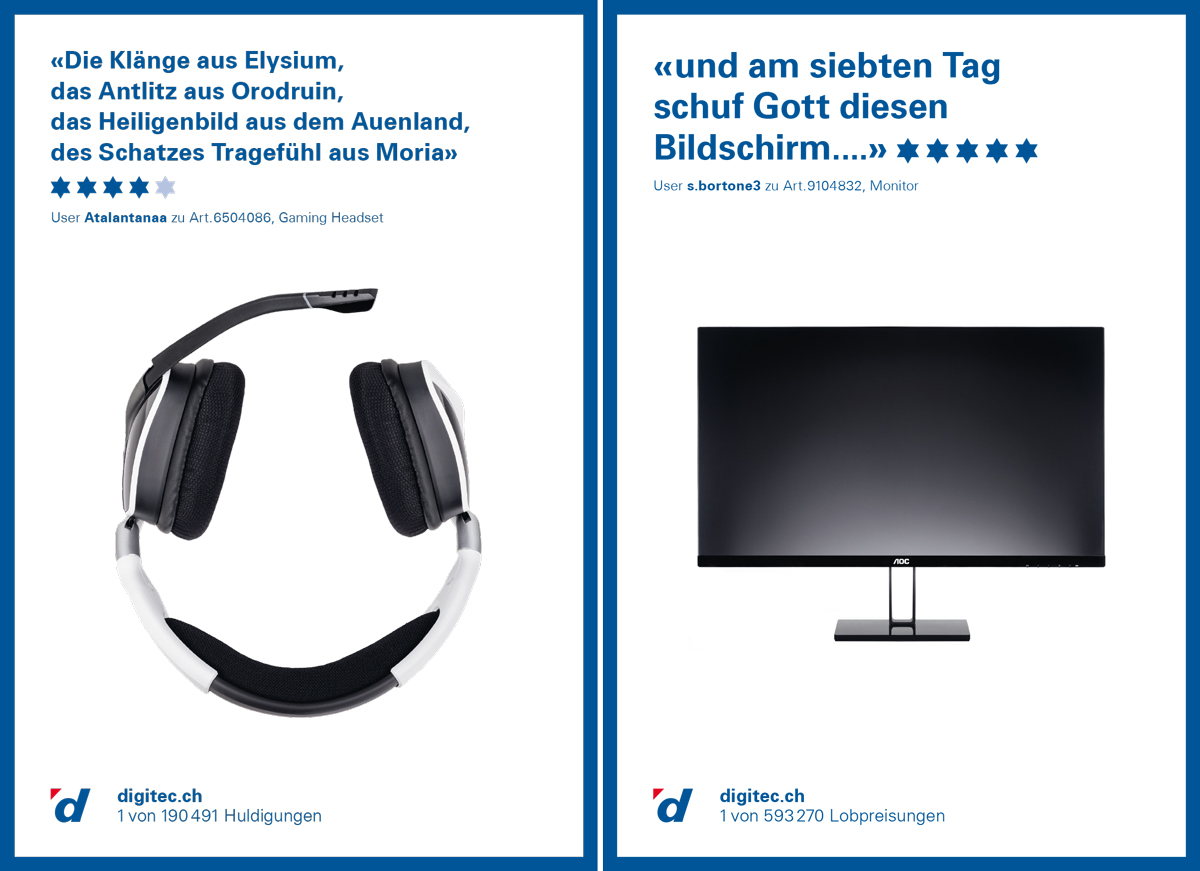
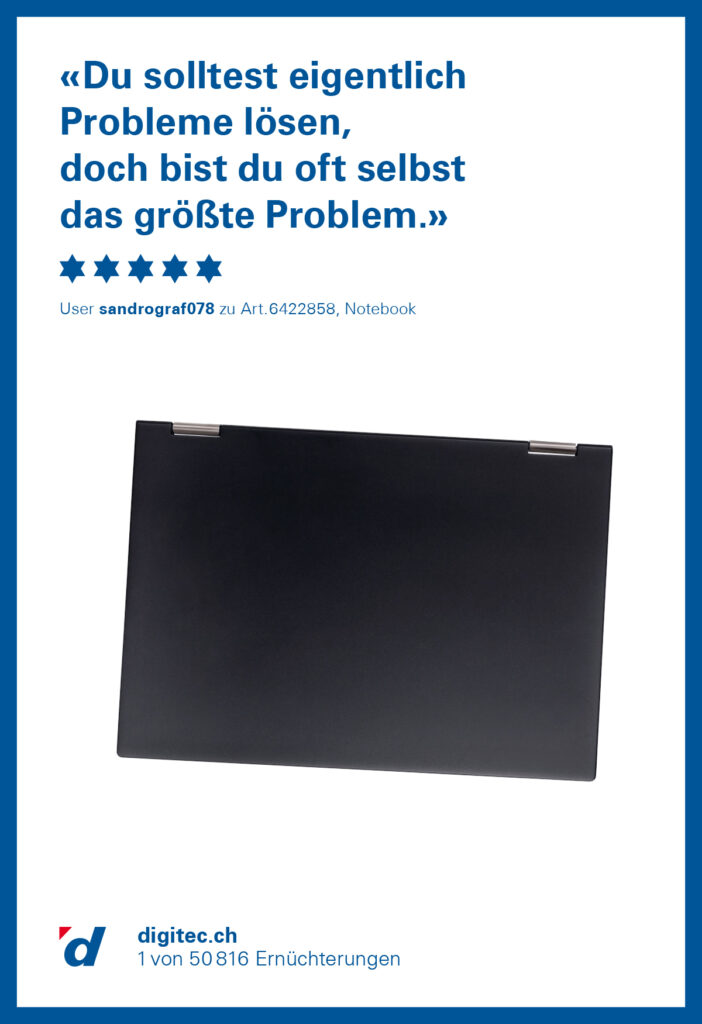
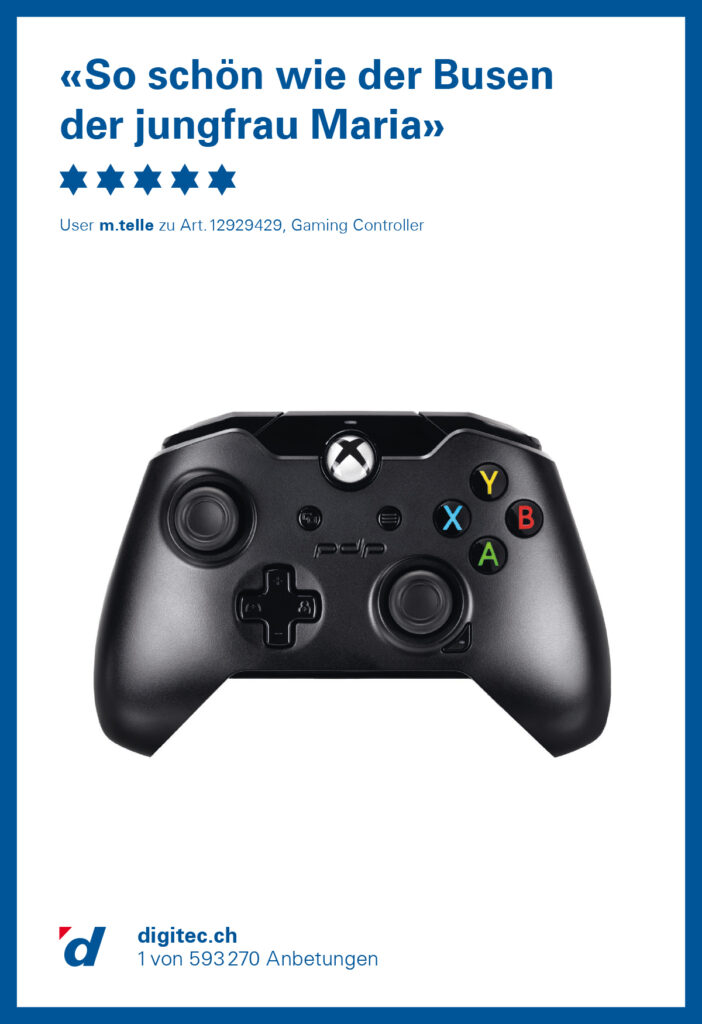
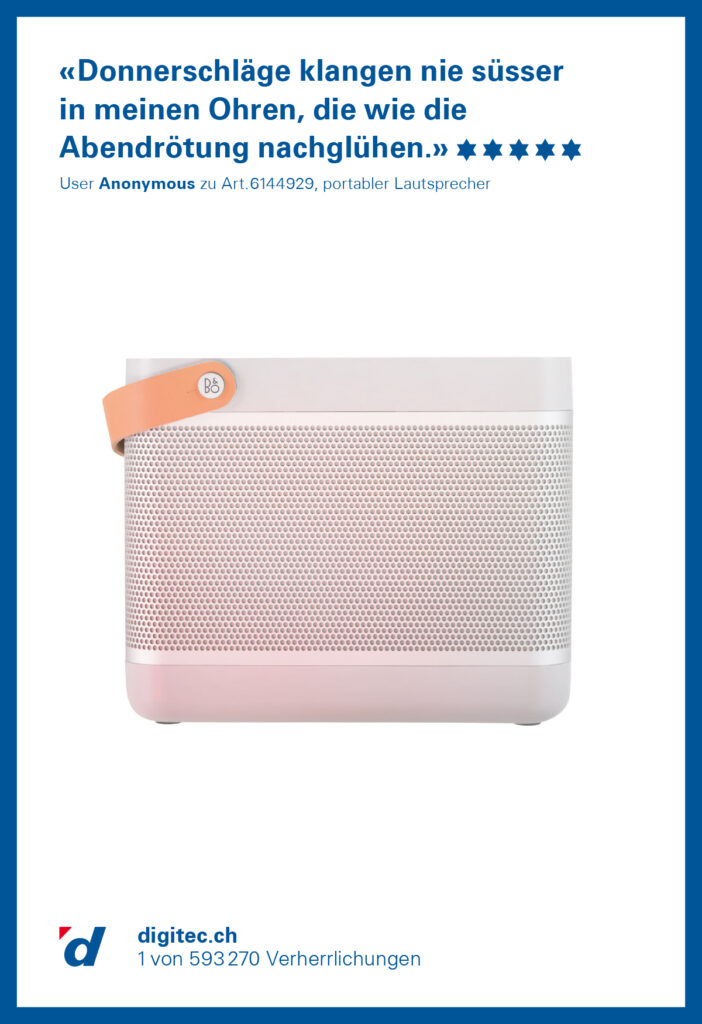
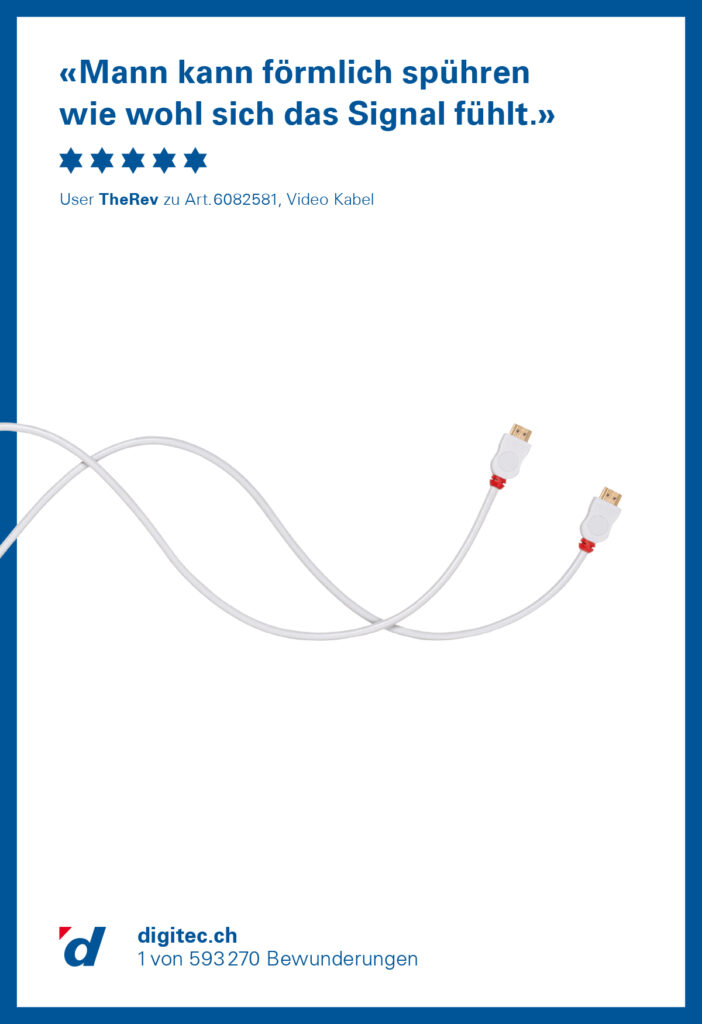
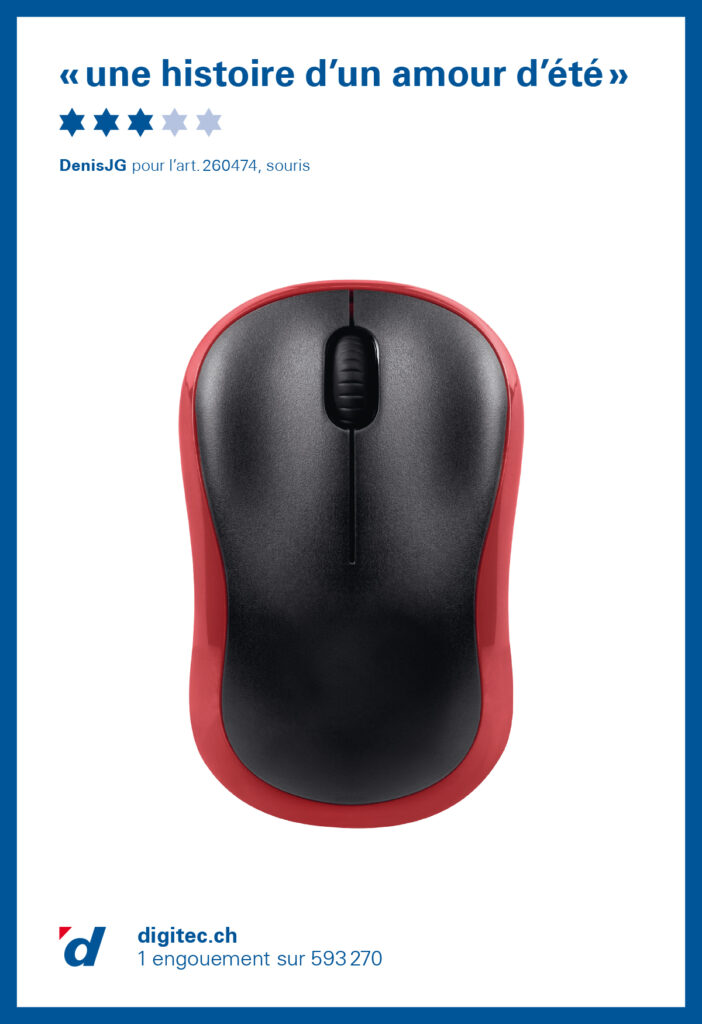
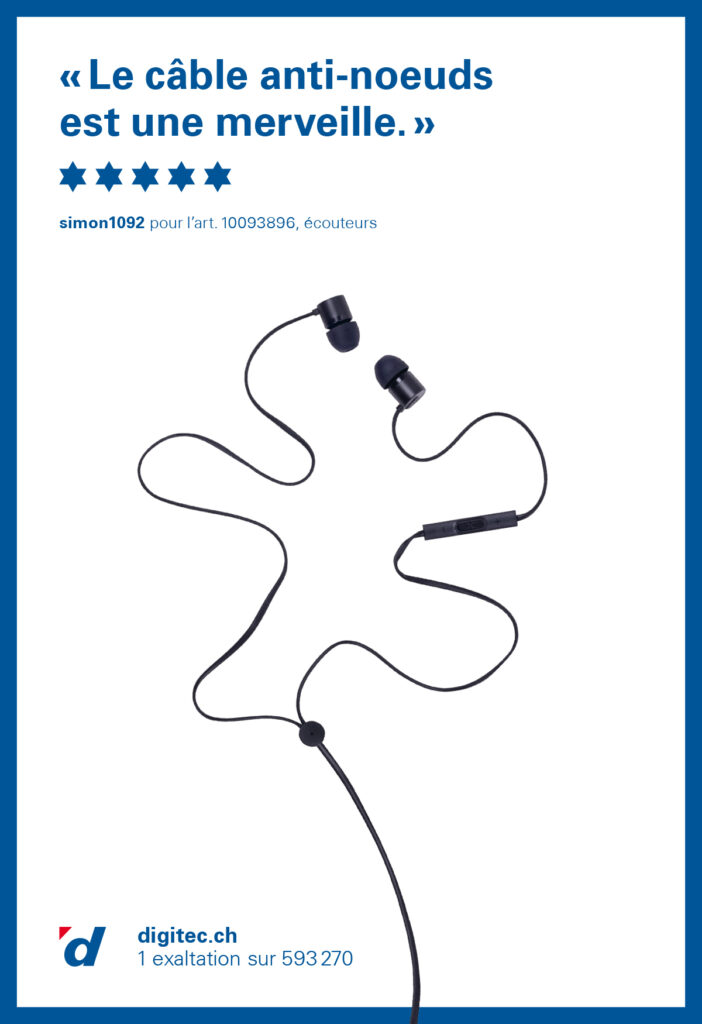
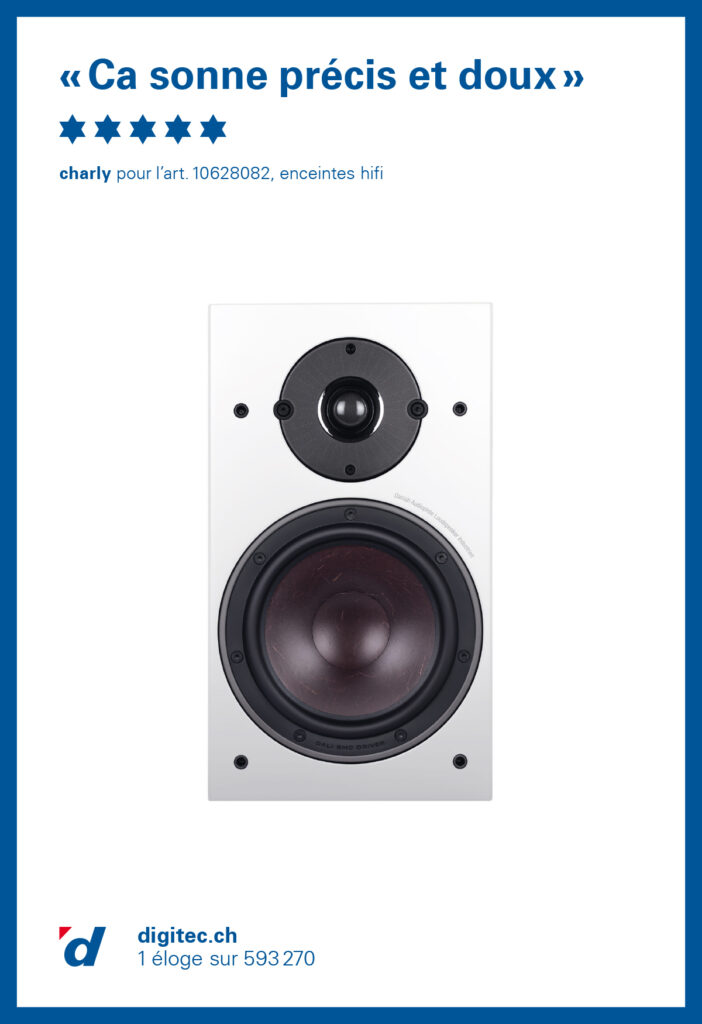
Electronics arouse emotions - at least if the Digitec community has its way. Proof of this is provided by eight German and 6 French subjects with lyrical product reviews.
The campaign will run from Monday until April 18, 2021 in German- and French-speaking Switzerland. The subjects can be seen on backlit posters, wet posters, hanging boxes, advertisements, social media and online banners, e-boards and e-panels.
Responsible at Digitec Galaxus: Martin Walthert (Chief Marketing Officer), Flurin Spring (Creative Director), Daniel Kobi (Art Director), Ursina Grimm (Head of Brand Management), Jill Wanner (Project Management & Brand Management), Clémence Censi (Graphic Design), Severin Keller (Digital Media Design), Roberto de Bonis (Digital Marketing), Gesine Hauder (Media Planning), Anne Chapuis (French Translation). Responsible at Focus Product Photography: Cathrin Schön (Photography).
Grips repositions itself and gets location in Zurich
CH Media Entertainment Grips’ young production unit can look back on a successful fiscal year; it will restructure its operations starting in April 2021 and expand its Zurich location. With this virtual centralization, the company will increasingly focus on three core competencies in the future.
Editorial
-
March 19, 2021
The co-leaders of Grips: Marco Hess (left) and Raul Steffer.
CH Media's production unit specializes in the conception and production of moving image and audio content and operates decentrally at the St. Gallen and Lucerne locations. Under the co-management of Raul Steffer (Lucerne location) and Marco Hess (St. Gallen location), the still young unit has already been successful in its first year of existence, according to a CH Media statement.
Stronger focus on core competencies
Now, as of April 1, 2021, Grips will be further developed organizationally and structurally and expanded to include the Zurich location. Marco Hess will take over the management, and Raul Steffer will contribute his knowledge as a cross-site executive producer.
In its market development, Grips intends to focus even more specifically on its three core competencies of studio and outside productions, commissioned video production and commissioned audio production. In the audio segment, Grips is expanding its range to include podcast productions.
In the area of studio and outside production, the unit is taking advantage of synergies arising from CH Media Entertainment's infrastructure, according to the statement. This should enable a unique market presence almost across the whole of German-speaking Switzerland. With the move to CH Media Entertainment's new headquarters and production site in Oerlikon, customers will have the opportunity to realize complex productions in the studios.
Trollhauser realizes campaign for Stiftsschule Engelberg
The Lucerne-based copywriting agency Trollhauser has created a campaign for the Stiftsschule Engelberg that strikes a fresh and direct tone.
Editorial
-
March 19, 2021
Martin Rutishauser is no stranger to Engelberg. As co-owner of the Lucerne-based text agency Trollhauser, he already designed and wrote the text for the brochure celebrating the 900th anniversary of Engelberg Abbey in 2020. "This tone, this lightness, hit the mark very well for the monastery and delighted the readers," explains Claudia Heil, Head of Marketing at Stiftsschule Engelberg.
For the Stiftsschule campaign, Rutishauser called in graphic designer Hampi Krähenbühl from Werbetypografik Fürigen NW. Together they presented two versions, one with an image and one purely typographic. Stiftsschule opted for the version without an image. "I also liked the typographic one better, it has more tonality and there is enough white space," explains Krähenbühl.
The first ad is in the March issue of Parents magazine Fritz and Fränzi appeared. From mid-March to mid-April, advertisements also appear in the NZZ on Sunday as well as in the Sunday newspaper; additionally, display advertising runs online. The advertisements and banners direct via QR code to a Landing pagewhich also ensures measurability.
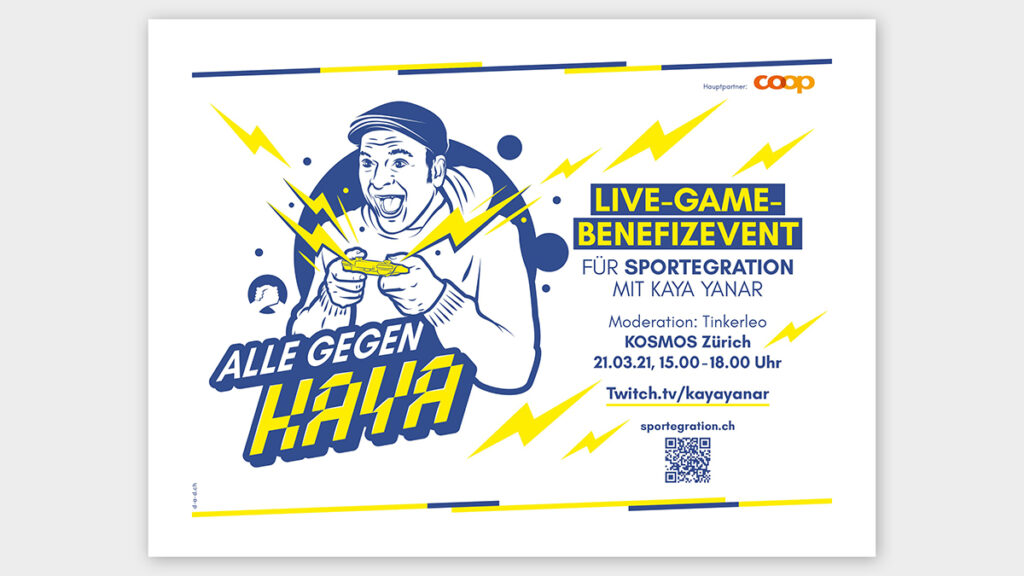
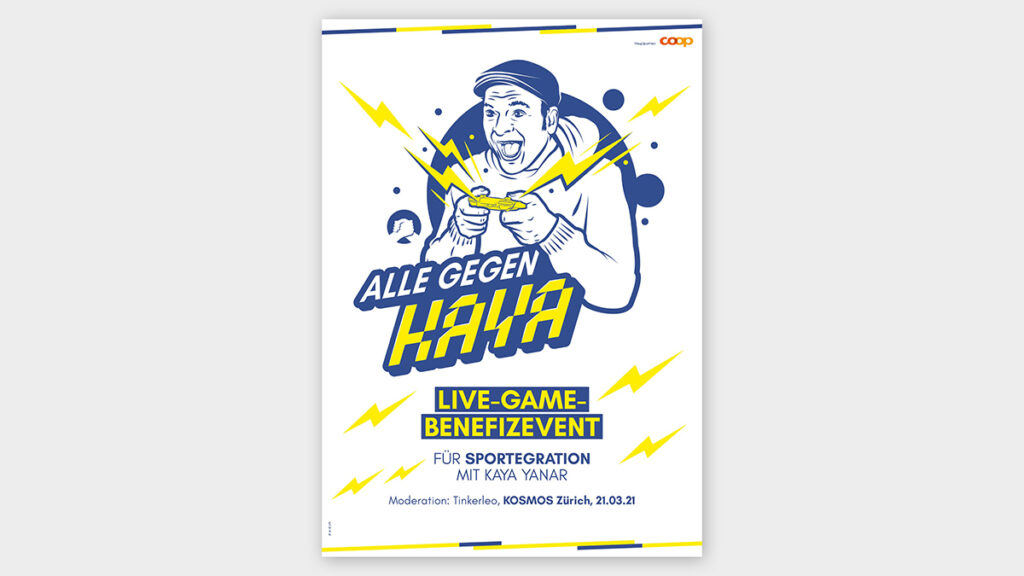
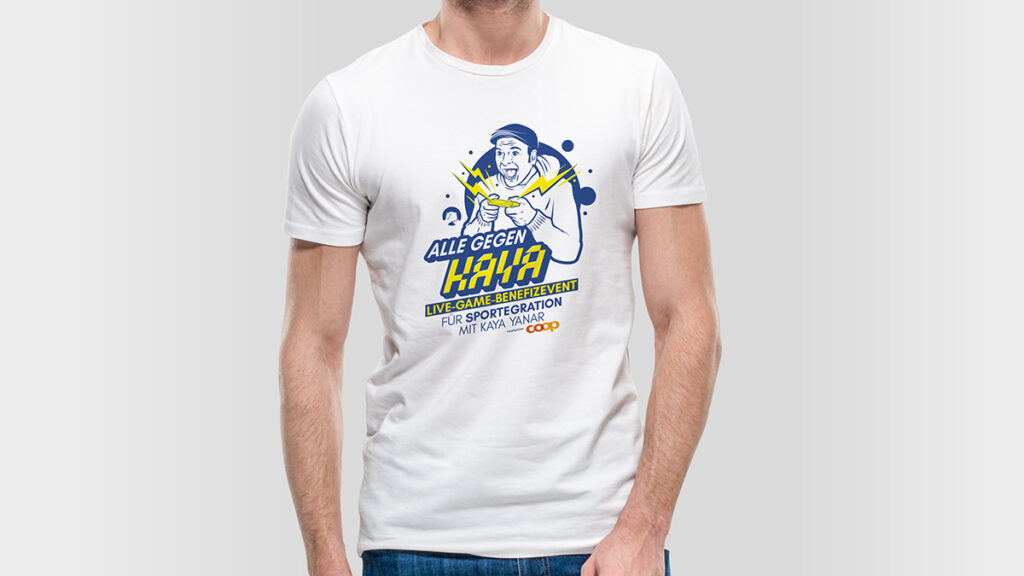
Rogo & Friends: Communications appearance for "All against Kaya
On Sunday, comedian Kaya Yanar will host a live game charity event on Twitch at the Kosmos in Zurich to benefit the Sportegration association. Rogo & Friends was commissioned to handle the event's communications.
Editorial
-
March 19, 2021
The Sportegration association has been organizing numerous projects for refugees in the Zurich area since 2016. The shared enjoyment of sports and exercise are at the center of these projects. Kaya Yanar became aware of the association last year and knew immediately that he wanted to support this project.
As an official Sportegration supporter, he went jogging with the refugees and traded his gaming controller for a pair of sneakers for one afternoon. The Sportegration participants clearly had the edge (and the legs) when it came to jogging, so it seemed only fair to swap roles and dive into Kaya's gaming world for the next meeting.
On Sunday, twelve Sportegration participants will now face off in the Nintendo game "Mario Party" the gaming pro and want to prove that they can easily beat the comedian in the virtual world as well. The benefit event will be streamed live on Twitch from 3 p.m. on Sunday. Viewers can donate to the work of Sportegration. It will be hosted by Twitch streamer Tinkerleo and the main partner is Coop. Rogo&Friends are contributing the appropriate cross-media communication tools for the event, in true Mario and game style.
The key visual and associated animation are used in print, on social media and at the event.
Responsible at the association Sportegration: Annina Largo (President). Responsible at Rogo&Friends: Roger Grolimund (concept and consulting), Marco Donada (Animation and graphics).
Off The Record 4: Video Podcast with Cheyenne Mackay
"Off the Record" is the video podcast for the trade magazines m&k and Werbewoche.ch. Editor-in-Chief Anna Kohler gets to the heart of the matter with selected guests in one-on-one conversations.
Editorial
-
March 18, 2021
Cheyenne Mackay loves audio and that's why she's right at home at the Podcast-Schmiede agency. She discusses what punk rock is all about and why her brand new podcast is called "Snot Phase" with Anna Kohler in "Off The Record," the video podcast by m&k and Advertising Week.
The portrait about Cheyenne Mackay in the m&k-Print issue 3/2021 you can here read
Jessica Scholz becomes Group Chief Marketing Officer at Ringier
Jessica Scholz is the new Group CMO of the Ringier Group. The promotion coincides with the transformation of the User Marketing & Technology team she leads into Global Marketing, which supports local marketing teams across the group.
Editorial
-
March 18, 2021
Jessica Scholz was previously International Digital Director and responsible for the globally operating User Marketing & Technology team. As Group Chief Marketing Officer, she now leads the Global Marketing team, which aims to provide strategic support, collaboration, knowledge sharing and Group-wide solutions to ensure that local marketing teams have the best possible conditions. In her new role, Jessica Scholz reports to Ladina Heimgartner, Head Global Media and CEO of Blick Group.
"Jessica Scholz has been the driving force behind Audience Development at Ringier Group for more than seven years and knows the local challenges of our businesses inside out. She and her team make it possible for us to reach the next level in marketing," says Ladina Heimgartner about Scholz's promotion.
As Head of Online Marketing for the markets of the Ringier portfolio, Jessica Scholz started her career in the Ringier Group in 2013. Before joining the international unit in January 2018 to head the User Marketing & Technology team, she was Chief Marketing Officer of the African marketplaces group Ringier One Africa Media (ROAM) for two years. Jessica Scholz's professional path led her to the Berlin start-up scene. Born in Australia, she studied marketing, media and communications, management and sociology at the University of Wollongong.
Swiss advertising market struggles with long-term consequences of the Corona crisis
While the Swiss advertising market has always been significantly weaker in February than in January over the past two years, it has recovered slightly in February 2021 following the significant slump in January. This is shown by the advertising market trend from Media Focus.
Editorial
-
March 18, 2021
Compared to the previous month of January, the Swiss advertising market recorded an increase of 7.4% in February. However, at 313.2 million gross advertising francs, the month is still well down on the previous year at 20.1%. Cumulative advertising pressure amounted to 604.7 million gross advertising francs, around 28% below the previous year's figure.
Among the sectors, six out of 21 sectors reported higher advertising pressure in February, while only radio saw a slight increase among the media groups. However, this increase in advertising pressure is not organic, but can be attributed to the integration of three new stations in French-speaking Switzerland at the beginning of the year.
Advertising pressure in the overall market: development of advertising pressure as at February 2021 in million gross francs
Cleaning further increases advertising pressure
The cleaning industry also significantly increased its advertising pressure in February (+76.6%). The winning sectors also include tobacco products (+43.6%), energy (+24.4%) and retail (+23.3%), which recorded double-digit year-on-year growth. The retail trade is thus less than one percent behind its previous year's result YTD. The food sector (+2.5%) increased slightly again in February and is thus only just (-2.3%) behind the previous year's YTD figure. Digital and household (+1.2%) also saw a slight increase after the significant decline in January.
Lockdown leaves its mark
The list of sectors that are more defensive in terms of advertising in February 2021 than in the previous year is long. Events (-76.7%) and leisure, gastronomy, tourism (-59.6%) are - unsurprisingly - the sectors with the highest percentage decline in advertising pressure. They are directly followed by transport companies (-59%), the media industry (-53.8%), fashion & sport (-48%) and the beverage industry (-36.6%), which was even more stable in January 2021 at "only" -8.1%. Vehicles (-28.7%), services (-27%) and finance (-22.4%) also saw declines of over 20 percent.
The top advertisers and most frequently advertised products and services (excluding product range and image advertising) in February.
Top product: Samsung Galaxy S21 5G
The Apple iPhone 12 Pro, which ranked third in the previous month, dropped out of the top 10 products in February. Instead, another smartphone from the competition shot to the top of the rankings - the Samsung Galaxy S21 5G. In 2nd place is the Caddy Cargo Transporter from VW. Credit Suisse in 3rd place with its management consultancy campaign. Knorr Stocki (4th place) and McDonald's Restaurant (6th place) provide food during the lockdown.
UPC Giga Internet (5th place) and the Sunrise We Mobile subscription (7th place) ensure that the online order is received and you can shop at Home24.ch (8th place). If you want to escape the daily grind with a little luck and a lot of cash, you can bet on Swisslos Euromillions tickets (rank 9). Those who dream more realistically can escape into the world of Disney+ (ranked 10th). The streaming service is back in the top 10 for the first time since July 2020 with new star content.
There is no major movement among advertisers. Coop, Migros and Procter & Gamble secure the podium places.
Media Mix for the month of February.
Mygosh brings more thrust to the energy transition for Groupe E
New solutions are needed to ensure the energy transition is achieved in a timely manner. Groupe E encourages people to rethink and take action—with a promotional video created by Creative Director Olivier Girard and directed by Mygosh.
Editorial
-
March 18, 2021
Groupe E is launching a new campaign under the premise "Your future is our present". For the energy transition to achieve its ambitious goals, habits must now be changed, decision-making processes accelerated and energy better utilized. Groupe E is taking on these challenges and is encouraging customers to join Groupe E on its journey with an image film - for new solutions, for better energy management, for families, companies and entire cities.
The campaign was developed by Urs Vogt and Gilles Allemann at Groupe E, under the direction of Olivier Girard, Executive Creative Director at Studio M&C Saatchi in Geneva, and realized by the film production company Mygosh in Zurich. Nabil Senhaji directed the film and Vincent Calmel realized the photo campaign.
After a month-long casting in Switzerland, France and Belgium, the young actress Lorianne Klupsch was signed as the lead actress. "The result is a very poetic film that conveys Groupe E's brand strategy in a sympathetic and understandable way," explains Lamar Hawkins from Mygosh.