Bank Cler launches campaign on Smadooh Media with location partner Gidor Coiffure
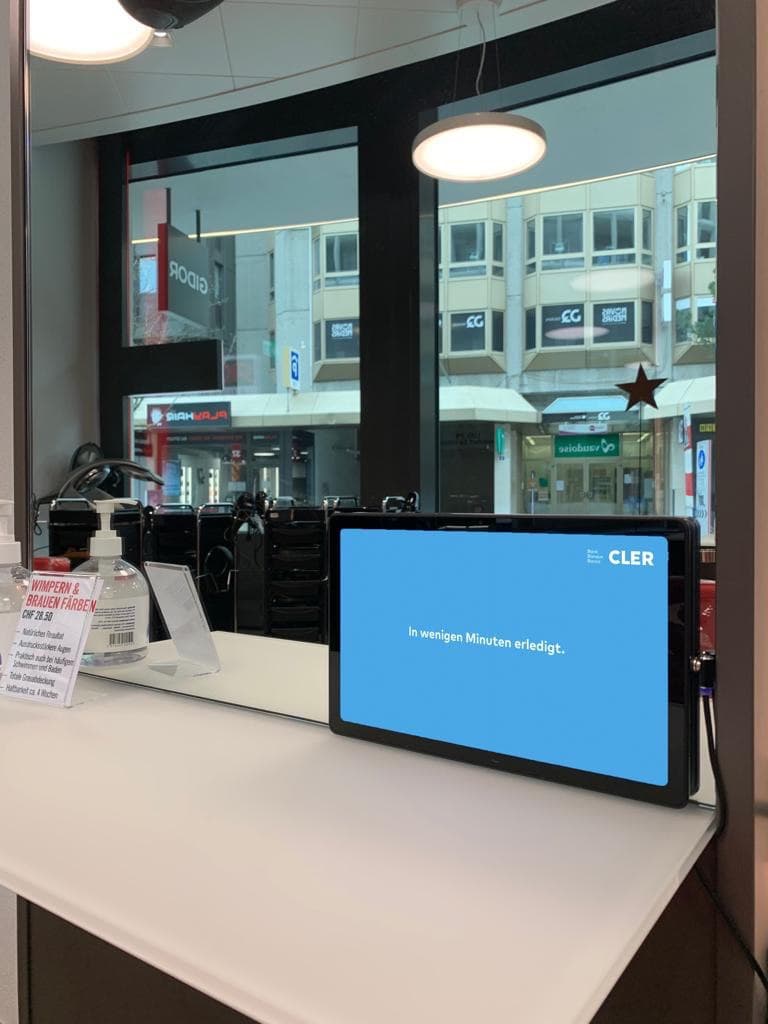
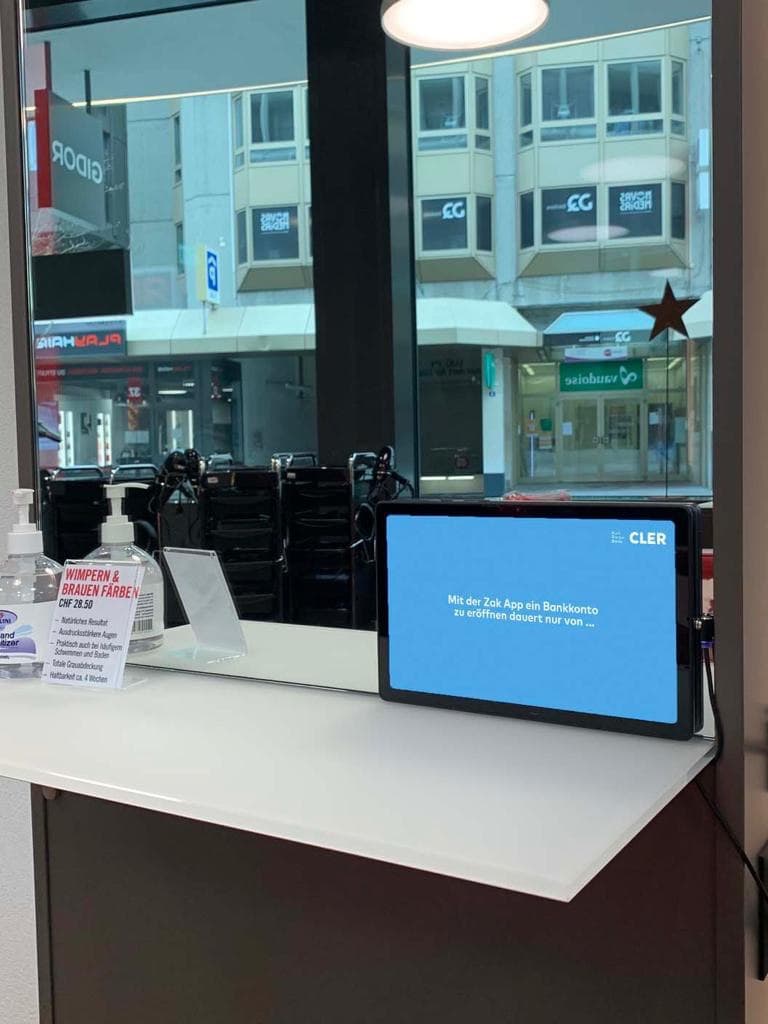
On Monday, Bank Cler’s current «Zak» campaign was expanded to include Smadooh Media screens, which are in use at all Gidor Coiffure locations.
Editorial
-
March 24, 2021
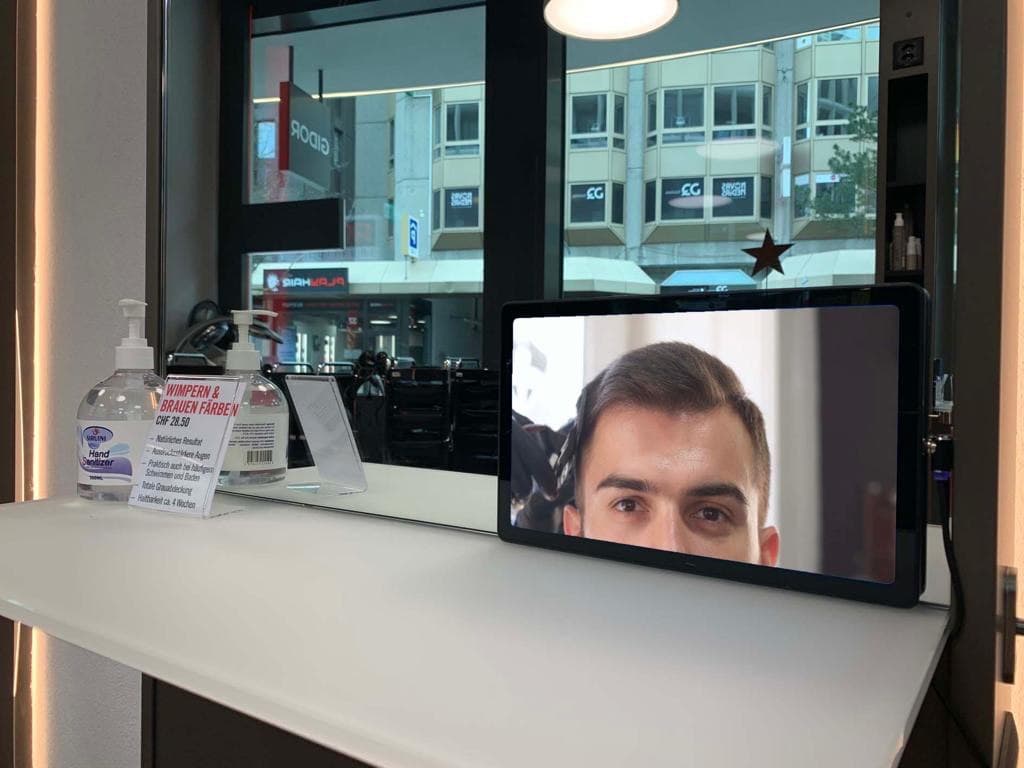
In the branches of Gidor Coiffure, attention will be drawn to the advantages of Bank Cler's banking app "Zak" during the next month by means of a creative motif. The focus will be on the speed of the app installation, which is compared to a quickly completed hair trim.
This is intended to succeed in a playful way the skillful interplay of message and consideration of the local circumstances and to provide for a striking effect with smirk factor.
Deeper cooperation planned
In addition to the classic advertising campaign, a more in-depth cooperation is also on the agenda. From the second half of 2021, selected offers from Gidor Coiffure will be available in the "Zak" app.
TX Group launches public bug bounty program for 20 minutes
Cybersecurity is more important than ever. To identify vulnerabilities in its IT systems, the TX Group is launching a public bug bounty program that allows all external security researchers and hackers to search for security vulnerabilities in 20 Minuten’s digital presence.
Editorial
-
March 24, 2021
Since spring 2020, the digital presence of 20 minutes in a new guise (Werbewoche.ch reported). In the process, the platform has also been "raised to a very high level" in terms of security technology, as the TX Group writes in a statement. From technical design to go-live, state-of-the-art security elements have been built in to ensure the availability of the platform and the data and security of its readership at all times. In addition, some 850 hackers and security researchers spent more than a year searching for security vulnerabilities as part of a closed bug bounty program. In such a program, payment is made for each security hole found. A bounty, so to speak - or a bounty. The group collaborated with the company BugCrowd for the program.
Program now open to the public
Now the TX Group is making the program publicly available to all security researchers and hackers. In doing so, the group aims to raise the security level even further. "Our bug bounty programs have been one of the most effective measures of our product security strategy for quite some time. Offering this program publicly is the culmination of our efforts to build the most secure news platform in Switzerland. TX Group is thus taking a pioneering role in Switzerland for cyber security," Andreas Schneider, Group CISO of TX Group, was quoted as saying in the statement.
Hacking platforms is normally punishable by law. A bug bounty program is ethical hacking, in which hackers deliberately penetrate systems and specifically search for vulnerabilities. However, because they follow certain rules, they are not legally prosecuted. "Such programs not only improve our cyber security, but also create trust as well as transparency and thus make an important contribution to the digital transformation of TX Group," explains Schneider, adding, "20 minutes is just the beginning. Later this year, we will make more bug bounty programs available to the public, further increasing our digital trustworthiness."
Livesystems screens are now available at BLS stations
Throughout 2021, Livesystems will install large-format, high-profile advertising columns on platforms, in station shops, and in station plazas across the BLS rail network. Starting in winter 2021, they are expected to generate 39,000 daily impressions for Livesystems.
Editorial
-
March 24, 2021
Livesystems has won the BLS tender with its digital screens against the competition. "We are very pleased about the renewed confidence of BLS," Christian Imhof, CEO of Livesystems Dooh, was quoted as saying in a statement. BLS, Switzerland's second-largest railroad, has already relied on products from Livesystems to equip its Lötschberger trains and its new Flirts with Passengertv. "With the digitalization of the BLS stations, our entire advertising network gains in attractiveness," Imhof added.
This year, a number of locations outside BLS stations will now follow. They will be equipped with 75-inch screens.
Marketing from Q4 2021
Rollouts are planned at several BLS stops in the area of the city of Bern, as well as at the stations of Belp, Frutigen, Grenchen, Huttwil, Interlaken, Schwarzenburg, and Spiez. Other locations on the BLS commuter rail network are being examined. Marketing of the new advertising spaces is scheduled to start in the fourth quarter of 2021.
The content supplier for the news is the online news portal Nau.ch, which is under the umbrella of Livesystems Holding.
Over 2.6 million contacts daily
According to the press release, the large-area city screen advertising beacons from Livesystems have established themselves quickly and widely over the last three years. Today, they can be found at train stations, in parking garages, in front of shopping malls and at well-frequented places in city centers.
With a growing number of service station stores, Livesystems is experiencing strong growth. Just last fall, Livesystems added over 400 new sites to its portfolio with partners Tamoil and Migrolino (Werbewoche.ch reported).
Together with the screens in public transport, the new marketing network in Swiss Post branches and the online news portal Nau.ch, an advertising campaign on the Livesystems product mix is said to achieve over 2.6 million daily contacts. The total figure does not currently include the "Passengersign" analog offering. According to Livesystems, the analog indoor and outdoor advertising spaces on the vehicle fleet of Verkehrsbetriebe Zürich VBZ achieve a potential of over one million contacts on weekdays.
In 2021 the fourth edition of Ticino Open Doors for Mice professionals will take place
This summer, Ticino Turismo, in collaboration with the four regional tourism organizations, is organizing the fourth edition of Ticino Open Doors. Sixty MICE professionals will have the opportunity to visit Ticino and explore some of the hotels and service providers there for organizing events, meetings, and conferences.
Editorial
-
March 24, 2021
Every three years, Ticino Turismo, together with the regional tourism organizationsMICE professionals the doors to seminar hotels and unique event locations throughout the canton of Ticino. Over the course of almost three days, the participants will put the MICE potential of Switzerland's southernmost canton through its paces. The participants are always accompanied by an expert from the region who can provide additional information.
In addition to site inspections Incentive activities During the Ticino MICE-Mart, all Ticino service providers, whether hoteliers, caterers or event technicians, will be available to answer questions and provide quotes. During the event, participants stay free of charge in hotels equipped for seminars and meetings.
This year's edition will take place from September 5 to 7, 2021, and interested parties can register at the Website of Ticino Turismo log in.
Off The Record 5: Video podcast with Oliver Stoldt
"Off the Record" is the video podcast for the trade magazines m&k and Werbewoche.ch. Editor-in-Chief Anna Kohler gets to the heart of the matter with selected guests in one-on-one conversations.
Editorial
-
March 24, 2021
He calls himself "unmanageable." Being employed and reporting to a boss? Think not, not with Oliver Stoldt. The head of Premium Speakers and the Mice Service Group is a driven man. Always on the ball, always with people, always curious, hungry. Anna Kohler talked to the go-getter.
Agency at the airport puts Hugo Steiner in a new light
The Altenrhein agency at the airport develops the brand of the real estate service provider Hugo Steiner further and realizes a communication appearance, which is aimed at private persons.
Editorial
-
March 24, 2021
The real estate services company Hugo Steiner from Eastern Switzerland is a member of the Intercity Group. In order to increase the communicative focus on private individuals, without thereby endangering the currently successful B2B positioning, the agency was commissioned at the airport after a pitch with the further development of the brand and its communication.
As a first measure visible to the outside world, the brand values were sharpened, the corporate design adapted and a new Website developed. In a next step, digital as well as classic communication measures will support the campaign.
The campaign runs from now until further notice.
Responsible at Hugo Steiner, St. Gallen: Robert Mazenauer (CEO), Stefan Lemberger (Co-Owner), Nathalie Meldau (Head of Backoffice) Responsible at Intercity Group, Zurich: Herbert Wüst (CEO). Responsible at agency at the airport: René Eugster (overall responsibility), Dominique Rutishauser (creative direction), Ketil Eggum (art direction), Katharina Eugster (interactive media design), Miriam Egli (text), Maximilian Eugster (consulting/coordination).
Online shopping: nothing beats clothes and shoes - even more so in Corona times
Online retail, which has been booming for years, has gained even more momentum due to the coronavirus. According to a survey by Marketagent.com Switzerland, «clothing and shoes» remains the most popular product category. And how will we shop in the future? Technologies such as AR and facial recognition are gaining acceptance.
Editorial
-
March 23, 2021
The study by Marketagent.com Switzerland shows that 74 percent of the German-speaking and French-speaking Swiss surveyed shop for clothes and shoes online at least once a year. This is 5 percentage points more than in the comparable survey in February 2020, i.e. before the Corona crisis.
(Source: Marketagent.com Switzerland)
In the personal care products and cosmetics category, the share has risen to 44 percent, which is also clearly higher than the figure in the previous year's February 2020 survey, which was 37 percent. The increase in the durable food category is similarly high. In 2021, this category comes in at 30 percent, just under one-third of the total, up from 23 percent in February 2020.
"Due to Corona, people inevitably had to shop online more. However, the fact that the share in the respective categories did not increase more significantly than in the previous year underlines how much shopping by mouse click is already established among the Swiss population," continues Martina Staub of Marketagent.com Switzerland.
AR and Co: Men and younger people are more open
New technologies will continue to shake up the way society shops. But which developments are welcomed, and which are rejected? Of the options surveyed, shopping in stores entirely without sales staff met with the greatest acceptance among respondents (33 percent). However, men are significantly more in favor of this than women (38 percent versus 29 percent). The difference between the age groups is even more pronounced: acceptance among 14- to 29-year-olds is 45 percent, and only 24 percent among 50- to 74-year-olds.
(Source: Marketagent.com Switzerland)
31 percent of respondents could imagine using augmented reality. There is no clear difference between the sexes here. However, there is a big difference depending on age. Half of 14- to 29-year-olds are in favor, but only one-fifth of 50- to 74-year-olds.
Overall, 31 percent are more likely to say yes to payment via facial recognition or fingerprint. Men are significantly more likely than women to say yes (34 percent versus 27 percent), and 14- to 29-year-olds are significantly more likely than 50- to 74-year-olds (41 percent versus 23 percent).
However, the purchase of products that are individually adapted to one's own needs on the basis of a DNA test meets with great disapproval. Overall, only 15 percent are in favor of this.
Marketagent.com Switzerland interviewed for the Study 1004 people from German- and French-speaking Switzerland aged 14 to 74. The representative survey was conducted from February 4 to 15, 2021.
Kreativbude Basel realizes five TV spots for Emil Frey Münchenstein
Kreativbude Basel conceived and realized five new TV commercials for the car dealership Emil Frey Münchenstein.
Editorial
-
March 23, 2021
The spots are intended to convey a positive team spirit, know-how and great vehicles. The five spots will be broadcast on Telebasel.
Customer: Emil Frey Münchenstein. Consulting, concept and direction: Thomas Rauch (Kreativbude Basel). Camera and light: Roman Linder.
Philipp Sauber joins the Board of Directors of Schneiterpartner
Philipp Sauber, former owner and Managing Director of Plan.Net Suisse, joins the Board of Directors of Schneiterpartner.
Editorial
-
March 23, 2021
Sauber can look back on 20 years of entrepreneurial activity and was the owner and managing director of Plan.Net Suisse until spring 2019. Since the sale to the Serviceplan Group, he has dedicated himself to selected board and project mandates as well as his private investments under the umbrella of Sauber.digital. He also teaches at the HWZ University of Applied Sciences in Business Administration Zurich.
Pink new without much pink and with new partner
Now that Rosarot has recently moved into its new, custom-designed agency offices, it is launching its newly created website—without too much pink. At the same time, the agency is reorganizing itself into a single unit and welcoming Labinot Gashi as a partner.
Editorial
-
March 23, 2021
After the beautification in the real world, now comes the digital lift. In an intensive beauty treatment, the website symmetry was balanced, the design tightened, the content chopped, superfluous data sucked out, internal links deep-cleaned, page performance corrected, usability increased, SEO fillers used and meta information implanted. Now the Zurich agency shows itself with the new page from the chocolate side. With the new content structure, Rosarot wants to make it clear at first glance which four disciplines the agency specializes in: design, content, digital and architecture.
The yellow (or pink?) of the egg for Easter
Because the creatives couldn't decide whether Easter is more beautiful or their own website, they combined both: Easter on Rosarot.ch. Anyone who discovers on the site that the yellow of the egg can indeed be pink will perhaps also find the hidden Easter bunny. Clicking on it directly enters you in the competition to win an ounce of gold.
Labinot Gashi as new partner
In the course of merging design, content and digital projects, Rosarot is optimizing processes and repositioning itself as a single entity: While various stock companies were previously united under the Rosarot brand, since the new year design, content and digital have been united in one company. Labinot Gashi is now also a partner under this new entity. The digital marketing specialist has already published four online marketing books, is a lecturer at the FHNW and heads the digital unit at Rosarot as a member of the management board.
Labinot Gashi is a new partner at Rosarot.
Creative oasis in Zurich
To allow employees to live out all their creativity, Rosarot recently created its own place of well-being. In 2020, the agency moved into its new premises. Rooms over five meters high, large plants, meeting rooms "with a view," generous windows, a 120-square-meter gallery, communal zones, retreats and a round ping-pong table welcome employees and clients. The interior design was created by the agency's own designers.
SRF coverage more "for Switzerland, rather than for the region"
The program commissions of five SRG Deutschschweiz member companies have assessed SRF's reporting: The verdict on the online reporting from the regions, which has been realigned for seven months, was thoroughly skeptical. The withdrawal from the local and regional area is considered problematic, which is why a reassessment of the strategy is desired.
Editorial
-
March 23, 2021
2020, online reporting from the regions was adapted and integrated into the "Switzerland" section.
At the beginning of September 2020, SRF adjusted its online reporting from the various German-speaking regions of Switzerland on the srf.ch/news website and in the "SRF News" app (Werbewoche.ch reported). Since then, articles from the regional journals are no longer published in a separate section, as was previously possible with "Regional" and a selection menu by regional journal. Selected contributions are now integrated into the domestic reporting under the heading "Switzerland". According to SRF, this was in response to findings from user research.
This was a change in strategy with major implications, which is why the program commissions (PC) of five SRG member companies in German-speaking Switzerland - SRG Aargau Solothurn, SRG Bern Fribourg Valais, SRG Ostschweiz, SRG Basel and SRG Zentralschweiz - got together to take a close look at the implications of this change in strategy. They had first assessed the offer for their own region. Afterwards, the presidents of the PFs exchanged these findings and discussed them with Maurice Velati, project manager of the strategy change and head of the regional journal Aargau Solothurn.
Regionally important topics no longer digitally recognizable
They came to a common conclusion: all the PKs were unanimous in attesting to the high quality of the reporting by the contributors. The articles and choice of topics were interesting, attractive and well done. However, they were equally unanimous in criticizing the change in perspective associated with the change in strategy. In their opinion, the "Regionaljournal" editorial teams no longer report "from the region for the region" but "from the region for Switzerland. Among other things, this leads to topics that are considered important and relevant in the respective region itself no longer being digitally available or recognizable.
Less visibility online
The fact that individual articles are no longer listed also means that the entire work of the regional editorial offices is no longer perceived and, for example, individual articles are more difficult to share via social media. Combined with the fact that the search function for individual contributions delivers poor results, this leads to the regional editorial offices being less visible in the digital space and thus less present in the region, according to the verdict. And the longer it takes to find something, the less demand there is for it. This also fits in with the fact that quite a few PK members no longer get their regional news online from the "SRF News" app, but from the digital offerings of other, private media.
However, since the private media are also increasingly withdrawing from local and regional reporting for economic reasons, it would be all the more important, according to the PK, if a public service offering is maintained in this area; after all, this is essential for shaping the opinions of the population. In part, there is a fear that the step in the digital offering could also be followed in radio, i.e. that the regional journals would only become regional correspondents, according to the statements of the PKs.
In the program commissions, the need to adapt the offering and thus respond to the signs of the times was acknowledged. SRF should not have to produce content that is not read, which is why in principle the attempt to actively break new ground is supported. In this context, the PFs also welcome the new "SRF News" app announced for the end of the year: this promises to meet many requirements that cannot currently be met.
Nevertheless, it is clear to the PKs that the fact that only a few reports from the various regions are now being published online in the relevant area is bad form for a media company serving the public service. After all, SRF must not only orient itself according to national quotas, but also according to regional relevance. Combined with other recent strategic adjustments on the part of SRF, this gives rise to an uneasy feeling. For example, there are fears of a further marginalization of regional information. That's why the program commissions are suggesting that the change in strategy be reconsidered.
UBI reports record number of complaints
The Independent Complaints Authority for Radio and Television (UBI) received 43 new complaints in 2020. The UBI calls this a record. According to its figures, the last time it received more complaints than last year was 30 years ago.
Editorial
-
March 23, 2021
Around 43 complaints were received by the UBI in 2020, including the one regarding the SRF documentary about whistleblower Adam Quadroni. The decision on this is not yet legally binding.
Only in 1991 did it receive 50 complaints, the UBI wrote in a statement on Tuesday. At that time, however, there were no ombudsman offices upstream of the UBI. Today, these eight offices received 2021,194 complaints, compared to 636 in the previous year. Around four percent of these cases resulted in a complaint to the UBI.
30 of the 43 complaints received in 2020 were directed against TV broadcasts. In eight cases, the complaints concerned several media from the same broadcaster, namely TV, radio and/or online. Radio broadcasts were complained about five times. 37 complaints concerned the SRG, the remaining six broadcasts by private broadcasters.
One complaint concerned a satirical program. All other submissions concerned news and information broadcasts and documentaries. In the second half of the year, according to the UBI, a number of complainants criticized the SRG broadcasters' coverage of the pandemic.
The UBI settled 36 complaint cases last year. In five of these cases, it found a violation of the law; in 2019, this was the case in three cases.
According to the UBI, the decision on the SRF documentary about Adam Quadroni is not yet legally binding. SRG has filed an appeal against the UBI decision with the Federal Supreme Court. In the UBI's assessment, the film about the Graubünden whistleblower had violated the principle of objectivity.
The UBI has been in existence since 1984 and is an extra-parliamentary commission of the federal government. On complaint, it must determine whether the content of radio and television broadcasts by Swiss broadcasters, as well as the rest of the SRG's offering, has violated provisions on the content of editorial publications. Decisions of the UBI can be appealed to the Federal Supreme Court. (SDA)






 He calls himself "unmanageable." Being employed and reporting to a boss? Think not, not with


