Bertelsmann confirms forecast despite decline in advertising and profits
Despite the slump in TV advertising and a decline in profits, the Bertelsmann Group is sticking to its full-year forecast.
Editorial
-
August 30, 2023
Bertelsmann CEO Thomas Rabe. (Image: Bertelsmann)
"I remain confident that we can achieve full-year revenues of around 21 billion euros and Ebitda at the previous year's level," Bertelsmann CEO Thomas Rabe told Deutsche Presse-Agentur on Wednesday. "We see the portfolio effects that the temporary weakness at RTL, especially in the advertising markets, will be compensated in terms of revenue by the other divisions."
Commenting on the earnings outlook - in the first half of the year, Group earnings were significantly below the figure for the first half of 2022 - Rabe added: "We will generate Group earnings of well over one billion euros, which is also related to the fact that we will make a high profit on the sale of Majorel." The Bertelsmann CEO expressed confidence that the sale of the shares in the call center subsidiary Majorel "will go through this year."
Significant decline in sales
The international media, services and education company posted consolidated earnings of 260 million euros in the first half of the year. Compared to the first half of 2022, this represents a significant decline - at that time, it was 492 million euros.
Among other things, Bertelsmann cited a lower operating result and restructuring measures as the reasons. These include the realignment of the magazine division (Gruner+Jahr) at RTL Germany, the realignment of the U.S. book business at Penguin Random House and the rotogravure site closures Liverpool and Ahrensburg near Hamburg.
Bertelsmann generated revenues of 9.7 billion euros in the first six months (H1 2022: 9.3 billion). Organic growth amounted to 2.3 percent. Operating earnings before interest, taxes, depreciation and amortization (Ebitda) were almost 1.3 billion euros, below the half-year 2022 figure of just over 1.4 billion euros. Bertelsmann also attributed the decline to the weak TV advertising markets.
There was revenue growth in Arvato's services business, the Penguin Random House book business, the BMG music division and the Education Group. (SDA)
Pink for Gazenergie: When limes suddenly become Laustärke
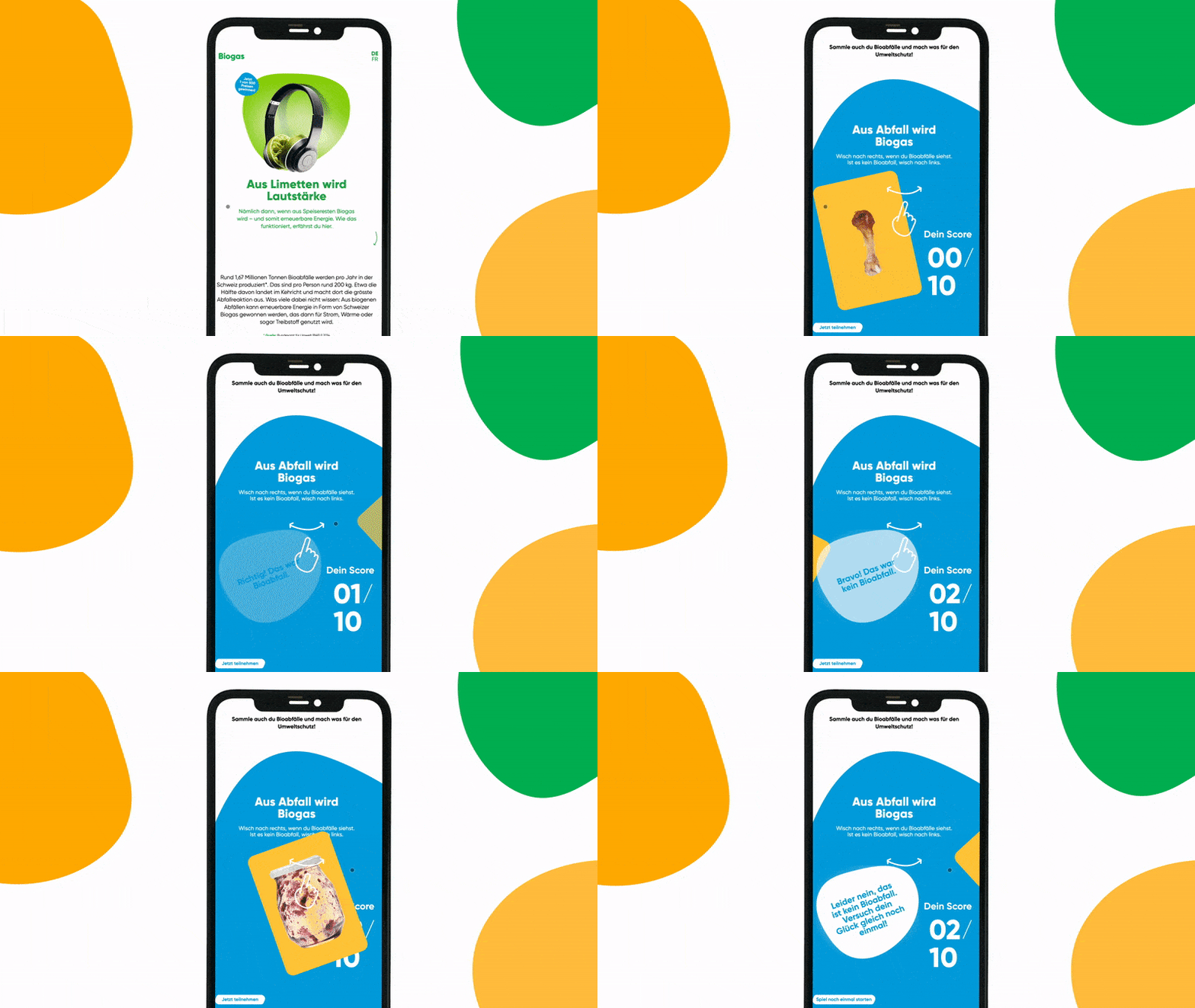
The Swiss Gas Industry Association (Gazenergie) has been working with Rosarot for a year. A campaign, complete with a landing page, aims to highlight that food scraps can be turned into biogas—and thus renewable energy. The initiative is being promoted at numerous events and street food festivals, where food waste is collected.
Editorial
-
August 30, 2023
According to the Federal Office for the Environment, 1.67 million tons of biowaste are produced in Switzerland each year. About half of this ends up in the garbage bin, where it accounts for the largest waste reaction. What many people do not know: Renewable energy can be produced from biogenic waste in the form of Swiss biogas, which is then used for electricity, heat or even fuel. The demand for renewable energy is particularly high in winter, when electricity production from solar and hydro power is reduced. The increasing use of electrically driven heat pumps and the electrification of mobility also increase this so-called winter electricity gap.
Turning biogenic waste into climate-friendly energy
Environmentally friendly alternatives are therefore in demand that are independent of the season and can be used flexibly because, like biogas, they can also be stored. And this is where Switzerland is a pioneer: In 1997, the first Swiss plant went into operation to feed biogas into the gas grid for the first time in the world. Today, 42 biogas plants throughout Switzerland ensure that heating is largely CO2 neutral.
Based on the idea that it is literally up to you at home or at an event to decide whether something valuable is created from organic waste, Rosarot developed a headline mechanism that shows in a surprising way what can be created from food waste. But only if organic waste is collected and renewable energy is created thanks to biogas.
Collection actions at Züri Fäscht, Street Food Festival and Open Air
The campaign was staged with visuals that always combine food waste with the possible form of energy. The motifs are always based on the events at which food waste is collected for the production of domestic biogas.
At open air festivals, for example, the core of a pear is turned into a bass, and at events like the Züri Fäscht, lime peels are used for cocktails. For the Weltklasse Zurich at the end of August, the banana peel, which is popular with many runners, is then turned into electricity for their sports watches.
The visuals each lead to a landing page that provides information about biogas and entices visitors with a competition.
Landing page and juice bar educate about biogas
For the design and conception of the landing page Win-biogaz.ch is also the responsibility of Rosarot. With five W-questions it informs briefly and crisply about biogas, shows its cycle as well as all event dates on which collection actions take place. For the competition with 500 prizes, a game was also developed with which one can test one's knowledge about biogas with simple swipe mechanics.
The Zurich agency also had a hand in the events themselves. At the street food festivals in Olten, St.Gallen and Bern, for example, it developed the entire visualization of a juice bar where the waste from the freely offered juices could be disposed of by the guests themselves.
After the campaign was played at the Züri Fäscht, the Openair Etzikon and the Openair Gampel in summer, it will now be used at the athletics event Weltklasse Zürich. In addition, visitors to the Street Food Festivals in Langenthal, Lugano and Thun can once again expect a juice bar in September.
Responsible at the Swiss Gas Energy Association: Petra Thomann (Brand Management and Industry Communications). Responsible at Rosarot: René Karrer (Creative Direction), Labinot Gashi (Head of Digital), Antonia Lattarulo (Digital Campaign Manager), Bettina Walder (Consultant), Sarah Pietrasanta (Head of Content), Thorsten Hainke (Senior Copywriter), Franz Neugebauer (Senior Copywriter), Bianca Berger (Art Direction), Fabio Montefiori (Polygraf); External partners: Lily Metzker (Compositing).
New layout for GlücksPost
Updated design, refined content: GlücksPost now features a refreshed and streamlined layout, new fonts, new content sections, and an expanded services section.
Editorial
-
August 30, 2023
The GlücksPost now appears in a refreshed design. In collaboration with the Hamburg agency Redaktion 4, the layout has been refined and modernized. On the front page, the magazine's contents have been moved closer to the logo, so that they are also visible when the issues are fanned out on top of each other at the newsstand. In addition, the previously rigid image arrangement on the front page has been broken up. The tidier design of the articles in the magazine as well as the new fonts are intended to make reading even more inviting.
Also in terms of content, the GlücksPost further developed. The section "Was macht eigentlich?" has been expanded and is now called "Rendez-vous": It reveals what former stars, now forgotten, did with their lives. In the new "Trick 77" section, SRF 1 presenter Krispin Zimmermann gives insightful tips on how to solve everyday problems practically, creatively and efficiently. And in the new column "Did you know that...?" celebrities reveal secrets from their lives.
In addition, the "Better Living" service section has been expanded with the relaunch: The new section offers a wealth of advice and information on the topics of "All-round Health," "Travel" and "Enjoyment. In addition, star hairdresser Martin Dürrenmatt has joined the team as the new fashion and beauty expert of the GlücksPost be committed.
Despite the innovations, the GlücksPost is true to its concept, as editor-in-chief Dominik Hug emphasizes in a press release: "The relaunch is an evolution. The mix of articles on Swiss celebrities, Hollywood stars and European royalty, as well as the rich service section and the numerous puzzles, is very popular with our readers and makes the GlücksPost to become the best-selling People magazine on Swiss newsstands."
Kargo for Landenhof: an innovation perceptible at all levels
«Landenhof,» a center of excellence for hearing and visual impairments based in the canton of Aargau, supports children and adolescents with these conditions in leading self-determined lives. Kargo developed a new overall brand identity for the center, a process that began with consulting on the fundamental brand architecture.
Editorial
-
August 30, 2023
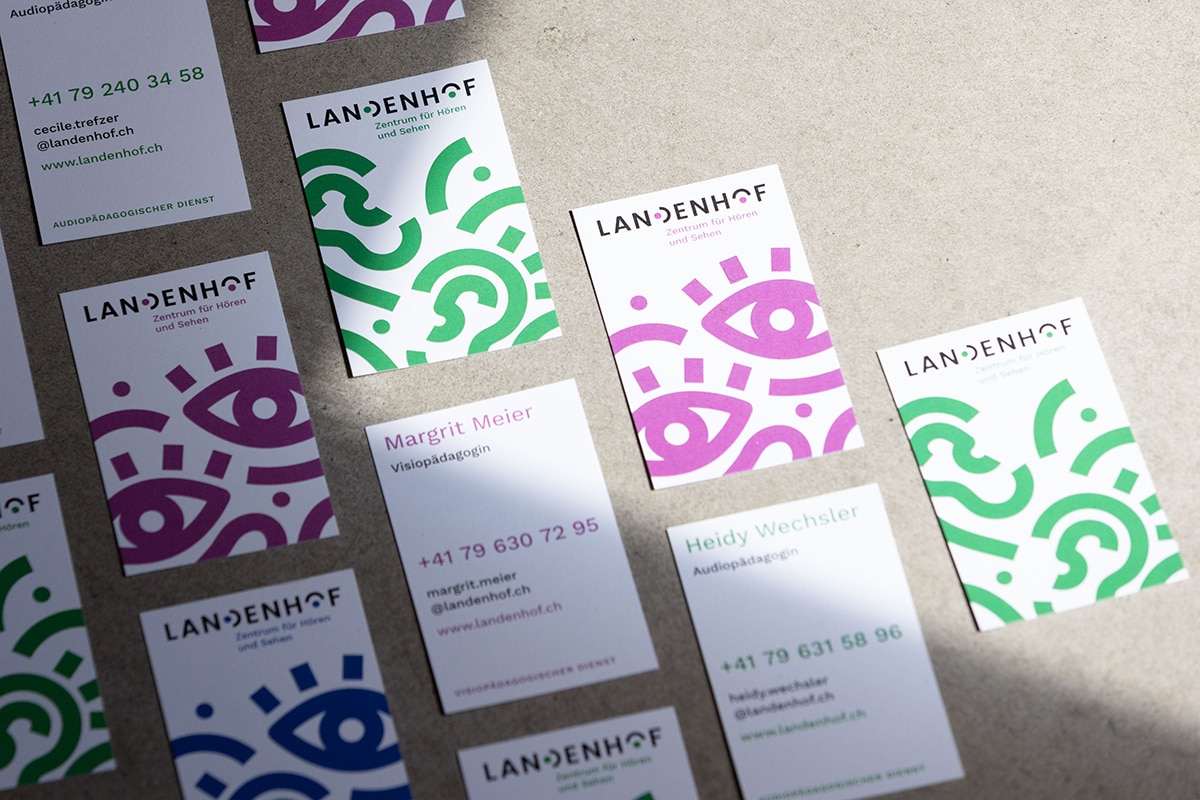
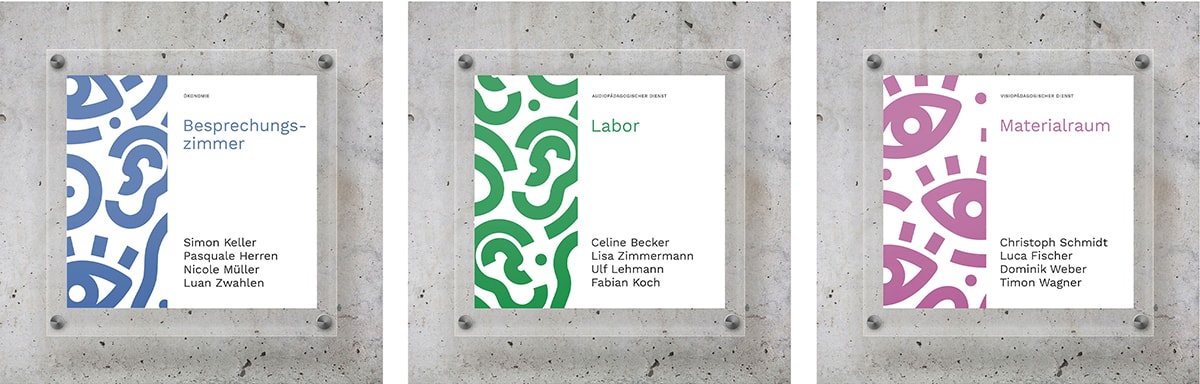
Among other things, Kargo unified the various organically grown appearances of the services and created an overarching brand on this basis. By separating the colors into pink for "seeing" and green for "hearing," Kargo was able to clearly emphasize the two offerings, while blue served as the overarching color.
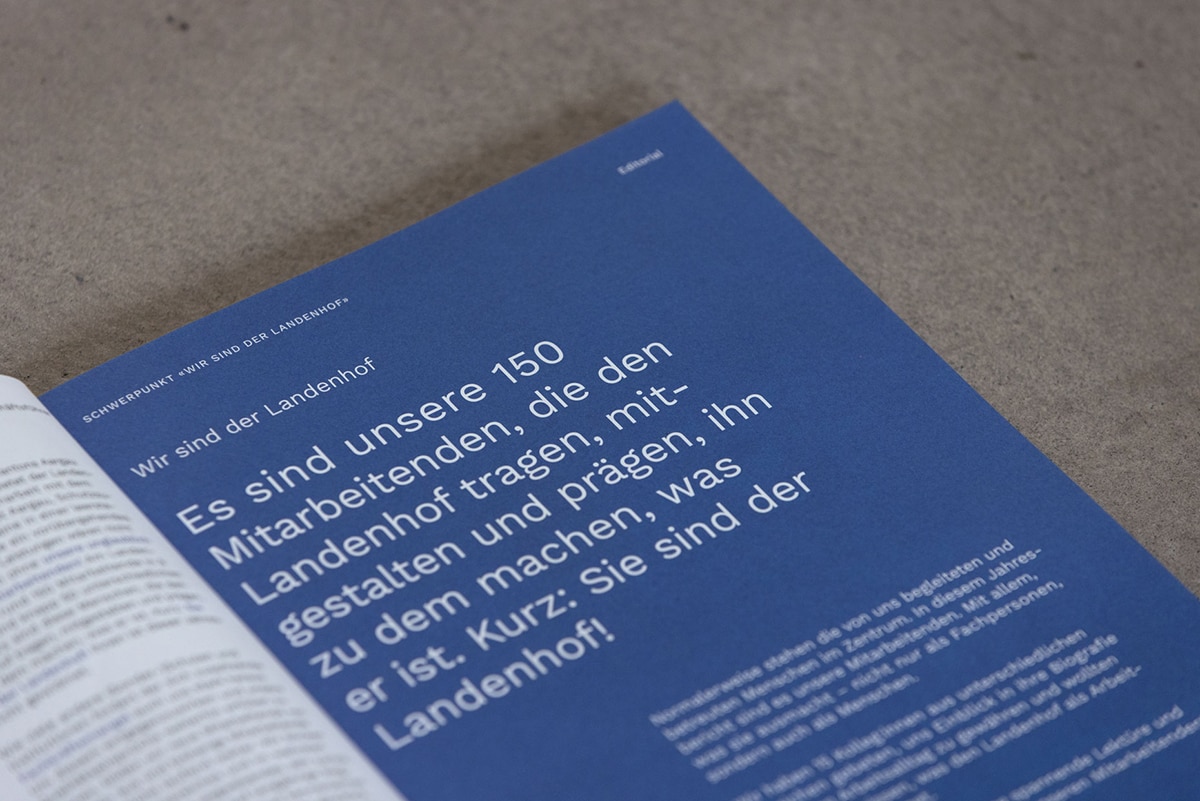
The aim was to create an accessible corporate design that is easy to read in both print and digital form. Particular emphasis was placed on easy-to-read fonts and font sizes as well as harmonious but easily perceivable color contrasts.
Lean feasibility
To ensure a lean and cost-efficient implementation of the branding in the long term, photographs, which also quickly lose their relevance, were dispensed with. Instead, a simple but playful world of illustrations and complementary icons were created, inspired by particularly well-known works of pop art, to shape and brighten up the new look across all touchpoints.
While accessibility could be implemented according to the latest standards, especially on the digital level, there was room in the analog area to make the innovations haptically tangible through the choice of paper, among other things.
The rebranding also included screen design and development support for the Website, the creation of printed matter and stationery, templates for the office palette, greeting cards and job advertisements, the signaling for the education center as well as the realization of the first annual report in the new dress.
Responsible at Landenhof: Stefan Buchmüller (Managing Director), Angie Ackermann (Communications), Sibylle Schelker. Ralph Bitterli (project team). Responsible at Kargo Communication LSA: Fabia Dellsperger (Art Direction), Pasquale Herren (Graphic Design & Illustration), Simon Thurnheer (Screendesign), Amanda Winter (Consulting & Project Management).
New podcast-first strategy at Radio Life Channel
Starting Monday, everything will be different at Radio Life Channel: The 14-member radio team is now adopting a “podcast-first” strategy. The twelve new, standalone podcast series will be incorporated into the radio station’s live programming after they are released.
Editorial
-
August 30, 2023
The co-leaders of Radio Life Channel: Michelle Boss and Simon Müller. (Image: Erf Medien)
Radio Life Channel has been broadcasting as a 24/7 radio station for almost 18 years and accompanies its listeners through the day. From the very beginning, the goal of the radio makers has been to make Christian spirituality a topic in talks and contributions.
This goal of reporting on God and the world has remained to this day. But the way it's done requires change, according to a news release. "As a team, we've been thinking about how we can reach more people, especially those who prefer podcasts and listen to content on a time-shifted basis. That's why we're introducing new audio productions and products to target topics that can't be adequately covered in the brevity of live radio," said Simon Mueller, co-head of Radio Life Channel.
The podcasts as a whole, but also individual topics and excerpts from them prepared as short reports, will subsequently flow into the programming of Radio Life Channel. Familiar formats will be retained on the station, including the usual positive music and accompaniment through the day. This will be supplemented by new content that will offer even more depth and reflect social issues.
More depth through podcasts
Starting in September, twelve new podcast series will be launched, published under the ERF Medien label. The current hosts and editors of the Radio Life Channel team will produce them and act as hosts of the individual podcasts. "In-depth topics can be better covered in the longer podcast formats," explains Michelle Boss, co-head of Radio Life Channel and journalistic director ERF Medien. "Podcasts give us the opportunity to dive deeper and track a story, a topic - without the heavy time constraints that live radio demands."
For example, in the podcast "endlich leben," guests will talk about dying and death and tell what their knowledge of finiteness means for their lives. In the podcast "Glaubenssache," two guests with different faiths talk about life, faith and church topics. The podcast "positive" brings a weekly dose of encouraging news about gratifying world events. An overview of the twelve new podcast series is available at Erf-medien.ch/podcast is switched on.
GroupM appoints Karin Ross as CEO of the three DACH markets
WPP’s media division, «GroupM,» has appointed Karin Ross as CEO for the DACH region. In this role, Karin Ross will provide strategic leadership for GroupM in Germany, Austria, and Switzerland and will continue to oversee operations in the largest of the three markets. Andreas Vretscha, CEO of GroupM Switzerland, reports to her.
Editorial
-
August 30, 2023
(Image: zVg.)
Karin Ross will take over the newly created position with immediate effect, according to a statement issued Wednesday morning. She has already been CEO of GroupM Germany for more than three years and has a total of more than 14 years in various roles within the WPP network.
The closer integration of the DACH markets will enable GroupM to meet the requirements of its customers even better, according to the statement. As CEO, Karin Ross is expected to strengthen synergies between the countries, create standards and drive innovation faster in order to achieve customers' business goals.
"Our diverse professionals, with their extensive knowledge of the respective local media landscape and cultural trends, are a great advantage for our clients that we will continue to cultivate," Ross is quoted as saying. "In addition, I strongly believe that combining the skills and experience of employees from all three countries will lead to even better communications solutions for our clients. We have been working together successfully at DACH level for some time now, and this will enable us to provide relevant offerings such as Connected TV or Responsible Media solutions to customers in all three countries."
IGEM Digimonitor: Media Use in Switzerland is Changing
Media consumption in Switzerland is undergoing a major shift: Instagram has overtaken Facebook, and ChatGPT is becoming a popular tool for work. Netflix and YouTube are losing ground, while podcasts are on the rise—and traditional media are gaining ground again. This is shown by the latest Digimonitor report from IGEM and Wemf. In-depth video interviews in this article provide exclusive expert insights on the topic.
Editorial
-
August 29, 2023
Experts in exclusive conversation with Werbewoche.ch about the most important findings from the IGEM Digimonitor 2023.
(Graphics: Digimonitor IGEM Wemf)
According to the study, 4.8 million people in Switzerland (72% of the population) use a social media platform at least occasionally. Half of them follow influencers, with the majority being under 40 years old. It is striking that there are hardly any people with an interest in politics among these followers.
Social shopping is gaining slightly in importance: 890,000 users (13%) at least occasionally buy something directly from a social media post, including mainly people between 30 and 40 years of age.
Instagram overtakes Facebook
Instagram increased by 150,000 users year-on-year and is now the most popular social media platform in Switzerland with 2.9 million users (42.2% of the population). Facebook, on the other hand, lost 180,000 users and now only has 2.8 million (41.7%). LinkedIn follows with 2.0 million (29%), Pinterest with 1.5 million (21%) and Snapchat with 1.2 million (17%). TikTok grows slightly, reaching 1.1 million (16%). Twitter, now with the new name X, records 740,000 user:in after a small loss (11%).
The average age varies greatly: The 290,000 users of BeReal (4%) are the youngest, with an average age of 21. Snapchat users are 24 years old on average, and TikTok users are 27 years old. On Facebook and LinkedIn, on the other hand, the average age is 46.
ChatGPT becomes popular tool overnight
The hype around ChatGPT is reflected in its usage: The AI-powered chatbot already has over 1 million users in Switzerland (15% of the population). 680,000 of these are men and 360,000 women. This means that every fifth man and every ninth woman in Switzerland is already a ChatGPT user. The tool has become particularly popular with younger people: just under half of all people in education use ChatGPT. The average age is 28.
YouTube, Netflix and Disney+ lose audience
The US market leaders in video streaming are all losing market share in Switzerland: YouTube has lost 370,000 viewers compared to the previous year, while Netflix has lost 300,000. While YouTube is losing audience share among men between 35 and 54, Netflix is mainly losing younger men under 35.
YouTube currently has 4.3 million occasional viewers (64% of the population), Netflix 2.9 million (43%). After a slight loss, Disney+ has 960,000 viewers (14%). The other foreign providers all have relatively small market shares: Twitch has 450,000 viewers:in (6.6%), Amazon Prime Video 420,000 (6.2%), Sky 400,000 (5.9%), Apple TV Plus 350,000 (5.2%) and RTL+ 280,000 (4.1%).
Streaming: SRF, RTS and RSI in the lead
Among the streaming providers from Switzerland, the SRF/RTS/RSI websites and apps are the clear leaders with 2.8 million viewers (42% of the population), followed by Play Suisse, the SRG streaming portal, with 1.3 million (19%). Blue+, formerly Teleclub, has 420,000 (6.2%) and MySports 340,000 (5.0%) viewers:inside. The Swisscom blue TV app has 1.2 million (18.4%), Zattoo 680,000 (10%) and the Sunrise TV app 620,000 Nutzer:innen (9.2%). The websites of private TV stations count 580,000 viewers:inside (8.6%) and Salt TV 250,000 (3.6%). Quickline TV and OnePlus, the streaming offering from 3+ and other broadcasters, both have just under 200,000 viewers (2.9%).
Television remains "the" mass medium
The popularity of classic television remains unbroken: With 6.3 million viewers (93% of the population), almost all of Switzerland watches television. This means that the audience is more than twice as large as for Netflix. Two out of three people (63%) switch on the TV every day, and TV is also popular with younger people: 3 out of 4 people under 30 (71%) watch at least once a week, and every third person even watches daily (36%).
The TV set remains the most important electronic device by a narrow margin: 6.1 million (90%) use a TV set and 6.0 million a smartphone (88%). The most common device connected to the TV set is a Blue TV box from Swisscom (25%), followed by the Sunrise TV box (incl. UPC) (17%).
Commercials on replay TV are overplayed, especially in French-speaking Switzerland
4.9 million (72% of the population) watch time-shifted TV at least occasionally. This is particularly popular among women between 35 and 54. Men under 35 do this least often. 3.9 million (57%) can fast-forward through commercials on at least some of the stations. This function is used primarily by women between 35 and 54 (69%) and people in French-speaking Switzerland (62%).
Entertainment is more popular than sports on pay TV
With the success of Netflix, pay TV has finally caught on. 2.5 million (36% of the population) pay for movies, series and entertainment. People under 35 and those with higher incomes are most likely to spend money on entertainment. At 1.2 million (18%), around half as many pay for documentaries, again mainly people under 35.
Sports content, on the other hand, is in much lower demand: 900,000 people (13%) pay for it at least occasionally, with above-average demand in Italian-speaking Switzerland (23%). Two-thirds of the sports content audience are men. People under 35 are most likely to pay for it - this applies to both men and women.
Cinema usage almost reaches pre-Corona levels again
Theaters are filling up again: 3.2 million (47% of the population) went to the movies in the last six months. That is 570,000 more visitors than in the previous year. Swiss cinemas thus reach 92% of pre-Corona attendance figures.
Younger people go to the movies more often: Two out of three people under 35 (65%) went at least once in the last six months. The cinema is particularly popular among people with a higher education or higher income.
Teletext grows by half a million users:inside
Teletext remains surprisingly popular, with usage up by 520,000 compared to the previous year. A total of 2.5 million (37% of the population) obtain information at least occasionally via teletext. 1.6 million (23%) even use the service at least once a week - one in four Swiss men and one in five women. Among men, teletext is already popular from the age of 35, while use among women increases from the age of 55. The average age is 54.
Teletext primarily appeals to people with an interest in sports, politics and business, as well as the audience of SRG, MySports and Blick TV.
Podcasts are the trend
Podcasts are still on the rise: Compared to the previous year, usage is up by 270,000 people. Of the total 2.9 million (43% of the population), most are occasional listeners. Only 400,000 people (6%) use podcasts daily. Podcasts have a relatively young audience compared to music streaming and radio: 54% of people under 55 listen to podcasts at least occasionally, and the average age is 44. The most frequently used podcast platforms in Switzerland are those of SRF/RTS/RSI (21%), Spotify (20%) and YouTube (16%). This puts SRG in the lead for the first time. For people under 35, however, Spotify and YouTube remain the most important podcast platforms.
Spotify accompanies the younger ones through everyday life
A total of 5.1 million people (75%) listen to audio streaming at least occasionally. The SRF/RTS/RSI websites and apps are the most popular audio platform across all population groups, with 2.84 million listeners (42% of the population). Spotify, on the other hand, is clearly in first place among the younger generations, gaining 140,000 new users and now has 2.8 million listeners (41%). 1.5 million (23%) use Spotify on a daily basis, with almost two-thirds buying the ad-free paid version. The average age is 36.
Radio cracks the 6 million mark
With 190,000 new listeners, traditional radio defies the streaming competition. With 6.1 million (90% of the population), the broad masses listen to the radio, 4 million (59%) even daily. This means that the medium has more than twice as many listeners as Spotify. The average listener is 51 years old, but younger people also listen to the radio: 83% of people under 35 listen occasionally and 35% daily.
Almost 90% read news online, but only 20% pay for it
The Swiss:inside also inform themselves very often on online news portals: 5.8 million (86% of the population) read news on the Internet at least occasionally. Swiss news portals such as 20min.ch, Blick.ch or Lematin.ch reach a total of 5.2 million people (76%). 1.4 million (20%) pay for a digital news subscription, with usage strongly dependent on income.
Swiss payment app Twint grows three times faster than Apple Pay
Mobile payment services are experiencing enormous growth and are now used at least occasionally by 4.3 million (64% of the population). There is a clear market leader: Twint is clearly in first place with 450,000 new users and 4.1 million (60%) in total in all population groups. The average age of users is 45. Apple Pay has grown significantly less, with 160,000 new users and currently 760,000 (11%). Google Pay has grown by 100,000 and now has 340,000 users (5%).
QR bill revolutionizes e-banking
E-banking is already part of everyday life for the vast majority of the population. With an increase of 380,000 new users, 5.4 million (80% of the population) now do their banking online. 3.7 million (55%) also use their smartphones for some of their transactions. With the introduction of QR billing, 870,000 new users scan QR codes. Already 5 million people (74%) do this at least occasionally.
Cryptocurrencies lose importance
The Bitcoin & Co boom is slowing down: With 370,000 people (5% of the population), 120,000 fewer use a cryptocurrency than in the previous year. On average, the users are 31 years old and three quarters of them are male. Men under 40 and with higher incomes are disproportionately more likely to be cryptocurrency users. Just under one in five men under 40 owns a cryptocurrency.
Metaverse remains a dream of the future
The Metaverse has hardly been able to gain a foothold in Switzerland yet. Only 88,000 people (1.3% of the population) use a Metaverse like Decentraland or The Sandbox at least occasionally, including 62,000 men and 26,000 women. At 23, the average age is very low.
The Study IGEM Digimonitor has been surveying the use of electronic media and devices in Switzerland every year since 2014. The data is representative of the Swiss population aged 15 and over (6.8 million people), because offliners and people without a fixed network connection are also surveyed. The telephone and online survey took place from the beginning of April to mid-June 2023.
On behalf of IGEM Interessengemeinschaft elektronische Medien and Wemf AG für Werbemedienforschung, Link surveyed 2,087 people, 1,052 of them in German-speaking Switzerland, 797 in French-speaking Switzerland and 238 in Italian-speaking Switzerland. The confidence interval is a maximum of +/- 2.2 percentage points. Italian-speaking Switzerland was surveyed exclusively in 2021 and 2023. Therefore, comparisons with the previous year are only possible on a limited basis (German- and French-speaking Switzerland).
The communicative guillotine: Why credibility is also a question of timing
When searching for the right answers to the question of what makes for good and credible corporate communication, one key factor is often overlooked: timing. In his article, communications expert Stefan Häseli encourages readers to reflect on the importance of proper timing in communication.
Guest author *
-
August 29, 2023
Of course, it is important and right that communication to the outside and inside is correct in terms of content, that no untruths are spread, and that nothing is glossed over or rambled over without content. In the medium and long term, the action that follows the communication is of decisive importance. It is the action that makes the communication credible. This principle means nothing other than that what I promise to do, I should actually do.
If a company trumpets "There will be no job cuts!" into the universe in an announcement and then does it anyway, the whole communication is screwed. If, after a disastrous year, a major bank holds a press conference with a "We're getting humbler and have repositioned ourselves!" vows to improve and then does neither humble itself nor anything else in this direction, the hard-won credibility will be completely lost. And anyone who smokes his audience with similar, communicative and shadowy formulations once again at the next incident will not be believed at all in the end.
Those who instead manage their communication in a clean and credible manner also gain nothing - if the timing is wrong. An example: A large company announces a severe price increase on day X. One that affects thousands of people. One that affects thousands of people. Everything is understandable in terms of content, makes business sense and is somehow consistent with the economic environment. So far, so good. A few days before, however, this very company announced a new logo and, with the new external appearance, also the financial outlay that this exercise entails. This is also formulated in an argumentatively coherent manner, everything is justified, makes sense and is plausible from a marketing point of view. So far also good.
A few days later, it comes to light that it is precisely during this time that employees are invited to a grandiose party. It's an expense worth millions, which one might begrudge the employees - after all, they've had to wait a long time for something like this - and when broken down to the cost per participant, it's actually a small amount. The shortcoming: each message in itself seems justified, comprehensible in terms of content and, viewed in isolation, well communicated. But because all the messages were communicated at more or less the same time, the shitstorm started, the negative spiral in public opinion turned downward, and the image is increasingly tattered.
What is the right time - for what?
The communicative guillotine was and is timing - or is it the lack of internal communication about exactly this and about that? Basically, it's the same as at home or among friends: there, too, you think about the best time to ask a fellow human being for a favor. For example, as a young person who wants to take the parents' car out for a spin again. When is the right time to ask the father for the key? Whether in private or professional contact: We need to think about timing and sometimes even consider whether we are already communicating the appointed time as such - this helps not only for comprehensibility and comprehensibility, but even more so in terms of credibility.
If you want to achieve the maximum positive effect, you can not avoid the axis of timing. Here are the most important tips:
Understandability and comprehensibility form the backbone of communication
Openness, transparency create trust
the action after communication makes credible
but the timing is what makes it all work: not only must the "what" and the "how" be illuminated, but the "when" must also be taken into account.
* Stefan Häseli is an expert in credible communication, keynote speaker, moderator and author of several books. He runs a training company in Gossau SG. Communication in its different worlds and the details in language fascinate him and shaped his professional career.
Infel launches "Story Match" on the Swiss market
The «Story Match» freelancer app, originally from Australia and the U.S., is now available in Switzerland. The app allows companies and freelancers to quickly and easily connect for collaborative projects in the communications and marketing industries. The app is being launched in Switzerland by the Bern-based agency Infel.
Editorial
-
August 29, 2023
The problem is familiar to many companies: Resources for a new project are often stretched to capacity - or even completely lacking. Accordingly, external expertise must be called upon at short notice. Often, specialists from different areas are needed: from a content marketing concept to a PR text, a layout for a sales documentation, an infographic for a customer magazine, to a video clip for social media.
Contact via Swipe
The analogy to Tinder was not chosen by chance: Often, the best collaboration arises from a spontaneous impulse and companies and freelancers find each other who would otherwise never have met.
Both companies and freelancers can register in the app for iOS or Android. Companies pitch their project with a maximum of 700 characters. Freelancers who are interested and have the relevant know-how for this project respond to the advertised pitch with a swipe. And the collaboration can begin with a first chat.
Both parties are always in control
Story Match gives both companies and freelancers full control over a project at all times. According to the information provided, unlike other offers, no freelancers are placed here with the skimming of a margin. It is up to the two parties themselves to determine the terms of the collaboration.
Three steps to uncomplicated cooperation
To make collaboration as uncomplicated as possible, the topics in the app should be set as precisely as possible. A clever combination of search words promotes the findability of the pitch. In addition, clear written briefings and the scope definition of the work help to provide a quick overview. And last but not least, the visual documentation of the project increases its attractiveness.
Bern-based agency Infel is the licensee for Story Match in Switzerland. The app is now available free of charge in the Apple and Google app stores.
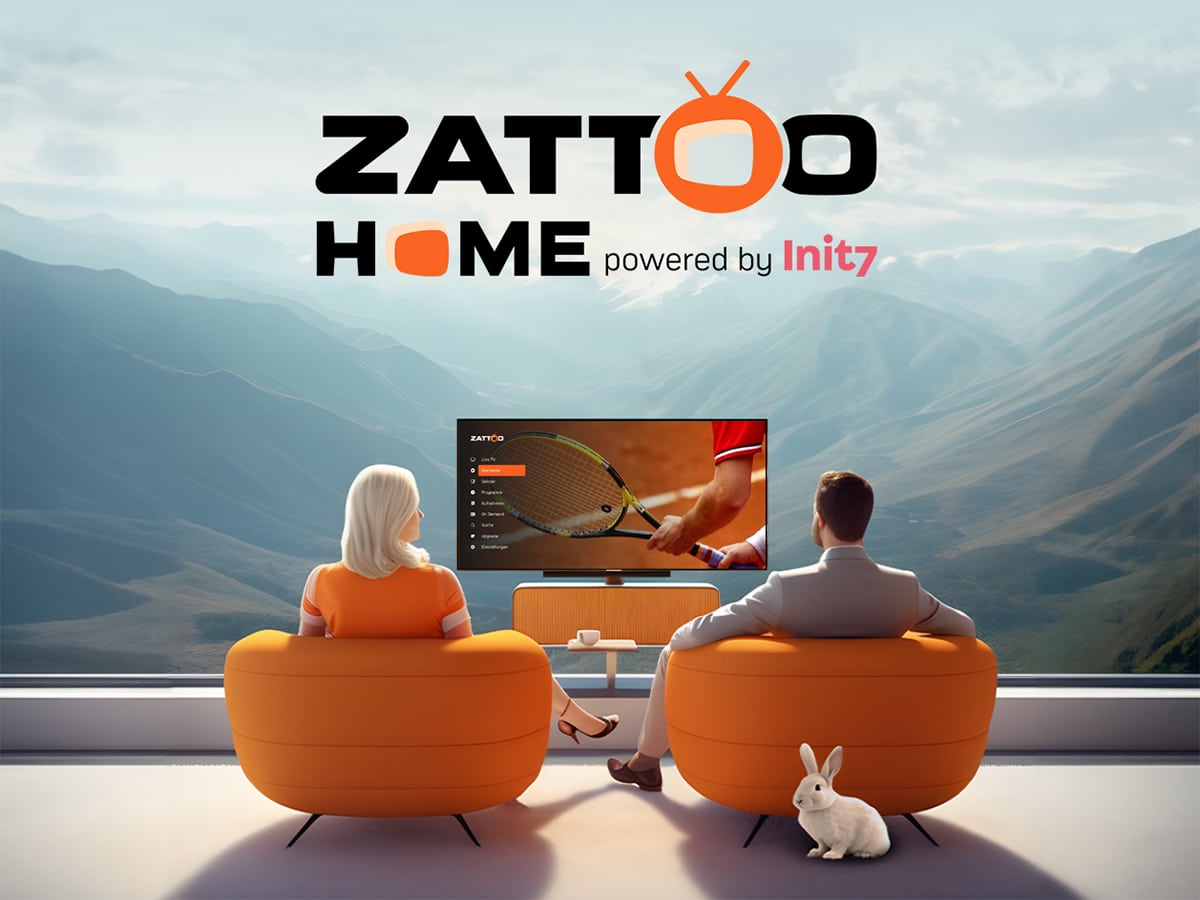
Zattoo and Init7 launch new TV and Internet offer
The TV streaming provider Zattoo and the internet service provider Init7 are teaming up. With the new «Zattoo Home» bundle, customers will be able to enjoy both high-speed fiber-optic internet and hundreds of TV channels in Full HD. Find all the details in this article, featuring an exclusive video interview.
Editorial
-
August 29, 2023
In Switzerland, 9 out of 10 paying TV customers have a bundle contract. At over 98 percent, the most frequently used components are Internet and TV. Surveys show that telephone, mobile communications and electricity are much less frequently part of a bundle offer. At the same time, more and more Swiss are also using the Internet for their TV reception, whether via IPTV or TV streaming apps - and the trend is rising. On the other hand, TV reception via cable continues to decline, as another study shows.
"Since our founding over 15 years ago, we have been shaping the future of television in Switzerland with our TV streaming service," explains Constanze Gilles, General Manager Direct-to-Consumer at Zattoo. In the process, she says Zattoo has now become a fully comprehensive alternative for TV reception on the big screen. "By now combining the advantages of TV streaming with fast fiber-optic Internet, we are opening up enormous potential for ourselves," Gilles continues.
Zattoo Home promises customers 1-Gbit fiber-optic Internet along with over 300 TV channels and many channels in full HD quality. The cost is 63 francs per month. Included is a Fritzbox rental router, seven days of replay, an ad-skipping function, recordings that can be accessed worldwide, and TV for the whole family with four parallel streams. No additional TV hardware is required for this. The connection fee costs 77 francs.
The new bundle offer runs on Init7's own infrastructure. This is not comparable to other reselling offers from market competitors, explains Init7 CEO Fredy Künzler: "The bandwidth of the Zattoo Home Internet connection is not shared with other connections. We at Init7 have been fighting for years for independent Internet and the freedom of choice of Internet provider desired by the legislator. From now on, with Zattoo Home powered by Init7, we can combine the best of both worlds in one product."
Schläfle Trittibach advocates more openness in wine enjoyment
The Schläfle Trittibach agency has developed a communications campaign for the market launch of the Latino Weine wine shop that encourages people to be more open to new culinary experiences.
Editorial
-
August 29, 2023
The wine shop Latino Wines specializes in wines from South America. The mission of the passionate wine lovers and connoisseurs is to curate an exquisite collection that will delight not only the palate, but also the senses. In addition to wines from Argentina and Chile, the range also includes drops from lesser-known wine-growing regions such as Bolivia, Brazil or Peru. The claim of Latino Wines is to offer a selection of wines that can be found nowhere else in Switzerland.
Schläfle Trittibach has developed a communication campaign for Latino wines. In it, she refers to the established wine regions and countries with a wink of the eye and calls for more openness to new experiences of enjoyment.
The campaign can be seen on posters, advertisements, at POS as well as on social media.
Responsible at Latino Wines: Manuel Bischof, Remo Schällibaum (owner). Responsible at Schläfle Trittibach: Marcel Schläfle, Christoph Trittibach (Creative Direction), Jürg Waeber (Text).
Campfire renews website of the long night of Zurich museums
The Biel-based agency Campfire has redesigned the website for Zurich's Long Night of Museums and added various useful features.
Editorial
-
August 29, 2023
On Saturday, the "Long Night of Zurich Museums" will take place again. 56 museums, several hundred events, food stalls and other offers can be discovered from 6 pm to 2 am.
To ensure that those interested can make the most of the night, Campfire, together with the Zurich Museums Association revised the website of the long night. The focus was on functions that should make planning before and orientation during the long night easier.
Various filter functions
With the new watch list, exhibitions, events and museums that one would like to visit can be saved in advance.
In addition, the program is now grouped and filterable by hour. So you can see at a glance which offers are running at the same time and which exhibitions will start soon.
Furthermore, many museums offer various events especially for the long night in addition to the regular exhibitions. With the new museum filter, all exhibitions and events of a museum can be displayed, as well as the location on Google Maps.
Sort by distance
Since the way to the next exhibition can be longer than previously assumed, the planned program can quickly fall behind schedule. Sorting by distance is intended to remedy this: In the program, but also in the museums and in the watch list, the entries can be sorted by distance from the current location. This makes it easy to see whether it is realistic to move to the new location.
Responsible at the Zurich Museums Association: Nicole Mayer. Responsible at Campfire: Nico Erb (Product Owner), Biliana Roth (Design), Vedat Demiri, Thomas Wüthrich (Development), Damian Kunz (Strategy).