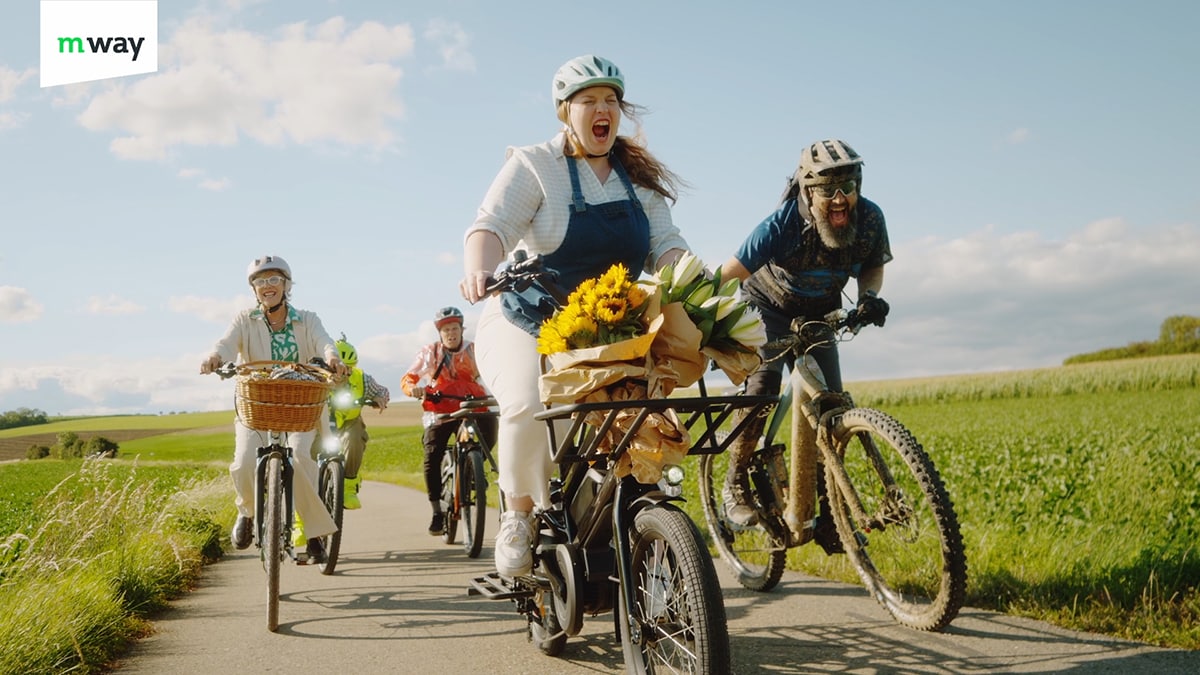
The e-bike retailer M-Way is sending its employees on a discount hunt. Playing the roles of five e-bike characters, they’re doing everything they can to secure discounts of up to 70 percent.
Editorial
-
September 1, 2023
Whether as a florist on an e-cargo bike, a nimble grandmother on an e-city bike or a mud-splattered e-mountain biker - all the protagonists seem to enjoy this chase. On the race for up to 70 percent off, the different characters are each on the e-bike that suits their needs.
The protagonists are employees of the Swiss e-bike specialist M-Way, who have transformed themselves into dynamic e-bikers for the campaign and slipped into the bright green costume of a human percent sign.
"We deliberately chose employees as models for this campaign, with one exception," explains Alfonso Patermo, Art Director at M-Way. He says this not only ensured an authentic look and feel, but also a shared experience during the shoot on a farm in the canton of Schaffhausen.
One of the main target groups for the "Percentage Hunt" campaign is commuters, which is why it is being shown on the City Lights around the major Swiss train stations, among other places. There are also radio spots on Radio Energy and One FM, and an online campaign.
The campaign was developed in-house at M-Way and implemented together with young Swiss talents. It was launched on Monday and will run until the end of September 2023.
Responsible at M-Way: Elyne Hager (Head of Marketing and Brands); Andreas Stopp (Digital Marketing Specialist); Alfonso Patermo (Art Director). Production: Matthias Kappeler (Director); Sven Probst (DoP); Daniela Rütimann (Graphic Designer); Nicolas Burri (Photographer); Lara Lienhard (Production); Kim Linherr (Styling); Jasmin Berger (Hair & Make Up); Daniela Rütimann, Graphic Designer.
Publicis/Notch implements refreshing website relaunch for Calanda
Calanda Brewery, in collaboration with Publicis and Notch, has launched a modern website. The goal was to give the outdated website a comprehensive redesign and thereby strengthen the brand's online presence.
Editorial
-
September 1, 2023
The new website Calanda.com features an airy design that combines tradition and modernity. The site's layout and intuitive navigation are designed to create a harmonious user experience. A new feature now allows quick and easy filtering of the diverse selection of Calanda beers based on individual preferences. This allows visitors to find their favorite beers quickly and effortlessly.
The various product pages focus on the Calanda beers and provide more detailed information. The new website also provides direct links to retailers where the beers can be purchased directly.
To further strengthen the media echo on the web, a social feed integration was also implemented. And thanks to the modular construction kit with Craft CMS, Calanda is able to flexibly manage news and brewery stories and share current information with customers.
Responsible at Heineken Switzerland: Lara Rohrer (Group Brand Manager), Sarina Hasler (Brand Manager). Responsible at Publicis: Matthias Koller (CEO Publicis Zurich), Cathy Nyffenegger (Business Director), Joas Landis (Business Director Notch), Cedric Moore (Design Engineering Lead), Tanja Schuler (Junior Account Manager), Tiago Dias (Programming, Thekitchen.agency).
Tom Berger takes over as head of the Polit-Forum Bern
Tom Berger will become the new director of the Polit-Forum Bern. The board of the sponsoring association unanimously elected him to succeed Lukas Hupfer, the association announced on Friday.
Editorial
-
September 1, 2023
(Image: zVg. Patrick Helfer)
The 37-year-old business economist Tom Berger has been a member of the Bern City Council since 2016. At present, the liberal is second vice president and should thus preside over the parliament in 2025.
The temporary commitment as "highest Bernese" is well compatible with the management of the Polit-Forum Bern, writes the sponsoring association. Berger will resign from other offices before he takes up his post on December 1 or in the coming months.
As a project manager at the Polsan agency, Berger has been managing several consulting mandates and business offices since 2015. Previously, he worked for ten years in various functions at SBB. (SDA/swi)
Gübelin is new co-partner of the ZFF
The Zurich Film Festival is receiving support from a new co-partner. The jewelry store Gübelin is teaming up with the festival.
Editorial
-
September 1, 2023
"We are very pleased to have Gübelin, a Swiss family-owned company, as a co-partner whose quality standards are a perfect fit for the festival," Jennifer Somm, managing director of Spoundation Motion Picture, was quoted as saying in a statement.
The management and selected talents will showcase Gübelin's jewelry in the fall. "With our partnership with the Zurich Film Festival, we want to make a lasting contribution to promoting talent, supporting cultural exchange and celebrating films," says Raphael Gübelin, President of the House of Gübelin.
Manuel Wyss becomes Head of the Logistics Sector at Syndicom
Manuel Wyss was elected head of the Logistics Sector of the Syndicom union on Thursday during the delegates' assembly in Bern. He succeeds Matteo Antonini, who has been president of Syndicom since June.
Editorial
-
September 1, 2023
(Image: zVg.)
At an extraordinary meeting in Bern on Thursday, delegates of the logistics sector of Syndicom, the media and communications union, elected a new sector leader. Manuel Wyss, a political science graduate from Berne, has 17 years of trade union experience in various regions, trade unions and activities. In his new function, he will also take a seat on the executive board of the Syndicom union.
In recent years, Manuel Wyss has already been active in the organization as Central Secretary of the Logistics Sector. Among other things, he was responsible for the implementation and also the renegotiation of collective labor agreements of various Swiss Post Group companies and represents Syndicom in various national and cantonal bodies. "The focus in the logistics sector is and will continue to be CLA policy," said Wyss in his inaugural speech on Thursday. "It is important to continue on the path we have chosen and to use this work to convince Syndicom's employees."
The election of a new sector manager became necessary after the previous function holder Matteo Antonini was elected President of the Syndicom union in June. Matteo Antonini had successfully led the logistics sector for over six years. Under his aegis, important improvements in working conditions were achieved in various sectors in which Syndicom represents its members.
Emil Frey Digital implements campaign for the launch of Carmarket
The online car marketplace Carmarket was recently launched as part of a campaign developed and implemented by Emil Frey Digital. It is intended to be the only marketplace where vehicles are offered that have been inspected exclusively by experts.
Editorial
-
September 1, 2023
The online car sales platform Carmarket.ch was developed by the specialist trade for the specialist trade and offers customers a wide range of vehicles that have been tested exclusively by car experts. Currently, more than 11,000 vehicles are on offer - and the number is constantly rising. Carmarket.ch guarantees the highest quality for the cars as well as for the advice, sales and additional services.
Professionals at the start
When you celebrate a birthday or Christmas, surprises are great - but when you buy a car, you want to avoid them. This was the idea behind Carmarket's launch campaign: cars without surprises are best bought from professionals. At the center of the communication is a commercial that shows what can happen if you don't buy your new used car from a specialist dealer and have it checked by an expert.
The scenes were shot in a locked parking garage in Zurich with an actor and stunt driver at the wheel. The car, which the protagonist has apparently bought freshly used and celebrates in the commercial according to all the rules of the art of driving, falls apart at the end - thanks to CGI. The idea "No desire for surprises" was also implemented in compressed form on static or lightly animated media.
Professionally distributed
On August 20, 2023, the campaign kicked off with the Sunday primetime TV spot before the daytime news on SRF1, followed by further broadcasts in the weeks that followed on other TV channels with large audiences.
Starting in calendar week 34, posters and a spot on the most popular radio stations, as well as various activities on different social media channels - including YouTube, Facebook and Instagram - complemented the campaign and further spread its message. In addition, the platform will be heavily promoted in the digital sphere.
Furthermore, Carmarket will act as the main sponsor for the ZSC Lions and will be visible on the goalkeeper's helmet and gloves as well as on the players' jerseys and pants. In addition, the brand will be present on the LED Cube in the Swiss Life Arena at every game.
Responsible at Carmarket: Henri Lyon (Managing Director). Responsible at Emil Frey Digital: Lajos Vizner (Agency Management), Guillaume Borel (CD), Markus Binggeli (Overall Management), Gian Andrea Maurizio (AD), Lukas Schmid, Marcel Elsener (Text), Tanea Kapor (Graphics), Roger Shanmugalingam (Head of Layout), Tina Wälti (Head of Social Media Management), Svenja Küng (Social Media Manager), Matteo Vaccari (Head of Translation). Film production: Shining, Stefan Girtanner (production management), Charley Stadler (direction), Timon Schäppi (camera), Jingle Jungle (sound), Trafo.TV (post / CGI). Radio: Jingle Jungle. 3D design: Pulk, Niko Eriksson (CGI animation), Wombat Studios, Lily Metzker (image editing).
Why calendars are important and beneficial as a corporate gift
In today’s business world, the art of customer loyalty is of central importance. A proven method for strengthening customer loyalty while also increasing brand awareness is giving away calendars. Why are calendars such an important and promising corporate gift? In this article, we’ll take a look at the reasons behind this business trend.
Advertorial
-
September 1, 2023
Gesture of appreciation and commitment
The gifting of a calendar by a company goes beyond the surface of the business relationship. It is a gesture of appreciation that shows that the company values its customers as individual partners. This appreciation can strengthen the emotional bond between customers and the company. By showing interest in customers and caring about their well-being, a company creates a positive experience that can strengthen customer loyalty.
Sustained brand presence
A gift calendar is an effective way to maintain brand presence throughout the year. Each time the calendar is used, the company's logo and name are integrated into the customer's daily life. This creates a lasting reminder of the brand and its values. When the customer or business partner uses the calendar, the company is constantly remembered, increasing the likelihood that it will be considered the first choice for future needs.
Effective advertising and information dissemination
A calendar offers a subtle way to advertise and convey information. Companies can cleverly integrate important dates, events, product launches or special offers into the calendar design. This makes it possible to highlight upcoming events or developments without being obtrusive. A well-designed calendar can draw customers' attention to important aspects of the company without being intrusive.
Useful everyday companion
A calendar is not only an advertising platform, but also a useful companion in everyday life. Customers can use the calendar to organize appointments, meetings and tasks. Daily use unobtrusively reminds the customer of the gift-giving company and creates a positive association with its services or products. The practical functionality of the calendar ensures that it is not simply put aside, but actively used.
In summary, calendars as corporate gifts are a powerful way to strengthen customer loyalty and brand awareness. They represent a gesture of appreciation and show that the company values its relationship with its customers. Through continued brand exposure, subtle promotion and practical usefulness, calendars create a positive connection between customers and the company. At a time when personal connections and customer satisfaction are critical, giving calendars as gifts is a smart business strategy.
Are you still looking for a suitable partner for the individual printing of your calendars? Flyeralarm offers you a large selection, which you can perfectly adapt to your company. Discover and order all calendars here.
Havas Brand Predictor 2023: Sustainable brands are more likeable
Traditional Swiss brands are highly regarded. This is shown by the latest Havas Brand Predictor. Swiss consumers also tend to view sustainable (consumer) brands and political parties as more likable. This year’s survey was expanded to include additional items on likability and sustainability.
Editorial
-
August 31, 2023
The Brand Predictor from Havas Switzerland examines brand preference for the most relevant brands in the Swiss market. Since 2012, the key indicators of dynamism and trust have been the central measures of the Brand Predictor. Both are regarded as indispensable indicators of brand preference and thus also of consumers' purchase intentions. While a high dynamic value from the point of view of the respondents indicates increased popularity and thus high brand attractiveness, a high value in trust shows that the respective brands are perceived as reliable.
The most dynamic brands 2023
Digital brands and brands in the area of sustainability once again dominate the top 20 ranking in dynamics. The differentiated analysis in the area of sustainability shows that classic sustainability labels on product origin such as "Miini Region" and labels on production and agricultural standards such as "BioSuisse" and "Migros Bio" have clearly lost momentum compared to the previous year. Instead, the sustainability trend is shifting further and further into the area of plant-based nutrition.
"At a time when consumers are becoming more demanding and informed, it is important for brands to act quickly. Planted, Beyond Meat and V-Love are particularly successful in this respect, as they offer not only sustainability but also convenience and make it easier for consumers to implement their eating behavior according to their personal values," explains Rachel Montalbo, study manager at Havas.
Twint once again occupies the top position among digital brands this year and remains unchallenged despite a slight decline in momentum. However, the momentum ranking also highlights the fast pace of digital brands: social media app BeReal is the strongest newcomer brand in the momentum ranking, positioning itself ahead of TikTok and Netflix, the high-flyers of recent years. The winners in the Dynamik ranking also include the video streaming platform Twitch, which shows a continuously positive development in the Dynamik ranking. The mobile bank neon can also reclaim a place in the top 20.
(Graphics: Havas Brand Predictor)
Momentum Factor: The trendiest brands
In addition to the core indicators momentum and trust, further key figures are reported: The Momentum Factor provides information on which brands are showing a strong increase in perceived popularity and are therefore trending strongly.
A look at the Momentum Factor confirms the observed trend toward the most dynamic brands. While classic organic and regional labels are losing relevance, vegan food manufacturers and digital lifestyle brands in particular are gaining ground. Twint can also defend its leading position in the category of the trendiest brands.
"Twint is a fine example of a brand responding to current consumer needs. The constant development of the service offering strikes a chord with the times and satisfies needs for efficiency and convenience. This creates an overall positive customer experience," reasons Rachel Montalbo.
The results from the Havas Brand Predictor show how societal and global megatrends can impact brand perceptions and preferences, as well as consumer behavior: The relevance of those brands that serve the needs of an efficient, authentic and sustainable lifestyle is increasing. For example, the strongest newcomers in the Momentum Factor include BeReal, CoffeeB, Polestar and Alpro.
Trust: Various factors play a role
Trust plays a decisive role in determining brand preference, with the time factor being of great importance. Nevertheless, a long existence of a brand alone does not automatically guarantee a high level of trust. Other factors, such as the industry to which a brand belongs, play an important role. Experience shows, for example, that health insurance companies score lower than brands from consumer electronics or retail brands.
Central, however, is the performance delivered in terms of core competence. Similar to previous waves of the survey, traditional Swiss brands, mainly from the food industry, score the highest trust ratings - including Le Gruyère, Cailler and Rivella. Migros also cements its leading position. The fact that the Group generally enjoys a great deal of trust is demonstrated, among other things, by the fact that "From the region, for the region" and "M-Budget" are two other brands from the Migros universe among the 20 most trusted brands in Switzerland.
New key figures: Likeability and sustainability
Two important brand evaluation indicators have now been added to the Brand Predictor. The value for perceived liking provides information on how much respondents like a brand and also takes into account subconsciously perceived brand experiences. The likability ranking shows similarities to the trust ranking and includes many traditional brands such as Le Gruyère and Wernli. Surprisingly, the sustainability label "From the region, for the region" makes it to the top of the most likeable brands. Switzerland, Wikipedia and SBB are also rated as very likeable.
The sustainability metric measures how sustainable a brand is perceived by respondents. Apart from the sustainability labels, which operate in the area of sustainability due to their core business, the following brands, among others, are perceived as particularly sustainable: The search engine Ecosia, Beyond Meat, Migros and Planted. At the top of this ranking is SBB, which is perceived as a driver of sustainable mobility. The car-sharing provider Mobility is also rated very highly.
The correlation between likability and sustainability is striking. "Respondents tend to rate sustainable brands more likable as well. Although no causality can be proven, the correlation is remarkable and reflects the current preferences of consumers," explains Rachel Montalbo. "This could be related to the meaningfulness of the brand. A brand generally has a harder time being liked if, from the respondents' point of view, it is not meaningful, in this case not sustainable. This is also confirmed time and again by the 'Meaningful Brands' study conducted annually by Havas. Almost 3 out of 4 people are of the opinion that brands already have to take responsibility for society and the planet. Brands that fail to live up to these expectations quickly lose relevance."
Sustainably oriented parties are dynamic
On the occasion of the 2023 elections, Brand Predictor also took a closer look at the perception of political parties. The two green parties, GLP and Grüne, score highest in terms of momentum, which is not surprising given the ongoing theme of sustainability. It remains to be seen whether they can maintain this momentum until the elections in order to win further seats in parliament.
The SP's very low rated momentum is striking. It is assumed that the rated momentum has suffered in recent months in connection with the Corona Leak entanglements of SP Federal Councilor Alain Berset.
Perceived trustworthiness will be particularly important for the parties in defending existing seats. The center, Greens and SP are seen as the most reliable parties, while FDP and SVP enjoy the lowest level of trust among respondents.
Gen Z likes sustainable and digital brands
The Brand Predictor also examines the assessment of the various segments within the study. The view of 15-26 year olds is particularly interesting. Members of Gen Z perceive either sustainable or digital brands as dynamic. The trends at the overall level are reinforced here, with the young in particular rating sustainability labels higher than the overall population. In addition, however, there is also a growing preference for digital brands. Thus, in addition to the aforementioned brands Twint, BeReal, Spotify, TikTok and Twitch, Disney+, ApplePay, digitec and Tesla can also be found in the top 20 ranking of the Young Generation.
The high affinity of the under-26s for digital brands becomes even clearer when looking at the Momentum Factor ranking. With Tiktok, BeReal, Twint (ranks 1-3) and Tesla (rank 5), four digitally associated brands are among the trendiest brands. V-Label ranks 4th as the strongest sustainability brand, with On performing better compared to the overall rating.
Among the under-26s, traditional Swiss brands such as Migros, SRF and food brands are particularly trusted. Migros positions itself in first place with top marks; but SRF's high ranking is also remarkable, as media brands are generally trusted less. Twint and Spotify represent the digital brands in the trust ranking, while trust in Switzerland as a country is high.
Ringier nominates AI Advisory Board
Ringier, an international media and technology company, is establishing AI guidelines for all its products and divisions. Going forward, an advisory board will provide guidance to the company in this regard.
Editorial
-
August 31, 2023
The Ringier AI Advisory Board: Anna Mossberg, Damian Borth and Léa Steinacker (from left to right). (Image: zVg. Ringier)
To strengthen expertise in the field of artificial intelligence, an AI Advisory Board made up of international specialists will advise the Ringier Group in the future. Anna Mossberg, Damian Borth and Léa Steinacker have been appointed. The members of the AI Advisory Board will broaden the Ringier Group's perspective on generative AI, as well as support the exchange on general developments and trends around generative AI through their international network.
Anna Mossberg is a digitization and technology expert as well as a board member at Ringier, Volvo Cars, Swedbank AB, Swisscom and the global FMCG company Orkla ASA, among others. Damian Borth is Director of the Institute of Computer Science at the University of St. Gallen and Full Professor of Artificial Intelligence and Machine Learning. Léa Steinacker is an award-winning journalist, entrepreneur and co-founder of Ada Learning. A social scientist, she holds a PhD in the social dimensions of AI systems. She is a lecturer at the University of St. Gallen.
Already at the beginning of May, a cross-national, operational AI Board headed by Petra Ehmann, Chief Innovation Officer at Ringier, and Patrick Rademacher, Chief Operations Officer ei the Ringier Global Media Unit, began its work and its task is to coordinate AI-related activities within the Ringier Group in all 19 countries. The board, which has a total of 16 members, ensures the internal exchange of knowledge around artificial intelligence, drives promising AI initiatives forward, and defines corresponding guidelines. The newly created AI Advisory Board, which meets up to three times a year, will support the operational AI Board in an advisory capacity.
FM radio continues to lose market share
A study presented at Swiss Radio Day shows that 81 percent of radio listening in the spring of 2023 took place digitally. FM usage has declined steadily in recent years.
Editorial
-
August 31, 2023
In spring, it was still at 19 percent, according to the study, which was presented on Thursday at the Swiss Radio Day in Zurich. According to the study, the FM share of listening time has declined by 32 percentage points since 2015. Only eight percent of listeners had relied exclusively on FM. With 41 percent of listening time, DAB+ was a touch more popular than internet radio, which accounted for 40 percent of listening time.
In 2014, the Swiss radio associations agreed that FM would finally be switched off in Switzerland at the end of 2024 and that all radio programs would be broadcast exclusively via DAB+ or the Internet.
In July, however, Federal Councillor Albert Rösti, head of the Department of the Environment, Transport, Energy and Communications, proposed to the Federal Council a "final" extension of the current licenses until the end of 2026 following criticism of the planned FM switch-off by individual radio operators. The decision will be made by the full Federal Council.
At Swiss Radio Day, Jürg Bachmann, President of the Association of German-Swiss Private Radio Stations VSP, emphasized the "much greater" possibilities offered by digital radio. However, he praised the "good compromise" proposed by Albert Rösti. This gives all players enough time to prepare for the transition and allows those who wish to do so to switch off FM before that date. (SDA)
Initiative to reduce SRG fees has come to fruition
The initiative to reduce radio and TV license fees has been launched. Next, the Federal Council must issue a statement on the so-called «Halving Initiative.» It is the second popular initiative—after the “No Billag” initiative—to target SRG license fees.
Editorial
-
August 31, 2023
The initiative committee had submitted almost 128,000 signatures to the Federal Chancellery on August 10. On Thursday, the federal government announced that a good 126,000 signatures are valid. This means that the politicians are now dealing with the Popular initiative "200 francs are enough! (SRG Initiative)".
The petition for a referendum wants to reduce radio and television fees from CHF 335 per household per year to CHF 200. The initiators argue that Switzerland has the highest device-independent fees in the world. Employers and businesses would be asked to pay twice.
The bisection initiative was launched by the SVP, the Swiss Trade Association SGV and the Young Freisinn. In addition to representatives of the SVP, the committee also includes representatives of the Freisinn, EDU, Lega and a former National Council member from the center.
In March 2018, voters rejected the "No Billag" initiative by 71.6 percent. Its aim was to abolish the fees altogether. In February 2022, on the other hand, voters rejected the media package by 55 percent. (Werbewoche.ch reported). It would have provided additional funding for various types of media. (SDA/swi)
9 out of 10 customers want to know whether they are communicating with AI or a human being
The Salesforce report «State of the Connected Customer» highlights how AI, digital transformation, and macroeconomic trends are changing customer expectations and behavior throughout the entire purchase cycle. To this end, 650 consumers and 150 retail decision-makers in Switzerland were surveyed.
Editorial
-
August 31, 2023
The report shows that economic and technological changes are influencing customers' priorities, behavior and expectations. Brands are under pressure to improve.
E-commerce websites and apps, regardless of brand, retailer or online marketplace, remain the most popular digital shopping channels. But newer digital channels, such as social media, messaging, and live streaming platforms, are gaining traction.
For example, 51 percent of customers in Switzerland expect companies to understand their needs as they change. And 75% of customers in Switzerland expect faster service due to technological advances.
Price alone does not bind customers
Brands have ample opportunity to compete on more than price. 75% of consumers in Switzerland say that the experience with the company is just as important as its products and services.
Brand loyalty is often not given too much weight: 63% of consumers in Switzerland have changed brands at least once in the past year. Better offers, product quality, and product selection and variety are the three most frequently cited reasons for switching.
(Graphic: Salesforce)
Generative AI arouses curiosity first and foremost
Customers face the rise of generative AI with different feelings. In all 25 countries surveyed, however, "curiosity" is among the top three sentiments associated with AI. Anxiousness is behind the feelings of hope (40%) and curiosity at 36 percent.
Trust is the key to the expansion of AI
Customers expect transparency when companies expand their use of AI: According to the report, 74% of respondents in Switzerland are concerned about the unethical use of AI by companies. 57% percent say greater transparency in the use of AI would increase their trust. And at 87%, nearly nine in ten say it is important for them to know whether they are communicating with AI or a human.
"With AI, companies have the opportunity to make customer experiences even more personalized and to significantly improve their service - consumers will not only benefit from this, these will be key decision criteria for a purchase," Luca Pastorino, Area Vice President & Head of Clouds at Salesforce, comments on the findings. "It's important that companies prioritize trust, handle data responsibly, and be transparent about where AI is being used."
(Graphic: Salesforce)
Navigating between online and offline businesses
The introduction of digital technologies, online and in stores, has changed the retail industry dramatically over the last two decades. This trend will continue with generative AI. The Connected Shopper Report - a related study - shows the renaissance of brick-and-mortar shopping in part because customers have missed that experience. While an estimated 59% of transactions worldwide were conducted digitally in 2021, that number dropped to 51% in 2023. However, forecasts indicate that the share of digital transactions is expected to rise again to 56% by 2025, as shoppers use both digital and physical touchpoints during their shopping journey.
The Connected Shopper Report also shows that 71% of consumers prefer different channels depending on the context. Facebook is the most popular social media platform worldwide when it comes to brand engagement. However, differences are emerging depending on the region. In Switzerland, for example, WhatsApp is the most popular platform.
The Data of the "Connected Customer Report" are from a double-blind survey of 11,000 consumers and 3,300 business customers conducted from May 3 to July 14, 2023. Data was collected from respondents in Australia, Belgium, Canada, Denmark, Finland, France, Germany, India, Ireland, Italy, Japan, the Netherlands, New Zealand, Norway, the Philippines, Poland, Singapore, South Africa, Spain, Sweden, Switzerland, Thailand, the United Arab Emirates and the United States.
The data of the "Connected Shopper Report. come from two anonymous surveys of 2,400 shoppers and 1,125 retail decision makers conducted from May 18 to June 21, 2023. The data was collected from respondents in Australia, Belgium, Brazil, Canada, Denmark, Finland, France, Germany, India, Japan, Luxembourg, the Netherlands, New Zealand, Norway, Spain, Sweden, the United Kingdom and the United States.