With the current campaign "Goodbye Stereotyes. Hello Zerotypes." Zalando is tackling what remains one of the biggest obstacles to diversity and self-actualization: Stereotypes.
Editorial
-
February 24, 2020
In a study conducted by Zalando in collaboration with YouGov in selected markets, 89 percent of respondents said that stereotypes still exist for them in today's society. 47 percent even said that they have increased compared to the past. The media was cited as the main cause, with 57 percent citing film and TV shows, and 60 percent pointing to advertising.
The new campaign aims to break away from this and challenges common notions. The idea is to encourage people to say goodbye to classic stereotypes and rediscover themselves fashionably: "'Zerotypes' stand for the belief that people should be free to be who they are - without specific types, expectations or boundaries to define them," says Jonny NG, Director Marketing Strategy & Campaigns at Zalando.
The campaign, developed by Mother London, is the third part of Zalando's "Free to be" brand positioning, which celebrated its launch last September. It was directed by Leila & Damien De Blinkk. The campaign launched on Sunday in all 17 of Zalando's markets and will be played out across all digital channels as well as paid and organic social media, OOH, print, TV, cinema and radio.
Cross-national cooperation: IVW, ÖAK and WEMF with joint logo
The national organizations of Germany, Austria and Switzerland for auditing and monitoring advertising media are uniting under a common logo. The logo stands for the synergy effects that have arisen from previous collaborations and are intended to bring direct benefits to the German-speaking advertising market in the future, increasingly with cross-border offerings.
Editorial
-
February 24, 2020
"We have intensified our exchange in recent years and have thus been able to benefit from each other, especially in the area of operations. Now, through our cooperation, we want not only to optimize and further develop our national testing offerings, but also to standardize them to a greater extent so that we can provide summarized data on advertising media performance for the DACH region," says Kai Kuhlmann, IVW Managing Director, on the background to the introduction of the new logo.
Alexandra Beier-Cizek, Managing Director of ÖAK, emphasizes: "The demand is there. There are media offerings that are marketed as advertising media in all our countries and booked for advertising campaigns in the DACH region. Here, cross-national key figures and reports on the advertising media services provided are of great benefit to market players who are active in the entire German-speaking region. This is not even opposed by the differences and peculiarities that our media and advertising markets have."
There is already an offer for the press market in the DACH region: "If press products are distributed in Austria, Switzerland and Germany and are also subject to the three circulation control procedures, they can receive an additional, cross-national circulation certificate. This then certifies the total circulation figures for the distribution of the press titles in the DACH region," explains Roland Achermann, Director of Audit and Statistics at WEMF.
IVW, ÖAK and WEMF are currently exploring the requirements for a coordinated, uniform procedure for monitoring DOOH advertising campaigns. Further projects for offerings that combine advertising media data from the three countries into key figures for the DACH region will follow.
Content and form and Stan Wawrinka serve for Vaudoise
The Zurich-based agency Inhalt und Form is celebrating the 125th anniversary of Vaudoise Insurance together with Stan Wawrinka.
Editorial
-
February 24, 2020
Vaudoise Insurance celebrates its 125th birthday in 2020. A good occasion to launch into the future with a new, dynamic communications presence: Vaudoise has always been guided by the cooperative principle that everything is easier when you work together. The benefits of community are also at the heart of the campaign for the anniversary year, which was developed and implemented by Content and Form.
Swiss tennis pro Stan Wawrinka was signed up as the star of the new campaign, taking on a supposedly simple task: He competes against an amateur tennis player. Actually a simple game for Wawrinka. But the tennis pro has not reckoned with the power of the community. Because together, everything is easier, even winning against a tennis pro like Stan Wawrinka.
The comprehensive, national anniversary campaign will take the form of TV commercials, posters, DOOH, megaposters at train stations, advertisements, and display ads, among other things. In addition, Stan Wawrinka will keep his community up to date on his use as Vaudoise testimonial on social media.
In addition to the campaign, an anniversary logo was also created, which will be used on all advertising materials in 2020. Also on an SBB locomotive that will travel through Switzerland in 2020 in Vaudoise green.
Responsible at Vaudoise: Véronique Oliveira (Communication & Branding); Marine Lintanf (Communication & Branding); Marc Bertoli (Corporate Design Center). Responsible for content and form: Dominik Stibal (CEO); Karin Estermann (Executive Creative Director); David Hugentobler (Creative Director); Marcus Josty (Creative Director); Vasco Bickel (Senior Art Director); Levia Stauber, Luana Saragoni (Realization); Manuela Marty (Consulting); Stories (Film Production); Johnathan Heyer (Photographer).
Trust has never been as important as it is today
Sustainably satisfied customers are the key to a brand's success. A convincing customer experience is of central importance here - and more important than ever before. Alexander Handcock from Selligent uses the "Global Connected Consumer Index" study to show what is particularly important to consumers in terms of their interaction with companies in the digital environment - and what should be taken into account.
Editorial
-
February 24, 2020
The fact that customers today expect a seamless CX across all touchpoints is nothing new. However, the demands in terms of personalization and customer service are becoming ever higher. 59% of German consumers surveyed in the study stated that a personalized shopping experience is important or very important to them. In principle, more than half (54%) of those surveyed are prepared to provide companies with the necessary data. However, the issue of data protection plays a decisive role here: 67% of respondents state that the protection of their data is more important to them than a personalized customer experience.
Consumers are becoming more cautious
The resulting equation is simple: without data protection there is no data and without data there is no personalized marketing. Anyone who shares their personal data anywhere on the Internet today must fear that it will fall into unauthorized hands in the event of a data breach. Numerous media reports have sensitized consumers to this issue. Selligent's consumer study, for example, shows that 45% of respondents have reduced their social media activities for data protection reasons, while a quarter have now completely given up Facebook, Instagram and the like.
Skepticism with regard to speech recognition
The ambivalent relationship between consumers and the topics of CX and data protection is currently particularly evident in connection with voice assistants, which are now found in many German households and are becoming increasingly important as a marketing channel: 41% of respondents use a voice assistant such as Google Home, Siri or Alexa, while 48% fear that the devices are listening in without their consent.
In any case, voice assistants as a channel for marketing messages should still be treated with caution at the moment: 61 percent of German consumers find it creepy to receive personalized offers from their device based on previous search queries.
Important insights for marketers
For companies, the "Global Connected Consumer Index" ultimately reveals that almost all consumers want a personalized customer experience, but are only willing to provide the necessary data under certain circumstances. The keyword is trust. Customers want to know that their personal data is in safe hands while enjoying the best possible customer experience.
* Alexander Handcock is Senior Global Marketing Director at Selligent Marketing Cloud.
Swico House View 2020: Cloud as the "gamechanger" of digitalization
Technology trends are on the rise worldwide. Investment patterns in the Swiss economy vary widely by industry—and do not always align with global trends. Twenty-six percent of all investments are directed toward cloud technology, an «enabler.» This is shown in the «Swico House View 2020» study.
Editorial
-
February 24, 2020
Swiss companies invest most frequently in cloud technology. This is the conclusion of the current "Swico House View 2020" study, for which the Swico business association surveyed its approximately 650 members. The study, which provides insights into the state of digitization in Switzerland, shows: Industries are investing in almost all technologies. However, they place different emphases. "The industries are investing in a very targeted manner," says Judith Bellaiche, Managing Director of Swico, and adds: "Cloud is the real 'gamechanger' - around 26 percent of all investments are in cloud technology. Cloud enables the digitization of Switzerland, so to speak".
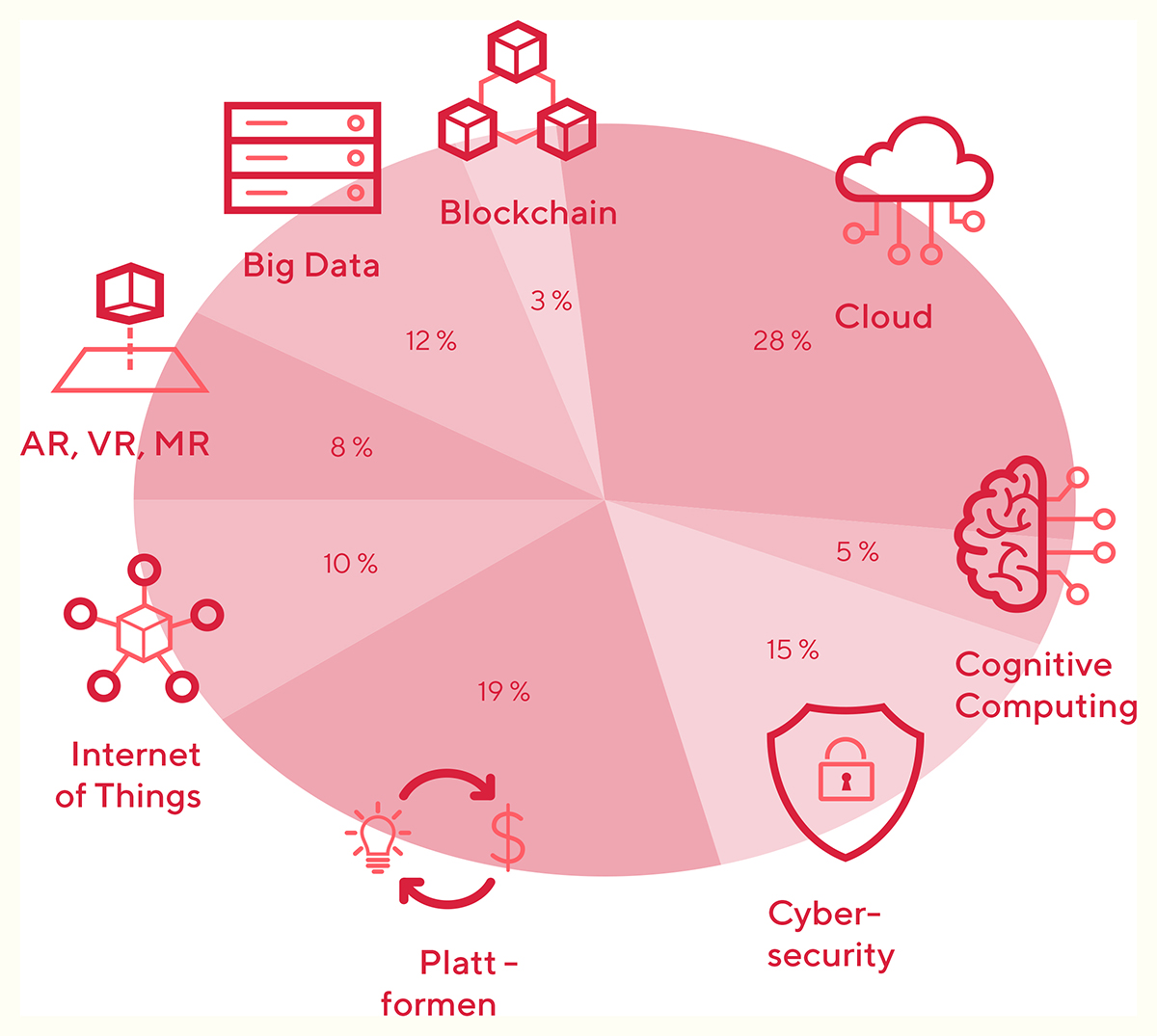
Investments in technologies by Swiss industries: According to the Federal Statistical Office, 16 sectors were taken into account in the questionnaire. The total of 1154 projects from around 100 responding companies are distributed among these. (Source: Swico House View 2020)
The information and communications technology sector (9 percent) and financial services providers and insurance companies (9 percent) are investing the most in the cloud. Transport and logistics as well as public administration also rely heavily on cloud projects, with 8 percent each.
Platforms" are also a strong trend: Around 19 percent of all ongoing projects of the Swico members surveyed are based on platform technology. The financial services and insurance industry recorded the most projects (12 percent), followed by public administration (10 percent) and information and communications technology (9 percent). "The service industries have recognized that platforms offer enormous potential," Bellaiche comments.
Global trends do not always coincide with Switzerland
A comparison with global growth trends shows: Switzerland is not investing in all technologies in sync with the rest of the world. "We are lagging behind in certain technology trends," says Bellaiche. For her, the study also shows where industries need to catch up: "Individual industries - agriculture, for example - are still making far too little use of the opportunities offered by digitization," Bellaiche is convinced.
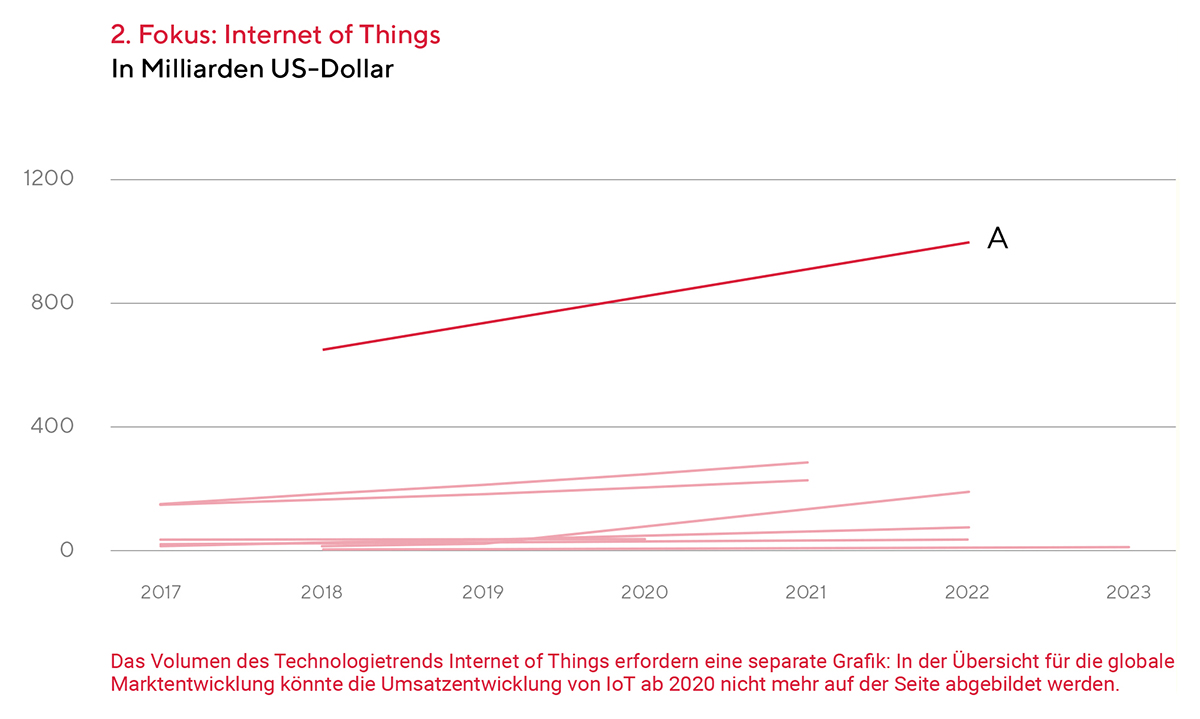
Global development of the "Internet of Things" technology trend
Overall, growing sales are forecast in the coming years for all eight technology trends examined. Most impressive is the huge volume of "Internet of Things" with over 800 billion US dollars in 2020. In Switzerland, "Internet of Things" accounts for 11 percent of the pie.
Switzerland also lags slightly behind in "Big Data": After "Cloud" in third place worldwide, "Big Data" is (still) in fourth place in this country. According to the study, however, "big data" will gain in importance: In 2021, global spending on Big Data solutions is already expected to amount to 231 billion US dollars (2018: 164 billion US dollars). This represents a doubling since 2015, with growth driven by rapid advances in machine learning and artificial intelligence. In Switzerland, the energy and transport sectors, the medical sector, Industry 4.0 application industries, financial services, telecommunications, and agriculture are particularly promising in terms of short- to medium-term market potential.
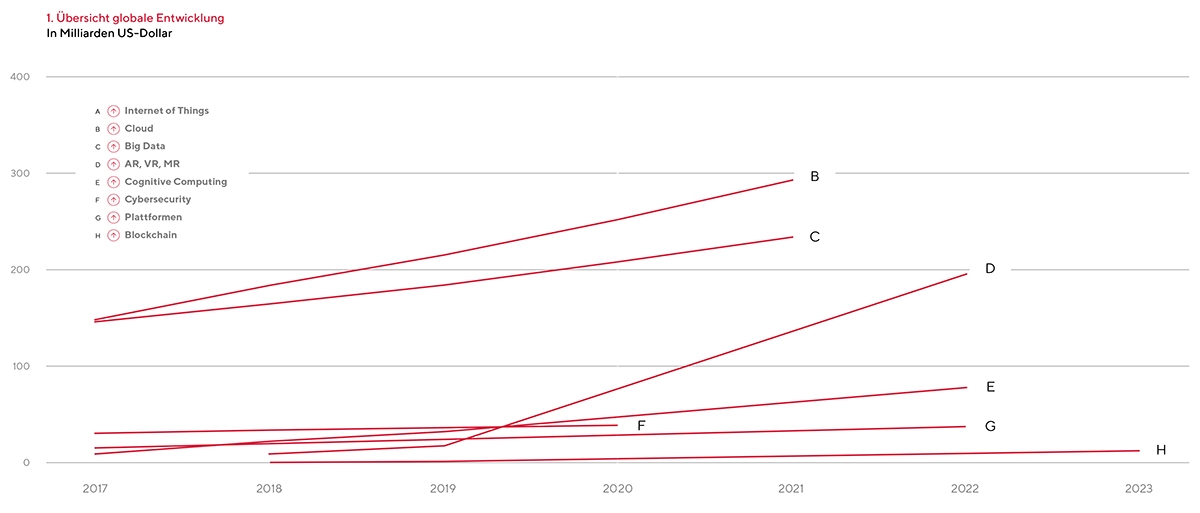
Global development of the eight most important technology trends: Big Data, platforms, IoT, cybersecurity, cloud, blockchain, cognitive computing (AI/AI), and augmented, virtual and mixed reality. (Source: Swico House View 2020)
Augmented reality is becoming increasingly important
An above-average growth trend is evident in the global market for augmented, virtual and mixed reality technologies: Here, the growth rate is expected to increase tenfold in the next three years, as shown by the approach of a veritable "field hockey stick" (see graphic on global development).
In Switzerland, the mechanical engineering and vehicle construction sectors as well as transport and logistics are the main users of AR. The technology trend "Blockchain" is by far the most frequently used by financial services and insurance, followed by services. "Cognitive computing" (AI) is again most frequently used by financial services and insurance, ICT, and transport and logostics.
And where is the ICT industry itself investing?
The ICT sector also invests most frequently in cloud technology, with around 28 percent. In second place comes the trend "platforms" with 19 percent, ahead of "cybersecurity" with 15 percent. For Judith Bellaiche, this reflects the growing need for security solutions: "Cybersecurity offers great potential for Switzerland as a service country," she is convinced.
"Big Data" is in fourth place with 12 percent, followed by "Internet of Things" with 10 percent and "Augmented/Virtual/Mixed Reality" with 8 percent. Although everyone is talking about technology trends, the Swiss ICT sector invests the least in cognitive computing (AI) and blockchain, at 5 and 3 percent respectively.
In the third edition of the "House View" Swico is placing an even stronger focus on Switzerland: In addition to global trends, the association asked its members about their investments and which technologies the companies use to implement their customer projects. Of the 650, around 100 Swico members responded. They were responsible for a total of 1154 projects in the various industries in 2019. The "Swico House View" thus paints a picture of the importance of the individual technologies for the Swiss ICT industry, but also for the Swiss economy as a whole. The figures also provide information on where the public sector stands in comparison to the economy.
Dynamic prices lead to a significant increase in ski days in Gstaad
The Bernese Oberland winter sports resort of Gstaad has significantly increased the number of ski days this winter thanks to the introduction of dynamic pricing. Compared to the previous year, the luxury ski resort was able to increase that number by 15.3 percent, as reported by the NZZ am Sonntag, citing an initial analysis.
Editorial
-
February 23, 2020
The average advance booking time - the number of days between ticket purchase and the actual ski day - has tripled this season. On average, tickets are booked online more than 20 days in advance. And instead of the previous 3 percent, 15 percent of skiers have now bought their ticket for the area online instead of at the ticket office.
According to Matthias In-Albon, head of Gstaad's mountain railroads, families in particular make use of the flexible prices. "They are generally more price-sensitive and are also able to book ski tickets well in advance." Due to the dynamic prices, consumers tend to book several days of skiing, explained In-Albon. This season, more multi-day tickets with more days of validity have been sold.
According to the report, instead of saving money, lower prices lead to increased consumption. The cut-off date for the interim report was January 31. Gstaad did not yet want to disclose details of turnover. However, this is "clearly" above the previous year.
"Price increase through the back door"
The dynamic ticket prices are criticized by Swiss Consumer Protection (SKS). President Sara Stalder says that they disguise the true price structure. Almost all the feedback she receives is negative. "Many skiers perceive dynamic pricing for what it is: a price increase through the back door.
Various ski resorts are already using dynamic price models. No destination has yet reversed this decision. (hae/SDA)
Fashion & Sports relies most heavily on online advertising of all sectors
January 2020 marked the end of the first month to include the validated database for Media Focus SEA data, with 439 million Swiss francs in gross revenue. Just under a third of advertising spend in the first month was generated by online advertising. This is shown in the 2020 Advertising Market Trends report.
Editorial
-
February 21, 2020
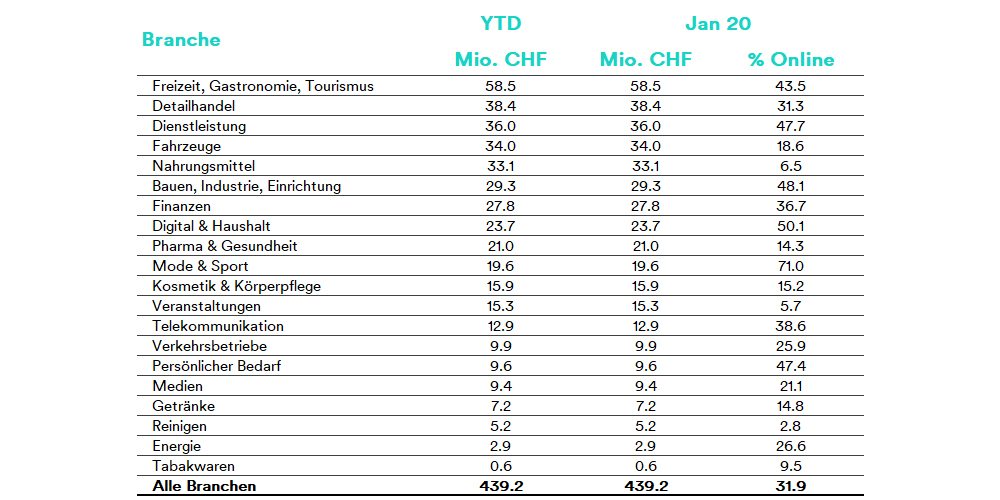
Development of advertising print as of January 2020 in millions of gross Swiss francs.
Leisure, gastronomy, tourism still in their own league
At the beginning of the year, the top industry Leisure, Hospitality, Tourism outshines all other industries and ranks first in the industry ranking by a wide margin. The retail trade sector is the second-place finisher. The service sector, which secured the silver medal at the end of 2019, starts the new year in third place.
Online vs. offline
The sector with the highest share of Internet advertising in sector advertising print is called Fashion & Sports (71%). Representatives of the Digital & Household sector also generated slightly more than half of their advertising print through Internet advertising in January (50.1%). The top sectors Leisure, Hospitality, Tourism as well as Services also show clearly above-average online advertising shares. By far the smallest online shares can be seen in the cleaning industry (2.8%), the event industry (5.7%) and the food industry (6.5%).
News from the Top 10
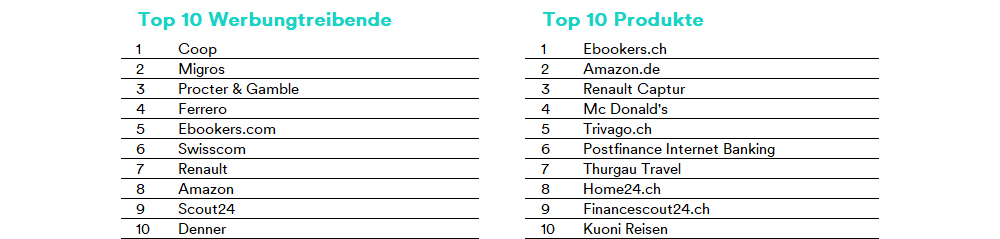
It is noticeable that 4 of the 10 most advertised products in January are travel providers. In the same month last year, the figure was also 4. There are no surprises among the top advertisers. The three advertising giants Coop, Migros and Procter & Gamble continue to lead the field in the new year. Amazon, which has the second most advertised product of the month, is in eighth place among the leading advertisers.
Advertising printing in the industries
The top 10 advertisers and most advertised products and services (excluding assortment and image advertising) in January.
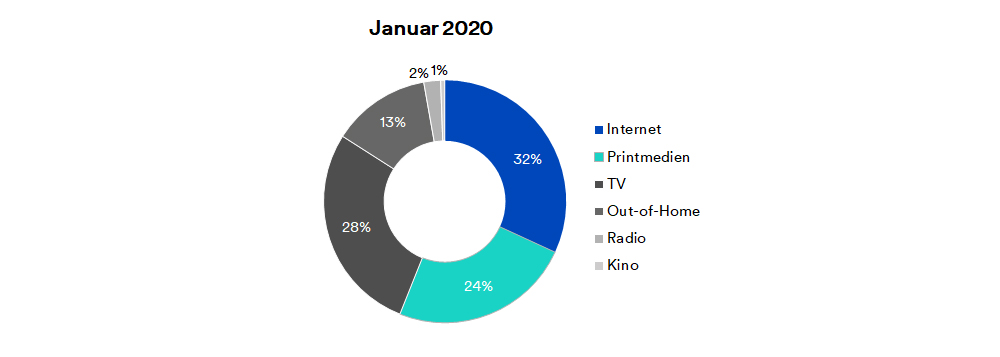
Media Mix January 2020
Methodology
With the January data close, Media Focus has integrated a more valid database for SEA advertising presence data. For the time being, the data is only available for 2020, which is why the January Advertising Market Trend only refers to this year. The back calculation for the years 2018 and 2019 will be completed by the February data close, which means that multi-year comparisons will then be integrated again in the next Advertising Market Trend February.
The integration of the new data into the Swiss advertising statistics will reduce the total volume of search advertising in the media mix by around 50 percent, depending on the industry. Proportionality within industries, customer groups, etc. will be maintained. The volatility of the data will be significantly reduced by the change in valuation.
UPC plans to cut around 160 jobs
UPC Switzerland's turnaround plan is having an impact on its workforce. The cable network operator plans to cut about 10 percent of its 1,600 jobs, a spokeswoman said Friday in response to inquiries regarding related media reports.
Editorial
-
February 21, 2020
This means that around 160 jobs are at risk. "UPC is committed to achieving reductions through natural attrition and measures such as internal transfers or early retirements wherever possible. UPC will make every effort to minimize the number of employee layoffs or terminations," UPC spokeswoman Stephanie Niggli continued. "However, UPC cannot avoid layoffs."
At this time, however, it is not possible to give a final number of redundancies, he said, as the focus is on a reduction through natural attrition. "We intend to have the final operating model defined by the end of April 2020 and currently expect to reduce the number of jobs in our organization by about 10 percent," Niggli said. In total, UPC Switzerland employs 1600 people, he said.
Various areas across all functions and levels are affected by the layoffs. UPC has a social plan that applies to the affected employees in the event of redundancies. This social plan was concluded jointly with UPC's social partners. As required, UPC has informed the employment offices of the affected cantons about the layoffs, Niggli said.
Broken deal with Sunrise not the trigger
UPC launched the turnaround one and a half years ago in order to achieve better business figures. However, the cable network operator has not yet been able to stop the downward slide. Last year, sales fell by a further 3.5 percent to CHF 1.25 billion. At least it succeeded in significantly slowing the decline in subscriber numbers. After losing around 153,000 subscriptions in 2018, the loss last year amounted to 68,000.
The collapsed deal with Sunrise was not the trigger for the cutbacks, Niggli said. "These measures were already part of UPC's growth plan from the beginning to further simplify and digitize the business - which would have been done regardless of this or any other strategic event."
The purchase of UPC by Sunrise was canceled at the end of October (Werbewoche.ch reported). The CHF 6.3 billion deal failed due to opposition from Sunrise's major shareholders led by Germany's Freenet, which owns just under a quarter of Sunrise's shares. (SDA)
Station & Novomind: Digital flagship store for Transa
Transa has developed a new website in collaboration with Station and Novomind. The new online store serves both as a sales channel and a platform for showcasing the customer experience and the brand.
Editorial
-
February 21, 2020
The company was founded 40 years ago and is now one of the best addresses for outdoor enthusiasts and travelers in Switzerland. The new website is designed to combine inspiration, advice, and the store into a holistic experience. Thus, the new platform takes on a central role in Transa's omnichannel e-commerce strategy. Station is responsible for the concept, UX design and frontend, and Novomind for the store system.
On Transa.ch, the focus should not be on pure sales, but on redeeming the brand's value proposition. Characteristic design, an explorative architecture, authentic storytelling and product-relevant content should ensure the desired shopping experience. At the heart of this are real experiences and in-depth know-how from employees - who are usually real outdoor enthusiasts themselves.
"In the process of making a purchase decision, we now make our appearance in the early phase of the inspiration search," explains Tom Lütolf, Head of E-Commerce at Transa. "With the consistent interplay of content, context and commerce, we also want to offer our customers online the Transa customer experience they know and appreciate from the stores." This is paying off: Since going live, for example, an increase in conversion rate of 67% and 54% more transactions could be measured (measurement period June 4, 2019 to January 15, 2020 compared to June 05, 2018 to January 16, 2019).
The project also produced a small innovation: the "Transallax". Visually expressive, the effect transforms conventional image material into interactive visuals - smart support for corporate identity and product emotionalization. The planned open source version with the predefined name "Transallax" turns it into a marketing tool.
Responsible at Transa: Sasa Löpfe (Team Leader Marketing); Michael Meier (Head of IT); Tom Lütolf (Head of E-Commerce); Manuel Scherrer (PL Online Marketing); Arjuna Dean (E-Commerce Manager). Responsible at station: Benjamin Kägi, Raphael Küttel (Project Management); Karl Badde (UX Design); Dennis Schmidlin (Design); Ricardo Sà, Simon Schoenenberger, Steve Ottoz (Frontend Development); Patrick Stoll (Strategy/CEO); Patman Spahr (CCO); Osiris Roost (CTO). Responsible at NovomindMichael Nicke (Project Manager); Micheal Barfs, Peter Lamby, Michael Spohner (Backend Development). Technologies and platforms used: Novomind iSHOP, novomind iPIM, Docker, Java, JSP, HTML, CSS, Javascript, Vue.js, Webpack, SCSS, PostCSS Git, Gerrit, Jenkins.
KPT and Medi24 launch physician chat service
The health insurance company KPT and the telemedicine specialist Medi24 are offering "DoctorChat," a new service for initial medical clarification. The service combines artificial intelligence with human consultation.
Editorial
-
February 21, 2020
With the chat service, the two Bern-based companies want to simplify quick access to reliable, medically supported medical information. Through the new service, a doctor can be contacted via Whatsapp, Telegram or SMS to provide professional advice.
"DoctorChat" is free of charge for KPT policyholders and accessible around the clock from anywhere. After a one-time registration, users select the desired communication channel and enter their health question. This is assigned to a real doctor using AI. The medical professional from the Medi24 network answers the question promptly on the selected channel. "We are eager to hear about our customers' experiences and will continue to develop our offering in line with their needs," says KPT CEO Reto Egloff.
Positive experience from abroad
he digital physician assistant is no substitute for telemedical consultation and goes into less depth than a telephone service. However, the service is intended to be a useful supplement to telemedicine and a better alternative to non-transparent Internet search services. Lebrecht Gerber, CEO of Medi24, says: "Digitization also offers completely new possibilities in medical consultation, which make patients' lives easier and at the same time relieve the burden on the healthcare system."
Experience from abroad shows that such services can prevent unnecessary doctor consultations. Up to 70 percent of inquiries can be completed in one chat session. Surveys also show a high level of acceptance among the population: 96 percent of existing users would recommend the innovative digital service to their friends. (pd/swi)
Republica speaks turkey for the Fernfachhochschule Schweiz
For its new client Fernfachhochschule Schweiz, the Bern-based agency Republica launches a campaign that really... glosses over nothing.
Editorial
-
February 20, 2020
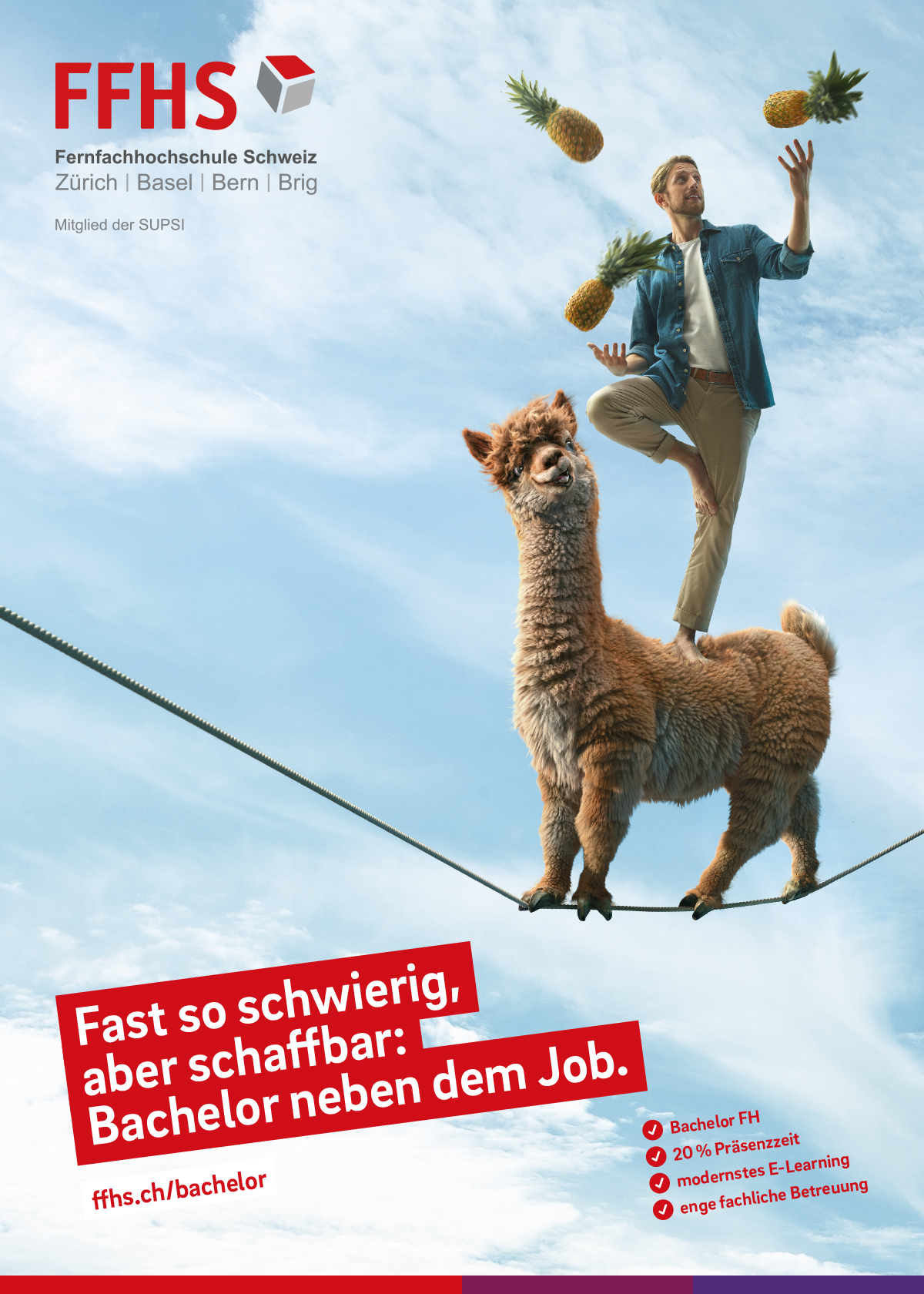
It is indeed an art to complete a course of study alongside one's job or parallel to everyday family life. For the most part, conventional study programs are aimed at what might be called "classic" students who can clearly focus on their studies. And this is exactly where the Distance Learning University of Applied Sciences Switzerland comes in with its flexible study model: 80% of the studies take place in accompanied self-study via its own online learning platform. The remaining 20% can be completed as face-to-face classes at one of the four FFHS locations in Zurich, Basel, Bern or Brig.
Republica therefore makes one thing clear for the promotion of this offer: Even with the flexible system of the FFHS, studying will not be a cheerful walk. But the FFHS makes it possible and feasible in the first place to reconcile work and/or family life with a well-founded continuing education program.
The campaign - with various online and offline adaptations - deliberately breaks with the usual recruitment mechanisms in the continuing education market, where highly dynamic achievers shake hands. Instead, the campaign makes it clear with a wink that the FFHS knows about individual life situations - and can therefore respond to them.
Responsible at FFHS: Natascha In-Albon, Claudine Studer. Responsible agency: Republica.
These are the reasons why a better customer experience fails
If companies want to optimize their customer experience, they must bring IT and business together and make more customer-centric investments. This is shown by a recent study by Pegasystems.
Editorial
-
February 20, 2020
The "2020 Global Customer Experience Study" by Pegasystems examines the global status quo in terms of customer experience (CX). On behalf of Pegasystems, the market research company Savanta surveyed decision-makers in twelve countries and from seven different industries - including 451 study participants in Germany. The study identified four key weaknesses in German companies when it comes to optimizing the customer experience towards more personalized customer experiences:
Lack of coordination between IT and business causes problems. In German companies, CX projects are mainly managed by IT departments (41%). Dedicated CX functions (6%), customer engagement specialists (6%) or senior management (5%) are only rarely responsible. While it is very important that IT supports such projects, it should not be forced to make business decisions for the business departments that involve a new approach or technology for them. If the business departments are not involved in these decisions, this can lead to considerable problems.
There is a lack of sponsorship from top management. In only 34% of German companies do CX projects have a sponsor at management level. In 30 percent of them, such projects are sponsored at division manager level or below. The consequences can be a lack of expertise and leadership responsibility within the initiatives; and those involved may doubt the company's conviction in the great importance of customer experience. If, on the other hand, management is involved, this can also promote alignment between business and IT and drive the necessary changes.
Companies are not investing in the most relevant channels. 90 percent of German respondents stated that they primarily focus on the needs of their customers when operating channels. However, their actual activities speak a different language. For example, 36 percent intend to spend money primarily on email in the coming year and 32 percent on digital advertising - and thus on channels whose response rates are considered to be falling. In contrast, only 28% want to invest in inbound centers, which are generally preferred by customers.
Outdated analysis methods are often used. Customer analysis methods have developed rapidly. However, many German companies still use outdated and ineffective solutions. For example, 37% rely on customer journey mapping, 33% on micro-segmentation and 26% still carry out time-consuming A/B tests. Customer-centric methods, which could give the customer experience a major boost, are still a long way from being widely adopted. For example, only 38 percent use propensity modeling, 34 percent forecast customer lifetime value and 33 percent carry out performance simulations.
"A new, holistic strategic approach is needed. Companies need to look at their customers in a completely new light - as individuals with unique preferences and needs in a complex real-time relationship," says Harald Esch, General Manager and Vice President DACH at Pegasystems.
"You have to earn the right to this relationship every single day. Above all, this requires a rethink at the top of the company. The management must be prepared to realign the core business with the customer at the center."
A total of 5,000 decision-makers from the USA, Canada, the UK, France, Germany, the Netherlands, Japan, India, China, Singapore, Hong Kong and Australia were surveyed for the 2020 Global Customer Experience Study by Pegasystems. They come from the insurance, healthcare, financial services, communications, automotive, energy supply and aviation sectors.
The complete report on the study is available for download at Pega.com.