Branders implements stylish omnichannel brand presence for Rausch

New clean beauty and direct-to-consumer brands are conquering the market, and "beautiful" is increasingly being equated with "healthy" and "natural". With a new omnichannel presence for Rausch, Branders shows that the brand has been living this philosophy for a long time.

Rausch

The beauty market is developing just as rapidly as consumer expectations and behavior. New clean beauty and direct-to-consumer brands are on the rise, and traditional brands that do not meet the new expectations are losing ground. At the same time, the definition of beauty has changed: instead of outward appearances, it is now based much more on the feeling of being comfortable and beautiful in one's own skin thanks to healthy choices.

Rausch's new omnichannel brand identity now brings this understanding of beauty to life in communication across all channels. With the exception of the iconographic bottle and the logo, all Rausch brand elements have been redesigned. Modular and individually combinable, they create a brand image that radiates warmth, lightness and natural beauty. The new Rausch images, which are used in image and product communication as well as in the content area, make the brand's natural approach visible and largely dispense with image processing, retouching and artificial light.

Rausch

Responsible at RauschLucas Baumann (CEO); Petra Hollenstein (Head of Marketing and Communications); Christian Heckmann (Digital Marketing Manager); Anja Kaiser (Senior Product Manager); Alina Hermann (Product Manager); Lea Riether (Product Manager); Dr. Katharina Alder (Head of R&D); Fabienne Sutter (R&D Employee); Esther Widmer, Bernadette Raschle (Communication/PR Manager); Laura Stillhart (Marketing Assistance). Responsible at BrandersRené Allemann (CEO); Marisa Güntlisberger (Director Omnichannel Experience); Thea Ferretti (Director Communications); Thom Pfister (Executive Creative Director); Philippe Knupp (Strategy Director); Sarah Egger (Junior Brand Consultant); Palma Manco Senior Brand Designer); Soraya Gaouaoua (Senior Brand Designer); Sarah Trendle (Executive Brand Designer); Katja Wölfel (Senior Copywriter); Martin Fähndrich (Video Journalist); Thomas Hausheer (Creative Brand Technologist).

KSP and Volkswagen are "On the road again at last

Volkswagen, together with KSP and the «Finally Back on the Road» campaign, is celebrating the end of the lockdown—while maintaining social distancing, of course. For the future, for all of Switzerland, and above all, for the joy of life.

Volkswagen

Volkswagen partner showrooms have been open again since May 11. It goes without saying that comprehensive protection, hygiene and prevention measures are being observed. This opening is now accompanied in a first step by the cross-media image campaign "Finally on the road again". It focuses for a lot of reach and visibility on the channels that have gained even more importance through Covid-19: TV, digital and social media. And, of course, it can also be seen in owned media and at POS. The campaign includes a TV spot, a social media spot and a variety of digital assets, among others. In a second step, an offer campaign will follow.


The remarkable thing about it is that all the film sequences, the film music and also the campaign images originally came from Volkswagen's extensive content archive. And thus from all over Europe.

And of course, the entire campaign was created in the home office, KSP writes in a statement. "In the shortest possible time, in close cooperation between the client-agency core team and with an extreme amount of pleasure and joy."

Volkswagen

Responsible at AMAG Import Volkswagen: Christian Wiegel (Brand Director); Melanie Felder (Team Leader Marketing Communication). Responsible at KSP: Daniel Krieg (creative direction); Alba Rau (art direction); Barbara Sarras (text); Lukas Vigniti, Jelena Germann (editing); Barbara Zingg (consulting); Bianca Jäger (production); Slaughterhouse (post production); Jingle Jungle (sound); Mediacom (media); SOP (social media).

Lockdown gives positive impetus to work breaks

Seven out of ten Swiss people have tried out new break activities for themselves in the home office. In particular, different types of exercise are highly popular. Now it's time to take these positive impulses into the regular working day as the economy opens up. Because a representative study commissioned by Xing Switzerland shows: One in three working people in Switzerland takes too few breaks, and exercise is often neglected in the normal course of everyday work.

Arbeitspausen

Breaks are an important factor for well-being at work and can thus contribute to a more fulfilling professional life. The online professional network Xing wanted to know what the break habits of Swiss professionals are and what influence working in a home office has. As part of a representative survey, Xing Switzerland first asked the market and opinion research institute Marketagent.com to collect data on the break behavior of Swiss professionals. In addition, around 600 Swiss home office workers were surveyed directly via the Xing platform about their break habits within their own four walls.

The main results of the study:


Home office brings movement into work breaks

Walking, jogging, biking: Working at home brings exercise into work breaks for many professionals. Almost four out of ten home office workers (38 percent) say they have tried outdoor exercise as a new break activity. In addition, 19 percent of respondents have used their breaks for fitness or yoga for the first time thanks to home office. At the regular workplace, however, sports and exercise as a break activity are in the lower ranks, according to the results of the representative study from the spring: Only one in ten regularly uses their work breaks to exercise. Conscious relaxation, such as breathing exercises or meditation, is also rarely practiced. Only six percent of those surveyed said they regularly relax consciously during their breaks. The list of the most frequent break activities is headed by drinking and eating, talking to colleagues and chatting via WhatsApp and text messages.


Also high on the list when taking a break: baking and power naps

Other break activities that Swiss people have discovered for themselves in the home office are housework (mentioned by 28 percent), cooking and baking (also 28 percent) and the little nap in between, the so-called power nap (17 percent). Overall, around 70 percent of respondents said they had tried out new break activities in the home office.

Xing Switzerland CEO Robert Bertschinger says of the results: "Working in a home office is often used by Swiss professionals as an opportunity to try out new ways of organizing breaks. Especially when it comes to exercise, it would be desirable for these positive impulses to continue to have an effect in the regular workday after the lockdown."


One in three takes too few breaks

The results of the representative survey from the spring show that around a third of working people (35 percent) do not take enough breaks according to their own assessment. Two-thirds of them (66 percent) would like to change that. The three most common reasons for not taking enough time off are: There is too much to do (a common reason for 61 percent), breaks are simply forgotten (a common reason for 42 percent) or forgoing breaks is part of the corporate culture (a common reason for 30 percent).


Break at home: more relaxing but more difficult to realize

Despite less social control and greater freedom to organize breaks, taking breaks at home does not seem to be easier. Slightly more than a third (35 percent) of the Xing members surveyed in the home office even find it more difficult to take work breaks at home. For 41 percent, there is no difference and only 24 percent of respondents find it easier to take breaks in the home office.

On the other hand, the effect of breaks in the home office is rated positively. Four out of ten respondents find the breaks in the home office more relaxing than in the office. Only 20 percent find the breaks in the office more relaxing. The remaining 40 percent feel no difference.

"Whether in the home office or at the workplace in the company, the positive effect of work breaks has already been demonstrated umpteen times. Employers who cultivate a conscious break culture not only promote the well-being of their employees, but also productivity within their own company at the same time," says Robert Bertschinger. "Our study shows that not all Swiss companies are yet exploiting this potential."

About the study

The survey on the topic of break behavior was conducted by the market and opinion research institute Marketagent.com at the beginning of 2020. A total of 788 employed persons from Switzerland were surveyed via online interview. The quota-controlled random sample is representative of the working population in Switzerland. To complement this, in May 2020 XING Switzerland surveyed 619 Swiss members who work fully or partially in a home office via the XING platform on the subject of work breaks during the corona lockdown.

Serviceplan Suisse stages the little things in life in a big way

The lockdown is gradually being eased and Switzerland is picking up speed again. In keeping with the regained freedom, Mini has launched a summer campaign in which selected models can be purchased at a reduced price: With "Enjoy the Mini things in life", Serviceplan Suisse is getting the post-lockdown spring fever going.

Serviceplan Suisse inszeniert die kleinen Dinge im Leben gross

Two key visuals emphasize the small moments that make driving a pleasure. Experiencing the airstream or being together in nature - these are Mini moments that are experienced even more intensely after the lockdown and at the same time reflect the Mini spirit emotionally.

The two subjects were shot during the lockdown and therefore under completely different conditions. Both the shoot in a moving car through Zurich city center and the shots at the idyllic Obersee in Glarnerland had to comply with the applicable hygiene and protective measures such as social distancing. A new challenge, but one that did not affect the emotionality of the end product in any way.

The campaign is being used immediately on advertisements, various online advertising media and at the POS.

Suisse

Responsible at Mini: Timo Di Pardo (Director MINI), Adrian Kwasnitza (Head Marketing Mini), Fabian Schlatter (Communication Mini).
Responsible at Serviceplan Suisse: Nadja Tandler (Art Direction), Michael Kathe (Creative Direction), Kelsang Gope (Text), Sidonie Bauer, Andrea Menzi (Consulting), Eliane Bachmann (Art Buying ), Barbara Meier, Victor Borel (Media Realization), Kurt Bösiger, Dominic Shota Schweingruber (Motion Design), Raul Serrat and Pam Hügli (Overall Responsibility); Yves Bachmann (Photographer), Katrin Lohman (Producer), Vizeum (Media Agency).

Agency at the airport gives Agrola Energy Card the necessary drive

The agency at the airport is responsible for the design of the new Agrola customer card.

Agrola Energy Card

With over 400 filling stations - mostly in rural areas - Agrola has the second-largest filling station network in Switzerland. The Agrola Energy Card, a credit card that can be used both to pay for fuel and to buy items in the company's 110 petrol station stores, is very popular with over 200,000 customers.

With the introduction of online authorization, Agrola also wanted to give its Energy Card a new look and invited tenders for a pitch. The agency at the airport emerged as the winner and was commissioned to develop various proposals. The focus was to be on the topic of mobility. The new, modern Energy Card in Agrola's corporate colors of green and yellow will find its way into 200,000 Swiss wallets this summer.

Responsible at Agrola: David Nievergelt (Project Manager Marketing), Rolf Lehner (Head of Marketing and Sales). Responsible at agency at the airport: René Eugster (overall responsibility), Dominique Rutishauser (creative direction), Ketil Eggum (art direction/design), Miriam Egli (consulting/project management).

Medium Micro in Western Switzerland gives up due to coronavirus

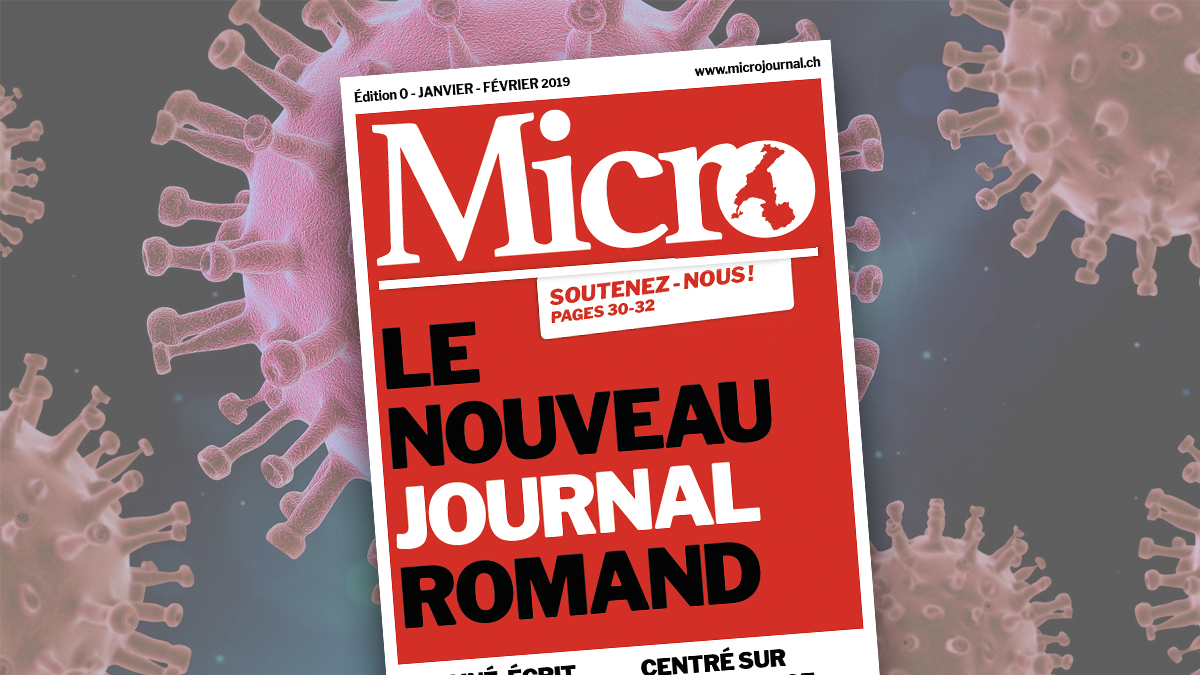
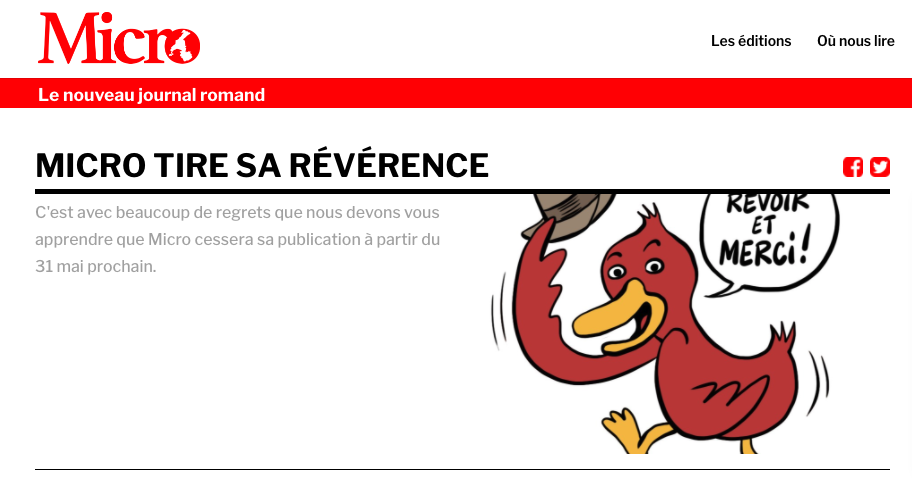
The recently launched weekly publication Micro in French-speaking Switzerland will cease operations. This was announced by the publishers on Monday night.

Coronavirus

Those responsible cite the measures to contain the coronavirus as the reason. The Covid-19 pandemic has severely affected the title's main customers: Cafés, doctors' surgeries, hairdressing salons and cafés, the communiqué continued. Under these circumstances, it was impossible to resume publication.

The publication will therefore be discontinued next Sunday. A final issue is planned for Saturday, according to the information provided.


Intended as a sheet to share

Publication in paper form had already been suspended since March 17 after the Federal Council issued the coronavirus measures. The concept of the newspaper, which was created specifically as a paper for sharing for ecological reasons, had become "very complicated" in the current coronavirus context, added Micro added.

The publishers would refund all subscriptions taken out in 2020 and make two donations of CHF 10,000 each to the satirical newspaper Vigousse and to the online media La Torche 2.0, it continued. (SDA)

Coronavirus

Marie Hettich and Vanja Kadic join Annabelle

Journalists Marie Hettich and Vanja Kadic will be joining the Annabelle editorial team in June and will work alongside Kerstin Hasse, head of online and deputy editor-in-chief, to drive the magazine’s digital strategy forward.

Annabelle

New at Annabelle: Marie Hettich.


Starting next year, the Annabelle.ch platform will be given a new look and repositioned with a relaunch. To this end, the editorial team will receive support from two new journalists: Starting in June, the team of online chief Kerstin Hasse will be strengthened by Vanja Kadic and Marie Hettich.

Marie Hettich was born in Stuttgart and has lived in Zurich since 2014. The 32-year-old journalist studied sociology and German language and literature studies and worked for six years as an editor and online page maker at 20 Minutes Friday active. In addition to her work as a journalist, she co-founded the Youtube format "Hoi".

Annabelle

Also joins the Annabelle team: Vanja Kadic.


Vanja Kadic moves from the View to the Medienart publishing house. From 2015 to 2020, the 29-year-old was People Editor for View, Blick.ch and Evening view active. At Ringier, Kadic graduated from journalism school in 2015. Before that, she worked for titles such as Friday, Gala or Faces. The journalist also produced and hosted the pop culture podcast "Popcast" for Ringer.

"I am extremely pleased that two such great women are joining my team, both of whom have a lot of experience in lifestyle-related digital journalism," says Kerstin Hasse, online chief and deputy editor-in-chief of Annabelle. "Together, we will now drive the relaunch of Annabelle.ch and redesign the digital platform of Switzerland's strongest women's magazine."

Media type has the Annabelle Acquired by TX Group in October 2019 (Werbewoche.ch reported).

Instagram becomes the common denominator of generations

For the eleventh time, Xeit is launching its «Social Media in Switzerland 2020» user survey and providing specific usage data on social media in Switzerland.

Nenner der Generationen

The survey asked consumers about social networking, social business, live communication, blogs, vlogs and influencers, and online vs. offline.

For the first time, a special evaluation was made for Generation Z, which revealed some surprising results. If you want to reach Generation Z, you can't avoid Instagram: 84% of those under 20 follow a company on Instagram.

Nenner der Generationen

The most important findings at a glance

  • Swiss people spend most of their time on Facebook, Instagram and YouTube.
  • The amount of screen time spent by the Swiss has increased significantly.
  • Political opinions are also made on the social web: Half of those surveyed use social media to form political opinions.
  • Every third person reads a blog at least once a week.
  • Influencers continue to gain in importance - across all age groups.
  • Lack of content relevance is the most common reason to unfollow a company.
  • Stories are the format of the hour. The surprise winner in terms of overall usage is WhatsApp.
  • Social TV formats like IGTV and YouTube TV are slowly entering the mainstream.
  • WhatsApp continues to extend its lead as a messenger.
  • Generation Z wants to have its say: surveys as social content are very popular.

Download "Social Media in Switzerland 2020" Factsheet

For the user survey, over 1100 consumers in Switzerland were questioned between the beginning of March and the beginning of April 2020. Xeit investigated the following questions, among others:

  • Has TikTok already overtaken Snapchat in the favor of the youth?
  • Is it still possible to reach the masses via Facebook?
  • Has social TV already arrived in the mainstream?
  • How much influence do influencers have? 
  • On which social networks do Mr. and Mrs. Swiss spend the most time?

The complete study can be found at Xeit.ch be ordered. 

Pro Senectute strengthens generational cohesion

The largest professional and service organization for old age in Switzerland launches a new awareness campaign created by Thjnk Zurich and shows in its film that old age has many indispensable jobs - and seniors are an important part of our society.

Generationenzusammenhalt

The Corona crisis hits everyone hard. The retreat into the private sphere and into self-isolation weighed on the minds of older people in particular. Depending on their state of health and type of housing, the social isolation meant that important daily structures were no longer available. A feeling of exclusion spread. Or even worse, being perceived as a "burden" on society. At the same time, voices were raised that the working generation felt left alone to cope with the crisis. Initial indications accumulated that senior citizens were being blamed for the shutdown.

For this reason, Pro Senectute appeals to generational solidarity. It is more in demand than ever. Only if young and old continue to stick together can the challenges ahead be mastered - even in the time after the crisis.

Together with Thjnk Zurich, Pro Senectute stages senior citizens in their daily activities in connection with the working generation in an emotional film. And thus shows that older people are an important part of a prosperous Switzerland, and thus make an important contribution. Thus, the film shows the many different "side jobs" of the older generation for the working population in Switzerland.

From the "trustee" who helps with the bookkeeping for a young bar owner to the "psychologist" who stands by her daughter on the phone with patience and advice. In keeping with Pro Senectute's credo, which has been used for years and has never been more apt than today: "Stronger together". The film was conceived within a very short time and implemented in compliance with the FOPH's Covid 19 guidelines.

The spot has been on Swiss television and in various online formats since the Ascension weekend.


Responsible at Pro Senectute: Alain Huber (Director), Peter Burri (Head of Communications), Tatjana Kistler (Media Officer). Responsible at Thjnk Zurich: Alexander Jaggy (GF Creation), Andrea Bison (GF Consulting), Lukas Amgwerd (Text), Lukas Frischknecht (Art Direction), Manuela Käslin, Marie Vuilleumier (Project Management), Gordon Nemitz (GF Strategy). Responsible at Stories: Humbi Entress (director), Jan Mettler (DOP), Michèle Seligmann (executive producer), Debby Caplunik (line producer), Edoardo Moruzzi (post production). Other responsible persons: Gian Dolder (Music), Manuela Birghan (Head of Sales, Admeira), Kartheepan Sivakumaran (Project Manager Online Marketing, Xeit).

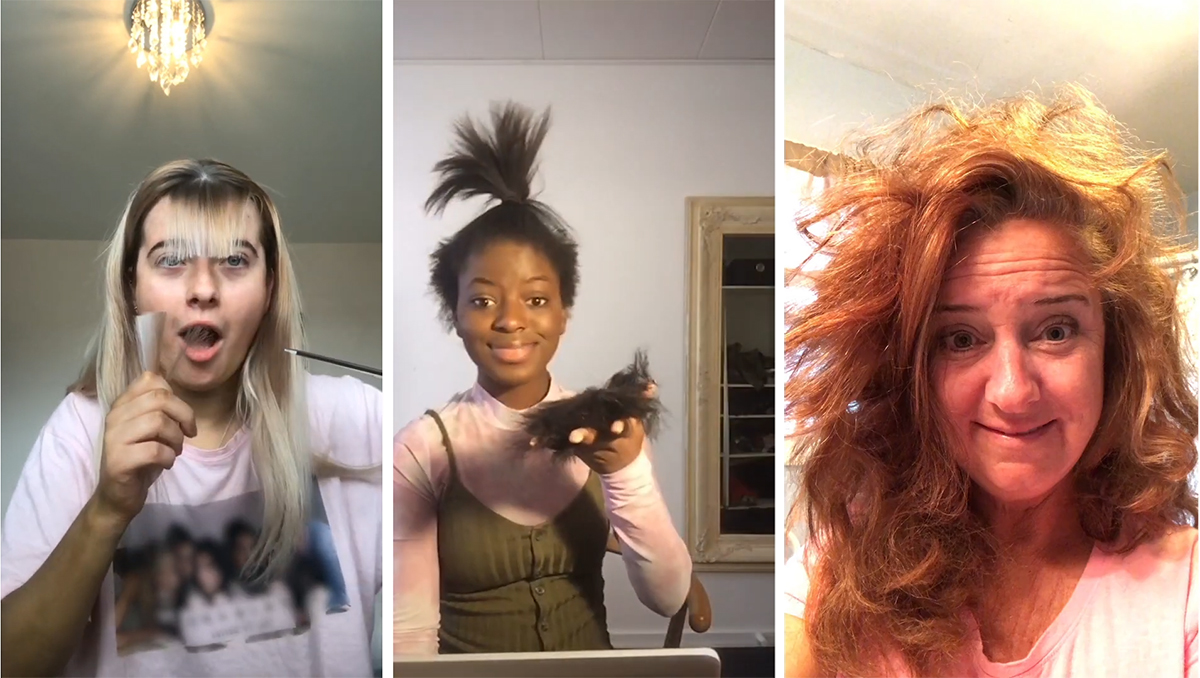
Corona haircut homemade

Ogilvy Paris and Dove are calling on all women to celebrate their own hairstyles—in good times and bad.

Corona-Haarschnitt selbstgemacht

In a remotely implemented video campaign, 16 different women show their (partly non-existent) hairstyling skills, which they had to apply unceremoniously due to corona. The personal care brand Dove stands by all women, even in the hairiest of times, and calls for corona hairstyles to be shared under the hashtag #MyHairMyStyle.


https://youtu.be/01T3HsBpYmk

Solid Identities realizes naming and brand identity for new KKL Luzern restaurants

In mid-May, the two new restaurants "Le Piaf" and "Lucide" opened their doors for the first time in the KKL Luzern. The name and graphic appearance of the two restaurants were created by the Zurich agency Solid Identities.

KKL Luzern

With the completely redesigned restaurants "Le Piaf" and "Lucide" the KKL Luzern is replacing two of its previous, somewhat outdated restaurants in the building. The restaurants were repositioned more independently and created by the KKL Luzern as fully-fledged gastro brands with an individual market presence.

"Our task was to filter out the unifying essence between French-influenced gastro concept, spectacular interior design and the personal lifeworld of the guests for each restaurant and to cast it in corresponding names and brand identity," says Elmar Müller, Strategy Director at Solid Identities, describing the assignment to his agency. "The point was to create something that would excite people in terms of content and form and immediately make them take the two restaurants to their hearts."


Simple and flexible

In addition, Solid Identities placed great emphasis on the everyday usability of their work. "Names have to be short, associative and easy to remember. Only then can they be remembered and develop their full power as a mental gateway to an entire world of experience," says Elmar Müller. In addition, he says, meticulous attention was paid in designing the visual brand presences to optimally meet the requirements of the restaurants' day-to-day operations.

In concrete terms, this means simple design rules, flexibly applicable design elements, so that all implementations can be carried out quickly and efficiently in-house by the customer. One example of this is the sparrow illustration, which is part of the Le Piaf logo but can also be used as a pattern for background areas.

KKL Luzern

Eastern Switzerland's creative scene hit hard by Corona crisis

The results of a member survey conducted by the Werbeclub-Ostschweiz on Corona clearly show that the crisis is also hitting the creative industry in Eastern Switzerland hard. Declines or losses in turnover, short-time work and expected liquidity bottlenecks have become a harsh reality, with almost a quarter of those surveyed no longer receiving any orders at all. Nevertheless, there have hardly been any redundancies so far.

Almost 90 percent of the 150 or so corporate and individual members of the Advertising Club of Eastern Switzerland took part in the survey. A good 47% of the members surveyed - which include communications agencies, web agencies, service providers such as printers, but also event organizers - stated that their company has been strongly or very strongly affected by the coronavirus crisis.

Most companies are feeling the effects of the current situation: 47.6% are receiving fewer orders, and almost a quarter are receiving virtually no orders at all. Nevertheless, a good one in ten companies seems to be acquiring more or even many more orders.

Kreativszene

"Better" short-time work than bridging loans

The majority of respondents (58.3%) expect little to no loss of turnover. Nevertheless, a fifth of all respondents anticipate a loss in sales of 50 percent or more in 2020.

Kreativszene

Just under half of all respondents make use of the most well-known "countermeasure", short-time working. However, just under three quarters have not applied for a bridging loan for this. "Only" one in five companies had to go this far.

Kreativszene

Fortunately, redundancies have so far been the exception: over 95 percent stated that they had not made any employees redundant.


Federal measures appropriate, exit strategy sensible

63.1% of respondents believe that the measures taken by the federal government to contain Covid-19 are appropriate and sufficient. A quarter, on the other hand, believe they go too far.

Kreativszene

The Confederation received even more support for its gradual "re-entry" approach: over 70% consider the exit strategy to be sensible, as it provides room for maneuver. However, a good 16% complain that it is an unfair solution, as equal rights do not apply to everyone.

Kreativszene

Cautiously optimistic forecasts 

A good 20 percent of respondents expect difficulties in terms of liquidity in the current year. Slightly more than half consider this to be rather or very unlikely - although this assessment will certainly depend on how the crisis develops: This is because continuing falls in demand, prolonged restrictions imposed by the authorities and defaults by customers will inevitably lead to liquidity problems.

Nevertheless, the creative scene in Eastern Switzerland remains optimistic. After all, more than half of all respondents expect that their company will no longer feel any negative consequences of the coronavirus crisis by the second half of 2020 at the latest.

get_footer();