The out-of-home country

What's happening in the world of out-of-home advertising? Pru Parkinson, Global Chief Marketing Officer at Clear Channel Outdoor, discusses the latest trends, and Jürg Rötheli, CEO of Clear Channel Switzerland, talks about digital innovations.

Unbenannt-14_7
Pru Parkinson, Global Chief Marketing Officer at Clear Channel Outdoor, during her visit to the Zurich office, together with CEO Jürg Rötheli. Photo: Andreas Panzeri

WW: Ms. Parkinson, what brings you to Switzerland?
Pru Parkinson: I visit all our subsidiaries regularly. You have to know what's going on in each market. We have certain strategic priorities at Clear Channel. I want to make sure personally that these are being adhered to all over the world.
 
What are these strategic priorities?
We focus on three things. First, creativity. That's why we've been supporting the Cannes Festival for several years - both on the Côte d'Azur and as a sponsor of the Outdoor category in Switzerland, for example. The second is technology. How can we use the new achievements for outdoor advertising as well? Finally, effectiveness. We want to know why a poster works and how we can increase its impact.
 
Clear Channel is represented on all continents. Where is your work most exciting?
A very difficult question. Each of our 30 countries has its own challenges. I love visiting all our subsidiaries. That sounds like a platitude, but it is. Latin America is fascinating right now. In Rio, we have the World Cup coming up in 2014 and the Summer Olympics in 2016. There is a lot of momentum for our industry. The U.S. fascinates me because the country is very vast and deals with advertising somewhat differently than Europe. Just think of the mass of oversized billboards, for example in Times Square, where Clear Channel is present with several mega screens. But the large billboards along the highways and roads also offer interesting opportunities.
 
Clear Channel reports great growth in Asia and Australia. What is happening there?
There are huge changes taking place in Asia at the moment, as we know from all industries. In Singapore, we can use a lot of our latest technologies. China is gigantic because of its size. Several hundred thousand people pass through our megaposters in Shanghai or Beijing every day. On the other hand, we have the problem in China that we sometimes don't even get enough posters from the print shops in the required time to be able to serve all the desired locations for a large campaign. The country is so gigantically large. We are working very hard on our infrastructure at the moment.
 
What is the difference in the weighting of outdoor in different countries?
A lot of it is historical. France is an interesting market because 12 percent of media budgets there go to out-of-home advertising. In Australia, it's only 3 percent. In France and Italy, it is noticeable that very many luxury brands consider outdoor as their channel. In other countries, legal regulations have to be observed for advertising certain products on a billboard. What all countries have in common is that outdoor is used in a very targeted way, where consumers make their purchasing decisions. This is still our big advantage in the media mix, even though advertising on the Internet is becoming more and more personalized. We are where the customer makes the purchase. And at the same time, we are also at the forefront of new technologies, for example, when people can access further information about products directly from the poster via an app.
 
Today, people on the move can be reached more and more with advertising on mobile devices. Does this development take a lot of budget away from classic billboard advertising?
The flow of money is heading in the direction of the Internet. This growing trend is clear to see. But media budgets are not increasing. There have to be cutbacks in other channels. But we at Outdoor are not suffering from this development. Out of Home is one of the strongest means of linking the target group to the Internet via the poster. So we need to work on how to make it more sophisticated, and we need to research how such interactions work. The "social - local" link is the future, and this is the direction in which we need to invest, research and develop. When surfing at home or in the office, an advertisement will not trigger the big reactions. But in the market outside and up to the POS it will work. And there our offers can trigger the entry with QR codes and new developments that will surely surprise us soon.
 
What will digital development in the poster sector bring us in the future?
We could talk about that for hours. On the one hand, we have very targeted advertising with the technical achievements of targeting. On the other hand, we have the billboard, where anyone can happen to pass by it. We are working on being able to use the connection between these two channels better and better. Goods can be ordered directly with a smartphone by photographing the posters. We launched a campaign with Madonna where you could download her latest album in front of the poster. There are no limits to the imagination. Another development will certainly be that we shorten people's time on the road. Entertainment from our installations when they are waiting for the train, stuck in a traffic jam or have to stand in line somewhere. "Filling gaps with desired content will be a rewarding task for us.

Interview: Andreas Panzeri

Unbenannt-15_4
Unbenannt-16a
Unbenannt-16b
Clear Channel's latest and in every respect groundbreaking installations at Zurich Airport.

Jürg Rötheli, CEO Clear Channel Switzerland, on digital innovations

WW: What are Clear Channel's plans for digital in Switzerland?
Jürg Rötheli: We have various initiatives underway. We are already the leading company in the digital sector. At Zurich Airport, five years ago, we were the first with digital installations in Switzerland in the outdoor advertising sector. Currently, we have five products on the market there. For example, the sequence of multiple screens when walking to the gates, which we call ad-e-motion. We have expanded this offering. There are also the screens with the films, the so-called flight information media, on the fourth screen next to the displays at the airport. Here we can offer advertising on a network across the entire airport. Baggage claim media at the baggage belts is also attractive. Then there are our new screens at check-in, which are now moving rather than static, and Wi-Fi sponsorship. All these installations are being continuously expanded. As a zone, the airport is particularly well suited for digital advertising. There is a large volume of passengers at very different times. During the vacation season, different people are on the move than on Monday morning with the commuters. With digital advertising, you reach the target group in an ideal form at the right time.

What's going on away from the airport?

Our goal here is to be able to offer a network of digital advertising spaces throughout Switzerland, at points where most consumers spend time. In other words, in shopping centers and malls. We are constantly developing at these locations. Studies on reaching the consumer show that the purchase decision is very strongly influenced by sales as close as possible to the POS. Sales are said to increase by up to 20 percent. We can pick up the consumer on the street, lead him through the parking lot to the mall and then to the point of sale. Clear Channel can accompany the consumer all the way. That's why such zones as airports and shopping malls or even train stations are best suited for digital advertising.

Where can we expect something completely new?

A pilot project is currently underway with the city of Zurich. This is not just about out-of-home, but about out-of-home outdoor, i.e. on the street. It's about the best locations in the biggest cities. We are in negotiations with the authorities to allow us to either replace our advertising space at existing locations with digital or to identify new areas where we can put digital panels. We believe that Clear Channel can contribute to a modern and good image of a city. This can also lead to the fact that less is perhaps more. Even as a representative of an outdoor advertising company, we have no interest in simply covering the whole of Switzerland with posters. What we want are high-quality advertising spaces that we can market as optimally as possible. Then there really is a triple win-win situation: as a company, we can place six advertisements on a digital advertising space and not just one or two. The city benefits with revenue sharing. The citizen benefits because such a digital advertisement is a qualitatively beautiful, aesthetic and pleasing product and not simply a proliferation of posters cluttered up somewhere. Piccadilly Circus or Times Square is also perceived as a tourist attraction.

pan

Unbenannt-20b
Switzerland is an out-of-home country. The genre has a budget share of 12 percent, which is far higher than in other countries. Clear Channel estimates that this share could go up to 20 percent because the ROI is right.


Social media marketing is experimental marketing

Whether it's product innovation, storytelling, or social responsibility campaigns, consumer engagement is transforming traditional marketing. By Beat Hürlimann

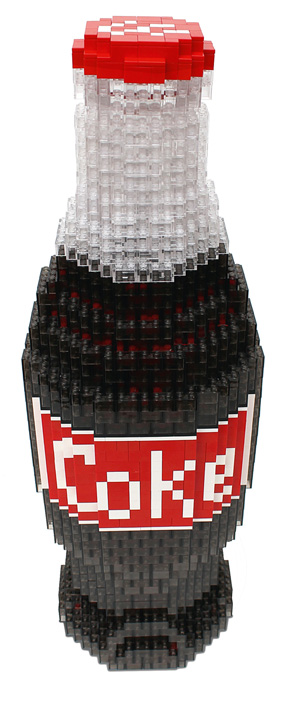
David Haliski is a LEGO artist from New York. "Life, and LEGO®, is much more than what is in the instruction manual." We found each other via Google and Facebook. He put together this Coke bottle especially for my contribution. We found each other because we share something: the joy of experimenting. Now you're thinking: experimentation has no place in marketing plans. The opposite is true: marketing plans without experimentation have no place. The exciting case with a 5-pack secret formula for social media marketing is provided by the maker of the most famous bottle in the world: The Coca-Cola Company!

Unbenannt-12_10

Setting ambitious goals

Coca-Cola is over 100 years old, the most popular brand on Facebook with 73 million fans, its logo is known by 94 percent of the world's population and its brand value is 74 billion dollars. Only Apple and Google are more valuable. What more could you want? Anthony Newstead, Global Director of Innovation, IT and Interactive at Coca-Cola, provides the answer: double sales by 2020. A clear statement.

Boldly cutting away old habits

With "Great New Taste! Better than ever." and "Change for the Best", the ads in the USA went viral in spring 86. Sales had been declining for 15 years in a row. The idea was to turn things around with a new flavor formula. 200,000 test persons helped. What followed was a disaster with a happy ending. Every consumer had their own relationship with Coke and the taste was part of it. The outrage was correspondingly great. After 79 days, on July 11, the company announced its return to the original formula. Today, 27 years later, the global Coca-Cola brand community has a seat at the decision-making table when it comes to product innovations and other experiments. At Coca-Cola, "Case of Change" stands for the marketing age in which the stories of technologically advanced, always-connected consumers far exceed the reach of the company's own campaigns and stories. The strategy of openness and collaboration is well underway.

The founding principle of the "Secret Formula" is gradually fading. It is increasingly being replaced by an attitude of openness and exchange. Anthony Newstead calls it "The mantra of sharing formula". The change also harbors risks. Newstead comments: "We are going through a phase of risk awareness rather than risk aversion when it comes to innovation." Rapid communication and decision-making channels and trust-based collaboration models are therefore essential. They are replacing the rigid hierarchy and control models based on controllable one-way communication. Creative teams are spontaneously formed across countries, supplemented by technicians and programmers, who hatch ideas together, adopt the latest technologies and experimentally feed campaigns into the social networks. At Coca-Cola, they call this "social collaboration".

Imaginative storytelling

With "Dynamic Storytelling", Coca-Cola is setting completely new accents in campaign management. Classic campaigns, if they have something to tell, are based on the principle of "one-way storytelling". Storytelling is feared. People are not prepared for it, for example because the department is deserted at the weekend or because the IT manager is busy at the moment. The aim of dynamic storytelling is the complete opposite. Stories are launched by consumers, employees or the official Coca-Cola teams. They are recorded, retold and updated chapter by chapter over time. What other users like is included by eliciting a like, retweet or comment. It starts when the material is available. Speed is an important aspect here. Stories whose posts on social media platforms remain unanswered for more than two to three hours end in agony. Context is another aspect. And here Coca-Cola has created a story platform with the highest inspirational content with "Open Happiness". Praise also comes from the highest social media authority. For Faebook COO Sheryl Sandberg, Open Happiness is "the next step in fan culture".

Diligently increasing sales

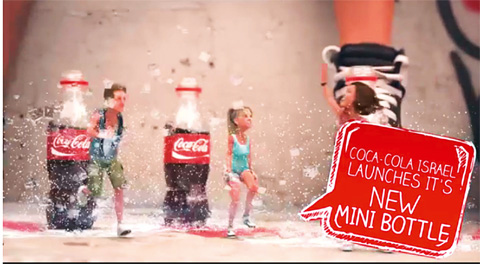
When it comes to stories to increase sales, the focus is on the product. At Coca-Cola Israel, experimenting with the latest trends in marketing and technology seems to be particularly popular. State-of-the-art 3D printer technology was used for the launch of "mini-bottles". Consumers were able to win a 3D printed plastic mini-figure of themselves as part of a competition. They had to download an app, create a digital mini version of themselves and then make it happy by grooming, pampering and playing. Who remembers Tamatgotchi? The winners were 3D scanned in the studio and the little "mini-me" was printed out. A story about little characters with lots of material to tell. The makers of our second Coke case thought half the fun. The "Coke Social Can" story, with a can that can be shared, is exemplary in two respects. The idea is a "social co-production" by creatives from Singapore and France. And the shareable Social Can allows friends to enjoy Coca-Cola in no time at all. Thanks to its physical properties, the product itself becomes a shareable social medium. The perfect Shared Happiness story for the Open Happiness platform.

Unbenannt-11_8

Giving something back to society

When it comes to stories in the service of reputation, the focus is on the well-being of people and the community. To this end, Coca-Cola has launched the "Live Positively" program for sustainability and social responsibility. With good reason. According to a recent US study, young people of student age in particular, who are highly influential on the social web, so-called "millennials", attach great importance to companies giving something back to society. According to Head of Marketing Joseph Tripodi, the fight against obesity is a particularly urgent issue for Coca-Cola in terms of reputation management. This clear admission is surprising, but shows what transparent communication should look like in the digital age. Provided that big words are followed by concrete action. This is what happened at the end of June in the Argentinian test market, where "Coca-Cola Life", the first Coca-Cola drink to contain the natural sweetener stevia, was launched. Stevia is a plant whose leaves contain a substance that is more than 200 times sweeter than sugar. It is said to come very close to the original taste of Classic Cola. This is a project that is both innovative and experimental. Will Americans and Europeans also like it? The two video stories "Be Ok" and "Coming Together" are currently causing a surprise in the advertising world. In one, Coca-Cola explains that all the calories we consume every day count - including the calories from the Coke bottle. A second commercial is even clearer and shows how to get rid of the 140 calories in a can of Coke. And how many calories can you get rid of with a blog comment? Dare to experiment and spark an exciting discussion with your contribution on Huerlimanncc. com.

Beat Hürlimann

Beat Hürlimann
 

Advertising impact: TV top even without online?

Many brands today rely on a cross-media approach to reach their target audiences. The combination of TV and online advertising, in particular, is often seen as a «dream team.» But are integrated communication strategies that combine TV and online really more successful than single-media approaches?

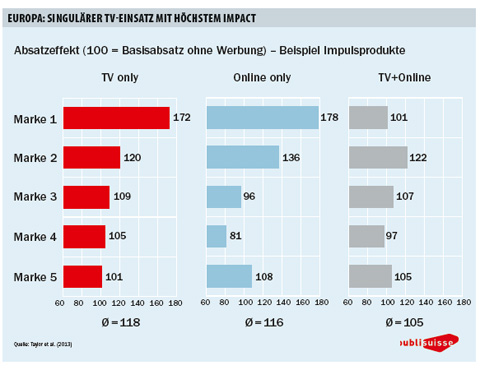
Consumers' use of media is becoming increasingly diverse. Companies are trying to take this fact into account by relying on cross-media communication strategies - and in particular the combination of TV and online advertising. The associated reach and sales effects are much discussed and not yet understood in detail. A team of researchers from the University of South Australia has investigated this question. The study attempts to shed some more light on this darkness by correlating the media use and purchasing behavior of around 6000 European consumers. The data, which the Australian researchers examined together with Mars, was taken from the GfK Media Efficiency Panel and relates to five brands each for staple foods and impulse products. The result: TV continues to achieve top reach and is clearly ahead in terms of sales stimulation. What is particularly interesting is that the combination of TV and online does not necessarily have a stronger sales effect than TV alone.

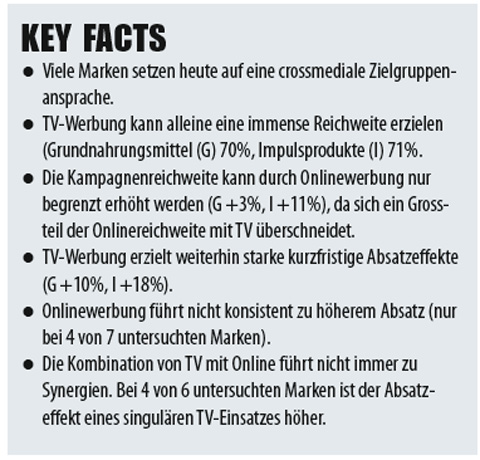
First of all, the analysis shows that the reach achieved by TV advertising remains immense, despite the increasingly diverse media usage patterns. In the case of staple foods, TV advertising achieved an average reach of 70% in the period under review. Many consumers (57%) only had contact with TV advertising, plus 13% who had contact with TV and online advertising. It is interesting to note that online advertising only increased the reach of the campaigns examined by 3% to a total of 73% - i.e. hardly at all. A large proportion of the online reach of 16% overlaps with TV. The results were similar for impulse products - here too, a large proportion of online reach overlapped with TV (32% duplication, 11% unique reach). According to the study, TV advertising not only achieves large reach, but also strong short-term sales effects. For the staple foods examined, TV advertising increased the propensity to buy by up to 35% or an average of 10%. In the case of impulse products, the maximum sales effect was 72% and the average was 18%.

However, the picture was not quite as clear for online advertising. Online advertising was able to achieve positive sales effects for four out of seven brands for which corresponding data was available. For the impulse products examined, online advertising increased the propensity to buy by an average of 16 percent, whereas for basic foodstuffs it fell by 3 percent compared to a situation without advertising. Online advertising therefore often, but not always, generates positive sales effects. But what effect does the combined use of TV and online advertising have on sales? Interestingly, the study found no significant synergies.

For 4 out of 6 brands for which corresponding data was available, TV advertising alone was able to achieve a higher sales effect than the combination of TV and online. Even for the two brands where the TV/online combination was superior to the single use of TV, the cross-media campaign had an impact advantage of no more than 4 percent. Another fact: for the impulse products analyzed, the single use of TV advertising led to an average increase in the propensity to buy of 18%, while the sales effect of the TV/online combination was only 5% on average for these products.

Clemens Koob

Unbenannt-24_0
Unbenannt-24b
 

The out-of-home country

What's happening in the world of out-of-home advertising? Pru Parkinson, Global Chief Marketing Officer at Clear Channel Outdoor, discusses the latest trends, and Jürg Rötheli, CEO of Clear Channel Switzerland, talks about digital innovations.

Unbenannt-14_7
Pru Parkinson, Global Chief Marketing Officer at Clear Channel Outdoor, during her visit to the Zurich office, together with CEO Jürg Rötheli. Photo: Andreas Panzeri

WW: Ms. Parkinson, what brings you to Switzerland?
Pru Parkinson: I visit all our subsidiaries regularly. You have to know what's going on in each market. We have certain strategic priorities at Clear Channel. I want to make sure personally that these are being adhered to all over the world.
 
What are these strategic priorities?
We focus on three things. First, creativity. That's why we've been supporting the Cannes Festival for several years - both on the Côte d'Azur and as a sponsor of the Outdoor category in Switzerland, for example. The second is technology. How can we use the new achievements for outdoor advertising as well? Finally, effectiveness. We want to know why a poster works and how we can increase its impact.
 
Clear Channel is represented on all continents. Where is your work most exciting?
A very difficult question. Each of our 30 countries has its own challenges. I love visiting all our subsidiaries. That sounds like a platitude, but it is. Latin America is fascinating right now. In Rio, we have the World Cup coming up in 2014 and the Summer Olympics in 2016. There is a lot of momentum for our industry. The U.S. fascinates me because the country is very vast and deals with advertising somewhat differently than Europe. Just think of the mass of oversized billboards, for example in Times Square, where Clear Channel is present with several mega screens. But the large billboards along the highways and roads also offer interesting opportunities.
 
Clear Channel reports great growth in Asia and Australia. What is happening there?
There are huge changes taking place in Asia at the moment, as we know from all industries. In Singapore, we can use a lot of our latest technologies. China is gigantic because of its size. Several hundred thousand people pass through our megaposters in Shanghai or Beijing every day. On the other hand, we have the problem in China that we sometimes don't even get enough posters from the print shops in the required time to be able to serve all the desired locations for a large campaign. The country is so gigantically large. We are working very hard on our infrastructure at the moment.
 
What is the difference in the weighting of outdoor in different countries?
A lot of it is historical. France is an interesting market because 12 percent of media budgets there go to out-of-home advertising. In Australia, it's only 3 percent. In France and Italy, it is noticeable that very many luxury brands consider outdoor as their channel. In other countries, legal regulations have to be observed for advertising certain products on a billboard. What all countries have in common is that outdoor is used in a very targeted way, where consumers make their purchasing decisions. This is still our big advantage in the media mix, even though advertising on the Internet is becoming more and more personalized. We are where the customer makes the purchase. And at the same time, we are also at the forefront of new technologies, for example, when people can access further information about products directly from the poster via an app.
 
Today, people on the move can be reached more and more with advertising on mobile devices. Does this development take a lot of budget away from classic billboard advertising?
The flow of money is heading in the direction of the Internet. This growing trend is clear to see. But media budgets are not increasing. There have to be cutbacks in other channels. But we at Outdoor are not suffering from this development. Out of Home is one of the strongest means of linking the target group to the Internet via the poster. So we need to work on how to make it more sophisticated, and we need to research how such interactions work. The "social - local" link is the future, and this is the direction in which we need to invest, research and develop. When surfing at home or in the office, an advertisement will not trigger the big reactions. But in the market outside and up to the POS it will work. And there our offers can trigger the entry with QR codes and new developments that will surely surprise us soon.
 
What will digital development in the poster sector bring us in the future?
We could talk about that for hours. On the one hand, we have very targeted advertising with the technical achievements of targeting. On the other hand, we have the billboard, where anyone can happen to pass by it. We are working on being able to use the connection between these two channels better and better. Goods can be ordered directly with a smartphone by photographing the posters. We launched a campaign with Madonna where you could download her latest album in front of the poster. There are no limits to the imagination. Another development will certainly be that we shorten people's time on the road. Entertainment from our installations when they are waiting for the train, stuck in a traffic jam or have to stand in line somewhere. "Filling gaps with desired content will be a rewarding task for us.

Interview: Andreas Panzeri

Unbenannt-15_4
Unbenannt-16a
Unbenannt-16b
Clear Channel's latest and in every respect groundbreaking installations at Zurich Airport.

Jürg Rötheli, CEO Clear Channel Switzerland, on digital innovations

WW: What are Clear Channel's plans for digital in Switzerland?
Jürg Rötheli: We have various initiatives underway. We are already the leading company in the digital sector. At Zurich Airport, five years ago, we were the first with digital installations in Switzerland in the outdoor advertising sector. Currently, we have five products on the market there. For example, the sequence of multiple screens when walking to the gates, which we call ad-e-motion. We have expanded this offering. There are also the screens with the films, the so-called flight information media, on the fourth screen next to the displays at the airport. Here we can offer advertising on a network across the entire airport. Baggage claim media at the baggage belts is also attractive. Then there are our new screens at check-in, which are now moving rather than static, and Wi-Fi sponsorship. All these installations are being continuously expanded. As a zone, the airport is particularly well suited for digital advertising. There is a large volume of passengers at very different times. During the vacation season, different people are on the move than on Monday morning with the commuters. With digital advertising, you reach the target group in an ideal form at the right time.

What's going on away from the airport?

Our goal here is to be able to offer a network of digital advertising spaces throughout Switzerland, at points where most consumers spend time. In other words, in shopping centers and malls. We are constantly developing at these locations. Studies on reaching the consumer show that the purchase decision is very strongly influenced by sales as close as possible to the POS. Sales are said to increase by up to 20 percent. We can pick up the consumer on the street, lead him through the parking lot to the mall and then to the point of sale. Clear Channel can accompany the consumer all the way. That's why such zones as airports and shopping malls or even train stations are best suited for digital advertising.

Where can we expect something completely new?

A pilot project is currently underway with the city of Zurich. This is not just about out-of-home, but about out-of-home outdoor, i.e. on the street. It's about the best locations in the biggest cities. We are in negotiations with the authorities to allow us to either replace our advertising space at existing locations with digital or to identify new areas where we can put digital panels. We believe that Clear Channel can contribute to a modern and good image of a city. This can also lead to the fact that less is perhaps more. Even as a representative of an outdoor advertising company, we have no interest in simply covering the whole of Switzerland with posters. What we want are high-quality advertising spaces that we can market as optimally as possible. Then there really is a triple win-win situation: as a company, we can place six advertisements on a digital advertising space and not just one or two. The city benefits with revenue sharing. The citizen benefits because such a digital advertisement is a qualitatively beautiful, aesthetic and pleasing product and not simply a proliferation of posters cluttered up somewhere. Piccadilly Circus or Times Square is also perceived as a tourist attraction.

pan

Unbenannt-20b
Switzerland is an out-of-home country. The genre has a budget share of 12 percent, which is far higher than in other countries. Clear Channel estimates that this share could go up to 20 percent because the ROI is right.

jetzt-Abonnent-werden_5


A new travel service - and a new agency

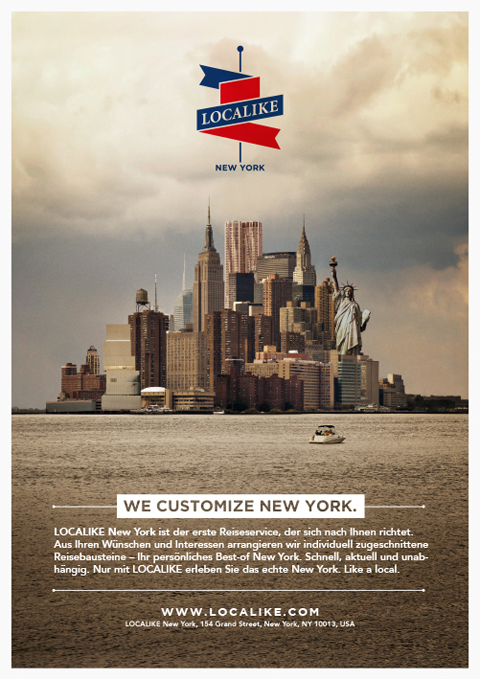
"Localike New York" arranges a customized visit to New York for tourists. The customized travel service was launched by a new agency: Pop Up Agency. Werbewoche has information on both.

loc

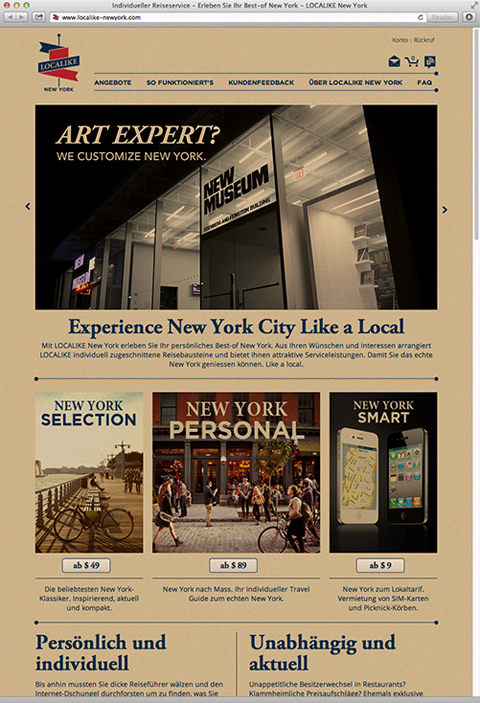
New York is the favorite destination of city travelers from Switzerland, Germany and Austria. From now on, visitors will benefit from a new travel service: Localike New York has committed itself to the principle of "Customized Traveling" and breaks with tourist conventions. Instead of picking out the right thing from a flood of offers, tips and information, Localike customers simply record their preferences and interests online. Localike New York uses this information to arrange an individual travel program for each customer. And thus offers its customers the opportunity to experience New York like a local. Like a local.

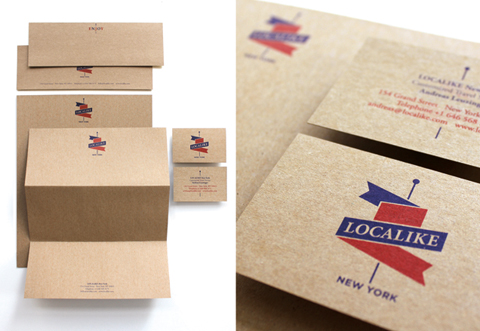
On behalf of the American-Swiss start-up, the Pop Up Agency brought this concept to market maturity. The intensive planning process with market analyses, desk and field research as well as the definition of positioning and corporate design was followed by the implementation on website, online advertising, SEM, print ads and PR in German-speaking Europe. The great media response (Die Zeit, Welt am Sonntag, GQ, annabelle, Brigitte, SI Style, Bolero and others) helped Localike New York to a successful start.

For the implementation of the website and e-commerce platform Localike.com is the responsibility of the Zurich web agency Square.

Who the f*** is Pop Up Agency?

Who or what is behind the Pop Up Agency? Werbewoche has profiled the new agency. You can read all about it in the print edition, which appears on Friday, or (for our subscribers) already online: Portrait Pop Up Agency.

popups

Responsible at Localike New York: Andreas Leuzinger, Simon Mingozzi. Responsible at Pop Up Agency: Roli Hofer (concept, art direction), Michi Benz (strategy, marketing, consulting, text, PR), Thomas Campolongo (naming), Andy Schmid (website concept). Website programming: Square. Photography: Sandra Kennel.

loc1
loc2
loc3


What kind of brand can it be?

It used to be clear that a trademark was a word or a logo. Nowadays, however, new forms of trademarks are constantly emerging, such as motion trademarks. To ensure proper protection, it is important to be aware of the options available. By Ueli Grüter

At the Swiss Trademark Office, the Swiss Federal Institute of Intellectual Property (IGE), one can register eight different types of trademarks: the word mark, the mark with figurative elements (logo), the color mark, the acoustic mark (jingle), the three-dimensional mark (shape mark), the motion mark, the position mark and the hologram.
 
The simplest and probably most common trademark is the word mark like SWISSCOM. This mark is contrasted with the logo, which consists only of a picture, the figurative mark, such as the Puma of the sporting goods manufacturer Puma. If the word is combined with a picture, trademark lawyers speak of a combined word/figurative mark, such as the designation "Swisscom" with the corresponding logo. However, such a trademark can also be a graphically original lettering, like that of the Coca- Cola Company. A color such as "postal yellow" is actually part of the public domain and cannot, in principle, be registered as a trademark. However, if a certain color is used for years or even decades for a certain product and the public identifies the certain color with the corresponding product over time, the trademark offices allow such colors to be registered as trademarks in special cases. A well-known example of this is "postal yellow," defined as Pantone 116 C/109U, which Swiss Post has filed as a trademark for postal services. Among the newer types of trademarks is the acoustic trademark, usually the acoustic sign of a company such as the well-known jingles of Migros and Swisscom. These are not filed as sound documents, but as written musical notes. The three-dimensional trademark or shape mark has existed for a long time. With this trademark, the public immediately identifies the shape of a product or its packaging with its manufacturer without any further references. The best-known example of this is probably the Coca-Cola bottle, while Nestlé's "Nespresso capsule" is still hotly disputed. The latest brand type is the movement brand. This is usually a figurative mark that moves in use. The best-known example in Switzerland is Swisscom's new logo. When a motion mark is deposited, it must be represented in several figures in such a way that the movement can be guessed at, even if it is not actually seen. The position mark is usually a sign that actually belongs to the public domain and thus cannot be registered. However, if the mark is always placed in the same position on the product by the manufacturer, the public may, over time, directly identify the mark in that position as the mark of the corresponding company. A well-known example of this is the three stripes of Adidas on sports shoes. For practical purposes, the hologram as a brand seems to be insignificant. 
 
As the example of the "Nespresso capsule" shows, special brand types can be worth their weight in gold. It is therefore important to know the possibilities of brand practice in order to make full use of them.

Unbenannt-13_7
 
Ueli Grüter, LL.M., Attorney at Law, Grüter Schneider & Partner AG, Zurich/Lucerne, is a lecturer in communications law at the Lucerne University of Applied Sciences and Arts and co-editor of the book Kommunikationsrecht.ch. He comments once a month in Werbewoche on practical legal issues in advertising. Questions can be sent to the Werbewoche legal expert at [email protected].

Der Motz vom Butz: Why bad advertising happens. Chapter 2

Theories on why bad, misleading, and incomprehensible advertising can emerge despite the presence of so many smart advertisers and marketing professionals. By Theophil Butz

Theory D: The wrong and unrealizable image ideas. The AD's and a copywriter's task is to invent an image print campaign for a family magazine. It should be as eye-catching and humorous as possible. The CD is persuaded to present photographed jokes to the client as an idea. The story is explained in scribble form, as everyone can imagine this idea very well. A new joke subject is to appear every month. So far everything is okay. Interestingly, however, jokes are usually drawn, and for good reason. The people in the joke are always depicted as exaggerated caricatures. Mordillo's characters are like bullets, Sempé's have big noses and Schaad's Eva only has three hairs on her head. And and and. If you photograph a joke, the joke is gone. There are many picture ideas that end up being incomprehensible after realization. The idea of having Denner consumers look surprised and wide-eyed into a shopping bag, so that the viewer is stuck in the bag and looking upwards into the opening, is unclear because people are not familiar with this frog's-eye view from a shopping bag. Everyone I asked about this couldn't understand the message. So the advertising missed its target.

Theory E: Throw five tennis balls to a consumer at the same time. How many can he catch? None. If, on the other hand, you only throw one ball to your target person, there is a very good chance that he will be able to catch it. A basic advertising rule known to all. Or also known as KIS. Surprisingly, however, I come across a lot of advertising that disregards this rule. In TV advertising, this overloading of messages doesn't happen so often, although there would be time for it. The poster, whose message I should be able to grasp in a second, tries to throw up to six tennis balls at me, see the automobile industry advertisement. H&M is spot on. A pretty bikini girl with the text "Top 12.50". You get it all in a second.

Theory F: Imitating successful advertising concepts can really backfire. The success story of Nespresso, for example, could be imitated. You could bring together a film actor like Til Schweiger with Charles Vögele or Hingis with a washing machine. As we know, that doesn't work. Nespresso's recipe for success is not just Clooney, but the product idea in excellent quality, the exclusive and perfectly styled stores and only then comes Clooney, who is presented as a minor matter but fits well with coffee. Nestlé can also afford such a campaign financially. To prevent the advertising message from being received negatively and inappropriately, it takes much more tact than simply copying something successful. In the next issue, you can read three more theories about the origins of bad advertising.

My dish of the week was mashed potatoes with olive oil, a quail egg and tartufi on top at Ristorante Il Cantuccio in Arezzo.

Unbenannt-6_17
 

World class made in Switzerland

From the Engadin to New York and back to Zurich, with a few high-profile clients in their portfolio. Based in Binz, Gian Klainguti and the animation company Kompost have managed to keep pace with the world’s top specialists in the industry.

His world is the rapidly expanding universe of animated film. Around ten years ago, Gian Klainguti and Oliver Conrad began to attract attention with innovative music videos, commercials and short films. The two, who are now 33 years old, founded their company with the nourishing name Kompost in New York in 2004. In the meantime, they mainly serve their clients from Binz in Zurich. Three years ago, the creative start-up from Switzerland was allowed to realize the McDonald's campaign "Happy Meal" with Spaceman Stu. The three spots have been broadcast from coast to coast in the USA and have also earned Kompost three nominations for an "Annie". This award is considered the "Oscar" for animated films. "We competed against Dreamworks and Psyop in this competition. As a small start-up, we naturally felt deeply honored among these giants," says Gian Klainguti.

International agents

But how did Kompost get such a commission in the first place? "We are one of the few Swiss studios represented by an agency in Los Angeles as well as a second global agent. They are invited to pitches and then pass the job on to us if they deem us suitable. Then we deliver a treatment that presents possible implementation concepts, animation-related story ideas and visualizations. If we're lucky, we get the contract," says Klainguti, explaining the procedure that is used less often by Swiss filmmakers. This work, also otherwise somewhat off the beaten track, got its start because Klainguti had an American mother in addition to his Grisons father. Thus, during his film studies in Zurich, the aspiring director regularly commuted to New York. There Oliver Conrad studied Fine Arts in Communication Design. Together, the two exiles found themselves working on various projects. These jobs grew steadily and eventually led to the founding of their own company in the Big Apple.

The first successes came with animated music videos. That led to contacts with New York advertising agencies. "Often the budgets for animation were only $1,000. But we still wanted to do something and almost never said no to a project. There's no other way for a newcomer to gain a foothold in this industry," recalls Klainguti, who in the meantime slid more and more into the role of producer alongside Conrad as CD. A two-room apartment in New York served as the studio, where they also cooked and slept at the same time.

Then the budgets slowly increased to five- to six-figure sums. "With that, we were able to implement more and more of our ideas as imagined. But New York remained a tough school, and that taught us a lot. Especially the high quality standards that prevail here within the industry. We have taken this with us." Even back in Switzerland, the specialists at Kompost always want to measure themselves against other countries and the qualities offered there. That's probably why the studio continues to be invited to international pitches, even though its "headquarters" have since been moved from the American advertising mecca to a loft in Binz. "In this environment, we have to prove ourselves against competitors from London, New York or Berlin. That's what makes it interesting. " The company's New York branch has been retained, however, because "sometimes a client wants us to handle their project locally." For such orders, those responsible are always happy to travel to the States for the necessary time. "In the meantime, however, the trust has been confirmed, so that they also let us realize orders from the USA in Zurich. Because the most important thing is to be able to deliver on time while meeting the highest quality standards."

This is now also appreciated by customers such as Samsung, WWF, UBS, Swiss Life, Migros and Swisscom. For Samsung, Kompost was able to implement a globally deployed project as part of the London Olympics. "For this campaign, we were able to shoot together with David Beckham and Jamie Oliver. With them, we realized ideas that go far beyond traditional TV spots with interactive effects and gaming options for the Internet. Such concepts are increasingly in demand," says Gian Klainguti, analyzing a booming trend in the industry.

Support from Edi

The constantly larger and more complicated orders have also required investments in new dimensions. From the founding cell in New York to a spacious open-plan office in Binzstrasse with around fifteen workstations, a ping-pong table and upholstered corner for brainstorming, and, as the centerpiece, a server room for a whole battery of high-performance equipment. The breakthrough in Switzerland was helped by some Edis for their music videos and, last but not least, a post-production for the Swisscom commercials for the series "Viva Casa" by Stories. For these Stories out of the set-up box, Kompost contributed the visual effects. It continued with commissions for Migros and their "Twistymania" or the successful animations for "Snacketti" by Zweifel.

"Since we have worked mainly for international clients, most of the work on our website at the moment comes from abroad," explains Klainguti. These projects are strikingly often dominated by animated figures. ≪In Switzerland, however, we offer the entire technical spectrum in the field of animation: elaborate 3-D spots, 2-D animations, infographics, animated product and educational films, as well as interactive animations for the web and apps. The development of characters and their physical realization in 3-D printing as well as illustrations for print campaigns are also one of our strengths.≫ Kompost will therefore be launching a new website in the next few weeks, ≪where we will present our entire range of services≫.

Agencies come primarily for classic commercials. Direct customers ask more for corporate and image stories. ≪We then develop the concept ourselves in collaboration with these customers. We are allowed to bundle entire packages with our ideas≫, is how Klainguti describes his studio's comprehensive range of services. However, animation will remain the focus of the work in any case. As a film production company, Kompost also knows how to combine live action with animation. The specialists see themselves not only in the role of implementation partner, but also increasingly use their technical and creative knowledge as a consulting partner. ≪In Switzerland, we often find that customers still have some reservations about animation. In this case, we see ourselves more as a partner who helps find a creative solution. We always take a close look at the concept before deciding on an implementation option. Sometimes clients absolutely want images in 3-D, even though 2-D could be used to create something much more appealing and better suited to the communication objective in question.

The style of Kompost is driven more by the staging idea than by the technique. ≪As a producer, I want to push the artists in our work so that they can carry their ideas through to the end and the ideal ideas are not washed away as far as possible.≫ At the same time, however, Gian Klainguti is present abroad a lot at congresses and observes the new technical possibilities there very closely. ≪You can't sleep in the area of this innovation in the digital world, which will soon be presented on a daily basis.

Klainguti sees a positive future for the animation industry. ≪Digital advertising and communication content is becoming increasingly important, and animated content can be multiplied particularly well and easily in this area.≫ Computer animation also offers huge potential in the creative staging of communication content. The advantages lie in the more effective and customer-oriented presentation of complex information, for example in animated infographics. Animation also creates an independent communications presence that is clearly differentiated from the competition and stands out better in the general flood of communications, for example a character as a likeable brand ambassador. This is illustrated by the Grand Prix winners at Cannes Lions 2012 (Chipotle ≪Back to the Start≫) and 2013 (Metro Trains ≪Dumb ways to die≫) - both animated campaigns. The Zweifel-Snacketti spot animated by Kompost also received top marks in the Werbewoche impact check. Furthermore, Klainguti also sees potential for interactive stories. ≪We don't just want to offer an image film, but create our own new worlds and drive the audience into them.

One of Kompost's goals, synchronized with the development of integrated advertising, is its sustainable impact. ≪Thinking about stories in the long term. Not just creating a spot, but first developing a new world, bringing a character to life in it, and then letting this package play out across a wide variety of media and levels.≫ In the area of self-advertising, Kompost also works consistently with the means of storytelling across new worlds. This is demonstrated on the Facebook page with its own webisodes. The mini-stories, which were created more as a gag, already have over 35,000 fans. Kompost is doing a different kind of self-promotion at TEDx Zurich. A year ago, Gian Klainguti was not only a guest speaker at this ≪Zeitgeistkarussell≫ der neuen Denker ≪und schragen Vogel≫ (carousel of the spirit of the times), which took place in Studio 1 of SRF. Since then, Kompost has also designed the entire corporate identity of the future-oriented event as part of a sponsorship.

Andreas Panzeri

Unbenannt-23_0
 

Swiss tubers without a chance?

Although YouTube is the most popular social network among consumers in Switzerland, very few local content creators have established themselves on the platform yet.

The video platform YouTube belongs to the search engine and advertising giant Google, so one thing is clear: there are no figures on its distribution in Switzerland. So it is (and will probably remain) an assertion when Werbewoche describes YouTube as the most popular social network in this country. But there is good evidence for this: Younger users in particular search for visual content first and do so on YouTube, and because they also frequently use the extensive range of music on YouTube for their individual soundtrack, they are connected to the site for long periods of time every day. YouTube has been the second-largest search engine since the end of 2011, when Google integrated the video platform with its Google+ social media initiative. Today, YouTube claims to have over one billion unique users worldwide every month, who watch six billion hours of videos. That is 50 percent more than a year ago.

Swiss YouTube stars

In Switzerland, YouTube launched a special Swiss channel in April. The timing of this is remarkable, namely a good five years after such a country-specific channel was introduced for Germany. This gives an indication of the market leader's assessment of the Swiss online video market. Like Google, the search engine giant's subsidiary also makes its money with advertisements that are tailored as precisely as possible to the target groups. In order to be able to offer attractive and exclusive content in addition to cat videos and the like, YouTube sets up an original channel for successful and well-known or up-and-coming names and contributes to the production costs. There are currently 13 original channels in German-speaking countries, 60 in Europe and 186 worldwide. When this initiative was launched, Google pledged 100 million dollars for it and last year invested 200 million for its promotion and marketing.

But even video producers who have not been selected for an original channel can benefit from YouTube by having their own videos released for advertising. Such YouTube partners receive a share of the advertising revenue. According to YouTube spokesperson Mounira Latrache, the partner program has more than 1 million partners from 27 countries. Every year, "millions of dollars" are paid out to the partners, with "a few hundred YouTube partners in the USA even generating profits in the six-figure range". However, this only works with correspondingly large target markets. Switzerland is far removed from this - so is it the end of the story for YouTube stars from Switzerland? Certainly not when it comes to Julia Graf alias MissChievous and Benoît Moreillon alias Diablox9 - both have already been the subject of several media reports due to their YouTube channels:

- MissChievous (572,706 subscribers): She posted her first make-up video on the internet five years ago and now earns her living from it. She produces at least one new video every week, with the most successful ones reaching up to six million viewers. The basis of her success is quickly clear: the Swiss-Canadian dual citizen speaks English and therefore reaches an international audience.

- Diablox9 (1,443,458 subscribers): He is also hereditarily favored, as his father is a radio journalist, so his appearances in front of the camera are characterized by a calm professionalism that cannot be taken for granted in a young person. And his topic is also typical of his generation: it's about video games. However, not in English like most others who tackle this topic, but in French. When he started at the age of 13, he was quick to conquer a gap in the market. As a 20-year-old, he now has an audience of millions thanks to YouTube, which he could only have reached decades later at best with a conventional professional career.

Although there are a few other YouTube practitioners in Switzerland with a sizeable following, no other YouTube stars from Switzerland with similar reach can be found (in the YouTube statistics from Socialblade or Socialbakers). Above all, there is a lack of channels with genuinely Swiss content (in dialect, for example) from independent new talents who make YouTube their stage.

Networks

It is precisely these commercially successful Tubers that have led to another commercially interesting phenomenon in other markets such as the USA or Germany over the last two years: YouTube networks. These are sometimes compared to the film studios in Hollywood in the 1930s, when the film business was in its infancy. Nobody knew exactly where the journey would take them, so they bought as much exclusive content as possible, mostly from young and inexperienced producers. Today, YouTube networks take a similar approach and merge different channels. Like record labels, they discover and promote talent. They help with production and promotion, as young talents are often unable to take care of all aspects as a one-man show. And they offer support in the event of conflicts relating to copyright issues, as they have better contacts with YouTube to resolve these. Such networks usually have clear target groups, bundle reach to improve marketing and sell advertising, sponsorship and product placements. The network earns from this and the partners involved should also be able to achieve better revenues.

YouTube networks have grown rapidly over the past year, particularly in the USA, and every major network now has investors from the media industry on board who do not want to miss out on these new gold mines. Google itself has invested in Machinima and Next New Networks, Comcast in Full Screen, Bertelsmann in Style Haul, Time Warner in Maker Studios, Discovery in Revision 3. Commentators therefore see the future of video currently at a turning point, with the next generation of big media companies being born on YouTube. They are combining new technologies with good old-fashioned video production and some will succeed in establishing themselves as partners or competitors to today's big media groups.

A good dozen such networks have also emerged in Germany. The German flagship network is Mediakraft. Unlike the equally wide-reaching Game Star&Friends network of media company IDG, for example, it was founded by YouTubers for YouTubers and today describes itself as "Central Europe's largest online TV station group". Mediakraft's most successful driving force is the comedy trio Y-Titty. With songs such as "Halt dein Maul" or "Ständertime" and Eminem parodies, they reach over 2.2 million subscribers, making them the most popular German YouTube channel. It has a fixed format: Every Wednesday, the troupe uploads a video from the comedy show section - this is where Philipp Laude (Phil, 23 years old), Matthias Roll, (TC, 22) and Oguz Yilmaz (OG, 22) discuss users' comments on their films. Fridays are FreiTitty Day, when new sketches are posted online. Mediakraft uses the appeal of its flagship channel to promote new channels such as Ponk, which got off to a fabulous start with over 100,000 subscribers on its first day. However, the top channels are generally relatively old. They have grown and their producers have constantly optimized their channel, producing videos for years that hardly anyone watched, and they have saved their time for it. Then they suddenly had a viral hit or were recommended by YouTube on the homepage. Anyone who has established a channel in this way not only generates views from the new videos, but also from the archive, which often accounts for more than half of the views.

La Suisse n'existe pas

In 1992, the motto "la Suisse n'existe pas" ("Switzerland does not exist") adorned the official Swiss pavilion at the World Expo in Seville, triggering fierce controversy. Today, this observation largely applies to YouTube: Although YouTube is consumed diligently in our country, Swiss content (still?) hardly plays a role on this new platform. On the Swiss homepage, YouTube documents what the often under-30-year-old YouTube consumers in Switzerland are watching: "An Interpretive Dance For My Boss Set To Kanye", "Treehouse of Horror XXIV Couch Gag by Guillermo" and "Rihanna - Pour It Up (Explicit)" (most popular videos from 7.10.2013). One reason for the lack of local video producers with Swiss content on YouTube is easy to find: The curse of the small market. What works in the USA and in Germany, namely that producers have a chance to finance themselves through a share of the advertising revenue, is hopeless in the Swiss mini-market. Possible measures to counteract this are quickly formulated, but hardly quick to implement:

- YT uses higher prices in the Swiss advertising market, which should also make the share payments to Swiss producers more attractive and ensure their survival in the event of success, as is the case abroad.

- The state instruments for media promotion (film promotion, etc.) will be extended to video producers on YouTube so that Swiss content can be used on this new media platform.

- Companies support video producers by enabling them to produce content that fits the You Tube platform and also has a positive impact on the image of the respective company.

- Depending on which of the above three options is mainly used, a corresponding Swiss network will be established to support and promote Swiss tubers.  In education, the production of videos should be promoted at the appropriate level. In schools, the production of video contributions should have the same status as the writing of essays, and there should be corresponding job profiles and courses of study at universities of applied sciences.

It's not that there aren't any talented video producers in Switzerland - it's just that they haven't yet achieved a brilliant reach on YouTube. We will present some of them in the rest of this video marketing series.

Christoph J. Walther
 

Workshop "Submit Effie Cases Effectively".

In order to facilitate the work of the participants and to remind once again the most important rules for an effective and efficient submission to Swiss Effie, BSW Leading Swiss Agencies organizes a workshop.

The aim of the workshop is to use the twelve golden Effie tips and successful case studies to show agency staff how to prepare their information and data effectively, convince the jury of the effectiveness of their campaign and stand the best chance of winning an Effie.

The speaker is Cary Steinmann, who has a lot of experience as a juror at the Euro Effies and at Swiss Effie as a strategic planner from the very beginning as well as a university lecturer.

Time: October 28, 2013, 4:00 - 6:00 p.m.
Location: HWZ University of Applied Sciences, Lagerstrasse 5, Zurich
Participation fee: Fr. 50.- per person
Registration deadline: October 18, 2013
Please register by mail to [email protected]


Advertising discovers their research

The minimal agency

The Pop Up Agency marks the launch of a new, unconventional agency model: a network of independent communications specialists from which advertisers can assemble a team.

There’s a touch of whimsy—and it’s intentional—as Michael Benz and Roli Hofer take center stage at the Bäckeranlage in Zurich’s Kreis 4. Benz has taken a seat on a park bench, while Hofer stands a little further ahead, sipping from a teacup.

The founders of Pop Up Agency like to break free from constraints. «Just because we’re an agency now doesn’t mean we need a fancy conference room,» says Hofer. Meetings take place in his studio on Kanzleistrasse, at Benz on Kreuzplatz, at a client’s office, in a pub—or, like today, somewhere outdoors. «We’re a non-physical agency.»

The agency’s work location is as flexible as its structure is agile. True to its name, the Pop Up Agency comes into being when there’s a project. When it’s no longer needed, it disappears again. Regardless, Hofer and Benz continue to operate as sole proprietors and serve their own clients.

The Pop Up Agency’s motto is «as much of an agency as necessary.» No office space, no employees. It consists of a network of freelance communications experts who come together under one roof for each project. This business model allows fixed costs to be kept to a minimum and calculated in a targeted manner.

The core team at Pop Up Agency currently consists of seven people. The agency thus covers the key areas of communication: art direction, copywriting, strategy/consulting, social media, mobile, web, film/production, and events/catering. Additional specialists are brought in as needed for each project.

Roli Hofer (Art Director) and Michael Benz (Consulting/Strategy) are in charge. Hofer has been working as a freelancer for five years. Benz, who worked on campaigns such as «Slow down, Take it easy» at the Rod agency, founded his own communications consulting firm a little over a year ago.

For each project, Benz and Hofer conduct the initial assessment and select suitable specialists. If they wish, advertisers can put together the team themselves right away—and contribute their own expertise in the process. «We believe in the empowered client,» says Benz.

«Does the English humor come across?» Hofer asks. A passerby has stopped in the meantime and is looking on curiously to see what’s going on here.

In time for its official launch in October, the Pop Up Agency is already able to showcase several projects that have been carried out within the network. For example, the team worked on the Berne Declaration (BD) Drawing consumers' attention to the unfair production conditions in the chocolate industry. For once, the chocolate bunny isn’t hopping happily through the ad—instead, he attempts suicide. The sweet mascot simply cannot live with the fact that he is made from unfairly produced chocolate. A giant chocolate bar was also assembled via a Facebook page. Every consumer could add a small bar with their name on it. The mega-bar, consisting of over 13,000 pieces, was eventually put into production and presented to the chocolate manufacturer Lindt & Sprüngli in front of the media, along with a call to offer more fairly produced foods.

//www.youtube.com/watch?v=TwWrKrPdgzU

The work of Pop Up Agency speaks a modern, urban language. «Contemporary,» says Hofer. When it comes to content, they don’t want to be held back by any constraints. «We think in a media-neutral way and believe in the power of storytelling—especially in the context of integrated communication,» says Benz.

Stories that are particularly likely to be picked up by the media. This worked exceptionally well with the project «No louder than 40 decibels in front of the club,» which raised awareness among Zurich’s nightlife-goers about the noise problem around bars and clubs. Instead of taking the moral high ground, a bed was set up right in front of the venues. Inside, two actors tried to take a nap. If the guests were too loud, they were given a warning. The campaign was covered by various media outlets, including 20 Minuten and Tele Züri. «I believe that honest, funny, and touching stories are often shared—even by the media,» says Benz.

loc

The strategy has also paid off for «LOCALIKE New York», a customized travel provider that arranges personalized travel itineraries tailored to customers’ interests and preferences. Pop Up Agency helped the American-Swiss startup get off the ground and, in addition to the planning process—including market analysis, research, positioning, and corporate design—managed its PR efforts in German-speaking countries. In addition to online and print advertising, media coverage in various publications helped raise the startup’s profile (including Die Zeit, Welt am Sonntag, GQ, annabelle, and SI Style).

«Are we almost done with the shoot? It's starting to get hot …,» Benz asks.

«One more question: For which clients are you the right partner?» – «Definitely startups—we have a lot of experience with them,» says Hofer. «And, in general, companies looking for a new, customized form of collaboration,» adds Benz. A collaboration in which clients can decide for themselves which services they need—and pay only for those. True to the agency’s slogan: «Whatever it takes.»

Isabel Imper

popup

In a nutshell
Since September 2012, Michael Benz (Photo on the right) his own communications consultancy specializing in strategy, consulting, and PR copywriting. His previous positions include stints at the agencies Rod and Publicis. At Rod, he served as Head of Consulting and Strategic Planner, overseeing campaigns such as «Slow down, Take it easy»; at Publicis, he handled PR and co-led the «Migros M’08» project, among other responsibilities. Roli Hofer He has been self-employed for five years (ROLI HOFER Graphics/Concepts/Campaigns). Before that, he worked at the advertising agencies By Heart and Sulzer, Sutter.


get_footer();