Last but not least: Turning set with pitfalls

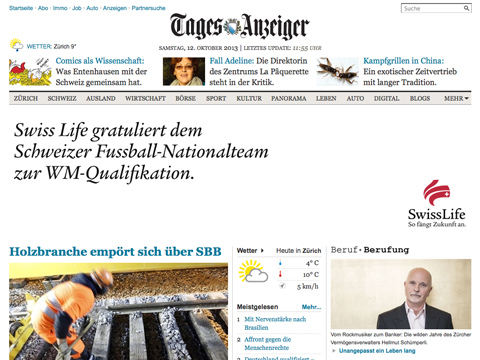
With an almost perfect turn of phrase, Leo Burnett congratulated Swiss Life on qualifying for the World Cup.

As seen on Saturday on Tagesanzeiger.ch:

wendesatz-01


wendesatz-02

Sport also takes unexpected turns. For once, the national soccer team has made everything clear ahead of time. A must-win match in which, in a positive sense, nothing more is at stake - uncharted territory for Switzerland. The group was undoubtedly easy. But one remembers all too well the times when Switzerland stumbled over supposedly easy opponents when the chips were down. Fortunately not this time, the turning point brought it to the point. For one day, because after a few calculations, the next unexpected twist followed: Against Slovenia, we better not take it easy at all! Because another - no less pleasing - premiere beckons: pot one in the group draw for the final round!

With a win on Tuesday and a little help from either Italy, Uruguay or Colombia, Switzerland can expect nothing less than to advance to the group of seven best teams in the FIFA world rankings. These, along with hosts Brazil, make up the coveted first pot - the top teams distributed by lot among the eight groups. In other words: Those who are themselves in the first pot are guaranteed not to meet the other seven top teams in the group stage, but "only" nominally weaker countries. That's a stroke of luck for Switzerland, because it will have to deal with opponents like Germany, Spain and Argentina soon enough in the knockout phase if it qualifies.

"A fantastic view and additional motivation for the game against Slovenia," national coach Otthmar Hitzfeld told the Sonntagsblick. It looks like the comfort will have to wait. But never mind, the next turnaround opportunity is sure to come. For example, on July 14, 2014, the day after the grand final:



swissnati
 

Thomas Häusermann

Le Temps: Jean-Claude Biver interested

Watchmaker Jean-Claude Biver is interested in purchasing the French-Swiss newspaper Le Temps. He said Thursday on a program aired by the TV station La Télé that he would contact the current owners and make an offer.

Biver is chairman of the board of the Swiss luxury watch brand Hublot. He does not want to make a fortune in the industry, it is rather a desire of his heart, said the 64-year-old. His involvement is private, he said, and he does this out of love for French-speaking Switzerland. However, he also does not want to lose too much money. The media company Agefi, which publishes the business newspaper of the same name, already expressed interest in buying Le Temps on Wednesday (Werbewoche.ch reported). Speaking on RTS radio in French-speaking Switzerland, Agefi shareholder Antoine Hubert said he had already discussed this possibility with major shareholder Alain Duménil. "Biver would be the ideal solution," Peter Rothenbühler, a member of the management board of Tamedia Publications Romandes and former editor-in-chief of Sonntagsblick and Le Matin, told the Switzerland on Sunday. The entrepreneur is aware of the importance of the newspaper as the western Swiss counterpart to the NZZ. Rothenbühler is convinced that there will be no staff reductions under Biver. He rather expects investments; Biver wants to have the best journalists from French-speaking Switzerland under one roof.

On Tuesday, Ringier and Tamedia had announced that they would look for a buyer for Le Temps by June 2014 (Werbewoche.ch reported). The two publishers each hold 46.2 percent of Le Temps. (SDA/SaS/hae)

Please note our current survey on this topic! (Results in the print edition)

Image: Keystone

"Schawinski" loses viewers

The ratings for Roger Schawinski's TV show «Schawinski» are falling. However, the talk show host is taking this trend in his stride.

As reported by Schweiz am Sonntag, the last show with photographer Alberto Venzago only reached 68,000 viewers, which corresponds to a market share of ten percent. By comparison, the guests Christoph Blocher with a market share of 24.4 percent and Melanie Winiger with 182,000 viewers achieved significantly higher ratings in 2013. The viewer and market share trend has been pointing downwards since the beginning of the year.

Nevertheless, the talker is sticking to the concept. According to Schawinski, guests from the cultural sector are only of interest to a specialist audience. It's the mix that makes the difference, otherwise he would only be able to invite SVP politicians and people from show business. The attractiveness of the supporting program ("It's hard to compete with Roger Federer") and the topicality of major Swiss events also play a role. On Monday, for example, Cédric Wehrmuth is to ensure more pleasing ratings as part of the 1:12 initiative. (hae/SaS).

On the topic: Werbewoche interview with Roger Schawinski "I go where it hurts"
 

Advico: Print subjects for Snacketti by Zweifel

The TV and online campaign for Snacketti was expanded to include two print ads. As in the TV commercial, Advico Y&R emphasizes that Snacketti by Zweifel are extremely crunchy and shouldn't be eaten just anywhere.

For example, you should be quite sure that you are not sitting on a sleeping monster that could be awakened by cracking. The "monster fish" subject has already been in use at POS since June, and the "snow monster" will be used as a poster and ad with immediate effect.

Responsible at Zweifel Pomy-Chips: Roger Harlacher (Director Marketing & Sales), Stefan Märki (Senior Key Account & Product Manager), Reto Anderwert (Product Manager). Responsible at Advico Y&R (Member of Y&R Group Switzerland): Dominik Oberwiler, Martin Stulz (CD), Lukas Wietlisbach (AD), Marion Lim (Text), Jeremy Küng, Annik Weber (Graphics), Kerstin Schnyder, Pascal Trütsch (Consulting), Responsible at Kompost (Animation Studio / Production Company): Oliver Conrad (Creative Director), Gian Klainguti (Executive Producer), Dennis Guggenheim (Producer), Angel De Franganillo (Illustrator).

Snacketti_Fisch
Snacketti_Yeti
 

Ruf Lanz: VBZ personnel campaign a success

Since Zurich Public Transportation has been recruiting women as tram drivers with a clear strategy, specific goals, and targeted communication, the number of women in the driver's cabs has increased significantly.

The most recent personnel campaign of the long-standing VBZ agency Ruf Lanz was aimed specifically at career changers from industries with irregular working hours and customer contact, for example bright bakers or nimble waitresses (Werbewoche.ch reported). Because in the driver's cabs, VBZ needs no fewer than 120 new drivers per year.
Jörg Buckmann, Head of Human Resources Management at VBZ, says: "The labor market is 45 percent female, and there is potential there. So we address women directly with targeted campaigns."

The lateral entry campaign for women has been successful, as the Tages-Anzeiger reported on Friday on the front page of the Wirtschaftsbund. Since the start of the campaign, the proportion of women among the applications received has risen to over 30 percent. Before that, only just under 100 out of a good 500 people interested in a job had been women, he said. In addition, VBZ has received significantly more application dossiers than in previous years, which Jörg Buckmann attributes largely to the greater response from women. In the meantime, 42 percent of the jobs in the streetcar cockpit have gone to women. And this is without any quota pressure at all.

"Women like to drive shifts" (Tagesanzeiger.ch)

VBZ-Rekrutierungskampagne-Tagi
 

Republica: Digital power play for SCB

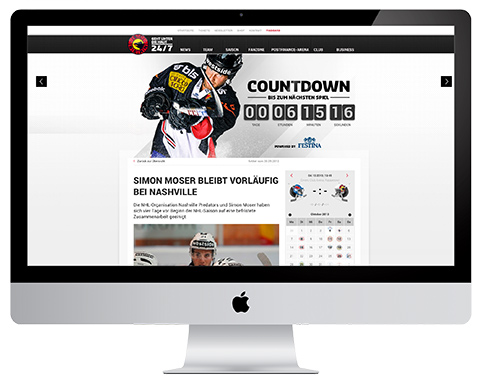
Republica has developed and implemented a new digital marketing strategy for SC Bern. Shortly before the start of the 2013/14 season, the online portal, the SCB app and SCB TV were relaunched as the centerpiece of the digital offensive.

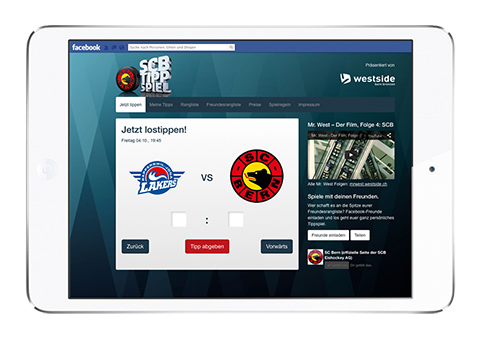
The SCB wants to exploit its digital brand potential, tap into new sources of revenue and strengthen the bond with fans outside of the PostFinance Arena. According to the press release, Republica's current mandate therefore includes design, development and consulting as well as editorial management and implementation of the digital platforms. With the cross-device-capable redesign of scb.ch, the systematic integration of social media and the relaunch of SCB TV and the SCB app, Republica has created added value for fans as well as new interactive forms of advertising (multi-screen) for sponsors and partners.

New multi-screen presence at Scb.ch

Republica has not only given the SCB website a facelift, but has also created numerous advantages for users. News and information are quickly available thanks to the clear navigation. Images and videos as well as texts and information offer an optimal mix of information and entertainment. New marketing platforms for sponsors and partners have also created additional sources of income for the club.

SCB TV - unique glimpses behind the scenes

SCB TV, produced by VJii Productions, provides a unique look behind the scenes of the reigning Swiss ice hockey champions in around 60 TV reports per season. In addition to sporting news, the program also includes background reports. Republica is responsible for the design and overall content planning.

SCB App - successful launch

In collaboration with Ahrina and Swiss Ice Hockey, Republica has also launched a new native app for the SCB. It offers everything you need to know about the SCB and the league, from information and news about the players, team and club to live results with push notifications and the current standings. Initial figures after around three weeks confirm the successful launch: 15,624 users (as of October 10, 2013) are registered (9,517 iOS, 6,107 Android), who have already received more than 768,237 push notifications. The SCB app also remained in the App Store's top 10 hit list of free sports downloads for three weeks.

Responsible at SC Bern: Nicole Isenschmid (Head of Marketing), Christian Dick (Head of Media). Responsible at Republica: Bala Trachsel (overall responsibility), Simon Muster (project management), Christoph Emch (responsible for content/consulting), Michael Müller (social media), Simon Matz (graphics), Fabian Schäublin (multimedia producing). Responsible at VJii Productions: Urs Koller (overall responsibility); Michael Kasper (VJ/producer), Stefanie Giardina (VJ), Simon Schenk (VJ). Programming: Gutknecht Informatik, Matthias Gutknecht (ONLINE), Ahrina (APP). Art Direction: Fabian Bürgy. Marketing: IMS Sport, Erwin Gross (CEO), Mike Dähler (Director Marketing & Media), Björn Sie-genthaler (Sponsoring & Media Manager).

SCB_TV_Screen


//www.youtube.com/watch?v=RPP4KclRb3g

web_0
tippspiel
SCB_App_Montage

Popcorn makes you immune to cinema advertising

Cinema commercials can fail to have the desired effect on popcorn-eating viewers. Cologne researchers have come to this surprising conclusion. Advertisers should therefore insist on this: First watch, then nibble.

According to a study, cinema advertising for new products does not work for popcorn-eating viewers. According to the researchers, the reason for this is that people can only remember unfamiliar product names correctly if they unconsciously repeat them silently. However, this is not possible when your mouth is full, the University of Cologne announced on Friday. "Advertising for new products could therefore be pointless for snacking movie audiences," conclude the researchers, led by psychologist Sascha Topolinski, in an article in the Journal of Consumer
Psychology. The study had a total of 284 participants.

The advertising effect does not apply to chewing visitors

Previous studies have already demonstrated the mechanism behind advertising: When people perceive the names of products, the muscles in the lip and tongue automatically reproduce the pronunciation of these names without the mouth actually moving. Similar to a small child learning its mother tongue, the brain unconsciously trains itself to speak these names. As a result, the next time you encounter the name, you like it more than an unfamiliar name. If this pronunciation simulation is disturbed, for example by chewing gum or popcorn, the brain cannot train the articulation of the product names - and the advertising effect is lost. In the movie theater, this is exactly what happens when eating snacks. The mouth is then busy with other things than joining in with the names presented.

Popcorn eaters no longer liked the products on display

For the study, the scientists showed participants commercials of products they were unfamiliar with, for example a Scandinavian butter brand. Half of them ate popcorn, the other half did not. A week later, they were shown pictures of the products advertised in the cinema and of completely new, unknown products. The result: the participants who had not eaten popcorn liked the advertised products more, the others did not. In a purchasing situation, the non-eaters were also more willing to buy the advertised products. From the advertisers' point of view, it would probably be best if breaks were reintroduced at the movies, said Topolinski. Then the commercials would come first and then you could buy something to eat. In Switzerland, this problem only exists to a minor extent: here, most cinemas insert breaks halfway through the film so that moviegoers can enjoy popcorn or other products. (SDA)

"Die Schweizer": SRG upsets women

In November, Swiss Radio and Television (SRF) launches the month-long history debate "The Swiss". Female personalities find no place in the four main films.

Highlight of the Theme month are four feature-length films about six great figures in Swiss history. According to Schweiz am Sonntag, SRG is making Roger de Weck's "prestige project" cost more than five million francs. As the Sonntagsblatt reports, resistance is already stirring before the broadcast: an alliance of women is fighting against a "one-sided image of history" being conveyed by SRG. Among others, Council of States member Pascale Bruderer, ex-National Council member Judith Stamm and National Council president Maya Graf find it "inconceivable" that in 2013 women still do not feature in history. Alongside battle leader Hans Waldmann, Rütli conspirator Werner Stauffacher, hermit Niklaus von der Flüe, Red Cross founder Dufour, business magnate Alfred Escher and ETH founder Stefano Franscini, women such as Julie Bondeli, Johanna Spyri, Gertrud Stauffacher and Susanna Orelli find no place in SRG's historiography.

In the fall session, the 30 female SP parliamentarians sent Roger de Weck a letter of protest, whereupon he stated in a debate during the session that it had not been possible to put the women who shaped Swiss history in the background in the foreground, because the audience could not be picked up that way. SRG spokesman Iso Rechsteiner told the newspaper Schweiz am Sonntag that historically important Swiss women would be brought to the fore in the Sunday morning "Sternstunde" series. (hae/SaS)

dieschweizer
Image: Srf.ch
 

Publicitas continues to market Corriere del Ticino

The daily newspaper Corriere del Ticino has renewed its partnership with Publicitas for the marketing of advertising space in print, online, TV, and radio.

Corriere del Ticino, an independent daily newspaper in Italian-speaking Switzerland, is renewing its contract with Publicitas for the marketing of its advertising space, according to a statement. The mandate includes exclusive marketing of the daily print edition Corriere del Ticino as well as non-exclusive marketing of the weekly newspaper Extra, the online edition on Cdt.ch and the TImedia multimedia packages consisting of TV TeleTicino, online portal Cdt.ch, Radio 3i and print.

Fabio Balmelli, Sales Manager for Italian-speaking Switzerland, says: "We are very pleased to be able to continue our cooperation of over 120 years. Thanks to the marketing of the leading newspaper in the canton of Ticino and the various TImedia products, we can offer our customers a cross-media and at the same time regionally attractive portfolio of media solutions." The marketing partnership between Publicitas and the Corriere del Ticino has existed since Feb. 1, 1892, and is thus almost as old as the daily newspaper itself, which was founded in 1891. The print edition of Corriere del Ticino is published six times a week, has a certified circulation of 36'535 copies (Wemf) and appears in the circulation area of Ticino and Moesa (Grisons).
 

Last but not least: For not so smart people

Nimble offers «smart loans» to people with urgent financial worries. In the Australian company’s latest commercial, only idiots take advantage of this offer.

You can register on the Nimble website in five minutes, get access to a loan of up to 1,200 dollars within an hour and have to pay it back in 50 days with a steep interest rate of around 25 percent.

How do you advertise a service that gets people in a financial emergency into an even greater financial emergency after 50 days? For example, with cynicism and a pinch of absurd humor. (sis)

//www.youtube.com/watch?v=qAo-QDFbjkw

Press subsidies: Bakom requirements excessive

According to the Federal Administrative Court, Bakom imposes excessive requirements on press subsidies. To qualify for discounted postal rates, it should not be required that three-quarters of a newspaper or magazine’s readers be subscribers.

In 2012, the Federal Office of Communications (Bakom) rejected an application for press funding from the satirical magazine Vigousse in French-speaking Switzerland. Its negative decision was based on the fact that only 53 percent of the recipients of the circulation were subscribers. However, a subscriber share of 75 percent was required to be granted the discounted postal rates. The Federal Administrative Court has now upheld Vigousse's appeal. According to the court, the Postal Act stipulates that press subsidies are only granted for subscribed daily and weekly newspapers. In this respect, of course, no subsidy can be granted for copies sold at newsstands. However, a certain proportion of subscribers in relation to the total circulation was not required for the press subsidy to be granted. The decision can now still be appealed to the Federal Court.
(SDA)
 

The end of full service

The Bernese copywriter and consultant Ben Loosli has submitted a thesis at the HFW in Bern entitled "Visionaries without visions". In it, he examines which strategies advertisers "avoid".

Unbenannt-3_7
In Bern, Ben Loosli investigated the entrepreneurial strategies used by advertising agencies. He is convinced that his findings also apply to Zurich.

WW: What was the impetus for your study?
Ben Loosli: The thesis is part of my degree in business administration at the HFW Bern. On the one hand, I liked the subject of strategic management. On the other hand, it made sense for me to do something about advertising agencies. The connection to my everyday working life is very important to me and also to the school. So I looked for a starting point and soon came up with the provocative thesis: advertisers talk a lot about strategies, but in the management of their agency they often have no clear line, no vision, no clear strategy. I wanted to investigate this thesis. And above all, I wanted to offer solutions, not criticize or lecture.
 
In other words, have the agencies in Bern stuck with the graphics studio model and are simply doing everything that comes along?
First of all, I don't believe that there is a fundamental difference in the management of an agency between Bern, Zurich or Geneva. The difference lies in whether the agency is smaller and owner-managed or not. Large network agencies have a different background and often apply the standards of their international headquarters in their strategic management. However, the owner-managed agencies in Berne and Zurich seem to me to have a similar basic set-up. In other words, both are struggling with the same problems.
 
Does the ongoing fragmentation of agencies require other specialists?
The full-service concept, many also call it integrated, as a practically comprehensive agency positioning will die out. I can confirm this with my research. In future, the agencies that will win will be those that have the clearest, most unique and innovative profile possible.
 
Do agencies lack the courage to position themselves clearly because they have to accept all orders in the current economic situation?
That's how it is. People often lack the entrepreneurial courage to lean out of the window with a clear positioning. People think they are safe by saying: "We do everything and can do anything."
 
You can talk a good game, you don't bear any entrepreneurial risk yourself.
I am of course aware that it is much easier to demand a willingness to take risks in a scientific paper than to prove this in day-to-day competition. Nevertheless, other studies, experience from other sectors and conversations with owners of successful agencies in Bern confirm that those who practice consistent strategic management, as I describe in my work, are more successful in the long term.
 
The BSW also recently presented a study. The majority of respondents were satisfied with the business of Swiss agencies. They just need to become a little friendlier. A contradiction to your theses?
I contacted the people responsible for this BSW study at Lucerne University of Applied Sciences and Arts because I wanted to incorporate their findings into my research. Then there were delays in Lucerne and we were working in parallel. As a result, I was only able to read the BSW study when my thesis was finished. The two studies are designed differently. BSW and HSLU are more interested in customer satisfaction, so they talked more with clients. I did not take this into account in my research. I was interested in the agencies' point of view.
 
How did you do your research?
My research was based on five interviews with key figures from the Bernese BSW agency scene. I supplemented the insights gained from these interviews with my own thoughts, but also with models and results from other studies. And, of course, I was a lone wolf and was only able to substantiate a few results statistically. That is why my statements are more daring and more pointed.
 
In general, do you miss the pointedness in Swiss advertising?
You have to differentiate: My study is not about the work of the agencies. What interests me is the strategic management of an agency.
 
How did the agencies react to your request?
I emphasized from the outset that it was not important for me to analyze or comment on the strategic direction of individual agencies. One agency still didn't want to talk to me, they said it was "too hot" for them because I work for a competitor. But the owners who took part found it exciting.
 
And what was the reaction to the result?
Everyone involved has now received my finished work. I haven't heard from some of them. I don't know how to interpret that. Perhaps they find the statements too provocative. But they are all busy advertisers, so I suspect they simply didn't have time to read the work. One interviewee reacted very positively and thought it was exactly the kind of questions he was confronted with in his everyday life.
 
Was the sting in the wasp's nest worth it for you?
I think it is important to initiate the discussion about strategic opportunities in the industry now, both in Bern and in Zurich. The challenges facing our industry are clear: the market is becoming more competitive. That's why agencies need to start thinking today rather than tomorrow: How do we position ourselves so that we will still be around in the future? There are agencies that are doing this. For example, the new agency tbd in Zurich. They position themselves very precisely. tbd stands for "to be defined". They work with the network concept, which is a new approach for agencies in terms of corporate strategy. I find that courageous and exciting. The Bern agency Bold, for example, which is a small agency with big names in its portfolio, is also consciously turning away from the full-service concept, according to the text on its website.
 
What is the most important finding of your study?
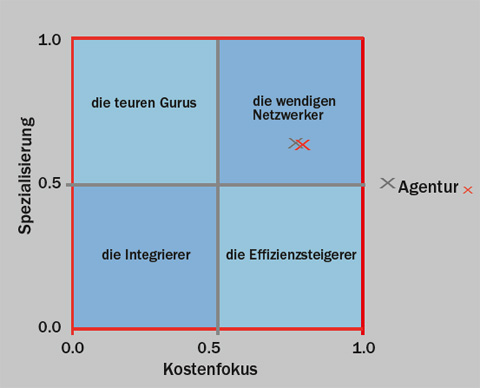
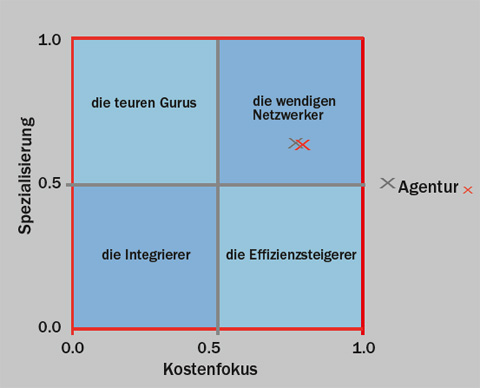
There are two. Firstly, it was confirmed that strategic management, as practiced by large companies, is neglected in most owner-managed agencies. But much more important for me was finding solutions, i.e. the second insight. I was looking for answers to the following questions: What would I do if I were an agency owner? What opportunities would I have to reposition myself? As a quintessence, I developed a matrix. This is based on the fact that today, as an agency, I can either focus on my costs and optimize them or throw out offers and only offer what I really know how to do. This results in the two dimensions of cost focus and specialization. This results in four visions, from which the corresponding strategy can then be derived. I have given the four visions, i.e. the possible agency models, names: the expensive gurus, the agile networkers, the integrators and the efficiency enhancers. The integrator model is closest to the full-service concept. The trend is therefore moving in the direction of the other three. Anyone who implements one of these models with stringent strategic management on a day-to-day basis has, in my view, at least an interesting alternative to the one-size-fits-all full-service approach.

Interview: Andreas Panzeri

Interested parties can request the work by sending an e-mail to ben.loosli(at)gmx.ch.

Unbenannt-5_16
The matrix developed by Ben Loosli with the newly designated four strategy types.

The thesis:
One strategy is omnipresent among Bern's advertising agencies today: full service. In their profile description, the agencies emphasize their ability to master all disciplines of marketing communication, to serve all advertising channels and to work for clients from all sectors. Ben Loosli's research has shown that this is not just intentional: rather, the advertisers lack ideas in their corporate management. Strategic management is neglected. At the same time, advertising agencies are facing uncertain times. The market is more competitive than ever. All the more reason why advertising agencies need new entrepreneurial visions for the future, and not just in Bern.

Unbenannt-5_17

Ben Loosli
After the "Gymer" in Bern, Ben Loosli spent several years on the road as a jazz professional. The musician practiced drums in his basement for days on end and played in various bands. After this period of "research and self-discovery", he switched to journalism, became a freelancer at the Berner Zeitung and finally a copywriter at Hofer Kommunikation when the company was looking for a PR editor. Today he works for Hofer as a writing consultant. Loosli graduated from the HFW in Bern on a part-time basis.

get_footer();