«Lügenpresse» is the «Unword of the Year 2014»

The «Unword of the Year» for 2014 is “Lügenpresse.” The jury, chaired by linguist Nina Janich, announced this on Tuesday in Darmstadt.

«The term was already a central battle cry during World War I and was also used by the Nazis to indiscriminately defame independent media,» the explanation stated. «The term «Lügenpresse» is used to defame the media across the board,» said Janisch. «Such sweeping condemnation prevents well-founded media criticism and thus contributes to undermining press freedom, which is so vital to democracy.»

«Social tourism» was chosen as the «Unword of the Year 2013»; in 2012 it was «victim subscription,» and in 2011, «kebab murders.» The «Unwort» campaign has been running since 1991. (SDA)

Previous «Unwords of the Year»:
 

2014 "Lying press"
2013 Social Tourism
2012 Donation Subscription
2011 Kebab Murders
2010 no alternative
2009 infested with works council members
2008 distressed banks
2007 Stove Bonus
2006 voluntary departure
2005 Productivity per Layoff
2004 Human Capital
2003 Perpetrator Nation
2002 Me, Inc.
2001 Warrior of God
2000 National Liberation Zone
1999 Collateral damage
1998 socially acceptable premature death
1997 Affluence Waste
1996 A Flood of Retirees
1995 Diet Adjustment
1994 Peanuts
1993 Foreign Invasion
1992 ethnic cleansing
1991 No Foreigners Allowed

Source: Wikipedia

Radio Silence at "Roger vs.

Roger Schawinski and Roger Köppel are at each other's throats. Their popular joint show, «Roger vs. Roger,» was canceled on Monday—its future is uncertain.

How the NZZ writes, the dispute is about a Thiel quote from 2012, with which Schawinski confronted his interlocutor in the memorable "Schawinski" program. The quote said that the humor of Muslims is "stuck somewhere in the transition between Neanderthal man and Homo sapiens." Schawinski finds the statement racist, Köppel does not. The Weltwoche editor-in-chief apparently wanted to take up the question in an article. The two disputants did not agree on the form in which Schawinski could have expressed himself on the topic. "I wanted to present my arguments in the context of an article, in view of another Thiel story in which Weltwoche wants to accuse me of blatant journalistic failure, as it has announced in detail in writing to both me and SRF," Schawinski told the NZZ.

As a result, Monday's "Roger vs Roger" show was canceled. What happens next with the format remains open for the time being. The show has been "put on hold" until the issue is clarified in the form of a discussion of principles between Köppel and himself, Schawinski said. (hae/NZZ)
 

DOOH measurement: outdoor advertisers unite

The international outdoor advertising companies APG|SGA, Clear Channel Outdoor, Exterion Media, and JCDecaux are collaborating to develop the industry’s first standardized concept for measuring the media performance of digital out-of-home media.

This unique collaboration within the industry is in response to continued global growth in digital outdoor advertising, estimated at 23 percent per year between 2007 and 2014, according to the release. In 2015, the increase is expected to be 21 percent.

As global advertisers struggle to keep up with consumer expectations for impactful and innovative campaigns, brands such as Samsung, Coca-Cola, Google and BMW are using an increasing proportion of digital out-of-home advertising in their campaigns. In response, the out-of-home advertising industry is investing in the development of a global standard for collecting digital out-of-home performance data, especially as all stakeholders understand the importance of reliable figures in factually underpinning consumers' purchasing decisions. For the first time, the advertising industry will be able to measure the clear benefits and overall performance of campaigns in this fast-growing segment and incorporate the findings into the planning of future campaigns.

That's why a working group of advertising research experts from all the companies involved has been put together and is now ready to start the project with a view to completing it in 2015. This pioneering project uses a virtual world to give consumers a realistic experience of how they encounter the various forms of digital and traditional outdoor advertising. Combined with eye-tracking methodology, this will allow the consortium to provide advertisers with accurate insights into how consumers respond to out-of-home formats of all types in a variety of different environments.

The results will be made available to OOH media performance measurement bodies around the world to enable them to view the results and decide whether they are acceptable to integrate into their national research systems. This will then allow digital and traditional outdoor advertising campaigns to be evaluated in combination.

The comment of Markus Ehrle, CEO of APG|SGA, is: "For our stakeholders and for ourselves, the exact knowledge of the performance contribution of the fast growing digital OOH segment is of central interest, because it allows us to optimize the performance of the OOH campaigns specifically to the needs of the respective customer. We firmly believe that this industry-wide research project will produce an international standard that will then augment national research systems based on existing viewability weightings, as this study will be conducted in a very scientific and transparent manner. This accountability is a key success factor and for the continued sustainable growth of the DOOH segment in the future."

Parveen Bdesha, International Research and Insight Director at Clear Channel Outdoor, explains, "By working together as an industry to develop a system for collecting performance data for digital outdoor advertising, we are helping to better unlock the potential of this medium. We're providing accurate, comparable and compelling data on targeted audiences to optimize media planning."

Details of the digital range measurement system will be provided in due course.


Leo Burnett: Action created for Swiss Life

The Swiss Life Group is placing an even greater focus on its customers. The goal is to make this a tangible experience for the 7,000 Swiss Life employees in Europe and Singapore.

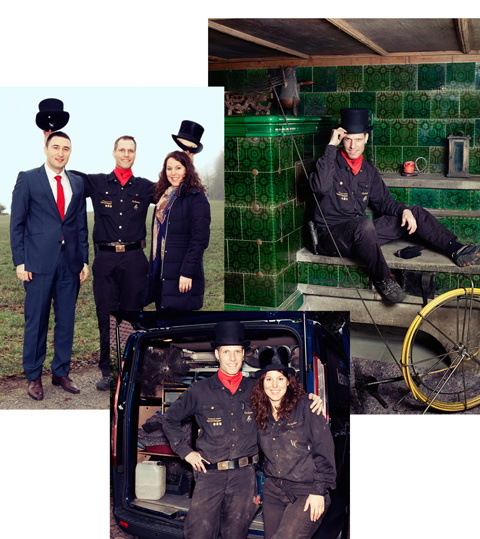
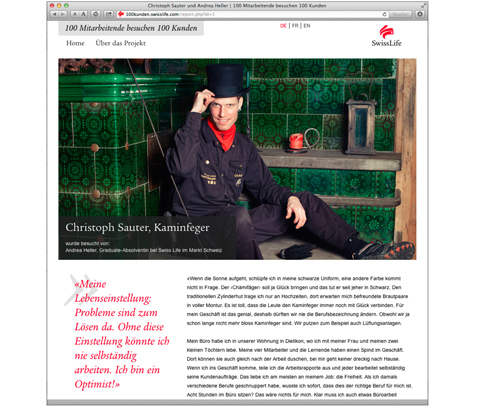
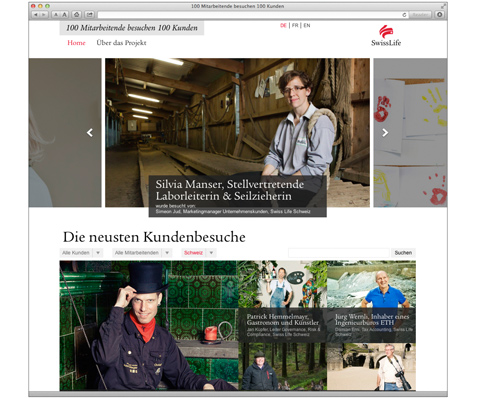
Leo Burnett created the campaign "100 employees visit 100 customers for a day" in collaboration with Swiss Life. The idea is that employees who have little or no contact with customers accompany Swiss Life customers for a day and thus participate in a customer's life for a day and learn what is important to them in life.

Pressemeldung_SL_990x557px_d1
Pressemeldung_SL_990x557px_d8
Pressemeldung_SL_990x557px_d5
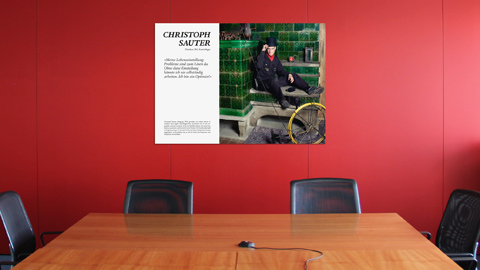
Pressemeldung_SL_990x557px_d3

These visits are recorded in the form of video and photo reports as well as journalistic reports, which are made available to all Swiss Life employees via the intranet, among other channels. Employees then talk about their impressive experiences at internal events, thus bringing valuable lessons back to the company.

Pressemeldung_SL_990x557px_d2

After the publication of the report, Swiss Life also names a meeting room after the client. In this meeting room, the client is portrayed with a photo and a short text. In this way, Swiss Life employees in 100 meeting rooms throughout the company will always have their clients in mind. Leo Burnett is working with more than 24 photographers, film producers and journalists in nine countries. The campaign, which was launched at the beginning of 2014, will run for the next two years.

Responsible at Swiss Life: Christian Pfister (Head of Group Communications & Strategic Marketing), Martin Läderach (Head of Communications Switzerland), Carsten Dieckmann (Head Strategic Marketing & Brand Management), Urs Hunziker (Brand Management), Fabienne Strobel (Project Management, Group Communications), Michael Preisig (Head Internal & Online Communications). Responsible at Leo Burnett Switzerland: Reto Clement (art direction), Mark Stahel (text), Peter Brönnimann, Axel Eckstein (ECD), Rolf Zimmermann (overall responsibility), Gianna Meisel (consulting), Erasmo Palomba, Suzana Kovacevic (FFF), Redworks (website).
 

More commitment and fairness in the new year

Lucerne Cantonal Councilor Robert Küng and Lucerne City Councilor Manuela Jost spoke out in favor of active dialogue and fair relations between politics, the media, and businesses at the New Year’s reception hosted by the Central Switzerland Public Relations Association.

In keeping with the tradition of the Central Switzerland Public Relations Society (ZSPR), the regional communications industry meets every year in the first half of January for a New Year's aperitif. On Monday evening at the Grand Hotel National, Lucerne cantonal councillor Robert Küng and Lucerne city councillor Manuela Jost addressed their wishes to the communication professionals of Central Switzerland. Robert Küng is hoping for support from communication professionals to ensure that strategies with good ideas are implemented and do not disappear into a drawer. He also demanded unequivocally: "Please don't blame politics for everything. That's too easy." Manuela Jost made four wishes for the new year: not to lose sight of the big picture, personal exchange, more commitment to your own concerns and a positive attitude instead of widespread mistrust.

Unbenannt-23_11
Robert Küng and Manuela Jost at the ZSPR New Year's drinks reception. Picture: Aura

The true craft of communication in demand again

In an outlook for 2015, Marc Lustenberger, President of the ZSPR, outlined the challenges facing the communications industry: "We need to focus on simplicity and cultivate our actual craft. This means maintaining an overview, putting problems into words or expressing them in images and skillfully using a wide variety of channels - both traditional and digital." According to the press release, the next ZSPR events will focus on the professional standards of the PR industry, political communication for the upcoming government and cantonal council elections and visual communication.

Unbenannt-24_14
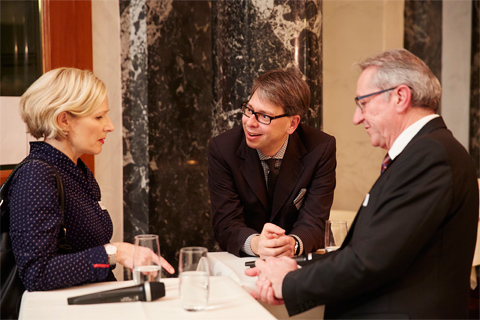
ZSPR President Marc Lustenberger (center) in conversation with Manuela Jost and Robert Küng. Picture: Aura

The ZSPR is the organization of communication professionals in Central Switzerland and one of seven regional associations of PR Suisse, the Swiss Public Relations Association. The ZSPR has around 150 members and organizes eight to ten events on communication topics every year.

NZZ shareholders should be able to express their opinion on the closure of the printing plant

As part of the consultation process regarding the closure of the NZZ printing plant in Schlieren, employee committees are proposing to consult with shareholders if management does not ultimately decide to call off the closure. 125 jobs are at risk.

The closure of NZZ-Print is currently "economically unnecessary, strategically wrong and even dangerous from a long-term perspective", write the Schlieren Operations Commission and the NZZ Personnel Commission in their report to the NZZ management published on Monday. Their main proposal is to forego the closure. If the management rejects this, it should at least postpone the closure decision until 2018 and re-evaluate the situation at the end of 2017. At the very least, however, the decision should not be implemented until the 2015 NZZ Annual General Meeting so that a consultative vote can be held among the shareholders.

Shareholders' decision would be accepted by employees

If the NZZ owners were in favor of outsourcing printing, the risk of subsequent legal disputes between shareholders and the NZZ media group or the Board of Directors would be lower. The decision would be better legitimized and would be accepted by the employees, according to the report. The two committees would have gained an impression of the current economic situation of NZZ-Druckerei and the future forecasts during discussions with the company and management. There are business models that also speak in favor of retaining the company's own printing plant for economic reasons, the two commissions write. The reasons for the planned closure are not valid. And for journalistic and publishing reasons, it is simply essential "that the traditional institution Neue Zürcher Zeitung continues to have its own printing plant in the future".

At the end of November 2014, the NZZ Media Group announced that it intended to close the printing plant in Schlieren for economic reasons and have the Neue Zürcher Zeitung and NZZ am Sonntag printed at the Zurich printing center of its competitor Tamedia (Werbewoche.ch reported). As part of the statutory consultation procedure, the workforce had until January 9 to submit proposals to management on how to save the threatened jobs. (SDA)

Teaser photo: Keystone

Jung von Matt/Limmat: 100 years of life

With the «100 Years of Life» project, Jung von Matt/Limmat is presenting its first campaign for its new client, Swiss Life. The campaign launched a nationwide discussion on longer life expectancy.

In November 2014, the Swiss life and pensions specialist had matched three centenarians with three newborns. Since Sunday, Swiss Life has been acting as the official sender of the project. The next phase of Swiss Life's new campaign will begin before the end of January. The background to these encounters is the statement by demographic experts that every second newborn born today will live to be over 100 years old. A longer life affects us all. And yet: the steadily increasing life expectancy still has little influence on our behavior. As a life and pensions specialist with over 150 years of experience and the inventor of voluntary life and pensions, Swiss Life is ideally placed to initiate the public debate.

As part of the "100 Years of Life" project, Swiss film director Alain Gsponer ("Heidi," "The Grüninger File," "Lila Lila") used two cameras to capture the magical moment when a century of age difference meets. The results are touching images of Rosa and Nayana, Reine and Leonie, and Karl and Flavio. The three TV spots have been running on TV since December 28, 2014, and initially gave room for speculation. This is because the trailers consistently refrained from using a sender, as the Swiss population was supposed to engage with the socially important topic of "living longer" regardless of the context of a brand. Only the URL Welivealwayslonger.ch was superimposed. Parallel to the TV launch, megaposters and eBoards were set up in five Swiss cities. On the website, people can find out their life facts in a playful way. Since the start of the campaign, the website has received over 60,000 hits and 50,000 generator queries. The films have been viewed a total of over 180'000 times.

Since January 11, 2015, Swiss Life has been appearing on TV, in print, on the web, and on megaposters as the official sender of the "100 Years of Life" project. The next phase will follow before the end of January.

The Swiss Life films on Youtube:

Karl meets Flavio:

//www.youtube.com/watch?v=1EHYbacvddM

Reine meets Leonie:

//www.youtube.com/watch?v=jUiFlAqtdD0

Rosa meets Nayana:

//www.youtube.com/watch?v=jIjJ4SYPIuw

SL_Megaposter_jvm
150109_SL_Teaser_Screen_Mood
150109_SL_LebenLaenger_Web

Responsible at Swiss Life: Elke Guhl (CMO Switzerland); Stefan Erhart (Head of Brand Management) Martin Läderach (Head of Communications Switzerland); Eliana Wüst (Head of Digital Experience). Responsible at Jung von Matt/Limmat: Alexander Jaggy (executive creative direction); Samuel Christ (creative direction); David Hanselmann (art direction); Mateo Sacchetti (text); Tanja Jablanovic (graphics); Deborah Herzig and Sarida Bossoni (art buying); Simone Jehle, Sebastian Suter and Jasmin Schmid (consulting); Maurice Haas (photography); Pumpkin Film (film production); Alain Gsponer (direction); Jan Mettler (camera); Great Garbo (composition); Jingle Jungle (sound studio); Caroline Nünlist (Zip Media). Responsible at Jung von Matt/Next: Markus Schärer (Executive Digital Director); Sam Sherbini (Consulting); Marco Zimmerli (Creative Direction); Andrea Klainguti (Screen Design); Jonas Grümann and Raphael Prader (Technology). Responsible at Jung von Matt/Public Relations: Cyrill Hauser, Joël Frey and Philipp Bühler (PR, Content and Social Media).


KSP strategically strengthens with Sonja Kingsley-Curry

Since early January, Sonja Kingsley-Curry has been working as a strategy consultant on a contract basis for KSP Krieg Schlupp Partner.

As part of its "collaboration strategy", KSP is thus also specifically expanding its strategy power in the area of 360-degree communication, according to a statement. Sonja Kingsley-Curry is an experienced marketing strategist who has held leading marketing positions with international retail and luxury groups on the client side (including IWC Schaffhausen, Valora and Tchibo Hamburg), as well as Strategy Director on the agency side (AY&R and Euro RSCG).


SSM supports the new fee system

In a statement released on Monday, the Swiss Media Professionals Union (SSM) expressed its support for the new licensing fee system for radio and TV.

With the new fee system, against which the referendum was submitted today, the fees per household will decrease. Nevertheless, the new regulation will secure the public service for radio and television (at SRG and private), writes the union. This is a fair proposal by the parliament. Therefore, the Swiss Syndicate of Media Professionals SSM supports this revision of the Radio and Television Act and will campaign for a Yes vote in view of the referendum. The signatures for the referendum against the new Radio and TV Act RTVG were submitted in Bern on Monday, and the people will now decide on the new fee system at the ballot box (Werbewoche.ch reported).

German-speaking Swiss watch two hours of television a day

People in German-speaking Switzerland watch more than two hours of television every day. On average, that amounts to exactly 125.6 minutes, as Mediapulse reported on Monday. However, more and more people are not sticking to the regular broadcast schedule but are watching shows later, for example online.

On average, around 64.6 percent of people in German-speaking Switzerland watched TV every day in the second half of 2014. In French-speaking Switzerland, the proportion of TV consumers was roughly the same at 64.9 percent - but the sets were on for longer, an average of 139.3 minutes per day. People in the Italian-speaking parts of the country were more persistent viewers: 71.6 percent switched on the TV every day, and watched for an average of almost three hours, namely for 167.7 minutes.

Time-shifted use becomes more popular

There was an increase in television viewing without fixed broadcasting times, for example via the Internet: In the second half of the year, 7.4 percent of viewing time in German-speaking Switzerland was time-shifted, compared with 6.2 percent in the first half. French-speaking Swiss make more frequent use of the option to set their own TV program. In French-speaking Switzerland, 9.9 percent watched time-shifted, compared with 8.0 percent in the first half. In Ticino, the figure was 7.7 percent, compared with 5.6 percent in the first half.

Bildschirmfoto-2015-01-12-um-19.14.14
Excerpt from market shares, 2nd half of 2014, persons aged three and over. Full charts linked below.

The statistics cover programs watched up to seven days after broadcast. TV usage on TV sets, desktop computers and laptops is measured. In German-speaking Switzerland, SRF 1 had the highest market share, with an average of 19.5 percent (first half: 19.3 percent). This was followed by SRFzwei with 9.8 (12.3 percent). Compared to the first half of the year, the German stations behind them lost some ground. ARD's share fell from 5.5 to 5.2 percent, and ZDF's from 5.5 to 5.1 percent.

The Mediapulse Foundation is independent. It is commissioned by the federal government to measure the official parameters of radio and TV usage in Switzerland. (SDA)

2014, 2nd semester (PDF)

TV in the course of the day by language region
Reach and usage by language region and different target groups
Market shares German-speaking Switzerland across different target groups
Market shares Suisse romande across different target groups
Market shares Svizzera italiana across different target groups
Use of the licensed regional TV stations
Time-shifted usage by language region

People can vote on new media fee

The Radio and Television Act (RTVG) is being put to a public vote. The Swiss Trade Association has collected over 100,000 signatures opposing the revision and submitted them to the Federal Chancellery on Monday.

He opposes the idea that all companies should pay radio and television fees in future. According to the amendment to the law passed by parliament in the last fall session, the fee is payable from an annual turnover of CHF 500,000 - regardless of whether the company actually has a receiver. Trade association director Hans-Ulrich Bigler spoke of a "compulsory levy" when the signatures were submitted. Today, a company only pays if it actually uses radio or television. The economy would be burdened with an additional 200 million francs.

234907460
Natalie Rickli, National Councillor SVP-ZH, right, poses next to Hans-Ulrich Bigler, Director of the Swiss Trade Association SGV, left, and Dieter Klaey, Cantonal Councillor ZH, center, at the submission of signatures. (Keystone/Peter Klaunzer)

Households would also have to pay a reception fee in future, even if they do not own a device. In reality, this is a tax that citizens should be able to vote on, said Bigler. If the law comes into force, it will no longer be possible to watch and listen in the dark. In addition, companies would also bear the costs. According to the Federal Council, the Billag fees could therefore be reduced from the current CHF 462. Bigler does not believe in this: in view of the cost development at SRG, he does not consider Billag fees of CHF 1,000 to be out of the question.

The background to the system change is the fact that radio and TV broadcasts can now also be listened to and watched on computers, tablets or smartphones. The amendment to the law also provides for private radio and television stations to receive more money from the licence fee pot in future. An association Stopbillag.ch is also collecting signatures against the RTVA revision. Two popular initiatives, for which signatures are currently being collected, want to abolish reception fees altogether. The referendum on the RTVG revision may take place on June 14. (SDA)

On the subject: RTVG referendum: industry divided (11.01.2015)

Getunik expands management and community management

Kristin Hartmann has joined the team at the web agency Getunik as COO, and Jan Uekermann as Community Manager. Both positions were newly created in January 2015.

As COO and member of the Executive Board, Kristin Hartmann is responsible for organizational, personnel and process development as well as communication. The 41-year-old communications and organizational expert has worked for the internet comparison service Comparis.ch for the past twelve years. She was responsible for managing the editorial department and, as Project Portfolio Responsible and a member of the extended Executive Board, was jointly responsible for the organizational development of the company.

Unbenannt-3xdda

Jan Uekermann works 50% for the Getunik brand Raisenow and is responsible for building a digital fundraising community. The 33-year-old has been active in professional fundraising for over 12 years. He is co-founder of the Major Giving Institute in Wiesbaden, which is offering the "Major Donations Fundraiser" training course for the fourth time in 2015. Most recently, he worked as a project manager at Swissfundraising, the professional association of Swiss fundraisers.

get_footer();