Walder, advertiser: Auto Discount Uster shows the Tiger

40 brands, 600 cars—Auto Discount Uster is Switzerland’s largest car dealership. Walder, Werber is developing and producing three TV and promotional spots that will begin airing immediately to promote all current special offers on regional stations and online.

With monster discounts, price crashes and hamster weeks, the best conditions when buying a car are a matter of course here. However, not everyone is aware of this and so the pensioner Ruedi, the emotional Italian and the self-confident "rocker" hone their negotiating strategy.

Responsible at Auto Discount Uster: Gianluca Di Modica (Marketing). Responsible at Walder, Advertiser: Sandro Walder (overall direction); Stefan Moeschlin (concept/text), Corsin Kessler (graphics). Film production: Alex Szombath (director and camera).

iKiosk: New design, improved functions

iKiosk, Axel Springer's digital newspaper and magazine kiosk, is now available with a new design. The service is now optimized for all devices.

Users can access their purchased issues at any time and from any device, as well as purchase back issues. The web reader - which can be used to read the newspapers and magazines on the website - has also been completely revamped and equipped with a search function. For selected daily newspapers, there is also an article view for individual articles.

Simone Schwartau, Head of iKiosk: "With these optimizations, we are meeting our customers' need for an easy-to-use ePaper store with web and app access. We now also have significantly more opportunities to carry out joint marketing campaigns with our publishing partners. The current improvements are the first step, with further expansion stages to follow over the course of the year."

The iKiosk's range of titles has been expanded once again: Geo, P.M., Neon, Nido and Viva have been added to the portfolio. Readers can now choose from more than 500 German-language and international newspapers and magazines from over 130 publishers. The range also includes the Advertising Week.

Bildschirmfoto-2015-05-18-um-13.11.20

iKiosk can be used across devices both on the web at Ikiosk.com as well as an application for iOS and Android-based devices. The digital offering is also available on board the Aida and TUI Cruises cruise ships and on board some airlines.


Weko reviews providers

The Competition Commission (Weko) is conducting an informal investigation into the extent to which major providers such as Swisscom and UPC Cablecom are preventing smaller providers from gaining efficient access to the Internet.

The Weko has set its sights on major broadband providers such as Swisscom and UPC Cablecom. Marc Schäfer, telecom expert at the Weko, confirmed this to the NZZ am Sonntag.

If large providers deliberately restrict their data lines, then video providers with high data volumes such as Zattoo, Youtube or Netflix are hit the hardest, the article says. The possibility that the providers are abusing their power exists, according to Schäfer. However, the Weko has apparently not yet decided whether it will open a formal investigation at a later date. (NZZ am Sonntag/sis)


Bakom figures recalculated

According to NZZ am Sonntag, the new media tax will generate around 130 million more annually for the SRG than the existing levy. The Federal Council assures that the amount would be adjusted downward if this should indeed be the case.

The new levy for households is to be around CHF 400 instead of the current CHF 462. The Federal Council promises that the transition to the new system will be revenue-neutral: Neither will more fees be collected nor will the SRG receive more money.

According to NZZ am Sonntag, this calculation does not add up. If the figures from the Federal Office of Communications (OFCOM) are to be believed, revenues should increase by a total of almost 200 million francs, and there would also be significantly more money left over for SRG.

The NZZ am Sonntag's calculation is based on the figures in Bakom's fact sheet "Die neue Abgabe für Radio und Fernsehen. In it, the office reckons with around 145,000 paying companies and 3.302 million households liable to pay the fee in the event of a system change. Multiplying this number of fee payers (after deducting households without reception equipment) by the planned tariffs of 400 to 39,000 francs, this results in a total revenue of 1.53 billion francs, according to NZZ am Sonntag.

That would be almost 200 million francs more than the Billag fee brought in in 2013. And according to this calculation, SRG should also receive more: under the new system, less (a maximum of six percent of total revenues) would go to the private broadcasters; after all other deductions, SRG would be left with around CHF 1.34 billion. That would be 130 million more than in 2013.

For Hans-Ulrich Bigler, director of the trade association, this fits in with the obfuscation tactics of the proponents. Bakom did not want to comment in detail on the calculation. However, it writes that the figures used in the fact sheet are from 2012 and 2013, and no one yet knows how they will develop until the planned entry into force of the law in 2018. In addition, inflation must also be taken into account.

The office reiterated to the NZZ am Sonntag that the system change is in no way intended to provide the SRG with more money. "If revenues turn out to be higher than envisaged, the Federal Council would set the amount of the levy correspondingly lower than the envisaged 400 francs." Definitive calculations will be made in 2018, if the bill goes through.

However, if the number of companies and households continues to grow as it has in the past, it is quite conceivable that the Federal Council could then be taken at its word and demand a further reduction in fees, the article continues. (NZZ am Sonntag/sis)
 

Last but not least: Multinationals mix brands

Nestlé and Google are collaborating in the United Kingdom on the branding of two well-known brands: The food company is launching 600,000 KitKat chocolate bars featuring a YouTube logo.

The "Youtube break" lettering on the chocolate bar refers to the international brand claim "Have a break, have a Kitkat". Apparently, both companies believe that they benefit from such a mix. In return, Nestlé is the official sponsor of the most-watched videos on YouTube. Remarkable: apparently no money was involved in the deal. (sis)

kitkatyoutubebild
 

Geneva Airport no longer relies on APG

Following a closed bidding process, Geneva Airport has awarded a new concession contract for outdoor advertising, which was set to expire on June 30, 2015. The contract was not awarded to APG.

APG|SGA regrets the decision by Geneva Airport to terminate the "long-standing, very successful cooperation", according to a press release issued on Friday. with APG|SGA Airport (Bercher SA) in the area of analog poster advertising. This is associated with the closure of the APG|SGA Airport branch in Geneva with four employees, for whom new opportunities are being sought internally.

According to the billposting company, the impact of the non-renewal of this contract on APG|SGA's operating result will be minimal. At the same time, APG|SGA Airport will remain active in its segment with its services in and around Lugano and Basel airports and the train stations at Zurich and Geneva airports and will take advantage of further opportunities.

Survey on measuring the success of content marketing

How do marketing managers measure the effectiveness and efficiency of their content marketing? A master's thesis at ZHAW aims to make the effectiveness of content marketing measures measurable and tests the developed model using Webrepublic as a case study.

Customers are less and less influenced by mass media alone. When making purchasing decisions, they search the web, blogs, microsites and social media for high-quality, relevant and credible content. Companies that convince with expertise and appealing content gain the interest and attention of their target groups. Brands that offer their target group relevant content can strengthen customer relationships in the long term. Successful content marketing therefore has a positive impact on the company's success.

These effects of content marketing strategies are undisputed. However, only a few brands manage to draw on the full potential of content marketing. According to US studies by the Content Marketing Institute (CMI), for example, less than half of marketing professionals feel that they are using content marketing effectively.

Companies see the biggest challenge in comprehensively analyzing the success of content marketing and deriving strategic decisions from this. Natalie Schönbächler's master's thesis at Webrepublic focuses on precisely this challenge. The graduate of the ZHAW Business Administration program has developed a corresponding model, which she is now testing using the example of her employer Webrepublic. The time required for the Survey is around 10 minutes.
 

Telecom companies consider blocking ads on cell phones

It's an idea that could bring tensions between the telecommunications industry and Internet companies to a head: According to the Financial Times, several mobile carriers are working to block online advertising on their networks.

A European network operator has already installed the necessary software in its data centers and wants to switch it on by the end of 2015, the Financial Times wrote on Friday. Such a move could cost Internet companies such as Google or Yahoo revenue. Ads in the form of paid messages - such as those used by Facebook or Twitter - would not be affected, the business newspaper reported.

A senior manager at a European network operator told the Financial Times that they initially wanted to offer customers the option of booking an ad-free service. However, a more radical step called "the bomb" is also being considered, in which ads could be blocked across the entire network of millions of customers in one fell swoop. The idea behind this is to force Google in particular to share advertising revenue, the paper wrote.

Telecoms companies like to complain that internet companies make a lot of money on their networks without contributing to the high infrastructure costs. However, blocking ads could raise the question of a violation of the principle of net neutrality, according to which all data must be treated equally. (SDA)
 

Animal appearance for French red wines

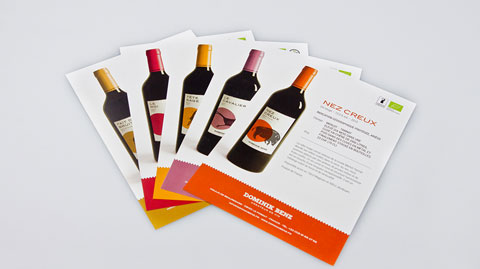
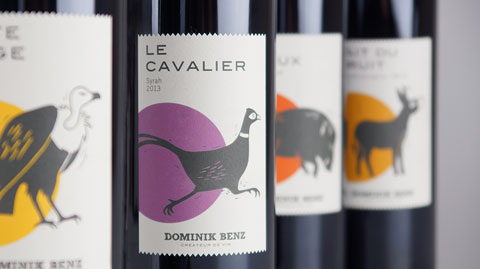
Dominik Benz grows certified organic wines in the French department of Ariège. Evoq has now created the packaging design and product information for the Swiss winemaker.

The focus is on the high importance of traditional craftsmanship and the winemaker's strong connection to nature, which are expressed with classic woodcuts of animals from the region. Because "only with careful handling of nature and gentle vinification in the cellar does this pleasure also come into the glass," says Dominik Benz. As a contrast and sign of modernity, strong colors complement the design and additionally underline the character of the different wines. In addition to the labels, Evoq also designed the wine box as well as brochures, factsheets, and postcards.

nik1
nik3
nik4

Responsible at Dominik Benz Wines: Dominik Benz, Martina Fretz. Responsible at Evoq: Susanne Pfäffli (Consulting), Sara Streule (Design Direction), Sandra Spielmann (Graphics).
 

App brings back quality time

A new Swiss start-up wants to reward us with an app for the time we spend offline.

We look at our smartphones up to 90 times a day without learning anything significantly new. Danijel Sljivo and Mirco Fehr are convinced that real life does not take place on smartphones. Now they are launching the STFU ("shut the fuck up") app, which motivates us to enjoy time in real life.

In the first version, 19 awards are available as an incentive to go offline. For the next version - which will also be available for iOS - the two founders are currently looking for cooperation partners to be able to offer users a real value for every minute spent offline with STFU, such as a voucher or discounts for travel, cinema, restaurants or sport.

Danijel Sljivo and Mirco Fehr studied business administration together and previously worked in the same Zurich advertising agency.
 

stfu

The app can be found here. 

Beautiful annual report for the University Hospital Basel

Kreisvier produced the 2014 annual report for the University Hospital of Basel. The report centers on the magazine «Im Blickpunkt,» which summarizes the year at the University Hospital through interviews, feature articles, and extensive photographic material.

The Basel agency is responsible for the conception, editing, text and layout of the annual report on "Patient Safety & Quality". In addition to the "Blickpunkt" magazine, the four-part annual report consists of the performance and quality report, the financial report and the "Persönlich" booklet.

The visualization of "Blickpunkt" is implemented by Kreisvier using a modern editorial design with colorful photos and specially developed icons and info-graphics, which vividly illustrate the complex processes of everyday hospital life. All people photos show employees of the university hospital and thus illustrate its diversity and interdisciplinarity. The A6 booklet "Personal" enclosed with "Blickpunkt" portrays an employee of the University Hospital Basel.

For the online presentation of the annual report, a new Microsite where the most important key figures are presented as a clear animation.

bild1_9
bild2_6
bild3_4
bild4_0
bild5_0

Responsible at University Hospital Basel: Sabina Heuss Pace (Head of Marketing & Communications), Angela Roos (PR Officer, Marketing & Communications). Responsible at Kreisvier: Christian Jost-Cellarius (Head of Consulting), Lukas Gysin (Senior Consulting), Philipp Kropf (Art Direction), Steffi Thöni (DTP), Tanja Steiger and Gerald Mink (Text & Concept), Thomas Bauer (Digital). Photography: Derek Li Wan Po; Lithography: Sturm; Printing: Steudler Press and buysite.
 

TCS promotes travel protection

Many Swiss people travel abroad without comprehensive travel insurance. That’s understandable—after all, who wants to let negative thoughts spoil the anticipation of a wonderful vacation? The TCS raises awareness without pointing fingers.

The current TCS product campaign uses subtle humor to create an impact with a smile. In other words, it encourages people to check before the summer vacations whether they are covered for travel in the event of an emergency - at home, in Europe or anywhere in the world. And that applies to travel with or without a car.

The campaign stimulates the imagination with linguistically pointed disasters to promote travel safety with the TCS Eti-Schutzbrief. At the same time, people without a car are to be made aware that TCS also offers meaningful things for them.

The nationwide campaign will run from mid-May with five motifs on posters, as well as in and on public transport. Based on selected themes and motifs, online advertising and dialog marketing will play a key role in the overall campaign.

karibik2_0
karibik3
karibik4
karibik5

Responsible at Touring Club Switzerland: Simon Stauber, Marius Fink, Stefanie Thüler (overall responsibility, strategy and project management), David Köder (concept, text and design). Responsible at Blue Spirit: The Sarah Pietrasanta (CD), Jürg Büchi (AD), Danny Bron (graphics), Melissa Pauli (DTP), Rolf Jeger and Vanessa Jenni (consulting). French/Italian adaptation by Diction. Photography: Ari Sanjaya, Pavel Losevsky, Tawan Chaisom, Filip Fuxa. Image editing: Widmer & Fluri. Dialog marketing: Pinkup. Banners: 1,618. Media: Mediatonic.
 

get_footer();