Negative trend already noticeable?

Mediafocus: Compared to the previous year, advertising pressure fell by 2.1% in September. Nevertheless, the cumulative increase since the beginning of the year is still 4.7%.

Mediafocus Compared to the previous year, advertising pressure fell by 2.1% in September. Nevertheless, the cumulative increase since the beginning of the year is still 4.7%. It remains to be seen whether the current advertising year can be concluded at the previous year's level. A drop of 9 percent in the financial market is not surprising, given that September saw a slump of 10 percent. The key market of finance is the third-largest advertising market (after vehicles and food).
img081029_grafik_mediafocus

Coop Naturaline: National campaign with Melanie

Coop Naturaline has launched a national campaign featuring Melanie Winiger for its fall collection. The photos were shot by star photographer Michel Comte.

Green with Melanie Winiger: The national campaign launched by KSB/SJ for Coop Naturaline relies entirely on the glowing-eyed ex-Miss Switzerland, who wears the fall collection to prove that an eco-label can also keep up with others in terms of coolness. Ambassador Winiger wears the current Naturaline fall fashion in ads and in the new Naturaline brochure. She was photographed by star photographer Michel Comte. Coop launched the Naturaline brand 12 years ago and wants to use the campaign to once again underline its pioneering role in fashion made from organic cotton and fair trade, according to the Zurich agency KSB/SJ. The ads appear nationally in the popular press and in various fashion and women's magazines.
Responsible at Coop: Jürg Peritz (Head of Marketing/Procurement), Sandro Corpina (Head of Category Management Textiles) and Jürg Kräuchi (Advertising Manager Coop City). Responsible at KSB/SJ: Uwe Schlupp (CD), Anita Kummer (AD), Marion Lim, (text), Barbara Lagger (consulting management), Flavia Salvisberg (consulting), Andrea Baltis (DTP), Michel Comte (photo), Melanie Winiger (model), Eqal Visual Productions AG (agency), Eliane Kobler (styling, creative consulting). Image editing: Detail AG. Media: Coop Media as well as Initiative Media Western AG.

1290582388_img081029_coop
1290582388_img081029_coop1
1290582388_img081029_coop2

To the point: no one knows where it's going

The U.S. mortgage bubble turned into a banking crisis, which in turn evolved into a financial crisis. The financial crisis now threatens to become an economic crisis, and that is why the media industry is already preparing for a potential media crisis.

The U.S. mortgage bubble turned into a banking crisis, which mutated into a financial crisis. The financial crisis is now threatening to turn into an economic crisis, which is why the media industry is already preparing for a possible media crisis. It's not just a question of the lack of or declining advertising revenues from the financial sector, which after all ranks third among the advertising industries in Switzerland. As of September, advertising pressure from bankers fell by around nine percent, according to Media Focus, and the trend is upwards. There is more at stake.
The economic upswing has slowed, and the signs that we will come within a hair's breadth of a recession are triggering fears. Although positive consumer sentiment has not yet turned negative, the more bad news from the economy, the stock markets, and the media that rain down on consumers, the more likely such a reversal of consumer sentiment becomes. Some advertisers will cut back on their advertising because of the uncertain future outlook. Many may do so already this year, others perhaps not until next year.
About a month ago, I was still reasonably positive about the development of advertising spending in 2009. Today, I no longer dare make a forecast. All too much has happened in politics and business in the last few weeks. In the USA, in Europe and in Switzerland. Thanks to globalization. The leftists are already heralding the end of capitalism, the neoliberals are licking their wounds and trying to hide, states are letting ailing financial institutions go bankrupt and supporting others with many billions. Politicians are calling for more state controls, for more influence.
No one knows where things are headed. The media industry - and not only in Switzerland - is getting restless. People fear the worst. According to an SDA report, the market value of U.S. media companies has recently plummeted, in some cases dramatically - by around 60 percent year-on-year, according to investment bank Goldman Sachs. The Essen-based WAZ Group is facing drastic cost-cutting measures. Savings of around 30 million euros are at stake. Ringier wants or needs to save. There is talk of an unconfirmed 50 million. Edipresse has already saved: 20 million for the next two years. Further savings measures will follow. We can only guess who will be next. Is it the NZZ or even the almighty Tamedia with its flagship Tages-Anzeiger? In any case, the outlook is bleak.
Bleak prospects also for all those who will not receive the long-awaited broadcasting licenses for local radio and television stations this Friday. The outlook is brighter, however, for the winners of the coveted licenses. Some of them will at least receive money from the state.

Pierre C. Meier, Editor-in-Chief
[email protected]

Head of the week: The globetrotter

Jörg Schminke looks back on 40 years of Schminke and Team and believes in a bright future for «highly specialized generalists.».

His career began like something out of an American fairy tale. No sooner had the ink dried on his diploma in corporate design from the Kunstgewerbeschule Bern than Jörg Schminke had an offer as a graphic designer at DDB in New York fluttering across his desk. "That was a crazy coincidence," says the managing director of Schminke und Team happily even today, if you want to hear more details about this story.
We are in the sixties. In order to be able to participate in the upheaval of the times with new ideas, DDB New York also wanted to look for talented newcomers in Europe. Advertisements were placed in London, Paris and Zurich. Schminke applied. And after an interview at Zurich's Hotel Ascot, he had the "most sleepless night" of his life. At ten o'clock the next morning came the acceptance. However, the young graphic designer had to wait a whole year for the visa. The American immigration authorities preferred technicians to artists. Schminke, however, was able to bridge the waiting period as a graphic artist at the British Museum in London. Then the U.S. was ready, and Jörg Schminke had to swear his oath to the Constitution at the embassy in Bern.
Schminke worked at DDB in the Big Apple for five years. Not on the prestige campaigns for VW or Avis at the time. But otherwise "on fun things" like a zipper company Talon Zippers, the department store Bloomingdales or the New York Police Department. "Twelve hours a day in the studio was normal." In return, the 22-year-old - in true American fashion - got his first raise after just three months. Since DDB was considered a visually oriented agency, Schminke also wanted to gain experience in copywriting in New York. Ogilvy was the best address for this. But the interview fell through because Schminke was asking for far too little pay. "In that economy, only those who knew how to sell themselves expensively were good." Since then, he has never sold himself too cheaply, Schminke laughs.
Back in Switzerland, the graphic designer, who was also able to complete a degree in marketing and communications in New York, immediately found a job at Atlas Copco. In 1974, he became advertising manager for Switzerland at this Swedish company in the hydraulics and compressed air sector, then manager of communications Europe. From 1978, he was given global responsibility at the headquarters in Stockholm and later in Antwerp. Working on the customer side was very interesting for Schminke. Nevertheless, he wanted to get a taste of something other than compressed air and moved to Hoffmann-La-Roche. In Basel, he was appointed Communication Manager Worldwide for the Vitamine Division. "But that was a culture shock," recalls Schminke, who soon felt "out of place" as a creative in the midst of the chemists' power struggles.
A challenge at Nestlé made more sense to him. That was around 1982, when the Vevey-based multinational had previously made headlines around the world with "Nestlé kills babies". As the person in charge of advertising for infant nutrition, Schminke now had to look for ways for Nestlé to find its way out of this communication crisis. In Vevey, they were convinced that Nestlé had the highest production standards. Nestlé therefore sent a chemist and a production expert to a hearing with Senator Ted Kennedy and concerned nurses from Africa. When the latter tried to defend the attacks as a "communist conspiracy" in keeping with the spirit of the times, the misunderstanding was perfect, Kennedy was quite annoyed, and the Swiss' weak act was worth a top story on American TV. "But we then managed to launch a worldwide campaign in which Nestlé was able to explain why our baby food can also make sense in the Third World," explains Schminke. To do this, he had to prepare the information in such a way that even mothers without education could mix the powdered milk properly.
His successes subsequently opened the door for Schminke to Farner, because a large part of Nestlé's budget was managed there. In the "cradle" of today's Publicis, he worked as deputy managing director in the era before Fredy Collioud. "That's how I got to know the agency business from the administrative side as well," Schminke says, referring to the "not always easy way of dealing with clients." Schminke describes himself as an "extreme critic of the classic agency attitude," where people still show a certain arrogance toward the client. But: "Advertisers tend to be inert and in no way pioneers of anything," Schminke is convinced. A "key experience of this inertia" has remained in his memory at the old fernery. When Maggi wanted to realize one of those just-emerged radio spots, the customer was turned away because they didn't yet have reliable figures on the new medium. A process that has since been repeated regularly in the industry when other new media are introduced.
Jörg Schminke came to his own agency via a headhunter. He was looking for a buyer to take over a small but well-established company that "was founded on the historic 1st of May 1968. The agency had over 30 smaller clients. So the first thing Schminke did was try to bring more illustrious names into his portfolio. "If the agency is to become better known, I have to have clients who have a certain charisma."
Thanks to his references, Schminke first won Revi Suisse Price Waterhouse, later Elida, Brother Switzerland, Ernst & Young, and then the Fiduciary Chamber. Many of these companies work with a vast amount of brochures. "Often that's over a hundred printed items a year from invitation cards to annual reports." Out of this need, Schminke and team specialized more and more in printed matter and thus corporate design, in addition to traditional communication. "An elaborate but beautiful business. We cultivate it with great care and love," Schminke reveals.
For Mepha, the Zurich-based company developed the logo and the entire corporate design. For PackSys packaging machines, Schminke und Team makes the brochures for the whole world. The agency's third mainstay was the Internet as early as 1996. This pioneering achievement came about because a young "Internet freak" named Markus Gabriel was employed at the agency at the time, before he went into business for himself with Angelink.
Jörg Schminke is the only consultant in his agency. In addition to administration and production, he leads the creative team. Its members are allowed and encouraged to communicate directly with their clients. "The client feels taken more seriously and closer to the source of creativity," Schminke knows. And the creatives appreciate the fact that their ideas are not "watered down by a consultant.
And the future after so many years of exciting history? "Oops, I haven't even thought about that yet," says Schminke, who still seems to be in the midst of a dynamic present. But then it does occur to him: "I hope that the current crisis will at least give positive impetus to interpersonal relationships in business."
Andreas Panzeri

Last but not least: Voodoo doll outdoes Sarkozy in court

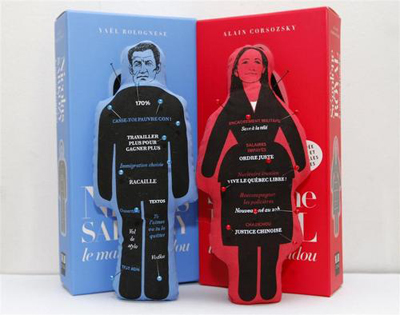
One might almost think that French President Nicolas Sarkozy was just trying to be funny when he called rioting youths «scum» or advocated «working more to earn more.» But now he has once again shown just how seriously he takes himself. He went to court over a blue Sarkozy voodoo doll.

You could almost think that France's head of state Nicolas Sarkozy was just trying to be funny when he called rioting youths "riff-raff" or pleaded for "working more to earn more". But now he has once again shown how seriously he takes himself. He went to court over a blue Sarkozy voodoo doll. On Wednesday, he even lodged an appeal because the court rejected his demand to ban the sale of the doll. A French publisher has been offering the rag doll for sale since the beginning of the month, including the needles. The toy features sayings by politician Sarkozy. Buyers can use the voodoo doll to "prevent the president from doing even more damage", promises an advertisement for the doll. Nevertheless, Sarkozy has reason to be pleased. After all, he is number one on the sales list of the internet retailer Amazon as the Sakozy-Ségolène rag doll set. The set consists of a blue Sarkozy doll and a red Ségolène doll. The rag dolls come with pins and a small booklet. The sayings on the Royal doll are almost as inspiring for reaching for the needle. For example, Royal's praise of "Chinese justice" is immortalized on it.
Ségolène Royal used the opportunity, and Sarkozy's war campaign against the sale of the dolls, to now also tease: if he continues like this, he will soon take action against the satirical television program "Guignols de l'Info" or against the left-wing "Marianne", she said on the Europe 1 radio station, for example. Or was Sarkozy's decision to go to court merely a quiet fear that the voodoo spell might one day work and he himself would be forced to "work more to earn more"?
1290582384_img081029_voodoo
The controversial voodoo dolls of Nicolas Sarkozy and Ségolène Royal

Last but not least: Keep up the good work

After three years as head of the Media & Medien department, René Worni has left *Werbewoche*. To ensure that the departure of this print editor—who has also made his mark online—does not go unnoticed, we are featuring one of his commentaries here. Long live media convergence!

After three years as Head of Media & Media, René Worni has left Werbewoche. To ensure that the departure of the print editor, who has also left his mark online, does not go unheard, we are posting one of his comments here. Long live media convergence!
"The following is a small contribution to ease the controversy as to whether print or online journalism can or should claim quality:
The German media journalist Stefan Niggemeier recently formulated the following thesis at the conference of the German Journalists' Association: "Publishers and broadcasters are currently trying out the Internet to see if they can do it with less journalism." Niggemeier supports his thesis with eight rules: 1. online journalists do not have to be able to write. 2. editing and correcting is optional. 3. every medium on the Internet becomes a tabloid medium 4. relevance is not a criterion. 5. what is easily researched is reported. 6 Editorial and advertising do not have to be separated so precisely. 7. why show a good photo when 100 bad ones will do? 8. clicks always come before quality.
In contrast, the 20 most popular sentences during the newspaper review collected by the Austrian quality paper Standard are: 1.
2. that leaves me perplexed. 3 I enjoyed reading it. 4 I don't understand that ... 5 The reader doesn't understand that ... 6 This graphic is incomprehensible. 7. the article leaves me perplexed. 8. traxler is great again. 9. again no web tip on the whole page. 10. the first paragraph is too long. 11. the sentence goes on for 17 lines. 12. beautiful pictures in sports. 13. wonderful titles in sports. 14. funny picture texts in sport. 15. sport has too little space. 16. we have better/more detailed/... than ... 17. we need an interview. 18. that's boch'n.
19 "Why don't we have that? 20. go on!"

Brüngger Bachmann Dialog wins Pro Juventute budget

Brüngger Bachmann Dialog has won the account for Pro Juventute's fundraising activities following a multi-stage agency selection process. With the campaign, the foundation hopes to increase the volume of brand sales and refresh its image as a traditional aid organization.

Brüngger Bachmann Dialog has won the account for Pro Juventute's fundraising activities following a multi-stage agency selection process. With the campaign, the foundation hopes to increase the volume of brand sales and refresh its image as a traditional aid organization.
The new campaign by Brüngger Bachmann Dialog will be launched on October 27. The Zurich-based dialog agency's posters feature prominent Swiss people as children. The campaign is based on the idea that every adult was once a child and knows the needs of this stage of life, writes the agency in a press release on Wednesday.
Otto Stich, Stephanie Glaser, Beat Schlatter, Denise Biellmann, Tom Lüthi, Clown Dimitri and Franco Knie can be seen on the posters. Amanda Ammann will also be supporting Pro Juventute with her first major appearance as former Miss Switzerland.
The national poster campaign is accompanied by various dialog media such as mailings, response flyers in the public transport network and a specially created landing page.

Responsible at Pro Juventute: Roland Meier (Central Services) Christian Urech and Matthias Delafontaine (Advertising / Sales). Responsible at Brüngger Bachmann Dialog: Remo Bachmann (CD), Manuela Eigenmann (art / web design), Jakob Schmid (text), Daniel Brüngger (strategy), Liv Bianchet and Sarah Meili (consulting), Phil Müller (photo), Byjld (litho).

Internet scores

The Goldbach Index shows a positive result for advertising intensity tracked by Media Focus in September: With the exception of electronic media, all media rose by one index point to 202, while electronic media as a whole increased by 3 index points to 443 (440).

Gemi The Goldbach Index shows a positive result in September for the advertising pressure recorded by Media Focus: with the exception of electronic media, all media rose by one index point to 202, while electronic media as a whole increased by 3 index points to 443 (440). The Internet emerged as the winner in the September round. It climbed 14 index points to 318 (304) points. Television with 2 index points to 465 (463) and radio with 7 to 271 (264) also recorded increases. Only teletext was somewhat tied back in September with one index point down to 146. When assessing the GEMI, it must be taken into account that the monthly seasonality is filtered out of the time series in a two-stage process. The 13 previous months are shown in the short-term view. The index for advertising pressure in the overall market and electronic media initiated by Goldbach Media is based 100 percent on the Media Focus data collected and published monthly. The GEMI provides information on the indexed development of electronic media compared to the overall market since the introduction of the first advertising window in 1993 (Adscreen December 2004 by AIS, no survey).

Japanese for Beginners: Too Muchi

The Internet is rich in text and poor in quality. Three Japanese tricks to save time and nerves. Guest commentary by Oliver Reichenstein, information architect from Tokyo.

Over an after-work beer, my buddy Taro, a banker who has been spending his time surfing and drinking since being made redundant, suddenly shouts at me: "You with your Twitter, Friendfeed and RSS stuff! I signed up everywhere because of you. You're driving me up the wall with this read-this-read-that terror!"
To which I simply replied that nobody was forcing him to read everything.
"Yes, when I get a text from you, I have to read it. Otherwise I'll miss everything again, and then..." Taro exclaimed.
"Who says you have to read a text to the end? You save time if you study the first section of a text; and you also learn more. If you would 'not do this first studied section again', you can safely click away. Nietzsche said that the eternal recurrence...", I said.
That's when Brille interrupted me. Brille is an editor at a small Japanese design magazine, and we call him "Brille" because he wears the same dark green Ray Ban day and night: "If the first sentence bores me, then I read the last one; if the last one scores better than the beginning, then I read the article from bottom to top. I used to think that was somehow forbidden. But there is no god who checks whether you read a text backwards, from the middle or whatever. We're happy for every letter that gets read anyway."
Taro the banker waved him off: "I've known that trick for a long time. What I don't know is how to filter online information. Twitter, Friendfeed, RSS, Flickr, Mixi, it's all just too much for me."
Glasses nodded: "I know. But at least. With all the information junk the web throws at us, you get to choose. If at a certain point you start to get annoyed with the author, or even worse: bored, don't bother with the text. As long as the text entertains, it's good, isn't it?" said Brille, toasting me.
All I could think of was: "Online texts don't just want to be read, understood and liked, but above all linked to. Links increase the attention they receive and thus their core value. In order to be found, read, liked and linked to, the texts actually need a high entertainment value. This is a clear disadvantage compared to texts with an obligation to buy, which neither have to be found nor read, let alone entertain. The entertainment dogma is often good for the text, but just as often leads to shallow depths. When the author rages and rages like a toddler, he is usually just vying for attention. In short: texts worth reading are cheerful and make you cheerful. Nietsche thinks that the eternal...", I said, whereupon Brille, the print editor, interrupted me again. He tore my assertion that print texts don't want to be read to shreds.
At least he admitted this much: "You're certainly right about one thing. One of my grandmother's rules of life, famous throughout Kansai for her outbursts of anger, was: 'Never go to sleep in a rage, otherwise you'll have bad dreams'. I've made this rule of life my writing rule and, if I have to, I write about the banking crisis with a smile."
To which Taro said: "Nonsense! You don't write about banking crises! But tell me, why do you always wear those silly sunglasses?"

Matter & Gretener: Pratteln shopping bridge celebrated

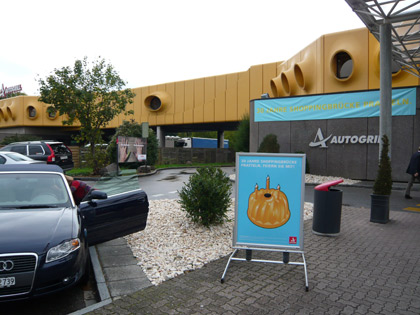
To mark its 30th anniversary, Matter & Gretener gave the rubber-yellow Prattel highway shopping bridge a new visual identity. The designs are inspired by the architecture of this avant-garde structure.

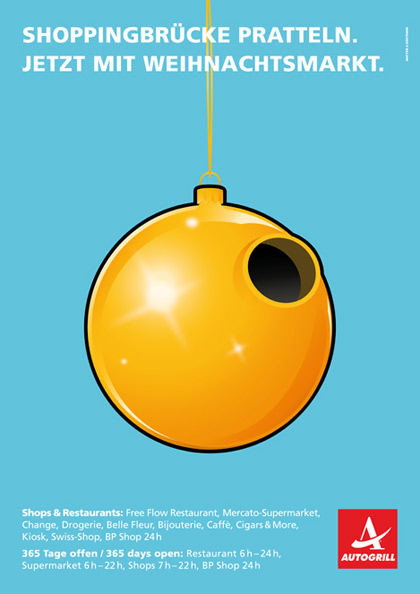
The Zurich agency Matter & Gretener has developed a new communication campaign for Autogrill to mark the 30th anniversary of the Pratteln shopping bridge. It focuses on the unusual architecture of the freeway service station and showcases the avant-garde, trendy building with its yellow plastic elements and eye-catching porthole windows. One poster shows a yellow Christmas tree ball with a porthole to draw attention to the Christmas market taking place there. Another poster shows a yellow Gugelhopf cake tin with the same hole in the middle instead of an ordinary birthday cake. Further measures with the same design are to follow.
Responsible at Autogrill: Daniel Summermatter (Area Manager), Nicole Thurnherr (Marketing Consultant). Responsible at Matter & Gretener: Daniel Matter (Creative Direction), Dominik Imseng (Text), Imer Krasniqi (Graphics), Simone Frei (Consulting), Richterich & Partner (PR).

1290582392_img081028_pratteln
1290582392_img081028_pratteln1
img081028_pratteln3

Manor plays a trump card

Alex Schmid Direct is giving the Manor Card a new look.

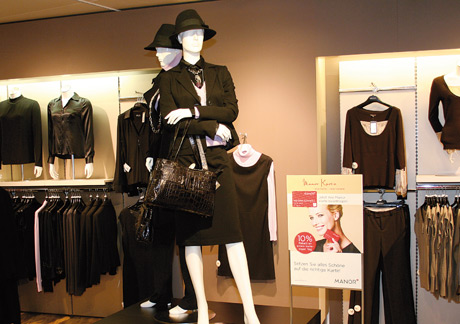
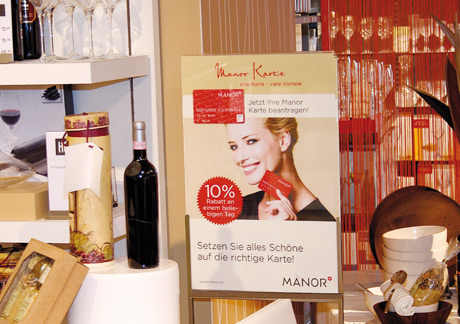
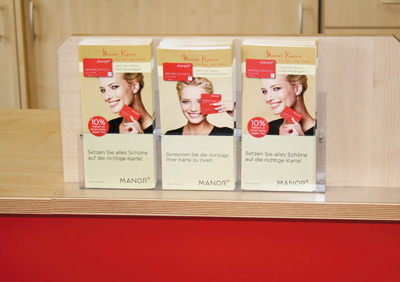
The Zolliker direct marketing agency Alex Schmid Direct has been managing the Manor card program since this spring and has aligned all customer communication with the new Manor branding. The cross-media dialogue process ensures long-term and profit-optimized customer loyalty.
The brand promise of the Manor card says it clearly: one card - many benefits. The newly designed appearance is feminine and stylish and "stands for inspiration for beautiful style", as Julia Tatje and Monika Gutzwiller from Manor Marketing describe it. In keeping with the fresh Manor claim "Donnons du style à la vie."
Alex Schmid Direct has designed over 50 different advertising materials - from stationery and business cards to mouse pads. All communication elements were tested for their impact at the POS using image montages and optimized for the fashionable woman in her mid-thirties.
The customer loyalty program includes two card applications, a welcome brochure, various forms, seamless customer correspondence and a colourful range of POS materials. The program was designed by Marc Magnenat and Carole Rütimann, with advice from Sabrina Björn and Lynn Häsler. The many text modules were put together by Sara Meier.
The implementation of the advertising material had to work on various components such as card applications, welcome brochures, Giganto façade posters and, of course, invoices. The agency only had just under a month to do this. The client was involved in weekly meetings.
For more than 40 years, Manor has been offering its customers the opportunity to pay in all of the Group's department stores, restaurants and supermarkets as well as at more than 10,000 myOne acceptance points and benefit from many other advantages with the now refreshed card. (pan)
1290582390_img081029_manor4
1290582390_img081029_manor3
1290582390_img081029_manor2
1290582390_img081029_manor1

Ringier appoints Christian Unger as new Group CEO

Christian Unger will become the new CEO of the Ringier publishing group. The 41-year-old will succeed Martin Werfeli in early 2009; Werfeli has been elected to Ringier's board of directors.

Christian Unger is to become the new Group CEO of the Ringier publishing house. As the Zurich-based media group announced on Wednesday evening, the 41-year-old will replace Martin Werfeli, who was elected to Ringier's Board of Directors, at the beginning of 2009. Unger had most recently headed MIH Internet Europe, a subsidiary of the South African media group Naspers. In this role, he was responsible for the entire European Internet division, which also includes the auction house Ricardo.ch.
Unger's career in the publishing industry began at the German Bertelsmann Group. From 1995, he was Managing Director there, responsible for two specialist information publishers. From 2002, Unger founded various joint ventures in Shanghai, Beijing and Hong Kong in China as CEO of Bertelsmann China. From 2005, he worked for the German retail and tourism group Arcandor and in 2007 moved to London as Managing Director of the e-commerce company Tradus. This was sold to Naspers in March 2008. So from January 1, 2009, he will now manage the good 7,000 employees of Ringier AG from Zurich.
Christian Unger is a German citizen, married and father of three children. His predecessor Werfeli has been with Ringier since 1977, and a member of the Group Executive Board since 1996. He was appointed Group CEO in 2003. According to Ringier, he is stepping down from the operational business at his own request at the end of the year.
On the Board of Directors, which is chaired by co-owner Michael Ringier, the 51-year-old Werfeli will join Vice President Uli Sigg, former Swiss Ambassador to China Oscar Frei, Jan O. Frøshaug, Hans-Olaf Henkel and Christiane zu Salm.
In addition, Martin Werfeli will remain Chairman of the Board of Ringier Print Holding AG and thus continue to bear direct responsibility for all Ringier print activities in Switzerland. As the media company further writes in its announcement, Werfeli will also remain the personal advisor to the Ringier family in the future.

(Pictures: Keystone)

get_footer();