The direct path to safety

Smile.direct insures itself against exchangeable insurance advertising with Ruf Lanz.

After a pitch "among three well-known agencies," as Markus Ruf is pleased to report, Ruf Lanz was awarded the contract to "confidently position Smile.direct as the fair online insurance company." The company, based in Zurich-Wallisellen, is the direct insurance provider for motor vehicles and for private households. Smile.direct is a 100 percent subsidiary of Nationale Suisse and emerged from the former Coop Insurance.
Smile.direct is the only insurance company in Switzerland with a "fairness guarantee". Life is not fair. "At least the insurance should be," say the advertisers. In concrete terms, this fairness guarantee means short contract and cancellation periods. Life changes quickly, for example, living arrangements in cohabitation. Furthermore, with this fair insurance there is no fine print, no hidden fees, and instead low premiums and a commitment to corporate sustainability.
If the insurance is taken out online, there is a 10 percent discount on the entire term. Already 60 percent of customers take out insurance online, 40 percent by phone.
"More than just a logo"
The goal of the first campaign: Smile.direct as a brand had to get into people's heads quickly and sustainably. Before working on Smile.direct, the creative team at Ruf Lanz plastered the entire conference room with ads from other insurers. After analyzing Swiss insurance advertising, Ruf Lanz then came to the conclusion: the imagery of many insurers is largely the same, often banal and interchangeable. The agency saw this as an opportunity for Smile.direct to distinguish itself from other providers of insurance solutions with a fresh appearance and to position itself independently. "Everyone is looking for an effective and concise market presence, because a strong brand with an equally strong brand strategy helps to achieve an advantageous position in the dynamic direct insurance environment," says Claudia Staub, Head of Marketing and Communications at Smile.direct. "We deliberately want our brand to be more than just a logo."
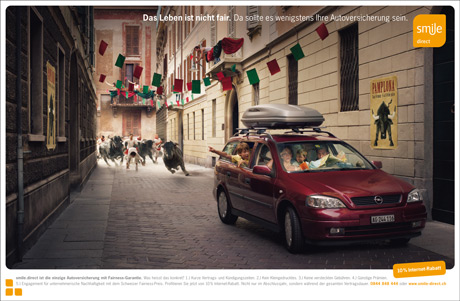
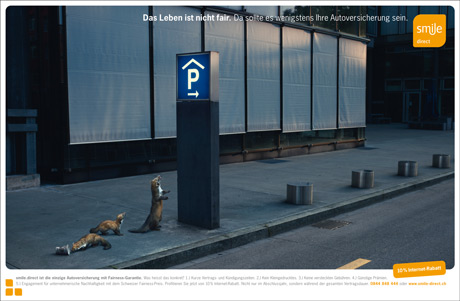
In the subjects designed with a sympathetic "smile," Ruf Lanz, in search of a new approach, shows not the damage, as other insurance companies do, but the situation just before it. This leaves it up to the viewer to imagine the damage and its extent in the most colorful of colors. The first three subjects are dedicated to car insurance. Three marten are hungrily making their way to the next parking garage. Real martens from the breeding of an animal trainer from Austria stood model for the funny picture. On the second subject, a Swiss tourist got lost in Pamplona on the most dangerous day of the year. Arthur Mebius photographed with great attention to detail. As a little inside joke, the car has an Aargau number. The third subject may not be revealed yet, because it will soon play topically around a "hot event".
Commitment to fairness
Independent of this campaign, the insurance company's annual Fairness Award is also intended to promote a positive image and set an example. This year, Sherpa Outdoor and Migros have already received awards for their "corporate sustainability". The Fairness Award will be presented again in 2009.
The Ruf Lanz subjects appear offline as advertisements with a footer where the fairness guarantee is explained in detail. In order to quickly interest a large audience in the new brand, double pages in the Sunday press were used at the beginning. Online, the subjects appear as animated banners with a direct link to Smile.direct. Already in planning are two "matching" guerrilla actions, as Markus Ruf can reveal.
Andreas Panzeri
1290582389_img081029_ruflanz1
1290582389_img081029_ruflanz2

Flop of the week: Stop AIDS campaign criticized

The Federal Office of Public Health (FOPH) has been involved in the fight against Aids for years. The campaigns are usually very direct and repeatedly meet with criticism. This is also the case with the latest poster series, which shows couples having sex in unusual situations and in unfamiliar surroundings.

The Federal Office of Public Health (FOPH) has been involved in the fight against Aids for years. The campaigns are usually very direct and repeatedly meet with criticism. This is also the case with the latest poster series, which shows couples having sex in unusual situations and in unfamiliar surroundings. The "Love Live Stop Aids" campaign has led to several complaints to the Fairness Commission. The FOPH is accused of using offensive subjects that degrade the most intimate relationship between people and reduce it to a mechanical activity. Others were outraged and consider the scenes to be hostile to children and families. Still others saw it as an appeal for public sexual intercourse, which is against morality and custom. However, the Fairness Commission did not take up the complaint because, according to its rules of procedure, it only has the task of checking commercial communication for fairness. Too bad for the moralizers.

Thomas Werder becomes Deputy CEO of Burson-Marsteller Switzerland

In mid-November 2008, Thomas Werder will take over as head of the Corporate & Financial Communications business unit at Burson-Marsteller Switzerland and will also assume the role of deputy managing director.

In mid-November 2008, Thomas Werder will join Burson-Marsteller Switzerland as Head of the Corporate & Financial Communications business unit and additionally assume the function of Deputy Managing Director. Previously, he was Head of Corporate Communications and Investor Relations of the SIG Group and, at the same time, a member of the extended Group Executive Committee.
With the addition of Thomas Werder, the company is deliberately seeking to strengthen the areas of financial and capital market communications as well as strategic reputation management, according to a quote from Managing Director Roman Geiser. In addition to Thomas Werder, the Executive Board also includes Marie-Louise Baumann, Theo Zijdenbos (Public Affairs), Dr. Toula Stoffel (Healthcare), Martin Hofer (Media Relations & Training), Joanna Corsaro (Geneva office) and Roland Oberhauser (CFO).

Sustainable brand promise

Brüngger Bachmann accompanies Pro Juventute's sales campaigns with prominent testimonials.

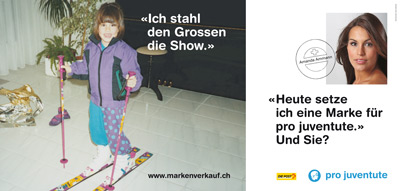
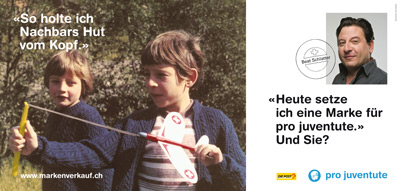
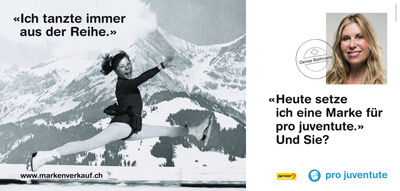
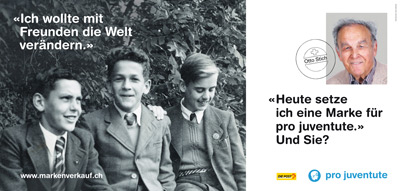
Since the beginning of this week, around 100,000 schoolchildren have once again been out and about selling the new stamps for Pro Juventute. These were designed by children themselves. In several workshops with the artist Ted Scapa, the children were allowed to create drawings on the theme of "Friendship". The campaign is also supported by a campaign. In a multi-stage agency selection process, Brüngger Bachmann Dialog won the budget for the fundraising activities of the Pro Juventute Foundation. The Zurich-based dialog specialists are supporting brand sales with a poster campaign featuring prominent Swiss people as children.
The celebrities were selected in such a way that an optimal mix of different age groups in the fields of business, politics, sport and art was created and thus has a different effect on the various target groups. Of course, all the celebrities play along for free. The national poster campaign is accompanied by various dialog media such as mailings, response flyers in the public transport network and a specially created landing page.
90% of the proceeds go to local projects where the brands are sold. Ten percent is used to support national ideas such as the 147 telephone helpline or www.147.ch. Pro Juventute celebrates its 100th anniversary in 2012. The charity was founded to combat tuberculosis in young people. It later supported kindergartens, youth hostels and, for a time, the Pestalozzi Children's Village. The SJW booklets have been available since 1931, the Robinson playgrounds since 1954 and many vacation pass activities today.
Andreas Panzeri
1290582390_img081029_projuventute_bruengger_bachmann1
1290582390_img081020_pro_juventute_bruengger_bachmann2
1290582390_img081029_projuventute_bruengger_bachmann3
1290582390_img081029_projuventute_bruengger_bachmann4

The journey is also part of the destination

Erdmannpeisker has created a new brand identity for BLS and is working on a wide-ranging campaign.

As a result of the merger of BLS Lötschbergbahn AG and Regionalverkehr Mittelland AG, the CD of the new BLS was revised in collaboration with Erdmannpeisker. Only the corporate colors remained the same. A design grid was developed that is as concise and open as possible and ensures clear recognition in all media.
The bar in the market is high. SBB has a strong presence in the market due to its high penetration alone. In order to stand up to this, a strong and concise visual world had to be developed in addition to the design. This should show BLS's offerings "in an independent and fascinating way", as required in the briefing for Erdmannpeisker.
Both the positioning of the umbrella brand and the principles of corporate design are used in BLS's brand communication. "This is why the course has also been set for advertising," explains Mark Bachmann, Head of Advertising Passenger Transport at BLS. Together with Erdmannpeisker, BLS is developing campaigns "with a clear focus and strong desirability". In the SBB market, only the desirable excursion destination is usually communicated. In contrast, BLS also wants to link its campaigns closely with the topic of "rail travel".
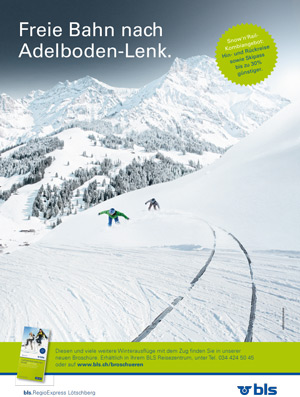
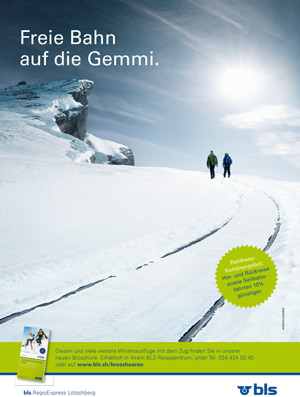
Whereas in the winter campaign, the campaign mechanics with symbolized tracks make it clear that customers can reach their excursion destination by the most direct route with BLS, the new summer campaign subtly communicates the advantages of a train journey for a successful excursion in the stylized train information. The options for en route are placed in front of the excursion destination like intermediate stops.
In line with its new positioning, BLS wants to be perceived as a highly professional railroad company with great customer proximity. Communication should also play a decisive role in achieving this goal.
With its extensive route network between Biel and Brig as well as Romont and Lucerne, the new BLS can offer an optimally developed infrastructure. During peak times, countless commuters are transported quickly, comfortably and reliably to their places of work in the morning and evening. But what happens to this expensive infrastructure between the start and end of the working day? This is where BLS wants to raise its profile as an attractive railroad for tourism in the future.
If you want to travel to Valais by the fastest route today, you can choose the route with the NRLA base tunnel. This is operated by SBB. Those who prefer to "make the journey the destination" choose the mountain route. The BLS Lötschberg line, built in 1912, offers a number of attractive excursion destinations. "Train travel and showcasing beautiful places" is therefore the concept behind the summer campaign, as CD Gabriel Peisker explains. Tourists - families, retired people, foreigners - want to fill their time and see as much as possible. Peisker has staged the imagery in an appropriately mystifying way. The scenes are intended to invite you to dream, like films in the style of "The Lord of the Rings". In winter, getting there is more important. Anyone traveling in ski boots and thick sweaters wants to get to their destination as quickly as possible. That's why the agency visualizes this offer with symbolized tracks that lead directly to the slopes.
Andreas Panzeri
In addition to SBB, the two private railroads Südostbahn SOB in central and eastern Switzerland and BLS in the extended Bern region will ensure competitive market behavior in Switzerland. BLS's main activities include regional passenger transport by train and bus, shipping in the Bernese Oberland and rail-based freight transport. Here, BLS is the Swiss partner of DB Cargo.
1290582391_img081029_bls1
1290582391_img081029_bls2
1290582391_img081029_bls3
1290582391_img081029_bls4

Against violence: Both Basel cities tighten youth protection for films and computer games

Due to increasing depictions of violence, the governments of the two Basel cantons want to strengthen the protection of minors in films and electronic media. A uniform national age rating for films and other media is already under discussion.

With the law, which is identical for Basel-Stadt and Baselland, the two half-cantons are reacting to increasingly drastic depictions of violence, particularly in computer games and on DVD. The law therefore aims to extend the protection of minors from cinemas to other media and establish binding age limits. Sellers of videos, DVDs and computer, console or video games will be obliged to indicate the age restriction on the products and to adhere to it when selling them. However, the cantons are powerless when it comes to the Internet, as the two members of government admitted at a press conference on Wednesday. According to SDA, the Conference of Justice and Police Directors is already working on a uniform national age rating for films and other media.

Two new customers for BSSM

The Basel-based advertising agency BSSM has been awarded two new contracts. The Lucerne bakery Hug has commissioned the BSSM advertising agency to redesign its corporate design and communication measures.

The Basel-based advertising agency BSSM has been awarded two new contracts. The Lucerne bakery Hug has commissioned the BSSM advertising agency to redesign its corporate design and communication measures. The occasion is a generational change in the management of the bakery, which was founded in 1877.
BSSM will also be redesigning the corporate design and communication presence for the construction company Ernst Frey. The Northwestern Swiss construction company is active in the core areas of road construction and civil engineering, building construction, customer operations and in the areas of building materials and real estate.
The first work for the two new customers will be carried out in the next few weeks.

Martin Boner takes over management of "Glanz & Gloria

The new editor-in-chief of the SF People magazine «Glanz & Gloria» is Martin Boner. Boner will succeed Daniel Pünter starting in January 2009. Pünter will head the editorial team of «Schweiz Aktuell» going forward.

The new editorial director of the SF People magazine "Glanz & Gloria" is Martin Boner. Boner succeeds Daniel Pünter as of January 2009. In the future, the latter will head the editorial department of "Schweiz Aktuell.
The 39-year-old Boner has been producer and deputy editorial director of "Glanz & Gloria" since 2005. During this period, he has played a significant role in the development of the new program, writes Schweizer Fernsehen in a statement on Wednesday. Boner has worked at Schweizer Fernsehen since 1998. Among other things, he was editor and producer of the youth magazine "Oops!

Orange and Sony Ericsson unite cross-media for "Bands on Tour

On Friday, Switzerland’s first interactive documentary event show, «Bands on Tour,« came to an end. Under the motto »We were young and needed the money,” three up-and-coming bands competed against each other in a musical contest during a mini-tour across Switzerland.

On Friday, Switzerland’s first interactive documentary event show, «Bands on Tour,« came to an end. Under the motto »We were young and needed the money,” three up-and-coming bands competed against each other in a musical contest during a mini-tour across Switzerland.
The agency Zürich Tokio developed the design for the accompanying website. The website served as the centerpiece of the event. Editorial ads were intended to attract as many fans and interested visitors as possible to the site. The visual concept is based on three key ideas: three bands, one goal, no money.
The goal of the event was to mobilize as many fans as possible for the final concert at Liquid in Bern by gathering as many submissions as possible through the new mass media platforms of web TV, online newspapers, WAP, SMS, and MMS. The winner then received a new tour bus as the headliner of the evening.
Following the «successful launch,» the joint project between Orange and Sony Ericsson is expected to continue, Zürich Tokio adds in a press release.
Responsible at Sony Ericsson: Rolf Weiss (Head of Marketing). Responsible at Orange: Amsler Miranda (Communications Project Manager), Trousseau Xavier (Communications Project Manager). Contact at BOOM Propaganda & Events: Joachim Bodmer (Overall Responsibility), Roman Bucher (Project Manager). Responsible at Zurich Tokyo: Daniel Donati (Creative Direction), Karin Glarner (Art Direction), Fabian Widmer (Graphic Design), Micha Schmid (DTP), Stefan Lemberger (Consulting).
1290582385_img081029_website_bandsontour
1290582385_img081029_plakat_bandsontour

Local strategy in the Zurich Oberland

On November 6, Zürcher Oberland Medien will launch five small-circulation weekly newspapers. With this move, the media company aims to establish a stronger foothold in the local market.

It has the same format as a commuter newspaper, but even at first glance it is clear that the free newspaper Regio.ch is not intended for commuters: the new newspaper, which will be published once a week in the Zurich Oberland from November 6, has much longer texts than a classic commuter newspaper. If you take a closer look, you can also see differences in content: Regio.ch articles have a clear local focus; world events do not feature in this printed product - or only if they are directly related to the people in the five Oberland regions of Illnau-Effretikon, Uster, Pfäffikon, Wetzikon and Rüti. "The region in a nutshell" is the subtitle of Regio.ch. This is also meant geographically: there is a separate Regio.ch edition for each of the areas mentioned, covering the largest town in each case as well as the surrounding four to five municipalities. And all of these editions, with a total circulation of 89,502 copies, will in future be distributed free of charge on Thursdays and delivered to letterboxes early.
The five Regio.ch editions are published by ZO Wochenzeitungen AG, a young subsidiary of Zürcher Oberland Medien (ZOM), which also publishes the daily newspaper Zürcher Oberländer (ZO). Until August, the company was still called Kiebitz Verlag AG. This is no coincidence. Kiebitz is a small weekly newspaper that was distributed for the last time this week in the municipalities of Illnau-Effretikon, Lindau and Brütten. Kiebitz already belonged to ZOM, but will now also supply Kyburg and Weisslingen as Regio.ch issue 1. The circulation will increase from 9,500 to 11,510 copies. The Kiebitz logo will complement that of Regio.ch for another two months, after which it will disappear.
A second title, the Wetziker Spiegel (11,000 copies), also owned by ZOM and previously only published monthly, will be integrated into the Regio.ch concept. This title will also disappear, but the corresponding Regio.ch issue 4 will be expanded to include the municipalities of Hinwil, Bäretswil, Seegräben, Gossau and Grüningen. The circulation here will increase from 11,000 to 22,817 copies. In the three remaining small regions of Uster, Pfäffikon and Rüti, however, ZOM is launching new newspapers, all of which should also function as official publication organs for the respective municipalities if possible. Whether this will succeed remains to be seen. Apart from the municipality of Illnau-Effretikon, which has cooperated with the Kiebitz to date, there are still no commitments. Apparently, they want to wait and see how many readers there are first.

ZOM Publishing Director Konrad Müller describes the reason for launching the five micro-regional newspapers as follows: "We want to retain the reader market and gain additional market share in the advertising sector, particularly among small businesses, SMEs and associations. In this way, we want to distance ourselves from the competition from the city of Zurich." So is Regio.ch a response to the regional edition of the Tages-Anzeiger in the Zurich Oberland? Yes, says Müller, although the idea of dividing the market into small sub-regions has been maturing at ZOM since 2004. But one thing is clear: instead of attacking the Tagi head-on and wearing itself out, ZOM would rather consolidate its local foundations and try to secure the reader and advertising market in its own core area in the long term with three media - the subscription-based ZO, ZO-Online and Regio.ch.

1290582390_img081029_mueller
Konrad MüllerThe experiment is interesting, but it remains to be seen whether it will work out. Müller expects Regio.ch alone to generate a total turnover of 2.9 million francs in its first year - and a "small loss". He also anticipates a cannibalization effect: "Regio.ch is likely to eat up around 600,000 francs from the ZO, which is why the actual additional turnover will probably only amount to 2.3 million francs," he says. But that doesn't worry Müller. "I'd rather have competition in-house than lose sales to the competition."
But that is not the end of the story. As soon as Regio.ch has established itself, Konrad Müller also expects good reach figures. He is assuming one reader per copy (LpE) at the start. "We hope to reach 1.5 LpE by 2010," he says. A third of these expected 130,000 readers are likely to be younger people, Müller assumes. This should make a combination of Regio.ch and ZO interesting. Even if it is still a long way off, such a combination is already being offered - with a 10 percent discount on the two individual tariffs. For the time being, however, local customers are likely to be particularly interested in the individual Regio.ch editions, which can be combined as desired.
Markus Knöpfli
Wait and see
If you look closely, you will notice that ZOM has left out two small regions in the ZO circulation area - namely the lower district of Uster and the Tösstal. In fact, it has decided not to publish a Regio.ch edition there, even though this would make sense in terms of the overall concept. The reason: similar newspapers already exist in both areas, the Glattaler and the Tösstaler. The Glattaler, with a weekly circulation of just under 26,000 copies, is owned by Zürcher Unterland Medien, with which ZOM is closely associated with the Zürcher Landzeitung. And the Tösstaler is published three times a week with almost 4,500 copies and is owned by Buchdruckerei Turbenthal. "The two will first see how our project gets off the ground for a year and then decide whether they want to join," says Konrad Müller. (mk)
Historically grown
A closer look at Regio.ch reveals another specialty: The Illnau-Effretikon edition has the highest rate of all the splits - but the smallest circulation. This comes from the Kiebitz, says Konrad Müller. "It's just a historically evolved rate." The other editions are different: There, the prices are based on circulation and (expected) reach. (mk)

Edipresse takes over Swissfriends.ch

The Lausanne-based publishing house Edipresse has acquired Comfriends SA and, with it, the dating platform Swissfriends.ch. Just recently, the publishing companies Ringier and Tamedia also acquired online platforms.

Lausanne-based publisher Edipresse has acquired Comfriends SA and with it the dating platform Swissfriends.ch. The publisher has already held a stake in Comfriends since 2005, but has now exercised its purchase options and bought the remaining 51 percent from the other shareholders. Swissfriends.ch was founded in 1999 and says it now has 90,000 members and 20 million page views per month. As Netzwoche writes, Edipresse is not the first publisher to feel a renewed hunger for online platforms. Ringier recently acquired Geschenkidee.ch and Tamedia Search.ch.

Office Web: Microsoft will offer ad-supported Office

The software giant Microsoft is breaking a taboo: in response to numerous free applications, the company will in future offer its Office for private users on the Internet for a rental fee or with advertising. The corresponding Windows Azure operating system was already presented on Monday.

The software giant Microsoft is breaking a taboo: in response to numerous free applications, the company will in future offer its Office for private users on the Internet for a rental fee or with advertising. Companies will still have to pay for the service. Microsoft had previously doubted the overall benefit of web-based applications, such as those offered by Google with Google Apps. It remains to be seen when Web Office, which runs in a web browser, will be launched.
With the Group's focus on Internet-based software services, which was announced some time ago, Microsoft is threatened with a loss of revenue in the billions. In 2007, the Office business alone generated a turnover of 18.9 billion dollars, as reported by Financial Times Deutschland. The profit amounted to 12.4 billion dollars. The Office division generates even more profit and turnover than the highly profitable Windows operating system.
According to FTD Germany, however, Microsoft does not expect private users with a conventional version of Office to use the ad-financed version on a large scale. The online version processes large, bulky data more slowly. Rather, the company is hoping for additional revenue from those users who would not have bought a license for their computer anyway. It is extremely doubtful that this hope will be realized.
With this change in strategy, Microsoft is responding to increasing competition from free or ad-financed programs from Google, Yahoo or Open Office, for example. The predicted technology trend is also pointing in this direction: it is expected that programs will be installed less on the PC in future and will increasingly be offered and accessed on the Internet in the so-called computer cloud.
On Monday, the company presented the Windows Azure operating system, which is intended to serve as the basis for web-based software offerings and services. Azure and Web Office are being developed in parallel with the next Windows and Office versions for PCs. Although it is not yet known when the Web Office will be released, a so-called technology preview is to take place this year, which will allow a look at the program before the beta version is released. The beta version is planned for 2009.
get_footer();