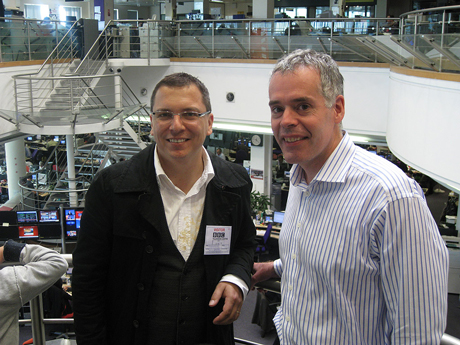
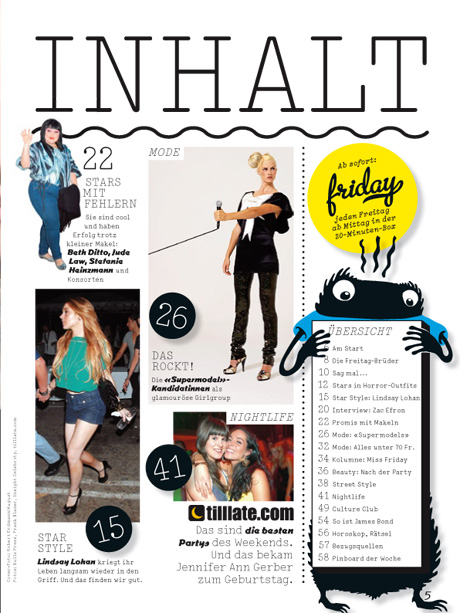
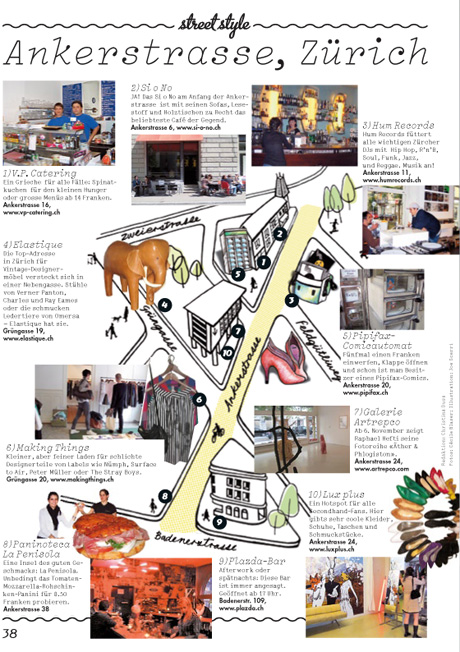
"20 Minuten needs a glossy sister in which we can depict the consumer world."The new lifestyle magazine from 20 Minuten has been launched. Tamedia launched its latest baby with a celebrity-filled christening party on Thursday evening. A free magazine for young female readers aged 16 to 28, which Editor-in-Chief Marco Boselli (43) is very proud of.
The successor to the music-based magazine Week celebrated its christening on Thursday with an almost pompous event. Swiss media, PR and show business celebrities gathered at the recently opened Klub Escherwyss on the Sulzer site to toast the new lifestyle magazine, which is increasingly geared towards the needs of the advertising industry. The magazine, born from a pool of ideas fed by the heads of the commuter newspaper 20 Minuten, the women's magazine Annabelle, the event platform Tilllate and the top management of Tamedia, is being published for the first time today, Friday.
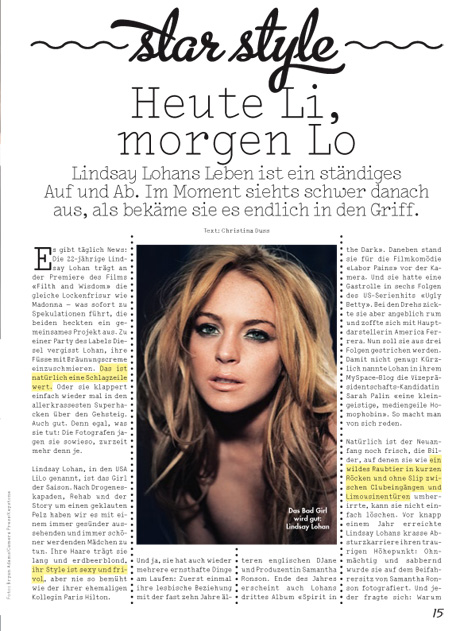
American actress Lindsay Lohan, known for her forays into singing and numerous escapades, was emblazoned on the cover. And it is precisely such personalities and their lives that will in future fill the magazine, which is printed on glossy paper and in many ways resembles the layout of Annabelle. An interview with editor-in-chief Marco Boselli.
What caused Week's death?If, like us, you make a newspaper that reaches 1.5 million readers, you have similar expectations for a free magazine from the same company. Unfortunately, Week has never reached more than 240,000 readers. So we had to question ourselves. There seemed to be something wrong with the expectations, with the potential that the magazine actually had. We analyzed this quite carefully. We made a good magazine, but in the end there were already other papers in the regions that were superior to us. For example, Züritipp or other event calendars from Bern or Basel. We simply never succeeded in creating a good product for the whole of Switzerland that fully exploited the potential of the 20 Minuten brand. We also noticed from customers that the need was more in the lifestyle sector. However, the paper quality of the Week was not good enough for this. That's why we never got these customers. We were always in the black, but it was a constant kicking in the teeth. That frustrated us as creators.
What was done then?We then decided that things couldn't go on like this and retreated into a quiet little room. We thought about it: What would be a magazine that could be successful in this country? What doesn't exist yet? What is the advertising market interested in? - After all, we are a free magazine, so we are dependent on our advertisers. And then it was actually obvious not to make corrections in between, but to tackle the whole thing from A to Z from scratch.
To summarize again: What did Week miss?A new calculation, a new approach. If you want to produce a magazine that is suitable for the masses in this form, you have to have glossy paper, a large editorial team and a large budget for images. If you want to cover these costs, then that defines the type of content you have to produce. And that is no longer music, but lifestyle, cosmetics and fashion. 20 Minuten needs a glossy sister in which we can better reflect the consumer world.
Week was already often described as a prestige paper in the publishing house, should 20 Minuten Friday also fulfill this role?Week was a prestige object. Now a new era has begun. Friday will also be a prestige object. I believe we have succeeded in bringing another innovation to the market. We have discovered that our hundreds of thousands of readers do not have a magazine that meets their needs.
The layout is very reminiscent of Annabelle in places. How is the collaboration going?That was an interesting development. We have a so-called "innovation group" at Tamedia in which we think about new projects. All the editors-in-chief are part of it. Annabelle editor-in-chief Lisa Feldmann and I discovered that we both had a problem. We haven't fully exploited the potential of our brand and Annabelle lacks a young mainstay. So we decided to combine the two problems and look for a solution. Tilllate then came on board relatively quickly. They had the problem that they didn't have a print connection yet.
How did you then proceed?Well, you have to be honest: there are already magazines that work in a similar way. There are a relatively large number of such titles in America. We thought that with our strong 20 Minuten brand behind us and the incredibly good distribution via the box system, it should be possible to produce a magazine that can be financed by advertising revenue. We then got together in a group of five and came up with a draft. When this was ready, we presented it to the management of Tamedia. After a critical assessment, the go-ahead came relatively quickly.
(Interview: Adrian Schräder)