Michael Schaepe founded the Bronx Fotografen photography agency in Zurich. It represents photographers Daniel Gerber, Mirjam Kluka, and Bettina Schaefer.
Editorial
-
November 5, 2008
Michael Schaepe founded the photography agency Bronx Fotografen in Zurich. It represents the photographers Daniel Gerber, Mirjam Kluka and Bettina Schaefer. Schaepe is an art director with a love of photography and a wealth of experience with shoots ranging from fashion to still life, according to a press release. Daniel Gerber is a still life photographer specializing in portraits of people and photographic reports on companies or other topics. Mirjam Kluka works with a focus on beauty and fashion photography and also applies this to portrait and advertising photography. Bettina Schaefer specializes in storytelling with photos and works for portraits with professional models as well as with others.
Lesch + Frei: Carving wood for Pastorini
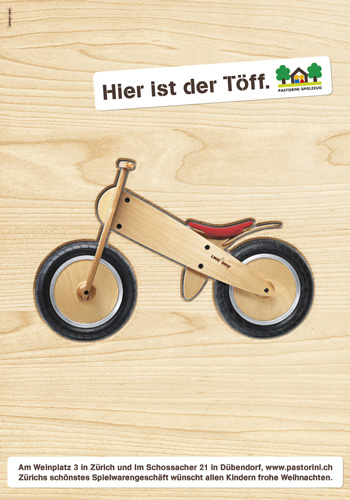
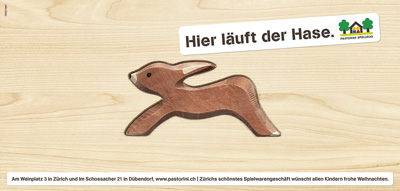
Since mid-October, wooden advertisements have been on display throughout the city of Zurich and in Dübendorf, as well as on public transportation in the region. Until now, it was unclear what or who these ads were promoting. Now we have the answer.
Editorial
-
November 5, 2008
Since mid-October, wooden advertisements have been hanging in the city of Zurich and in Dübendorf, as well as on public transport in the region. What or who is being advertised was unknown until now. Now the solution follows: The 13 wooden posters as well as 100 further, "normal" print posters advertise for Pastorini toys, especially known for wooden toys. The campaign originates from the pen of the agency Lesch + free and is to update according to communication the mark Pastorini, so that it can exist opposite the many offerers of plastic and electrical toys. Success has already set itself thereby, so the agency. Numerous Zurich residents have found their way to Pastorini via the senderless teaser posters and have taken part in the competition. Responsible at Lesch+Frei Zurich: Thomas Lüber (CD, text), Matthias Kadlubsky (AD, Susanne Fürst (consulting), Barbara Meier and Désirée Guzzo (polygraphy). Mariano Lo Presti (illustration/image editing), Hans-Jörg F. Walter (photography). Responsible at Christinger Partner AG: Damian Stark (Division Manager Screen Printing/Print and Cut). Responsible at APG: Juan Manuel Fernandez, Ronny Meier, Karin Komar. Responsible at Pastorini toys: Christa Pastorini, Felix Schumacher (owner).
No boredom guaranteed with this article
Wirz Werbung is breaking new ground in online advertising for the online job platform Jobwinner.ch—using the oldest form of online advertising: banners.
Editorial
-
November 5, 2008
What, are you so underemployed that you're reading this article? Wirz has already created several funny subjects in the style of this basic idea to entice bored employees to take a quick look at the www.jobwinner.ch job portal. So far, the creative gags have worked in print. Now Wirz wants to break new ground in online advertising. "And with the oldest of all online advertising media: namely banners," as CD Thomas Kurzmeyer explains. However, these are not conventional representatives of their kind, but a new form for which the Jobwinner.ch team at Wirz Werbung and Assai Interactive have coined the term "Trojan banners". Because there is something completely different going on here than what is recognizable from the outside: they advertise things like a competition to win a billion dollars, promise to matchmake dream princes and lure people to particularly silly celebrity clips under "You Tubel". However, those who are tempted to click end up somewhere else than expected: namely with the leading Swiss job agency, which asks itself and the user anxiously whether they really already have the job they feel called to. The aim of the campaign was to generate as many clicks as possible on the website. And with values that are up to eight times higher than the average click rate of normal banners, this seems to have been successful. Especially as Wirz and Assai also react flexibly to current events, for example with an additional banner that promises the immediate purchase of junk mortgages. The highly targeted placement of the banners also certainly contributes to the success of the campaign. For example, the YouTube parody banner was used on various occasions on the real YouTube site - and was also clicked on there. (pan)
"Trojan banners": Wirz uses this witty method to generate a remarkable amount of traffic on the Jobwinner homepage.
E-readers could save newspapers
American print publishers are eagerly awaiting the new e-reader from Plastic Logic.
Editorial
-
November 5, 2008
America is finally catching up. At least that's what the media professionals in the publishing houses who are dedicated to the future of the industry, i.e. who are involved in the development of new technologies such as the e-paper, are saying. Because although the American industry is about three years behind the Europeans in this respect, there is something to celebrate: the launch of a new e-paper platform from Plastic Logic, which will be officially launched in January. The product is particularly interesting for the newspaper and magazine business because, with its dimensions of 21.5 × 28 centimetres, it comes relatively close to today's paper products. The previous forerunners in so-called e-readers are the Sony product of the same name and the Kindle from Amazon.com, which are not even half the size because they were tailored to the book format from the outset. Amazon does offer a total of 20 American newspapers, from the New York Times and the Wall Street Journal to the regional newspaper Denver Post, for downloading onto the Kindle. However, the format is not exactly newspaper-friendly with its small screen, which can only display a small amount of content, let alone advertisements. "E-readers have the potential to provide a widespread distribution mechanism that is not only environmentally friendly, but also a way to make money from content," says former publisher and current industry consultant Rebecca McPheters. "The previous models have worked well for the book business, but far less well for newspapers." In fact, the e-paper has the important advantage for publishers that readers pay for the content. A subscription to the New York Times, for example, costs 15 dollars a month on Amazon.com. Although this is significantly less than the 40 dollars for the print product, it is still clearly more than the free website. In addition, newspapers can save up to 50 percent of their previous costs for paper, production and delivery by distributing the e-paper. The Plastic-Logic product, which at 370 grams weighs less than a newspaper, was originally intended as an electronic reading tool for business documents, but quickly mutated into a beacon of hope for the beleaguered newspaper industry due to the high demand. The screen is currently still in black and white, but in a few years it should be able to show colors and even be rolled up like a newspaper. The content is constantly updated via a wireless Internet connection. It will also be possible to read international publications. "The e-paper combines the advantages of print and the Internet," says Vin Crosbie, communications professor at Syracuse University. The new technology is easier to read and displays graphics better than a computer screen - just like a print product. At the same time, it enables interactive advertising - the great advantage of the Internet. The new technology therefore benefits advertisers in particular: they learn more about their readers. The format makes it clear which readers actually read which articles and advertisers can target specific demographics more effectively. It is expected that all major publishers will be on board for the launch of the plastic-logic reader. Hearst and Time Inc. are already distributing their magazines via Kindle. The men's magazine Esquire also flew the flag in October by publishing the cover of part of its print run as an e-paper, i.e. a flexible plastic screen. If the e-paper becomes established on the mass market, Vin Crosbie believes this will have an impact on journalism. "There will be shorter texts, more photos and videos, and reporters will have to adapt to this," he says. However, he believes that the short form is not only popular because the format is more convenient for readers. "People also have a shorter attention span these days." Gerti Schön
Promising technology: In contrast to free websites, newspaper publishers can earn money by delivering content on e-readers.
Walder Werber is campaigning for the new weekly newspaper Regio.ch.
Walder Werber is campaigning for the new weekly newspaper Regio.ch.
Editorial
-
November 5, 2008
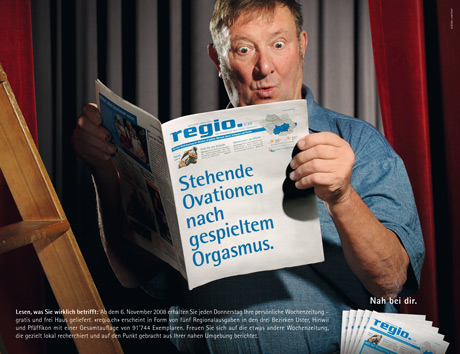
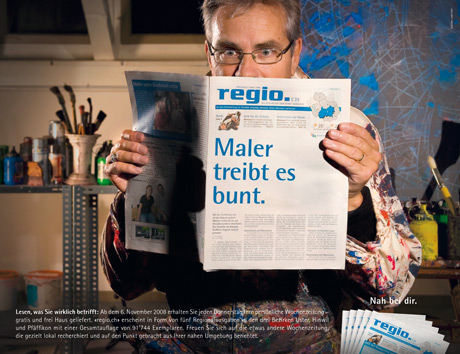
The ZO weekly newspapers have entrusted the Walder Werber agency in Uster with the launch campaign for their weekly newspaper Regio.ch. The campaign consists of a poster and advertising campaign, a 3D mailing and accompanying measures. Walder Werber has made the claim "Close to you" the main message. Under the same motto, the agency launched a regional casting "to find people who could convey this campaign", as Sandro Walder, the agency's overall manager, explains. Protagonists were found who would make the viewer smile by taking the claim as literally as possible. The message: in the new Regio.ch you can read what really concerns the people of the Zurich Oberland. The campaign was supported by sending a 3D mailing to potential customers and communication managers. When the mailing is opened, five different colored eyes look out at the surprised recipient. The five eyes stand for five regional editions. "This is where you become instantly eye-catching", the text reads. To ensure that the gift is still fun even after the advertising effect, the "eyes" conceal a marble game with instructions. Andreas Panzeri
Top of the week: Cicero honored with OMG Award 2008
For the second time since 2004, the political magazine Cicero has been honored with the OMG Award by Ringier Germany. This year's prize from the Organization of Media Agencies (OMG) goes to the 2007 year-end edition of Cicero, which was published in a series of 160,000 unique copies.
Editorial
-
November 5, 2008
For the second time since 2004, the political magazine Cicero has been honored with the OMG Award by Ringier Germany. This year's prize from the Organization of Media Agencies (OMG) goes to the 2007 year-end edition of Cicero, which was published in a series of 160,000 unique copies. The jury of media experts from leading German agencies and companies awarded Cicero in four evaluation criteria: Innovative strength, market position, marketing and media performance. The magazine came out on top against fellow nominees Die Zeit and RTL. At the award ceremony held in Berlin by OMG Managing Director Werner Bitz, Martin Paff, Managing Director of Ringier in Germany, said: "This prize means a great deal to us because it is awarded by experts who are very good at assessing the importance of a medium on the reader and advertising market. They have recognized that print still stands for very strong communication solutions in today's competitive media environment. And they have encouraged Cicero to continue to surprise with print innovations in the future." The 2007 year-end edition, which has now won the OMG Award 2008, surprised with 160,000 individualized covers and 160,000 different BMW advertisements for the 1 Series Coupé. Almost 50 million images were used for the covers. And over 12,000 decision-makers from politics, business, media and marketing received a personal copy with their own picture on the cover by post.
Christof Lenhard new at MS Mail Service
Christof Lenhard is joining the St. Gallen-based direct marketing company MS Mail Service. The 41-year-old will become the new Head of Strategic Projects effective May 1, 2009.
Editorial
-
November 4, 2008
Christof Lenhard is moving to the St. Gallen-based direct marketing company MS Mail Service. The 41-year-old will become the new Head of Strategic Projects as of May 1, 2009. According to Chairman of the Board Peter Stössel, in the 30th anniversary year of the MS Group, the company intends to secure further market share in Switzerland through increased presence and targeted acquisitions, and also to strengthen its commitment abroad. Many of these activities will be managed by Christof Lenhard in the future, the company said in a statement. Lenhard is currently head of the Dialog Marketing strategic business unit at Swiss Post in the Postmail division. In this function, he initiated the study "Measuring advertising success between desire and reality," among other things. Lenhard holds a degree in economics and has been working in direct marketing for 15 years in Germany and Switzerland.
Image of the banks: Raiffeisen top, UBS a flop
According to a survey on the image of banks published on Tuesday, the Raiffeisen Group in particular has benefited from the financial crisis. The biggest loser, however, is UBS, which is struggling with its battered reputation. The vast majority of the approximately 1,020 people surveyed were also critical of the rescue package for UBS.
Editorial
-
November 4, 2008
According to a survey on the image of banks published on Tuesday, the Raiffeisen Group in particular has benefited from the financial crisis. The biggest loser, however, is UBS, which is struggling with its battered reputation. The vast majority of the approximately 1,020 people surveyed were also critical of the rescue package for UBS. The winner of the survey, which was conducted by the brand agency Young & Rubicam, is Raiffeisenbank. It has a 20 percent higher preference among bank customers than a year ago. The cantonal banks, Clientis and Postfinance have also gained in credibility and esteem. The two big banks UBS and Credit Suisse have lost a great deal of credibility as a result of the financial crisis. UBS has been hit the hardest. It lost 66 percent of its brand preference compared to the previous year. Around 80 percent of consumers surveyed rated UBS as less credible than a year ago, compared to 50 percent for CS. However, 85 percent of bank customers are not considering any direct measures. They are convinced that their money is safe with their bank. The CHF 68 billion rescue package for UBS is viewed critically. 65% of those surveyed were against state aid for the banks financed with taxpayers' money. More than 80 percent demand that the failed managers pay back their bonuses. 60 percent of respondents believe that the financial crisis has had little or no impact on their immediate living situation. Nevertheless, two thirds stated that they were more cautious with money and had postponed major investments. This applies above all to luxury goods such as watches, jewelry, cars, home electronics and travel.
Two out of three Swiss people use the internet regularly
Just under 70 percent of the Swiss population uses the Internet regularly. This is according to the new publication «Indicators on the Information Society in Switzerland» by the Federal Statistical Office (FSO). Just ten years ago, the figure was less than 10 percent of the population. However, Internet use varies greatly depending on educational level and age.
Editorial
-
November 4, 2008
Almost 70 percent of the Swiss population aged 14 and over use the internet regularly. This is according to the new publication "Indicators on the Swiss Information Society" from the Federal Statistical Office (FSO). In spring 2008, around 77 percent of respondents stated that they had used the Internet at least once in the past six months. 68 percent use it weekly or daily. Ten years ago, this figure was less than 10 percent of the population. The proportion of regular users grew particularly strongly between 1997 and 2001, from 7% to over 40%. Since 2005, it has been over 60 percent. However, internet usage varies greatly depending on education level and age. While 90 percent of people with a university degree or higher vocational training use the Internet, the proportion of people who have only completed compulsory schooling is 47 percent. This educational gap is only slowly narrowing. There are also differences in age: 90% of 14 to 19-year-olds use the Internet regularly, but only four in ten of those over 50. Although the older age groups are catching up, the gap between the age groups has not narrowed significantly. 70% of households in Switzerland have Internet access. This puts Switzerland above the average for EU countries, but behind South Korea and Scandinavia. Three quarters of households with Internet access have a broadband connection. This proportion is below that of the leading countries, for example 89% in Denmark. The development of e-commerce fell short of expectations. In 2006, households spent around CHF 2.5 billion a year on goods and services purchased online. The most money was spent on travel, multimedia and IT equipment.
Imprint: Postcards sent out for the "Stand up for Journalism" day of action
The media union Impressum is carrying out a postcard campaign on the occasion of the international day of action "Stand up for Journalism", which takes place on Wednesday. In it, it calls on media companies to respect the copyright of media professionals and to compensate them appropriately for the rights of use they have acquired.
Editorial
-
November 4, 2008
The media union Impressum is carrying out a postcard campaign on the occasion of the international day of action "Stand up for Journalism", which takes place on Wednesday. In it, it calls on media companies to respect the copyright of media professionals and to compensate them appropriately for the rights of use they have acquired. By law, journalists and press photographers have all copyrights to their works. However, they can assign these by contract. This is usually done by agreeing a one-off reproduction right with a medium for a fee. However, media companies are increasingly trying to circumvent copyrights, writes Impressum in a press release on Tuesday. They only pay media professionals a fee for one-time use, but demand the assignment of all copyrights in framework agreements, including those for future use, multiple use and Internet distribution. For freelance journalists in particular, the lack of compensation for the "forced" rights means a massive deterioration in their income situation, the report continued. If freelance journalists refused to sign such contracts, they would have to reckon with no more assignments.
Radio 24 is excited about the US presidential election
Radio 24 is broadcasting a special program on the US presidential election. During the US election night, US correspondent Arndt Peltner and political scientist Regula Stämpfli will provide a running commentary on the election results.
Editorial
-
November 4, 2008
Radio 24 is broadcasting a special program on the US presidential election. During the US election night from November 4 to 5, US correspondent Arndt Peltner and political scientist Regula Stämpfli will provide a running commentary on the election results. In addition, reporters will be out and about in Zurich, reporting from various locations where politicians and Americans abroad are following the elections. The election night begins on Radio 24 at 6.15 pm with a 30-minute interview with Erich Gysling on the starting position of the elections. The coverage will end on November 5 at 6 pm with another talk. Regula Stämpfli and Erich Gysling will comment on the consequences of the election. Throughout the night, listeners will also have the chance to win a trip to the USA.
fMRI study: Emotional brand experience increases purchase probability
Promarca, the professional association for the Swiss branded goods industry, conducted an independent study together with the HSG Research Center for Business Metrics, Audi Lab for Market Research. This examined the effect of emotions when engaging with brands.
Editorial
-
November 4, 2008
Promarca, the professional association for the Swiss branded goods industry, has conducted an independent brand study together with the HSG Research Center for Business Metrics, Audi Lab for Market Research. The research project, entitled "Tell me what you feel and I'll tell you what you think", used functional magnetic resonance imaging (fMRI) to investigate the effect of emotions on test subjects when engaging with brands. The research project has now been presented. The results of the study suggest that highly emotional brands evoke positive associations and feelings of pleasure in customers and thus have a positive influence on decision-making. It is primarily these emotions that make up the value of a brand and determine brand judgment. With highly emotional brands, cognitive brand information such as quality or price take a back seat in the purchase decision. Customers can identify better with highly emotional brands than with less emotional or unknown brands. They feel more attracted to emotional brands and remember brand-relevant information better. With low-emotional brands, on the other hand, the purchase decision is primarily influenced by content-related, cognitive brand content. According to the study, successful brand management should aim for a high level of brand emotionalization in the long term. A strong emotional connection to the brand has the ability to compensate for minor weaknesses in the physical product core. It also allows a brand to better differentiate itself from other brands.