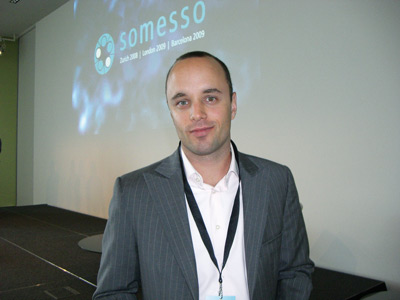
That happened fast. Three weeks ago, Arjen Strijker launched a call for participation on Twitter. The Dutchman, who lives in Zurich and works in business relationship management—and is a specialist in executive recruitment in the finance and consulting sectors—wanted to exchange ideas with like-minded people about trends and the latest developments in web services. He is convinced that social media platforms such as Facebook, Twitter, Xing, and First Tuesday «offer more than just a way to pass the time.» Such web services have long since brought about massive changes in the world of corporate communications. «How can companies get the most out of social media?» is therefore the question.
No sooner said than done: Three weeks after Strijker’s call on Twitter, Somesso Zürich 08 took place at the Gottlieb Duttweiler Institute in Rüschlikon. At the conference, a select group of about 80 entrepreneurs from all over Europe gathered to spend an entire day discussing the Internet and networking.
«I came across the idea for Somesso on Twitter and was immediately drawn to it,» reveals Daniel Jörg. The Head of Cross-Media at Burson-Marsteller in Bern shared the tweet with like-minded colleagues and, together with his agency and other specialists, launched the website www.sommesso.com within a few days. This platform could now become something of an umbrella organization for the united portal operators. Most of the key figures among them were able to clear their schedules for the event in Rüschlikon. The GDI also responded to the Twitter message and offered its conference rooms for Somesso. Jojo Rufener, who has long been known as a major networker, is so enthusiastic about the new initiative that he has already offered to organize not only Somesso at the GDI but also the next conference in March in London and another in Barcelona in 2009 through Rufener Events. «At a subsidized rate, of course.» Because even though Agoracs, as the organizer of Somesso, already brings together many initiatives aimed at expanding business contacts, the vanguard of such developments naturally continues to be found in the startup sector.
75 percent of innovations failNine selected startups were also given four minutes each at the first Somesso to present their ideas and business models. Prior to that, experts and representatives of already successful networks spoke about their activities. The presentation was moderated by Susan Kish, who has been an international expert in this field since the emergence of the first social networks. «Social media has been around for ages. But today we have a new technology that will change society even more in the future than the invention of the newspaper,» said Kish, attempting to put the significance of new media into proper perspective. What’s revolutionary about this form of communication: It enables anyone to share information and connect with like-minded people at an extremely low cost. Kish demonstrated that print media is far from obsolete by showing a souvenir she brought back from London. There, at an airport kiosk, she found a colorful, thick magazine called *Facebook Guide Magazine*.
In his preview of upcoming trends, Dutch professor Frans van der Reep has observed a shift from marketing to sales. The Spanish fashion retailer Zara, for example, no longer engages in any marketing at all. They simply stock their stores with a large selection of new clothes. Whatever sells within three weeks is added to the lineup. The rest gets tossed out. The customers themselves thus determine the fashion strategy for marketing. Reep offers further analysis: «Social media turns everyone into a salesperson.» An online presence will become essential. Anyone who isn’t connected somewhere simply won’t be seen. Also interesting are his figures showing that 75 percent of planned innovations come to nothing. In our current era, what works is what somehow emerges organically from the grassroots and then grows from the bottom up. «This leads to new business models that rely much more on cooperation than on traditional top-down command structures.» It’s also necessary to be open to ideas from one’s surroundings because 70 percent of inventions come from outside an institution or even the industry itself. «Develop talent to spot talent,» Reep concluded.
One such talent is undoubtedly Julie Meyer. The Englishwoman was awarded the title «Ernst & Young Entrepreneur of the Year 2000» for building her platform, First Tuesday. Four years ago, she sold her «new economy» think tank for $50 million. Through her firm, Ariadne Capital, Meyer has since been supporting startups such as Skype, which enables revolutionary Internet telephony. At the WEF in Davos, Julie Meyer was named a «Global Leader of Tomorrow.» In Rüschlikon, she explained that the evolution is moving from a «digital island» to an «entrepreneur country.» Meyer sees a growing trend toward micro-enterprises. If these companies ever grow large, they must absolutely be able to maintain their startup mentality; otherwise, the company will become too bloated. Her statement that by 2012, «90 percent of companies will be using »open source’ software” also caused a stir in blogs following the Somesso. Open source refers to software whose source code is publicly accessible and whose generally available license encourages further development. Another promising business model, which operates via the “Slice The Pie” platform, is a network where musicians can post their work online and connect with their fans. Fans can interactively invest in their favorite bands and thus share financially in the success of the artists they support.
Paying users – more interesting users«The Greater IBM Connection – IBM’s Social Media Tools.» Under this title, Bettina Kahlau of IBM presented how the once-leading computer company aims to use a new network to once again bring together as many active—and, above all, former—IBM employees as possible. As part of a cultural shift at IBM, the specialists—who often left the company out of frustration—are expected to help restore the IBM brand to its former glory. «It simply can’t be that so much expertise is suddenly no longer accessible,» said Kahlau, summarizing the idea behind this new IBM Family. In fact, 30 percent of former employees have already joined the new network, which initially ran through Xing.
Ten years ago, Thomas Power and his wife founded the platform www.ecademy.com. It took them six years for their network to become a major player in the market. On Ecademy, you can find and offer anything that fits the slogan «connecting business people.» The platform is funded 80 percent by subscribers and 20 percent by advertising. «Members who pay for a network are the most interesting users, even setting aside the financial aspect,» said Power.
During his digression into the history of such networks, he presented James F. Moore’s non-fiction book *The Death of Competition* as the «bible» that sparked this entire movement. Summarized in six words, the evolution was «find me» for Web 1.0, «join me» for Web 2.0, and soon «follow me» for Web 3.0. Related to this: «Microsoft is struggling to succeed on the web because it focuses on organizing and managing documents. But the internet isn’t about documents—it’s about people.»
In his presentation, Daniel Jörg of Burson-Marsteller explored the question: What can happen if you don’t take the blogging community seriously and ignore or dismiss comments? His conclusion: You’ll very quickly find yourself at odds not only with bloggers, but in the worst-case scenario, with the entire media. In the case of the bike lock manufacturer Kryptonite, ignoring criticism nearly led to bankruptcy. Of course, an event like Somesso has already made its way into many blogs. Bottom line: Somesso was worth the money, even though the conference cost 720 euros—or 590 for early birds.
Among the nine startups presented by Peter Hogenkamp, the founder and CEO of Blogwerk, Cassiber.com stood out with its slogan «Make ideas happen,» as did the Swiss company Amazee.com, which helps launch projects. Kyte, based in Zurich and San Francisco, is also promising. Nokia is a major investor in this «digital multimedia platform for the 21st century.».
Andreas Panzeri
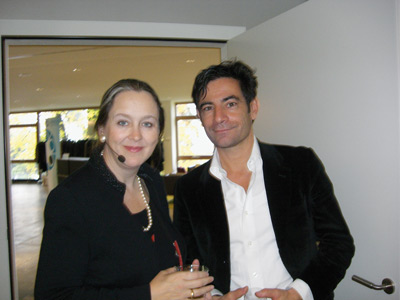
Daniel Jörg of Burson-Marsteller has pulled a lot of strings.
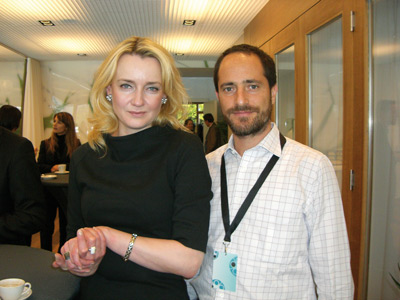
Julie Meyer founded First Tuesday. Amir Suissa is an advisor.
Susan Kish and Jojo Rufener are committed to Somesso.
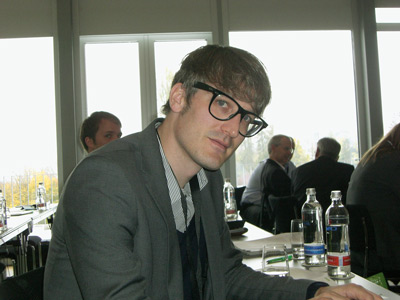
Arjen Strijker came up with the idea for the Somesso Conference.