Time Warner posts 16 billion dollar loss

The American media group Time Warner suffered a loss of more than 16 billion dollars in the final quarter of 2008 due to immensely high write-downs. Time Warner expects a stagnating result for the current year.

The American media group Time Warner suffered a loss of more than 16 billion dollars in the final quarter of 2008 due to immensely high write-downs. Time Warner expects a stagnating result for the current year.
The Group had to write down a total of 24.2 billion dollars on its struggling Internet division as well as its cable and publishing business due to a fall in goodwill. This was announced by Time Warner in New York on Wednesday. A year earlier, the company had made a profit of one billion dollars. Sales fell by just under three percent to 12.3 billion dollars in the fourth quarter. The loss was even greater than the company had feared in advance.
The loss for the year as a whole amounted to 13.4 billion dollars. In the previous year, the Group had made a profit of 4.4 billion dollars. Turnover grew by one percent to 47 billion dollars.
Group CEO Jeff Bewkes, who has been in office for just over a year, is in the process of restructuring the media giant. The Group has been looking for a new strategy or a buyer for the struggling AOL business for some time. Time Warner expects a stagnating result for the current year.

The magic mountain gives birth to media mice

While most corporate leaders in Davos dutifully feigned concern, many journalists were in a state of genuine panic. So the WEF did yield one insight after all: The global economic crisis is, at least here in Switzerland, also a national media crisis. Op-ed by Oliver Classen, media spokesperson for the Berne Declaration. Classen was in Davos last week as coordinator of «Public Eye,» an organization critical of the WEF.

John Gapper, chief columnist at the Financial Times (FT), is a man with fundamental liberal convictions and that dry sense of humor without which the Anglo-Saxon world business press would be unpalatable. According to well-informed friends, he commented on the panel spat between Recip Erdogan and Shimon Peres at the hotel bar caused by a Washington Post presenter as "probably the greatest effect a journalist has ever had on the World Economic Forum (WEF)". Well, the man should know, after all, Gapper is a Davos habitué and one of the most widely read observers - even locally - of this alpine procession of the select.
Journalistic two-tier society
Despite having a home advantage, Swiss media executives are at most allowed to take over the moderation of one of the far less prominent Open Forum panels, as Susanne Wille or Hannes Britschgi did this year. Here the global players CNN, Reuters or Wall Street Journal (whose new publisher Rupert Murdoch also acted as co-chair of the WEF this time), there marginalized national and regional media: this journalistic two-tier society is naturally reflected in the quality of reporting. There are two reasons for this "Davos Gap", which was particularly noticeable in 2009: limited access to the top shots and staffing. By way of comparison: while half a dozen hardened reporters are scurrying through the corridors of the congress center for the FT, a likeable but inexperienced young journalist is serving the German-speaking Swiss regional pool, consisting of Südostschweiz, Landbote, St. Galler Tagblatt and Aargauer Zeitung. In addition, the colleagues from the salmon-colored Finanzblatt hoard all the exclusive party invitations without which you can't get any relevant (off-the-record) quotes in this environment.
Frustrated in Davos
It's not surprising, but it's still frightening: instead of discussing (the lack of) recipes to combat the recession, the Davos bar talks with Swiss press representatives primarily revolved around their own job anxiety. In times like these, when publishing red pencils are once again in full swing, everyone is out for themselves. However, the discussion was less about current or pending redundancies and more about the fundamental uncertainty as to whether the reasons for this are structural or cyclical in nature. The sense of helplessness in this regard was palpable even after the third beer and corresponded eerily with the collective shrugging of shoulders in the congress center. Nevertheless, some colleagues made a hopeful pilgrimage to an industry panel entitled "Fragility of the Fourth Estate" with Steve Forbes, Thomson Reuters CEO Thomas Glocer and WPP boss Marin Sorrell. Instead of new clues, however, this elephant panel only provided "arrogant platitudes", as one frustrated sda representative summed it up. Unfortunately, he was not allowed to write it down.

Suppressed dissenters
In this respect, it was probably a representative WEF event, but at least the flip side of the dominance of Anglo-Saxon business media was discussed: As amplifiers of both bullish euphoria and bearish depression, they form a communicative cluster risk and a liberal opinion cartel in which dissenters hardly get a chance to speak. The "Davos lemming effect" diagnosed (unanimously!) by the Tagi and NZZ does not stop at the leading media. Incidentally, this also applies to the arrogance of power. In one of his dreaded commentaries, FT editor Gapper recently expressed the view that regional media are "completely dispensable both politically and economically", even in times of faltering globalization. It would become critical for our democracy if "journalistic premium quality" could no longer be refinanced. In addition to intellectual arrogance, such assessments show above all that even the magic mountain only gives birth to media mice.

TVs in French-speaking Switzerland are upgrading - Advertising Week

Vaud Fribourg TV has been founded, and Tele Bielingue is investing in a digital studio.

A company based in Lausanne was recently founded under the name Vaud Fribourg TV SA. The share capital amounts to CHF 2.7 million. The eleven-member Board of Directors, which also includes representatives from the municipalities of Lausanne, Yverdon, Aigle and Vevey, is chaired by Philippe Sordet from the Edipresse Switzerland media group. The municipalities of Vaud hold 38 percent of the station (with Lausanne alone holding 22 percent), Edipresse has 28.6 percent, media from Fribourg, including Groupe Saint Paule (La Liberté) and Freiburger Nachrichten (FN), hold 20.4 percent, and the remainder is divided among numerous private shareholders. According to Sordet, Edipresse has a total of three representatives: Eric Hoesli, head of journalism, and Yvon Duboule, head of finance, are also on the Board of Directors. There are two representatives from the canton of Fribourg: Pierre Savary, co-director of Radio Fribourg, and Albert Noth (Fondation Saint Paule, FN).
Senior positions at operational level have already been filled, says Sordet: Christoph Rasch, Head of TV and Interactive Media at Edipresse, has been appointed Managing Director of Vaud Fribourg TV. Rasch played a key role in the new broadcasting concept and in bringing together the fragmented Vaud TV scene. With Fathi Derder (38), an editor-in-chief has also been appointed who previously worked at Radio Suisse Romande. According to Sordet, the start of broadcasting is planned for the middle of the year. Vaud Fribourg TV will have an operating budget of CHF 7 million and an editorial team of around 14 employees, a third of whom will be based in the canton of Fribourg.
TeleBielingue is also expanding: The shareholders increased the share capital from CHF 300,000 to CHF 800,000. The two media companies Büro Cortesi, publisher of the free newspaper Biel-Bienne, and Multimedia Gassmann AG (Bieler Tagblatt, Journal du Jura) each hold half of the shares in the Biel-based broadcaster. This ratio will not change and everything will remain the same in terms of personnel, said Roger Burckhard, Head of Finance at Gassmann. The increase in AK is because the company wants to invest in a digital TV studio. The company is currently evaluating this.
Markus Knöpfli

Bench with beautiful views

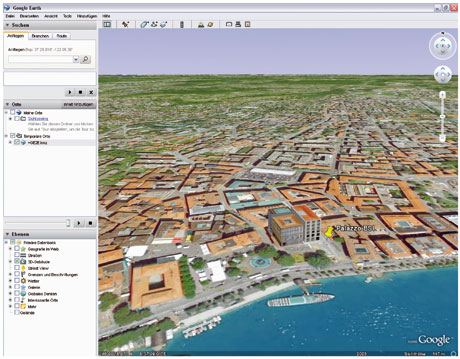
The Lugano-based BSI Bank is drawing attention to itself in a clever and highly effective way: It is the first financial institution in Switzerland to present itself in 3D on Google Earth. The works of art in the bank’s buildings can be admired on a separate website.

How does a bank stand out as modern and customer-oriented in the midst of the financial crisis? In times of tight budgets, a large-scale advertising campaign is just as inappropriate as excessive bonus payments. But if you keep completely quiet, you miss the chance to draw attention to yourself in the general calm of the crisis. The oldest credit institution in Ticino, the BSI Bank in Lugano, had a clever idea: it is the first bank in Switzerland and the first building in Ticino to be visible in 3D format on Google Earth. The free Google Earth software makes it possible to view countries, cities, individual streets or buildings around the world via satellite images. If you search for "Palazzo BSI" under "Lugano" on Google Earth, you will surf directly in front of the Palazzo Riva and the Palazzo BSI, the complex of historical and modern buildings of the BSI headquarters in Lugano. A virtual tour around the building, which is located directly on Lake Lugano, is just as possible as a visit to the bank's buildings or a view of the street from the roof of the building. This puts the BSI Bank in the same league as famous buildings such as the Louvre in Paris or Hamburg City Hall, which can also be admired in 3D format on Google Earth.

Enjoying art in three dimensions
The BSI presence on Google Earth is also linked to the website www.virtual.bsibank.com, where surfers interested in art can stroll through the Palazzo BSI and view works by contemporary artists. The paintings and installations spread over five floors were created especially for the BSI Bank premises by Daniel Buren (France, born 1938), Robert Barry (USA, 1936), John Armleder (Switzerland, 1948) and Liam Gillick (Great Britain, 1964). Visitors can take a guided 360° virtual tour of the exhibition or take a gallery tour on their own. They can view the works up close - art enjoyment without the barriers. Background information on the artists is provided by short films in which the curator of the BSI Art Collection, Luca Cerizza, introduces the artists and their work. A section with information about Palazzo BSI is also planned. "The presence of two of the most representative BSI buildings on Google Earth is due to the bank's strong technological orientation and its tireless efforts to make its increasingly important collection of contemporary art accessible to everyone worldwide, not only through traditional channels such as exhibitions," says Gianluca Balò, Head of Web Communication at BSI.
The presentation is certainly a successful move: with architecture and art in three dimensions, BSI Bank is doing image work at its best. The surfer imagines himself in a gallery for modern art and architecture rather than at an asset manager - and the subject of bonuses is off the table, at least for a few entertaining minutes.

Anne-Friederike Wilhelm

1290582052_img090204_bsi1
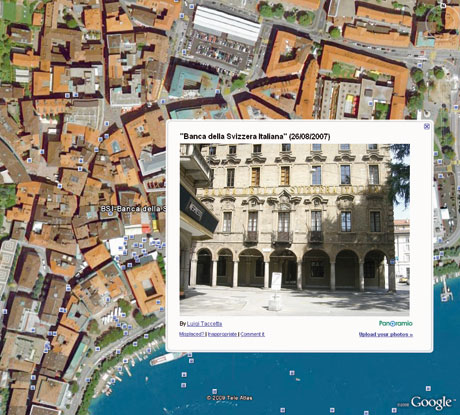
1290582052_img090204_bsi3
Rich in images: The facade of the former Banca della Svizzera Italiana as a photo on Google Earth.
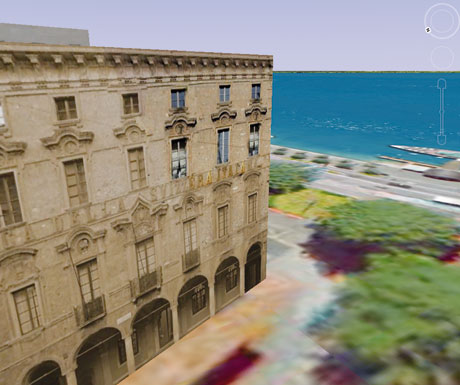
1290582052_img090204_bsi2
Virtual impressions: Bird's eye view of Lake Lugano and the two palazzi from Palazzo Riva.

Airport advertising was on the up

Thanks to an increase in air travel in 2008, advertising in and around airports benefited—particularly in Zurich and Geneva.

The two most important Swiss airports recorded a further increase in passenger numbers last year and thus more contacts for airport advertising. Zurich Airport handled 22.1 million passengers in 2008, 6.6 percent more than in the previous year. This was just short of the previous record of 22.7 million passengers set in 2000, whereas Geneva-Cointrin set a new record with 11.5 million passengers (+ 5.7 %). EuroAirport Basel-Mulhouse, on the other hand, remained practically stable at 4.26 million, with a drop of 11,000 passengers or -0.3 percent. The situation was similar at Alpar Airport (Bern-Belp), which recorded a decline of 1% with around 105,000 passengers. In Lugano-Agno, passenger numbers fell by 3.8% to 188,796 travelers.
The following outdoor advertisers benefited from the overall increase in frequencies: Clear Channel Outdoor Plakanda (CCOP), which serves Unique and parts of EuroAirport, APG, which is present in Basel, Geneva and Lugano, JCDecaux, which was also active at EuroAirport, and Baracom, which markets Bern-Belp.
Zurich becomes Basel's role model
However, the situation in Basel changed in 2009: Following a tender for poster sites at EuroAirport, APG was chosen for the areas along the access roads on the Swiss side and CBS on the French side. CCOP, on the other hand, was chosen for all areas in and around the buildings. The company has been commissioned to create and implement a large-format concept adapted to Basel conditions, following the example of Zurich Airport. "The classic poster sites will decrease because our customers want greater visibility," says Werner Parini, who was responsible for the tender at EuroAirport.
Markus Knöpfli

To the point: Fatal and dangerous

If you are currently attending industry events and talking to people from the print media industry, then you need to have a healthy dose of optimism to avoid falling into a deep black hole straight away.

If you are currently attending industry events and talking to people from the print media industry, then you need to have a healthy dose of optimism to avoid falling into a deep black hole straight away.
The mood in the industry is depressed - to put it mildly - and tense. With a certain masochistic delight, the event participants are trying to outdo each other with bad news. Everyone wants to have read an even worse economic forecast, everyone knows about even more drastic austerity measures. People toast each other (at least that!), only to develop new disaster scenarios together in conversation. A topsy-turvy world. Until now, people were proud of the fact that they were doing well, but now they are seen as outsiders. To belong to the circle of established industry experts, you can't be doing well. Complaining is part of the trade and has become a status symbol, so to speak.
Such a negative attitude is fatal and dangerous. Self-fulfilling prophecy is the name of the evil. According to Wikipedia, a self-fulfilling prophecy is a prediction that comes true simply because it was uttered by a social actor and received by others. It is therefore a particular cause of the consequences of which it speaks.
I don't want to talk about optimism for the sake of it. Not at all. That would be negligent in view of the current economic forecasts. But it is equally negligent and dangerous for anyone, whether politician, manager, economic expert or journalist, to constantly point out the expected negative, even catastrophic development scenarios for the economy. Over and over again, like a prayer wheel. The current crisis is the worst in x years and will last longer than any crisis before it. The effects cannot even be estimated yet, and people will have to get used to an uncertain, insecure and gloomy future. This is how the Cassandra cries sound in newspaper articles, in television interviews and in the columns of some experts.
This pessimism is not only poison for consumer sentiment, but also poison for the economy. And it is particularly dangerous for the print media industry, which is always the first to be affected by a crisis - but then things pick up again quickly when the crisis ends. Instead of innovations and new creative ideas to meet the challenges of the reader market, defensive measures are being taken. Costs are being cut, redimensioned and focused. It is doubtful whether the company is prepared for the next upturn in this way.
Pierre C. Meier, Editor-in-Chief
[email protected]

The young entrepreneurs

Caroline Braun and Stefan Bircher were employed at Absolutturnus Films. Now Reiner Roduner has brought them on board and founded the commercial production unit Shining Pictures.

What does a business owner do when he has employees he doesn't want to lose? "On average, people stay for five years. Then they want to move on and have more responsibility as well as skills," says Reiner Roduner of Absolutturnus Films in Zurich. If an employee wants children in the process, that's its own story. "But with many other motives, you can steer against it." And that's by "getting the employees involved!" is Roduner's conviction.
You give your best specialists new tasks and more responsibility. The energy that arises when you get people involved "is a completely different one," Roduner believes, and now wants to see this confirmed with the founding of Shining Pictures. In addition, this policy also fits perfectly into Absolutturnus' concept and is an ideal reaction to current developments in the market.
Shining Pictures is the result of an opening strategy of Absolutturnus Films. The foundation was based on the same idea as the outsourcing of Seed Audio-Visual Communication from Reiner Roduner's company. The strategic goal is called integrated communication: Seed for corporate films, Shining for commercials, Utainment for TV formats and Absolutturnus Films for new media. With such a structure, Roduner wants to be able to offer his own competence centers for the entire audiovisual sector.

1290582049_img090204_kdw_braun_bircher

The returnee
"It makes sense if I can communicate clearly to the outside world: We do advertising, we do corporate, we produce TV formats," Roduner says. Otherwise, he says, it's difficult to make a name for yourself if you offer everything. Corporate films are a different world for advertisers. That's why Roduner has divided and clearly structured his Absolutturnus. "Of course, we remain a tight-knit team. There are eleven of us now. When we brainstorm, everyone is there and has to think along. That also reflects modern developments. After all, a commercial today is no longer just a commercial. Integrated communication is the spirit of the age. Customers want to be able to use their moving images in as many different ways as possible. We have the means to do that, and now we have all the specialists under one roof."
Take Caroline Braun, for example. After completing her commercial training at a bank and her vocational baccalaureate, she first wanted to "travel extensively. The half-New Zealander visited her homeland and also hitchhiked through Australia for a long time. The "road movie" finally ended up being the real thing. With Susanne Henggeler and Christian Aeby, Braun got a chance as a production assistant at the then Tin Tin Film in Zurich. She quickly knew all about cameras and action: "That's my world." When Henggeler left Tin Tin, Braun was also looking for a new challenge and shot for the first time with Reiner Roduner. She stayed with the early Absolut Film as production manager for three years. Then she wanted to "look a little further." Caroline Braun managed to gain admission to the German Film and Television Academy in Berlin. A coveted training position, because only ten out of hundreds of applicants are accepted here each year. The specialized course, which no longer exists, was called "TV Producer. The students learned the craft of producing series and feature films in a very practical way. How is a material developed? What are the processes of an in-house production? This professionalization also involved two internships at ProSieben and Sat 1.
After film school, Caroline Braun had an offer in Berlin. The city was "very exciting" for her - but somehow also a bit "too big". So she preferred to work as a freelancer in Switzerland for the next four years. From this time, she remembers countless spots as well as a "big box" with Stefan Zürcher and Leonhard Gmür for "Band of Brothers," a production by Hollywood greats Steven Spielberg and Tom Hanks. Other valuable experiences also brought a few assignments for the Bloofeld Entertainment event agency, before the now experienced media woman was again looking for "something more permanent". The ideal offer finally came from Reiner Roduner, who in the meantime had expanded his Absolut to Absolutturnus. Five years after her departure, Braun's "remake" followed in 2005, this time in the role of producer.

The sporty creative
Stefan Bircher also found his fortune at Roduner. After graduating from business school, Bircher studied journalism. Film - that had been his dream for many years. After countless small productions of his own, his first opportunity to enter the professional TV business came at Star TV. There he was able to take over the then still externally produced show "Freestyle" as producer and from then on produce it in-house. "Marco Schwab, who was very controversial at the time, as he is today, because he was a very provocative and polarizing presenter, and whom I brought onto the show back then, is still with us today," says Bircher happily.
In his almost three years at Star TV, the producer enjoyed above all the many freedoms. "You can make a lot of decisions yourself at Paul Grau, but you also have to take a reprimand if a show doesn't work." Bircher very quickly found the right visual language for his young target audience. He was just the right person for this show about extreme sports - after all, he has a strong background as a skateboarder himself. As an eight-year-old, he discovered a passion for the rollerboard.
After his time at Star TV, professional contract offers followed. Bircher had to make a decision and knew, "I have to do it NOW." He followed offers from Levis and DC and was sent all over the world as a brand ambassador. "At the time, I was able to make a good living. I wasn't making the big bucks, but I had almost no expenses either. Hotels and travel were paid for, cars and equipment were provided." Most valuable during this phase, however, was his insight into the professional world of media. "I experienced firsthand how sponsorship works. To that end, I was also able to participate in many international film shoots."
Bircher also got to know fellow professional athletes like Marco Lutz and Johannes Eisenhut back then. The two snowboard legends and other friends from that time also ended up in advertising. Bircher finally found this curve seven years ago via the acquisition of the federal marketing communications planner and his entry into Reiner Roduner.
Twelve women had applied to be production assistants. The boss's opinion was already formed when Stefan Bircher suddenly appeared and stole the show from the girls. "He just somehow ticked completely different and convinced me immediately," Roduner is still happy about his decision today.

Andreas Panzeri

Shining Pictures, under the umbrella of Absolutturnus Films, already has major contracts in the can for McOptik, the Concordia health insurance company and PricewaterhouseCoopers. Currently, a spot for Zimtstern Streetwear with Marco Lutz as director is in post-production. Various pitches are also in progress. What's particularly interesting is that more and more clients or agencies are not just submitting one spot, but several forms. Viral films, cinema trailers, billboards: cross-media is the order of the day today. And the Absolutturnus network can handle it all in-house.

Great spot: How the animal world gets its hands on black gold

The commercials from Coca-Cola, the maker of Imperial soda, are always elaborate and expensive. They’re also usually rich in detail and sophisticated. But none have been as beautiful as this commercial, in which the animal kingdom unites to snatch a Coke bottle, in quite some time. It premiered last Sunday during the Super Bowl.

The commercials of the imperial soda manufacturer Coca-Cola are always elaborate and expensive. They are also usually rich in detail and ingenious. But as beautiful as this graphically animated Commercialin which the united animal kingdom snatches a Coke bottle, opens it with combined forces and then divides the contents fairly among themselves, has not been seen for a long time. It was presented for the first time last Sunday as part of the Superbowl (the advertising week reported)
The American agency Wieden + Kennedy, based in Portland, is responsible for this. Cats would buy Whiskas, beetles, butterflies, bees, grasshoppers, dragonflies and caterpillars would apparently drink cola.

The large number of broadcasting slots pays off

Thanks to new broadcasting slots, some PresseTV programs could return to their former ratings heights.

Hans-Jürg Deutsch, Managing Director of publisher television PresseTV (PTV), has repeatedly pointed out in recent years that since SF director Ingrid Deltenre focused SF zwei more consistently on sport and youth and programmed "Musicstar" or "Gotthelf-TV" on SF1 on Sunday evenings, the PTV programs have looked old. In two senses: firstly because they could not keep up with the SF in-house productions, and secondly because the PTV programs with their rather older target audience seemed out of place on the youthful SF zwei. As a result, the ratings plummeted year after year.
It is therefore not surprising that almost all PTV programs lost ground again in 2008 and many have reached an all-time low. The Ringier program "Gesundheit Sprechstunde" (GES) led the way, losing a third of its viewers compared to 2007 and even 60 percent or almost 200,000 fewer viewers compared to 2003. "NZZ Format", "NZZ Swiss made", "konsumTV" and "MotorShow TCS" also plummeted. Only "BaZ Fussballtalk" saw an increase of around 12 percent last year.
For a long time, PTV was helplessly at the mercy of this development. Switching to other broadcasting slots was hardly possible, partly for licensing reasons and partly because Deltenre was opposed to it. Publisher television, which in better times had helped to raise the ratings average of SF zwei, was suddenly sidelined.
It was only with the new SRG concession in 2007 that things started to move. SRG and PTV negotiated a new cooperation agreement in May 2008 and agreed that PTV programs would be placed where they could better reach their audience from 2009. The consequence: four PTV formats, namely "Cash-Talk", "BaZ Fussballtalk", "konsumTV" and "100 Minuten", were canceled and all others moved - most of them to SF1. At the same time, certain internal ratings targets were set for the individual programs. Accordingly, the January results were eagerly awaited in order to identify initial trends.
> Table: PTV shipments
And these are encouraging. This is because viewer figures for some PTV formats soared in the new slots, with GES, now broadcast on Saturdays at 6.10 p.m. on SF1, even increasing by almost 100 percent to 208,800 viewers. The five January programs, which are now broadcast weekly instead of fortnightly and last half as long as before, picked up where GES left off in 2006. The format even achieved a record market share of 20 percent.
Several other programs are doing similarly: "Motorshow TCS", new on Sunday evening on SF zwei, has increased by a good 50 percent compared to 2008 and is back to its 2006 levels. Here too, the market share has reached a historic high. Standpunkte" is also being watched more often than ever before. And "NZZ Format", which is now broadcast on Thursdays after Aeschbacher, has only reached the 2007 figure with 89,000 viewers - but with its record market share of 14.3 percent, it trumps the series that SF1 previously had in its program at the same time and which only achieved 10 percent in 2008. In contrast, "CashTV" and "NZZ Swiss made" have improved only slightly. The January market share for "CashTV" is even lower than ever.
Markus Knöpfli

Weber Harbeke hires new Art Director

A new art director: Zurich agency Weber Harbeke is strengthening its team with creative David Dudler.

A new art director: Zurich agency Weber Harbeke is strengthening its team with creative David Dudler.
The 36-year-old David Dudler began his advertising career at Lang Gysi Knoll in Bern. Further stations in his career to date were Lowe, Wirz Werbung and Scholz & Friends in Hamburg, where he already worked as an art director. Most recently, he worked at Assai Interactive for clients such as Chrysler (Jeep, Dodge) and Migros Assistance.
His portfolio also includes campaigns for brands such as Orange, Sunrise, John Player Special, Basler Versicherungen and Express Post. David Dudler is a 2005 graduate of the ADC Creative School.

Dispute over collective agreements in Hollywood

The 120,000 members of the Screen Actors Guild (SAG) have been working without a collective bargaining agreement since June. Now, the power struggle within the Hollywood actors’ union is also being played out in court.

The 120,000 members of the Screen Actors Guild (SAG) union have been working without a collective agreement since June. Now the power struggle in the Hollywood actors' association is also being fought out in court. Union president Alan Rosenberg has lodged an appeal against the dismissal of his managing director Doug Allen.
At the end of January, the Board of Directors fired Allen, who was known as a hardliner, in order to appoint a negotiating partner who was more willing to compromise, as talks with the major studios had reached an impasse.
But Rosenberg and Allen "are so desperate to hold onto their power that they're willing to burn their own house down," said New York labor union president Sam Freed, who is among the defendants, according to a Los Angeles Times report.
In the meantime, the union leadership, led by Rosenberg, had even wanted to put a strike to the vote, but the plan met with massive internal resistance.

Google knows your location

The Google Maps service is adding a new feature. With Google Latitude, you can track the location of friends and family members via cell phone.

The map service Google Maps is expanding its offering with a new function: Google Latitude can be used to locate friends and family members via cell phone. You can register for the new tool via your own Google account. From then on, profile pictures of friends who are also logged in will be displayed on the cell phone screen. You can contact the person you have located directly by phone call, instant messaging or email and, if you wish, ask for directions.
The position is determined by locating radio masts, GPS and Wifi connections. Google Latitude is available in Switzerland and 26 other countries. The service runs on most Blackberry devices, most Windows Mobile 5.0+ devices and most Nokia smartphones. The service will also soon be available on the iPhone.
Google wants to dispel the concerns of data protectionists. Each user can decide for themselves to whom their location should be shown. Google also ensures that it does not record or save any routes traveled. Only the last position is stored on the computers.
However, data protectionists see precisely the latter as a problem. The question arises as to why Google wants to store the last location of users at all, Maximilian Hartung, Managing Director of the data protection agency, told the media service Pressetext. Hartung sees the danger that the company could possibly misuse the collected information for its own purposes. The decisive factor is that the data is stored anonymously so that no conclusions can be drawn about the identity of the user.
In principle, the use of such systems is prohibited by law. However, if users expressly allow this, data protection is undermined and its provisions no longer apply. According to Hartung, users today are generally too little aware of the dangers when it comes to publishing personal data.

get_footer();