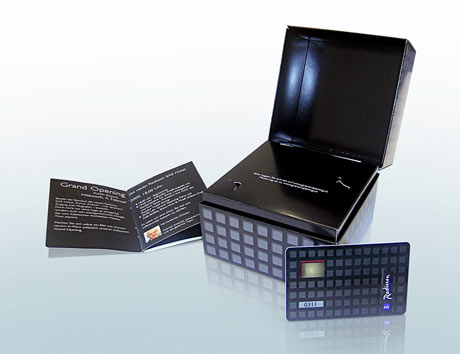
Matter & Gretener designs invitation to the opening of the new Radisson Blu

On January 4, 2009, the grand opening of the new Radisson Blu at Zurich Airport took place. The Zurich-based agency Matter & Gretener designed the invitation for this social event.

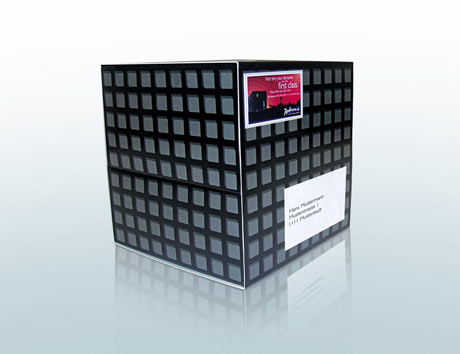
The Grand Opening of the new Radisson Blu at Zurich Airport took place on January 4, 2009. The Zurich agency Matter & Gretener created the invitation to this society event. According to a press release issued by the agency, the cube shape was based on the design of the building designed by architect Matteo Thun. The invitation also contained an Ambassador card with an embossed code that served as a login for a registration website. As the owner of such a card, you remain a VIP even after the Grand Opening, as it entitles the holder to various privileges within the Rezidor Group - from room category upgrades to exclusive memberships.
Responsible at Radisson Blu: Werner Knechtli (General Manager), Stefan Schaer (Director of Sales & Marketing). Responsible at Matter & Gretener: Daniel Matter (CD), Dominik Imseng (text), Imer Krasniqi (graphics), Nicole Liebermann (consulting). Website: Hausheer AG.
1290582036_img090206_radisson_blu1
1290582036_img090206_radisson_blue2
1290582037_img090206_radisson_blu3

Publicitas Cinecom takes over spot marketing from Star TV

Publicitas Cinecom is taking over the exclusive advertising sales for Star TV effective immediately. After many years of handling its own advertising sales, the commercial broadcaster has decided to entrust advertising sales to Publicitas Cinecom, according to a statement released on Friday.

Publicitas Cinecom is taking over the exclusive spot marketing of Star TV with immediate effect. After many years of in-house marketing, the private broadcaster has decided to place the spot acquisition in the hands of Publicitas Cinecom, according to a press release issued on Friday. The broadcaster now wants to focus more on the expansion and communication of the program, particularly in the areas of live events and new formats.

Edition Renteria organizes investor relations workshop

Edition Renteria SA is organizing a practical workshop for investor relations offices on Wednesday, 25 March 2008 at the Widder Hotel in Zurich. The topic is communication with financial analysts, investors and the media in difficult economic times.

Edition Renteria SA is organizing a practical workshop for investor relations offices on Wednesday, 25 March 2008 at the Widder Hotel in Zurich. The topic is communication with financial analysts, investors and the media in difficult economic times.
Speakers and topics:
What information is relevant in the financial crisis. Speaker: Marco Curti, Head of Research Zürcher Kantonalbank and Chairman of the SFAA, Zurich.
Appropriate means for the company's messages. Speaker: Benjamin Wilding, seminar leader at the Banking Institute of the University of Zurich.
Where investor relations belongs. Speaker: Alexander Fleischer, Head of Marketing+Communications and President of the HarbourClub, PricewaterhouseCooper AG, Zurich.
Balanced information with falling share prices. Speaker: Michel Gerber, Head of Investor Relations and President SIRV, ABB, Zurich.
New approaches and solutions in investor relations practice. Speaker: Edwin van der Geest, Senior Partner of Dynamics Group AG, Zurich.
Practical exercises with David Strohm (business editor NZZ am Sonntag and president of the Zurich Press Association ZPV) and the speakers will round off this 1-day workshop.
Cost: CHF 780 per person, including course materials and meals.
Registration by mail: [email protected]
Edition Renteria SA, Hopfenstrasse 10, P.O. Box, 8045 Zurich. Telephone 044 451 46 47, fax 044 451 36 38.

News Corporation deep in the red due to write-downs

News Corporation, which is controlled by US media mogul Rupert Murdoch, suffered a billion-dollar loss in the last quarter due to the economic crisis and enormous write-downs. The bottom line was a loss of 6.4 billion dollars.

News Corporation, which is controlled by US media mogul Rupert Murdoch, suffered a billion-dollar loss in the last quarter due to the economic crisis and enormous write-downs. The bottom line was a loss of 6.4 billion dollars.
According to SDA, turnover fell by more than eight percent to 7.9 billion dollars. The group announced rigorous savings and job cuts on Thursday evening in New York. News Corp. had to make write-downs of around 8.4 billion dollars in its second quarter alone, mainly on goodwill in the TV business and in the newspaper and news division.
"The downturn is even more severe and probably longer than initially thought," Murdoch admitted. The figures were worse than analysts had expected. The share price fluctuated between gains and losses in after-hours trading. Like its competitors, News Corporation is suffering from the clear reluctance of advertising customers in the recession. Industry giants Walt Disney and Time Warner also suffered a sharp drop in profits at the end of the year and are skeptical about the future.
In addition to newspapers such as the Times of London and the Wall Street Journal, the US group also owns the Fox television channels, the Hollywood studio Twentieth Century Fox, the German TV channel Premiere and the online network My Space.

Corinne Auer becomes Sales Manager at Gourmedia

Gourmedia, the publisher of the annual gastronomy magazine *Geht aus!*, is expanding its sales department and promoting Corinne Auer to sales manager.

The publishing house Gourmedia, publisher of the annual gastronomy publication Geht aus!, is expanding its sales department and promoting Corinne Auer to Sales Manager. Previously responsible for the project management of the individual annual editions, Auer is now responsible for the further expansion and anchoring of Geht aus! in Switzerland, according to a press release issued on Friday.

Journalists' union criticizes TV interview with Sarkozy

The French journalists' union has criticized President Nicolas Sarkozy's hour-and-a-half television interview on Thursday evening as a "masquerade" and an "insult to journalism".

The French journalists' union has criticized President Nicolas Sarkozy's hour-and-a-half television interview on Thursday evening as a "masquerade" and an "insult to journalism".
"In no other democratic country is it customary for leading politicians to choose their own interviewees", according to a statement issued by SDA in Paris on Friday. The four journalists who interviewed Sarkozy acted as "courtiers". The questions were harmless and had been agreed in advance. Nobody contradicted Sarkozy when he deviated from the truth. The union appealed to the journalists not to become stooges of the PR departments.
On Thursday evening, Sarkozy defended his government's controversial reforms in a one-and-a-half hour television broadcast from the Elysée Palace, despite the mood of crisis and nationwide protests.

Study: Journalists attribute less power to the media than politicians

Journalists believe they have little influence on politics. Politicians see things differently. For them, the media are essential to political success.

According to their own assessment, journalists have little influence on politics. Politicians see things differently. For them, the media are fundamental to political success. This is shown by the study "Political Communication Culture in Switzerland", which the Institute of Mass Communication and Media Research at the University of Zurich IPMZ published on Thursday, according to SDA.
According to the results of the study, the roles of journalists and politicians also differ. Editors say that their most important task is to provide citizens with comprehensive information. Politicians, on the other hand, take a more critical view of journalism: the media primarily want to reach as large an audience as possible. They are less interested in highlighting different opinions or controlling the political elite.
A similar pattern can be seen in the self-perception and external perception of politicians. According to their own statements, they themselves primarily want to provide information about political projects. Journalists do not believe in these goals. Instead, politicians are more interested in promoting their own popularity when they speak in public.
Swiss television has a major influence
Media people and the political elite - politicians, media spokespeople and lobbyists - agree that Swiss television exerts the greatest influence on politics. This is followed by the quality newspapers and then the tabloids. Private television and online media, on the other hand, are considered to have little influence.
For the study, the research institute gfs.bern surveyed 322 executives from politics and the media. The Swiss results are part of an international research project investigating the culture of political communication.

Former Radio Emotion employees found Mediapro GmbH

Until recently, Claudia Sieber and Peter Gmür worked for the Zurich radio advertising agency Radio Emotion. Now - despite the difficult economic situation - they have founded their own company, Mediapro GmbH.

Until recently, Claudia Sieber and Peter Gmür worked for the Zurich radio advertising agency Radio Emotion. Now - despite the difficult economic situation - they have founded their own company, Mediapro GmbH.
As they wrote in a press release on Thursday, the separation from Radioemotion came as a surprise and was incomprehensible to them. Both had co-founded the Urdorf-based company in 2007. After careful consideration, they decided to take the plunge into self-employment despite the adverse circumstances. With their new small business, Sieber and Gmür want to act as independent agents for the medium of radio.

AZ Medien: Stadtanzeiger and Bezirksanzeiger launched

With the Stadtanzeiger Aarau, the Stadtanzeiger Baden and the Bezirksanzeiger Dietikon, three new newspapers are now published in the canton of Aargau and the Limmattal in Zurich. Die Woche with its regional split editions was discontinued at the end of 2008.

With the Stadtanzeiger Aarau, the Stadtanzeiger Baden and the Bezirksanzeiger Dietikon, three new newspapers are now published in the canton of Aargau and the Limmattal in Zurich. Die Woche with its regional split editions was discontinued at the end of 2008.
The two new Stadtanzeiger and Bezirksanzeiger newspapers will be distributed free of charge to households every Thursday, according to a press release issued by AZ Medien on Thursday - the Stadtanzeiger Aarau in the Aarau and Zofingen region with a circulation of 36,202 copies and the Stadtanzeiger Baden in the Baden, Wettingen, Brugg region with a circulation of 42,747 copies. As before, the Wettinger Poscht will also be integrated into this edition. The Bezirksanzeiger reaches households in the Limmat Valley with a circulation of 33,507 copies.
Under the leadership of Managing Director Oscar Meier and Editor-in-Chief Hubert Keller, the three advertisements are published in the large broadsheet newspaper format. In terms of content, the focus will be on local and regional stories with current relevance.

Free newspaper Pravda launched with not entirely serious content

Zurich now has one more free newspaper. Starting this week, distributors have been handing out the new paper *Prawda*, which translates to “truth.” Its eight pages feature fictional stories and advertisements.

Zurich has one more free newspaper. Since this week, colporteurs have been distributing the new paper Prawda, which translates as truth. It contains eight pages of made-up stories and advertisements. The lead story of the first edition is a review of Barack Obama's two weeks in office, according to an article in the Tages-Anzeiger on Thursday. The US President did not attend the Wef in Davos and therefore cannot be taxed on a flat-rate basis, it says, among other things. The classifieds section also offers a "geranium fertilization course for assholes" or "candle making for cocaine addicts".
The content of Prawda is not meant to be deadly serious, editor-in-chief, publisher and chief ideologist René Louis Bommeli is quoted as saying in the Tages-Anzeiger. He came up with the idea of his own newspaper because he was fed up with the monotony that the free newspapers printed every day. From now on, an edition with a print run of 10,000 copies will be published every Tuesday. The project is financed by advertisements and patrons.

France: Controversial broadcasting reform clears final hurdle

The broadcasting reform proposed by President Sarkozy has cleared the final hurdle. The Senate passed the controversial project on Wednesday with a majority of votes from the supporters of France's top politician.

The broadcasting reform proposed by President Sarkozy has cleared the final hurdle. The Senate passed the controversial project on Wednesday with a majority of votes from the supporters of France's top politician.
Among other things, the reform provides for the complete abolition of advertising on public television by the end of 2011. To finance this, the fees for broadcasting users are to increase gradually from 116 to 122 euros per year. There will also be a new tax for private broadcasters and telephone companies.
Advertising after 8 p.m. had already been banned on public television at the beginning of January, although the law was not even in force at the time. The broadcasters' board of directors had ordered the abolition on the advice of the government itself when it became apparent that the corresponding law would meet with fierce resistance from the opposition.
The reorganization of public broadcasting in France has been the subject of intense debate for weeks. By abolishing advertising, Sarkozy wants to raise the standard of state television and reduce "dependence on ratings". Critics accuse Sarkozy that the reform will primarily benefit private broadcasters, who can hope for additional advertising revenue. The French President is close friends with the head of the largest private broadcaster TF1, Martin Bouygues.
The opposition and employees of the public broadcaster fear that the state will not fully compensate for the loss of advertising revenue. In future, the appointment of the head of state television will be the direct responsibility of the President.

Superspot: "That's milk!"

get_footer();