Titanic cartoonist catches unfaithful fish for Scholz & Friends

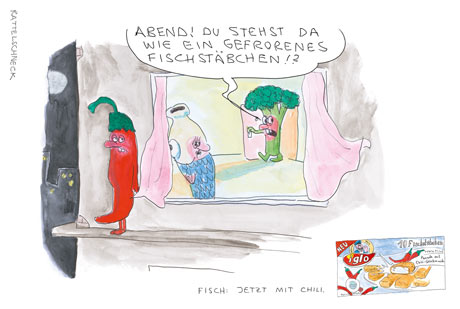
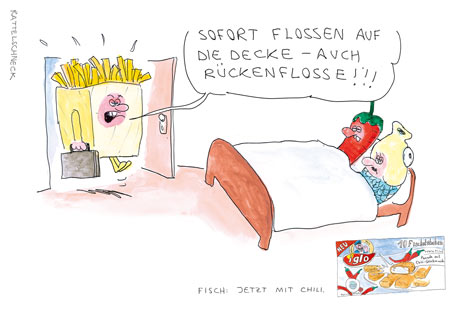
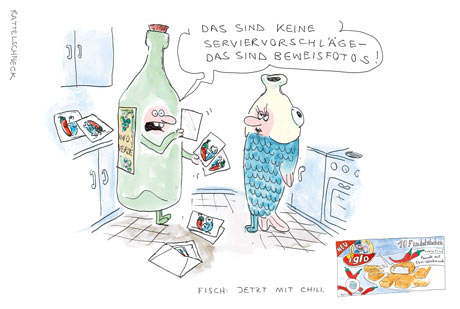
Illustrator Marcus Weimer of the duo Rattelschneck—known, among other things, for his cartoons in *Faz*, *Titanic*, and *Die Zeit*—has put his own unique spin on the current campaign for Iglo’s new chili fish sticks. In collaboration with the agency Scholz & Friends Hamburg, he has illustrated his first advertising campaign.

The illustrator Marcus Weimer from the duo Rattelschneck, known for his cartoons in Faz, Titanic and Die Zeit, among others, has given the current campaign for Iglo's new chili fish sticks his own signature. In collaboration with the agency Scholz & Friends Hamburg, he has illustrated his first advertising campaign.
The series of advertisements comprises four motifs drawn by Weimer and always shows the personified frozen products in the situation of a fling. The fish cheats on its partner - in the form of classic side dishes such as French fries, lemon and broccoli - each time with a chili pepper.
The advertisements will appear on both sides of selected magazines until the end of February 2009.
Client: Iglo Gmbh, Hamburg.Product: Iglo Chili Fish Sticks. Agency: Scholz & Friends, Hamburg.
1290582038_img0990205_scholz_iglo
1290582038_img090205_scholz_iglo2
1290582038_img090205_scholz_iglo3
imng090205_scholz_iglo4

Axel Springer sells stakes in regional newspapers

Axel Springer sells its holdings in Leipziger Volkszeitung, Lübecker Nachrichten and Kieler Nachrichten as well as its stake in the northern German publishing holding company Hanseatische Verlags-Beteiligung to the Madsack publishing group.

Axel Springer is selling its stakes in Leipziger Volkszeitung (50 percent), Lübecker Nachrichten (49 percent), Kieler Nachrichten (24.5 percent) and its share in the northern German publishing holding company Hanseatische Verlags-Beteiligung (23 percent) to the Madsack publishing group. At the same time, Lübecker Nachrichten is taking over Axel Springer's share in Ostsee-Zeitung in Rostock (50 percent). According to the announcement, the total volume amounts to 310 million euros.
"With the sale of the minority shareholdings, we are concentrating even more consistently on investments in our own newspapers, the multimedia expansion of our brands and acquisitions of new online growth businesses," Mathias Döpfner, CEO of Axel Springer, is quoted as saying in the press release.

Mediador brings Terezija Stagljar on board as a consultant

Terezija Stagljar joined the team at Mediador, a Zurich-based media recruitment firm, as a recruitment consultant in early February. Stagljar previously worked at Cinecom.

Terezija Stagljar joined the team of Zurich-based media recruitment agency Mediador as a personnel consultant at the beginning of February. Stagljar previously worked at Cinecom, as was reported in a press release on Thursday. She also gained experience in human resources at the German motor vehicle manufacturer BMW as Head of Customer Service. Stagljar acquired in-depth knowledge of the media industry and know-how of the corresponding market requirements through her work in sales. At Mediador, she is taking on the role of personnel consultant, actively supporting the specialist recruitment agency in the media and communications sector.

Observer Nature is published for the first time

This Friday marks the debut of Axel Springer's new magazine, *Beobachter Natur*. The new publication will be released four times a year starting now. It focuses on nature, the environment, and sustainable practices.

The new Beobachter Natur magazine from Axel Springer-Verlag will be published for the first time on Friday. The new magazine will be published four times a year from now on. It is dedicated to nature, the environment and sustainable action (die Werbewoche reported already at the beginning of December).
As the publishing house announced on Thursday, Beobachter subscribers will receive the magazine free of charge. The Beobachternatur.ch website will be launched at the same time as the new magazine. The site is intended to provide consumers with tips on environmentally friendly shopping, instructions on how to save energy and information on sustainable investments, Springer continues.

Sunrise 2008 with more profit and less sales

Telecommunications provider Sunrise increased its total number of customers by 26% to 2.86 million last year. Net profit rose by 8.8 percent, but the company generated 4.8 percent less revenue.

Telecom provider Sunrise increased the number of customers by a good quarter in 2008 with the takeover of Tele 2. However, the price offensives against market leader Swisscom caused sales to fall by 4.8 percent to CHF 1.856 billion. At the same time, earnings before interest, taxes, depreciation and amortization (EBITDA) fell by CHF 59 million to CHF 459 million. Net profit, on the other hand, improved by 8.8 percent to CHF 185 million, as Sunrise announced on Thursday. The main reason for the higher net result is a reversal of CHF 30 million from the former monopolist Swisscom, which lowered prices on the "last mile" for 2007 and 2008 at the behest of the Swiss Federal Communications Commission (Comcom).
Two years after taking office, Switzerland's second-largest telecoms provider is in a much better position, Sunrise CEO Christoph Brand told the media in Zurich, according to SDA. With the repositioning of the brand, the number of customers rose by 584,000 to 2.86 million last year. 419,000 of these came from the takeover of Tele 2 in the fall. Tele 2 CEO Mats Tilly and CFO Horst Rzepka are now leaving the company at the end of February 2009.
The acquisition for CHF 50 million increased Sunrise's investments by 8.5 percent to CHF 205 million. The funds flowed primarily into the expansion of the broadband, fiber optic and mobile network. By the end of 2008, Sunrise had connected 153 local centers with its own fiber optic broadband network. The growth and investment course is to be continued in 2009: Sunrise plans to create 100 jobs in the stores, provide 80 percent of households with its own broadband services and expand the mobile network. At the end of January
In 2009, Sunrise supplied 28,800 customers with ADSL2+ and thus "unbundled" them.
Parent company writes off
But it's not all sunshine and rainbows: the Danish parent company TDC is writing off an additional CHF 600 million to Sunrise. The reason given for this is that the regulatory legal framework and the "hesitant liberalization" have worsened the prospects for private telecom companies in Switzerland.
The prices that alternative providers have to pay for the use of the former PTT network are still the key obstacle to further intensification of competition and the main reason for higher prices than abroad, said Brand. In 2008, Sunrise transferred CHF 334 million to Swisscom, 0.9 percent more than in the previous year and "far too much" for Brand. Another reason for the write-down was the generally difficult economic situation worldwide. TDC had thrown out its managing director, former Swisscom CEO Jens Alder, in November.

Surprise sellers silenced

The street magazine *Surprise* may continue to be sold at train stations. However, there is one significant restriction: it may no longer be promoted by shouting. This was decided by SBB.

The street magazine *Surprise* may continue to be sold at train stations. However, there is one significant restriction: it may no longer be promoted by shouting. This was decided by SBB.
As reported by the commuter newspaper *News*, even vigorous gesturing is no longer permitted. These restrictions were imposed after SBB initially attempted to ban *Surprise* vendors from its train stations entirely at the end of last year. It was only after the street magazine made SBB’s termination public that a new contract was finally reached. However, the magazine had to make some concessions. «We’re just glad we’re still allowed to sell our magazine at all,» Surprise Managing Director Fred Lauener told News. He finds it hard to understand, however, why others—such as carnival revelers selling badges—are still allowed to make a loud commotion on the station grounds. “We accepted the new conditions so as not to jeopardize the contract.” These now also include a ban on sales on weekends.

Maxomedia is now on the road for SBB and Railaway

Maxomedia, an agency based in Bern and Zurich, prevailed over five competitors in the pitch for a new online platform for SBB and Railaway. The project involves the development of a new platform designed exclusively for group travelers.

Maxomedia, an agency based in Bern and Zurich, has won the pitch for a new online platform for SBB and Railaway against five competitors. According to a press release issued on Thursday, the project involves the implementation of a new platform aimed exclusively at group travelers. The aim of the platform is to channel and deepen the content of the Sbb.ch and Railaway.ch websites in order to cater more specifically to the needs of group travelers. Among other things, groups will be able to find out about offer prices and request offers online.

Last but not least: How contraceptives cost Vasella his job at Vatican Radio

After it was announced yesterday that Novartis CEO Vasella would be joining Vatican Radio as a commentator, that bubble has already burst again today: The papal radio station has backtracked.

After it was announced yesterday that Novartis boss Vasella would be joining Radio Vatican as a commentator, this bubble has already burst again today: the papal radio station is backtracking. As can be read on the website, the decision has been made to write the commentaries "in-house" after all. The radio station apologizes to Mr. Vasella and its listeners. With this decision, Radio Vatican is apparently reacting to voices within its own ranks criticizing the fact that the Basel-based pharmaceutical company manufactures contraceptives. The radio station admits that this also influenced the decision. Vasella will probably survive the rebuff - he will be able to make ends meet without this side job.

Study: Television consumption is said to promote the development of depression

Frequent television viewing in childhood can have a negative impact on the psyche in adulthood. This is the result of a study conducted by researchers from the Faculty of Medicine at the University of Pittsburgh (USA).

Frequent television viewing in childhood can have a negative impact on the psyche in adulthood. This is the result of a study conducted by researchers from the Faculty of Medicine at the University of Pittsburgh (USA).
According to an article on 20minuten.ch, over 4,000 teenagers took part in the scientific study. None of the participants are said to have suffered from mental health problems at the beginning of the study. At the beginning of the study in 1995, it was recorded how many hours the test subjects spent playing computer games, listening to the radio and watching television. It turned out that the young people spent 5.7 hours a day in front of the screen (computer/TV) - 2.3 hours of which were spent watching television. Seven years later, 7.4 percent of all participants suffered from depression. A particularly large number of people who used to watch a lot of TV developed depression.
The scientists suspect that TV consumption replaces social, intellectual and physical activities that could protect against the development of depression.

Association of the Swiss Printing Industry with a new website

The Swiss Printing Industry Association (VSD) has launched a new online presence with a fresh look and an expanded range of services.

The Association of the Swiss Printing Industry VSD is presenting itself online with a new look and an expanded range of services. For example, according to the press release, the modules of the digital learning workshop have been restructured and the Visual Print Reference, the control tool for standardized offset printing, is now even faster to use thanks to the store. In the eco-rating, print customers can also see how environmentally and climate-friendly the various companies produce and thus have the opportunity to act sustainably and climate-neutrally when procuring printed materials.

SFLB: New fresh spots created for Feldschlösschen Alkoholfrei

Following last year's campaign for Feldschlösschen Alkoholfrei, the latest TV commercials from the SFLB agency once again ask the question "Why is Feldschlösschen Alkoholfrei so fresh?".

Following last year's campaign for Feldschlösschen Alkoholfrei, the latest TV commercials from the SFLB agency once again ask why non-alcoholic beer is so fresh. One spot shows how the master brewer likes to carry out his very own quality control after work. The second spot explores the question of why the Swiss like to play cards so much.
> Spot 1
> Spot 2
The two commercials have been shown on various TV stations since the beginning of the year.
Responsible at Feldschlösschen Beverages: Marlis Ackermann (Head of Marketing), Dominik Nyffenegger, Patrick Schweizer (Brand Manager Feldschlösschen). Responsible at Spillmann/Felser/Leo Burnett: Peter Brönnimann, Martin Spillmann (CD), Katja Puccio (AD), Rolf Zimmermann, Silvia Peter (consulting), Suzana Kovacevic (TV production). Film production: Caramel Pictures. Director: Will van der Vlught.

ADC cube

Spillmann Felser Leo Burnett has been named "Agency of the Year" by ADC. Wirz took the press prize. 2 agencies got gold, 11 silver and 44 bronze out of 773 entries.

Spillmann Felser Leo Burnett has been named "Agency of the Year" by ADC. Wirz took the press prize. 2 agencies got gold, 11 silver and 44 bronze out of 773 entries.
> To the winning campaigns
get_footer();