Last but not least: With crispbread and chutzpah against the entertainment industry
The showdown continues: last week, the operators of the torrent site The Pirate Bay called for a revenge action against the music and movie industry.
Editorial
-
May 21, 2009
The showdown continues: last week, the operators of the torrent site The Pirate Bay called for a revenge action against the music and film industry. Their fine of 4.2 million Swiss francs will soon be due, despite the verdict appealed first by the defendants, then also by the plaintiffs - the latter are demanding higher compensation. The authorities announced that they would block the accounts of the four defendants if necessary. Among them is Carl Lundström, a truly wealthy young man. He is the grandson of Wasa crispbread empire founder Karl Edvard Lundström. Since the Pirate Bay operators are jointly liable for the damage, the crispbread scion, who is the only one of the four pirates on trial to have a considerable fortune, may have to pay for the demanded sum on his own. The four creators have now called on their users to help them pay the required sum. However, this is not a belated admission of guilt, but a targeted revenge action against the music and film industry. The money is to be transferred in mini amounts to the Swedish law firm, which has filed a lawsuit against The Pirate Bay on behalf of the music and film industry. The users are supposed to pay in only one crown at a time. The joke is that only 1,000 transactions per year can be processed free of charge via the law firm's bank account; each additional transaction costs the lawyers two kronor. Afterwards, the money is supposed to be booked back as an erroneous transfer, thus incurring further costs for the law firm. According to press reports, the first payments have already been received. Perhaps the entertainment industry would have been better off getting these bright young minds on board as allies after all.
Twitter wants to introduce payment offers for companies
The microblogging service Twitter is planning to integrate various business tools into its offering. From the end of this year, services for companies and professional users are to be introduced on the site so that they can easily support their customers.
Editorial
-
May 21, 2009
The microblogging service Twitter is planning to integrate various business tools into its offering. From the end of this year, services for companies and professional users are to be introduced on the site so that they can easily support their customers. As Twitter co-founder Biz Stone said at a conference in San Francisco this week, it is likely that these will be paid services. "We are looking at who uses Twitter and for what," said Stone. The question for the platform is what commercial use would be possible and to what extent this would make sense. Advertising is still not an issue for Twitter and a possible IPO is also not up for discussion. According to Stone, the microblogging service does not want to risk scaring off its user community with online ads. Furthermore, the company also lacks the necessary know-how and employees to introduce advertising. Twitter currently has around 40 employees. However, the company plans to double this number by the end of the year. The site has experienced a real hype in recent months and its user numbers have increased dramatically. Now Twitter is looking for ways to turn this popularity into money. s behind a company name is actually the company in question. Various takeover rumors have been circulating in recent weeks and months. For example, that Google wanted to take over Twitter. However, these rumors have not been confirmed to date.
Muller Martini cuts 150 jobs
The Swiss company Muller Martini, a manufacturer of systems for print processing, is cutting around 150 jobs. The Zofingen, Stans and Hasle sites are affected.
Editorial
-
May 21, 2009
The Swiss company Muller Martini, a manufacturer of systems for print processing, is cutting around 150 jobs. The Zofingen, Stans and Hasle sites are affected. It is not yet clear how many redundancies will have to be announced, a company spokeswoman told SDA on request. Negotiations must first be held with the social partners. However, it is certain that the redundancies cannot be made exclusively through natural fluctuation. Some of the 2,000 employees in Switzerland will be made redundant. The ongoing newspaper crisis was cited as the reason for the job cuts. In a press release published on Wednesday, Muller Martini is also rather pessimistic about the future: it looks as if "a sustained recovery of business activity to the previous level cannot be expected in the next two to three years". With the current downsizing, Muller Martini, which employs 4,000 people worldwide, is creating the conditions to be able to "continue to offer the world market products that are in line with the market in terms of technology and price" in the changed environment. Muller Martini had already begun restructuring in February: 60 jobs were cut at the Felben TG site and 30 people were made redundant. The trade unions Syna and Unia sharply criticize past and planned redundancies in press releases issued on Wednesday. They had "expected more perseverance from the large and traditional family business", writes Syna. Muller Martini is solving economic problems with redundancies instead of relying on extended short-time working, write the Unia trade unionists. The company has learned nothing from the last economic downturn and is now responsible for the largest wave of crisis-related redundancies in Switzerland to date. Unia also mentions the number of employees who are to be affected at the individual plants: The company spokeswoman confirmed these figures to the SDA news agency, but emphasized that no redundancies had been announced at present.
Gimmicks around a cheese
Wunderman has launched a comic contest for Mini Babybel.
Editorial
-
May 20, 2009
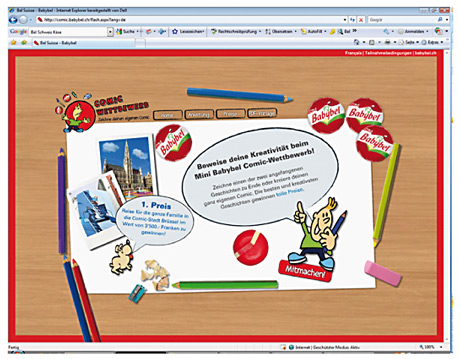
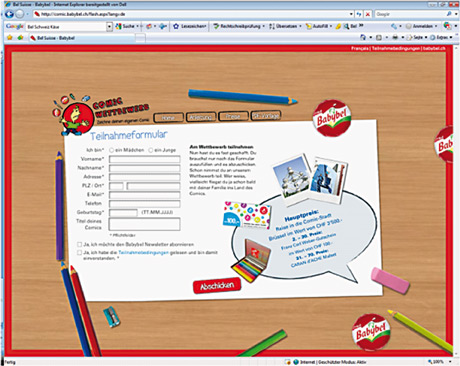
There are no limits to the imagination: Instead of a simple 08/15 competition, Bel Suisse is launching a cheeky online comic drawing competition in which the young and young-at-heart target group can give free rein to their creativity. With this online idea, the Wundermann agency wants to draw attention to the popular red "cheese lump" Mini Babybel. Participants in the competition can either choose between two comic stories that they have already started and have to finish drawing, or they can opt for the completely creative option and draw their own comic strip. It's worth taking part: in keeping with the comic theme, the main prize is a trip with the whole family to the comic city of Brussels. Wunderman has developed a complete drawing platform for the web, which provides various tools familiar from drawing programs for creating a small masterpiece. In addition, the user can select, insert and edit various objects, characters, backgrounds and speech bubble templates that have been lovingly illustrated especially for the competition. They can even upload their own images. Alternatively, participants can also print out a comic template, draw it by hand and take part in the classic way by post. Visually, the creatives at Wunderman deliberately opted for a design that corresponds to the young target group. "The viewer should get the impression that they are sitting at a drawing table," says AD Roland Dill. Playful and, of course, entirely in comic style, the website http://comic.babybel.ch should immediately "make you want to draw", as consultant Rahel Güttler hopes. The comic competition is being promoted with a banner campaign, print advertisements, e-newsletters and a corresponding on-pack presence on the Mini Babybel. (pan)
Jung von Matt/Limmat wins the Crossmedia Award with "Viva La Grischa
The Crossmedia Award, presented on Tuesday evening, went to Jung von Matt/Limmat for the «Viva La Grischa» campaign by Graubünden Ferien and Heineken Switzerland. Wirz Werbung and Rod took home the silver and bronze awards.
Editorial
-
May 20, 2009
The Crossmedia Award presented on Tuesday evening went to Jung von Matt/Limmat for the campaign "Viva La Grischa" by Graubünden Ferien and Heineken Switzerland. The campaign prevailed against five other nominees in the competition, which was held for the fifth time by the Goldbach Media Group. The winner of the silver medal is Mars Switzerland's "Hopp Schwiiz - Power to the Fans" campaign, which was created and implemented by advertising agency Wirz Werbung. The bronze medal went to "I Have MSF" for Médecins Sans Frontières by the Rod Kommunikation agency. The "Viva La Grischa" campaign is a very creative solution for how to generate a high level of attention on TV as well, despite the ban on advertising alcoholic beverages on TV, said jury president Marco Taborelli, explaining the decision. "The entire campaign has a high degree of innovation in addressing completely different target groups and the unconventional way of bringing two brands together." He added that it contained an intelligent networking of a wide variety of channels from the Internet, print, TV, radio and mobile via a connecting element: a song. The "Crossmedia Award Night" took place in a festive setting at the Hürlimann-Areal in Zurich with more than 150 guests. The award ceremony was hosted by Viola Tami. Jury president Marco Taborelli praised each of the winners in a short laudatory speech, and Goldbach Media CEO Klaus Kappeler presented all the nominees with their certificates and the lucky winners with their trophies containing prize money of CHF 10,000. Rocking entertainment was provided by the young Swiss band "The Rambling Wheels", winners of the MyCokeMusic Soundcheck 2008. You can find the cases of the winner and nominee here. The three winners will present their cross-media case at the Mediarena to a wider audience in the form of a workshop on May 27, 2009.
Flop of the week: Advertising revenues on a rapid decline
Advertising revenue for the Swiss press plummeted by 28.6 percent compared with the same month last year. In March, the decline had been 16.6 percent.
Editorial
-
May 20, 2009
Advertising revenue for the Swiss press fell by 28.6% compared to the same month last year. In March, the decline amounted to 16.6 percent. Advertisements worth CHF 145 million were placed in April, according to Wemf. It should be noted that the daily newspapers published two fewer editions than in 2008 due to the Easter holidays. 14.3 million francs of this was accounted for by job advertisements, which fell by 53.2 percent year-on-year. Commercial advertising fell by 26.1 percent to 114.1 million. The financial and business press had to cope with a drop of 42.9 percent to 4.7 million. Revenues in the Sunday press fell by 30.1 percent to 14.5 million. The daily press recorded a drop of 29.5 percent to CHF 79.8 million. The specialty press (-28.8 percent to 15.6 million), the general press (-23.3 percent to 21.1 million) and the trade press (-21.9 percent to 5 million) fared no better. The regional weekly press got off relatively lightly (-16.6 percent to 4.3 million). The only increase was recorded in brochure inserts (+3.9 percent).
Minds of the week: The double thinkers
Pia Lehmann is known for her work with Coca-Cola, and Stefan Epli for his work with the Street Parade. But that’s not all they have to offer. Since February, their agency, Epli&Lehmann, has been providing a full range of PR services.
Editorial
-
May 20, 2009
Actually, it was supposed to be another "head of the week". But Pia Lehmann (42) and Stefan Epli (41) are a team. They have been appearing on the market together since February. Each of them has experience with PR, communication and design, but also proven core competencies: Lehmann is particularly familiar with PR and crisis communications, Epli has been running a communications agency for twelve years and successfully communicates in the popular culture and lifestyle segments. So now: Doppelkopf. With their new agency, Epli and Lehmann offer the whole communications bouquet: from brand and crisis PR to internal and external communications, media coaching and strategy consulting to design. "What I particularly like to do always depends a bit on my mood," Lehmann says. "Sometimes it's pleasant when I can write in peace, but I also like to go to the client and advise them. Fortunately, we have a wide range of services, so the work is always exciting." Street Parade spokesman Epli has a proven passion for music and lifestyle, but even he says, "What I like to do most depends on the mood. That's why it's brilliant that we can control our work and dedicate ourselves to the project we have particularly good ideas for at any given time." Amazing. No one will deny that emotions play a big role at work. Creative professions in particular thrive on the impulses that evoke emotions. But it is rare that someone admits this so openly. At Epli&Lehmann, transparency is part of the company culture, along with honesty and emotion. That's why they can talk about feelings. Communicate imaginatively Epli and Lehmann have put the stamp "creative communication" on their portfolio. Stefan Epli explains what they mean by this: "Communication does not mean sending out a media release. This classic variant is perfectly fine, but you can also convey messages in a completely different way, for example personalized, with videos, pointed messages or guerrilla PR. You can achieve more with creativity than with mass production, and that applies just as much to internal communications as it does to external ones." To find the right communications strategy for a client, Lehmann and Epli take a close look at their customers. They want to know what makes them tick, what moves them. After all, simply talking about a product that a company wants to sell doesn't get anywhere. The message must also fit the company and the potential consumers. Two in one Pia Lehmann worked for Coca-Cola Switzerland from 1997 to 2007. Until 2005, she worked as Brand PR Manager and Media Spokesperson at the beverage giant. From 2005, she headed Corporate Communications and was responsible for all PR activities in consumer marketing and product launches as well as for brand PR. During this time, Lehmann gained experience primarily in PR, crisis and marketing communications. "Then, after ten years, I wanted a change and quit Coca-Cola," she says. "At Coca-Cola, my work revolved around the brand world of the company. That was very exciting, but now I work on a much broader spectrum." After Coca-Cola came Australia. Lehmann took time off to travel to the land of her dreams. But she always stayed in touch with Stefan Epli. In the meantime, Epli had decided to expand his agency "Atelier Epli" - and wanted to bring Lehmann on board. "After my return from Australia in December 2008, we discussed the topic and founded our joint company in January. It all happened quite ad hoc," says Lehmann. Never miss a beat Stefan Epli quickly found his way into the media industry after training in the commercial field. He worked at Züriwoche before setting up his own business, Atelier Epli, in 1997. For ten years, Epli has been the media spokesman for the Street Parade. In this role, he has also experienced black times: "Three years ago, there was a media GAU for the Street Parade," he says. "The media reported almost exclusively about drugs, sex and alcohol - and we wanted to convey music, festival and peaceful party. Going up against that was tough. But we were able to turn the tide by creating content. Nevertheless, it is a big challenge every year to transport the Street Parade as a cultural event and not as a cheap party on the street. In doing so, we rely on visitors to support this character of the event, for example by abstaining from drugs and vast amounts of alcohol." Of course, Epli not only takes care of the Street Parade, but also looks after media, training companies, and fashion and lifestyle clients, for example Ed Hardy and Diesel. "I find the different characters of our clients very exciting," he says. "Whether our client is a bank or a fashion label makes a huge difference. Even though our contacts come from the same management level, they are totally different from each other in the way they communicate, dress and work." Perfect symbiosis Lehmann and Epli got to know each other through work. "In 2004, Coca-Cola was the main sponsor of the Street Parade," Epli recalls. "That's when Pia and I worked on PR reports together, for example. That led to further collaboration, on Coke Light, Christmas activities, the Coke Tram, etc." As head of communications at Coca-Cola, Lehmann entrusted Atelier Epli with a number of mandates that she herself was unable to handle for capacity reasons. "We have always worked well together and complemented each other extremely well," says Lehmann. Both Epli and Lehmann have brought existing clients with them to the new agency, which they are currently each managing on their own. In the medium term, however, they want to collaborate more on projects. "Sure, we already look at tasks together now and discuss them," says Epli. "But of course there are also clients who specifically want to work with me or with Pia. Nevertheless, we want to complement each other even more in the projects. What's special about our agency is that we can now draw on a wealth of expertise." Lehmann confirms this: "We complement each other very well. With the clients I look after, I find it very pleasant that I can get a second opinion - and still keep everything confidential." Another advantage for both of them is the connection between their networks of contacts: Lehmann knows many decision-makers in companies from her time at Coca-Cola, while Epli has a number of contacts with journalists. The resulting synergies are manifold. A perfect symbiosis. Meeting in the middle Although Epli and Lehmann approach projects very differently, emotionally they are on the same page. "We always find each other in the middle, even if we rarely agree at the beginning," they both say. The new agency can't be blamed for a bad working atmosphere. Nevertheless, there are more favorable times to become self-employed. For Epli, it hardly makes a difference economically whether he runs a one-man or a two-man agency. Lehmann, however, didn't want to anchor back in the safe harbor of a permanent position after her trip to Australia. "For me, it's the optimal time to start my own business," Lehmann says. "Because I was ready for a change, am motivated and have a good network. Our start went great, we are very satisfied." Apart from a mixed payment record, Epli and Lehmann are not noticing anything of the much-vaunted crisis. They are also benefiting from the fact that many companies are currently cutting back on their 100-percent communications position and buying in sporadic communications services instead. Crisis communication is very much in demand at the moment, but so are strategic consulting and brand PR. In the three months since the agency was founded, the team has already won ten new clients, ranging from a local kindergarten to a major global corporation. Current clients of the agency are Coca-Cola, the Street Parade Zurich, Nestlé, Ed Hardy, Adroplan, Energy Stars for Free and the Monday Night Skate. The agency has also taken on mandates for Ticketcorner, Ben & Jerry's Ice Cream and Radio Energy Zurich. Apparently, word has gotten around that Epli and Lehmann don't look at size and sales figures when it comes to clients: "We didn't acquire, we just sent out our brochure. And then the clients approached us," says Lehmann. Customers are a matter for the boss And what are the team's plans for the future? "We don't have the goal of having 20 employees in two years," Lehmann emphasizes. "We always want to be involved in our projects ourselves and not have mandates handled by assistants after the contract is signed." Epli and Lehmann know from their clients that they have often had bad experiences with agencies. Once the contract was signed, they were passed on to the depths of the agency, and the quality of the work they had already paid for suffered. Epli and Lehmann vouch that this is not the case with them. "A small team of four or five would be nice, but we still want to be on the front lines ourselves," Epli says. "We don't need a fat car or a custom suit. We want to create creatively." Lehmann nods. The two agree on that, too. Anne-Friederike Wilhelm
Good news from the insurance company
Wirz demonstrates for Mobiliar just how fair the concept of a cooperative is.
Editorial
-
May 20, 2009
Many people dream of winning the lottery. However, it only becomes reality for very few. On the other hand, there is real money every year when Mobiliar distributes its surplus among its customers. As an insurance company organized as a cooperative, it is not the top managers who benefit from a bonus, but the customers with a fair share. This means that every year is payday at Mobiliar. In 2008, SMEs were allowed to benefit. In odd-numbered years, such as 2009, it is everyone who has taken out household and buildings insurance with Mobiliar. A total of 110 million francs will be distributed this year. And this needs to be communicated loud and clear - especially in times like these. "It's nice to be able to tell your customers good news for once," says Christoph Ott, Head of Marketing Communication at Mobiliar. A nice, but not necessarily easy task at Wirz. "The public expects a certain humor from Mobiliar's advertising, just like the claims reports," says CD Matthias Freuler. His team found the solution in a satire on the world of lottery dreams. Three new commercials were created in collaboration with WirzFraefelPaal. All of them show Mobiliar customers who have supposedly hit the big jackpot. But to be fair - as life goes - they end up having to share it out cooperatively. But there is still joy. > To the three spots Andreas Panzeri
Lichtsteiner's dribbling
Numéro 10 amazes with a guerrilla campaign for a Puma lifestyle shoe.
Editorial
-
May 20, 2009
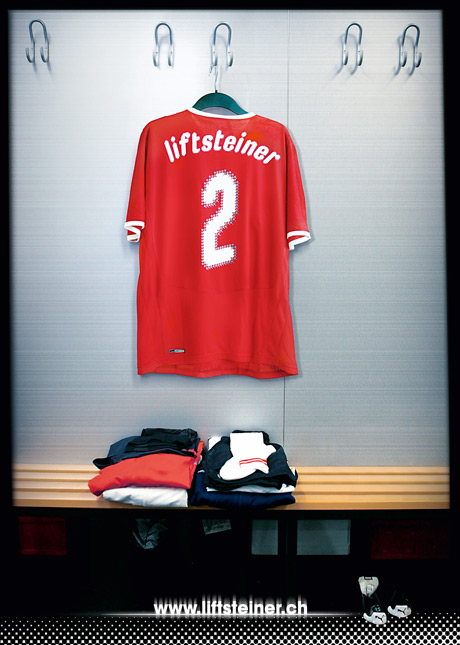
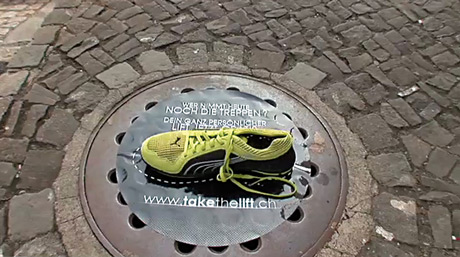
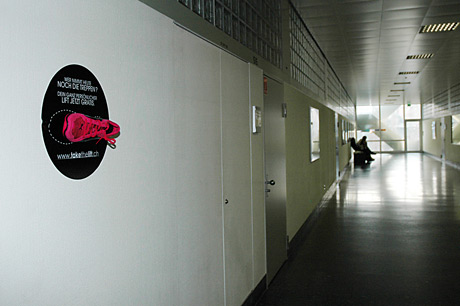
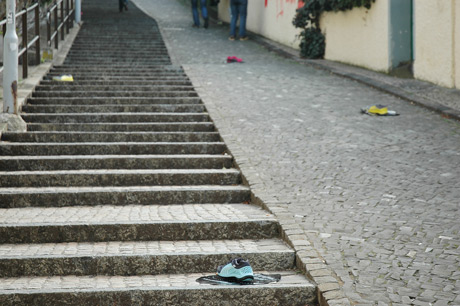
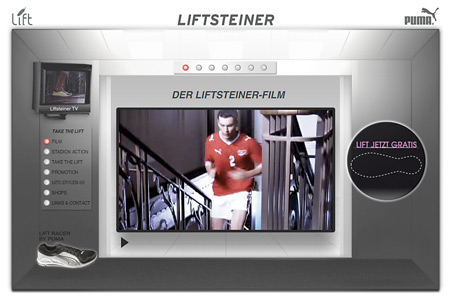
Sports brands usually have international ties for their advertising campaigns. This is also the case for Puma, which has its European headquarters in Germany. "It's difficult to get big contracts here," says Gilles Aeby. But because the strategic head of the agency Numéro 10 in Bremgarten, Bern, has already attracted attention beyond the country's borders several times with his guerrilla unit, the Swiss have now been invited to a pitch by Puma - and won it. A new lifestyle shoe called "Lift" is to be launched. The campaign is primarily intended for the regional market in Switzerland, but has already enjoyed considerable success in Rome. This is of course due to Stephan Lichtsteiner. The Swiss footballer plays as a defender for Lazio Roma. But let's take a brief look back. Because Puma is involved in various football sponsorship contracts (which are now being scaled back somewhat), the campaign for the "Lift" lifestyle shoe should also be associated with football as much as possible. And because "Lift" sounds similar to "light", the creatives at Numéro 10 came up with the idea of turning the footballer Lichtsteiner, known for his fast running, into an advertising character called Liftsteiner. The Puma shoe is called "Lift" because it weighs just 173 grams per foot. "Ideal for climbing stairs quickly", said the advertisers - and made a tongue-in-cheek video showing Lichtsteiner sprinting up several floors faster than an elevator. The video was then posted online with all the tricks of the trade. The film was made widely known at the international match between Switzerland and Moldova. Lichtsteiner was an important support for our national team in this decisive match for Switzerland's World Cup qualification. Numéro 10 cleverly took advantage of this and smuggled a professionally recruited "fan block" into the Geneva stadium for their guerrilla action. The fans with "Liftsteiner" T-shirts had the simple-sounding, but not so easy to implement, task of waving a "Liftsteiner" banner for so long and conspicuously that it had to be captured by the official SRG TV cameras. The prank worked. The "Liftsteiner" film was also shown on the stadium's big screens, and Lichtsteiner has since been called "Liftsteiner" by his colleagues in the national team. The newspaper Le Matin also included the Lazio star's new name in its match report. Cinderella effect After the Moldova game, 250 individual shoes were hung up in high-traffic locations at ETH and trade schools in Zurich in another guerrilla campaign. The students quickly realized that the aim here was to find the second shoe. Anyone who came up with the idea themselves by logging onto www.takethelift.ch was given a tip on how to pick up the additional second shoe for free in a Puma store. Andreas Panzeri
The T-shirt for the virtual fan club.
All the campaigns were aimed at attracting people to this website, where they can find more information about the Puma shoe.
Top of the week: Ruf Lanz wins Swiss Poster Award
The Ruf Lanz agency won the Swiss Poster Award at the APG Poster Night for its «Winter Prevention» poster for the accident insurer Suvaliv. The agency was also awarded a gold medal in the Commercial category and two silver medals in the Public Service and Commercial categories.
Editorial
-
May 20, 2009
The Ruf Lanz agency has won the Swiss Poster Award at the APG Poster Night with its poster for the accident insurer Suvaliv "Winter prevention". The agency was also awarded a gold medal in the Commercial category and two silver medals in the Public Service and Commercial categories. Spillmann Felser Leo Burnett and Stefan Bundi's studio in Boll also won gold. SFLB was awarded a prize in the Public Service category for the "Youth Session - List 77" poster design, while Atelier Bundi received the gold medal for its work "Weisse Rose" for Theater Biel/Solothurn in the Culture category. In addition to the silver award, SFLB won a bronze medal for the "Floralp Butter" poster for the Swiss milk producers in the Commercial category. The agency was also awarded the special prize for "100 posters to keep you going", the poster design for the Zürcher Tages-Anzeiger. Bronze medals also went to the "Juso" poster by Zurich agency Advico Young & Rubicam and to Erich Brechbühl (Mixer) for the cultural poster "Die rote Zora" for the Sempach Youth Theater.
Birkhäuser discontinues commercial web offset printing
The Birkhäuser+GBC printing plant in Reinach, Baselland, is discontinuing web offset printing. Fifty-eight jobs will be cut. Birkhäuser sees no potential in traditional offset printing.
Editorial
-
May 20, 2009
The Birkhäuser+GBC print shop in Reinach, Baselland, is discontinuing web offset printing. The company has recently invested heavily in specialist areas and shifted its core business to various other areas such as asset and content management, sheetfed offset, labels and digital printing. Birkhäuser sees no potential for traditional offset printing. 58 jobs will be cut. The commercial web offset division had already been regularly cross-subsidized with considerable funds for some time, as this printing division had become increasingly unprofitable due to the market situation, the printing company wrote in a press release on Wednesday. The pressure from the market had now become so great that the company had to decide to close the division. The closure of the division will make job cuts at the Basel and Reinach sites unavoidable. A total of 58 people will be affected. The company is very keen to remain an attractive employer in the region in the future, Birkhäuser continues.
French-speaking Swiss private television la télé: several birds in one stone
La télé is the only private television station in French-speaking Switzerland with regional ambitions. And rightly so.
Editorial
-
May 20, 2009
It is called, in light-footed lower case, la télé, as if there were no others. The plans that the makers of the future television station are forging for the Vaud and Fribourg concession area position la télé as a serious competitor to the French-speaking Swiss television station TSR. The broadcaster has a number of trump cards in its hand that make it believe in its future in the language region. On the one hand, there is a large broadcasting area: because there was no regional station in the canton of Fribourg, Bakom unceremoniously added the French-speaking part of the canton to the canton of Vaud when granting the license. Now la télé has a distribution area with 990,000 potential viewers. On the other hand, the sale of Edipresse to Tamedia has reshuffled the cards for almost all media in French-speaking Switzerland: for la télé, which is 31% owned by Edipresse, the sale - which has not yet been approved by the Competition Commission - is an opportunity. In one fell swoop, the ambitious start-up has a powerful co-owner with experience in the electronic media market. A co-owner who is, of course, domiciled in Zurich, making la télé an interesting player for national advertising. Director Christophe Rasch is delighted with the "extremely positive" development: "Edipresse has not been particularly present in the electronic media sector up to now, but now we have a contact in Zurich in Tamedia, with whom very intensive discussions are already underway." No, as far as the national advertising industry is concerned, no decisions have yet been made. Ecran Pub, which belongs to Edipresse, has been appointed as the regional advertising agency for the canton of Vaud and Mediapub, the advertising agency of Radio Fribourg/Freiburg, for the canton of Fribourg. Talks are also underway with the four other licensed television stations in French-speaking Switzerland, namely Canal Alpha in the cantons of Neuchâtel and Jura, Canal 9 in Valais, Télé Bielingue in Biel and Léman Bleu in Geneva. The aim is to form an advertising pool and to cooperate in the area of programming. "The regional advertising markets in French-speaking Switzerland are still barely structured because there have only been local stations up to now. There is still a lot to do," says Rasch. There is also work to be done in the area of programs: At the end of May, la télé plans to present its program line-up. This is still top secret at the moment. However, Rasch lifts the veil a little: "We'll be doing a two-hour talk show every evening on the current affairs of the day, live, if you please!" Rasch wants to hit two birds with one stone with this centerpiece of the broadcasts: He wants to overtake TSR in terms of speed and provide a platform for the players in politics, business and society. For Christophe Rasch, television must above all be up to date: "Today you see topics in the main news on TSR that were news at the end of the morning. During the afternoon, these topics have long since been disseminated by faster media such as radio and the Internet, and the television viewer actually wants to know what the reactions to the news are." And so la télé has developed the concept of a talk show in which the most important players of the day appear, debate and comment every day. Rasch hopes that this will enable it to compete with its big brother TSR despite its modest resources: "We have one hundredth of TSR's resources and thus make television for an area that covers seventy percent of TSR's territory!" Another advantage of the talk show concept is that it allows local current affairs to be viewed and dealt with from a broader, linguistic-regional perspective: "Our tone is not cantonal, but Romand." The concept stands and falls with the involvement of the politicians and other public stakeholders addressed: "We sense that there is a great deal of frustration, particularly in the canton of Fribourg, because TSR is neglecting the Fribourg news." A total of four studios, two main studios in Lausanne and Fribourg and two regional studios in Vevey and Yverdon, also bring the station geographically close to its listeners. "I firmly believe that we will get people into the studio for the talk show, provided, of course, that we succeed in establishing ourselves as a reference medium." At the end of July, la télé goes on air, initially with a summer program: the teams and the talk show team are to be tested with coverage of the various summer festivals. At the end of August, at the start of the political season, things will really get going. Helen Brügger
A semi-public private television La télé has an unusual ownership structure. The station is 31% owned by the French-speaking Swiss publisher Edipresse, which publishes the major daily newspapers 24 heures, Tribune de Genève and Le Matin, and a further 12% by the Fribourg publishing house Saint Paul, which publishes the newspaper La Liberté and prints the Fribourg News. Smaller blocks of shares belong to Radio Fribourg/Freiburg and its advertising company Mediapub as well as some small local Vaud television stations that are participating in the project. There are also associations and several Vaud municipalities, including the city of Lausanne. Private shareholders account for 62%, public shareholders for 32% and shareholders in the hands of associations and institutions for 6%.