Bureaucrats, the gravediggers

Unnoticed by the public, a bureaucracy of overzealous apparatchiks has developed even in our “model state”—people who, unelected and lacking any expertise, decide what may be communicated and how. The case of a giant poster by the fashion chain Tally Weijl is a prime example of this. Op-ed by Kaspar Loeb, CEO of the Swiss advertising agency Saatchi & Saatchi.

We keep reading about censorship and the obstruction of free speech and communication in banana republics and authoritarian systems. Such a thing would of course be unthinkable in the model country of democracy. Really?
Unnoticed by the public, an apparatus of overzealous bureaucrats has also developed in our model country, who decide unelected and free of any specialist knowledge what may be communicated and how. If they were just petty pranks, you could smile and shake your head at them, but the encroachments on freedom of communication are systematic.
In March, a giant poster for the Tally Weijl fashion chain was supposed to hang for three weeks on a scaffolding at Zurich's Bahnhofplatz. The space was booked, but then the "Traffic Department" arrived. And suddenly the state traffic controllers mutated into a state censorship authority. The busy location was "highly sensitive", a spokesperson told the media, adding the remarkable sentence: "Only a simple message would be unobjectionable." The subject matter was obviously questionable, a "lascivious" looking, "scantily clad" woman, but above all an English text with eight (!) words.
What an outrage and what an obvious violation of the Zurich regulations on large posters. They may only show subjects that are easy to grasp and must be designed in legible lettering. And then it comes to this: only SEVEN words are allowed.
You might think this is an April 1st joke, but not at all. Imagine that a hand-picked panel of selected (unelected!) traffic regulators spent hours in meetings and found the egg of Columbus, that with more than seven words, the men driving past would have caused a series of rear-end collisions while gawking at the "lascivious" female gaze and the monstrosity of EIGHT words.
Or perhaps they just had a divine inspiration and came up with the symbolic number 7 with the help of the Holy Spirit, so to speak.
The only reassuring thing for the industry of advertising creatives is the fact that the bureaucrats apparently believed that people would actually have taken note of the giant poster, which was quite attractive by the way, and even read the text: "I fight to protect the little wave riders." However, the traffic department (the name alone is a communicative work of art) only wanted to allow three words, which would have fitted in perfectly with their absurd request: "I fight to..." Yes, what are they actually fighting for?
But that's pretty much the only good news, because authorities and departments are increasingly filled with regulation-hungry bureaucrats who have a similar relationship to communication as a landscape gardener has to weeds. These civil servants would never tolerate non-expert, self-appointed experts running riot in their front garden. But because communication is like the referee, everyone is an expert, a proliferation of pointless regulations has developed that not only restrict commercial communication, but also strangulate freedom of communication as a whole.
But when there really is cause for discussion, the top regulators are conspicuous by their absence. When the most prominent giant poster in Switzerland at Zurich's main station features an incredibly stupidly sexist image of Saxobank, showing a man making a quick trade on his cell phone while looking through women's spread legs, nothing happens. Of course, there are no cars driving through the station concourse and rear-end collisions would probably only happen between passers-by at walking pace. And then, of course, someone else is responsible, and the bureaucrat will be happy to refer to his regulations and, in this case, his lack of responsibility.
But what do we want to complain about, since our French neighbors are doing even worse. In Paris, 2000 posters for an exhibition about the French comedian Jacques Tati had to be retouched. The "Mon Oncle" poster showed Tati riding a bicycle with a pipe in his mouth. Of course, in the age of the ban on advertising tobacco products, this goes too far.
The great director Costa Gavras, who is organizing the exhibition at the Cinémathèque française, found the right words: this is "absurd and ridiculous". He is right.

Striking

Among other things, *Werbewoche* noticed an SBB campaign in the free newspaper *Blick am Abend*. «Masturbate for half price» was proclaimed there—with more or less effective advertising results.

Step by Step Toward Long-Term Success
This takes Isostar a big step forward! With Viktor Röthlin, the European marathon silver medalist, the brand is currently running a national campaign with a fresh new look. The Winterthur-based agency +söhne Werbung was commissioned to create this campaign for Wander. The team at +söhne collaborated with their network partner and photographer Gian-Paul Lozza on the project. The landscape was shot in South Africa. The blur effects featuring Röthlin were filmed in Zurich.
1290581696_img090520_isostar2

Bern's Cultural Exports
The Bern-based advertising and communications agency Wapico has won the contract for the Théâtre de la Cité Internationale in Paris in a competitive bid. Despite facing stiff international competition, the Swiss agency came out on top. The first posters have now been put up, and a cross-media campaign is also promoting the newly launched theater. More of Wapico’s work can be found at theatredelacite.com.

1290581696_img090520_theaterhaus

The Media Strategy of the Newspaper Defamers
There are no limits to shamelessness when cash-strapped media agencies increasingly pressure struggling newspapers to publish even the most outlandish ramblings of their creative staff. «We’re young and need the money,» is the excuse they give. But the fact that this kind of prostitution eventually leaves its mark became clear to the attentive reader last Friday with a glance at the Abend newspaper. “Masturbate for half price” was proclaimed here with more or less effective advertising flair. The source of this sexual harassment was the SBB. But perhaps this placement wasn’t intended as creative advertising at all, but simply as revenge. The commuter papers are polluting the trains. In return, the SBB ruins the layout. The text is punched full of holes, the photo is… Long live the freedom of advertisers—because it may continue to guarantee us at least a little bit of the freedom of the press we once had. (pan)

1290581696_img090520_blick1

Wanner's rebuke is not appreciated

So far, the Basellandschaftliche Zeitung (bz) in Liestal has weathered the advertising crisis surprisingly well. Nevertheless, it has been publicly reprimanded by Peter Wanner for the second time. Publisher Mathis Lüdin and the P are fighting back.

Of the five partners in the Mittellandzeitung (MZ) association, the bz closed 2008 with the highest increase. According to Wemf advertising statistics, it increased by 3.5 percent, while the Aargauer Zeitung (AZ) lost 13.1 percent. With 11.9 advertising pages per issue, the bz was almost on a par with the AZ (12.1 pages). In the first quarter of 2009, the bz reported a volume decline of 26.8 percent, three times more than the AZ, mainly due to a slump (-52.9 percent) in job advertisements. However, other MZ titles, in particular Sonntag, performed even worse.
In north-western Switzerland, the bz is also holding its own. In 2008, it took a total of 24 more advertising pages than arch-rival Basler Zeitung. And so far in 2009, it has clearly outperformed BaZ in terms of jobs. The bz is also doing well in other respects: nowhere is the joint "Sonntag" more accepted than in WG 31: virtually all bz subscribers also subscribe to the Sonntagsblatt. No other MZ title has achieved this.
In view of this performance in Basel, it is surprising what MZ boss Peter Wanner said last week in an interview with AZ (and also in the bz!). The 2008 financial year of his AZ Medien was "unsatisfactory", he said. On the one hand because AZ was massively under budget in terms of advertising, but also "because the performance of bz was inadequate". Wanner did not say which bz services he was referring to.
Wanner should stop constantly bashing the bz, says bz publisher Mathis Lüdin. This is particularly frustrating for the editorial team, who are doing a good job. "It would be more honest if Peter Wanner would admit that it is not the bz, but the Sonntag that causes financial problems because it generates massive additional costs," says Lüdin. "Without this additional burden, the bz would be successful." But including Sunday, the bz result is actually not pleasing. It has to bear a particularly heavy burden on the Sunday title - for three reasons: No other MZ partner has to cover three cantons (SO, BL, BS) in its regional section like the bz - without synergies with other partner editorial offices. Secondly, the bz would have to produce its own local sports section. Thirdly, early delivery costs the bz more than the other partners, who have their own distribution organizations, while the bz has to have this done by the postal subsidiary Prevag at significantly higher prices.
The Chairman of the Board of Basellandschaftliche Zeitung AG explains the decline in job advertisements by the fact that the bz continues to run its own job advertisement with mono ads from Northwestern Switzerland. "This was successful last year, but now it has also collapsed." The other MZ partners, on the other hand, would publish all job advertisements in the joint job advertisement on Saturday and Sunday. In other words: "The bz is losing out on exclusive job advertisements due to the economic situation, while the other MZ partners hardly have any jobs of their own and therefore have nothing more to lose," says Lüdin. This makes the bz look bad at the moment.
Werbewoche wanted to confront Peter Wanner with all these things. But he simply wrote that he was not referring to the bz in the AZ interview, but to "the inadequate performance of Publicitas for the bz". "Unfortunately, the wording was not clear enough."
Mathis Lüdin is not prepared to let this stand. In particular, P cannot be blamed across the board, but must be differentiated according to P branches, he says. For example, the P branch in Liestal was up on the previous year in terms of commercial advertisements, occasional advertisements and publicity reports, while the volumes from the Basel, Rheinfelden and Breitenbach branches were down on the previous year.
Markus Knöpfli

The P is also fighting back
René Gehrig, Managing Director Central Region, also sees the criticism that Peter Wanner has recently leveled at Publicitas as "sabre-rattling". A lot of it also has to do with the publisher and its policies: Three years ago, he opted for full P-direction, then began parallel regional self-marketing, which he suspended again at the beginning of 2009. According to Gehrig, this back and forth was not conducive to marketing the AZ titles. "Customers and P employees are unsettled." He therefore hopes that the publisher will soon make a clear decision on direction.
Although Gehrig is pleased with Mathis Lüdin's praise for the Liestal P branch, he wants to "put it into perspective for reasons of fairness". The increase in advertisements from Liestal and the minus from other branches also arose because customers are increasingly booking the bz directly via the P Liestal.

The problem cannot be suppressed forever

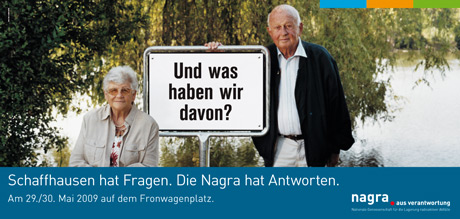
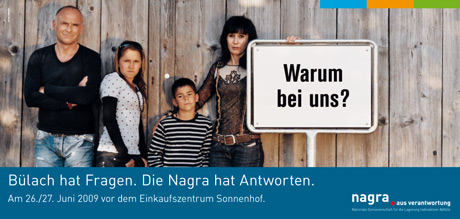
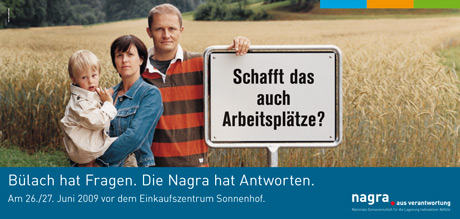
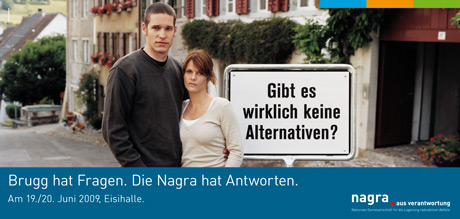
Matter & Gretener invites people living near potential final repositories to learn more about Nagra.

The problem is not new, but it is far from being solved: Since the 1970s, radioactive waste from five nuclear power plants has been accumulating in Switzerland. Beznau 1 was opened in 1969, the second reactor in Beznau in 1971, Mühleberg in 1972, the first plant in the 1,000 megawatt class in Gösgen in 1979 and the now largest plant in Leibstadt in 1984. The radioactive waste from all these nuclear power plants undergoes a multi-stage disposal process. This takes place centrally in an interim storage facility in Würenlingen. This high-tech facility went into operation in 2001 and is considered exemplary worldwide. However, it can only postpone the problem of radioactive waste. At some point, the spent fuel elements as well as more and more contaminated waste from research and medicine - for example from X-rays - will have to be stored in a safe repository. Nagra - the National Cooperative for the Disposal of Radioactive Waste - has now evaluated six geologically suitable sites for these repositories. Which one will be realized has been a hotly debated political issue ever since. Nagra has now launched a broad campaign in order to conduct this debate as objectively as possible. The contract for this was put out to tender almost two years ago in a pitch. Matter & Gretener won with a concept that does not focus on the nuclear issue, but only aims to raise public awareness of various educational events. "Nudge" or "the push" in the right direction is the name of this technique. The agency wants to arouse interest with its subjects so that the affected population in the selected regions will attend Nagra's information events.
Andreas Panzeri
1290581697_img090520_nagra4
1290581697_img090520_nagra3
1290581697_img09520_nagra2
1290581698_img090520_nagra1

Christo with the ibexes

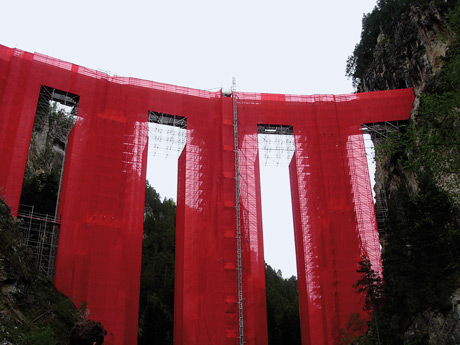
The Rhaetian Railway has landed a spectacular advertising coup with the wrapping of the famous Landwasser Viaduct, which is currently being currently being renovated, has landed a spectacular advertising coup.

No photos" proclaimed a banner high up on the bright red Landwasser viaduct. A cabaret artist dressed up as a construction worker with a helmet made sure that the assembled media people deep down at Landwasser did not take any photos of the eye-catcher. A gag that was part of the staging. A short time later, dozens of cameras were clicking away and even a mini helicopter equipped with a camera was circling around the alienated structure. The Rhaetian Railway (RhB) pulled off a theatrical advertising coup by wrapping its most-photographed monument. The brilliant idea was hatched by a small team consisting of Reto Wilhelm from the PR agency Panta rhei and the Alpine Railway's marketing professionals.
"Construction sites are actually a nuisance," explains Peider Härtli, RhB media spokesman, "but we're making an event out of it." The renovation work on the elegantly curved Landwasser Viaduct, which was completed in 1902 and leads into a tunnel, will continue into November at a cost of five million francs. The much-admired bridge cost 280,000 francs at the time, several million in today's purchasing power. But unlike modern concrete structures, which often crumble after just a few decades and have to be completely renovated or even replaced, this masterpiece has held up remarkably well to this day. What now stands in the wild landscape, covered up for a few months as a monumental advertising stunt, is structurally protected from the ingress of water, the main enemy of such bridges. The track trough and the mortar between the natural limestone dolomite stones of the 65-metre-high and 142-metre-long viaduct are being restored: a gentle renovation worthy of the structure's status.
Accompanying advertising campaigns
The Albula line, recently ennobled by Unesco as a World Heritage Site, is the right place for a campaign that would do credit to the packaging artist Christo. Red is not just any color for the RhB, but has always been the visual hallmark of carriages and locomotives, which, of course, have recently also attracted attention with advertising paint for companies such as Ems Chemie or Swisscanto. Japanese or Indians who jet halfway around the world to take pictures of the Landwasser Viaduct may be disappointed by the camouflage. But the marketing communications department, headed by local Vera Stiffler, has taken precautions. In the Regio Express trains and the Glacier Express, which runs from St. Moritz to Zermatt via the Albula line, there are colorful leaflets with information about the history of the monument and postcards with the uncovered crossing so that guests can send a card greeting with the "Landwasser Viaduct nature". "But we are doing a lot more to arouse interest," explains Vera Stiffler. "Since the start of renovation work in mid-March, we have been monitoring the progress of construction with a webcam (www.rhb.ch) every minute. Within a few weeks, thousands have logged in, and the number is growing all the time." A competition for amateur photographers (www.rhb.ch/fotowettbewerb) rounds off the electronic promotion. The best pictures of the altered Landwasser viaduct and the Albula line will be published and prizes awarded.
Great response
The Rhaetian Railway is not commenting on the cost of the spectacular advertising campaign, but the response will justify the expense by far. Already on the day of the event, SF DRS reported in "10 vor 10" as well as private TV stations, and the next day the bright red wrapped viaduct in the midst of rocks, forests and sugared mountain peaks greeted many Swiss newspapers and some foreign papers.
By the time the renovation is completed and the unveiling takes place in late fall, around one million passengers will - for technical reasons - glide slowly over the viaduct, 200,000 of them on the panoramic trains of the Glacier and Bernina Express alone. "It's not just the train passengers who will have an exclusive experience thanks to the wrapping," says press spokesman Härtli, "the red-wrapped bridge will also encourage motorists on the cantonal road between Alvaneu and Filisur and the many hikers to travel by train." And thus further increase the number of visitors to the Unesco World Heritage Site in the ibex territory.
Werner Catrina (text and pictures)
1290581697_img090520_christo1

SRG also has to make substantial savings

SRG will not be able to avoid making staff cuts either. The reason for the additional cost-cutting measures is the decline in advertising revenue, Armin Walpen told the French-speaking Swiss newspaper Le Temps.

SRG will not be able to avoid making staff cuts either. The reason for the additional cost-cutting measures is the decline in advertising revenue, Armin Walpen told the French-speaking Swiss newspaper Le Temps.
The financial situation of SRG is not pleasant, said the Director General of the television and radio company. Walpen assumes that advertising revenue will fall by 6 to 7 percent in the current year. The 2009 deficit will be much higher than the budgeted CHF 25 million. In 2008, it amounted to CHF 79 million, CHF 24 million more than planned.
Cost-cutting measures were therefore unavoidable and would undoubtedly also affect staff, said Walpen. This will be "anything but motivating", although the company would need a lot of motivation for the recently launched media convergence project.

Advertising print in free fall

The latest figures from Media Focus speak for themselves: advertising expenditure really slumped in April due to the poor economic situation. Advertising expenditure fell by 18.6% year-on-year to CHF 323 million.

The latest figures from Media Focus speak for themselves: advertising expenditure really slumped in April due to the poor economic situation. Advertising expenditure fell by 18.6% year-on-year to CHF 323 million.
Between January and April, revenues fell by a total of 10.3%, which corresponds to a loss of CHF 133 million, as Media Focus reported on Wednesday. Poster advertising recorded the sharpest decline (-20.5 percent), followed by the consumer, financial and business press (-18 percent).
The media group with daily newspapers and Sunday and regional weekly press earned 13 percent less between January and April than a year ago. Only the trade press (+7 percent) and the Internet media group (+26.1 percent) stood out positively. However, their share of the overall market trend is very small.
The key market of finance slumped by almost 30 percent in April and vehicles by a good 21 percent, both of which can be attributed to the major problems in the respective sectors. However, Media Focus attributes the slump in watches and jewelry by almost half to the fact that the Baselworld trade fair had already taken place in March this year. The only group that grew in April was energy, with a good 13%. In the first four months of 2009, advertising expenditure for political campaigns recorded the highest growth (+72.2 percent), followed by pharmaceuticals and health (+15.7 percent).
Migros spent the most on advertising in April, followed by Coop and Nestlé. The most advertised product was Bluewin TV, followed by the Nespresso Citiz coffee machine. Despite the car crisis, 5 cars are also in the top 10, mainly small and compact cars.

Kurt Schaad leaves SF business magazine Eco

Kurt Schaad is stepping down as editor-in-chief of the business magazine Eco at the end of the year. The TV journalist explains that the pioneering phase is over and he is now looking for a new challenge. The Monday evening program was launched in August 2007.

Kurt Schaad is stepping down as editor-in-chief of the business magazine Eco at the end of the year. The TV journalist explains that the pioneering phase is now over and he is looking for a new challenge. The Monday evening program was launched in August 2007.
The pioneering phase of the program is over and the time is right for a change, Schaad was quoted as saying in a press release on Wednesday. "I'm 58 years old, and now is the best time to tackle something new again - either internally or externally."
It has not yet been decided who will succeed Schaad as editor-in-chief. The position will now be re-advertised, according to the press release from Schweizer Fernsehen.
Schaad has worked for SF since 1972. He has produced, presented and directed a wide variety of programs. Among other things, he was co-founder of the program Karussell. From 1991 to 2006, he was head of the SF Spezial editorial team and was responsible for major live reports such as "Eiger live" and "Flughafen live".

Federal Council wants to make audiovisual cultural assets more easily accessible

Swiss film and audio documents are to be made more easily accessible electronically. This was decided by the Federal Council on Wednesday. The Memoriav association is to receive an additional CHF 2.4 million over the next four years.

Swiss film and audio documents are to be made more easily accessible electronically. This was decided by the Federal Council on Wednesday. The Memoriav association is to receive an additional CHF 2.4 million over the next four years.
Memoriav aims to simplify online access to audiovisual cultural heritage by offering a broadband service. The association was founded in 1995. Its aim is to evaluate, index and preserve films, videos, photos and audio documents from Switzerland and make them accessible to third parties. Memoriav has 170 institutional members. 21 cantons are affiliated through their state archives, libraries or museums. The Confederation contributes over 80 percent of the association's income. Parliament approved a budget of 11.7 million for the 2006-2009 period.
The Federal Council is now asking Parliament to increase this payment framework by CHF 2.4 million to CHF 14.1 million for the years 2010-2013. This corresponds to an annual increase of CHF 600,000.

St. Galler Tagblatt cuts six jobs

After it was announced last week that, following the Tagi, the Bund, and the Berner Zeitung, the St. Galler Tagblatt would also be cutting jobs, the final figures have now been released: Six positions will be eliminated, resulting in two layoffs.

Following last week's announcement that the St. Galler Tagblatt will also be cutting jobs after the Tagi, Bund and Berner Zeitung, the definitive figures have now been communicated. Six jobs will be cut. There will be two redundancies, as Hans-Peter Klauser, General Manager of St. Galler Tagblatt AG, explained to SDA on Wednesday.
The editorial team of the St. Galler Tagblatt comprises around 100 people. Various departments are affected by the job cuts. Klauser went on to say that the company would have to "tighten its belt". Unsurprisingly, he cited the decline in advertising revenue due to the economic crisis as the reason.

Dialog is always an opportunity

Many companies are afraid—afraid of their customers, afraid of taking the initiative, afraid of criticism, and afraid of dynamic brand management. As a result, even bold initiatives are often slowed down, halted, or implemented only halfheartedly. But there is another way. By Roger Baur, Managing Director of NetProfit GmbH.

Many a product manager or marketing director has made a fist of it: no sooner has a new product been launched - with a lot of money and creativity - than the first critical comments appear in blogs and forums. The product is good - but far too expensive. And yet the calculations were so tight.
So how do the majority of companies react today? First option: They never even find out about the comments, as the Internet is jinxed anyway and it has worked without online monitoring up to now. Second option: get annoyed, ignore and sit it out. After all, this has always been a good strategy. Third option: guerrilla counter-attack. Or was it viral? Buzz? Never mind: "fan posts" left under false user names and lots of praise for the product are ultimately as good as real comments - almost.
All three options have one thing in common: they are not geared towards the reality of modern consumers and their new behaviors. The buzzword is "community management". Because the most worthwhile option is dialog. This is not really all that new. PR people have always sought this form of dialog. For example, when it came to convincing a small village that the new factory would bring many positive benefits. Unfortunately, many consultants and agencies seem to have overslept online PR somewhat.
Will the effort now be immeasurable? Do armies of community managers have to respond to every single "troll" (Internet users who simply like to provoke)? No. Just as at a village meeting only a few people speak, but many listen and even more hear the message - after all, word of mouth existed before the Internet. This means that a single detailed and positively answered question is read by hundreds or thousands of people and spread even further by word of mouth.
Half-hearted communication
Can that also go wrong? Of course it can. But the risk increases with half-hearted communication. If you respond to criticism openly and honestly and, above all, take it seriously, you are already on the right track. But anyone who starts discussions and then deactivates comment functions because it becomes uncomfortable; anyone who mocks users or threatens legal action if fans use a logo on YouTube is treading on Internet quicksand.
But perhaps the internet is also separating the wheat from the chaff: into those companies that really believe in their products or offers and stand behind them one hundred percent, and into companies that know about the skeletons in their closet and therefore prefer to tread softly. There are already brands that are on the road to success thanks to "authentic" communication - also and above all online.
Complexity has increased massively
Does this make traditional advertising campaigns, banner spaces or TV commercials superfluous and useless? Are branding, brand rights and advertising agencies passé? Not at all. A well thought-out poster campaign or a witty commercial will continue to retain their important tasks and functions in the future. But the complexity of communication has increased massively, and this must be taken into account. And, as always, the companies with the best offers and the most honest message have the least to fear. On the contrary: committed customers are worth a great deal.
Roger Baur has been working in the online industry for over 10 years and is Managing Director of NetProfit GmbH.

Tamedia cleans up in Bern

At first glance, little seems to be changing in Bern’s media landscape. But it’s worth taking a closer look: Competition between the Berner Zeitung and the Bund is intensifying, the BZ is putting an end to its market-distorting marketing practices, and the Bund is regaining its own reach.

Because Tamedia is retaining the Bund as an independent title and is also continuing the Bern model with two journalistically different daily newspapers in one publishing house, little will change at first glance. It is true that there will be massive job cuts in Berne and Zurich. However, the new cooperation with the Tages-Anzeiger ensures that the Confederation will continue to have high-quality content and positions. From the point of view of national advertising customers, nothing will change for the time being either: the previous compulsory advertising combination between the Bund and Berner Zeitung (BZ) will continue to exist, meaning that the Bund will remain part of the overall reach of the BZ, which currently has 415,000 readers and a reach of 60 percent in its home region. Tamedia spokesman Christoph Zimmer describes this combination as "a prerequisite for the economic future of the Bund".
Readership figures for the Bund again from 2010
On closer inspection, however, some changes (and also improvements) can be expected for both readers and advertising customers. Thanks to the cooperation with the Tages-Anzeiger, journalistic competition between the Bund and BZ will become tougher. The Bund will even receive the sports section, which it currently takes over from the BZ, from the Tagi in future - as will other national topics. What's more, the Bund will again be reporting its own readership figures from next year. Zimmer confirms: "In the interests of journalistic competition, we want to create transparency in this regard." The separate Bund reach has not been reported since 2005, i.e. since the start of the Bern model.
Another very important change: the Berner Zeitung is reducing its circulation. More precisely, it will gradually reduce the proportion of trial subscriptions and free circulation. These circulation sections, which generate hardly any income but have in some cases been extended for years, are particularly high at the BZ. In the city of Berne alone, it distributes around 18,000 copies almost free of charge, whereas the federal government does not even have 3,000 such subscriptions. So far, the BZ has blatantly distorted the market in the Berne area by artificially increasing its circulation. Tamedia is now putting an end to this (see interview), which at the same time gives the Bund new opportunities for growth. However, the Bund subscription will become more expensive, while the BZ subscription will not. Today, both cost CHF 355 per year. "We will raise the price of the Bund subscription, which is currently below the level of other regional newspapers such as Neue Luzerner Zeitung or Aargauer Zeitung," says Zimmer. For the Bund, the cooperation with the Tages-Anzeiger could mean a significant expansion of editorial services. "This justifies the higher subscription price," says Zimmer. In addition, the survey conducted by the Committee to Save the Bund also shows that Bund readers are prepared to pay a slightly higher subscription fee.
"Merger with BZ would be more profitable"
From Tamedia's point of view, however, the continuation of the Bund is anything but a matter of course. The press release states that the continuation of the Bern newspaper model is a strategy "that will have to prove itself over the next few years". Christoph Zimmer adds: "We are convinced that we will be in the black with this model in the medium term, not in 2009 and probably not in 2010 either, depending on the advertising market, but later." The cooperation with the Tages-Anzeiger is by no means the most profitable option. "From a purely economic point of view, the merger of Berner Zeitung and Bund would have been more profitable," he says. However, the aim is to put the Bund on its own feet.
Tamedia does not seem to be worried about the approximately 10,000 Tagi readers in Bern (WG 34). Even though the Bund and Tagi will be almost identical in the jacket section in future, the Tagi is not expected to suffer any losses. Because those who read the Tagi in Bern do so because they want to know what's going on in Zurich, says Zimmer. In addition: "60 percent of the Tagi will continue to be read exclusively in the Tagi."
Markus Knöpfli
The NZZ remains calm
What does the NZZ actually think about Tamedia's decision? When asked, CEO Albert P. Stäheli declined to comment. Just a few weeks ago, he had considered launching an NZZ split in Bern. Is the idea still on the table or has Tamedia now thrown a spanner in the works? Stäheli's answer is sibylline: "There are projects on the table, but the decisions on launches remain open," he writes. He is also convinced that "the already strong NZZ circulation in Bern will tend to benefit from the new situation." The NZZ currently has 21,000 readers in WG 34. (mk)

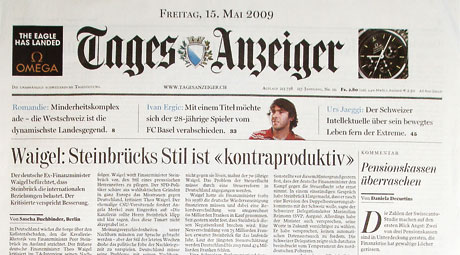
1290581699_img090520_tagi1
Tages-Anzeiger
- Reduction of 57 full-time positions (editorial + printing)
- New editorial team 177 full-time positions
- News, News-Netz and Tages-Anzeiger cooperate
(Total editorial office now 235 full-time positions)
- Relaunch in the fall
- new 4-Bund newspaper
- 5 regiosplits together in the 3rd bundle in future

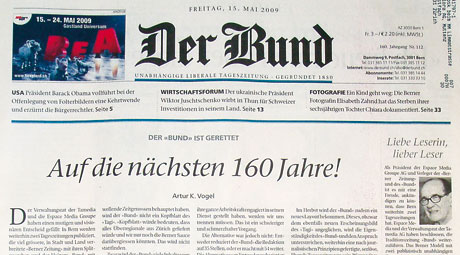
1290581699_img090520_bund2
Confederation
- Reduction of 22 full-time positions
- New editorial team 35 full-time positions
- Relaunch in the fall
- new 4-Bund newspaper
- Weekend supplement "Der kleine Bund" becomes the daily 4th Bund
- Obtains new jacket section from Tages-Anzeiger
- Leads the editorial office of the Federal Parliament (also for Tages-Anzeiger)
- delivers articles and special pages to Zurich
- Subscription fee to be increased

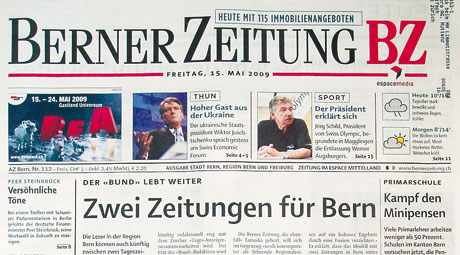
1290581699_img090520_bernerzeitung3
Bernese Newspaper
- Reduction of 3 full-time positions (editorial + publishing)
- Circulation is reduced (fewer trial and free subscriptions)
- Large circulation of Solothurner Tagblatt is stopped
- will bear costs for sports editorial office alone in future
- Greater regionalization of Bernerzeitung.ch
get_footer();