To the point: White smoke

The past week will likely go down in the annals of Swiss press history. After months of wrangling over the right solution, followed by equally long periods of speculation, rumors, and supposedly rock-solid insider information, the moment had finally arrived.

Last week will probably go down in the annals of Swiss press history. After months of struggling to find the right solution, after equally long periods of conjecture, rumor and supposedly surefire insider knowledge, the time had finally come. Although no white smoke rose from Tamedia into the Zurich sky, the decisions that were announced gave as much to discuss as the election of a new pontiff. Everyone had their say: stakeholders, unions, sympathizers, readers. On the one hand, it was about the future of the Bund, on the other hand about that of the Tages-Anzeiger.
Let's start with the covenant. For a long time, it was unclear what would happen to it. The newspaper, nostalgically held in high esteem by its readership, had to contend with major difficulties. And not only after Tamedia had acquired Espace Media. For years, the Bund had been in trouble, lost a lot of money and, after a while, was passed on like a hot potato.
Ringier was operating quite unhappily, losing money, and was still so happy when the Neue Zürcher Zeitung took over the problem child. At that time, the NZZ Group did not have a functioning group strategy, so the Bernese appendage was left to do as it pleased. Without much control, but also without really thinking strategically about a possible further development. This attempt also failed, money was lost again, and the child finally ended up with the unloved competitor Espace Media.
The joint advertising section of the Berner model allowed some breathing space. Cost-cutting measures did the rest. But the future remained uncertain. For months, the survival of the Confederation hung by a thread. The solution that has now been presented, with a drastically reduced editorial team and intensive cooperation with the Tages-Anzeiger at the same time, seems to me to be the right one. It is only to be hoped that this time it will last.
At the Tages-Anzeiger, too, everything is new. It is seeking to break free with a four-bundle concept. The regionalization of the paper is to be strengthened, the appearance is to be "higher quality" with a new design from fall 2009, and reader guidance is to be greatly improved. As part of this realignment, a total of 50 full-time editorial positions will be cut. A hard blow for the editorial team, but probably a necessary step. The only incomprehensible thing is that Tamedia is holding on to the free newspaper project News. Now that its unloved competitor .ch has disappeared, News would no longer be needed.
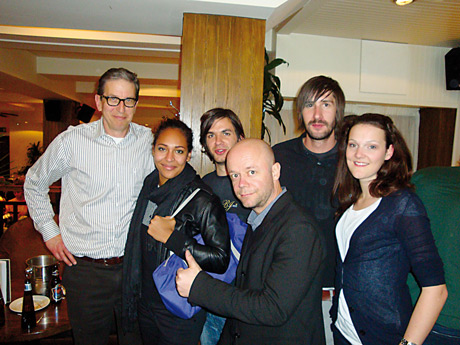
Pierre C. Meier, Editor-in-Chief
[email protected]
The eurozone becomes an online dream

About 80 percent of all marketing decision-makers plan to invest more in online marketing in 2009 than they did in 2008. A survey conducted in 14 European countries confirms expected trends but also reveals some surprising insights.

With its sixth "Digital Marketing Compass" study, Neo@Ogilvy has once again presented an interesting PR and analysis tool. Together with market researcher Skopos, the German branch of Ogilvy's global digital and direct media network took a close look at 873 media decision-makers in 14 European countries. They were asked about their investments, budgeting and their attitude towards online marketing.
First the unsurprising fact: Online advertising in all its forms is enjoying growing popularity. "79 percent of the media decision-makers surveyed - from both large companies and SMEs - say they plan to invest more in online media in 2009 than in 2008," says Nicolas Noth, Head of Switzerland and Austria at Planetactive/Neo@Ogilvy. "This includes mobile marketing as well as search engine marketing, direct e-mail and classic display advertising." It has also been shown that online media is already used as frequently as traditional media in Europe.
Significant country differences
Nevertheless, there are clear differences in the weighting of digital measures in the various countries. In Germany or Switzerland, display advertising or web services are used more frequently than on average, while email marketing is less important. This contrasts with countries such as Turkey, Italy, Belgium and Sweden, which use email marketing more frequently than average.
In addition, the growth of digital marketing varies greatly from country to country: while in Belgium the share of online media in the media budget is likely to rise from 14 to 16 percent (2009), the corresponding share in the UK will increase from 27 to an estimated 30 percent (2009). The information provided by the Swiss media decision-makers surveyed indicates a share of 17% in 2008 and a potential increase in this share to 20% in 2009. The European average is 22% and 24% respectively.
Nevertheless, Swiss expenditure is surprisingly high at 17 and 20 percent. It should be noted that this figure includes all forms of digital marketing, including online presence. In addition, the actual expenditure in the online sector is likely to be somewhat lower, as these are survey figures. In any case, they indicate where the media mix is heading: the 17 percent spent on online marketing in 2008 compares with 17 percent on sponsorship and events, 13 percent on PR, 6 percent on other and 48 percent on traditional advertising. In 2009, online will gain three percent and PR two percent, while traditional advertising and other forms of advertising will lose.
Online: Advertising overload as the greatest danger
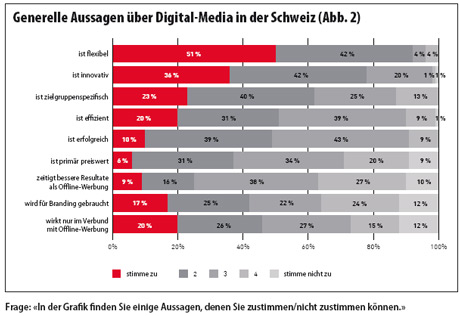
When it comes to the greatest strengths of online marketing, the responses from media decision-makers paint an unmistakably clear picture. The following statements received a lot of approval: better target group reach, high reach, speed and flexibility. There are a few differences between Switzerland and the national average. Abroad, many respondents saw online marketing primarily as a cost-effective tool. In Switzerland, significantly fewer respondents shared this simplified view. On the other hand, the Swiss are more skeptical about the success of digital marketing measures and still believe that traditional media works better (see Fig. 2).
Other major differences between Switzerland and other countries are that in Switzerland the budget for online media is determined much more individually for individual campaigns and activities. E-mail marketing with external addresses plays only a minor role in Switzerland, whereas search engine marketing and optimization are used more than average in this country. However, Switzerland and other countries are equally of the opinion that advertising overload is the main danger of online media.
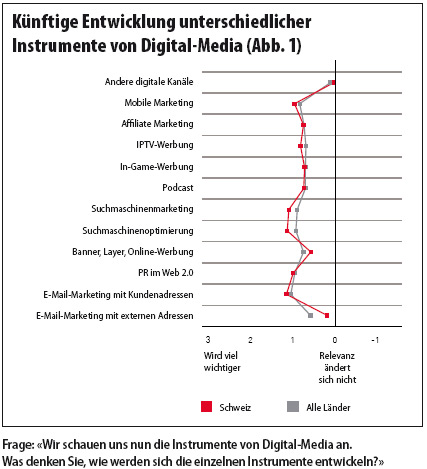
With regard to the growth prospects of online instruments, people in Switzerland are very optimistic overall (see Fig. 1), more optimistic than in most other countries. The Swiss see the greatest potential in mobile marketing, search engine marketing and optimization and email marketing with customer addresses. Just as Swiss media decision-makers are more optimistic in the online sector, they are more pessimistic with regard to traditional advertising media. According to their assessment, poster advertising and TV are facing zero growth, cinema and radio will be weak and print will lose somewhat more.
The survey also showed that media budgets are primarily split between online and offline. The allocation of funds is often made dependent on current market activities or the success of the previous year. Only 15 percent of respondents draw up a general annual plan. All in all, the study found a clear trend towards quality and professionalization in the online sector. More and more digital marketing tools are being implemented by specialized agencies.
Michael Koller

Digital Marketing Compass 06
The "Digital Marketing Compass" study will be published for the sixth time in May 2009. It was conducted by Neo@Ogilvy together with the market research company Skopos. With the subtitle "Digital marketing in times of crisis", the question of how budgets will change in 2009 compared to previous years is of particular interest. The survey questioned 873 media decision-makers from large companies to SMEs with budgets ranging from under 1 million to over 100 million euros. The survey was conducted in the 14 European countries of Switzerland, Italy, Germany, France, the UK, Belgium, the Netherlands, Sweden, Turkey, Portugal, Poland, Spain, Denmark and Austria.

1290581700_img090520_top2_1
1290581700_img090520_top2_2
1290581700_img090520_top2_3

Pixels against crisis

Numéro 10 launches a goodwill campaign for the Swiss advertising industry on behalf of Swiss Teletext.

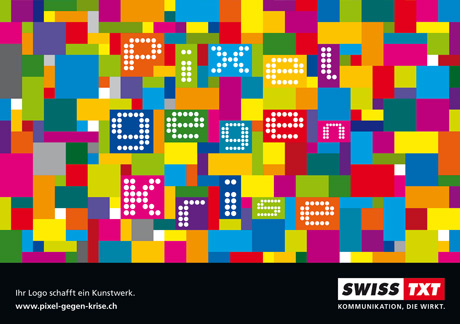
This week, Swiss TXT is launching a campaign calling on all advertising companies and advertising and media agencies in Switzerland to make a statement with their logo. With the "Pixel against crisis" campaign, Swiss TXT wants to call for solidarity in the current economic situation. Anyone wishing to take part can upload their logo as a vectorized EPS file free of charge to the website www.pixel-gegen-krise.ch. There, the Numéro 10 logo will be integrated into a graphic work of art. This will later be printed as a poster and made public via various channels. As a thank you for their participation, all participants will receive a voucher for an advertising placement on Swiss TXT.
Gilles Aeby from Numéro 10 is behind "Pixel against crisis".
WW: How did the idea come about?
Gilles Aeby: On the one hand, we live in a world where all values are questionable. A period where everything is changing very quickly. A time of uncertainty. On the other hand, the color pixels of Teletext have remained unchanged for years. They have become a cult and create a certain nostalgia. So they provide exactly the emotional roots that people need in difficult times.
What is the aim of this offensive?
Advertising companies, advertising agencies and media agencies in Switzerland are invited to unite symbolically. The crisis should bring these players together. For once, we should promote and develop collective rather than individual ideas. It may only be a small act of solidarity, but it will have a big impact - in the form of a work of art with over 300 logos from all over Switzerland.
What do you want to achieve with it?
We want to show that companies - even if they often operate in a competitive environment - are sometimes prepared to do something together and appear together. Swiss TXT also wants to prove that a good advertising campaign doesn't just have to sell. It can also give something as a gift. The "Pixel against Crisis" campaign offers several free benefits for the participating players: Visibility in the campaign with the respective logo, a direct link on the website by clicking on the logo, presence on posters as well as on a souvenir poster. There is also an attractive offer for placement on the Swiss TXT multimedia platform.
What are the initial reactions?
The campaign has just started on May 19. But we already have well-known brands participating: Swisscom, Coop, EasyJet, Puma, Denner, Allianz, SBB. Now we are also expecting strong participation from the most important advertising and media agencies.
What does Swiss TXT expect from the campaign?
More solidarity in the advertising industry. A signal against the crisis. And certainly also an opportunity to rediscover the medium of teletext and the Swiss TXT multimedia platform and to consider it as an integrated and complementary medium for the next campaign. Every company that takes part in "Pixels against the crisis" will receive a voucher.
Interview: Andreas Panzeri
1290581698_img090520_teletext_numero10

Wirz implements new brand identity for Medartis

Wirz Corporate will design the new brand identity for the Basel-based company Medartis. The first results are expected to be unveiled in early summer 2009.

As part of an agency pitch, Wirz Corporate has won the mandate to revise Medartis' entire brand identity. With the new image, the Basel-based implant manufacturer wants to position itself in a new competitive environment and is thus responding to its expansion into new geographical markets in recent years. The defining element of the brand world is to be the artistic, photographic staging of the company's core service: high-quality and innovative products and instruments for the operating theater. The first elements of the new brand identity are to be used from early summer 2009.

Berlin agency KircherBurkhardt redesigns Blick

As already announced, Blick will be undergoing a little cosmetic surgery for its 50th anniversary and is expected to change its format from tabloid to broadsheet. The Berlin agency KircherBurkhardt won the pitch for the redesign.

The Berlin media agency KircherBurkhardt will be redesigning Blick, which is expected to switch from tabloid to broadsheet format. The prototype of the Swiss tabloid newspapers wants to present itself with a fresh face and new format for its 50th anniversary in the fall. The agency won the Ringier pitch against four other participants. As a brand title, Blick should be modern and stylish, unobtrusive and yet always present, writes KircherBurkhardt in a press release. "KircherBurkhardt has refreshed and inspired us with new ideas. We are looking forward to what is sure to be an exciting collaboration in the coming months," Blick editor-in-chief Bernhard Weissberg is quoted as saying.

When Migros notes fall from the sky

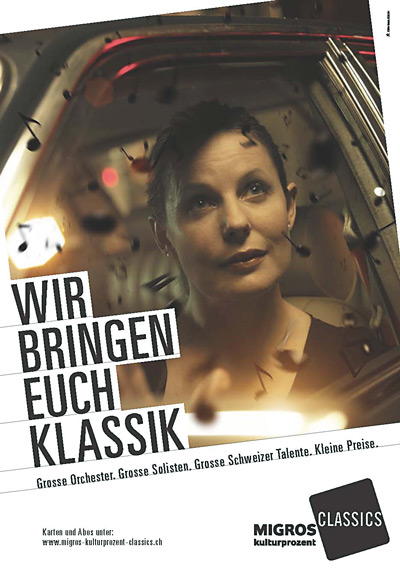
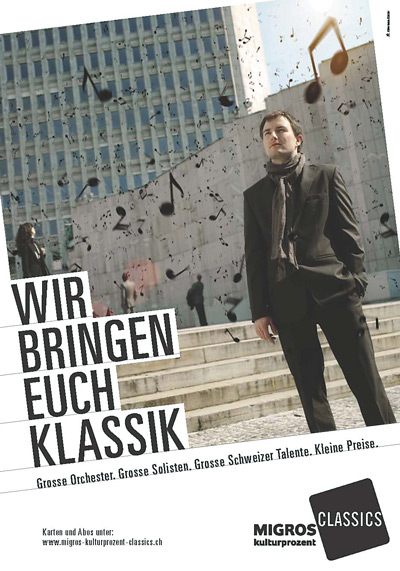
Euro RSCG Zurich has given the Klubhaus concerts a new cover as Migros Culture Percentage Classics and is making it rain notes for the overture.

The traditional Klubhaus concerts are under new artistic direction, have been given a contemporary look and a new name: Migros Culture Percentage Classics. In February of this year, Migros launched a pitch for the relaunch of its concerts. The winner was Euro RSCG Zurich with the idea "Migros makes it rain notes".
The Migros Concerts have been around for 60 years. They were launched by Gottlieb Duttweiler because the Migros founder wanted to offer not only fine delicacies, but also high-quality classical music for the general public at affordable prices. Since then, the concerts financed by the Culture Percentage have brought not only famous composers, but also major orchestras and renowned conductors to the country's established concert halls.
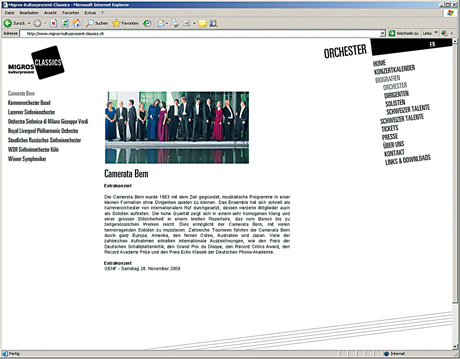
Unlike the festivals installed at a fixed location, the Klubhaus concerts take their art on tour to various cities such as Basel, Geneva, Bern, Lucerne, St. Gallen, Zurich, Visp and Lugano. In addition to the stars, each tour also gives a young Swiss talent their big chance. The orchestras include illustrious names such as the Vienna Symphony Orchestra, the Royal Liverpool Philharmonic Orchestra and the WDR Symphony Orchestra Cologne. The new artistic director of the Migros Culture Percentage Classics is Mischa Damey.
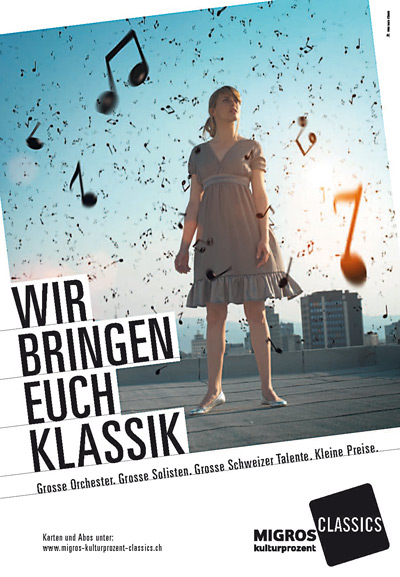
The agency used the fact that the Federation of Migros Cooperatives is making top cultural performances accessible to a wide audience as the basis for its creative work. Under the motto "We bring you classical music", Euro RSCG Zurich developed an integrated campaign that was used on TV, in cinemas, on posters, in advertisements and online. The campaign uses a simple symbol for the classical genre - musical notes. The team led by former conductor Frank Bodin and CD Axel Eckstein uses these symbols as if in a natural spectacle. Thousands of notes fall from the sky, leaving all witnesses to this "musical rain" in spellbound amazement. In the film, the images are harmoniously accompanied by the music of Antonio Vivaldi.
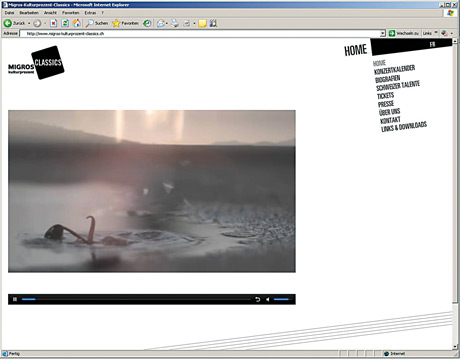
The commercial was shot in Ljubljana with Luzian Schlatter. The imagery and models served efficiently as the basis for all other media, explain consultants Walter Tagliaferri and Cornelia Dürst. The photographs were taken by Pascal Walder. An important element is the Migros-kulturprozent-classics.ch site. Audio samples can also be played on this site.
Andreas Panzeri
1290581699_img090520_migros1
1290581699_img090520_migros2
1290581699_img090520_migros3
1290581699_img090520_migros4
1290581699_img090520_migros5

Kratzer and Rungwerth new members of the board of the Zurich PR company

Two new members have joined the Board of the Zurich Public Relations Society (ZPRG). Nathaly Kratzer and Holger Rungwerth were elected for a term of one year.

Two new members have joined the Board of the Zurich Public Relations Society (ZPRG). Nathaly Kratzer and Holger Rungwerth were elected for a term of one year.
Two new members have joined the board of the Zurich Public Relations Society (ZPRG). Nathaly Kratzer, Paroli agency, and Holger Rungwerth, SAP Switzerland, were elected to the Board for a one-year term at the 23rd General Assembly. President Christian Wick (WickPR) and the board members Pascale Lehmann (Lehmann Horat Partners), Myriam Ziesack (Swisscom), Eva-Maria Bauder (Spitäler Schaffhausen), Grazia Grassi (Denner), Luca Roncoroni (Hauseigentümerverband Zürich), Peter Müller (Change Communications) and Dominik Allemann (Bernet PR) were confirmed for a further year in office. With over 600 members, the ZPRG is the largest regional association of the umbrella organization Swiss Public Relations Association (SPRG).

1290581698_img090520_zprg
Nathaly Kratzer, Luca Roncoroni, Pascale Lehmann, Grazia Grassi, Dominik Allemann, Holger Rungwerth, Christian Wick, President, Eva-Maria Bauder and Peter Müller (from left). Not in the picture: Myriam Ziesack.

Last but not least: The country needs new products

Good news from the print media's "Valley of Tears": Financially successful magazines still exist.

Good news from the print media's valley of tears: they still exist, the financially successful magazines. Schweizer Soldat, which sees itself as an independent publication for defense and civil protection, is leading the way. At the AGM of the Schweizer Soldat publishing cooperative, President Robert Nussbaumer recently said that the company could look back on a successful 2008 and that its finances were healthy. So fears for the future are not an issue. But what is the secret of success? Army Chief André Blattmann provided the key to this in his welcoming address to the AGM: what Schweizer Soldat does to maintain the will to fight and the cohesion of the army cannot be quantified in monetary terms, he said.
We summarize: You make a newspaper that can't be put up against money and you succeed. So it must be something supernatural. It should work.

Ringier launches new youth portal in Hungary

Ringier Hungary is expanding its portfolio in Eastern Europe with Neon.hu, an interactive community portal for young people. It is promoted with the slogan: «Neon.hu – only available to those of legal age!»

Ringier Hungary is expanding its portfolio in Eastern Europe with Neon.hu, an interactive community portal for young people. The company intends to further strengthen its presence in the Hungarian youth segment, as detailed in a press release. The portal will be updated several times a day and will be geared towards the tastes of young people, reporting on stars, fashion, games and technical news as well as offering top lists and advice.
The content of the new community portal works closely with the publisher's youth magazines, including Bravo, Bravo Girl and IM. The websites of the youth magazines will be integrated into the new portal with immediate effect. With the slogan "Neon.hu - only released with age restriction!", Ringier is promoting the new concept of showing young people what is "in" and what they need to watch out for. For this reason, anyone over the age of 24 is only permitted to visit the site if accompanied by a young person.

Bachmann for Kaufmann: Change at the top of the LZ Medien Board of Directors

Changes on the LZ Medien Board of Directors: Hans Kaufmann, the former chairman, has stepped down to make way for Managing Director Erwin Bachmann (photo). Albert P. Stäheli and Jörg Schnyder have also joined the board, which now consists of five members.

At the Annual General Meeting of LZ Medien Holding, the publisher of the Neue Luzerner Zeitung, held on Tuesday, Hans Kaufmann stepped down as Chairman of the Board of Directors. He had held this office since 2002. His successor, Erwin Bachmann, the former managing director, was elected. Bachmann also chairs the LZ subsidiaries and acts as publisher for the Neue Luzerner Zeitung, Radio Pilatus and Tele 1.
Albert P. Stäheli, Managing Director of NZZ, and Jörg Schnyder, Chief Financial Officer of the NZZ Group, are new to the Board of Directors. Together with Beat Lauber and Doris Russi Schurter as well as the new Chairman, they form the Board of Directors, which has been reduced to five members. Board members Ulrich Bollmann, Beat Fischer, Meinrad Hofmann, Alfred Hümmerich, Heinz Karrer and Franz Steinegger have left the Board.

Ultimate battle

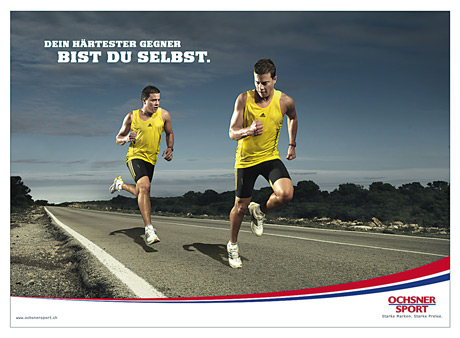
Wirz doubles up for Ochsner Sport.

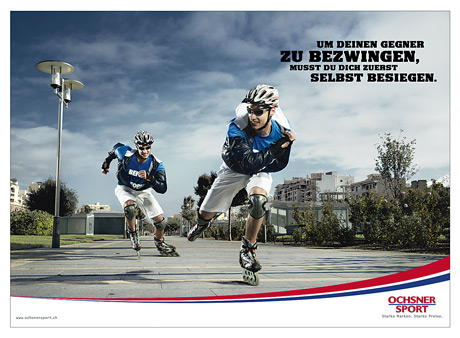
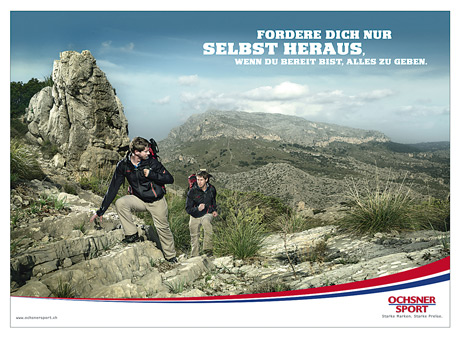
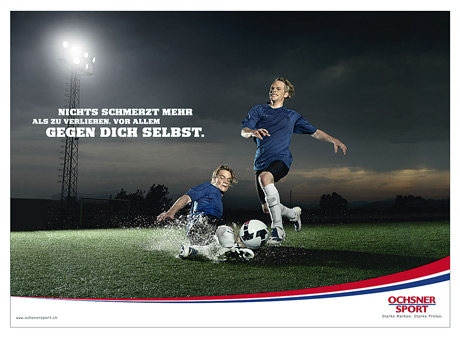
Whether you're a top athlete or an alibi jogger, the basic rule in sport is: your toughest opponent is yourself. This wisdom also underlies the new motifs that Wirz has come up with for Ochsner Sport. The unusual thing about the campaign for Switzerland's largest sporting goods retailer is the challenge of not having professional models in front of the camera. The psychologically well thought-out concept is to have only Ochsner Sport employees appear in this advertisement.
This not only motivates employees and provides internal support for the campaign. It should also create trust among customers - because the employees can also demonstrate their particular expertise in the respective sport with their appearance. "As a customer in the sports business, you couldn't wish for more identification," Patrik Pörtig, Team Leader Marketing and Communication at Ochsner Sport, is convinced. "Sports retailers have a flair for creative advertising," says CD Hanspeter Schweizer at Wirz, pleased about the sporting challenge with this customer.
The current subjects follow on from an earlier series. This time the photos were taken in Mallorca. The photographs were taken by Sven Germann. The elaborate image processing with the doppelganger effect was designed by Markus Graf at Bildwerk. The campaign starts with advertisements and posters and continues with promotions right through to the point of sale.
Andreas Panzeri
1290581699_img090520_ochsner1
1290581699_img090520_ochsner2
1290581699_img090520_ochsner3
1290581699_img090520_ochsner5
img090520_ochsner4

Eruption of young idea volcanoes

What does it look like when young creatives from all over Europe compete to create? The winners of best YET and their work are covered by the press throughout Europe. But how does the European creative elite work? How does the jury judge? Advertising Week took a look behind the scenes at the eighth Best Yet in London.

Thursday, May 7, 12 noon local time, London Islington. The 19 participating teams, country delegates and media representatives from ten countries arrive at London Art House. Croatians mingle with English, Germans with Dutch, French with Swedes. The Swiss delegation, which has traveled to London sponsored by Publicitas Publimedia, also explores the terrain: the two creative teams Bettina Klossner (OgilvyOne) and Laurie Morard (Advico Young & Rubicam) as well as Silvio Seiler (Wegelin & Co., Privatbankiers) and Oliver Schaich (freicom), as well as delegates Toni Vetterli from the Swiss Press Association and Marco Hendriks from Publicitas Publimedia, and Andreas Prokesch, former president of the Art Directors Club, copywriter, text trainer and one of the Best Yet 2009 jurors.
The mood is relaxed and full of expectation. What task will the young creative talents be given this year? The answer is clear at 2 p.m.: within 24 hours, they have to develop a newspaper advertisement for World Literacy Day, which takes place on September 8, 2009. It is being organized by Room to Read, an organization that aims to give children access to education and literature. A complex task, as the advertisement has three intentions: to promote the literacy day, to position the Room to Read brand and to fundraise for Room to Read. The young creatives have to scribble the ad. They are only allowed to use the Apple they almost all have with them for research. How do they get started?
Serious with fun
The Swiss teams retire for a conspiratorial meeting. They are joined by juror Andreas Prokesch and the delegates. The participants can ask the judges for advice on how to implement their work. However, the judges are not allowed to influence the creative ideas. Not so easy: Andreas Prokesch is practiced in only giving factual advice. The delegates, on the other hand, have to constantly bite their tongues to avoid bursting out with their own ideas. The process that is now taking its course is too captivating.
In a competition like Best Yet, it is important to approach the task seriously without losing the fun because of all the pressure. Prokesch knows this and reassures: "You have time. Let your thoughts run free and don't restrict them immediately. Don't think in terms of advertisements, but focus on the press aspect." Prokesch also advises not to tense up when searching for ideas: "You won't get the brilliant idea in a meeting, but in the toilet, in the shower or in your sleep. You can't force a good idea." The professional has spoken.
1290581700_img090520_bestyet4
Relaxed thinking
Bettina and Laurie set up in the Rococo Room, Oliver and Silvio in the Baroque Hall. In each of the lovingly and inspiringly designed rooms of the Art House, workstations are prepared with everything the creatives need: paper and pens. Now all you can hear are clattering computer keyboards, scratching pens and muffled conversations, in all languages and with lots of Øs - the Nordic countries are strongly represented at this year's Best Yet. Every team is looking for THE idea. After an hour, the first sketches have already emerged here and there. The two Swiss teams have very different ideas that you can watch grow. Prokesch lets his youngsters work. "It's important that they now think in many directions and also think through approaches that seem strange," he explains. But he keeps an eye on the tight timeline: "I already tell our teams when they have to commit to an idea. But a deadline doesn't make sense now. Tomorrow at noon it will be time to focus on an approach."
Despite the relaxed attitude, Prokesch wants to keep the four of them on topic: "You shouldn't make art. Art is too often not looked at. Stay close to the core topic. The ad has to work within seconds." After just two and a half hours, the program includes a cooling off session for the hot brain coils: a city tour through the windy London Main afternoon. The young creatives, who are still pondering the ideal subject in view of the London beauties in stone and hot pants, at least do so in an oxygen-rich and cheerful atmosphere. Before and after dinner and a nightcap, the ideas continue to grow. "We worked on our idea until about two o'clock the next morning," reveals Oliver Schaich.
Fresh air for ideas
The two Swiss teams work in the hotel on Friday. "Please do not disturb" is signaled by hangers on their door handles. Every now and then, a door opens to reveal that Bettina, Laurie, Silvio and Oliver are talking to each other and discussing their ideas with Andreas Prokesch. Prokesch's wish for the two Swiss teams to act as friends rather than competitors in the competition has been fulfilled. "The four of them wanted to look at their ideas together," he says later. "I was very happy about that. There's never been teamwork like this before."
At around 1 p.m. local time, the Swiss teams drive over to the Art House to put their chosen idea on paper. The four of them also have to prepare a two-minute presentation of the subject in English. "I have a good feeling about our idea, and Laurie and Bettina's idea is also great," says Oliver Schaich on the way to the Art House. That's right. Silvio and Oliver will be presenting a newspaper without text. They want to convey what it's like when you can't read. The letter-free newspaper would be published the day before World Literacy Day to draw attention to the event. Laurie and Bettina have given each letter of the alphabet a value in euros. For example, you can text "Independence" to a number and donate the amount calculated from the letter combination to Room to Read. Despite the great ideas, the two teams are very excited. "But I'm excited too," says Laurie. "And I'm really looking forward to seeing what the other groups come up with." The other 17 teams of two were selected from 450 teams in country-specific preliminary rounds. The young European creative elite. The tension is rising.
Tense anticipation
When the Swiss delegation arrives at the Art House, the air is crackling. Concentrated work is going on everywhere. "Stay away from the other teams now and don't get distracted," warns Prokesch. "Now you have to get it done." The deadline is 3.30 pm. Two and a half hours to go. The first team has already finished their subjects by 1.30 p.m. and asks for cardboard and spray adhesive. Silvio and Oliver are getting hectic. This is largely due to the presentation, during which they have to explain their design in English. Prokesch reassures them: "The other teams don't speak English as their first language either. Before you start, wait until the audience is with you. And don't forget to smile: you're having fun in this competition." Prokesch does his best, but in the last few minutes before the presentation, nervousness is a thing of the past. It's not just the two Swiss teams who are excited. Apart from a few Frenchmen who are relaxed and smoking outside the door, there is a sense of hecticness or even panic among all the groups. After all, it's all about who is the best young creative team in Europe - and a trip to Cannes for the Cannes Lions Advertising Festival. Nevertheless, Prokesch radiates calm and maintains his eye for detail. Oliver wears a shirt with text printed on it. "Put a shirt on over it," Prokesch advises him. "The text on the shirt competes with your idea." You have to come up with something like that first.
Tough selection
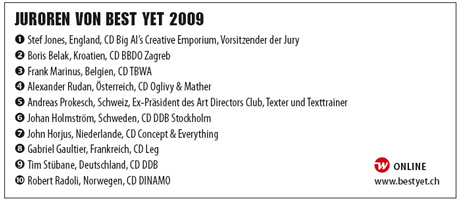
After 38 minutes, 19 times 24 hours of work are presented. Anyone who takes longer than two minutes to present their subject is cut off by the squawking of a horn. The jury retires for evaluation. Each juror has three votes, which are used to select eight works in the first round of judging. The best three subjects are then selected from these eight. "As a juror, I don't see myself as a representative of the Swiss teams," says Andreas Prokesch. "Of course I would be delighted if one of our teams won, their ideas are really good. But if one idea is better, it's the enemy of the good ones." After 45 minutes, the result of the tough selection is clear: the subject of Belgians Ross Mc Currach and Arnaud Bailly from Saatchi Brussels has the most Post-its stuck to it. This makes them the best Young European Team 2009, with Job Damien Bakker and Paul van Raak from the Netherlands in second place and Philip Frendberg and Tobias Gronberg from Sweden third on the podium. "The standard of all the work is excellent," said a delighted Stef Jones, chairman of the jury.
Moving advertising
"We are surprised that we won," say the two winners. "The many super-creative teams presented great work. We were even a little scared to go up against such competition with our subject." Mc Currach and Bailly followed the idea that education prevents hardship and is therefore a good pill against HIV infection, for example. They presented the "pill" under the slogan "We found a cure for HIV" in the form of two books facing each other. This convinced the international jury. "We were looking for the simplest possible subject," explain the two winners. "And then we waited for an idea to come to us, not for us to come up with an idea. That's how we always work." Sounds good - even if we've heard it somewhere before.
Although Oliver Schaich and Silvio Seiler's subject was shortlisted by the jury, it did not make it into the top three. Bettina Klossner and Laurie Morard's work was also not awarded a prize. The four of them are taking it in their stride: after all, they are among the top young creatives in Europe. They can be proud of this even without gold, silver or bronze.
Anne-Friederike Wilhelm
1290581700_img090520_bestyet2
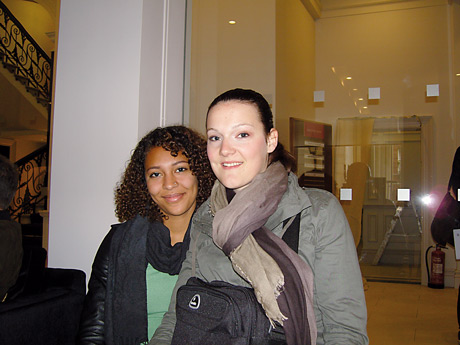
Team 1: Laurie Morard and Bettina Klossner.
1290581700_img090520_bestyet3
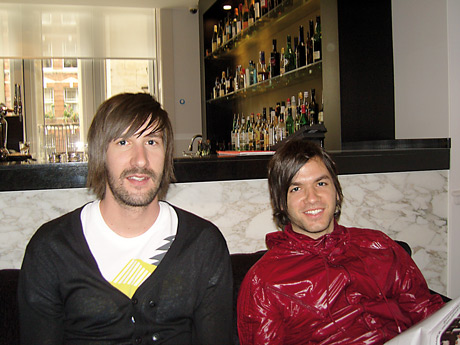
Team 2: Oliver Schaich and Silvio Seiler.
1290581700_img090520_bestyet11
Juror Andreas Prokesch, Laurie Morard, Silvio Seiler, Marco Hendriks from Publicitas Publimedia, Oliver Schaich, Bettina KLossner.

get_footer();