SDA: Confederation demands compliance with quality

The federal government wants to oblige the SDA news agency to deliver quality. The Federal Administration receives reports in three languages from the agency to the tune of around one million francs every year.

According to the Sonntagszeitung, the Federal Administration is now insisting on quality in the ongoing negotiations for the new contract from 2011: "It is important to us that the three voice services are offered in the same high quality," Vice-Chancellor André Simonazzi is quoted as saying in the Sonntagszeitung. Simonazzi said that a corresponding clause would therefore be included in the new contract. The background to this is the round of cost-cutting at SDA. 10 percent of the 140 jobs will be cut, with French-speaking Switzerland more affected than German-speaking Switzerland. This puts the language solidarity guaranteed in the service agreement at risk. Editor-in-chief Bernard Maissen says that the cuts in French-speaking Switzerland are "only minimally greater" than in German-speaking Switzerland. SDA will comply with the federal government's requirements.

Tele 1 goes on air with Frame Eleven

Tele 1, the new television station for Central Switzerland, will go on the air on February 1. The station's visual identity was designed by the agency Frame Eleven.

The on-air package includes the station logo, station IDs, promotional elements as well as all design components and signets for more than 13 broadcasting channels. The core element of the Tele1 logo runs through everything from the opener to the broadcast signage and advertising bumpers, and guides the viewer through the unique landscapes and customs of the region, the agency writes in a press release.
In October 2008, Tele 1 received a license from OFCOM to operate a new television station in Central Switzerland. Frame Eleven won the pitch against six competitors in a multi-stage process.
Responsible at Tele1: Bruno Hollenweger (Managing Director Tele 1 AG). Responsible at Frame Eleven: Christoph Müller and Marc Haas (consulting / creative direction), Mike Frei (art direction), Jürg Egli (co-concept & camera direction), Pablo Kirschke (3D), Oliver Aemisegger & Thibault Mueller (graphics / animation), Beni Kägi (project management), music/sound design: Kirschnermusic.

1290581102_img100129_tele1_1
1290581102_img100129_tele1_2
1290581102_img100129_tele1_3
1290581102_img100129_tele1_4
1290581102_img100129_tele1_5
1290581102_img100129_tele1_6
img100129_tele1_7

Last but not least: The secret activities of the professors

Stefan Raab's show «TV-Total» on Pro Sieben and the ARD political talk show «Hart aber fair» with Frank Plasberg are both broadcast on Wednesday evening at almost the same time. However, there is one major difference between the two shows.

While "TV-Total" is notorious as trash TV, "Hart aber fair" enjoys a reputation as intelligent educational television. Which program do you think has the more educated audience?
The answer is surprising: Raab's viewers are more educated than those of Plasberg. According to Welt.de, the Society for Consumer Research has found that "TV-Total" attracts 56 percent of people with secondary school, A-levels and university degrees to the television. The figure for "Hart aber fair" is only 48 percent. Incidentally, the RTL 2 reality soap "Big Brother" is only just behind the ARD discussion show in terms of the educational level of the audience at 47%... Some Prof. Dr. Dr. phil. jur. med. dent. probably like to sit down in front of the TV after a hard day's work and secretly watch a show that is not really made for professors with a beer and a bag of potato chips. And the educational elite are allowed this pleasure: After all, everyone has to be able to switch off at some point.

SF: "Deal or No Deal" is canceled

Swiss television is discontinuing "Deal or No Deal". Despite a market share of over 30 percent, the game show will disappear from the screen in the summer

It is well known that quiz shows have a limited lifespan, SF press spokesman David Affentranger is quoted as saying in the Sonntag newspaper. The program was originally only planned for two years. Some time ago, Ueli Haldimann had given the editorial team the task of developing a follow-up program. This work is progressing well and will be shown in the fall. SF does not yet want to reveal anything about the content of the new show - nor who will present it.
"Deal or No Deal" has been hosted by Roman Kilchsperger since its launch six years ago.

Concessions: Tele Säntis criticizes Uvek decision, Radio Südost satisfied

Radio Grischa and Tele Ostschweiz have been granted a provisional license. Radio Südost welcomes this, Tele Säntis regrets the decision.

Radio Südost welcomes the provisional license for Radio Grischa. This is because the interim solution does not create any precedent. However, Roger Schawinski and his team still have their sights set on the main license for the Graubünden/Glarus broadcasting area. The current interim solution is to be welcomed in principle so that Radio Grischa can remain on air, the initiators of Radio Südost write in a statement on their website, according to SDA. For the current proceedings, a solution has been created that offers legal certainty and "does not prejudge the main proceedings". Radio Südost has therefore decided not to appeal the decision to the Federal Administrative Court. They want the main license, says Stefan Bühler from Radio Südost unequivocally.
Tele Säntis regrets decision
Tele Ostschweiz (TVO) has also received a provisional license. In an initial statement, competitor Tele Säntis regrets this decision by the Uvek. According to SDA, Günter Heuberger, Managing Director of Tele Top, criticized the Uvek in a press release, stating that it was unacceptable for a transitional regulation to be issued "without a clear legal basis". This is particularly because the key points of the Federal Administrative Court's ruling have not been clarified. "This includes the threat to the diversity of opinion and offerings as a prerequisite for the granting of a license," said Heuberger.

The ADC judging 2010

As they do every year, the members of the Art Directors Club Switzerland reviewed the previous year's advertising and recognized the best of it.

As always, the judging was tough but fair, writes the ADC in a press release. The jury was chaired by jury chairman Andreas Prokesch. As part of the opening up of the ADC, Oscar winner Xavier Koller took part in the entire judging process as a guest juror for the first time. From a total of 755 entries, 195 works were awarded: 9 with gold, 23 with silver, 44 with bronze and 119 with a shortlist. Two new craft categories were judged this year: "Text" and "Art Direction". Works from all other categories could also be entered in these categories.
> To the awards (PDF)

Small selection of winning works:
Gold in the Text category:
> To the PDF

Gold in the Advertisements category:

1290581106_img100129_adc_anzeigen1
1290581106_img100129_adc_anzeigen2

Gold in the low'n'no budget category:

1290581106_img100129_lowbudget5
1290581106_img100129_lowbudget1
1290581106_img100129_lowbudget2
1290581106_img100129_lowbudget3

Hug & Dorfmüller stages Kjus by night

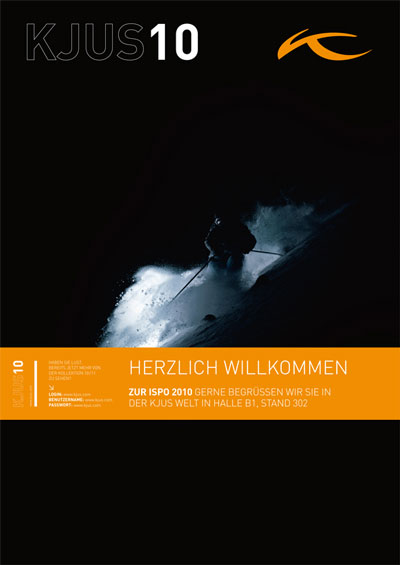
Hug & Dorfmüller created a magazine for LK International designed to get retailers and partners excited about the new Kjus winter sports collection.

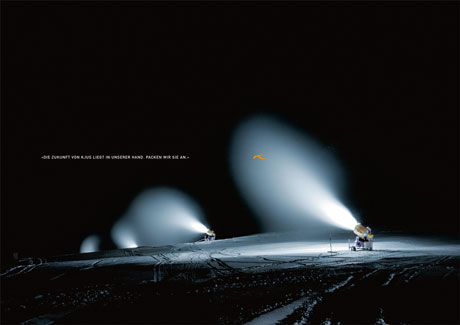
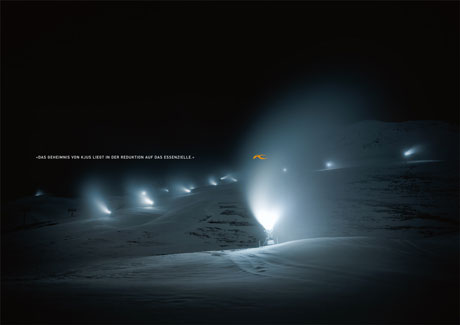
LK International invites you to Ispo with the large-format magazine Kjus 10. To get retailers and partners in the mood for the new Kjus winter sports collection, the night is staged. The ski slopes of the night are portrayed with shots of spotlight cones on snow-covered slopes, freshly and precisely groomed pistes or a poetic-looking ensemble of snow cannons.
The publication will be sent to dealers in a bandaged brochure format. A newspaper version is available at the trade fair stand. Full-page advertisements in trade journals and an outstanding trade fair appearance under the same motto ensure a uniform advertising presence.
Responsible at LK International: Daniel Schaffo (Marketing Manager), Silvia Huston (Project Manager). Responsible at Hug & Dorfmüller, Lucerne: Thomas Hug (Creative Direction), Christian Dorfmüller (Consulting), Robine Affentranger (Designer), Mario Mühlemann (Production). Text: Walter Kern. Product action and model photography: Syn für Gestaltung, Thomas Ulrich, Christoph Gramann Fotostudio. Skiers: Lucas Swieykowski, Anje Alme Gardli, Silje Ulrich, Tim Basil Stalder.
1290581107_img100129_kjus1
1290581107_img100129_kjus2
1290581107_img100129_kjus3
1290581107_img100202_design
1290581107_img100129_kjus6

SDA and DDP: Cooperation in the Swiss market

The two news agencies, SDA and DDP (Deutscher Depeschendienst), will collaborate in the Swiss market going forward. The AP office (now DDP Switzerland), which has been in operation since 1981, will become the DDP’s correspondent office.

The Swiss Dispatch Agency (SDA) will take over the German DDP text services as well as the DDP's foreign dispatch service (DAPD) for distribution in Switzerland as of February 1, the two companies announced on Thursday. In return, DDP will receive a license to distribute SDA services in its markets. The two partners explained that the cooperation was necessary due to the changed media landscape in Switzerland and the associated cost pressure. The DDP Group intends to concentrate on its core business in Germany in the future.
It has not been possible to maintain a national Swiss service with only 15 people, Martin Vorderwülbecke, board member of DDP Media, is quoted as saying in the statement. The DDP Group will continue to employ some of the AP Switzerland staff in a correspondents' office.
The DDP Group had acquired the exclusive rights for the news service in German for Germany, Austria and Switzerland from the American news agency Associated Press (AP) on December 7, 2009. The foreign news service is produced from the English-language service of AP International. SDA is now taking over the distribution of this DDP foreign news service for Switzerland. It thus ensures that the Swiss media can use another independent news source. The AP news service guarantees high journalistic quality as well as worldwide coverage. SDA is not taking on any of the existing ddp staff, as it has to cut jobs itself.
Editorial staff of the DDP "outraged and shocked".
The editorial staff of DDP Switzerland has reacted "outraged and shocked" to the dismissal of the staff announced on Thursday. The editorial office had to learn about the step in the Orginaltextservice of the competitor SDA. A social plan does not exist.
Only after the publication of the notice in the original text service had ddp managing director Franz Maurer informed the staff verbally. The dismissals were incomprehensible, after the new owners of DDP Switzerland had "still firmly committed themselves to the Swiss service" after the takeover of AP in December. It is incomprehensible why the "maintenance of a national Swiss service with only 15 people" should suddenly no longer be possible. After all, AP Switzerland had been successfully supplying the media with news for almost 30 years. The editorial team was deeply disappointed that it had not been consulted in the run-up to this drastic measure. In addition, the new owners had not given any assurances about a social plan or any severance payments. The fact that the move is supposed to be "also in the interest of the customers" also does not make sense to the editorial team. After all, competition also stimulates the media business. The press release concludes: "The layoffs hit us all the harder because we have always been extremely committed to providing a good agency service.
Comedia and Imprint demand social plan
The media union Comedia states that DDP only bought AP Schweiz in order to close it down. This is further bad news, and more media workers are being left on the street with no prospects. Comedia demands a decent social plan from the companies involved for those laid off.
The journalists' association Imprint echoed this demand. In addition, the dismissals were illegal. The two owners AP GmbH and The Associated Press Germany GmbH together maintained one editorial office each for German-speaking Switzerland and French-speaking Switzerland.
Although the two companies belonged to different owners, they operated a single business with more than 20 employees. Consequently - according to impressum - the dismissals violated the regulations for mass dismissals in the Code of Obligations.

Expansion of Radio Zürisee completed

Radio Zürisee can now fully cover its extended reception area via FM. The expansion of the transmitter network was completed three months after the license for the Zurich-Glarus area came into force.

This makes Radio Zürisee the first station to fully implement its license in this coverage region, according to a press release issued on Friday. The Radio Zürisee program can now also be received in the Andelfingen district on the FM frequency 90.6. The Neuhausen transmitter, which serves this area, went into operation on Wednesday. Radio Zürisee can now reach 1.5 million potential listeners every day in the canton of Zurich, the canton of Glarus and parts of the cantons of St. Gallen, Schwyz and Aargau.
The tunnel supply has also been further optimized. Radio Zürisee has been broadcasting in the Gubrist tunnel for a few days now. This will ensure uninterrupted reception of the program on Zurich's northern bypass in future, the station continues. To mark the occasion, Radio Zürisee will be broadcasting a series of background reports and features on the Gubrist Tunnel at 8.10 a.m. each week. Among other things, aspects of safety and maintenance will be highlighted. Radio Zürisee listeners will also receive tips on the quickest legal way to get through the Gubrist Tunnel.

BSSM: Advertising subjects realized for Mezger watches and jewelry

The Mezger watch and jewelry store in Basel has commissioned BSSM to create a new series of advertisements.

It uses pointed headlines to attract customers with high purchasing power. The full-page advertisements are used selectively in selected special interest magazines, customer magazines in the luxury segment and regional media.
Responsible at Mezger, watches and jewels, Basel: Urs Mezger (overall responsibility). Responsible at BSSM, Basel: Urs Schneider (CD), Hans Peter Brugger, Hannes Müller (text), Pascal Rehmann (AD), Roger Berthoud, Claudia Paganini (consulting). Photographer: Eugen Leu & Partner, Archive.
1290581107_img100129_mezger1
1290581107_img100129_mezger2
img100129_mezger3

Majority of audience council satisfied with "Benissimo"

«According to the Viewers» Council, “Benissimo” is diverse and entertaining. The changes introduced with the relaunch have been generally well-received by the Council.

The decor is welcomed by a majority of council members as "fresh and clear". The innovations in the game ball mode, in particular the introduction of the rivet, polarize the Council members. For some, this increases the excitement, while others consider the rivet to be regrettable and pointless.
A majority of viewers consider the mix of show acts and the lottery part to be a success. The show acts and the newly introduced "Telephone to the Federal Palace" with Birgit Steinegger and Walter Andreas Müller are seen by most of the Council as the highlight of the show. The performances by the acting friends, on the other hand, caused problems for the majority of the Council. Although the sketches are well staged, the jokes are shallow and often old and familiar.
Presenter Beni Thurnheer is inextricably linked to "Benissimo", according to the audience council. He manages to establish a connection with everyone, especially during the telephone conversations. He seems a little awkward at times when dealing with megastars.

Provisional license for Tele Ostschweiz and Radio Grischa

Tele Ostschweiz has been granted a provisional regional television license by the DETEC, and Radio Grischa has been granted a provisional FM radio license. Tele Säntis and Roger Schawinski’s Radio Südost will therefore come away empty-handed until the final licenses are granted.

The Federal Office for the Environment, Transport, Energy and Communications (Uvek) justifies the provisional granting of the license with the fact that Tele Säntis and Radio Südost are not yet on air. TVO already provides a significant proportion of regional public services, the Uvek wrote in a press release on Friday, according to SDA. The discontinuation or reduction of information services from Tele Ostschweiz (TVO) and Radio Grischa, on the other hand, would have a "detrimental effect on the public". Without a transitional solution, the staff would also have to bear "disadvantages that cannot easily be made good".
According to this Uvek decision, TVO and Radio Grischa are obliged to provide a regional public service. In return, regional television and local radio will receive 80 percent of the fee money as a transitional solution. Specifically, they will each receive just over CHF 1.7 million. However, the Uvek emphasizes that these transitional solutions only apply until the "legally binding award of the licence in the corresponding coverage areas". This is not expected before 2011.
The background to the interim solutions are rulings by the Federal Administrative Court. In 2008, TVO and Radio Grischa each received a license from the Uvek. Tele Säntis and Radio Südost were left empty-handed. They lodged an appeal with the Federal Administrative Court. In December, the court sent the decisions back to the Uvek with the instruction to re-examine the licensing requirements in both regions. None of the applicants were allowed to have a dominant market position and abuse it.
Lebrument against Schawinski
Publisher president Hanspeter Lebrument and his Radio Grischa and Radio 1 boss Roger Schawinski, who wants to compete with Lebrument in Graubünden with Radio Südost, are vying for the radio license. Two weeks ago, Lebrument threatened to sell or close down the two Graubünden daily newspapers Bündner Tagblatt and La Quotidiana so that Radio Grischa could continue broadcasting. Schawinski then accused Lebrument of wanting to use the two million francs from the fee-splitting for the newspapers. Schawinski now wants to prove in the new concession proceedings that Lebrument is abusing his dominant market position. "I have fought against monopolies all my life. And Lebrument's monopoly is probably the ugliest of all."
In addition to the Bündner Tagblatt and La Quotidiana, Lebrument also publishes the newspaper Die Südostschweiz and operates Tele Südostschweiz, Radio Grischa and Radio Engadina.
get_footer();