What an old folk wisdom already says has also been empirically proven today: Once you have reached a certain level of income, more money does not bring more satisfaction. Why do we still strive for more and more income? And what price do we pay for it? "Money has to be converted into things that make people happy," explained Prof. Dr. Mathias Binswanger, "and that takes time, which we often no longer have." Based on his book "The Treadmills of Happiness," the economics professor took us through various behaviors that promise us happiness but actually prevent it. "We move faster and faster, thinking we're making progress with our happiness. But like in a treadmill, we always stay in the same place."
New demands constantly grow out of the constant comparison with others. To meet them, we increase all those activities that bring us more strain than satisfaction. "By maximizing income rather than its benefits, we behave very uneconomically in terms of our happiness." So those activities that actually make us happy, according to surveys, such as spending time with friends and family, fall by the wayside. Or also, nota bene in the first place, sex. Binswanger pointed out ten strategies that lead out of these treadmills. From the optimization of the social life, over the fight against the mania to want to lead any ranking, up to the choice of the optimal surrounding field. After all, it is better to be a "local hero" than a "global loser," according to the economics professor.
More than 120 people accepted the invitation. With the theme of happiness, the agency addressed an aspect of contemporary life that concerns everyone - especially in difficult economic times, said Gaby Zimmerli, Managing Director of Ogilvy & Mather.
>To the presentation on Ogilvy.ch
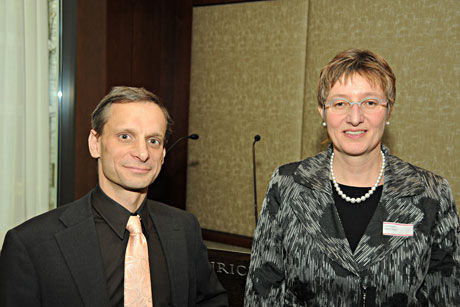
(Photo: Mathias Binswanger and Gaby Zimmerly (Managing Director, Ogilvy & Mather).