Crisis communication: association celebrates first birthday

The Swiss Association for Crisis Communication will celebrate its first anniversary at the end of March. Its more than 50 members include agencies and communications consultants, as well as companies and experts in the fields of caregiving, risk and crisis management, and strategy implementation.

The aim of the industry association is to improve and safeguard the quality of crisis communication through binding codes. The scientific advisory board is currently working on a code that will be presented to members over the course of the year, according to a press release issued on Tuesday. Another focus of the association is training and further education in order to promote the professionalization of crisis communication in Switzerland. Also in preparation is the "Crisis Communicator of the Year", an annual award for professional work in crisis communication.
The association invites interested persons to attend the AGM and the subsequent presentation. More information at Association-crisis-communication.ch.

Ruf Lanz fights for Suva against tripping hazards

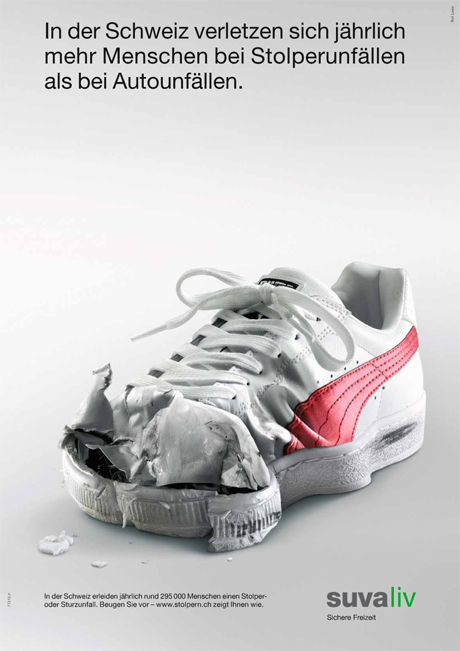
Suva has launched its new prevention campaign, «Stolpern.ch.» The campaign aims to raise awareness of the fact that more people in Switzerland are injured in tripping and falling accidents than in car accidents. The campaign was created by Ruf Lanz.

Over the next five years, Suva intends to reduce the 85,000 tripping accidents reported to it each year, which cost 640 million Swiss francs, with targeted prevention activities and to raise awareness among its insured companies and the general public. Among other things, a TV commercial and posters will be used. A core element of the campaign is the interactive website Stolpern.ch, where users are asked to identify tripping hazards as a prelude. The film "below", also available on the website, also brings viewers to eye level with the stumbling hazards and highlights dangers.
You can stumble across the full text on the campaign in the next print edition of Werbewoche.

1290581021_img100316_suva1
1290581021_img100316_suva2
img100316_suva3

SF remains the most-watched channel

Swiss Television was once again the most-watched channel in German-speaking Swiss households in 2009. Its average market share for the entire day was 33.3 percent. Compared to 2008, SF’s market share fell by 0.9 percentage points last year. The network attributes this primarily to the major sporting events of the previous year. However, news programs in particular saw a significant drop in market share.

Sporting events such as the European Football Championships and the Olympic Games in Beijing had delivered particularly good figures in the previous year, explained television director Ueli Haldimann to the media on Tuesday. "Compared to 2007, the last year without any major sporting events, we only lost 0.2 percentage points." Information programs have lost the most, such as the main edition of "Tagesschau". In 2008, it achieved a market share of 55.5 percent. Last year it was still at 53 percent. Ten years ago, the flagship program still achieved a market share of around 70 percent. The "Arena" was also less popular in 2009 and suffered a drop of 1.5 percent to 25.3 percent market share.

Increasing competition from abroad
Overall, Haldimann is nevertheless satisfied. It is a good achievement that the SF channels have remained reasonably stable over the years. This achievement is all the better when one considers the growing competition from the private sector and from abroad. However, the biggest competitors for attention last year were not the German private channels of the RTL or ProSiebenSat.1 Group, but channels from the home countries of the foreign population. Programs from Turkey, for example, or from countries in the Balkans already had a combined market share of 16.1 percent last year. That is more than the RTL Group with 15.7 percent and the ProSiebenSat.1 Group with 12 percent. Within five years, these "channels from the homeland" have gained around 6% market share.

(Pictures: SF)

Publicitas invites you to the Forum 2010

After the industry event "p-forum" was not held last year, Publicitas is inviting people to attend again this year. The forum will take place on Thursday morning, September 30, 2010, at Zurich's Arena Filmcity cinema in Sihlcity.

Advertising clients and communications experts from publishing houses, advertising and media agencies are invited. Publicitas is expecting up to 450 guests. In addition to speakers and a panel discussion, topics and trends from the media world will be addressed and discussed. The presentations will be simultaneously translated for French-speaking guests.

Flowcube and Zeta: Launched for SBB Europaallee-Journal

Flowcube and Zeta have developed a journal for SBB. It documents the Europaalle construction project, which is being carried out along the tracks at Zurich Central Station.

In the Europaallee Journal, which has just been published for the first time, people from Zurich, the neighborhood, architects, builders, students, store and restaurant operators have their say. The magazine is a mix of portraits, interviews and reports and provides information about new developments in the project. The generous visual language and modern, uncluttered typography are combined with playful illustrations. Europaallee Journal is published twice a year as a supplement to the Tagesanzeiger and NZZ (Zurich city editions).

Responsible at Flowcube Communications, Zurich: Maja Amrein (concept). Responsible at Zeta, Communication Design: Ibrahim Zbat (AD/graphics). Photography: Christian Knörr. Illustrations: Flag.

1290581022_img100315_europaallee

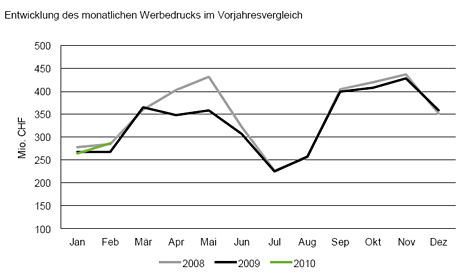
Media Focus: Advertising pressure rises by 7.2 percent in February

February’s advertising spending more than made up for the slight decline in the previous month. Compared to February 2009, gross advertising spend rose by a substantial 7.2 percent (+19.3 million francs). The current year (January–February) is 3.2 percent (+17.1 million francs) above the previous year’s figure.

After a long downward trend, the "Print" media category recorded an increase for the first time in ten months. A comparison with the same month last year shows an increase of 1.7 percent, which corresponds to around CHF 2.5 million. Across all media groups, only two - the "daily, regular weekly + Sunday press" and "consumer, financial + business press" - recorded a year-on-year decline (approx. 1% in each case).
In percentage terms, the development of the "Clothing + Lingerie", "Personal Supplies" and "Consumer Electronics + Photography" sectors is very positive.
The "clothing + underwear" sector launched a major offensive in February 2010. With an advertising pressure of +73.4 percent (+2.5 million francs) compared to the previous year, clothing manufacturers attracted customers with the new spring collection. The strongest advertising pressure was measured in the "outerwear" product group (CHF 2.9 million). The strongest advertiser in February 2010 was H&M with the "Sonia Rykiel for H&M" campaign. With Manor's first-time TV presence, the upcoming March analysis of the clothing industry is also likely to show an increase, according to the Media Focus forecast.
With 55.1% (+1.7 million francs) more advertising pressure than in the same month last year, the "Personal Supplies" sector performed positively. Although the top segment "Watches + Jewelry" recorded more advertising pressure in February 2010 than in the previous year (+7.5%; +138,200 francs), the segment was not yet able to make up for the decline in January 2010 (-49.1%; -1.3 million francs). For the year as a whole (Jan-Feb 2010), the segment has so far lost 25.9% (-1.2 million francs).
As in January, the current increase in the "Consumer electronics + photo" sector (+34.9%; +2.2 million Swiss francs) is largely attributable to image advertising. The segment increased by CHF 2.8 million (+364.4%) compared to February 2009. As in the previous month, this growth is mainly due to Media Markt. The anniversary campaign and various promotional offers from Media Markt accounted for around 85% of the segment total.

1290581022_img100315_mediafocus1
1290581022_img100315_mediafocus2

(Illustrations: Media Focus)

Relaxation of advertising regulations: Swiss press welcomes decision

The Swiss Press Association welcomes the Federal Council’s decision to relax advertising and sponsorship regulations for private radio and television stations. Freedom to advertise is one of the essential economic conditions for the private media.

Private radio and TV stations will be able to benefit from these improvements, particularly in the area of sponsorship, by eliminating disadvantages compared to foreign television stations broadcasting in Switzerland, as the association writes in a communiqué. In the advertising sector, however, the disadvantages caused by the numerous Swiss advertising windows from neighboring countries cannot be compensated for.
For the time being, the Federal Council has postponed the decision on a possible relaxation of advertising regulations for the SRG. The Swiss Press Association rejects an extension of the activities of SRG broadcasters financed by fees to commercial areas in the online sector. This would further distort the market and put private providers at a disadvantage. An expansion of the SRG's strong market position in the online sector as an advertising growth market would economically attack online news portals in particular, which are financed with private funds. SRG's claimed financial situation could also not justify an expansion into the online advertising sector.

ONZ: Capital procurement for new newspaper underway

Obwalden and Nidwalden will get a new newspaper at the end of April. So far, more than 200 shareholders have pledged over two million francs for the ONZ Obwalden and Nidwalden Zeitung project. However, one million francs still needs to be raised by the end of March.

The shareholders come from Nidwalden and Obwalden as well as other Swiss regions. The Board of Directors of ONZ is convinced that the subscription will be completed successfully and that the target of three million Swiss francs will be achieved, according to a press release issued on Monday. The subscription period for the capital increase from CHF 105,000 to CHF 3 million runs until March 31, 2010, and a maximum of 5,790 new registered shares with a nominal value of CHF 500 each will be issued. The capital increase serves to raise funds and will be used exclusively to finance the launch of ONZ. The Board of Directors is aiming for a broad-based shareholder structure consisting of private individuals, companies and institutions from both cantons.

Zürichsee-Zeitung: Zolliker entrepreneur offers

In addition to the two publishing houses, Tamedia and NZZ, two private individuals are also interested in the Zürichsee-Zeitung. One of them is Alfred Meili, an entrepreneur and lawyer from Zollikönn.

He is acting alone and not on behalf of the company, as Alfred Meili told the Sonntagszeitung newspaper at the weekend. With his offer, Meili wants to prevent a takeover by Tamedia for "political reasons". As a lawyer, the entrepreneur was already involved in the sale of Jean Frey AG to Basler Zeitung. Today, he manages Meili-Unternehmungen, which owns real estate holdings and hotels. He is also a major shareholder in Mobimo Holding in Lucerne.

YJOO: Agency expands consulting expertise

The YJOO Communications agency with offices in Zurich, St. Gallen and Lugano is expanding its consulting services. Gregor Ingold and Werner Mäder were hired as senior consultants at the beginning of March.

Gregor Ingold is a federally certified PR consultant and most recently worked for the Prime Communications agency. During his studies and before becoming a consultant, the 41-year-old worked in journalism for around four years. At YJOO, he will contribute his consulting expertise in the energy, finance, healthcare and IT sectors.
Werner Mäder spent 16 years at Trimedia Communications, where he was responsible for various major mandates and worked as a strategic consultant. Prior to that, he was a member of the executive board for communications and marketing at a municipal organization. At YJOO, Mäder will work on mandates in the energy, media, public sector and transportation sectors.

1290581023_img100315_yjoo
Gregor Ingold

1290581023_img100315_maeder
Werner Mäder

SF takes stock after the ski season

Swiss television takes stock of the Ski World Cup season that ended at the weekend. The live broadcasts of the ski races at the Winter Olympics in Vancouver were particularly popular. The Lauberhorn downhill was once again the World Cup race with the most viewers this year.

In the first half of the season from October to December 2009, an average of 236,000 viewers watched the World Cup ski broadcasts with a market share of 25.9%. In the second half of the season from January to March 2010, there were around 288,000 viewers with a 40.8% market share. The men's Olympic downhill recorded the greatest audience interest, followed by the men's Olympic super-G in second place and the second run of the Olympic giant slalom in third place. The men's World Cup downhill on the Lauberhorn was also popular this year. Once again, it was the World Cup race with the most viewers on Swiss television. The peak figure for direct transmission was 1.082 million viewers and a market share of 77.5 percent.

1290581022_img100315_sf_skirennen

(Table: SF; Picture: Didier Defago, Downhill Vancouver (Keystone))

Reuters: News agency creates social media rules

Reuters has set out social media guidelines in its journalism manual. In it, journalists from the news agency are encouraged to use social media.

Journalists are generally advised to create a professional account in addition to their private account. According to the guidelines, it is generally important that the persons concerned identify themselves as Reuters employees. In addition, caution is required when dealing with one's own sources in order to avoid "giving too much away", as the industry service Pressetext reports. Furthermore, news should not be distributed on Twitter or Facebook before the corresponding reports have been sent out via the company's own agency network. The social media guidelines are a newly added chapter in Reuters' existing set of rules for dealing with the Internet. It also includes, for example, guidelines for online forums, the use of Wikipedia and chat rooms.

get_footer();