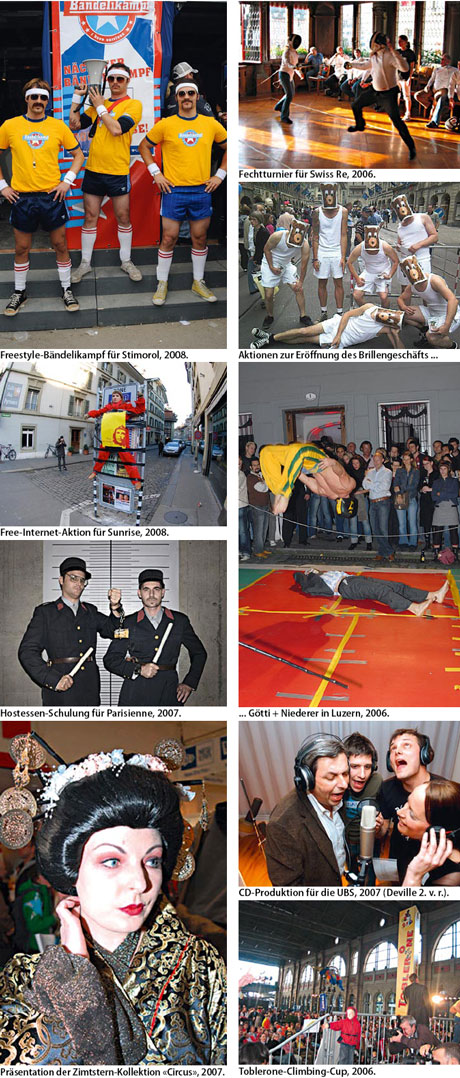
Guerrilla marketing comes from guerrilla warfare - and it has to be just as uncompromising," says Dominic Deville. The founder and CD of the Lucerne-based experience agency Clockworx spoke to the IAA Young Chapter about the possibilities and limits of guerrilla marketing. Marketing with a surprise effect offers many opportunities: companies can leave their well-trodden paths and show consumers new sides to their brand. They can throw strict guidelines such as CI/CD overboard and get closer to their customers than ever before. And they can immediately capture the consumer's reaction to their campaign. If the client has the courage to be really radical, a guerrilla campaign can even develop into a viral campaign. Because almost everyone has a cell phone camera these days - and pictures of a successful street promotion are often posted on YouTube. In the best case scenario.
If things go badly, the campaign fizzles out. Or there's real trouble. Because if, for example, a group of naked people walk through Zurich's Bahnhofstrasse at the best shopping time on a Saturday, it is at least a case of "gross mischief" and "causing a public nuisance" - so the naked people should be able to walk quickly. However, Dominic Deville finds it much worse than a possible fine if a guerrilla action is carried out half-heartedly and no one remembers it later: "It's a shame when guerrilla degenerates into a quick marketing stunt. Anyone who believes that guerrilla marketing costs
is cheap, simple and quick to prepare is wrong. On the contrary: if guerrilla marketing is to work, you have to plan it very well and invest money and manpower. Anything else is useless." Of course, a guerrilla campaign is not as expensive as a large, traditional campaign. But it should also not be misunderstood as a quick money-saving version of classic advertising measures. Being uncompromising is sometimes exhausting.
Freshly ventured ...It is very important that companies do not lose heart halfway through the guerrilla campaign. Deville talks about the free Internet campaign that Clockworx planned and implemented for Sunrise in spring 2008. The concept was to have a group of activists protest in various situations for free Internet access. The fact that Sunrise was the client for the promo was initially left unclear. Clockworx put up free Internet posters, for example with the likeness of revolutionary Che Guevara or a dove of peace that had flown away from the 1980s. There were also various protest actions: For example, 25 ran except for Che Guevara masks
naked activists ran through Bahnhofstrasse chanting "Free Internet". The streakers met in an apartment near Bahnhofstrasse to prepare for the action when a panicked Sunrise employee tried to stop the run at the last second. "After some discussion, we were allowed to start running after all," recalls Deville, who himself ran through Bahnhofstrasse "bloodied". "The campaign was a complete success. We filmed it ourselves and put it on YouTube, and later other videos from passers-by appeared."
The key to the success of a guerrilla campaign is to resolve it at the right time. "You should maximize the suspense and not break up the action too early," advises Deville. "But you shouldn't wait too long either, because then there's a big risk that journalists or bloggers will find out who's behind it in the meantime and spread the word." In addition, the resolution should offer the target group added value in some way, for example by promoting a particularly attractive, inexpensive or exclusive offer. This worked well with Sunrise's free Internet guerrilla, for example: 16 percent of all Swiss people visited the website linked to the campaign (whose URL now leads directly to the corresponding Sunrise offer), and Sunrise recorded customer growth of 20 percent.
... is half the battleIf there is one rule for guerrilla advertising, it is to stay cool: "If you do guerrilla advertising, you can't be afraid of negative reactions," emphasizes Deville. "There are always a few people who are against it - the key is to entertain the majority of people on the street in a humorous way and stay in their minds in a positive way." The fear of fines or sanctions is often exaggerated. Clockworx and its customers have never had to deal with the police, despite their often provocative actions. "Of course, we don't ask the police for permission beforehand," says Deville with a wink. "But a guerrilla marketing agency should be able to assess possible risks. Just in case, we agree with all our clients who is liable for what."
There is no guarantee that a guerrilla campaign will work. But if you follow a few tricks, you are more likely to succeed (see also the box "The 10 commandments"): A guerrilla campaign in which passers-by are asked to take part is always a risk. The campaign has to be really good and inspire people straight away so that they don't just keep walking. "If you appeal to people's play instinct, you'll usually be successful," advises Deville. A good example of a playful guerrilla campaign is VW's Piano Stairs (www.youtube.com, "Piano Stairs"). Here, the stairs of a Stockholm subway station were transformed into piano keys. It didn't take long for passers-by to "make music" with the stairs. This supported the car company's fun theory - all recorded on videos that went viral on YouTube.
Surprising is betterCompanies planning a guerrilla campaign are also well advised not to take themselves too seriously. Campaigns that demonstrate a sense of humor in dealing with their own cause are remembered as particularly likeable. "A client once told me explicitly: 'No joking around with the product'," recalls Deville. "We had a lot of funny ideas that would certainly have gone down well. Imagine, for example, how many fun activities you could do to show how well an adhesive cream sticks." If you make consumers laugh, you win their affection and stay in their memory. That's why companies shouldn't be afraid to poke fun at themselves. Even established brands are not harmed by a good pinch of humor, but at best regain their freshness.
Another clever move is to involve one or more media outlets in the guerrilla action. "We often team up with a newspaper so that we can steer the coverage a little," says Deville. "We offer this medium the opportunity to be the first to be informed exclusively when there is another campaign or a tip-off about the client - which we naturally try to keep secret for as long as possible." Especially for companies that fear that a guerrilla campaign could damage their brand, it is advisable to involve the media. To be on the safe side.
How long a guerrilla action lasts and how many sub-actions it consists of depends on its content and the desired goals. It is crucial that the tension between the first action and the resolution is maintained. On average, guerrilla campaigns run for two to three weeks. Then it is revealed who is behind it and what the aim of the campaign is. And if everything goes well, the surprise is big.
Anne-Friederike Wilhelm
The ten commandments of guerrilla marketing according to Dominic Deville
You should detach yourself from the identity:
Throw the CI/CD and other boundaries overboard for once.
You should be able to laugh at yourself.
Put all your eggs in one basket.
Subjugate the media.
You shouldn't please everyone.
As an agency you should take the reins, as a company you should hand over the reins.
You shall honor your father and mother -
If they don't understand your idea for an action, discard the idea.
Celebrate April 1: The resolution of the campaign must be worthwhile for the target group.
Work in secret.
Ignore all the rules. Good campaigns don't need rules.
In a nutshell
The Lucerne-based experience agency Clockworx was founded four years ago by Dominic Deville. Clockworx designs and implements events and advertising strategies that are far removed from the familiar. The agency is responsible, for example, for the campaigns shown above, for the Sunrise guerrilla "Free Internet" and for cross golf on Zurich's Bahnhofplatz. Clockworx's clients include Swiss Post, Kraft Foods, Parisienne, Swatch, Swisscom, UBS and Zimtstern. The agency employs five people.www.clockworx.ch
Dominic Deville (35) lives and works in Lucerne and Hamburg, is an advertising guerrilla, writer, theater maker, kindergarten teacher, drummer, entertainer - and from August he will also be a father.