Author: admin
SRG: Chairman of the Board of Directors Jean-Bernard Münch mistrusts colleagues
SRG Board Chairman Jean-Bernard Münch distrusts his own colleagues in the search for a new Director General and is therefore considering an unusual approach.
However, the distrust is causing resentment among the board members. He expects the files to be delivered in good time, says Duri Bezzola. His colleague Elisabeth Veya also calls for a few days to think things over - you have to be able to ask the right questions.
On May 18, the nine-member SRG Board of Directors will select a favorite from a list of two or three names. The election must then be approved by the 50-member Assembly of Delegates.
Orange/Sunrise merger: France Telecom and TDC sign agreement
The telecommunications companies France Telecom and TDC have signed a final agreement to merge the operations of their Swiss subsidiaries, Orange and Sunrise.
Together, Sunrise and Orange have a market share of around 38% in mobile communications and around 13% in broadband.
Kachelmann takes legal action against Swiss media
Meteorologist Jörg Kachelmann, who is currently in pretrial detention in Germany on suspicion of rape, is threatening to sue the Swiss media. He is objecting to the coverage over the past three weeks.
The publications had quoted from the investigation files of the public prosecutor's office or reported on alleged private text messages of the TV meteorologist to pop singer Indira. Höcker is quoted in the Sunday newspaper as saying that both constitute a serious infringement of his client's personal rights. So far, Höcker has not received any reactions from Switzerland. The media concerned must expect to hear from Höcker again. Höcker still reserves the right to take legal action against Swiss media. The cases are so clear that they would go through "like a hot knife through butter.
Advertising à la Che Guevara
If you want to stand out with your advertising today, you have to come up with something. Guerrilla advertising, however, not only walks a fine line between top and flop, but often also in the haze zone of illegality. What can guerrilla marketing do, what is guerrilla marketing allowed to do - and where does the fun end?
If things go badly, the campaign fizzles out. Or there's real trouble. Because if, for example, a group of naked people walk through Zurich's Bahnhofstrasse at the best shopping time on a Saturday, it is at least a case of "gross mischief" and "causing a public nuisance" - so the naked people should be able to walk quickly. However, Dominic Deville finds it much worse than a possible fine if a guerrilla action is carried out half-heartedly and no one remembers it later: "It's a shame when guerrilla degenerates into a quick marketing stunt. Anyone who believes that guerrilla marketing costs
is cheap, simple and quick to prepare is wrong. On the contrary: if guerrilla marketing is to work, you have to plan it very well and invest money and manpower. Anything else is useless." Of course, a guerrilla campaign is not as expensive as a large, traditional campaign. But it should also not be misunderstood as a quick money-saving version of classic advertising measures. Being uncompromising is sometimes exhausting.
Freshly ventured ...
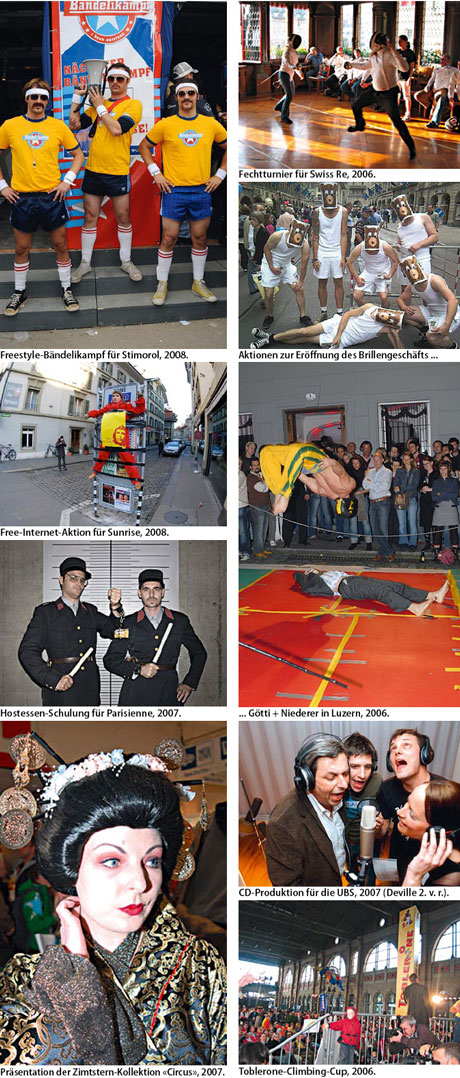
It is very important that companies do not lose heart halfway through the guerrilla campaign. Deville talks about the free Internet campaign that Clockworx planned and implemented for Sunrise in spring 2008. The concept was to have a group of activists protest in various situations for free Internet access. The fact that Sunrise was the client for the promo was initially left unclear. Clockworx put up free Internet posters, for example with the likeness of revolutionary Che Guevara or a dove of peace that had flown away from the 1980s. There were also various protest actions: For example, 25 activists, naked except for Che Guevara masks, ran through Bahnhofstrasse chanting "Free Internet". The streakers met in an apartment near Bahnhofstrasse to prepare for the action when a panicked Sunrise employee tried to stop the run at the last second. "After some discussion, we were allowed to start running after all," recalls Deville, who himself ran through Bahnhofstrasse "bloodied". "The campaign was a complete success. We filmed it ourselves and put it on YouTube, and later other videos from passers-by appeared."
The key to the success of a guerrilla campaign is to resolve it at the right time. "You should maximize the suspense and not break up the action too early," advises Deville. "But you shouldn't wait too long either, because then there's a big risk that journalists or bloggers will find out who's behind it in the meantime and spread the word." In addition, the resolution should offer the target group added value in some way, for example by promoting a particularly attractive, inexpensive or exclusive offer. This worked well with Sunrise's free Internet guerrilla, for example: 16 percent of all Swiss people visited the website linked to the campaign (whose URL now leads directly to the corresponding Sunrise offer), and Sunrise recorded customer growth of 20 percent.
...is half the battle
If there is one rule for guerrilla advertising, it is to stay cool: "If you do guerrilla advertising, you can't be afraid of negative reactions," emphasizes Deville. "There are always a few people who are against it - the key is to entertain the majority of people on the street in a humorous way and stay in their minds in a positive way." The fear of fines or sanctions is often exaggerated. Clockworx and its customers have never had to deal with the police, despite their often provocative actions. "Of course, we don't ask the police for permission beforehand," says Deville with a wink. "But a guerrilla marketing agency should be able to assess possible risks. Just in case, we agree with all our clients who is liable for what."
There is no guarantee that a guerrilla campaign will work. But if you follow a few tricks, you are more likely to succeed (see also the box "The 10 commandments"): A guerrilla campaign in which passers-by are asked to take part is always a risk. The campaign has to be really good and inspire people straight away so that they don't just keep walking. "If you appeal to people's play instinct, you'll usually be successful," advises Deville. A good example of a playful guerrilla campaign is VW's Piano Stairs (www.youtube.com, "Piano Stairs"). Here, the stairs of a Stockholm subway station were transformed into piano keys. It didn't take long for passers-by to "make music" with the stairs. This supported the car company's fun theory - all recorded on videos that went viral on YouTube.
Surprising is better
Companies planning a guerrilla campaign are also well advised not to take themselves too seriously. Campaigns that demonstrate a sense of humor in dealing with their own cause are remembered as particularly likeable. "A client once told me explicitly: 'No joking around with the product'," recalls Deville. "We had a lot of funny ideas that would certainly have gone down well. Imagine, for example, how many fun activities you could do to show how well an adhesive cream sticks." If you make consumers laugh, you win their affection and stay in their memory. That's why companies shouldn't be afraid to poke fun at themselves. Even established brands are not harmed by a good pinch of humor, but at best regain their freshness.
Another clever move is to involve one or more media outlets in the guerrilla action. "We often team up with a newspaper so that we can steer the coverage a little," says Deville. "We offer this medium the opportunity to be the first to be informed exclusively when there is another campaign or a tip-off about the client - which we naturally try to keep secret for as long as possible." Especially for companies that fear that a guerrilla campaign could damage their brand, it is advisable to involve the media. To be on the safe side.
How long a guerrilla action lasts and how many sub-actions it consists of depends on its content and the desired goals. It is crucial that the tension between the first action and the resolution is maintained. On average, guerrilla campaigns run for two to three weeks. Then it is revealed who is behind it and what the aim of the campaign is. And if everything goes well, the surprise is big.
Anne-Friederike Wilhelm
This article comes from the current print edition of Werbewoche.
The ten commandments of guerrilla marketing according to Dominic Deville
You should detach yourself from the identity:
Throw the CI/CD and other boundaries overboard for once.
You should be able to laugh at yourself.
Put all your eggs in one basket.
Subjugate the media.
You shouldn't please everyone.
As an agency you should take the reins, as a company you should hand over the reins.
You shall honor your father and mother -
If they don't understand your idea for an action, discard the idea.
Celebrate April 1: The resolution of the campaign must be worthwhile for the target group.
Work in secret.
Ignore all the rules. Good campaigns don't need rules.
In a nutshell
The Lucerne-based experience agency Clockworx was founded four years ago by Dominic Deville. Clockworx designs and implements events and advertising strategies that are far removed from the familiar. The agency is responsible, for example, for the campaigns shown above, for the Sunrise guerrilla "Free Internet" and for cross golf on Zurich's Bahnhofplatz. Clockworx's clients include Swiss Post, Kraft Foods, Parisienne, Swatch, Swisscom, UBS and Zimtstern. The agency employs five people.www.clockworx.ch
Dominic Deville (35) lives and works in Lucerne and Hamburg, is an advertising guerrilla, writer, theater maker, kindergarten teacher, drummer, entertainer - and from August he will also be a father.

On the matter: secret ballot
The election of the SRG Director General is approaching. In recent weeks and months, more and more candidates’ names have been leaked, even though the SRG, as usual, is keeping quiet. The explanation given for this sounds rather feeble: they don’t want unsuccessful candidates to be discredited.
Other names bandied about were Axpo CEO Heinz Karrer, who as former Ringier CEO has management experience in the media sector, but vehemently denied that he would be available as a candidate. Bakom CEO Martin Dumermuth also did not want to stand for election.
Andreas Blum is well-timed in speaking out on the website of the Swiss Society for Media Criticism (GFMKS). Blum was director of Radio DRS from 1979 to 1999, and he doesn't mince words: "SRG is run by economists, administrative lawyers and bureaucrats - personalities with a media-specific imprint and a passion for the public service are clearly in the minority." The ex-radio man goes even further: "Never before has the SRG's management been as weakly staffed as it is today. At the highest hierarchical level - general management and board of directors - the majority are people who could just as easily work in a state administration." And the SRG insider also has a clear opinion on the appointment policy: "The positions on the boards of directors as well as on the executive board level are not primarily filled according to professional qualifications, but rather according to the party-political supply principle or on the basis of personal relationships. The most important prerequisite for higher positions is membership in the nomenklatura.
Well, we can look forward to a great election! Under these conditions, only the hapless ex-Federal Councillor seems to have a real chance of succeeding the SRG's father Walpen. She would be the fourth CVP member in a row to head SRG.
Pierre C. Meier, Editor-in-Chief
[email protected]
30 years of Klartext - Personnel changes
The media magazine Klartext is celebrating its 30th anniversary in October. Editor-in-Chief Nick Lüthi will step down from his editorial leadership role after the anniversary to focus on further developing the magazine’s online presence.
During his three-year tenure, Lüthi sharpened the profile of Switzerland's oldest media magazine and gave the publication a contemporary look, the Foundation Board writes in a press release. He was also responsible for the comprehensive redesign of the Klartext.ch website. Following his resignation as Editor-in-Chief, Nick Lüthi will remain with Klartext with a mandate: he will drive forward the further development of the website. He will also be teaching online journalism to prospective journalists at the Zurich University of Applied Sciences (ZHAW).
Klartext celebrates its 30th anniversary in October. Issue no. 5/2010 will be published as a special edition to mark the anniversary. For three decades, Klartext has been commenting on and analyzing the revolutionary changes in the media landscape and providing space for debate.
Customers can come out here
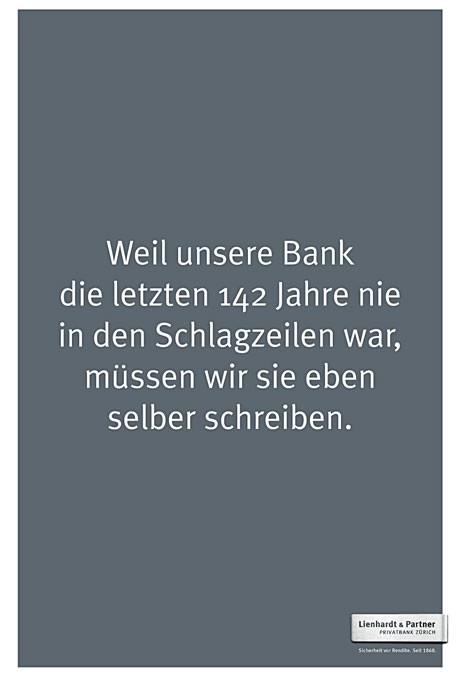
Clever copy by Ruf Lanz for Lienhardt & Partner Privatbank Zurich.
The readers of NZZ and Handelszeitung have the last word - and can vote for their favorites by SMS, e-mail or with a good old postcard. The subjects that receive the most votes will then appear on a full page in the coming weeks. The texts were written by Markus Ruf, Andreas Hornung and Thomas Schöb.
Clients have been able to rely on the services of Lienhardt & Partner Privatbank Zürich since 1868. The bank does not engage in speculative proprietary trading, has never sold structured products due to a lack of transparency and does not offer its own products in order to be able to advise its clients independently. True to its guiding principle: security before quick returns. pan


Tops of the week
This week's top stories include a digital pilot project by Tamedia, Ringier, and NZZ, as well as the 3+ channel, which continued to gain market share in 2009.
Tamedia, Ringier and NZZ are planning to sell newspapers digitally on a joint platform called Codex from the fall. The book publisher Orell Füssli is also involved and intends to offer electronic books. Swisscom will be responsible for the technical implementation. In a pilot phase from May to July, 150 readers are to be equipped with an e-reader, according to a report in the SonntagsZeitung. It is not yet clear exactly which publishers' titles are included in the test offer. Payment will be made in a fictitious currency. The publishers want to understand what readers are prepared to pay for and how much. Definitive prices for the commercial launch in the fall have not yet been decided. The option of a personalized newspaper is also being discussed. In the music business, Apple can now dictate prices thanks to iTunes. With the launch of the Codex platform, publishers are trying to prevent a similar dependency in the newspaper and book business: Although the plan is to sell their own e-readers, the Codex platform is intended to be compatible with third-party products. The iPad should therefore also be able to be served with digital Swiss newspapers in the fall.
Top 2: 3+ continued to increase its market share in 2009
In the 15- to 49-year-old segment, Switzerland's largest private broadcaster recorded a market share of 4.4% during prime time. In 2008, the figure was 3.3 percent. This put 3+ ahead of all other Swiss private channels and also ahead of Vox, RTL2, Kabel1, ARD, ZDF, ORF1 and ORF2 (source: GfK Switzerland/Publicadata AG/Telecontrol/3+ Medienforschung). In addition, a small profit of around CHF 30,000 was reported for the first time in 2009. This is an important signal, said station boss Dominik Kaiser in an interview with the Sonntagszeitung. "You can also make successful television in Switzerland, even in a very difficult year." First and foremost, however, he does not want to optimize profits, but rather grow and continue to invest in programming. In addition to US series, the channel is focusing on in-house productions such as "Bauer, ledig, sucht ..." and "Restauranttester Bumann". "Bauer, ledig, sucht ..." was also the most successful show in the fourth season. The fifth season starts in August. However, the matchmaking show is not profitable. "One season costs us around 1.7 million francs," Kaiser continues. However, the programs in Swiss German are very important for positioning the channel.
Control advertising effect
What is the potential of your advertising efforts?
Advertising success is when advertising objectives are achieved. For a subject to be effective, the target group must perceive its message quickly and accurately. Every two weeks, advertising effectiveness researcher Patrik Zwahlen assesses the persuasive potential and visualization quality of five selected advertising subjects exclusively for Advertising Week - and thus provides an objective assessment of your advertising success.
Analysis with method
This brief analysis assesses the communication performance of advertisements with the help of the two metrics "persuasive potential" and "visualization quality". To determine the persuasive potential, Zwahlen first formulates measurable goals such as "sell more," "become better known," or "reduce the frequency of accidents. In order to achieve such goals, the subject needs a credible reason for impact that corresponds to the message. After defining a plausible goal for each ad, the message is unencrypted and written down. A green arrow means that the subject is convincing; a red arrow means that it is not.
With the visualization quality, Zwahlen provides an assessment of whether the message is perceived quickly and without wasted coverage. A green arrow indicates that the ad communicates quickly and without errors. If the subject is marked with a red arrow, misunderstandings and misinterpretations are to be expected.
> Results at a glance
> Detailed results
APGS panel: Brand strategy between pressure to succeed and sustainability
The Account Planning Group Switzerland, the club of Swiss advertising strategists, is holding a panel discussion on May 4, 2010 on the topic of "Growth, values, advertising - brand strategy between pressure to succeed and sustainability".
Under the direction of Martin Spieler, happiness researcher Mathias Binswanger, 2010 Advertiser of the Year Regula Fecker, Chief Risk Officer of Zurich Financial Services Group Axel P. Lehmann, author and former Advertiser of the Year Liliane Lerch and alternative banker Sven Thali will debate. Strategic interventions by Frank Bodin and Pascal Schaub enrich the discussion with additional questions, theses and food for thought.
The program starts at 6 pm at the Park Hyatt Zurich. Binding registrations can be made at [email protected] be submitted.
In the beginning is the idea
Rivella is off to a flying start with Erdmannpeisker.
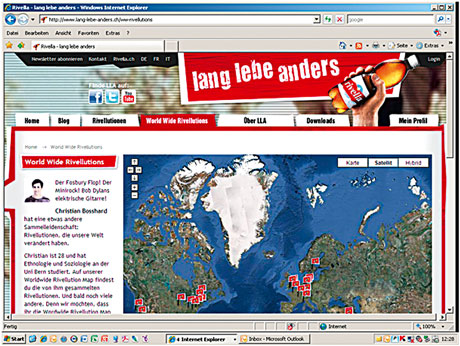
Since March, four well-known bloggers have been swarming out on behalf of Rivella, looking for people from all over Switzerland who stand out with unusual actions and ideas. The discoveries are filmed and make it onto the website www.lang-lebe-anders.ch as "Rivellutions".
The visual language of the cross-media campaign also seeks a "rivellutionary" look. Erdmannpeisker works in the style of the guerrillas with artfully torn billboards, cheeky music and pasted-over advertisements. pan