BVB and BLT establish joint advertising sales company

Basler Verkehrs-Betriebe (BVB) and Baselland Transport AG (BLT) have decided to merge their public transit advertising operations and are establishing a joint venture called Moving Media Basel.

From April 2016, the company will market advertising space on and in streetcars and buses from a single source. For advertisers, this should result in easier access to Basel's public transport advertising spaces as well as greater reach for their advertising.

BVB previously marketed its advertising spaces on its own, as media spokesman Benjamin Schmid explains in response to an inquiry from Werbewoche.ch. BLT's indoor advertising was previously marketed by APG|SGA Traffic. BLT itself was responsible for the outdoor advertising - namely the roof advertising. However, BLT director Andreas Büttiker told Werbewoche, the company did not actively manage this source of revenue, nor did it rent out the advertising space at market rates. "Our core business is transportation, not advertising marketing," Büttiker said. This untapped potential is now to be tapped with a joint entity that is fully focused on the advertising market.

Tango_und_Flexity_2016

"Relief for the public sector"

Together, the two companies currently generate sales of just under eight million Swiss francs per year from transport advertising. BVB and BLT expect significant synergies from the new organization and the joint use of advertising booking systems, and thus significant increases in revenue from this ancillary business. According to Büttiker, additional revenues of around three million francs are expected over the next five years, which will benefit public transport. "In this way, we are helping to finance the public transport service, thus relieving the public purse and reducing the pressure of having to make tariff adjustments," says Büttiker. "It is our responsibility to generate additional revenue".

The joint advertising sales company will be structured as a stock corporation with a shareholding ratio of 66.6 percent (BVB) to 33.4 percent (BLT). The company is expected to have around five employees when it is completed. The new company will be set up over the next few weeks. The two governments of Basel-Stadt and Basel-Landschaft have been informed about the approach of BVB and BLT and welcome the establishment of a joint advertising sales company, according to the statement.

The current contracts between APG|SGA Traffic and BLT, respectively BVB, will continue until at least the end of 2016, as Daniel Flück, Head of APG|SGA Traffic Switzerland, says in response to an inquiry from Werbewoche. Discussions are currently planned on the form of further cooperation, he said. "APG|SGA Traffic is the market leader in the marketing of public transport advertising and is present at nine locations throughout Switzerland. Both in the Basel area as well as in the rest of Switzerland, the two marketing companies complement each other well." This is also confirmed by Andreas Büttiker - they are open to continuing the partnership and cooperation with APG|SGA Traffic, for example through additional offers. (hae)
 

Best of Swiss Web extends registration deadline

Best of Swiss Web 2016 is extending the registration deadline by one week. The new deadline is February 8, 2016.

The special "Swiss Digital Transormation Award" integrated into the Best of Swiss Web is also extending its deadline. The organizers will provide information on further steps once the extended registration deadline has expired, as detailed in a press release. Best of Swiss Web is an initiative of Simsa (Swiss Internet Industry Association) and the net media. The aim of Best of Swiss Web is to promote transparency and quality standards in the Swiss web and ICT industry and to offer attractive networking opportunities.

To the point: Turning time into money

Declining advertising spending, shrinking print circulations, and digitization on the one hand; ineffective paywalls, ad blockers, and a “free-of-charge” mentality on the other—the media industry has been under pressure for quite some time now. And with it, the advertising industry.

"What does the medium of the future look like? How do I turn my newspaper into an indispensable media brand? How can you still earn money with journalism? And how can I advertise cleverly in this environment?" ask media makers and journalists, advertising clients and advertisers.

And the customer, our reader, simply asks, "Why should I spend money on this service?"

Mathias Müller von Blumencron, head of faz.net, starts the year full of euphoria and with four theses: 2016 will be the year of digital journalism, he writes. In the flood of information disseminated via digital channels and social media, the value of credible information backed by an established media brand is increasing. Readers want to be able to trust content again. Let's hope he's right. For the readers we already know from print, that's certainly true. But what about the young people who are just becoming media recipients? What will they actually read in the future? And why?

Müller von Blumencron goes on to forecast an "offensive of excellence in the digital realm": in the future, readers will be willing to pay for quality, not just in print, but also on the web. If more and more printed media disappear from the market, they will of course have no choice. Media makers must finally understand that readers are willing to pay for the quality of information, not for delivery on a particular channel; print or digital is irrelevant. The value of the information must be right.

Müller von Blumencron also sees an "explosion of journalistic formats" coming. Of course, the possibilities for preparing a topic in the digital world - with text, images, film, sound and cross-references - are heavenly. Nevertheless, there will only be two formats: Speed and depth. One variant is fast, small-scale information that is brought to the reader as quickly as possible and free of charge. The other variant is stories: well-researched stories, background reports and advice articles for which the author has invested time and which only reach the public when they are round and ready. The reader has to pay for this work, because the production of such journalistic output costs money. A classic value chain.

Operators of editorial departments, which are being bled dry and shrunk, need to think carefully about what this means: Editorial departments need people for speed and people for depth. A one-man show cannot continuously serve both formats day after day. And even in the newsroom, drilling deep is difficult. In short, journalists need time for research, thinking and polishing the text in their day-to-day work.

Fourth, Müller von Blumencron expects the development of a new business model: Journalistic offerings would detach themselves from media presences and find their way to readers via global online platforms. In return, the editorial team would receive the advertising revenues. An interesting approach. And perhaps an opportunity for freelance journalists: Research in peace, place polished text and exciting research results, and collect. But how does one control and limit the use of one's intellectual property once it has landed on the web? And can a few advertising banners feed a family? Let alone finance a publishing house?

This is where the development of an e-commerce offering, which is defined in a current trend study by the Federal Association of German Newspaper Publishers as "the dominant trend" of the hour, may come into play. If newspaper publishers enter the Internet trade in food and consumer goods - à la Entlebucher Anzeiger (Entlebucher-shop.ch), this offers "huge potential," as the study puts it. However, such activities mean that the focus on the actual journalistic mission and its transfer to the digital realm is falling by the wayside. But that's exactly what it's all about in the first place.

I think the range of products and services offered by media companies can only be expanded to a very limited extent. Otherwise, they put their credibility on the line.

Think about it: when do you spend money on written, thoughtful things, whether they come in print or digital? I pay when I can save some of my most scarce commodity: Time.

Readers gain time either when they receive information that is important to them quickly and concisely prepared. Or when the time they invest in reading is rewarded with excitement, entertainment, knowledge or assistance. This is the value chain of the future. Only those who save readers time or fill their time with profit will still be able to earn money with journalism. More than ever, Benjamin Franklin is right: Time is money.

Anne-Friederike Heinrich, Editor-in-Chief Werbewoche

[email protected]
 

Telebasel launches new multimedia offering under resistance

Telebasel launched its new multimedia offering on Thursday. In addition to the revised television program, the partially fee-financed broadcaster is relying heavily on a new news portal on the Internet. Two Basel media companies are fighting back.

At 6:30 p.m., a presenter welcomed viewers to the first edition of the new "Telebasel Hour". Beforehand, Telebasel broadcast a countdown and the new logo, a large colorful B, for about a day.

The TV program, which is now broadcast from a multimedia studio, begins with headlines and the weather. The following program, "News," which replaces the previous news magazine "7vor7," features short reports on current topics for about five minutes. In addition to regional reports, there are also short national and international reports. The only longer news report follows after sports with the topic of the day. This is followed by a "talk" program, then more short news reports as well as a stock market program and the new people magazine "Glam". After the news content is repeated at the top of the hour, a new magazine, such as the new cooking show "Kitchen Stars," is broadcast every day.

Together with the completely revamped television program, Telebasel also launched on Thursday an expanded Internet offer. A new online editorial team puts news and film reports on the Internet every day between six and 11 pm. There is also a new Telebasel app for smartphones. According to the regional broadcaster, the multimedia offering is aimed primarily at people between the ages of 30 and 50. The focus is on news, sports, society and enjoyment.

Barfi.ch and BaZ file complaint

Resistance to Telebasel's new offering has formed even before its launch: Basel media entrepreneur Christian Heeb, who runs the online portal Barfi.ch, has filed a complaint with the Federal Office of Communications (Bakom): Telebasel, which is partly financed by licence fees, is violating its licence with the new online presence. The program mandate contains binding requirements, the complaint states. The program must concentrate on local and regional news. The use of public funds for tasks that are not directly related to the production and distribution of news programs via television is therefore inadmissible. Barfi.ch's complaint was joined by the Basler Zeitung (BaZ), the company announced in its Thursday edition. Telebasel's online involvement is an attack on private media companies, the newspaper wrote in a commentary. The attack could be carried out without risk due to state subsidies.

Telebasel: Changes agreed

Telebasel argued before the relaunch that it generated around 70 percent of its revenues from advertising. Only 30 percent came from license fees. The station therefore sees itself as a private media company. In addition, the reorientation had been agreed with Bakom. Telebasel currently employs 120 people. The concession for the operation of a regional television station is held by the Telebasel Foundation. The station went on the air in 1993 as a city channel and has been called Telebasel since 1997. (SDA)

Y&R Group Switzerland: The trends of 2016

2016 will be a year of evolutionary—yet accelerated—development. Not a revolution, then, but a transformation characterized by exponential growth. That’s how the trend researchers at Y&R Group Switzerland summarize it.

The dominant themes at the Consumer Electronics Show (CES) in Las Vegas at the beginning of January 2016 are a good indication of this: Self-driving cars, drones, the Internet of Things, robots and wearables are all not completely new developments. But many things that were recently considered utopian or at least experimental have now reached market maturity and will have a lasting impact on the economy and society.

In the area of marketing, media and technology, the following trends are particularly worth mentioning:

Messaging apps

The main purpose of smartphones in Switzerland today is not to make phone calls, but to send messages. As the Y&R Group Switzerland's Media Use Index shows, 63% of the Swiss population write messages every day and 54% read and write emails. In contrast, only 46% of respondents use their smartphone to make phone calls every day.

YRG_Exchange_Trends_2016_01_Messaging_Apps_0

Messaging apps are also gaining in importance on a global level and are even overtaking social networks: The four largest messaging apps together have more users than the four largest social media platforms, namely close to 3 billion Monthly Active Users (Businessinsider.com). The leader is WhatsApp, followed by Facebook Messenger, WeChat and Viber.
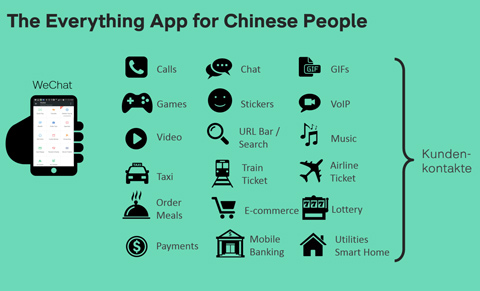
However, the example of WeChat shows that messaging apps are not only used for chatting with friends. The service, which originated in China, also allows its users to order a cab, buy tickets or even carry out banking transactions. Messaging apps are developing into universal service platforms, a "remote control for life". Facebook is also developing Messenger in this direction, as the "M" project shows. It will therefore be crucial for companies in future that their services are available via messaging apps.

YRG_Exchange_Trends_2016_02_Messaging_Apps

Marketing Automation

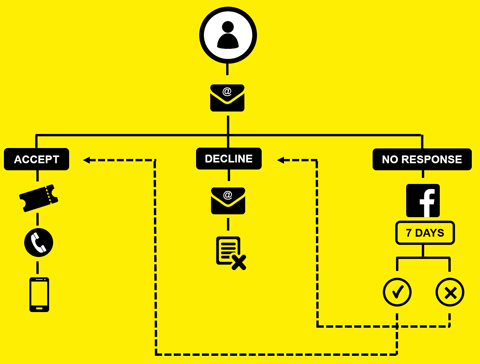
Marketing automation makes it possible to react automatically and individually to the behavior of the target group as part of a digital campaign and thus achieve maximum conversion. For example, a company that invites people to an event can set up different processes for people who a) register, b) unsubscribe and c) do not respond. For example, those who have registered receive a reminder shortly before the event, while follow-up measures are played out via additional channels if there is no response.

YRG_Exchange_Trends_2016_03_Marketing_Automation

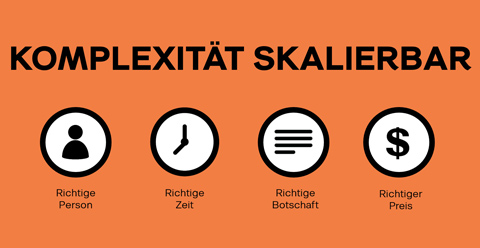
Another level of marketing automation involves running different campaigns for individual target group segments. Such complex processes were an organizational nightmare until recently, but can now be managed automatically and efficiently with specialized software. With Adobe Campaign, Marketo, Silverpop or Autopilot, solutions are available to manage all processes across all channels.

Programmatic Buying

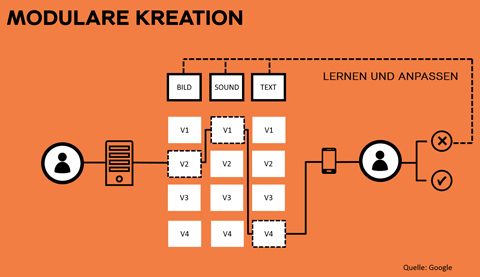
In the area of display ads and text ads, programmatic buying ensures even more effective campaigns than the current fixed placements. Whereas with fixed placements, the advertiser defines who gets to see a campaign based on relatively broad categories, with programmatic buying this is controlled by software. This continuously optimizes an ongoing campaign in terms of conversions and costs. Within 120 milliseconds, it evaluates a large number of parameters and decides which advertising material to display for each individual ad. Programmatic buying also makes it possible to run campaigns worldwide via a single cockpit.

YRG_Exchange_Trends_2016_04_Programmatic_Buying
YRG_Exchange_Trends_2016_05_Programmatic_Buying

Virtual Reality & Augmented Reality

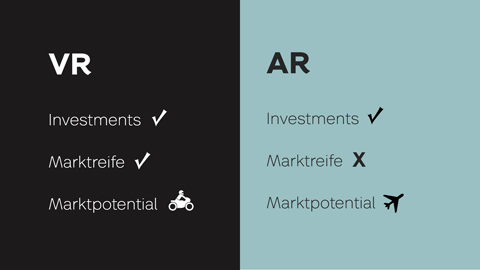
The upcoming market launch of the 3D VR headset Oculus Rift marks a milestone in the field of virtual reality. The fact that the consumer version was sold out for four months within 24 hours of going on sale shows the high level of acceptance of this technology among consumers - despite a retail price of 599 US dollars.

While VR headsets are still often seen purely as a gamer accessory, a wide range of potential applications are now emerging - including in the professional environment. Architects, for example, can make rooms and buildings virtually accessible during the planning phase, while psychiatrists are hoping for new treatment methods for post-traumatic stress disorder or phobias.

The fact that virtual reality is one of the most important trends of 2016 is also shown by the variety of solutions appearing this year: they range from simple cardboards (where a smartphone serves as a screen) to Playstation VR and the high-priced HTC Vive.

Solutions in the field of augmented reality are not yet fully ready for the market. However, Google Glass and Microsoft HoloLens already show the potential of this technology. Many companies are investing heavily in this area - as impressively demonstrated by the more than 800 million US dollars in venture capital that Magic Leap received for a development of which only a few screenshots and animations have been released to the public.

YRG_Exchange_Trends_2016_06_Virtual_Reality_Augmented_Reality

Internet of Things

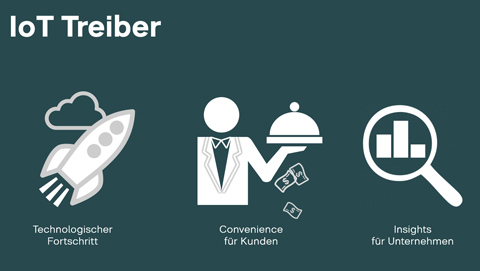
The Internet of Things (IoT) is also one of the key trends of 2016. However, while interest is often focused on the individual products (the "things") and their features, consumers and companies still often fail to recognize the importance of the data that the IoT generates.

The example of Nest Labs, the home automation provider acquired by Google for a record sum, shows that even the room temperature settings can be used to draw conclusions about a family's behavior. The informative value of this data increases many times over when it is combined with data from additional networked devices. This explains why all well-known technology companies are currently trying to establish a standard for networking smart home and other IoT components.

YRG_Exchange_Trends_2016_07_Internet_of_Things

Personal Digital Assistants

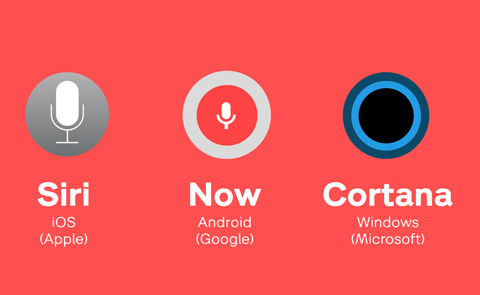
Apple Siri, Google Now and Microsoft Cortana are currently giving us a taste of what we can expect from digital assistants with artificial intelligence. Amazon has also created a good starting position with Echo, particularly as a smart home platform. All of these solutions impress with their voice control, but still fail to carry out chargeable transactions.

YRG_Exchange_Trends_2016_08_Personal_Digital_Assistants

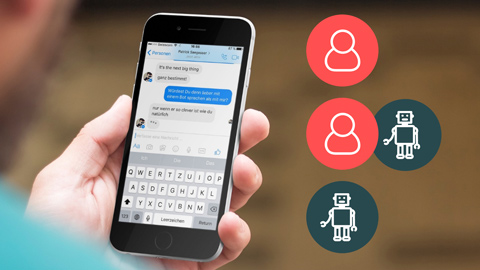
Text-based systems are sometimes further ahead here. Both the messaging app WeChat and the "Assist" service integrated into Facebook Messenger make it possible, for example, to request a cab, reserve a restaurant table or order flowers via text messages. It is becoming apparent that consumers will soon no longer make many transactions via a telephone call or a web interface, but via messages in natural language.

YRG_Exchange_Trends_2016_09_Personal_Digital_Assistants
 

Swiss Poster Award: Nominations are fixed

The nominees for the Swiss Poster Award 2015 have been determined. The jury has selected 29 creations from over 239 submitted campaigns.

All nominees have already been informed personally. Who it is will remain a secret until the awards ceremony. This innovation is intended to increase the suspense at the awards ceremony, explains APG|SGA in response to an inquiry from Werbewoche. Nominees and winners will be announced with a big show at the Swiss Poster Night in the Maag-Areal. The "APG|SGA Poster Night" will take place on March 10, 2016 at the Maag Halle in Zurich.

New formats, surprising subjects

In December 2015, the twenty-member independent jury of experts met with renowned personalities from advertising, culture and design to evaluate the submitted campaigns. "The jury's task was to select and award the 29 best and most successful creations from over 239 competition entries in the categories Commercial National, Commercial Local and Regional, Public Service, Culture, Digital Out of Home and Poster Innovations. 2015 was an extraordinarily exciting year for outdoor advertising overall, which impressed us with new formats, surprising subjects and excellence in the tried and tested," says jury president Christian Brändle.

The evaluation focused on: Originality of the idea, innovative approach and inspiration, striking implementation of the advertising message, communicative sustainability, graphic and design execution, and typography.

The winners of the Swiss Poster Award 2015 will be formally announced on March 10, 2016, during the "APG|SGA Poster Night". The highlight of the evening will be the presentation of the "Poster of the Year" title. The big show with numerous guests will take place in the Maag Halle in Zurich and will be presented by Swiss radio and TV presenter Röbi Koller.

The Swiss Poster Award is presented annually. The award underscores the importance of the poster in intermedia competition and documents the diversity, creativity, and impact strength of outdoor advertising in Switzerland. The competition can be counted towards the creative ranking of Werbewoche.
 

New Advertising Week format: Industry reports

Werbewoche is now offering a new format: the Werbewoche Industry Report. And there will be some changes at Werbewoche in the near future as well.

The industry report is a new, 16-page special publication that will be published six times a year under the Werbewoche label and will highlight various sections of our industry.

Our aim is not to record the status quo in the respective segment, but to outline visions for the near future and present groundbreaking practical examples to inspire you in your day-to-day business. Thought leaders, trendsetters and important representatives of the relevant industry segment - both nationally and internationally - have their say in the industry report.

The first industry report on marketing will be published on February 26 and will be sent to all subscribers together with Werbewoche 4/2016. In this issue, for example, you can read an article by Mirko Kaminski on the topic of storydoing and an interview with the author and leading international expert in marketing brain research Hans-Georg Häusel.

Following:

Industry Report Digital
April 15; with Advertising Week 7/2016

Advertising industry report
May 27; to the day of advertising with the
"Advertising Week Advertiser of the Year 2016"

Content marketing industry report
July 15; with Advertising Week 12/2016

Industry Report Direct
November 18; with Advertising Week 19/2016

Industry Report Industry Balance Sheet
December 16; with Advertising Week 21/2016

In addition to Werbewoche, the industry reports offer our subscribers a concise overview of the current status in the relevant industry segment and give advertisers the opportunity to address very specific target groups. The industry reports can also be ordered separately by non-subscribers. Please send your orders to [email protected].

You would like to work as Advertiser be represented in the industry report? You can find all info here.

Advertising week: Relaunch

In addition, the first four industry reports offer you a foretaste of what the new print edition of Werbewoche will look like after our summer break. We are currently working on a relaunch of Werbewoche, which will be available in a new format, new look and with new content in print and digital from August 19. We won't reveal any more at this point. Only this: You can be very excited.

Anne-Friederike Heinrich, Editor-in-Chief Werbewoche

E-commerce trend December 2015

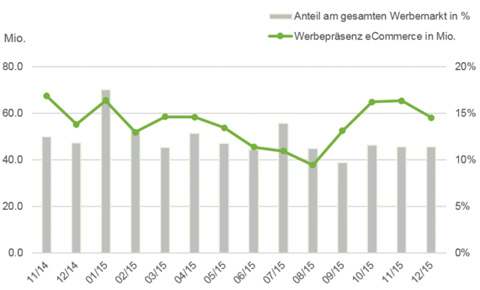
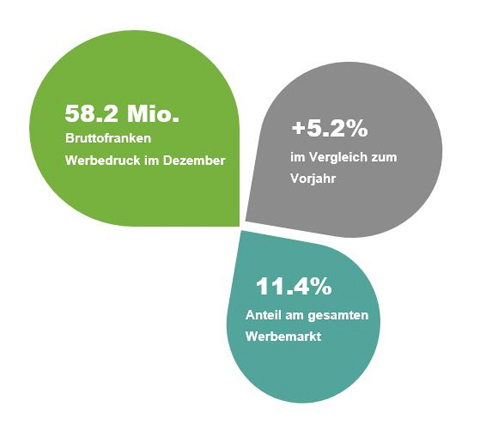
Gross advertising spend in the e-commerce advertising market totaled 58.2 million Swiss francs in December, well below the previous month’s figure (65.5 million). Compared to the same month last year, advertising spend in December was up 5.2 percent.

As in the previous month, the share of the total advertising market is 11.4 percent. This is shown by the E-Commerce Trend Report 2015 from Media Focus on the development of advertising in Swiss e-commerce.
 

Consumer Electronics in the Top 3 for the first time

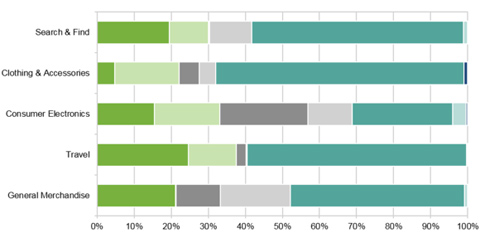
Among the top 3 market categories, it is noticeable that Consumer Electronics is in the top 3 for the first time in months. However, this ranking is not only due to additional investment in the category itself, but also to the Travel category, which has relinquished third place in recent months with a drop of CHF 0.5 million. The first place continues to be occupied by the Search & Find category, which shows a smaller advertising pressure of 7.7 million Swiss francs in December (-5.3 million Swiss francs). Two major changes stand out among the top brands: Twerenbold has made it to the front of the Travel category for the first time and the Finance category is now led by Swissquote.

The media mix in upheaval

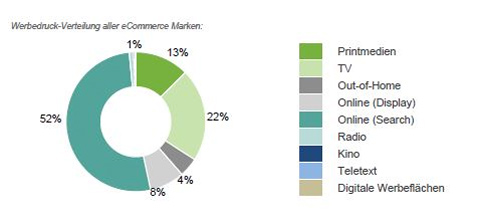
In December, less was invested in print (-5 percent), TV (-4 percent), out-of-home (-1 percent) and online display (-2 percent). On the other hand, search advertising saw a marked increase of eleven percent over the previous month. This increase is primarily attributable to Search & Find (+18 percent) and Clothing & Accessories (+15 percent).

In retrospect, the trends show

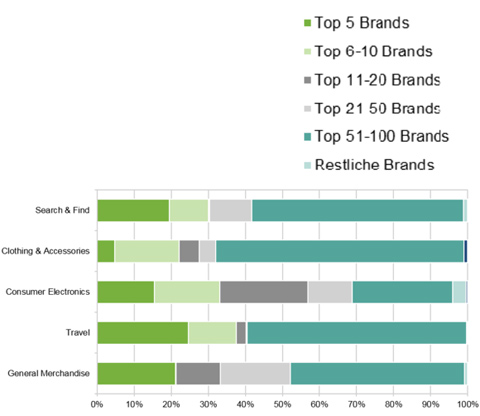
A review of the last six months clearly shows that around ten more brands advertised in the Search & Find category every month from July to December 2015. With currently 256 brands, it is in second place among the most hotly contested categories. In first place, with 497 brands in December, is the Clothing & Accessories category, one of the most hotly contested online businesses of all. However, in the last six months, only an average of five more brands competed for the favor of shoppers in this category each month. To be successful in this category, you either have to invest a lot of money or stand out from the crowd.

Total market

Development of e-commerce advertising print as of December 2015

Unbenannt-21_22
Unbenannt-22_21

Media Mix

December 2015

Unbenannt-23_21
Unbenannt-24_23

Top 10 categories

Advertising shares of eCommerce brands in December 2015

Unbenannt-24_24

Here the complete e-commerce trend with tabular trend indication for 28 different e-commerce markets as well as methodological notes are available for download.

Friendly greetings: The first shower gel to drink

Using a fictional product as an example, the new campaign by the Swiss Association for Market and Social Research (VSMS) explains the personal benefits of market research and aims to encourage the Swiss public to participate in surveys.

The association is thus launching the third flight of its awareness campaign "Your opinion helps decide". The first two campaigns (2012, 2014) have already been very successful in achieving the goal of raising awareness and visibility, according to the statement: "Feedback at the office and active requests for participation confirm that the campaign is well received and the message is accepted. Only through active communication can the benefits of market and social research be demonstrated," said Susan Shaw, president of VSMS.

This benefit is to be conveyed in an even more emotional and pointed way with the new appearance. The centerpiece of the campaign is a TV spot in which a new type of product is launched - the drinkable shower gel "Jetset" with Prosecco flavor. The spot dramatizes the message that by taking part in surveys, people can make their opinions heard and thus help shape products.

https://www.youtube.com/watch?v=cskdqmoWZjA

The film has been running in several waves in German- and French-speaking Switzerland since Christmas 2015. Ads in various daily and Sunday newspapers, online banners, and the Campaign website are intended to further strengthen the message.

Unbenannt-19_28
Unbenannt-20_23

Responsible at the Swiss Market and Social Research Association: Mitja Ruggle (overall responsibility), Nicole Siegrist (management), Susan Shaw (president). Responsible at Friendly regards: Res Matthys, Karsten Friemel (creative direction), Max Benrath (text), Anne Dikkerboom (online), Mr. Bob Films (film production), Christopher Schlierf, Benjamin Kratzin (direction), Daniel Krebs, Tino Bungert (production), Px1 (photography and print production).
 

Gemi December 2015: Electronic media on the rise at the end of the year

TV, radio, the Internet, and digital out-of-home advertising saw further growth in the last month of 2015. In some cases, the growth was even massive.

Only teletext suffered a decline. Overall, this led to a renewed marked increase for electronic media, while the overall market grew only slightly. This is shown by the figures of the Goldbach Index (Gemi) on advertising print in December 2015.

Bildschirmfoto-2016-01-27-um-11.46.48

The year 2015 closed on a very positive note for the electronic media. TV increased by three points to 670, the highest level ever measured. Radio also increased to 390 points. With an increase of five points, it was even stronger than at any time since October 2013. The Internet division even increased by 25 points to close at a record 917 points. However, the digital out-of-home sector topped everything in December. The increase was a full 115 points. And the 815 points now achieved represent a record value here, too.

Bildschirmfoto-2016-01-27-um-11.46.37

Consequently, the electronic media as a whole also reached a new high of 672 points, thanks to an increase of five points. This is despite a decline of four points to 39 points for the teletext sector. Meanwhile, the market as a whole increased by only one point to 240. Compared with the previous year's figures, digital out of home increased by 23 percent, Internet by 19 percent and TV by two percent. Radio lost two percent, teletext even 20 percent. Electronic media increased by 3 percent, while the overall market grew by only one percent.
 

NP8 initiators found association

The «NP8» news portal platform has been in active use for half a year. Now, the founders have established an association to expand the solution.

Around one and a half years ago, Somedia in Chur and Gassmann in Biel jointly commissioned the development of the "NP8" news portal platform. NP8 is a news portal solution based on Drupal 8. Designed as a complete solution, NP8 not only takes care of the commercialization of content, but also covers many other areas, from the integration of local B2B customers to the personalization of content. The project was supported by SWS Medien in Willisau right from the start. Since then, the portals Suedostschweiz.ch, Willisauerbote.ch, Seetalerbote.ch and Letemps.ch have been relaunched by Ringier on the basis of NP8.

The initiators have now founded the "Media Commons Association" to intensify their collaboration. NP8 is the first product, and further projects are to be launched together in the future. And the association is set to grow: talks are being held with other media companies about becoming members. In 2016, at least Zol.ch and Bielertagblatt.ch will also be relaunched on the basis of NP8.

One of the main aims of the association is to pool development budgets and thus reduce costs. The members jointly develop and maintain the technical basis of the news portal platform and advise each other on keeping it up to date. Industry-standard functionalities are jointly specified and developed. (hae/pd)

Smokers in French-speaking Switzerland should be able to quit thanks to Facebook

This spring, thousands of smokers in French-speaking Switzerland are expected to quit smoking thanks to Facebook. A campaign to that end is being launched in all French-speaking cantons.

Initial trials in Valais last fall were encouraging. "Between 4,000 and 6,000 French-speaking Swiss could stop smoking thanks to Facebook," hopes Roland Savioz, who designed the prevention project. In a trial in Valais in September, around 1000 people signed up and over half of them stopped smoking. The project, launched by various prevention organizations in French-speaking Switzerland, relies on positive pressure from groups. Anyone who wants to quit should join the relevant group in their canton of residence on Facebook by the first day of spring on March 20. Participants will then receive advice on quitting smoking for six months.

The trick of the program is that the participants are not alone. "The physical craving for a cigarette lasts about three minutes," Alexandre Dubuis, coordinator of the program in French-speaking Switzerland, told the media in Neuchâtel on Wednesday. Facebook instead of a cigarette During this time, people wanting to quit should go on Facebook, write comments and read other people's experiences until the craving has passed. The organizers have set their sights on a target group between the ages of 26 and 34. The Tobacco Prevention Fund is financing the program with CHF 600,000. The cantons are to contribute the same amount. According to the organizers, the project will not initially be extended to German-speaking Switzerland. (SDA)

get_footer();