Journalist acquitted after spreading "Dölf" retweet

A journalist ended up in Zurich District Court on charges of alleged defamation or slander after retweeting a post on Twitter. The court has now acquitted him.

The dissemination of a retweet is not punishable by law. The public prosecutor's office accused the Woz journalist of disseminating a message on the short message service Twitter on July 13, 2012 with a so-called retweet. The tweet, written by an anonymous twitterer, referred to the Thurgau SVP cantonal councillor Hermann Lei as "Hermann 'Dölf' Lei". According to the public prosecutor's office, the addition of "Dölf" suggests that Lei sympathizes with Adolf Hitler and his National Socialist ideas. The accused was aware of the inaccuracy of this insinuation, but by forwarding the tweet, he at least accepted the risk of damaging Lei's reputation. The public prosecutor's office requested a conditional fine of CHF 4,500 and a fine of CHF 1,000, while Lei demanded compensation of CHF 1,500.

Retweet classified as a typical media dissemination chain

The Zurich District Court acquitted the accused on Tuesday. He will also receive compensation of CHF 5,400. According to the court, the dissemination of a retweet is "a dissemination chain typical of the media". It compared the procedure to sticking up a poster. Only the author of the message is liable to prosecution, not the person who puts up the poster. It is unclear who wrote the original tweet. The Woz journalist therefore has nothing to fear under criminal law. The situation is somewhat different under civil law. According to the court, the dissemination of the tweet is definitely a violation of personality rights. The court therefore requires the journalist to write a tweet in which he makes it clear that the dissemination of the "Dölf" tweet was not a criminal offense, but that it was a violation of personality rights. The judgment is not yet final. (SDA)

Teaser image: Gerichte-zh.ch

Zurich Tokyo: St. Moritz for a visit

As part of the collaboration between Engadin St. Moritz and the Concept Store N°2, the Zurich-Tokyo agency created the editorial design for a St. Moritz guide.

The Engadin St. Moritz tourism organization has entered into a partnership with Swiss concept store N°2. From November 2015 to March 2016, the theme of St. Moritz will be staged on two floors at Neumarkt 20 in Zurich. Zürich Tokio was commissioned to design a St. Moritz guide as an accompanying measure, which will be available in both Zurich and St. Moritz and will position and publicize N°2 as an innovative brand.

ZT_no2_01

In a declaration of love to the winter paradise, the guide "N°2 loves St. Moritz" looks at the seemingly most trivial facts about one of the world's most renowned Grand Hotels and provides an overview of the hotspots of the 15/16 season, from couscous quinoa salad and party gondolas to free fall - everything is included.

ZT_no2_02
ZT_no2_03
ZT_no2_04
 

Comcom must review prices for last-mile unbundling

The Federal Administrative Court has partially upheld an appeal filed by the telecommunications provider Sunrise regarding the rates for access to the Swisscom network.

The Federal Communications Commission Comcom has to go over the books again on many points when calculating prices. Sunrise had lodged an appeal against a ComCom ruling of December 18, 2013. In it, the telecoms regulator had set the prices for alternative providers for shared use of Swisscom infrastructure. This includes, for example, the interconnection price, which compensates for the use of Swisscom's fixed network for the transit of telephone calls. Various factors must be taken into account when calculating prices, such as the cost of debt or network structure adjustments. In its ruling, the Federal Administrative Court came to the conclusion that a large part of Sunrise's complaints are to be upheld. As the issues involved are highly technical, the St. Gallen judges referred the matter back to the lower court for a new assessment. (SDA)

B-Public opens branch office in Frankfurt

The Swiss PR agency B-Public is expanding into Germany. Its managing director is financial journalist Christian Hiller von Gaertringen.

Hiller has reported on financial topics and banks as a journalist for more than 25 years and has worked for the Frankfurt Allgemeine Zeitung (FAZ) for the past 14 years. "We are delighted that in Christian Hiller we have gained a partner who is well connected in the financial world in Germany", said Markus Baumgartner, founding partner of B-Public, in a statement. The Zurich-based communications agency already has a representative office in French-speaking Switzerland. "With these locations and our good local network, we can offer our clients real added value," says Baumgartner.

B-Public was founded in 2012 and has since made a name for itself in the financial sector, particularly with its integrated approach to communication. "We support our clients in both traditional public relations and online communication," explains Baumgartner. B-Public also offers comprehensive services in the field of IT solutions & advisory. The agency is managed by the four partners: In addition to Markus Baumgartner, these are Thomas Egger, Daniel Jazbec and Christian Hiller von Gaertringen.

B-Public offers a complete range of services for banks, fund companies and asset management companies and covers the entire German-speaking region and French-speaking Switzerland. "Our team continues to expand and will grow to a total of ten people this year. We are strengthening our team in a targeted manner to ensure quality, expertise and accessibility to meet growing customer demands," says agency founder Baumgartner.

Havas: Undisturbed musical enjoyment with the Zurich Chamber Orchestra

Havas Worldwide Zurich invites you to take a break from the stress of everyday life with a new ad campaign for the Zurich Chamber Orchestra.

The Zurich Chamber Orchestra has been playing classical music at the highest level since 1945. Almost weekly concerts with the works of great masters await the interested audience. This is always an ideal opportunity to consciously enjoy music and thus take time out from the stresses of everyday life. With a catchy and reduced motif, the ZKO now wants to encourage more such substantial breaks: a standard smartphone on a sheet of music simply forms the note value of an entire break. Since November, the motif has been used as a poster in the immediate vicinity of the ZKO and has appeared as an advertisement in selected magazines.

zko_pause

Responsible at the Zurich Chamber Orchestra: Michael Bühler (Director), Lukas Bernays (Marketing & Communications). Responsible at Havas Worldwide Zurich: Frank Bodin (overall responsibility), Folker Wrage (CCO), Michael Kathe (creative direction), Mathias Bart (text), Denis Schwarz (art direction), Davide Schenker (graphics), Claudia Sigg (consulting).

Last but not least: Drying Paint - The Movie

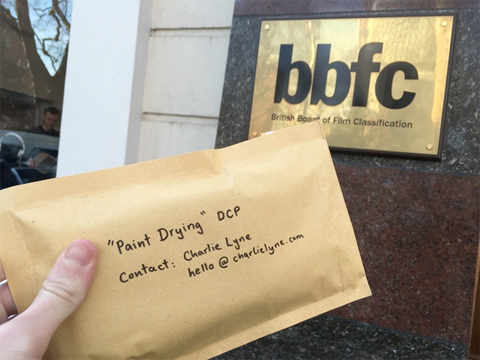
In England, movies have to be rated—at great expense. This bothers independent filmmakers. Brilliant: A Kickstarter project recently had the censorship board watch paint dry for 14 hours.

The British Board of Film Classification (BBFC) is a British organization that rates and gives age ratings to films, as well as computer and video games. The organization was founded in 1912 to ensure that no "indecent dances," "men and women in the same bed," or "references to controversial politicians" made it into theaters. Today, the BBFC is still repeatedly accused of exercising censorship unjustifiably and according to outdated standards.

Problem number one: If a film wants to make it into theaters, it needs a BBFC certificate. Problem number two: The inspection is expensive. The production company of a blockbuster might not mind paying a seven-pound processing fee per minute of film. Financially less well-off filmmakers, on the other hand, do, because a film that is a good hour and a half long costs about a thousand francs. Just to get a stamp that you actually think is stupid anyway.

London filmmaker Charlie Lyne has therefore launched the ultimate counter-attack and launched the Kickstarter project "Make the Censors Watch "Paint Drying"" was founded. With the minimum amount of seven pounds, supporters could finance one minute of the film "Paint Drying" and thus force the censorship authority to watch paint drying for hours - in 4k, of course. Targeted length: 14 hours. The 6000 pounds needed came from the   together.

Unbenannt-16_45
The film shows for 14 hours how the paint dries on a wall.

Reassuringly, the authority guarantees with the certificate that it examines every minute of the film to be examined in pairs: "The BBFC claim that all theatrical submissions are watched in their entirety by a pair of examiners, who then discuss the work before writing a detailed report." And that will be necessary, because Lyne could have included touchstones (e.g., audio messages or short, forbidden inserts).

The sifting took place on Monday and Tuesday, as examiners are allowed to sift a maximum of nine hours of material per day, as Lyne reveals. At the subsequent discussion of the examiners would be happy to be present. Lyne expects the result and the certificate in the coming weeks - we congratulate already now. (hae)

Unbenannt-15_47
Unbenannt-14_56

Groupon discontinues its service in Switzerland

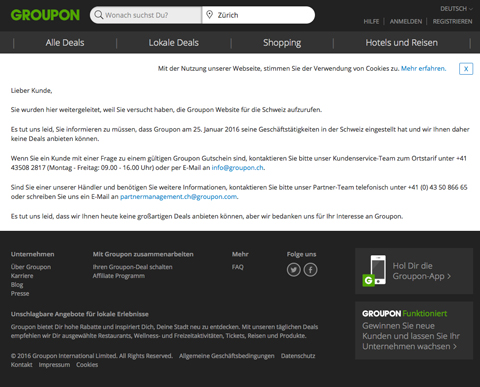
Groupon, the U.S.-based discount coupon provider, has discontinued its service in Switzerland.

"We are sorry to inform you that Groupon ceased its business activities in Switzerland on January 25, 2016 and we are therefore unable to offer you any deals," the Swiss customer is informed on the local website. Customers who click on Groupon's Swiss website are taken to a page stating that the service was discontinued in Switzerland on Monday, January 25. A call to the numbers provided for customers or merchants leads to a waiting queue, which informs you that unfortunately all employees are currently in customer meetings: "Your call is important to us" and: "Please be patient for a moment".

Bildschirmfoto-2016-01-26-um-12.51.01

No one could be reached for comment on the Groupon service in Switzerland. However, the headquarters in Chicago announced last November that the company had lost 27.6 million dollars in the previous quarter. A loss of over 21 million dollars had already been reported in the previous year. And turnover had stagnated at 713 million dollars. The share price plummeted on the stock exchange.

Rapid expansion led to high losses

And last September, Groupon announced in the USA that 1100 of its estimated 12,000 employees worldwide would be made redundant. The provider also announced its intention to withdraw from seven countries. At the same time, up to 200 million dollars more were to be spent on marketing in 2016. As reported by Blick on Tuesday, Groupon informed its Swiss customers that, following a market analysis, it had come to the conclusion that there was no basis for profitable business activities in Switzerland in the near future. In the first few years, Groupon grew rapidly and was at times traded as a stock market star. However, the hasty international expansion led to high losses. Restaurants, service providers and other businesses can offer discount coupons on the platform. In addition, Groupon itself sells goods at a discount. (hae/SDA)

Teleclub expands sports offering

Teleclub is expanding its sports package as part of an expanded partnership with Sky Deutschland and will begin broadcasting five new 24-hour live sports channels starting in February 2016. In addition, the network will now air the Italian and Spanish cup competitions.

Instead of three channels, previously Teleclub Sport 1 to 3, Teleclub now broadcasts a continuous program with premium sports content on a total of five linear sports channels. In addition to Teleclub Sport 1 and Teleclub Sport 2 / Sky Sport 2, Sky Sport 1, Sky Sport 2 and Sky Bundesliga 1 are now also available via Swisscom TV. Teleclub Sport 2 and Sky Sport 2 share a program slot in order to offer customers the best possible selection from both programs, as detailed in a press release. The sports feeds will be renamed Teleclub Sport 3 to Teleclub Sport 29.

Bildschirmfoto-2016-01-26-um-13.17.06

Even more football

Teleclub operates the largest sports television channel in Europe with over 5,000 live broadcasts per year and up to 35 parallel sports feeds. This sports offering is now being expanded: from January, the channel will broadcast matches from the Italian Coppa Italia and the Spanish Copa del Rey. All matches from the quarter-finals to the final of both cup competitions will be shown. The Supercup matches of both countries, in which the national champion meets the cup winner, are also included in the Teleclub offer with immediate effect.

The offering is also being expanded at international level with the broadcasting of international matches. All friendly matches of the Spanish national team will now also be broadcast on home soil. "With the Italian Serie A and Spanish LaLiga, we already have the championships of both countries in our program. For the numerous fans of the foreign leagues, the cup tournaments are an ideal addition to our offering," explains Claudia Lässer, Head of Programming and Member of the Management Board at Teleclub.
 

New program director at Radio SRF 2 Kultur

The new program director of Radio SRF 2 Kultur is Barbara Gysi. She succeeds Franziska Baetcke.

As part of the cost-cutting programme at SRF, Nathalie Wappler, Head of the Culture Department, has reorganized the organization and processes at Radio SRF 2 Kultur. In this context, the former "Current Affairs and Debate" and "Music" departments have been merged. Barbara Gysi will become the new Head of Division and thus Program Director of Radio SRF 2 Kultur.

Unbenannt-1_103

Barbara Gysi, who has a degree in musicology, has been Head of Music in the Culture department since 2011. Previously, the 52-year-old held various positions at SRF, including in the Information Radio department. She is also responsible for the three national programs Radio Swiss Classic, Swiss Jazz and Radio Swiss Pop. Barbara Gysi succeeds Franziska Baetcke, who is examining another offer within Swiss Radio and Television.

Franziska Baetcke has been with SRF since 1995. She has held various positions in the culture department, including head of the DRS 2 culture editorial team, head of the "DRS2 Aktuell" editorial team and, since 2010, program director of SRF 2 Kultur radio.


Thomas Harbeke leaves Weber Harbeke Partners

After a little more than 25 years, Thomas Harbeke is leaving the Zurich-based agency Weber Harbeke Partners, which he founded in 1991 together with Max Weber and has led ever since as a partner, co-managing director, and creative director.

This completes the generational change that was initiated three years ago with the retirement of AD Max Weber, according to a statement. The new partners Sven Oeschger and Guido Zehnder have both been on the management board of Weber Harbeke Partners since 2013. Under their leadership, the areas of online advertising and social media in particular have been greatly expanded over the past three years.

Unbenannt-4_138

"Today, we are well positioned as a full-service agency that thinks and acts in an integrated way, and I am happy that I can hand over the "baby" in a very good condition despite all the crises that probably every advertising agency goes through in more than two decades," Harbeke comments on his departure.

The 54-year-old creative director first wants to take some time off and then reorient himself professionally. "I want to turn over a new leaf and devote more of my time in communications to the strategic development of new brands. With the creation of the brands ok.- for energy drinks, Schnägg for vegetarian fast food or, for example, Why-Nut for nut chocolate bites, I have been able to gain valuable experience in this area over the years," says Thomas Harbeke, explaining his plans. However, Thomas Harbeke will remain collegially connected to the agency. "We will continue to work together on selected projects. Some long-term projects are already in the pipeline." says strategist Sven Oeschger.

The new owners, Sven Oeschger and Guido Zehnder, have announced that Weber Harbeke Partners will soon be operating under a new name following the departure of the second name giver.
 

E-commerce: nine trends on the rise

Innovations in e-commerce are evolving at a rapid pace. New opportunities for online sales and shopping are constantly emerging for retailers and consumers. Britta Kristin Böhle, an SEO/SEA expert at Trusted Shops, presents nine trends for 2016.

The occasion is the Online Handel 2016 conference, which will take place on January 26 and 27 in Düsseldorf. Founded in 1999, the Cologne-based company Trusted Shops has been Europe’s best-known trust mark in the e-commerce sector for over 15 years.

Trend 1: Even more focus on mobile

Mobile access and transactions will continue to grow in 2016. As a result, even more store operators will have to switch to mobile formats. In the publishing sector, the new AMP (Accelerated Mobile Pages) format is currently being discussed as the system of the future. The extent to which this will also be relevant for online stores will probably become clear in the coming months.

Trend 2: Augmented reality

The advantage of bricks-and-mortar retail over e-commerce is the direct look and feel, i.e. the ability to try on and try things on. Fashion stores in particular could score more points here with augmented reality offers and compensate for the apparent disadvantage. Virtual items of clothing can be worn or make-up tried on.

Trend 3: Personalization

The focus on the user—which Google is also promoting—will inevitably lead to more personalized communication. Users who are addressed in a better and more precise way tend to use online stores more frequently. For store operators, this means more satisfied customers who buy more often and in greater quantities. Telekom has already set an example with the Heins family and various other relatable characters. Another related area is gender-specific targeting, which falls under the umbrella of “shecommerce.”.

Trend 4: Channel dilution

The customer journey will become even more differentiated and the link between online and offline will become even stronger. Further solutions must be found to allocate visitor and sales shares to the individual channels in a meaningful way.

Trend 5: Amazon SEO

Although many retailers are skeptical about selling on Amazon, many are (still) reliant on its reach. Just as with Google, it’s important to have your products appear as high as possible in Amazon search results. This has given rise to a new SEO subtopic: Amazon SEO. To support this, the SEO toolbox provider SISTRIX has developed a free keyword tool that can be used to analyze e-commerce search terms.

Trend 6: Google Buy Button

In a possible response to Amazon’s market power, Google plans to enable direct e-commerce transactions within its Shopping results. For retailers, this would mean an additional dependency that might not outweigh the benefits of a faster purchasing process. Instead, an online store must offer an optimal shopping experience so that its regular customers don’t take the «detour» through Shopping. However, it is not yet clear when the “Buy” button will be introduced. For now, Google is already testing more Product Listing Ads in the visible area of search results.

Trend 7: Video marketing

As the second largest search engine, YouTube offers huge potential to reach interested users - whether with organic reach or with paid video ads. The True View format, for example, also allows smaller advertisers to place video ads with a low budget. Videos embedded on the website also have a positive effect. This generally increases the length of stay and user engagement.

Trend 8: Social media

Now that Facebook has become standard for online retailers, it's time to focus more on Instagram and Pinterest in 2016. Here, it is even more important than on Facebook to appear non-promotional and arouse users' curiosity with interesting content and popular influencers. It also remains exciting to what extent the messenger app WhatsApp can be developed as a communication channel. Some news sites already offer news updates via WhatsApp.

Trend 9: Wearables marketing

Now that mobile (point 1) is a must for the vast majority of retailers, another marketing platform follows with wearables such as the Apple Watch. The first apps are already available for the technology on your wrist. As a number of other technologies are sure to follow, it is important to keep a close eye on the new e-commerce opportunities that arise.


Karling: New subjects for Swiss farmers

Karling is continuing the "Farm Animals" campaign for Swiss farmers and launching new ad concepts. For the first time, animated e-panels are also being used.

Just over a year ago, the new poster campaign for Swiss farmers (Werbewoche.ch reported). After the second posting, the campaign was subjected to an advertising effectiveness test by the market research institute GfK. The results were positive: The majority of those surveyed felt addressed. 77% felt that the brand promise was credible and almost two thirds said that they liked the advertising.

F200_Schwein_D
F200_Katze_D
F200_Schaf_D

The campaign will be continued from Monday and new motifs and measures will be added. From now on, a pig and a sheep will also take center stage. Both were photographed on a farm in Kaisten, Canton Aargau.

The pig is intended to raise awareness of species-appropriate animal husbandry and proper nutrition. With the sheep, the farmers want to draw attention to the fact that they have a strong influence on the landscape and look after it every day. The Karling campaign is being launched throughout Switzerland. Posters in various formats and APG e-panels with moving images will be used. In addition, a short film with the sheep will be shown on Agriculture.ch and in the social media.


get_footer();