Opportunities for paid content on the web

Everyone is talking about the iPad. The new must-have from Apple is fascinating. The Apple fan community and publishing managers are enthusiastic. They are hoping that the new device will achieve a breakthrough in paid content for the printed press.

It is very possible that this could succeed, because the integration of text, image, film, sound and interactivity is very tempting.
Anyone who has ever played around with one of the new apps from Paris-Match or Sports Illustrated is thrilled and realizes that a new fascinating dimension of media consumption is coming our way. Alongside the nostalgic rustling of paper in a printed newspaper or magazine, there is now the fascination of a new media reality. Being able to access attractive media content anytime and anywhere with a stylish gadget that not only looks good on the go, but also on the designer sofa, is a lot of fun. And that should be worth something to many media users.
Werbewoche is asking for your opinion on the topic of apps and paid content. The study "Paid Content - Opportunities for the Media Industry" is being conducted by the Zurich-based digital consultancy Transaction Consulting and Facit Digital, Munich. You can read the results here and in Werbewoche.
> To the study questionnaire: "Paid content - opportunities for the media industry".
img100428_ipad

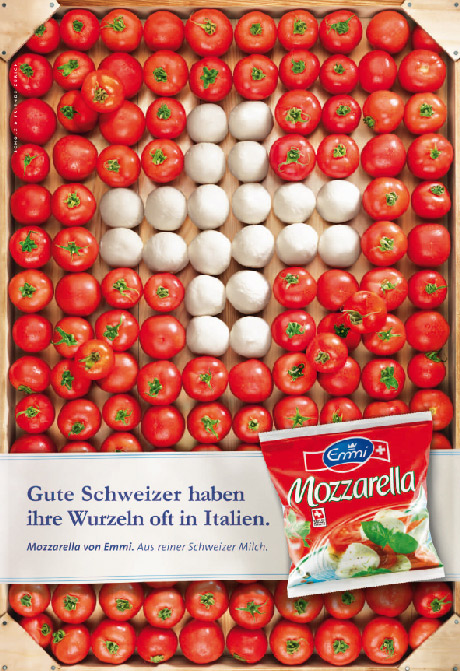
Scholz & Friends Zurich: Motif developed for Emmi mozzarella

Bright red and radiant white—Scholz & Friends Zurich has designed the campaign for Emmi’s mozzarella using the Swiss national colors.

With its campaign motif, Scholz & Friends Zurich shows that good mozzarella doesn't have to come from Italy: Emmi mozzarella balls are presented in the form of a Swiss cross in a box full of tomatoes. Even though Italy is considered the home of the popular cheese specialty, Emmi produces its mozzarella exclusively in Switzerland from Swiss milk.
The motifs can be seen from May 3, 2010 in general-interest, special-interest and daily newspapers as well as on billboards throughout German- and French-speaking Switzerland.
Responsible at Emmi Switzerland: Robin A. Barraclough (Head of Marketing Emmi Group), Marco Peter (Marketing Manager), Katharina Müller (Group Brand Manager), Constantin von Andrian (Brand Manager). Responsible at Scholz & Friends Zurich: Wolfgang Steinhaus, Mathias Rösch (consulting), Joerg Jahn, Christian Sommer, Ivo Hlavac (creation). Photographer: Armin Zogbaum. Image processing: Olivier Yoshitomi. Prepress: Digicom Digital Media.
1290580947_newsmail100428_mozzarella

Charles Vögele Group: Sandra Lüttin becomes Head of Fashion PR

The Charles Vögele Group has appointed Sandra Lüttin as Head of Fashion PR.

In this newly created position, the 30-year-old will further expand media and public relations work in the fashion sector from May 1, 2010 and coordinate communication activities centrally via PR agencies in the countries in which the Charles Vögele Group operates.
Lüttin studied law at the University of Zurich. She joined the Charles Vögele Group a year ago. Lüttin reports directly to Daniel Bärlocher, Vice President Group Communications.

APG Montagne: Moritz Weibel becomes Key Account Consultant

Affichage subsidiary APG Montagne has appointed Moritz Weibel as its new key account consultant. Weibel will assume the position on May 1, 2010.

The 43-year-old acquired a wealth of experience as an advertising manager and account manager before joining the "Spezialistin am Berg", as detailed in a press release on Wednesday. Among other things, he has worked for Publigroupe and various Zurich publishing houses.

Handelszeitung: Beat Balzli becomes new editor-in-chief

Beat Balzli has been appointed Editor-in-Chief of the Handelszeitung. The 44-year-old will take up his new post in October 2010 at the latest. He succeeds Martin Spieler, who has led the Swiss business newspaper since 2004.

Beat Balzli, born in Hamburg and raised in Lucerne, studied economics and business administration in Bern and Paris and turned to business journalism after his studies. After holding various positions in Switzerland - at the Handelszeitung, Sonntagszeitung and Facts - Balzli joined the Hamburg news magazine Spiegel as an editor in 2001. His editorial work at Spiegel brought him numerous awards, including the Henri Nannen Prize 2009, the Herbert Quandt Media Prize 2009 and the Helmut Schmidt Journalism Prize 2008 (2nd place). Last year, Balzli was voted "Business Journalist of the Year 2009" by the magazine Wirtschaftsjournalist.

Sawi: Director Pia Kasper leaves

The Swiss Training Center for Marketing, Advertising and Communication Sawi and its current director Pia Kasper will be going their separate ways in the future. The President and Board have initiated the search for a successor.

Pia Kasper took over Sawi in the fall of 2006 in a difficult situation and in the three and a half years since then has achieved a financial turnaround and refocused the school on the market, according to a press release issued on Tuesday. Until a successor is definitively chosen, the current management, supported by the Board of Directors and external experts, will continue to run the day-to-day business.

Tamedia: New Head of Sales and Marketing Publishing Services

Jürg Mosimann is to become the new Head of Sales and Marketing Publishing Services at Tamedia. The 41-year-old is currently a member of the Management Board and Head of Marketing and Sales Bookfactory at the Burkhardt bookbindery in Mönchaltorf. He will succeed Paul Galli, who is retiring at the end of June 2010, at the beginning of July 2010.

In his new role, Jürg Mosimann is responsible for all sales and marketing activities at the two Tamedia printing centers in Berne and Zurich. The trained offset fitter and graduate of the Swiss Engineering School for Printing and Packaging in Lausanne (esig+) worked for many years in sales and marketing at various printing companies. In 2007 he obtained an Executive MBA in Marketing from the Zurich School of Business.
Paul Galli, Managing Director of the Büchler Grafino printing center and long-standing member of the Espace Media management team, is to retire at the end of June 2010. He took up his post as Managing Director of Büchler Grafino, a subsidiary of Espace Media, on August 1, 1993. Following the merger of Espace Media with Tamedia, Galli also took over as Head of Sales and Marketing Switzerland at the Bern and Zurich printing centers on 1 January 2009. In future, Paul Galli will be available to the company on a mandate basis for various projects.

Last but not least: Happy ending in Hollywood

A conclusion that couldn't be more perfect. After a long period of hope and anxiety, it is now finally certain: The famous Hollywood sign, originally a publicity stunt from 1923, will remain in the California city.

But why should the Los Angeles landmark be taken down at all - it would be like removing the Eiffel Tower from Paris? Allegedly, the previous owner had wanted to demolish the lettering for a new building complex. The property has now been purchased for 12.5 million dollars thanks to donations. Director Steven Spielberg and actor Tom Hanks as well as Playboy founder Hugh Hefner are said to have shown their generosity. The editor-in-chief of the men's magazine put up a whole 900,000 dollars for the nine letters. However, it is unclear whether Hefner made any demands. It wouldn't be the first time that the landmark has been used for some kind of gimmick: In the 1970s, for example, advocates of a more generous marijuana law unceremoniously converted the lettering to "Hollyweed". When Pope John Paul II came to visit in 1987, he was greeted with "Holywood". Will a Playboy bunny soon be added to the lettering?

1290580949_img100427_hollywood
1290580949_img100427_hollywood2
(Pictures: Keystone)

BMB: Summer season opens for Stöckli

Since 2007, Stöckli Outdoor Sports has been using two talking mountains in its advertising. Now, the advertising agency BMB has created a new TV commercial for the campaign, which was nominated for the 2010 Swiss Effie Award.

To mark the start of the summer season, a short commercial will be running for seven weeks to draw attention to the Stöckli Outdoor Sports summer range. The TV campaign will run on SF 1, SF 2, SF Info, several regional television stations and various online portals.

> To the spot

Responsible at Stöckli Swiss Sports: Beni Stöckli (CEO) and Adrian Albrecht (Head of Marketing). Responsible at BMB: Flavio Meroni and Markus Rottmann (creation), Marion Schwager (consulting), Sam Bolleter and Ruth Meier (realization). Production: Heinrich Reinacher (Markenfilm Schweiz AG). Animation: Animationsfabrik GmbH, Hamburg. Director: Kay Woitas. Media: Caroline Nünlist and Caroline Landolt (ZipMedia GmbH, Zurich).

SRG posts another loss in 2009 - high deficit expected for 2010

SRG closed the 2009 fiscal year with a loss of 46.7 million Swiss francs. From 2007 to 2010, the cumulative deficits thus total approximately 220 million Swiss francs. Although the 2009 loss is lower than that of the previous year (79.1 million), the SRG expects a deficit of around 75 million Swiss francs for the current year due to the Winter Olympics in Vancouver and the FIFA World Cup.

Commercial income fell by CHF 16.5 million to CHF 344.6 million (-4.6%) in 2009. Other income also decreased by CHF 24.2 million and amounted to CHF 66.5 million (-26.7%). In the reporting year, there was also an increased cash outflow (free cash loss) of CHF 110.3 million (previous year: CHF 52.6 million). Borrowed capital had to be increased from CHF 260.3 million to CHF 335.8 million, while equity fell from CHF 609.8 million to CHF 563.1 million. Excluding the reserves for the pension fund, the equity ratio fell from 44.3% to 41.4% of the balance sheet total and is therefore only just within the range of 40% to 50% set by the Board of Directors (BoD).

Fee increases did not generate any additional income
The loss of revenue was only partially offset by the increase in fee income of CHF 24.4 million to CHF 1,153.3 million (+2.2 percent). Since 2000, SRG has not been able to generate any additional income through fee increases: The fee adjustment in 2007 (2.5 percent) served to finance the fee splitting for private radio and television, while the increase in 2003 (4.1 percent) was a partial compensation for the social policy fee exemption for recipients of AHV and IV supplementary benefits. However, the falling revenue was partially offset by three savings packages (2005, 2007 and 2008) amounting to a savings volume of over CHF 100 million.
In June 2009, the Board of Directors approved a restructuring concept and decided on a savings package effective from 2010, which includes a general and individual wage freeze in 2010 as well as an investment freeze and sales in the real estate sector. In 2009, full-time positions were capped at the 2008 budget. Personnel expenses were practically stable in the reporting year at CHF 681.2 million (+3.6 million/+0.5 percent). The 2009 annual report shows an increase of 110 full-time positions compared to the previous year under the heading "Headcount". However, this increase is mainly of an accounting nature and cost-neutral, as the internship positions were included for the first time (around 40 full-time positions); in addition, some outsourced production services were again provided in-house in the business units (around 40 full-time positions), and the planned transfer of teletext positions from the subsidiary Swiss TXT to the business units (around 30 full-time positions) was completed in mid-2009.

Decision of the Federal Council decisive
In the period 2011-2014, SRG will lack an average of 54 million per year to fulfill its performance mandate. Without the above-mentioned cost-cutting measures that have already been introduced, the average funding shortfall would be more than twice as high. This is the conclusion of the report "Financial requirements 2011-2014", which SRG submitted to the Federal Office of Communications (Bakom) for the attention of the Federal Council on November 27, 2009. How SRG is to balance its finances now depends on the decision of the Federal Council. A decision on a program reduction will only be made once the Federal Council's decisions have been finalized, according to the statement. As far as the elimination of entire channels is concerned, the corresponding resolutions of the Assembly of Delegates must be submitted to the Federal Council for approval.
The 2009 Annual Report will be submitted to the Delegates' Meeting on May 18, 2010 for approval. It will be available online from May 20, 2010 and in print from mid-June.

Univox study: Television replaces newspapers as the leading medium

According to the latest Univox study, television has replaced newspapers as the leading medium. At the same time, however, TV is losing importance as a source of information. Radio, especially the SRG programs, recorded massively fewer listeners.

As the Univox study "Communication and Media" by the research institute GFS-Zurich shows, two-thirds (67 percent) of those surveyed watch television every day - longer in French-speaking Switzerland than in German-speaking Switzerland. The daily newspaper, on the other hand, is again losing readership. Around 60 percent still turn to this medium every day. In German-speaking Switzerland, 64 percent still read it daily, and in French-speaking Switzerland only 50 percent.
In comparison, only 46 percent still listen to the radio daily. That's 11 percent fewer daily listeners than in 2006, primarily due to steady, almost dramatic losses in SRG programming, according to a media release on Tuesday. In German-speaking Switzerland, the programs of the private local radio stations meet with a greater response than in French-speaking Switzerland, where the SRG radio programs are listened to even more frequently.

Information versus entertainment
In terms of information, daily newspapers and television lead the field. 57 percent of respondents cite daily newspapers as their source of information, 37 percent SRG television and 34 percent local radio stations. SRG television has thus lost massively in importance since the last study in 2006 (20 percent).
In terms of entertainment, foreign TV programs are clearly in the lead with 77 percent, ahead of SRG television with 55 percent. Private Swiss TV channels continue to play only a minor role in terms of both information and entertainment. Complementing this, the entertainment function of the Internet has steadily increased, from 13 percent in 2006 to 21 percent in 2009. At 24 percent (2006: 21 percent), the share of information use is only slightly higher for the Internet.

Internet use is increasing rapidly
In addition, more and more Swiss people are using the Internet every day. In 2000, the figure was 16 percent; today it's 38 percent. A good three-quarters of respondents use the World Wide Web at home at least once a week. Only one in five respondents explicitly stated that they had no access to the virtual world of the Internet. However, there is still a certain digital divide in Switzerland. Two-thirds of retirees and more than half of respondents with only elementary school education are still excluded from the Internet. The typical Internet user is "male, young, educated" and has an above-average income.
For the Univox study, Mediapulse conducted a total of 718 personal interviews with eligible voters from German- and French-speaking Switzerland on behalf of GFS-Zurich in November and December 2009.

US press: Circulation continues to shrink

Circulation figures for U.S. newspapers have declined significantly over the past six months. On average, newspapers sold just under 9 percent fewer copies than during the same period last year. Sunday sales fell by 6.5 percent, and weekday sales by 8.7 percent.

As the Audit Bureau of Circulations announced on Monday, almost all major US newspapers were affected by the decline in circulation. In total, ten of the 25 largest US titles recorded a decline of more than ten percent. In terms of weekday sales, the San Francisco Chronicle lost the most at minus 22.7 percent. Circulation figures for the Sunday editions were generally somewhat better, although most of them also had to contend with sharp declines. According to industry service Pressetext, however, there are slight indications that the massive drop in circulation is slowing down. The New York Times, for example, was able to slightly increase its average weekday circulation again when comparing the past six months with the previous six months. Some other US titles - including the Wall Street Journal - also saw a slight increase.
get_footer();