The advertising week on Star TV: "I AM - What does Nikon make of you?"

Today, Thursday at 19:45, Star TV takes you on a journey through various historical and musical events.

The Japanese camera manufacturer Nikon is focusing on the aspect of credibility with its new campaign. Extracts from real life show how the brand influences its customers. British superstar Robbie Williams provides the necessary impact.
You can see how most of the scenes were shot with Nikon D3S, what difficulties the film team had to contend with in Egypt, Spain and Germany, and how the appearance of entertainer Robbie Williams came about in the exclusive "Making of" on Star TV or as a stream on Startv.ch.
Advertising week on Star TV: New every Thursday at 19:45 on Star TV.
img100610_startv

Last but not least: When the shirt suddenly changes color

Just in time for the World Cup, the Dutch energy provider Nuon has launched T-shirts that are sure to make the hearts of Dutch fans beat faster: the shirts turn orange when they get warm.

The agency N=5 in Amsterdam has come up with a funny story - but take a look for yourself:

Google plans to invest in renewable energies

Google wants to invest in renewable energies in Italy. The head of Google Italy, Stefano Maruzzi, told the newspaper Il Sole 24 Ore on Thursday that direct investments in companies in the sector or the financing of individual projects are planned.

The company is currently examining various options. According to Maruzzi, Google also wants to build its data centers near dams in order to operate the facilities with high energy requirements using hydropower.
Last month, the internet giant announced that it was investing 38.8 million dollars in two wind farms in the USA. The company, which has long offered far more than just its search engine and earns its money primarily from online advertising, has also already invested in solar energy and the use of geothermal energy.

Second Life: Almost one in three jobs is being cut

The operator of the virtual world Second Life is cutting almost a third of all jobs. The company, Linden Lab, has announced a reorganization in which around 30 percent of jobs are to be cut.

However, according to SDA, Linden Lab did not disclose any employee numbers on Wednesday evening. According to media reports, the Second Life operator last had more than 300 employees. Second Life allows computer users to move around as fantasy figures - avatars - in a virtual 3D world and communicate with each other. A few years ago, Second Life was predicted to have a great future.

Republica whistles the World Cup in the Westside

Die Agentur Republica hat für das Einkaufs- und Freizeitzentrum Westside in Bern Brünnen eine Kampagne mit einer Hommage an den Berner Sportmoderator Albi Saner realisiert.

Albi Saner will never forget May 5, 2010 for the rest of his life, the agency writes in a press release: He is sitting in front of the microphone for a local Bernese radio station when YB player Henri Bienvenu scores the all-important 2:1 against St. Gallen in the 93rd minute. Saner freaks out with enthusiasm and his presentation (subsequently visualized with television images) becomes a hit with over 90,000 YouTube views to date.
For the promotion of the Westside World Cup Lawn Bar, Republica takes up Albi Saner's steep pass and translates the content to be communicated into the emotionally charged language of Saner's moderation masterpiece. Instead of the players Hochstrasser and Bienvenu, the pitch bar and the big screens become the main protagonists. And it's not the goal that triggers the big cheers, but the public viewing itself. The Westside radio spot is also visualized and put online in the same way as the "role model". The graphic elements from the print communication are sent onto the field as protagonists.
The campaign will run until the end of June 2010.
> To the radio spot (mp3)
> To the TV spot (mov)
Responsible at Republica, Bern: Roger Keller (overall responsibility), Stéphanie Schneuwly,
(consulting), Rahel Bühler (consulting assistance), Re Wilk (CD), Kasper Kobel (AD), Jaron Gyger (graphics). Responsible at Westside: Massimiliano Madonna (Head of Marketing Communications).
Radio spot: Promoton, Bobby Gertsch, Bern. Animation: Efentwell!, Kaspar Kilchenmann, Bern.
img100610_westside

Football advertising is already perceived as annoying in the run-up to the World Cup

Most media consumers are already fed up with the ubiquity of the World Cup even before it begins—at least when it comes to advertising.

As the German market research institute Yougov Psychonomics shows, the majority of recipients are already overwhelmed and annoyed by the round leather in TV commercials, advertisements, posters, competitions and other World Cup campaigns. According to consumers, the tournament and the topic of soccer simply appear too often in advertising.
"The aim for advertising companies should be to keep this 'annoyance factor' as low as possible," says Yougov marketing manager Markus Braun when asked by Pressetext. This is possible, for example, in well thought-out campaigns in which consumers are actively involved The topic of soccer alone is not a sure-fire success, emphasizes Braun. Ultimately, the soccer theme must also fit the brand. Above all, a commitment should be authentic.
According to the expert, major damage to the image of companies jumping on the World Cup bandwagon is only to be expected in exceptional cases. However, it is bad enough for companies if the often very high advertising or sponsorship investments have no effect, Braun told Pressetext.
Not many more annoyed women than men
55% of the media audience find soccer advertising annoying in the run-up to the World Cup. However, according to Yougov, the proportion of women who find World Cup-related marketing campaigns annoying is not significantly higher than that of men at 59%. At 51 percent, more than one in two men share the same opinion. Women are still sidelined when it comes to World Cup and soccer commercials. The vast majority of advertisements shown during the World Cup are aimed at men, while women are neglected.
According to the market researchers, there are greater differences between the various age groups than between the sexes. According to the study, older people in particular are annoyed by the soccer hype. Almost two thirds of the 50-plus generation feel overloaded with the topic. People under 30, on the other hand, are the most receptive to World Cup and soccer advertising news. Only two out of five young recipients feel inundated by marketing messages about the current major event.

Günther Jauch moves from RTL to ARD

Günther Jauch is returning to ARD after years at RTL. He is to take over from Anne Will from fall 2011 and take over the Sunday evening political talk show.

RTL wrote this in a press release on Thursday. Jauch will receive a three-year contract. Anne Will's talk show is to vacate its current Sunday slot for Jauch. With Jauch, ARD will further strengthen its information profile and structure its offering more clearly and reliably, said program director Volker Herres. The ARD committees still have to approve the decision. Jauch's appointment at ARD also goes hand in hand with a new program concept. In future, "Tagesthemen" will begin at 10.15 p.m. as a standard program.
Jauch is giving up his role as presenter of the RTL magazine show "Stern tv". However, RTL was able to retain Jauch for the RTL quiz show "Who wants to be a millionaire?
In January 2007, Jauch broke off negotiations with ARD. At the time, he was supposed to present a Sunday evening political talk show as Sabine Christiansen's successor. Jauch justified his refusal with fear of the constraints of the public broadcaster, which wanted to tie him exclusively to itself.
(Image: Keystone)

CNN: Separation from AP planned

Laut US-Medienberichten will sich CNN von der Agentur Associated Press (AP) trennen. Damit würde der Nachrichtensender künftig keine Inhalte mehr von grossen Nachrichtenagenturen beziehen.

Mediabistro.com writes according to the press release that CNN is close to ending the collaboration, as people in informed circles are said to have confirmed. However, no final decision has yet been made, according to a spokesperson for the broadcaster.
If CNN does indeed separate itself from the agency services of the AP, it would no longer obtain content from major news services in future. As early as 2007, CNN stopped using text and image material from Reuters. Instead of sourcing content from the agencies, the broadcaster went its own way.
By dispensing with Reuters and now apparently also AP, CNN can concentrate on presenting its own content better. This should also attract new customers as a result. Individual CNN departments such as CNN.com and CNN Radio have been operating without AP content since 2009.

Freicom transforms Rätia Energie into Repower

Freicom hat für die Unternehmensgruppe Rätia Energie ein neues Corporate Design entwickelt. Entstanden sind ein neuer Name und ein neues Logo, welche den Aufbruch, aber auch die Dynamik, das Vertrauen und die Umsetzungskraft verkörpern sollen.

The new Repower brand is communicated in various channels: from customer information mailings to the advertising campaign, corporate literature, website, employee launch event and corporate music.
Rätia Energie is present in Switzerland, Italy, Germany and Southeastern Europe. It operates its own power plants, is active in electricity trading and supplies end customers with energy.
Responsible at Repower: Franco Milani (Head of Corporate Marketing), Werner Steinmann (Head of Corporate Communications). Responsible at Freicom: Christian Ruppanner (overall responsibility), Karina Swierzy, Mark Herrera (art direction) Antonio Lopez (text), Angelo Ressegatti (graphics), Roche Hufnagl, Mirjana Vujic (polygraphy), Norbert Scheiwiller, Nadja Grabher (consulting), Bettina Emmenegger (PR), Raffael Soppelsa (event management). Oli Keinath (photography), Alex Kirschner (music).
1290580871_img100609_re_neueslogo
1290580871_img100609_re_1
1290580871_img100609_re2
1290580871_img100609_re3

SF with a market share of 32.2 percent in May 2010

In May 2010, Swiss television achieved an average market share of 32.2% for the whole day. With 421,500 visits per day, Sf.tv exceeded the 400,000 mark for the first time and thus achieved the highest monthly figure since measurements began.

SF achieved a market share of 32.2 percent in May 2010. This is 1.8 percentage points above the figure for April 2010 and 0.6 percentage points below the annual average for 2010 to date of 32.8%, according to a press release issued on Wednesday.
On SF 1, "SF bi de Lüt - Über Stock und Stein" continued to meet with great audience interest: The four programs in May were watched by an average of 655,000 people (41.9 percent market share). The five editions of "Kassensturz" (average 628,000 viewers, 36.6 percent) and the four episodes of the "DOK" series "Kairo - Kapstadt" (average 550,000 viewers, 33.7 percent) also generated high market shares. A highlight on Sunday evening was the SF Schweizer film "Sonntagsvierer" (523,000 viewers, 27.0 percent).
The Super League match between Young Boys and FC Basel on May 16, which produced the 2010 Swiss football champions, attracted a lot of attention on SF zwei (672,000 viewers, 52.4 percent). The ice hockey world championship match between Switzerland and Germany reached 517,000 viewers and a market share of 30.4 percent. The most successful program apart from the sports broadcasts was the Eurovision Song Contest semi-final on SF zwei (438,000 viewers, 29.7 percent).
With 421,500 visits per day, Sf.tv exceeded the 400,000 mark for the first time in May 2010 and thus achieved the highest monthly figure since the start of measurement. The number of visits increased by around 60 percent compared to the same month last year. An average of 29,100 podcasts were downloaded per day in May 2010. Internet users also watched 205,800 SF videos per day, which is double the number of May 2009.

Meyer Werbung: Campaign developed for Striker Beer

Die Zürcher Agentur Meyer Werbung hat für die Schweizer Biermarke Striker Beer eine Schlagzeilenkampagne realisiert.

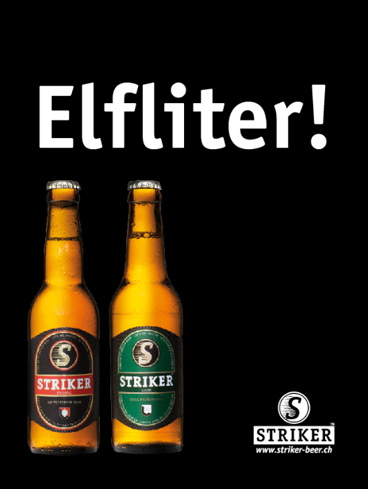
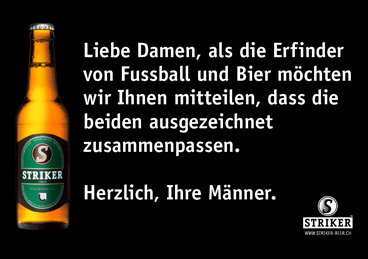
According to the agency's press release, the result is a series of witty to rather cheeky subjects that are mostly situation-based, i.e. related to the immediate environment or a specific point in time. The latest is the World Cup subject with the one-word headline "Elfliter!", which can be seen on advertisements and will soon be displayed on F24 posters in all major Swiss cities.
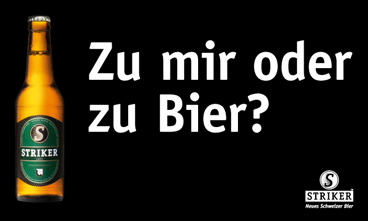
In addition to over ten other headlines, the "Zu mir oder zu Bier?" ("To me or to beer?") motif in particular has established itself, which is displayed on hundreds of pins and can be heard again and again at evening events, writes the agency. The campaign is constantly evolving, with more than 20 further motifs planned for the coming months.
1290580872_img100610_bier1
1290580872_img100609_bier2
1290580872_img100609_bier3
img100609_bier4

Online advertising business growing rapidly

The slowdown in the advertising market caused by the economic crisis has slightly dampened growth in the online sector. However, the volume is now growing at a faster pace again.

The slump in the advertising market in the wake of the economic crisis has put a slight damper on growth in the online sector. However, volumes are now increasing again at a faster pace. According to the analysts at Magna Global, global Internet advertising expenditure is even expected to break the 100 billion dollar mark by 2015 in view of the expected strong development. This would mean that the volume would almost double within five years. However, experts are skeptical.
This year alone, Magna Global expects growth in the online advertising business of 12.4 percent to 61 billion dollars. Search engine advertising is the most important driver here. In 2010, the segment is expected to grow by 16.5 percent to just under 30 billion dollars. The global market leader Google is claiming a large share of this for itself. At the same time, however, the group is facing competition in some countries. The fastest-growing markets, Russia and China in particular, pose a challenge for the internet giant with almost insurmountable political hurdles. However, this will not hinder the growth of the advertising market.
Social networks such as market leader Facebook are also contributing significantly to growth in the online advertising sector. According to the Magna Global forecast, the volume will increase by 11.7 percent in 2011 and then by a constant eleven percent until 2015 to reach a total of 103 billion dollars. Latin America is expected to be the fastest growing region. The global economic recovery, the increasing number of companies and strong brands as well as the growing competitive pressure between advertisers in the online sector are decisive factors for the expected trend.
get_footer();