SBB bans swastika poster

SBB has immediately pulled the poster featuring a swastika symbol, which was created by Zurich-based advertising executive Parvez Sheik Fareed. Back in mid-February, BDP President Martin Landolt caused a stir when he shared the image on Twitter.

The poster had deeply hurt the feelings of numerous customers and played down their personal past, SBB said on Wednesday. This was shown by the vehement reactions it had received over the past two days. The poster, which shows a white swastika on a red background, promotes a No vote to the enforcement initiative, referencing Nazi Germany and apartheid in South Africa. It went up on e-boards at Zurich's main train station on Monday and at Geneva station on Tuesday.
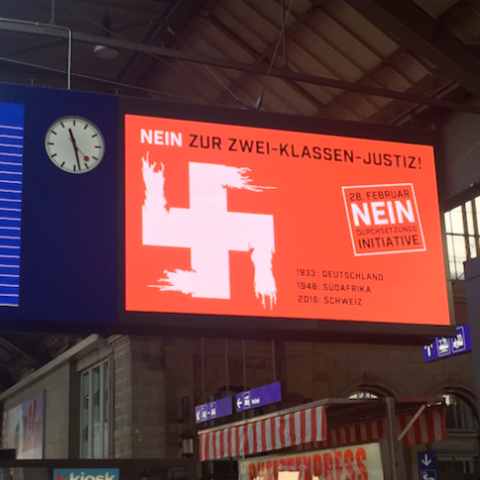
Unbenannt-44_1
Photo: Twitter.com/@robinaschwarz

SBB is not interfering in the referendum campaign and is offering the advertiser the opportunity to run his poster without the symbol, the statement continues. It will not allow the poster with the swastika to continue. According to a federal court decision from 2012, public areas in train stations are public space. SBB must therefore allow political advertising in principle. SBB assumes "that with the swastika symbol in such a prominent place, the limits of the aforementioned Federal Court decision have been exceeded." The poster is a "blatant individual case".
Bildschirmfoto-2016-02-24-um-20.13.04
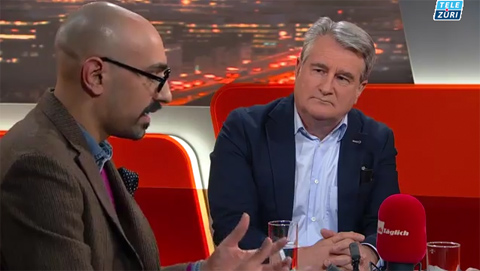
Zurich-based advertiser Parvez Sheik Fareed (left) - most recently noticed for the project Donateballs.com (Werbewoche.ch reported) - defended his poster on Tuesday in the program "Talktäglich" to communications consultant and PR expert Kaspar Loeb (right). Loeb, himself an opponent of the enforcement initiative, accused Sheik Fareed of having disturbed a factual public discussion, which from the opponents' point of view was going in the right direction, by scandalizing it and thus giving the proponents a boost. The undecideds, who ultimately make up the decision, would thus be driven more into the camp of the supporters. Sheik Fareed countered the accusations by saying that his poster had finally brought the discussion to a relevant level, away from the paragraph rhetoric that had been pursued so far. Furthermore, the true historical background legitimized the content and form of his poster. The program can be viewed on Telezueri.ch be viewed. (hae)

Uproar about tweet of the BDP president

The subject had already made headlines in mid-February. BDP President Martin Landolt published the image on Twitter without comment, showing a Swiss cross distorted into a swastika. His tweet triggered fierce reactions on Twitter, many of them negative. Landolt said at the time, when asked by news agency SDA, that he had not actively sought the provocation. The picture, however, "gets to the heart of the matter." The central message, he said, was that the enforcement initiative would create a two-tier justice system. He spoke of provocative imagery, but did not see it as a Nazi accusation against the SVP. On the contrary, Landolt said he was surprised by the furor that had arisen, since the poster was not new. One day after the tweet of the BDP president, the consequence followed from the French-speaking part of Switzerland. Christine Bussat, founder of the Marche Blanche organization, resigned from the party with immediate effect. She did not appreciate the message. Landolt had an abysmal hatred of the SVP. It was a fight against a party and not for a cause, she said at the time. However, Bussat also justified the resignation with differences of opinion - especially on the enforcement initiative. She supports the initiative contrary to the BDP's slogan. (SDA)

NZZ CEO Veit Dengler sticks to online project in Austria

The Neue Zürcher Zeitung is sticking to its journalistic online project in Austria. "NZZ.at will exist as long as there is a market for it," said Veit Dengler, head of the NZZ media group, at a discussion in Vienna on Monday evening.

The Austrian Dengler referred to the NZZ am Sonntag. It took six years for the Sunday edition of the NZZ to break even. However, Dengler is not yet entirely satisfied with the NZZ.at offering launched at the beginning of 2015. In the public debate, the medium could be even more relevant. "This is an ongoing process, we will certainly have to keep tweaking the product," he said. NZZ Austria had received a loan of the equivalent of about 1.3 million Swiss francs from its Swiss parent in 2014, the year it was founded. Dengler would not reveal whether the publishing group has had to inject further money since the launch of NZZ.at. Only this much: It was clear that the first year was not yet in the black. NZZ.at is financed by contributions from users as well as by advertising, as was said before the launch. (SDA)

NZZ decides on digital pay offer for Austria

NZZ launches digital payment product in Austria

Ruf Lanz for VBZ: Tram and bus are cleaned more often than the teeth

The latest theme of the VBZ campaign is dedicated to cleanliness. After all, cleanliness is a top priority at VBZ.

For example, the VBZ Clean Team cleans each vehicle five times a day on average. In addition, the drivers regularly collect the newspapers lying around at the terminal stops. In the evening, each vehicle is cleaned again at the depot. And every seven to ten days, the vehicles are taken to the large-scale washing facility. The motif can currently be seen on the driver's rear walls of all VBZ vehicles and appears online and offline in other applications.

VBZ_Sauberkeit

Responsible at VBZ: Heinz Vögeli, Silvia Behofsits (Head of Corporate Communications until the end of 2015 and from 2016), Julia Müller (Project Management). Responsible at Ruf Lanz: Markus Ruf, Danielle Lanz (Creative Direction), Marcel Schläfle (Art Direction), Markus Ruf (Text), Laura Hofer (Graphics), Pascal Trütsch (Consulting), CGI: Tobias Stierli, Simone Vogel.
 

Zermatt Bergbahnen launches its own app

Zermatt Bergbahnen is launching the «Skiguide Zermatt App,» a digital companion for the ski resort. The Zurich-based agency Dreipol is responsible for the design and technical implementation.

The app helps users to locate themselves in the ski area via GPS and navigate from point A to B on the 3D map. In addition to the route finder, the app contains many other features that are useful for the perfect ski day. The free app is available now for iOS devices, the Android version will follow in March.

The heart of the app is the innovative navigation function on the georeferenced 3D map. The route finder shows the user, for example, how to get from Zermatt to his favorite mountain restaurant and how much time he needs to get there based on the currently open lifts and slopes. The calculated time depends on the individually stored skiing style - sporty or leisurely - and the desired difficulty levels of the slopes. On the 3D map, users navigate both freely and within defined area views.

Unbenannt-40_1

"To prevent users from getting lost in 3D space, a rail-snap system was developed for the app. This allows the map to be operated with just one finger, a great advantage in the often low temperatures in the Zermatt/Cervinia ski area," says Sandra Stockinger, Head of Marketing and Sales at Zermatt Bergbahnen.

All content on the map, such as lifts, slopes, restaurants and various points of interest, is designed interactively and provides detailed information in addition to live statuses.

Unbenannt-42_0

More features

Mountain restaurant guide: Thanks to the app, users can find the desired mountain restaurant in the ski area. The restaurant guide presents the mountain restaurants of Zermatt and Cervinia and provides details and picture galleries as well as the opening hours of the individual establishments. The mountain restaurant guide is rounded off by intelligent filter and search options.

Warnings for the safety of guests: via push notifications or display in the app, users are always informed about the wind and avalanche situation or any unscheduled closures of lifts and slopes.

Webshop: Here, the user conveniently books the ski pass online in the Zermatt Bergbahnen webshop, which is also made accessible through the Skiguide Zermatt app. In addition to ski passes, events, offers, rental equipment and ski courses can also be booked online. Tour suggestions: With the tour tool, users travel predefined routes while always maintaining an overview.

Unbenannt-41_0

Innovative implementation partner from Zurich

The Skiguide Zermatt app was designed and technically implemented by the interaction design agency Dreipol from Zurich. For about nine months, the agency worked intensively with the marketing team of Zermatt Bergbahnen on the realization of the app.

More: App.matterhornparadise.ch

Pop: Helping where no one else will

The SOS Beobachter Foundation has been helping people in need in Switzerland for more than 30 years. The Zurich-based agency Pop has created a campaign for them.

Poverty is omnipresent in our country, too, and those who fall through the social net quickly find themselves alone. Whether existential hardships or personal strokes of fate, whether missed opportunities or dashed dreams - the predicaments are as individual and complex as the biographies of those affected.

Inserat_1_1

Three times dot, three times dash, three times dot. The international code for people in need now identifies the SOS Beobachter foundation. The Zurich agency Pop stages the universal symbolism without pathos and shows how SOS Beobachter helps where no one else does: concretely, quickly and individually. The first subjects of the campaign can now be seen in print, online and on Facebook.

inserat_2
inserat_3
Inserat_4_0
Inserat_5
larger image (4 subjects)

Responsible at SOS Beobachter (Ringier Axel Springer Switzerland): Carmen Demund (Product Manager), Roland Wahrenberger (President of the Foundation Board), Walter Noser (Managing Director SOS Observer Foundation) . Responsible at Pop Creative Services: Roli Hofer (concept, art direction), Michi Benz (strategy, consulting, text).
 

Last but not least: steady hand

How do you get viewers to stare, spellbound and fascinated, at an airline's seating options for nearly two and a half minutes? Singapore Airlines knows how.

Not for the clumsy: On behalf of Singapore Airlines, the Dentsu Mobius agency demonstrates what attention to detail really means. The airline is consistently recognized for its customer service and satisfaction, ranking among the very best in every global comparison. You can only achieve that if you make sure that absolutely every detail is just right. Just like in Dentsu’s video. If even the seat mechanisms work at the end, you’ve done something right. And you’ve got a very steady hand. (hae)

Leo Burnett launches battle of the issues

Swiss Tourism: Stabilization in Sight

The Swiss tourism industry battled the strong franc in 2015. The country is very popular among locals and in China. Switzerland Tourism is now launching a special campaign to promote late winter.

Domestic guests proved to be very loyal—with just over 16 million hotel overnight stays, another record result was achieved. Switzerland is also more popular than ever in China. For the first time, the growth in hotel overnight stays from this market and from India offset the declines from Germany. Alpine tourism, however, has been particularly affected by a decline in hotel overnight stays from Europe. On Tuesday, Switzerland Tourism (ST) will present potential solutions as part of its 2016 marketing strategy and launch a special campaign to promote late winter.

Domestic guests are vacationing in Switzerland like never before: Swiss residents generated a whopping 16.05 million overnight stays (LN) in 2015, a record result «unprecedented.» And China is now the fourth-largest international market for the Swiss hotel industry, behind Germany, the U.S., and the United Kingdom, and ahead of France and Italy. Overall, however, the overnight stays statistics show a slight decline of -0.8 percent compared to the previous year (Switzerland: +0.2% / international only: -1.7%).

Europe: Turnaround Expected by the End of the Year

«Following significant declines since 2010, we expect the trend in overnight stays from Europe to stabilize by the end of 2016. A gradual turnaround in Alpine and rural tourism is beginning to take shape,» said Jürg Schmid, Director of Switzerland Tourism. The strong market presence in Europe will be maintained in the 2016 marketing strategy; Switzerland Tourism will also continue to focus on intensifying its efforts in less price-sensitive markets such as Scandinavia. The consistent focus on high-spending target groups in Europe with an affinity for Switzerland—such as nature lovers or city travelers—is intended to help support the expected stabilization of the decline in overnight stays. The decline in hotel overnight stays in mountain regions and high price sensitivity in Europe remain challenges that ST is addressing with an even more consistent focus on experiential marketing.

Foreign Markets: Accelerating Diversification

Switzerland is perceived positively in Asia as a travel destination; meetings and incentive travel to our country are associated with high prestige and offer promising prospects. ST is therefore stepping up its efforts to promote conferences and incentive travel. At the same time, the marketing organization will continue to address the growing trend toward independent travel. The goal here is to extend the length of stay for Asian guests and allow them to discover the diversity of Switzerland beyond the well-known tourist hotspots. Diversifying the product offering—such as establishing new seasons (particularly winter in China)—is another key pillar of ST’s commitment in Asia. Potential factors that could hinder growth from long-haul markets include the possible economic slowdown in Asia and fears of terrorist attacks in Europe, which could affect global travel patterns.

Swiss Winter Finale – #abindieBerge

«The start of the winter season was extremely difficult. Now the conditions are excellent. Sun, snow, and long days await guests—that’s also the message of the additional campaign »#abindieBerge,’ which is intended to help ensure a strong finish to the season well into Easter,” explains Jürg Schmid. ST is launching this campaign on Tuesday together with its partners: in March, the fun on the slopes is at its peak, the sun is higher in the sky, and prices are extremely attractive following the peak season. The campaign ad is now airing on television, on social media, and of course on Myswitzerland.com.


In Flagranti: Student Acquisition for the School of Life Sciences FHNW

Faced with increased competition, the School of Life Sciences (HLS) is looking for new students. With a campaign on real projects, they are shown the potential for shaping the future.

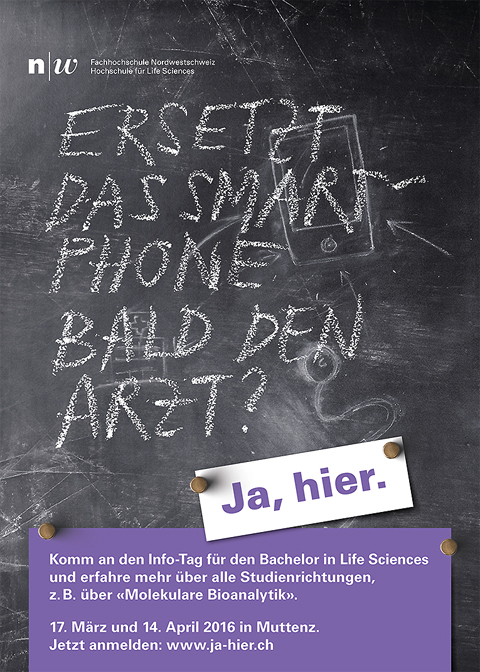
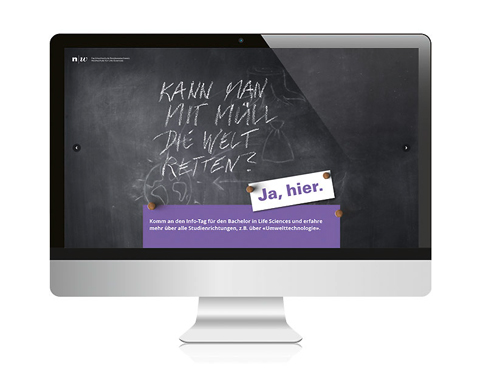
The idea behind the In Flagranti campaign for the School of Life Sciences (HLS) can be summarized as mass with class. The aim is not only to attract more prospective students to the information events for the Bachelor's degree courses in an increasingly competitive situation. The aim is also to attract suitable candidates with an interest in natural sciences and engineering. This selection is based on questions that appeal to the idealism of the target group and at the same time are based on real HLS projects. Anyone who feels addressed by these questions is basically in the right place here. The questions appear to be written "by professors" on blackboards. The resolution "yes here" leads to the landing page Yes-here.ch as the main medium, to which Google Adwords, online banners, videos, public transport hanging boxes, radio spots and print advertisements in educational supplements draw attention. According to the press release, the annual campaign has been well received. Two weeks after the start, the HLS has already recorded a new record number of registrations for its first information day.

inflagranti_FHNW_HLS_Infotage_Haengekarton_2
inflagranti_FHNW_HLS_Infotage_Haengekarton_3
inflagranti_FHNW_HLS_Infotage_Landingpage_1
 

Study: Native advertising will be the dominant digital advertising form by 2020

Native advertising is expected to account for more than half of all digital advertising in 2020. This is the conclusion reached by the study «Native Advertising in Europe to 2020» by Yahoo and Enders Analysis.

The study will be presented for the first time at this year's Mobile World Congress. According to the study, native ads will increase by 156 percent over the next five years and account for 52 percent of digital advertising across Europe by 2020. According to the study, native advertising will account for three quarters of the growth in online ads over the next five years.

The study attributes the explosive growth of native advertising to changes in user behavior, particularly the increased use of smartphones and tablets, which will dominate content search and consumption in the future. As a result, most of the growth in spending on native advertising will come from serving content to mobile devices. In 2020, EUR 8.8 billion is expected to be spent on this across Europe - almost six times the EUR 1.5 billion that advertisers invested in this last year.

The most important forecasts from "Native Advertising in Europe to 2020" at a glance:

  • Spending on native advertising in Europe will grow 2.6 times over the next five years, from €5.2 billion in 2015 to €13.2 billion in 2020. This means it will account for 52 percent of total online advertising spend in 2020.
  • Spending in the mobile sector will amount to EUR 8.8 billion in 2020, a significant increase compared with EUR 1.5 billion in 2015.
  • Native advertising on social networks will grow from €2 billion in 2015 to €6.3 billion in 2020.
  • In-stream advertising will grow from EUR 2.4 billion in 2015 to EUR 5.1 billion in 2020.

Country-specific forecasts (Germany, UK and France):

Germany: Native advertising is forecast to grow from EUR 545 million in 2015 to EUR 1.7 billion in 2020.

UK: Native advertising is forecast to grow from £1.2 billion (€1.7 billion) in 2015 to £2.8 billion (€3.9 billion) in 2020.

France: Native advertising is forecast to grow from €343 million in 2015 to €824 million in 2020.

Access to content via social networks as an important growth factor

Increasing access to content via social media is another key growth factor. This will cause spending on native social network advertising to increase by more than 300 percent by 2020, from two billion euros at present to 6.3 billion euros in 2020. Furthermore, rising video consumption will cause investment in in-stream advertising to more than double from 2.4 billion euros in 2015 to 5.1 billion euros in 2020.

Based on an analysis of the digital advertising market in 19 European countries, the report evaluates various native advertising formats and platforms such as mobile, social, video, ads tailored to PC screens, and widgets. It highlights the benefits of native advertising for media companies that see the development of novel formats as a unique selling point for their advertising offering. Advertisers and agencies should find native advertising more powerful and efficient.

Native advertising hardly recognizable for ad blockers

The study also shows that Native Advertising can be used to mitigate the effects of ad blockers, as this form of advertising is difficult for blockers to detect. At the same time, the study points out that native ads are not completely immune to ad blockers. However, the still young format offers advertisers an attractive opportunity to set new standards. At the heart of this are the specific interests of users: Those who take them into account give media users less reason to block ads.

"Mobile users are driving rapid change in media consumption. This is a huge opportunity for advertisers," says Nick Hugh, VP EMEA, Yahoo. "Native advertising is a format that works extremely well on small displays and can provide a user experience that is appropriate and engaging for the context. It's both a scalable solution for publishers to monetize and a creative and effective opportunity for advertisers - so it's an optimal solution for all parties."

"Native advertising is one of the rare win-win opportunities in the industry," adds Joseph Evans, digital media analyst at Enders Analysis. "The fledgling advertising form promises advertisers increased effectiveness, is valuable to publishers, and is more likely to be accepted by users than traditional banners."

Yahoo's native advertising platform, Yahoo Gemini, is a unified marketplace for native advertising across devices. Yahoo Gemini helps advertisers reach and engage the audience they want, delivering measurable results.

Method

"Native Advertising in Europe to 2020" was compiled based on industry data and interviews with media and agency executives. The study examines native advertising in key European markets and in Europe as a whole. Data on Internet access, device penetration and Internet usage were also taken into account.

Native advertising on the Internet is defined as advertising that is seamlessly embedded in its respective appearance environment. It is therefore advertising that fits in with the content surrounding it, rather than simply being to the left or right of it or appearing as a pop-up. The forecasts relate primarily to the most important devices for Internet use, i.e., desktop and laptop PCs, smartphones, and tablets.

Tamedia: Ombudsmen confirmed

The board of directors of the Swiss media group Tamedia has reappointed the two ombudsmen, Daniel Cornu and Ignaz Staub, to their positions.

Ignaz Staub, who has held this position since 2010, will continue to be responsible for Tamedia's newspapers, magazines and news platforms in German-speaking Switzerland as well as for 20 minutes and 20 minuti. Daniel Cornu remains ombudsman for the media of Tamedia Publications romandes in French-speaking Switzerland.

Daniel Cornu can look back on a long career in journalism, including as editor-in-chief of the Tribune de Genève. After his retirement, he passed on his experience to young journalists as director of the Centre romand de formation des journalistes CRFJ and taught media ethics at the universities of Neuchâtel and Geneva. After being appointed ombudsman of the Tribune de Genève in 1998, he took on this role in 2007 for all other media of the former Groupe Edipresse in Switzerland, which are now published by Tamedia Publications romandes.

Ignaz Staub began his career in journalism as a freelance sports reporter for Swiss radio and television before joining the Tages-Anzeiger in 1987 after working for Weltwoche and Schweizer Illustrierte. During his more than twenty years at the Tages-Anzeiger, he was head of the foreign department and reported as a correspondent from the Middle East and the United States of America. He is a member of the Organization of News Ombudsmen (ONO).

Tamedia's ombudsmen receive complaints about editorial and commercial content relating to Tamedia publications. As independent individuals who are not bound by instructions, they contribute to the quality assurance of Tamedia's media. All submissions are treated confidentially and responded to within 60 days.

Ogilvy & Mather: Mailing with 1000 reasons for Ford

get_footer();