Last but not least: Vögele millions for the image, as a monthly salary the value of a cheap pair of jeans
This year's title sponsor of the Zurich "Fashion Days", Charles Vögele, wants to create a new image for itself with design, glamor and lots of advertising. However, while the Cruz sisters appearing in Zurich today are "expensive" even for the Vögele boss, the seamstresses producing for Vögele in Asian supplier factories are dirt cheap.
Editorial
-
November 3, 2010
The company, which is well-known in India, Bangladesh and Cambodia as a buyer and client, not only has a clean image as a sponsor of Fashion Days. According to Anannya Bhattachearjee, global coordinator of the Asia Floor Wage Alliance AWF, Vögele's workers in the textile industry regularly have to work very long overtime hours and receive wages that are far too low. As the Berne Declaration writes in a press release on Wednesday, it is a fact that Vögele, like the majority of clothing companies, is only committed to paying statutory minimum wages. However, it is also known that these wages do not provide a decent standard of living throughout Asia and are barely enough to cover a percentage of a garment worker's expenses. What is particularly outrageous is the fact that Vögele is building up a marketing budget in the millions on the back of these minimum wages. In Bangladesh, a country where a large proportion of Vögele products are manufactured, the statutory minimum wage has been raised. However, even this new state standard only covers 30 percent of the daily expenses of textile workers. The situation in Cambodia is not much different, which is why over 200,000 workers took to the streets there last September, as the EvB press release explains. In Cambodia, seamstresses receive just the value of a pair of Vögele trousers as a monthly wage. The legal minimum wage is 61 dollars. But the responsibility for specifying a fair approach to minimum wages lies with the producing countries, writes Charles Vögele in a response to a flood of protest emails.
The Asia Floor Wage Alliance AFW is a coalition of around 70 NGOs, trade unions and academics from across Asia. The AFW demands the payment of a living wage for seamstresses and presents a concrete calculation model as well as implementation proposals for a living wage. The Berne Declaration/Clean Clothes Campaign supports the AFW's demands.
You are a brand or you are not
"Werbewoche" editor Anne-Friederike Heinrich on men who wish they were brands.
Editorial
-
November 3, 2010
Big men like compliments, small men need them to feel big. Those who are considered a brand don't need compliments. Such men can make companies boom or collapse, share prices soar or plummet with a sneeze. They are real men. They are incomparable, usually well-dressed and generally well-paid. Such human brands no longer have to work. It's enough for them to play golf, be present in the media, write a book now and then (or have one written for them) and sit on one board or another. Brand management can be so simple. Because it seems extremely pleasant and uncomplicated to be a brand, small managers and provincial politicians have recently taken up a new hobby: turning themselves into a brand. "A brand like a friend" is very much in vogue. There's really only one problem left: how do you become a brand? To be or not to be distinctive Let's see: Roger Federer is one. He stands for likeable greatness without airs and graces. To achieve this, he plays tennis and has fathered twins. Or Arnold Schwarzenegger. The muscular Austrian has never been ashamed of even the most embarrassing films. He simply believes in himself and allowed himself to be married to the right woman, which is indeed a merit. Steve Jobs is also a brand. He holds up a new device and everyone buys it. It doesn't even matter that the Apple guru is not particularly likeable. Nicolas Hayek senior was a brand. With two watches on each wrist and his heart always on his sleeve, he was respected and loved. You have to achieve that in Switzerland. And Gordon Gekko is also a brand, albeit a fictitious one. The broker, to whom Michael Douglas lent his charismatic face, is envied rather than resented for his hard-nosed greed for money: "If you need a friend buy a dog!" Yes, that's actually true. Federer and Schwarzenegger, Jobs, Hayek and Gekko could not be more different. But they have one thing in common: they are authentic and always remain themselves. "You're probably a brand to me," my mother used to say to me a lot. What she meant was: "You're an incredible loudmouth, but I love you." I liked being a "brand". Human brands don't necessarily have to be super inventors like Steve Jobs or successful clean-cut fathers and mother-in-laws like Roger Federer. They can also have human flaws, like Haudrauf-Schwarzenegger, Polter-Hayek or Gier-Gekko. If you want to be a brand, you simply have to be authentic. I am also a textbook But have you ever resolved to be authentic? The effect is already gone with the resolution. Turkish Prime Minister Recep Tayyip Erdogan, better known as Prime Minister Erdogan, is currently experiencing this bitterly. He desperately wants to be a fire. That is why his lawyer is trying to have the initials RTE protected by the Turkish Patent Office. Erdogan wants to stamp his RTE on media, devices or teaching materials, reports the Turkish news agency Anadolu. Great idea. And how about "RTE Turkish honey"? Then at least I would love Erdogan.
SW: Communicators of the month October 2010
Swiss Advertising SW has named Dieter Meier and Boris Blank as its communicators of the month for October. According to the band's biography, they met in 1979 in a record store in Zurich.
Editorial
-
November 3, 2010
Their latest work "Yello by Yello The Anthology 1980-2010" is being released these days, just in time for their 30th anniversary. And the two musicians are once again showing that they are (even today) among the visionary minds of the music world, according to SW. The fact that the two can easily pass as communicators of the month is of course due to the fact that music as an international "language" is pure communication and their music has been used in hundreds of commercials.
Striking: More harmless than you think
Among other things, the *Werbewoche* editorial team noticed a campaign by Wirz aimed at revamping the image of poker.
Editorial
-
November 3, 2010
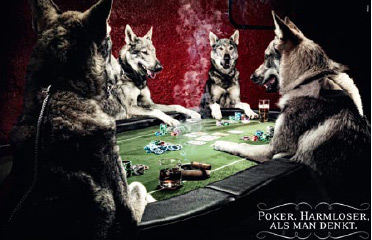
Poker has an image problem among the general public and politicians in particular. It is seen as a disreputable backyard game, where it's all down to luck or marked cards. Yet poker has long since become something of a secret popular sport. What's more, the average poker player doesn't spend more francs in one evening than he would on a trip to the movies with popcorn and cola, as Wirz says in an image campaign.
To the point: Errors excepted
And once again, someone is heralding the end of the classic newspaper. This someone seems to know it very well: In the U.S., the end of the daily newspaper will come as early as 2017.
Editorial
-
November 3, 2010
In 2019, the UK and Iceland will follow, and in 2020, newspapers in Canada and Norway will die. In 2021, Finland, Singapore and Greenland will be affected. And so the dance of death continues in one-year steps until the death knell rings in the Argentinean pampas in 2039. By the way, Switzerland will be hit in 2025 together with Poland and Sweden. Are these some pipe dreams of a prophet? Far from it! The Australian media expert Ross Dawson has backed up the whole thing strictly scientifically. Countless key factors are said to contribute to the demise. They are to be read up under www.futureexploration.net. One can justify any theory, no matter how abstruse, the only question is how accurate the statements are. Cautious as the Aussi researcher is, he notes laconically in the small print "This schedule for newspaper extinction shows best estimates given current trends". Which could be translated as "errors excepted. Should we now smile at these abstruse prophecies of doom? That would certainly be wrong, because it is very much the right thing to do to ask ourselves about the future of the daily newspaper. The daily newspaper will certainly not look the same in twenty years as it does today. The Neue Zürcher Zeitung also looked different in 1780 and carried different content than it does today. That's probably clear. What is wrong and bad about the whole thing is the simplification of an existing problem. The fact that the simplification is dressed up scientifically does not make the whole better. It will not take long until whole hosts of Nostradamus adepts parrot the realizations obediently. It's a mystery to me why the media industry doesn't ignore any possibility of prophesying its own demise. With masochistic pleasure, they are working valiantly on their self-destruction. I don't want to be misunderstood: God knows I'm not in favor of talking everything up; there are still many problems to be solved at the newspapers. Newspapers have to change, as they have always changed, but talking everything into the ground doesn't help at all. This is not just about the effect of the "self-fulfilling prophecy", a prophecy that comes true because you unconsciously behave in such a way that it must come true. It is about the fact that you have to believe in your own products in order to be able to sell them credibly and convincingly. Pierre C. Meier, Editor-in-Chief [email protected]
Marketing Day 2011: The Lucerne-Florida Connection
The countdown to next year’s biggest event is on. The 2011 Swiss Marketing Day is set to top the highly successful 2010 event with a new format. To make that happen, a world-renowned marketing expert will have to get up very, very early.
Editorial
-
November 3, 2010
He is a globally respected authority in the field of marketing. His book "Marketing Management", first published in 1967, is still a must-read for every marketer today. If even the otherwise sober NZZ newspaper calls Philip Kotler a "marketing pope", then it is fair to say that he is one: The Pope will be speaking at the Swiss Marketing Day 2011. But what even his most ardent admirers probably don't know will become clear on March 8, 2011 at the latest: Is Philip Kotler, 79, already in the shot in the morning? When the Swiss Marketing Day opens on March 8, 2011 at 9.15 a.m., Kotler's keynote speech on "Marketing 3.0" will follow shortly afterwards. Due to a certain amount of travel fatigue, Kotler will be speaking to those present at the KKL Lucerne from a TV studio in Florida via live videocast. In other words, in a way that will allow the established presenter Susanne Wille to talk to Kotler. In Florida, it will be around three o'clock in the morning. "The early bird catches the worm" - this saying will be mercilessly put into practice on Swiss Marketing Day. The global trend listener from Canada In addition to Philip Kotler as the big figurehead, the Swiss Marketing Day 2011 offers much more. Swiss Marketing President Uwe Tännler announced the highlights at a kick-off event in the Crystal Lounge in Lucerne's KKL. The other keynote speakers are Christian Belz from the University of St. Gallen, the German sociologist Holger Rust and Thorsten Truijens from Controlling Partner St. Gallen AG, who will highlight the relationship between finance and marketing in corporate management. During this presentation, the day's theme "Valuable or worthless? Marketing for marketing" will become particularly virulent. Another keynote speaker from Toronto is Jeremy Gutsche, who has the entire planet scanned for innovations and trends for the company Trendhunter. Record number of Marketing Trophy entries The "Best Practice" presentations will be omitted in 2011, but prominent speakers will be appearing instead: Emmi CEO Urs Riedener, Wolfgang Armbrecht (Brand Management Car Brand Mini) and, in a double presentation, Switzerland Tourism Director Jürg Schmid with the well-known Swiss advertising strategist Peter Felser. Promising news also from the Marketing Trophy front: a record number of entries were received for the 2011 edition. In addition to the existing categories (small, medium-sized and large companies, non-profit organizations, audience award), a new "Special Award" has been added. For outstanding ideas that do not fully comply with the rules of the other categories. Another member of the "Swiss Marketing Oscars" family. But a neo-member with a special goodie: the winner of the special award will be accompanied for a year by communication measures in various publications. The award-winning project can also count on coaching, as the jury has surprise services in store to accompany and support the successful path of the award winners. The Swiss Marketing Day 2011, as everyone in the Crystal Lounge at the KKL agreed, has the makings of an outstanding year. And even if March 8, 2011 still seems a long way off, the countdown is already underway. The new and absolutely worth seeing website for the Swiss Marketing Day is even very precise in this respect: the waiting time until March 8, 2011 is counted down in days, hours, minutes and seconds. www.marketingtag.ch
Journalism is a civil status"
Peter Wolf is a brand. For Ringier, he tests all kinds of tech products, from electric razors to smartphones. His reviews help readers navigate even the most finicky devices—and are entertaining to boot. But Wolf isn’t just a consumer journalist. Among other things, he helped build Ringier’s newsroom and is responsible for various other projects at Dufourstrasse. Who is this Wolf?
Editorial
-
November 3, 2010
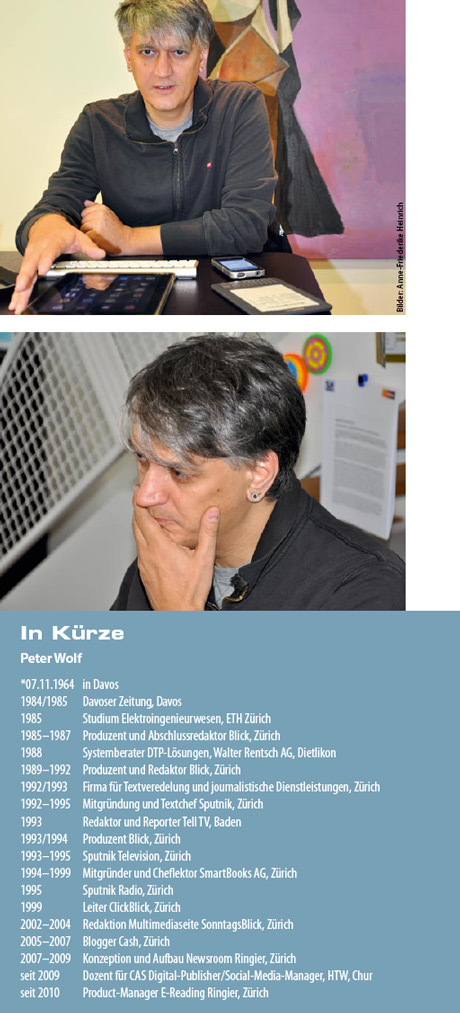
Anyone sitting at the table with Peter Wolf (45) has to be able to share. That's because his iPhone, Android phone, Blackberry, Kindle and iPad are always with him. "I'm not a gadget freak," Wolf says nonetheless. And indeed, a freak he is not. But he knows his way around pretty darn well, to be precise, and works with smartphones and reading devices like we do with a book, pad and pencil. Readers know the technology journalist primarily from his Cash blog, which has since been discontinued, and from numerous tests of technical devices in Blick, SonntagsBlick and various customer magazines. But Wolf's enthusiasm for the digital world, for networking and interconnectedness, goes much further: Not only does he always carry around at least five devices that are, of course, perfectly synchronized with each other. Wolf also designed and managed the IT and multimedia pages in Blick and SonntagsBlick. He launched the knowledge management tool Yammer at Ringier and is one of the brains behind the highly regarded Newsroom. Wolf also lectures on digital publishing and social media at the Chur University of Applied Sciences. "Journalism is not a profession, it's a civil status," Wolf says. "At Ringier, they know I think that way. That's another reason why I enjoy a lot of freedom, for which I'm very grateful." For Wolf, work must fulfill two conditions: It has to be fun and it has to make sense. "For a documentary about the Swiss Alpine Marathon, I filmed from a helicopter," he says. "That was cool, but that wasn't the point for me. We wouldn't have gotten the shots we wanted any other way. I put a lot of things on the line for an extraordinary result." Recognize what the world Peter Wolf was born in Davos in 1964, which plays a bigger role than one might initially suspect. Because when there's not skiing in Davos, there's not much going on. But Wolf loves and needs variety. So, at the age of 16, he already mixes up his hometown: Together with two school friends, he produces a school newspaper, organizes and manages the youth meeting point Terminus with events and disco, and manages a selection show from the Solothurn Film Festival three years in a row. He also plays keyboards in the electropop band Didadomino, which has produced one cassette. "I just had to do something," Wolf recalls. "In the off-season, you could have slept on the street without getting run over." Wolf is greedy: Greed for new things and the fun of change are his driving forces. His father, a master watchmaker, allows Peter to take apart and reassemble anything he wants. He does so with passion. "From ballpoint pens to music boxes, I unscrewed everything I could get my hands on," Wolf says. "Unlike today, back then there was a risk that you couldn't get things back together. I always got it right, though." Despite his penchant for precision mechanics, Wolf doesn't want to become a watchmaker. More like a veterinarian. Or an electrical engineer. Or a journalist. Wolf started in dream job No. 3 at the age of 19: In 1984 and 1985, he wrote and photographed as a freelancer for the Davos newspaper. But the paper and Davos soon became too small for Wolf. At the end of 1985, after graduating from high school, he goes to Zurich to study electrical engineering at the ETH. In doing so, he emulates his uncle, who works as an electrical engineer at NASA. A cool role model for the young man. However, Wolf does not want to go into space, but to become a technical journalist. He starts studying and joins Blick as a producer and final editor at the age of 20. Reassuringly, Wolf also sees this career leap as needing an explanation: "My friend from Davos slipped into the Ringier journalism school by chance. He caught the eye of the editor-in-chief at the time, Peter Übersax, who hired him on the spot, as did a second participant in the summer course, who immediately quit. They needed a replacement for him quickly, and Christoph talked me into it until I said yes." Wolf, who had written his Matura thesis on "Bild and Günther Wallraff," reluctantly goes to Blick. Because he fears the paper is like the pile of pigs at Bild described by Wallraff. But he quickly revised his employer's assessment. Wolf worked as a Blick producer for three years, and from the very first day he was allowed to produce directly into the newspaper. His keen visual sense helps him in this work: Wolf is a good photographer, knows a lot about films and is passionate about reading comics. ...holds together at its core In addition to the production job, Wolf also writes and photographs for the music, film and news pages of Blick for three years. Then he has had enough of journalism. He takes a job as a systems consultant for DTP solutions, but does too good a job: the market for early adopters is saturated after just one year. Wolf returns to Blick as a producer. After half a year, he also gets his own page, which appears weekly: "Rock & Pop with Peter Wolf". The 24-year-old travels around, does photo reports and concert reviews, and conducts over 100 interviews with greats such as the Scorpions, Pink Floyd, David Hasselhoff and Ozzy Osbourne. "Because I was on stage with the camera, most of the musicians thought I couldn't write," Wolf says. "So they often told me details that I wouldn't have known if I had asked." This time, Wolf lasted three and a half years at Blick, 60 percent as a producer, 40 percent as a journalist. Then he had to find a new challenge. In 1992, he founded a company for text enhancement and journalistic services, and in 1993 he became a reporter and news editor at Tell TV, Switzerland's first private broadcaster. But the station runs out of money shortly before its first broadcast. "Nevertheless, I learned a lot during that time," Wolf emphasizes. "We had the basement full of editing suites and technical equipment. While my colleagues racked their brains over the financial situation, I experimented around in the editing room and acquired a lot of expertise." When a project fails, Wolf immediately starts a new one: back in 1992, he co-founded the party and trend magazine Sputnik, which was actually planned as a flyer for the first Zurich Street Parade. Now Sputnik TV is still to be created. In order to finance himself during the build-up, Wolf hires on again as a producer at Blick. From 1993 on, Sputnik TV reports every 14 days for 30 minutes about parties and trends with Peter Wolf as cameraman, editor, reporter, editor and recording manager. In 1995, Sputnik Radio also went on the air on the Radio24 frequency. Sputnik was the first media network in Switzerland. Ringier again and again From 1994 onwards, Wolf was also involved as a publisher. With two business partners, the jack-of-all-trades founds the publishing house "SmartBooks" and publishes guidebooks on management, Macintosh computers and the Internet. As chief editor and production manager, Wolf produces around 50 books. He climbs the management ladder before leaving the publishing house in 1999. And then? Wolf goes back to Blick. Three times, Ringier was able to bring his man back for the technical side. The third time, Wolf stayed. For eleven years so far. But the number of years is deceptive: at Ringier, Wolf is no less lively than before. For five years, he headed the IT and multimedia pages of Blick, and from 2002 also the multimedia department of SonntagsBlick. Then he is appointed to Thomas Trüb's marketing committee, develops and implements concepts for various new Blick pages and supplements, blogs about technical achievements for Cash, is responsible for the multimedia development of the Cash daily business platform and installs the web center that produces moving images for all Ringier publications. Wolf currently describes himself as a product manager for e-reading. A more appropriate title would be technology missionary. Every day, Wolf takes a close look at electronic reading devices, smartphones, social media platforms and other new forms of communication and tests them for their shortcomings and pitfalls. Right now, he's testing the world's smallest tablet. "Trying out all these devices takes a lot of time and is often frustrating," Wolf says. "Because not everything always works as the manufacturer promises. I then write that, which sometimes takes courage. But it's the only way I can spare my readers the same trouble I had when testing. I firmly believe that "Many a false step is made by standing still. Future in view When Wolf is not writing, he is involved in projects: Since November 2007, he has been part of the team that planned, set up and introduced the Integrated Newsroom, and which will now implement it internationally. And he's involved with new opportunities for digital publishing, such as e-paper. "I haven't held a piece of paper in my hand for a year, at least not for reading," he says, as if that's par for the course for a journalist. "For tickets, though, I don't yet rely solely on the electronic version. There, I always have a printout with me." Two years ago, Ringier founded the Codex consortium with Tamedia/Edipresse, NZZ, Orell Füssli and Swisscom. Codex aims to bring the content of the participating content owners to mobile displays. In August, a six-week trial run started with 150 test users. They were able to buy 20 different digital newspapers, magazines and books with play money and read them on a reader. "The test went extremely well and provided important experience. The project will continue," Wolf says. He can't reveal more. Apparently, several good noses are organized in Codex. Because what is currently highly topical was not an issue two years ago. Wolf is one of those who sensed it early on: "You have to take a risk now and then," he says. "If you don't tackle something new until everyone is doing it, you might as well not do it at all. Europe is now close to the tipping point in digital publishing. And we're ready." This wolf is also a trend scout. So let's ask THE question: is paper becoming obsolete? "Absolutely not," Wolf reassures. "Paper is really just a display, a newspaper is a multi-display. True, it has a slow refresh rate, nothing moves, and nothing sounds. In return, everything is colorful, crash-proof, and needs no power. The Kindle's display overwrites itself, but currently only has 16 grayscales and is too slow for videos. Each display has its advantages and disadvantages. E-ink readers could be the place to find all new book releases in the future. Depending on the price, you can unlock 10, 50 or 100 of them. But e-ink, print and tablets will coexist. I've been waiting a long time for a tablet that has an e-ink display on the back, or a laptop that has one in the lid." Wolf will let us know if that exists. And whether it's any good. Anne-Friederike Heinrich
Peter Wolf
A short report on Peter Wolf's involvement in Davos in the 1980s.
On October 21, Avis Car Rental was honored with the Data Strategy Award in the Travel and Leisure category as part of Marketing Week 2010 in London. The award is presented annually for the most effective and innovative use of data for marketing strategy purposes.
Editorial
-
November 3, 2010
The relevant evaluation criteria include sales and marketing, CRM, customer value management and partner and personnel management. The award was presented for a profitability profiling project implemented in collaboration with Unique Digital, which combined Google ads with revenue management data and processes. Avis came out on top against various well-known companies such as RCI, BMI, Best Western and Europcar.
New copywriter for Etextera: Elisabeth Eder
The copywriting agency Etextera is getting some support. Elisabeth Eder, a copywriter and certified journalist, has recently joined the agency.
Editorial
-
November 3, 2010
Elisabeth Eder has already worked for radio, television, print and the Internet. She studied in Stuttgart and has written for PR agencies, Hubert Burda Media's intranet and Bild.de, among others. For Good News, she is also always on the lookout for good news from Stuttgart.
Light Shapes
Der November hat begonnen. Dieser dunkelste und graueste aller Monate schreit nach Licht. Es nimmt die Dunkelheit, strahlt Wärme und Sicherheit aus, verbreitet Stimmung, steht für die Wahrheit und ist ein herrlicher Luxus. Und Licht ist Werbung: Kerzenschein wirbt für das Edelrestaurant, die Beleuchtung der Einkaufszeile für die Stadt als Metropole, LED für den nächsten Supermarkt. Eine Lichtdusche.