New creative direction at Advico Young&Rubicam

The two long-time employees are taking over as creative leaders at Advico Young&Rubicam and Exxtra effective immediately: Dominik Oberwiler as Executive Creative Director and Martin Stulz as Creative Director.

The two creatives are among the most awarded advertisers in the country and are both members of the Art Director Club of Switzerland.
1292852057_img101103_oberweilerdominik
img101103_stulzmartin
Dominik Oberwiler and Martin Stulz

Heads: Performance ranking of the agencies

The BSW revenue ranking was released on Tuesday. Ralph Hermann, managing director of Heads Corporate Communication BSW, compiled a performance rating based on the figures from the BSW revenue ranking.

After all, revenue alone says little about an agency’s performance. Given that, in our labor-intensive industry, personnel costs account for roughly 60 to 70 percent of an agency’s total costs, profitability per employee is the truly meaningful metric for comparison. If we then relate the BBE to the reported number of employees per agency, a revenue ranking becomes a performance rating.
Ralph Hermann compiled this ranking entirely in accordance with the old rules of corporate management: people before things, profit before revenue, liquidity before profitability, and securing the company’s future before expansion. And he arrived at a ranking that completely reshapes the agencies’ positions.
Performance Rating

Think global, write local

Neue Lgk is launching a branding campaign for the Berner Zeitung.

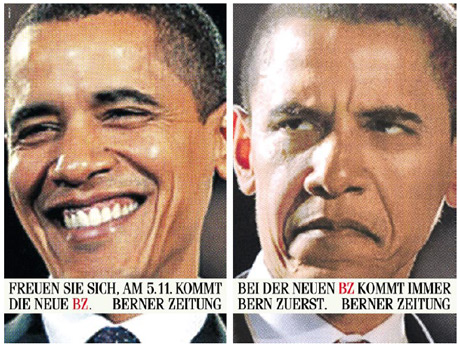
The Berner Zeitung and its associated titles Thuner Tagblatt and Berner Oberländer will appear in a new layout on Friday this week. However, it is not only the form that is changing, but also the content. The newspaper's new concept has an even stronger focus on the region than before. "The editorial team now always thinks of Bern, Thun and the Bernese Oberland first", explains Sandra Locher, Head of Marketing & Communication at Espace Media. This strict prioritization of local reporting is communicated by the advertising agency Neue Lgk in a broad-based image campaign with a tongue-in-cheek visual language. The closer the event, the more prominently it is reported in the new newspaper. This naturally pleases local politicians, business leaders, sportspeople and cultural figures. Global figures such as Obama and others are likely to be less pleased, unless the US President is once again having problems with his Senate. In Neue Lgk's striking campaign, André Benker and Hans Tanner and their teams dramatize the reactions that this new positioning of local news will trigger among those affected from near and far. In the teaser, people are still generally looking forward to the new Bernese newspaper. On the day of truth, even Barack Obama will have to realize what is really important to the people of Bern. In addition to posters and advertisements, the campaign also includes TV commercials, radio spots, online banners, a mailing and, of course, a newspaper supplement. Pan
1292852056_print101103_lgk1
img101103_lgk2

Fighting corruption through freedom of the press

A press that is also financially independent is the best safeguard against bribery and corruption. However, in many countries, journalism’s advertising-funded investigative capacity is under threat. Op-ed by Stephan Russ-Mohl, director of the European Journalism Observatory at the University of Lugano.

A reason to be proud? In the "Corruption Perception Index", a ranking by Transparency International, Switzerland is one of the ten nations in the world least at risk of corruption, together with Denmark, Sweden, Finland, the Netherlands and Norway as other European countries. Canada, Australia, New Zealand and Singapore are also among the top ten.
In another global ranking that Reporters sans Frontières compiles annually on press freedom, Switzerland has recently been ranked in first place again, together with Finland, Iceland, the Netherlands, Norway and Sweden. Estonia is the only country from the former Eastern bloc to make it into the top ten; Austria and Ireland are also in the top group, and New Zealand is the only non-European nation to be included.
A closer analysis of the two rankings reveals that:
- Europe, North America and Oceania have strong positions when it comes to curbing corruption and freedom of the press. Singapore is apparently the only country in the world that successfully combats corruption without freedom of the press.
- Within Europe, there is a dramatic north-south divide and still a strong west-east divide. Switzerland's three major neighbors, Germany, France and Italy, perform correspondingly differently: in the anti-corruption ranking, Germany is ranked 15th and France 25th. Italy, on the other hand, falls far behind, ranking 67th behind Rwanda and just ahead of Georgia. In terms of press freedom, Germany is ranked 17th, France 44th and Italy 49th.
- Sudan, Turkmenistan, Uzbekistan, Myanmar and Somalia, as well as Afghanistan and Iraq, two countries that have been ravaged by war for years, bring up the rear in terms of corruption. Syria, Myanmar, Iran, Turkmenistan, North Korea and Eritrea grant the least freedom of the press.
According to the two rankings, a high degree of press freedom correlates impressively with a low susceptibility to corruption. This leads to the conclusion that freedom of the press helps to curb corruption in the long term. However, it is important to be very careful when drawing conclusions from correlation to causality: If the number of births decreases drastically and the number of storks also decreases, this does not necessarily mean that the storks are bringing the children into the world.
Susceptibility to corruption is probably first and foremost a question of ethos and therefore of socialization and socio-culture. But those economists who believe that bribery tends to spread where it "pays" are probably not entirely wrong either. Whether it is worthwhile depends not least on how likely it is to be caught when engaging in corruption and what sanctions then follow.
If the powerful know that an independent press could catch them out and scandalize them, this is probably still the best prevention against bribery and corruption. Of course, in order to have this effect, not only the freedom of the press guaranteed by the rule of law is required, but also journalism that is financially independent and sufficiently equipped with research capacity. For decades, the latter was "cross-subsidized" by the advertising industry. Because it is now cheaper and more target group-oriented to advertise on social networks and with the help of search engines, this advertising-financed research capacity of journalism in the western democracies of Europe and North America is currently disappearing at breathtaking speed. This means that freedom of the press is only worth half as much as before. Unfortunately, Switzerland's laurels of victory are already wilting before we have really realized that we deserve them.

Flop of the week: Zero tolerance for SRG wine advertising

SRG is taking a case to the Federal Administrative Court over a commercial that was objected to by the Federal Office of Communications (Bakom). It considers it disproportionate to be required to turn over the entire net revenue of 160,000 francs from the commercial to the federal government.

The commercial that Bakom objected to contained an unlawful sales offer: at times, the winery's Internet address and a telephone number for ordering were displayed. The film also referred to a limited special offer including the price. However, SRG quickly established that this violated the ban on sales offers. In consultation with Bakom, the film was adjusted and broadcast correctly, as spokesman Daniel Steiner explained at the request of the SDA news agency. According to Steiner, the wine advertisement only violated the ban on sales offers for a few seconds. In addition, it was the first alcohol advertisement broadcast by an SRG station after SRG was allowed to advertise beer and wine on February 1, 2010. SRG now hopes that the amount will be significantly reduced by taking the case to the Federal Administrative Court.

Swiss Star Award 2010 honors Sarogold packaging from Dachcom.ch

The new tear-off box for Saropack’s Sarogold cling film was awarded the 2010 Swiss Star Award by the Swiss Packaging Institute (SVI). Dachcom.ch designed and implemented the new packaging solution in collaboration with Saropack.

The newly developed, patented tear-off blade has a special serration. With its slightly V-shaped teeth, this guarantees flawless tearing. The regripping of the film has also been improved. Unrolling and tearing, which has always proved to be prone to faults with conventional films, is now trouble-free. A smooth film insert prevents the film from slipping back. Thanks to two small lateral guides, the roll can no longer jump out.
Responsible at Saropack: Urs Stillhard (Head of Marketing), Christian Castelberg (Project Manager). Responsible at Dachcom.ch: René Frommelt (consulting), Hubert Stemer (graphics/design), Othmar Ulmi (text).
img101103_swissstar10a

New control for Le Monde

Le Monde, the long-established newspaper that has fallen into serious financial difficulties, will in the future be controlled by investors associated with the left-wing cultural patron Pierre Bergé. The rescue plan is thus finalized.

In future, the company Le Monde Libre, founded by Pierre Bergé, Xavier Niel and Matthieu Pigasse, will hold around 60% of the shares in the group. The trio is investing an estimated 110 million euros. The Annual General Meeting approved the planned capital increase, the newspaper announced on Tuesday evening.
The entry of the investors means a drastic change for the journalists. Until now, they have exercised power in the company via the editorial company SRM and its partners. With the entry of Bergé and his partners, the journalists' share of capital will now be diluted. For the first time, the editorial team will lose control of the newspaper. However, Bergé, who is joining forces with the banker Pigasse and the founder of the internet provider Free, Niel, wants to guarantee the editors their freedom.
The Group had to borrow 25 million euros last year. It had already borrowed almost 70 million euros in 2005.

Make subjects really work

Information Series on Advertising Effectiveness
The analytical method presented here by Zurich-based BildKom GmbH measures advertising effectiveness in both the narrow and broad senses, evaluates it, and thereby enables its management. This approach differs fundamentally from the conventional method: Today, the standard practice is to first produce a commercial or advertising campaign—and then try to determine whether the commercial and campaign are effective. Here, we turn the tables: We first identify the strategy with the most compelling rationale for effectiveness and then ensure a high-quality execution. The question of effectiveness should be answered not by a pretest, but by the financial results.
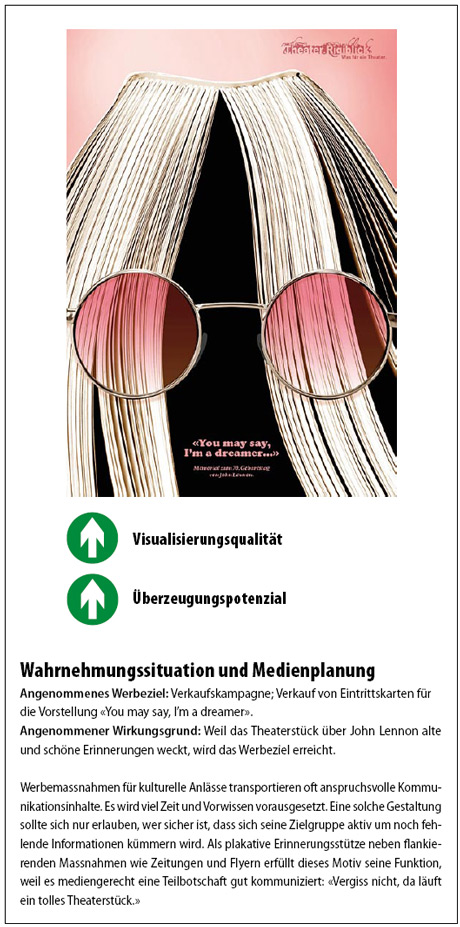
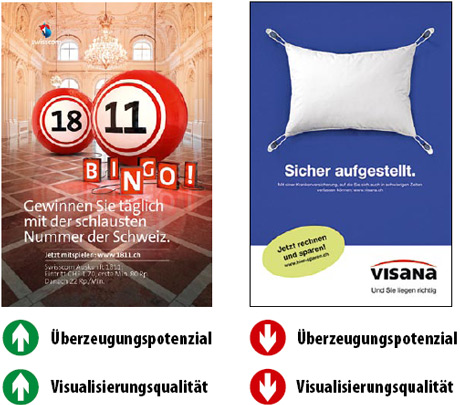
In terms of advertising impact, the message is the cause of the effect, and the advertising objective is its effect. If the advertising objective is influenced by the message, we refer to this as advertising impact. Since we do not know the advertising objective of each of the analyzed ad campaigns, we derive it—along with the strategy—from the advertisement itself. To make this approach easier to understand, we will focus the next six installments of this analysis on quality assurance—specifically, on the quality of visualization.
In the two previous issues, we explored how messages are seen (15/2010) and understood (17/2010). Next up are the special features «Different Target Groups in Advertising Effectiveness Measurement» (Issue 21/2010), «Integrating Messages Across Media» (1/2011), and «Timely Measurement» (Issue 3/2011). Each analysis briefly explains what the featured topic is about and then applies the underlying concepts to a specific advertisement.
Part 3: Perception Context and Media Planning
The message is inextricably linked to the medium and its effectiveness: A poster is viewed differently than an advertisement. The distance between the viewer and an advertisement is about 30 centimeters; for a poster, it ranges from one to fifteen meters (viewing distance). Sometimes we read carefully, other times we simply skim through the many pages of required reading (purposefulness). Then again, we drive past a poster at 50 km/h (time constraint).
How many messages are there in a campaign? And do the messages differ from one advertising medium to another? Should a message be tailored to the specific characteristics of the medium, or is the message unrelated to the medium’s design? The answer is simple when we link a message to a specific communication content. For example, if a vacuum cleaner is to be marketed with the benefit «silent,» not all advertising mediums are equally well-suited for this purpose. On a poster, it’s harder to convey the silence and the associated feeling. With a non-audio advertising medium, on the other hand, the necessary reach could be achieved more cost-effectively.
However, this means that for every piece of communication content, there are as many sub-messages as there are advertising mediums and design variations—and just as many ways of interpreting the message. Should each sub-message stand on its own, or should they be distributed in such a way that they only reveal the overall message when taken together? This question can be answered by comparing the effectiveness of the sub-messages with the advertising intensity and the performance goals. Simply put, sufficient funds must be available so that all sub-messages can be noticed by the target audience and integrated into the overall message. If the necessary advertising intensity is lacking, it makes sense to design each sub-message to be «self-contained» so that it does not depend on other sub-messages.
> View the detailed results (PDF)
1292852056_img101103_werbewirkung
1292852056_img101103_wirkung1
img101103_wirkung2

Zofinger Tagblatt takes over Solothurner Woche from Espace Media

Effective January 1, 2011, the Zofinger Tagblatt media company will take over the weekly newspaper Solothurner Woche from the Espace Media Groupe. All 14 employees from the editorial and publishing departments will be offered continued employment.

The head office in Solothurn will remain the same. The current Managing Director Paul Galli will continue to manage the business until the end of the year. This was announced by the media company in a press release on Wednesday. With the takeover of Solothurn's most traditional weekly, the Zofinger Tagblatt is expanding its portfolio in the free newspaper sector.
With the "Wiggertaler", the "Wuchedonner", the "Wuchedonner Oberaargau" and the "Landanzeiger", the media house already publishes four newspapers in the Suhren and Wiggertal valleys as well as in the neighboring canton of Solothurn. The "Solothurner Woche" optimally complements this existing offering in the cantons of Aargau and Solothurn both in terms of content and geography, according to a press release from the Zofinger Tagblatt media house. The free newspaper has a circulation of 80,000 copies.
With this step, Espace Media Groupe intends to concentrate on its newspaper, radio and TV activities in the canton of Berne. The Group had already sold the titles "Der Murtenbieter" and "Anzeiger von Kerzers" to Freiburger Nachrichten in March 2010.

Who is the right consultant?

In smaller businesses, it is often most advantageous for a family member to take over the accounting. When is it worthwhile to call in external experts and which criteria can be decisive. By Nathalie Garny, lic. iur., lawyer and specialist for money and consumer issues, lawyer and editor at the Beobachter consulting center.

Is your accounting course still enough to have an optimal grip on your company's finances? As soon as your company is so big that you no longer have just two or three employees, accounting and tax returns become more complicated. In fact, this is the right time to consider bringing in external professionals.
If you decide to do this, it is best to obtain several quotes from different consultants. It is worth spending enough time on this. After all, you are putting a key area of your business into the hands of a third party.
How to find the right professional?
The websites of the two industry associations list their members: Treuhand Suisse is made up of smaller and medium-sized fiduciary companies, while the big players in the sector are members of the Treuhand-Kammer.
The route via the associations offers some advantages: "You can be sure that the member in question has qualified training and up-to-date know-how, as he or she is obliged to undergo regular further training. In addition, the advisor or consultant must comply with the association's rules of professional conduct," says ¬Raoul Egeli, central president of Treuhand ¬Suisse, and adds: "If you approach a non-member, you may end up with a non-expert who calls himself a tax expert but has no qualified training in this area." Indeed, the titles "tax consultant," "trustee" and "tax expert" are not protected. In case of dispute, one can turn to the Professional Ethics Committee of the Association.
How do you prepare for the interview?
You should clarify these points at your first appointment:
- Education: Also check to see what training he has gone through and how he is continuing his education.
- Practical experience: Has he already worked with customers of your size and possibly even in your industry? Ask for references.
- Personal impression: Is it positive? Go ahead and make an appointment at his place of work to get an impression of his tidiness, available technical literature and EDP equipment.
- Fee: Check whether he charges a fixed price for certain work. For work that is billed on a time and material basis, agree on a cost ceiling and request monthly billing.
For yourself, you should clarify the following questions:
- Do you want to entrust him with the annual financial statement and tax return, including bookkeeping and VAT accounting, or do you continue to record the bookkeeping yourself (for example, using the trustee's system)?
- Do you need advice on financial planning (for example, with regard to raising capital, employee benefits or succession planning)?
- Do you want him to handle your private tax return as well?
Addresses: Treuhand Suisse, telephone 031 380 64 30
www.treuhandsuisse.ch
Fiduciary Chamber, telephone 044 267 75 75
www.treuhand-kammer.ch
Do you need legal advice?
The Beobachter Consulting Center offers you and your employees expert telephone consulting on legal issues concerning your company 6 months for only Fr. 99. Order the consulting package for SMEs at
Observer.ch/kmu/ or 0800 83 0800.
Book tip
Taxes made easy
Practical handbook for employees, self-employed and homeowners
The Beobachter guidebook offers support for everyone who will soon have to fill out their tax return. Whether professional expenses, child deductions or the upkeep of one's own four walls: the book provides valuable tips for employees, the self-employed, married couples, families and homeowners. In addition, there are clear tables on cantonal deductions, a useful glossary and many practical tips, addresses and links.
6th edition 2010, Beobachter-Buchverlag, ISBN 978-3-85569-427-3, 240 pages, paperback, Fr. 36.

Personnel changes at the NZZ

Markus Ehrle, Head of Advertising Sales, and Daniel Strobel, Head of Marketing for Magazines & Specials, have decided to leave the NZZ and take on a new professional challenge.

The date of her departure has not yet been set. Her successor will be appointed as soon as possible in consultation with Markus Spillmann, Head of Media Zurich, and Marius Hagger, Head of NZZ Publishing Products, according to an NZZ press release.
1292852055_img101103_ehrlemarkus
Markus Ehrle

Reaching the finish line at the second attempt

Practice, invest, succeed: If you don’t pass the exam the first time, you always have a second chance. Sales managers share how they succeeded on their second attempt—and what fundamental knowledge is essential to really pull it off after the first try.

It’s almost that time again. At one of Switzerland’s most dazzling hotel gems, the Victoria Jungfrau in Interlaken, the successful sales managers—the «Class of 2010»—can rightly treat themselves to a nice drink. The date has long been marked in red on the calendars of many sales professionals across the country: November 27—graduation ceremony! However, not everyone who has endured a tough period of sacrifice—juggling work and personal life while attending school and putting in many hours on case studies, assignments, and group work—will succeed. «On average, 70 to 75 percent of candidates pass on their first attempt,» says Jean-Paul Zürcher, president of the Sales Manager Examination Board. The unfortunate 20 to 25 percent who don’t make it the first time are explicitly encouraged in the letter they receive to take the exam again.
And that’s exactly what a large majority does. The percentage of those who don’t let themselves get discouraged and want to seize their second chance is high: «About 80 percent of those who failed try again,» says Zürcher. Many succeed on their second attempt: «62 percent of those who retook the exam passed in 2007, 58 percent in 2008, and as many as 92 percent in 2009,» reports Zürcher. In theory, retakers would also be entitled to a third attempt, but, says the exam commission president, this is done «extremely rarely.» Zürcher’s advice to all those who didn’t quite make it on their first try: «Definitely try a second time! Depending on the institution, it’s even possible to take the relevant subjects separately again.» Zürcher is backed up by Claude Dubois, Head of Examinations at Swiss Marketing: «These exams require peak performance, which isn’t always possible even with the best possible preparation. It’s definitely worth taking the exam again, because you’ve already mastered the material, invested time and money, and everyone has already gotten a taste of what the exam is like.»
First, press the reset button
Susanna Kupferschmied knows how to succeed on the second try. With a grade point average of 3.9, the native of the Bernese Oberland narrowly missed the mark on her first exam and thus missed the 2008 graduation ceremony. Too many low grades pulled her average just below the magic 4. A heavy professional workload during her studies also contributed to this. Working full-time during her training, plus a new job that demanded her full attention—that likely had a negative impact. Except for one subject in which she earned a 5, she had to retake everything. A daunting task. It was clear to the pharmaceutical specialist that she would have to retake the exams: «After all, I’d set a goal for myself and decided to pursue this degree. It would be a shame to waste all that time and energy if I didn’t give it another try.» And yet: she needed to take a break first. «I hit the reset button, so to speak, and took time for friends and family.» It wasn’t until her batteries were recharged after about three months that she got back to work. From then on, she set aside two hours two evenings a week for studying—a workload that Kupferschmied then intensified in preparation for the oral exams. Together with a colleague, she crammed for accounting, her personal weak subject. Her advice: «You really have to be very disciplined and basically stay in practice. If you don’t work through case studies regularly, you can fall behind.» It worked to her advantage that she could send completed case studies to a lecturer for grading. Her second attempt required a lot of dedication. That said, even here, it’s all a matter of finding the right balance: «Of course, approaching it too doggedly isn’t good either.» The second time around, she struck the right balance, and the trip to the sales manager graduation ceremony at the Victoria Jungfrau took place as planned in November 2009: «I got a 4.1—which, of course, was like Christmas and Easter rolled into one.»
On the seventh day, you shall study hard
Christian Löpfe also had to take a lap of honor. With a grade point average of 3.9, he just missed the mark on his first try. His grades ranged from 3.5 to 4.5, with a weakness in accounting—«which, of course, was a problem for almost everyone,» as the IT specialist from the Zürcher Unterland region smiles today. It wasn’t clear from the start that he would have to retake the course: «After that setback, I naturally wondered whether I wanted to put myself through all that a second time. But then I knew relatively soon that I wanted to give it another shot.» True to the principle: What you start, you finish.
From then on, Löpfe spent every Sunday morning studying, tackling one subject at a time and working through a case study. Even though, as the student now says, a study group would actually have been better. But given his time constraints and organizational situation at that stage, cramming on his own was the better option for him. It was a study marathon that turned into a veritable sprint as the exam date approached: «The key for me was that I took a week off before the exams and went through one subject every day.» In the mornings, he focused on refreshing the basics; in the afternoons, he worked on a case study: «That way, I was able to really recharge my short-term memory, which helped me a lot.» The second time around, things went better; Löpfe finished «right within the target range.» His advice to everyone else retaking the exam: «The final push is important. And it would be even better if you could exchange ideas with a private study group beforehand.»
The best way to go about it probably always depends on individual learning styles. But the fact that you can succeed the second time around after putting in the personal effort is proven not only by Susanna Kupferschmied and Christian Löpfe, but also by all the other students who retook the exam and made it to the finish line on their second try. It’s an effort that’s definitely worth it and also strengthens one’s frustration tolerance, assertiveness, and personal persistence. Claude Dubois, in any case, has great respect for everyone who dares to take a second shot: The head of the Examinations Department at Swiss Marketing puts it this way: «These are strong-willed people who want to achieve something. I have great respect for them and am convinced that they will prove themselves on the job market.»
Review – What You Need to Know
Of course it hurts; of course, right after the failure becomes known, morale hits rock bottom. But given all the knowledge you’ve already acquired, and the fact that you meet the strict admission criteria in the first place, failing the first time really leaves only one conclusion: give it another shot. Frequently asked questions on the topic—and what experts have to say.
Did I definitely pass with a grade point average of 4.0?
No. Although the overall grade must be at least 4.0, no more than two individual exam grades may be below 4.0, and none of the individual exam grades may be below 3.0.
I failed. Do I have to retake all my courses?
No. Retake exams apply only to exam sections in which a grade of at least 5.0 was not achieved.
I failed. How many times can I retake the test? Twice.
Can I retake the exam the very next year? Yes.
What if I fail again?
Then you can try again. In the past, there had to be a one-year gap between the second and third exams, but that's no longer the case.
If I retake the exam, do I have to pay the full exam fee again?
No. For each subject that does not need to be retaken, the exam fee is reduced by 75 francs.
get_footer();